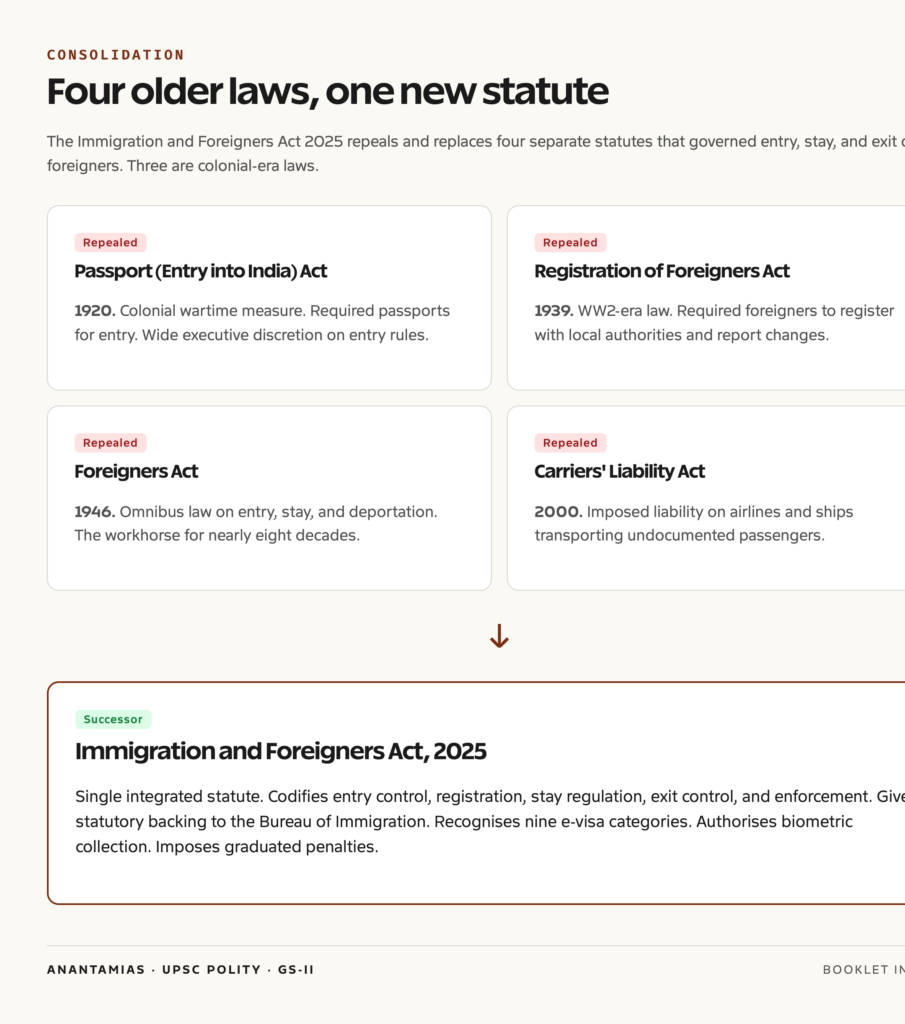
India had four major statutes governing the entry, stay, and exit of foreigners until the spring of 2025. Three of them were colonial-era laws written between 1920 and 1946, when the priorities were keeping track of suspect political travellers and managing wartime internal security. The fourth, from the year 2000, addressed the specific question of carrier liability for transporting passengers without valid documents. Across these four laws sat a body of executive orders, immigration manuals, and visa rules that the Bureau of Immigration administered without explicit statutory backing.
The Immigration and Foreigners Act of 2025 is the long-overdue consolidation. It repeals all four older laws and replaces them with a single statute that codifies the entry-and-exit regime, gives statutory recognition to the Bureau of Immigration, lays out digital reporting duties for educational institutions, hospitals, and accommodation providers, and codifies the framework for e-visas, biometric collection, and carrier obligations. The Act is one of the most comprehensive overhauls of border-management law since independence.
This article walks through the 2025 Act for the UPSC aspirant. It explains what was repealed, what was retained, what is genuinely new, and where the points of policy debate lie. The framework is GS Paper 2 with strong overlaps into GS Paper 3 internal security and the broader project of replacing colonial laws with modern statutes.
Quick Facts on the Immigration and Foreigners Act 2025
A short orientation set before deeper analysis.
- Objective: Consolidate and modernise India’s fragmented immigration and foreigners’ laws into a single statute.
- Repealed laws: Four older statutes are repealed. The Passport (Entry into India) Act 1920, the Registration of Foreigners Act 1939, the Foreigners Act 1946, and the Immigration (Carriers’ Liability) Act 2000.
- Statutory backing for the Bureau of Immigration: The Act gives formal statutory status to the Bureau, headed by a Commissioner appointed by the central government.
- Digital reporting: Universities, hospitals, and accommodation providers are required to maintain electronic records of foreign nationals and report to the Registration Officer.
- Carrier obligations: Airlines and ships must submit a General Declaration to immigration officers at least 45 minutes before departure.
- Biometric powers: Immigration officers may collect photographs and fingerprints from foreigners on entry or during stay.
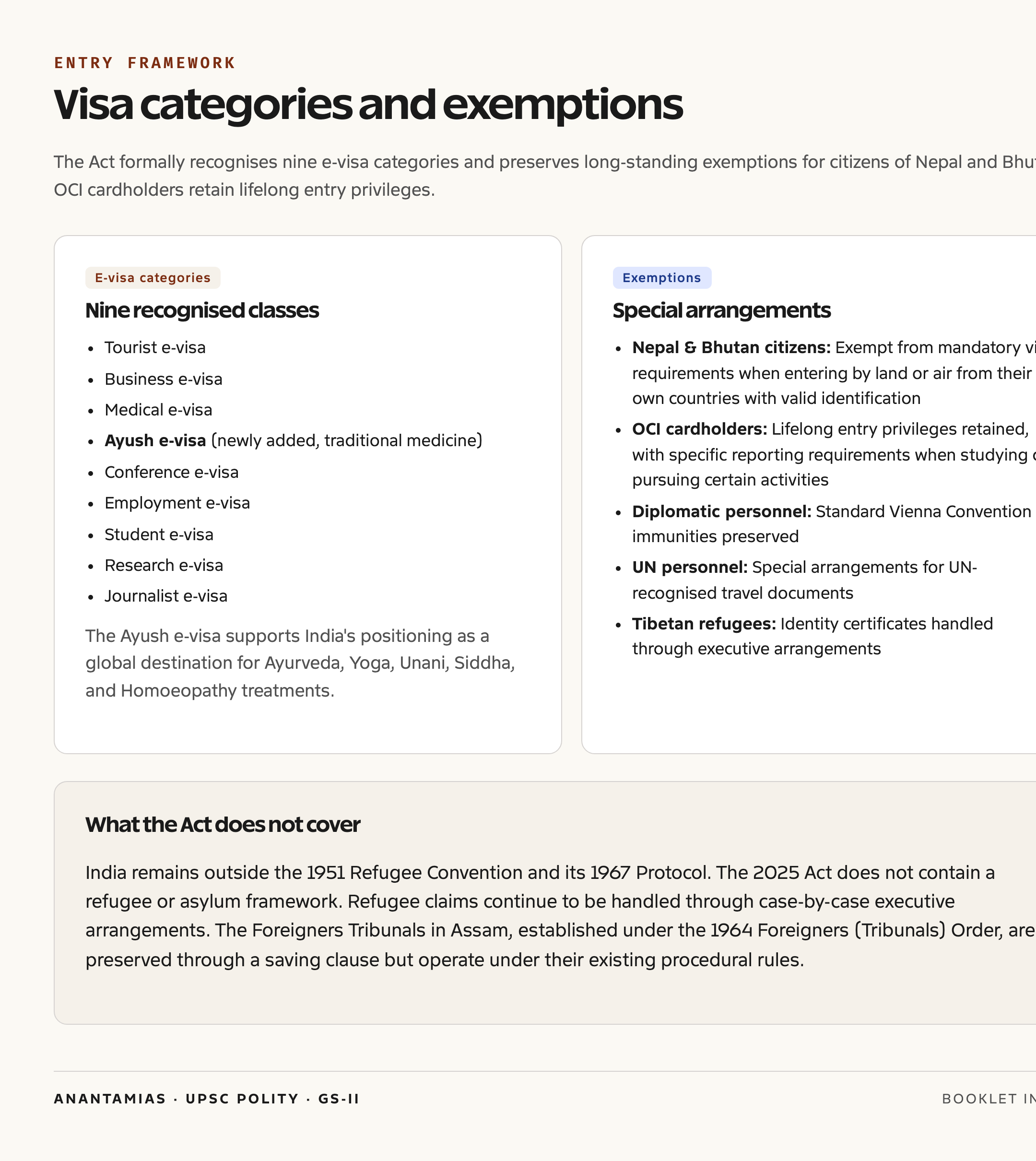
- E-visa categories: Nine categories of e-visa are formally recognised, including the new Ayush e-visa for traditional medicine tourism.
- Penalties: Up to seven years’ imprisonment for entry without valid documents or with forged passports.
- Exemptions: Citizens of Nepal and Bhutan are exempt from mandatory visa requirements when entering by land or air from their own countries with valid identification.
What the Act Actually Does
The Immigration and Foreigners Act of 2025 is structured around five core functions of border management. Entry control, registration of foreigners, stay regulation, exit control, and enforcement against illegal entry. Each function has its own chapter, and the Act maps the Bureau of Immigration as the operational authority across all five.
Entry control. The Act codifies the requirement that foreign nationals must possess a valid passport and a valid visa or other entry authorisation. It empowers immigration officers to deny entry on specified grounds, including risk to national security, public health, or public order. The grounds are defined more clearly than in the older statutes, which left wide discretion to executive authorities.
Registration. Foreign nationals staying beyond a specified period must register with the local Registration Officer. The Act keeps this requirement from the older Registration of Foreigners Act 1939 but moves the process to a digital platform. Universities and hospitals are now required to feed data on foreign students and patients into the Registration Officer’s system. Accommodation providers must maintain electronic records of foreign guests.
Stay regulation. The Act authorises the central government to make rules on duration of stay, change of category, conversion of visa class, and conditional permissions. Biometric collection is permitted on entry and during stay. The Act codifies a framework for OCI cardholders, who retain lifelong entry privileges but become subject to specific reporting requirements when, for example, studying in India.
Exit control. Foreign nationals leaving India must clear immigration, and immigration officers can refuse departure in cases of pending criminal proceedings or specified administrative concerns. Carriers are required to verify documents and submit advance passenger information.
Enforcement. The Act prescribes penalties for entry without valid documents, overstay beyond visa duration, use of forged passports, and violations of conditions of stay. Penalties range from monetary fines for minor infractions to up to seven years’ imprisonment for serious violations such as forgery and illegal entry.
Background and Historical Context
India’s immigration law architecture grew in layers over a century, and each layer addressed a problem of its time without disturbing the previous structure. The result by 2024 was a regulatory patchwork that any modern administrator would describe as untenable.
The Passport (Entry into India) Act of 1920 was a colonial wartime measure. It empowered the central government to require passports from persons entering India and to make rules about the format and conditions of entry authorisations. The Act was brief and gave the executive wide discretion, which suited the colonial state but was unsuited to a constitutional democracy.
The Registration of Foreigners Act of 1939 emerged from the run-up to the Second World War. Its purpose was to enable the colonial state to track foreigners for internal security reasons, especially Axis-power nationals and suspected sympathisers. The Act required foreigners to register with local authorities and report changes of address, occupation, and travel. The text was retained largely unchanged after independence.
The Foreigners Act of 1946 was the omnibus law of the immigration regime. It empowered the central government to regulate the entry, stay, and exit of foreigners, to deport them if necessary, and to set conditions on their conduct in India. The Act was the workhorse of immigration administration for nearly eight decades. The Foreigners (Tribunals) Order of 1964, made under this Act, became particularly significant in the context of citizenship determination in Assam.
The Immigration (Carriers’ Liability) Act of 2000 was the lone post-colonial addition. It addressed the specific problem of airlines and ships transporting passengers who lacked valid documents. The Act imposed financial liability on carriers for such passengers and required cooperation with immigration authorities. It was a narrow statute layered onto the older foundation.
By the early 2020s, the architecture was creaking. The Bureau of Immigration operated largely through executive orders. E-visa categories were notified through executive instruments without clear statutory underpinning. The reporting requirements for educational and medical institutions had not kept pace with the growth of foreign-student enrolment and medical tourism. The penalty structure under the older Acts was outdated. The 2025 Act consolidates and modernises in a single sweep.
Key Provisions and Institutional Mechanisms
Five sets of provisions in the Act deserve particular attention because they make the most operational difference.
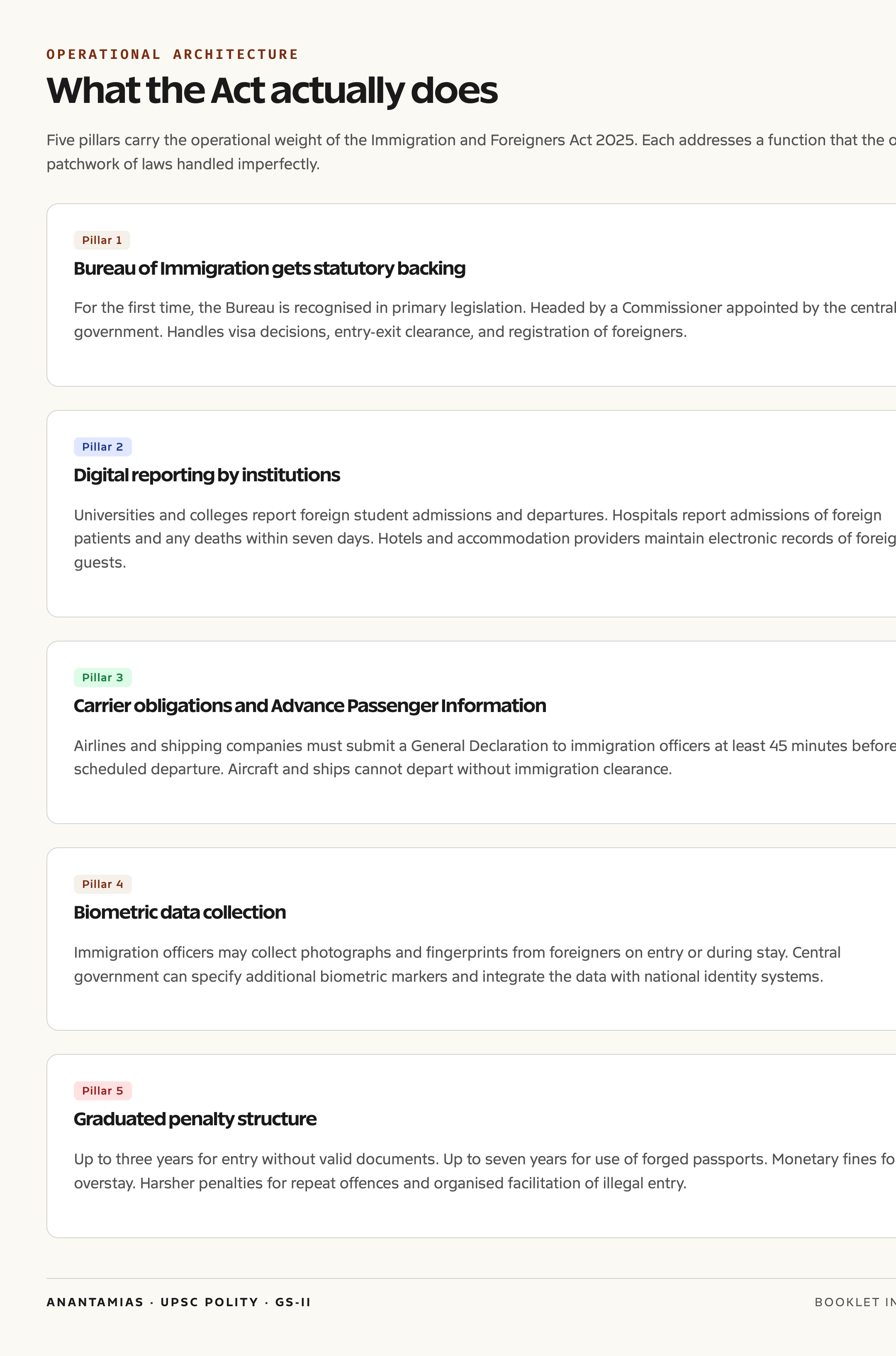
Bureau of Immigration. The Bureau is given statutory recognition for the first time. A Commissioner of Bureau is appointed by the central government and heads the institution. The Bureau handles visa decisions, entry and exit clearance, registration of foreigners, and coordination with state police forces in immigration matters. Statutory backing replaces what was previously a complex web of executive orders.
Digital reporting obligations. Educational institutions are required to report foreign student admissions, course details, and any departure from the institution to the Registration Officer through an electronic platform. Hospitals are required to report admissions of foreign patients and any deaths within seven days of the event. Accommodation providers, including hotels, guesthouses, and serviced apartments, must maintain electronic records of foreign guests and report arrivals and departures.
Carrier obligations and Advance Passenger Information. Airlines and shipping companies must submit a General Declaration to immigration officers at least 45 minutes before scheduled departure. Aircraft and ships cannot depart without immigration clearance. Carriers face financial liability for transporting passengers without valid documents and must cooperate with deportation processes.
Biometric data collection. Immigration officers may collect photographs and fingerprints from foreigners on entry or during their stay in India. The Act authorises the central government to specify additional biometric markers and to integrate the data with national identity systems for verification purposes. The framework is broadly aligned with international biometric standards but raises data protection questions that the Digital Personal Data Protection Act 2023 will need to address through subordinate legislation.
Penalty structure. The Act prescribes graduated penalties. Entry without valid documents can attract imprisonment up to three years. Use of forged passports can attract imprisonment up to seven years. Overstay beyond visa duration attracts monetary fines and possible deportation. Repeat offences and offences involving organised facilitation of illegal entry attract harsher penalties.
Why the Act Matters
Three reasons explain why the 2025 Act is significant beyond the immediate administrative consolidation.
Replacing colonial statutes. The Act is part of the broader project of replacing pre-independence laws with statutes drafted under and for a constitutional democracy. The Bharatiya Nyaya Sanhita 2023, the Bharatiya Nagarik Suraksha Sanhita 2023, and the Bharatiya Sakshya Adhiniyam 2023 replaced the Indian Penal Code, the Code of Criminal Procedure, and the Indian Evidence Act respectively. The Immigration and Foreigners Act 2025 fits the same pattern in the immigration domain.
Statutory backing for digital governance. Indian immigration administration has been digitising for two decades, but the legal authority for the digital infrastructure was scattered across executive orders and rules. The Act now provides a clear statutory basis for digital registration, electronic reporting, and biometric collection. This matters for legal challenges, for procurement of digital infrastructure, and for international cooperation on data sharing.
Internal security and economic openness. The Act tries to balance two objectives that often pull in opposite directions. Internal security requires tighter control over foreign entry and stay. Economic openness, especially in education, healthcare, and tourism, requires accessible visa regimes and friendly reporting frameworks. The Act’s combination of stricter enforcement against illegal entry with expanded e-visa categories reflects this balance.
Detailed Analysis: Reporting Architecture and Federal Implications
The reporting architecture is the most operationally significant feature of the Act. It changes how data on foreign nationals flows between the Bureau of Immigration, state police, and various private and public institutions.
Educational institutions. Universities and colleges that admit foreign students must report admissions through an electronic platform within a specified period. The data includes the student’s nationality, course of study, duration of stay, and accommodation address. Departures, transfers, and dropouts must also be reported. The framework allows the Bureau to track foreign students in real time and reduces the lag between visa issuance and on-ground confirmation of compliance.
Medical institutions. Hospitals that admit foreign patients, particularly those who travel to India under the Medical Visa or the new Ayush Visa, must report admission details, treatment categories, and any deaths within seven days. The Ayush Visa specifically covers traditional medicine including Ayurveda, Yoga, Unani, Siddha, and Homoeopathy treatments, an area where India has been positioning itself as a global destination.
Accommodation providers. Hotels, guesthouses, and serviced apartments must maintain electronic records of foreign guests. The C-Form system, which has existed under executive orders since the 1960s, is now codified and digitised. Long-term accommodation providers, including those who let property to foreign nationals on extended stays, also fall within the framework.
Federal implications. The reporting platform is designed for central administration but depends on coordination with state police and state university authorities. State governments have historically argued that the older Foreigners Act gave the centre too much room without adequate consultation. The 2025 Act formally vests immigration powers in the centre under entry 17 of the Union List but creates several consultative mechanisms with states for operational coordination. The federal balance is similar to the older Act but more clearly articulated.
Comparative Frame: Old Laws and the New Act
The replaced statutes and their successor provisions can be tabulated cleanly.
| Older Law | Year | Core Function | Successor in 2025 Act |
|---|---|---|---|
| Passport (Entry into India) Act | 1920 | Required passports for entry, executive rule-making power | Entry-control chapter, document requirements |
| Registration of Foreigners Act | 1939 | Registration of foreigners with local authorities | Registration chapter, digital platform |
| Foreigners Act | 1946 | Omnibus law on entry, stay, deportation | Stay regulation, deportation powers, penalty framework |
| Immigration (Carriers’ Liability) Act | 2000 | Carrier liability for undocumented passengers | Carrier obligations, Advance Passenger Information |
Three doctrinal changes accompany the consolidation. Penalties are codified and graduated rather than spread across multiple statutes. Digital reporting is given clear statutory basis rather than relying on executive instruments. The Bureau of Immigration is established as a statutory institution rather than an administrative arrangement.
Challenges and Open Questions
Several aspects of the Act will be tested in implementation and may attract litigation.
Data protection. The Act expands biometric collection and digital reporting on a substantial scale. The Digital Personal Data Protection Act 2023 sets out the broader framework for personal data, but the specific application to immigration data, especially the integration with national identity systems and international data-sharing arrangements, will need subordinate legislation. Civil liberties organisations have flagged concerns about scope creep and consent.
Refugee and asylum gaps. The Act, like the laws it replaces, does not contain a refugee or asylum framework. India is not a party to the 1951 Refugee Convention and continues to handle refugee claims through case-by-case executive orders. The Act misses an opportunity to codify even a minimal asylum regime, leaving refugees and stateless persons in a continuing legal grey zone.
Penalty proportionality. The seven-year imprisonment for forged passport use and the three-year term for illegal entry are stricter than the older Foreigners Act provisions. Whether the proportionality is calibrated correctly, especially for low-income migrants from neighbouring countries, will be a continuing debate. The Citizenship Amendment Act 2019 and the National Register of Citizens framework cast a long shadow over how these provisions will be applied in practice.
Foreigners Tribunals. The Foreigners (Tribunals) Order 1964, made under the older Foreigners Act 1946, created the tribunals that operate in Assam to determine citizenship questions arising under the National Register of Citizens. The 2025 Act preserves the tribunals through a saving clause but does not directly modify their functioning. Whether the tribunals require their own modernisation, given the criticisms about due process and access to legal aid, remains an open policy question.
State-centre coordination. Immigration is on the Union List, but operational enforcement depends on state police, state administration, and state-managed institutions such as universities and hospitals. The Act formalises consultative mechanisms, but the practical question of how state-level officers handle reporting compliance, deportation orders, and biometric collection will be tested over time. The same federal challenges that affected the older Foreigners Act will recur in modified form.
Prelims Pointers
A compact list of facts most likely to appear in objective questions.
- The Immigration and Foreigners Act 2025 repeals four older laws.
- The repealed laws are the Passport (Entry into India) Act 1920, the Registration of Foreigners Act 1939, the Foreigners Act 1946, and the Immigration (Carriers’ Liability) Act 2000.
- The Act gives statutory status to the Bureau of Immigration.
- The Bureau is headed by a Commissioner appointed by the central government.
- Universities and colleges must report foreign student admissions to the Registration Officer.
- Hospitals must report admissions and deaths of foreign patients within seven days.
- Accommodation providers must maintain electronic records of foreign guests.
- Carriers must submit a General Declaration to immigration officers at least 45 minutes before departure.
- Immigration officers may collect biometric data including photographs and fingerprints.
- The Act recognises nine categories of e-visa.
- The Ayush e-visa is for medical tourism in traditional medicine systems.
- Citizens of Nepal and Bhutan are exempt from mandatory visa requirements when entering by land or air from their own countries with valid identification.
- Penalties include imprisonment up to seven years for use of forged passports.
- OCI cardholders retain lifelong entry privileges but face specific reporting requirements when studying or pursuing certain activities in India.
- Immigration is governed by entry 17 of the Union List under the Seventh Schedule.
Mains Practice Questions
These are the kinds of analytical prompts the topic invites.
- Examine the significance of the Immigration and Foreigners Act 2025 in modernising India’s border management framework. How does it address the limitations of the colonial-era statutes that it replaces?
- Discuss the institutional changes introduced by the 2025 Act, with particular reference to the statutory recognition of the Bureau of Immigration and the digital reporting architecture.
- The 2025 Act expands biometric collection and digital reporting in significant ways. Critically analyse the data protection implications and the role of the Digital Personal Data Protection Act 2023 in this regard.
- India does not have a domestic refugee law and is not a party to the 1951 Refugee Convention. Did the Immigration and Foreigners Act 2025 miss an opportunity to address this gap?
- Discuss the federal implications of the new immigration framework. How does the Act balance Union legislative competence with state-level operational responsibilities?
Way Forward
Three calibrated steps would strengthen the implementation of the Act.
Build subordinate rules with public consultation. The Act delegates several operational details to central government rules. Drafting these rules through transparent consultation with universities, hospitals, hospitality industry bodies, and civil liberties organisations will improve quality and reduce compliance friction. The Bureau of Immigration should publish draft rules on its website and accept public comments before finalisation.
Layer a refugee framework on top. A separate refugee statute or rules under the Act, drawing on the United Nations Refugee Convention principles without necessarily acceding to the Convention, would close the gap that the 2025 Act left untouched. India has handled refugee flows from Tibet, Sri Lanka, Bangladesh, Myanmar, and Afghanistan through ad hoc executive arrangements, and the time for codification is overdue.
Strengthen Foreigners Tribunals. The tribunals operating in Assam under the 1964 Foreigners (Tribunals) Order need procedural modernisation, dedicated legal aid, and clearer evidentiary standards. The 2025 Act preserves the tribunals through a saving clause, but a parallel reform of the tribunal framework would address the due process concerns that have been raised repeatedly by judicial pronouncements and civil society reports.
The Immigration and Foreigners Act 2025 is a serious modernisation that closes a long-standing gap in India’s statutory architecture. It does not solve every immigration policy question, especially the refugee and asylum questions that lie outside its scope. But it gives the Bureau of Immigration a clear legal mandate, the digital governance infrastructure clear statutory backing, and the administrative system a coherent legal foundation that the four older laws had ceased to provide. The implementation challenges that follow will be substantial, but the legislative starting point is sound.
Frequently Asked Questions
What is the Immigration and Foreigners Act 2025?
The Immigration and Foreigners Act 2025 is a comprehensive statute that consolidates and modernises India’s immigration laws. It repeals four older laws, namely the Passport (Entry into India) Act 1920, the Registration of Foreigners Act 1939, the Foreigners Act 1946, and the Immigration (Carriers’ Liability) Act 2000, and replaces them with a single integrated framework. The Act gives statutory backing to the Bureau of Immigration, codifies digital reporting obligations for institutions and carriers, authorises biometric data collection, and recognises e-visa categories including the new Ayush e-visa for traditional medicine tourism.
Which laws does the Act repeal?
The Act repeals four statutes. The Passport (Entry into India) Act 1920 was a colonial-era law on passport requirements. The Registration of Foreigners Act 1939 required foreigners to register with local authorities. The Foreigners Act 1946 was the omnibus law on entry, stay, and deportation. The Immigration (Carriers’ Liability) Act 2000 imposed liability on airlines and ships for transporting undocumented passengers. The 2025 Act subsumes the functions of all four into a single statute.
What is the Bureau of Immigration?
The Bureau of Immigration is the operational body responsible for visa decisions, entry and exit clearance, registration of foreigners, and coordination with state police on immigration matters. The Bureau previously operated largely on the basis of executive orders, but the 2025 Act gives it statutory status for the first time. The Bureau is headed by a Commissioner appointed by the central government and reports to the Ministry of Home Affairs.
What are the key reporting obligations under the Act?
Three sets of institutions face new digital reporting obligations. Universities and colleges must report admissions of foreign students, course details, and any departures to the Registration Officer through an electronic platform. Hospitals must report admissions of foreign patients and any deaths within seven days. Accommodation providers, including hotels and serviced apartments, must maintain electronic records of foreign guests and report arrivals and departures. Carriers, namely airlines and shipping companies, must submit a General Declaration to immigration officers at least 45 minutes before scheduled departure.
What is the Ayush e-visa?
The Ayush e-visa is a new visa category formally recognised under the 2025 Act. It is issued to foreign nationals seeking treatment under traditional Indian medicine systems, including Ayurveda, Yoga, Unani, Siddha, and Homoeopathy. The category was created to support India’s positioning as a global destination for traditional medicine tourism and complements the existing Medical Visa, which covers allopathic treatment.
Are Nepal and Bhutan citizens exempt from the Act?
Citizens of Nepal and Bhutan are exempt from mandatory visa requirements when entering India by land or air from their own countries, provided they carry valid identification. The exemption is based on the longstanding open-border arrangements with Nepal under the 1950 India-Nepal Treaty of Peace and Friendship, and similar arrangements with Bhutan. The 2025 Act preserves these arrangements through the Immigration and Foreigners (Exemption) Order 2025.
What penalties does the Act prescribe?
Penalties are graduated based on the gravity of the violation. Overstay beyond visa duration attracts monetary fines and possible deportation. Entry without valid documents can attract imprisonment up to three years. Use of forged passports can attract imprisonment up to seven years. Repeat offences and organised facilitation of illegal entry attract harsher penalties. The penalty structure is generally stricter than the older Foreigners Act 1946.
Does the Act cover refugees?
The Act does not contain a refugee or asylum framework. India is not a party to the 1951 Refugee Convention or its 1967 Protocol, and continues to handle refugee claims through case-by-case executive arrangements. Refugees from Tibet, Sri Lanka, Bangladesh, Myanmar, and Afghanistan have historically been accommodated through such arrangements. The 2025 Act preserves the regulatory status quo on this point and does not codify refugee or asylum protection.
What are the implications for OCI cardholders?
Overseas Citizen of India cardholders retain their lifelong entry privileges to India under the 2025 Act. The Act, however, codifies specific reporting requirements that apply to OCI cardholders in particular situations, such as when they enrol in Indian universities or pursue certain professional activities. Educational institutions must report OCI student enrolment to the Registration Officer in the same way they report foreign student enrolment, although the underlying entry rights remain unchanged.
How does the Act affect Foreigners Tribunals in Assam?
The Foreigners (Tribunals) Order of 1964, made under the older Foreigners Act 1946, established the tribunals that operate in Assam to determine citizenship questions arising under the National Register of Citizens. The 2025 Act preserves these tribunals through a saving clause that maintains the validity of orders made under the repealed laws. The tribunals continue to function under their existing framework. Critics have argued that the 2025 Act missed an opportunity to modernise the tribunal procedure, address concerns about due process and legal aid, and bring tribunal practice into line with general administrative law standards.
Tell Google you want more of this.
Add Anantam IAS as a preferred sourceOne tap, and this site shows up more often in your own Top Stories, AI Overviews and AI Mode. Remove it any time.