Disclosure: this guide contains Amazon affiliate links. As an Amazon Associate, Anantam IAS earns from qualifying purchases — at no extra cost to you.
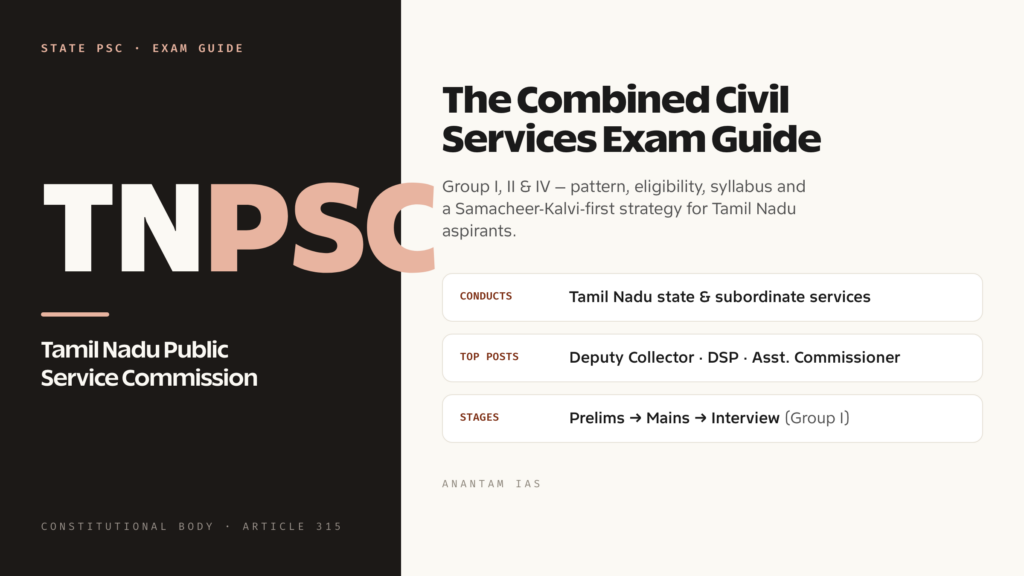
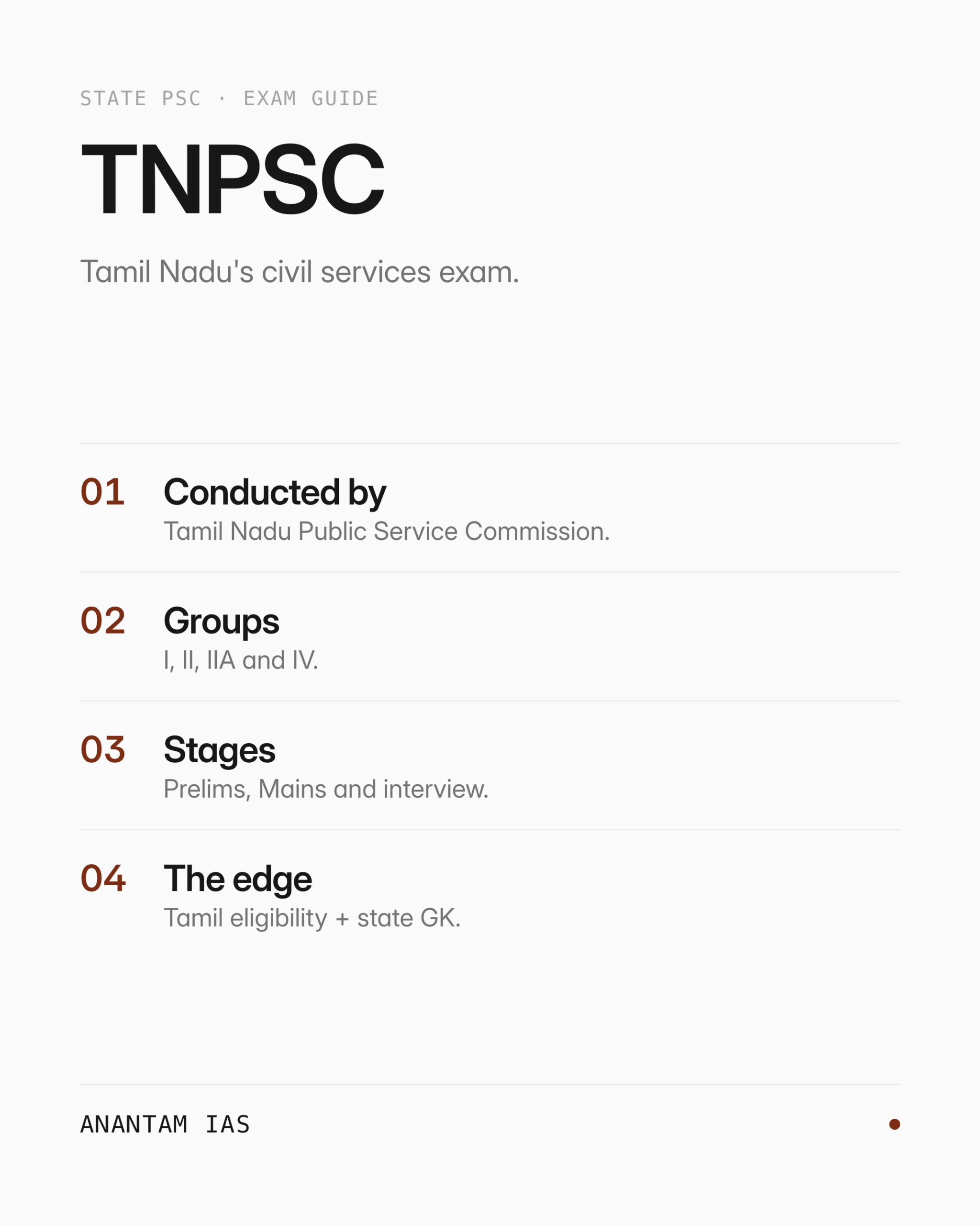
The Tamil Nadu Public Service Commission, almost always called TNPSC, is the constitutional body that recruits officers and staff for the Tamil Nadu state government — from Deputy Collectors and DSPs at the top to Junior Assistants and Village Administrative Officers at the entry level. If you want a career in Tamil Nadu’s administration without sitting the all-India UPSC race, TNPSC is the door you walk through.
TNPSC runs several “Combined Civil Services” exams, grouped by the level of post. Group I leads to the most senior state-cadre jobs, Group II and IIA cover supervisory and clerical roles with and without an interview, and Group IV fills lakhs of clerical and junior positions every cycle. The exams reward candidates who know Tamil Nadu deeply — its history, its social-justice movements, its geography and its schemes — so a Tamil Nadu aspirant starts with a real home advantage.
What Is TNPSC?
TNPSC is a constitutional body set up under Article 315 of the Constitution, which mandates a Public Service Commission for each state. It conducts recruitment for the Tamil Nadu state and subordinate services, advises the government on service matters, and enforces the state’s rule of reservation across direct-recruitment posts. Its head office is in Chennai, and notifications go out on the official portal at tnpsc.gov.in.
The recruitment is organised into “Combined Civil Services Examinations” by post level. Combined Civil Services Examination-I is Group I; Examination-II covers Group II (interview posts) and Group IIA (non-interview posts); and a separate Group IV examination handles clerical and junior roles. Each exam has its own notification, vacancy count, and pattern, but they share a common spine — General Studies, an aptitude/mental-ability component, and a Tamil-language element.
Key Facts
- Conducting authority: Tamil Nadu Public Service Commission, Chennai (constitutional body under Article 315).
- Flagship exam: Group I (Combined Civil Services Examination-I) — Deputy Collector, DSP, Assistant Commissioner and allied senior posts.
- Other major exams: Group II / IIA (supervisory and ministerial posts) and Group IV (Junior Assistant, Typist, Village Administrative Officer).
- Frequency: Notified through an annual planner; Group I prelims is typically held once a year, Group IV in most cycles.
- Scale: Group IV draws several lakh applicants for a few thousand seats; Group I is far smaller and far more competitive at the top.
- Reservation: Tamil Nadu’s 69% communal roster applies to all direct-recruitment vacancies — a defining feature of TNPSC selection.
TNPSC Exam Pattern
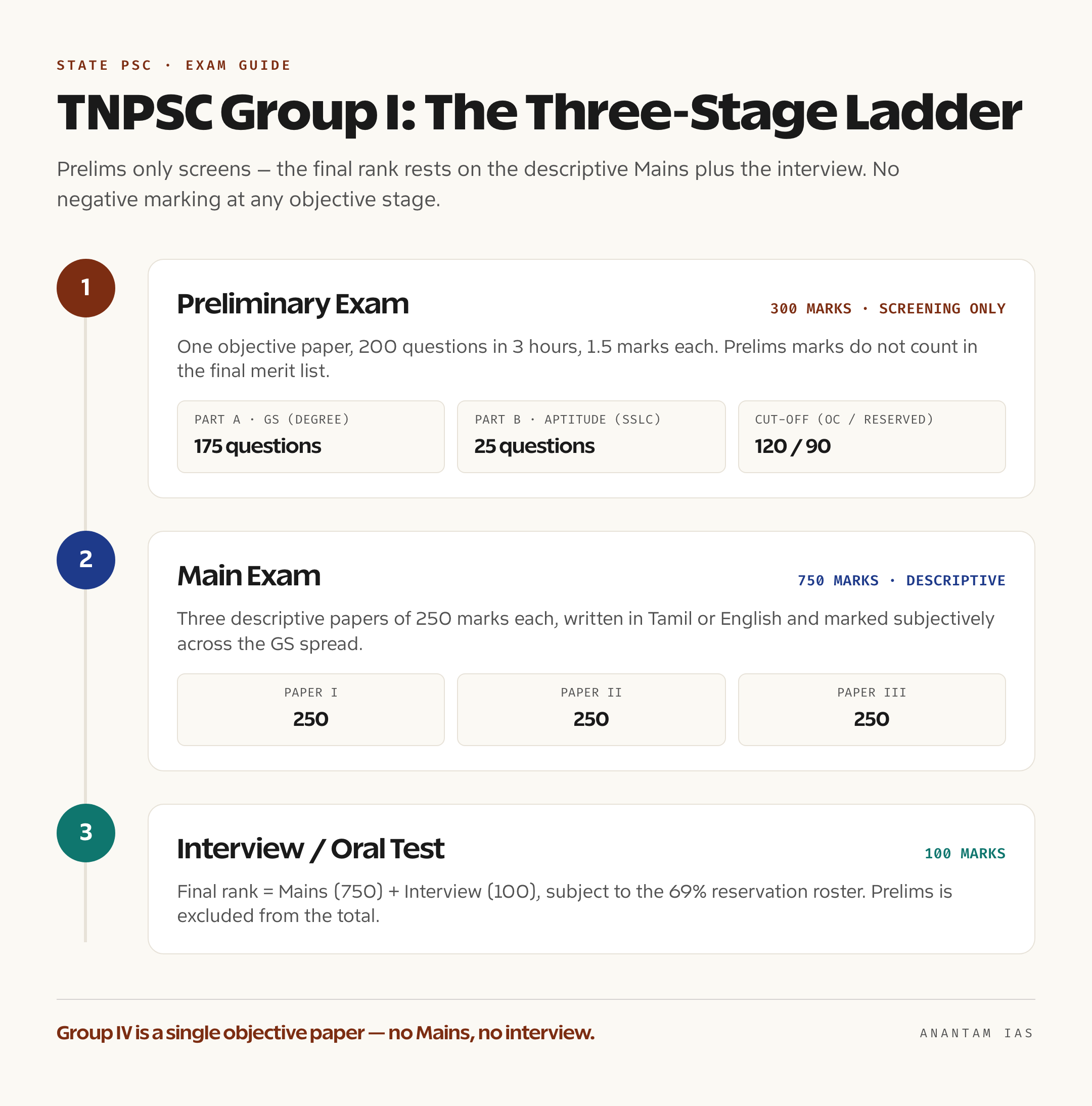
TNPSC’s pattern changes with the group, so it helps to learn the three flagship structures separately. Group I is a three-stage exam closest in spirit to UPSC; Group II/IIA splits on whether an interview is involved; and Group IV is a single objective paper. One quirk to internalise early: in Group I, prelims marks don’t count toward the final list — prelims is purely a screening filter, much like UPSC.
Prelims
For Group I, the preliminary exam is a single objective paper of 200 questions for 300 marks, to be finished in 3 hours. It splits into Part A — General Studies at degree standard (175 questions) — and Part B — Aptitude and Mental Ability at SSLC standard (25 questions), with 1.5 marks per correct answer. There’s no negative marking in TNPSC objective papers, which changes how you approach guessing compared to UPSC. Qualifying marks are 120/300 for the open category and 90/300 for reserved categories, and these prelims marks are used only to shortlist for Mains.
For Group II / IIA, the prelims paper carries 200 questions for 300 marks across three parts — General Tamil or General English (SSLC standard, 100 questions), General Studies (degree standard, 75 questions), and Aptitude and Mental Ability (SSLC standard, 25 questions). The qualifying bar is 90/300 across communities. Group IV is a single objective paper that blends General Studies, aptitude, and a General Tamil/General English component into one screening-cum-selection test, so the written score itself drives the merit list.
Mains
Only Group I and Group II (interview posts) have a true descriptive Mains. The Group I Mains has three descriptive papers of 250 marks each — 750 marks in total — answered in Tamil or English, marked subjectively by examiners across the spread of the GS syllabus. Group II Mains is descriptive for interview posts, while Group IIA has moved its General Studies Mains to an objective MCQ format for non-interview posts, keeping only the Tamil Eligibility test in descriptive form. Group IV has no Mains — selection is settled at the single objective stage plus certificate verification.
Interview / Personality Test
The Group I oral test carries 100 marks, and the final rank rests on the Mains descriptive papers plus this interview, subject to the rule of reservation — prelims is excluded. Group II interview posts carry a smaller oral component (around 40 marks in recent cycles), whereas Group IIA and Group IV have no interview: those results turn entirely on the written exam and verification. So the higher you aim within TNPSC, the more the personality test and answer-writing matter.
TNPSC Eligibility
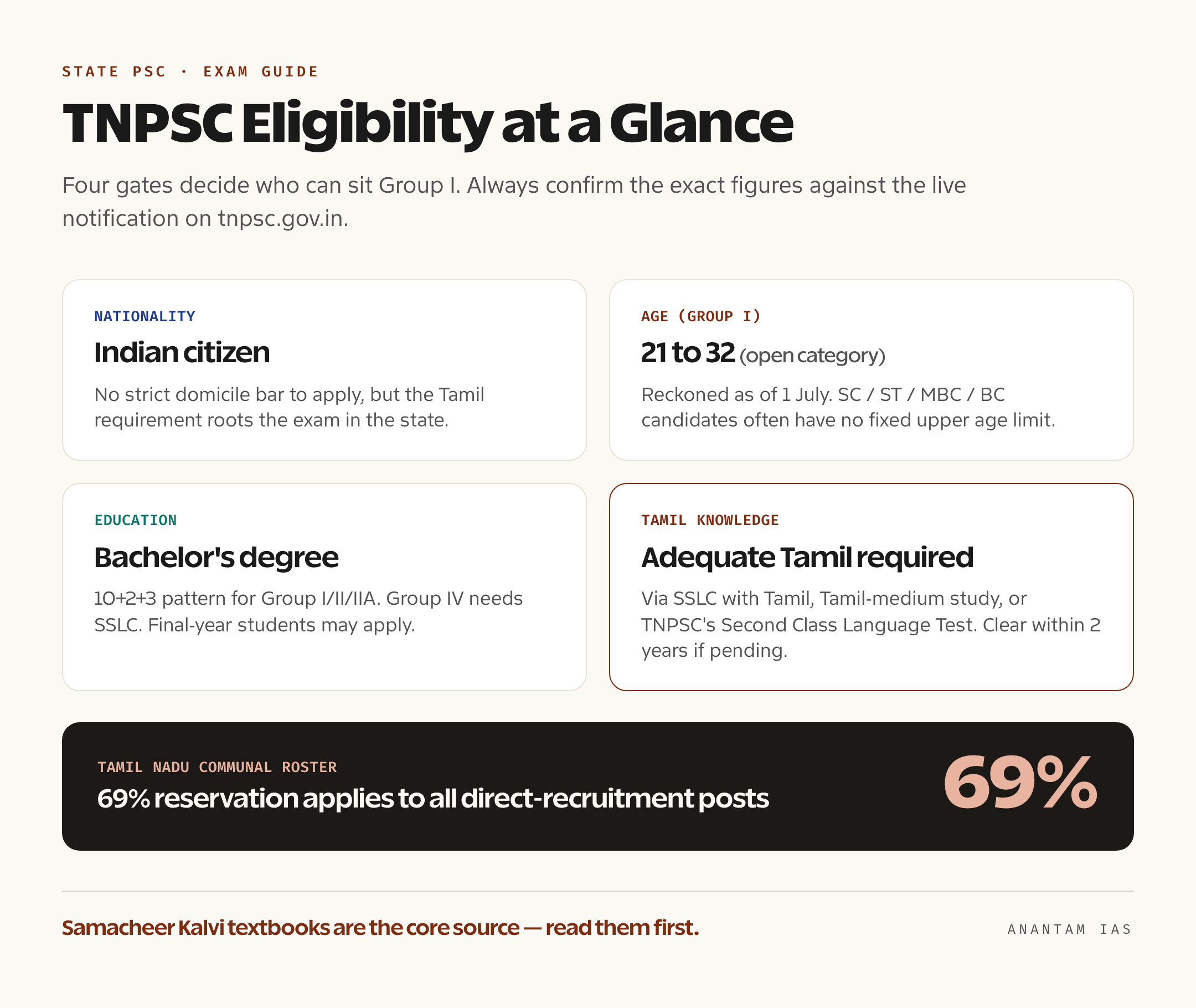
Eligibility for TNPSC turns on four things — nationality, age, education, and a Tamil-language requirement that’s unique among state PSCs. The exact age and qualification rules vary slightly by group and by post, so always cross-check the live notification on tnpsc.gov.in for the year you’re applying.
Nationality: You must be an Indian citizen. Tamil Nadu doesn’t impose a strict domicile bar to apply, but the Tamil-language requirement effectively roots the exam in the state.
Age: For Group I, the minimum age is 21 and the upper limit for the open category is typically 32 (reckoned as of 1 July of the exam year, per recent notifications). TNPSC’s age relaxations are unusually generous — SC, ST, MBC and BC candidates often have no fixed upper age limit for many posts, while “destitute widows” and differently-abled candidates get further concessions. This is a structural advantage over UPSC, where the age window is much tighter.
Educational qualification: A bachelor’s degree from a recognised university under the 10+2+3 pattern is the baseline for Group I, II and IIA. Some posts prefer a relevant discipline such as Law, Commerce or Social Sciences. Final-year students can usually apply, provided they produce the degree certificate before Mains registration. Group IV needs a minimum of SSLC (10th) pass, with typing/steno qualifications for Typist and Steno-Typist roles.
Tamil-language requirement: A candidate must have “adequate knowledge of Tamil.” You meet this if you’ve passed SSLC with Tamil as a language, studied HSC or a degree in Tamil medium, or cleared TNPSC’s Second Class Language Test (Full Test) in Tamil. Candidates who can’t prove it at the time of selection must pass that test within two years of appointment. This is the single biggest gate that keeps TNPSC a Tamil-Nadu-centred exam.
TNPSC Syllabus
The TNPSC syllabus rests on three pillars — General Studies, Aptitude and Mental Ability, and Tamil — with a heavy, deliberate tilt toward Tamil Nadu. The General Studies sweep overlaps a lot with UPSC and other state PSCs (history, polity, geography, economy, science, current affairs), which is good news if you’ve already built an NCERT foundation. The Tamil-Nadu-specific layer is where most marks are actually won or lost.
Prelims Syllabus
Group I prelims General Studies (degree standard) covers Indian history and culture, Indian polity and constitution, Indian and Tamil Nadu geography, Indian economy, general science, and current events. The Aptitude and Mental Ability part (SSLC standard) tests basic numeracy, data interpretation, logical reasoning and decision-making. For Group II/IIA and Group IV, the prelims/objective syllabus adds a General Tamil (or General English) language section that’s absent at the Group I prelims level — so lower-group aspirants must prepare language grammar and comprehension explicitly.
Mains Syllabus
Group I Mains spreads across three descriptive papers built on the same GS spine — modern Indian and Tamil Nadu history, society and culture; Indian polity, governance and public administration; geography, economy, science, technology and current affairs; plus an analytical and essay-style component testing reasoning and expression. Because answers are written and marked subjectively, content depth and answer-writing both matter, unlike the objective-only lower groups.
State-Specific Focus
This is the real differentiator. TNPSC loads its papers with Tamil Nadu’s own story — the ancient Tamil polity and Sangam-age society, the literary weight of the Thirukkural, and especially the 19th- and 20th-century socio-political movements: the Justice Party, the growth of rationalism, the Self-Respect Movement, the broader Dravidian movement, and the contributions of Thanthai Periyar and Perarignar Anna. Add Tamil Nadu geography, the state economy, welfare schemes, and the administrative history that shaped the 69% reservation roster. A candidate who treats this as optional will struggle; a candidate who masters it has a genuine edge over outsiders.
TNPSC Preparation Strategy
TNPSC rewards a sources-disciplined, Tamil-Nadu-first approach. The exam draws so directly from state-board textbooks that the right reading list matters more than the volume of coaching material. Here’s how to build it.
Start With Samacheer Kalvi
The Tamil Nadu state-board (Samacheer Kalvi) textbooks, classes 6 to 12, are the core source for TNPSC — they’re written by the same ecosystem that frames the questions. Read history, geography, economics, political science and science from these books before touching any commercial guide. They cover the Tamil-Nadu-specific content that no NCERT will give you, and they map almost line-for-line onto the syllabus.
Layer In NCERT and GS Overlap
Where the syllabus overlaps with national-level GS — Indian polity, modern history, geography, economy — supplement Samacheer Kalvi with NCERTs and a standard polity reference. If you’ve prepared for UPSC or another state PSC, this layer is largely done; you can read more about how the broader state-services landscape works in the PCS full form guide and weigh the all-India versus state route in UPSC vs State PCS.
Master the Tamil Nadu and Dravidian-Movement Layer
Build dedicated notes on the Self-Respect Movement, the Justice Party, Periyar, Anna, and the rationalist-Dravidian thread — this is high-frequency, high-yield, and uniquely TNPSC. Pair it with Tamil Nadu geography, economy and current state schemes. Treat current affairs through a state lens: track Tamil Nadu government decisions and welfare programmes alongside national news.
Prepare Tamil Deliberately
Don’t leave the Tamil-language and General Tamil component to chance, especially for Group II/IIA and Group IV. Work through grammar, literature and comprehension from the Samacheer Kalvi Tamil texts, and clear the eligibility test early if your schooling wasn’t Tamil-medium.
Drill PYQs and Mocks
Solve previous-year papers across the group you’re targeting to learn TNPSC’s question style — fact-dense, state-heavy, and direct. Because there’s no negative marking, attempt every question in objective papers. For Group I Mains, build an answer-writing habit and sit full-length mocks; for objective groups, run timed sectional tests until accuracy and speed both hold up.
Posts, Salary & Career
Group I unlocks the senior state-cadre jobs — Deputy Collector, Deputy Superintendent of Police (DSP), Assistant Commissioner, Deputy Registrar and District Employment Officer among them. A Group I officer’s pay starts on a scale of roughly ₹56,100-₹1,77,500 (Pay Level 22, with grade pay around ₹5,400); the gross monthly figure works out near ₹1.04 lakh and the in-hand around ₹85,000 in recent cycles, before promotions. A Deputy Collector can rise through the state administrative service and, with time and selection, into the IAS cadre.
Group II and IIA fill supervisory and ministerial posts across departments — Sub-Registrar, Assistant Section Officer, Municipal Commissioner (grade), and similar — with pay scales below Group I but secure and pensionable. Group IV recruits the largest numbers: Junior Assistant, Typist, Steno-Typist and Village Administrative Officer (VAO), the front line of Tamil Nadu’s revenue and clerical machinery, with clear promotion ladders into higher grades over a career. Across all groups, Tamil Nadu’s 69% reservation roster — BC, MBC, DNC, SC, Arunthathiar and ST quotas — shapes both who’s eligible and how the merit list resolves.
Books for TNPSC Group 1, 2 and 4
Most of what you read for UPSC transfers to TNPSC Group 1, 2 and 4: polity, economy, modern history and the NCERT base. What does not transfer is the Tamil Nadu section, and that is where the selection is decided. One state book, read three times, beats five read once.

Errorless 13-Year TNPSC Group 1 Prelims Previous Year Papers — Disha
- 356 pages, Disha, 2025 edition
- Every Group 1 Prelims paper since 2012, year-wise and solved
- The fastest way to see how much Tamil Nadu the paper carries

Lucent's General Knowledge 2026 — English (15th revised edition)
- 460 pages, Lucent Publications
- Static GK in the compressed, list-heavy format state PSC prelims reward
- Overrated for UPSC, right for this exam
- Indian Polity, M. Laxmikanth (Amazon.in). The polity questions are the same exam everywhere.
- Lucent’s General Knowledge (Amazon.in). Overrated for UPSC, right for the static questions here.
- Indian Economy, Ramesh Singh (Amazon.in). Read the concept chapters; the state budget goes on top.
- A Brief History of Modern India, Spectrum (Amazon.in). The freedom-struggle questions come straight from here.
- Errorless 13-Year TNPSC Group 1 Prelims Previous Year Papers — Disha (Amazon.in): thirteen years of Group 1 Prelims papers, solved; the Tamil Nadu questions show you the pattern.
- NCERTs, Classes 6 to 12, for history, geography and science. Free from NCERT; nothing to buy.
Skip the coaching compilations until you have finished these. They summarise books you have not read yet.
Frequently Asked Questions
What is the difference between TNPSC Group I, Group II/IIA, and Group IV?
Group I leads to the most senior posts like Deputy Collector and DSP and runs as a three-stage exam (prelims, descriptive Mains, interview). Group II covers interview posts and Group IIA covers non-interview posts at a supervisory/ministerial level, while Group IV fills clerical and junior roles such as Junior Assistant, Typist and VAO through a single objective paper plus verification.
Is Tamil compulsory for TNPSC?
Yes — every TNPSC candidate must show “adequate knowledge of Tamil,” and Group II/IIA and Group IV also test a General Tamil section in the written paper. You satisfy the requirement by passing SSLC with Tamil, studying in Tamil medium, or clearing TNPSC’s Second Class Language Test in Tamil; those who can’t prove it at selection must clear that test within two years of appointment.
Is there negative marking in TNPSC exams?
No. TNPSC objective papers carry no negative marking, so you should attempt every question — leaving a question blank only costs you a possible mark. This is a key difference from exams that penalise wrong answers, and it changes your guessing strategy completely.
What are the best books for TNPSC preparation?
The Tamil Nadu state-board Samacheer Kalvi textbooks (classes 6-12) are the single most important source, since the questions are drawn largely from them. Supplement with NCERTs for overlapping national GS, a standard Indian polity reference, and previous-year question papers; for Tamil Nadu and Dravidian-movement topics, the Samacheer Kalvi history and political-science books are enough to build strong notes.
Tell Google you want more of this.
Add Anantam IAS as a preferred sourceOne tap, and this site shows up more often in your own Top Stories, AI Overviews and AI Mode. Remove it any time.