Disclosure: this guide contains Amazon affiliate links. As an Amazon Associate, Anantam IAS earns from qualifying purchases — at no extra cost to you.
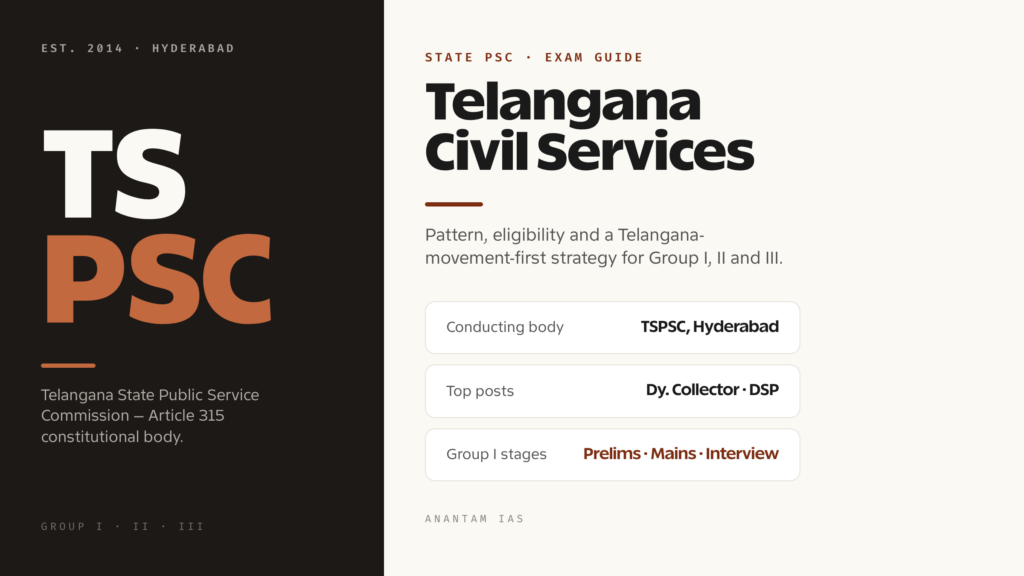
TSPSC full form: Telangana State Public Service Commission — the constitutional body under Article 315 that recruits officers and staff for the Telangana state government, from Deputy Collectors and DSPs at the top through its Group I, II and III examinations. (The commission has since been renamed the Telangana Public Service Commission, TGPSC, but TSPSC remains the name aspirants and notifications still use most.)
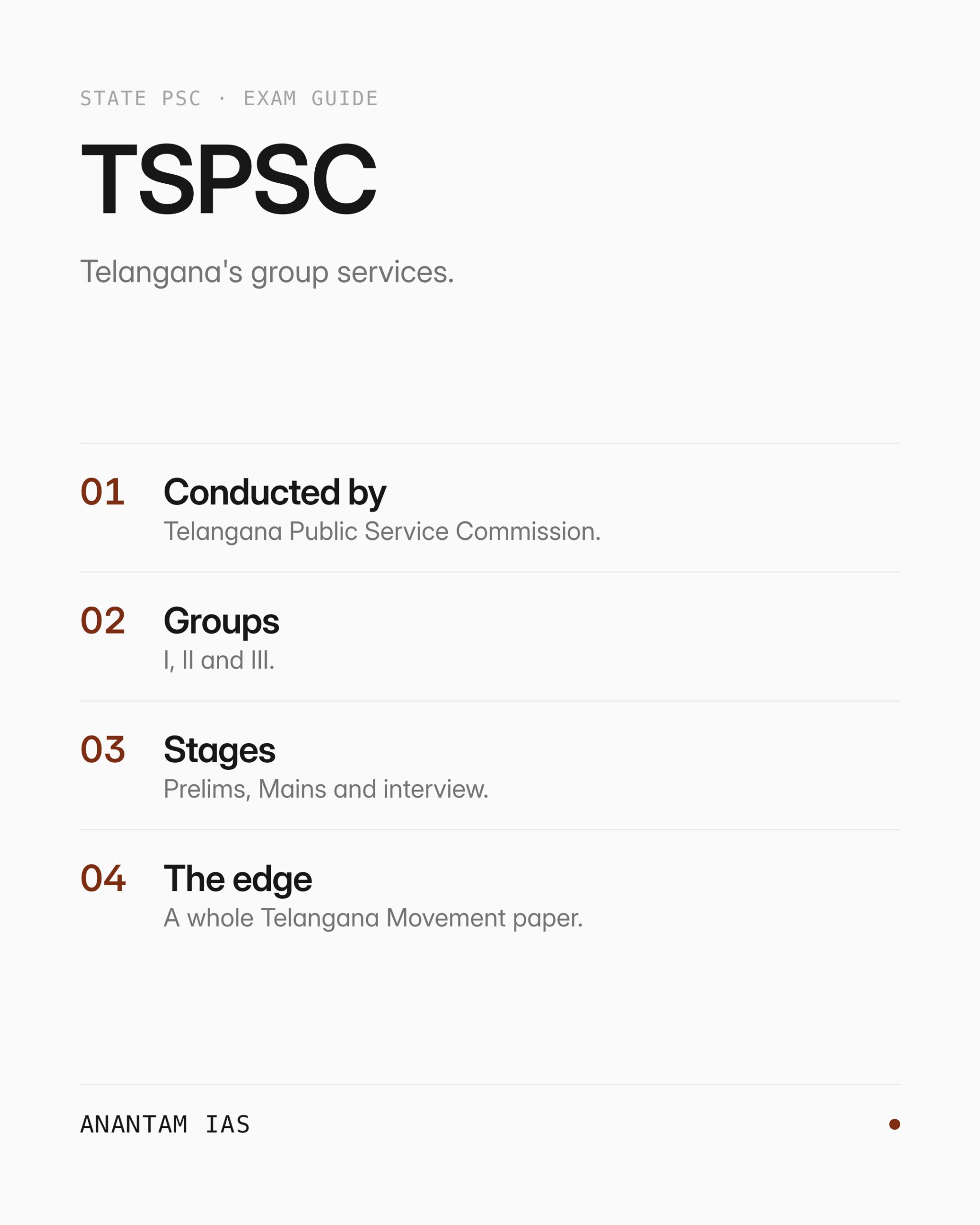
The Telangana State Public Service Commission, almost always called TSPSC, is the constitutional body that recruits officers and staff for the Telangana state government — from Deputy Collectors and Deputy Superintendents of Police at the top to a wide spread of degree-level executive and ministerial posts below. If you want a career in Telangana’s administration without sitting the all-India UPSC race, TSPSC is the door you walk through.
TSPSC runs its recruitment as “Group” exams, ranked by the level of post. Group I leads to the most senior state-cadre jobs, while Group II and Group III fill a large band of degree-level executive and supervisory roles every cycle. What sets TSPSC apart from every other state PSC is its dedicated weight on the Telangana statehood movement — the decades-long struggle that created the state in 2014 is a full subject in its own right, and mastering it is the single clearest path to a TSPSC rank.
What Is TSPSC?
TSPSC is a constitutional body operating under Article 315 of the Constitution, which mandates a Public Service Commission for each state. It was formed on 2 June 2014 under the Andhra Pradesh Reorganisation Act, 2014, when the unified Andhra Pradesh Public Service Commission was split into APPSC and TSPSC after Telangana became India’s 29th state. Its head office is in Hyderabad, and notifications go out on the official portal at tspsc.gov.in. (The commission has more recently been renamed the Telangana Public Service Commission, TGPSC, but TSPSC remains the name aspirants and notifications still use most.)
The recruitment is organised by post level into Groups. Group I is the flagship, leading to senior state-cadre administrative and police posts; Group II covers degree-level executive and supervisory jobs across departments; and Group III fills a further band of degree-level posts. Each Group has its own notification and pattern, but they share a common spine — General Studies, a Telangana-specific layer, and an economy-and-development focus that runs through every paper.
Key Facts
- Conducting authority: Telangana State Public Service Commission, Hyderabad (constitutional body under Article 315), formed in 2014.
- Flagship exam: Group I — Deputy Collector, DSP, Commercial Tax Officer, Regional Transport Officer, District Registrar and allied senior posts.
- Other major exams: Group II and Group III, covering degree-level executive, supervisory and ministerial posts across departments.
- Stages: Group I runs Prelims (screening) → descriptive Mains → interview; Group II and III run Prelims → objective Mains.
- Languages: Question papers are set in English, Telugu and Urdu.
- Differentiator: A dedicated Telangana Movement and State Formation paper — the statehood struggle as a full, high-weight subject.
TSPSC Exam Pattern
TSPSC’s pattern changes with the Group, so it helps to learn the structures separately. Group I is closest in spirit to UPSC — an objective screening Prelims followed by a long descriptive Mains and an interview. Group II and Group III are objective throughout, with a Prelims-style screening test and a multi-paper Mains that is still MCQ-based. One quirk to internalise early: in Group I, Prelims marks don’t count toward the final list — Prelims is purely a screening filter, much like UPSC.
Prelims
For Group I, the preliminary exam is a single objective paper of 150 questions for 150 marks, to be finished in 2 hours 30 minutes, covering General Studies and Mental Ability. It carries negative marking of one-third mark per wrong answer, and it is qualifying only — a screening test to shortlist candidates for Mains, with those marks excluded from the final merit. The shortlist is drawn at a multiple of the vacancies, so the Prelims cut-off is the first real filter you have to clear.
Group II and Group III don’t have a separate Prelims in the UPSC sense; their selection runs on a multi-paper objective written examination plus an initial screening test where the volume of applicants demands one. Across these objective papers, TSPSC applies negative marking of 0.25 mark per wrong answer — a smaller penalty than Group I’s one-third, but enough that blind guessing still costs you.
Mains
The Group I Mains is the heart of the exam: six descriptive (conventional-type) papers of 150 marks each, for 900 marks in total, with three hours per paper and no negative marking. The papers are General Essay; History, Culture and Geography; Indian Society, Constitution and Governance; Economy and Development; Science and Technology and Data Interpretation; and Telangana Movement and State Formation. A separate English paper is qualifying only and doesn’t add to the merit total.
Group II Mains is an objective written examination of four papers, each 150 marks, for 600 marks in total — General Studies and General Abilities; History, Polity and Society; Economy and Development; and Telangana Movement and State Formation. Group III Mains mirrors this at three papers of 150 marks each, for 450 marks, spanning General Studies and General Abilities; History, Polity and Society; and Economy and Development. So the lower you go, the more selection rests purely on objective accuracy.
Interview / Personality Test
Group I carries an oral test — the interview — worth 100 marks, with the final rank resting on the Mains descriptive papers plus this interview, while Prelims is excluded. (TSPSC has revised the interview weight across cycles and at times relied on the written stage alone, so confirm the live notification.) Group II and Group III, being objective-only, typically have no interview — those results turn entirely on the written Mains and certificate verification.

TSPSC Eligibility
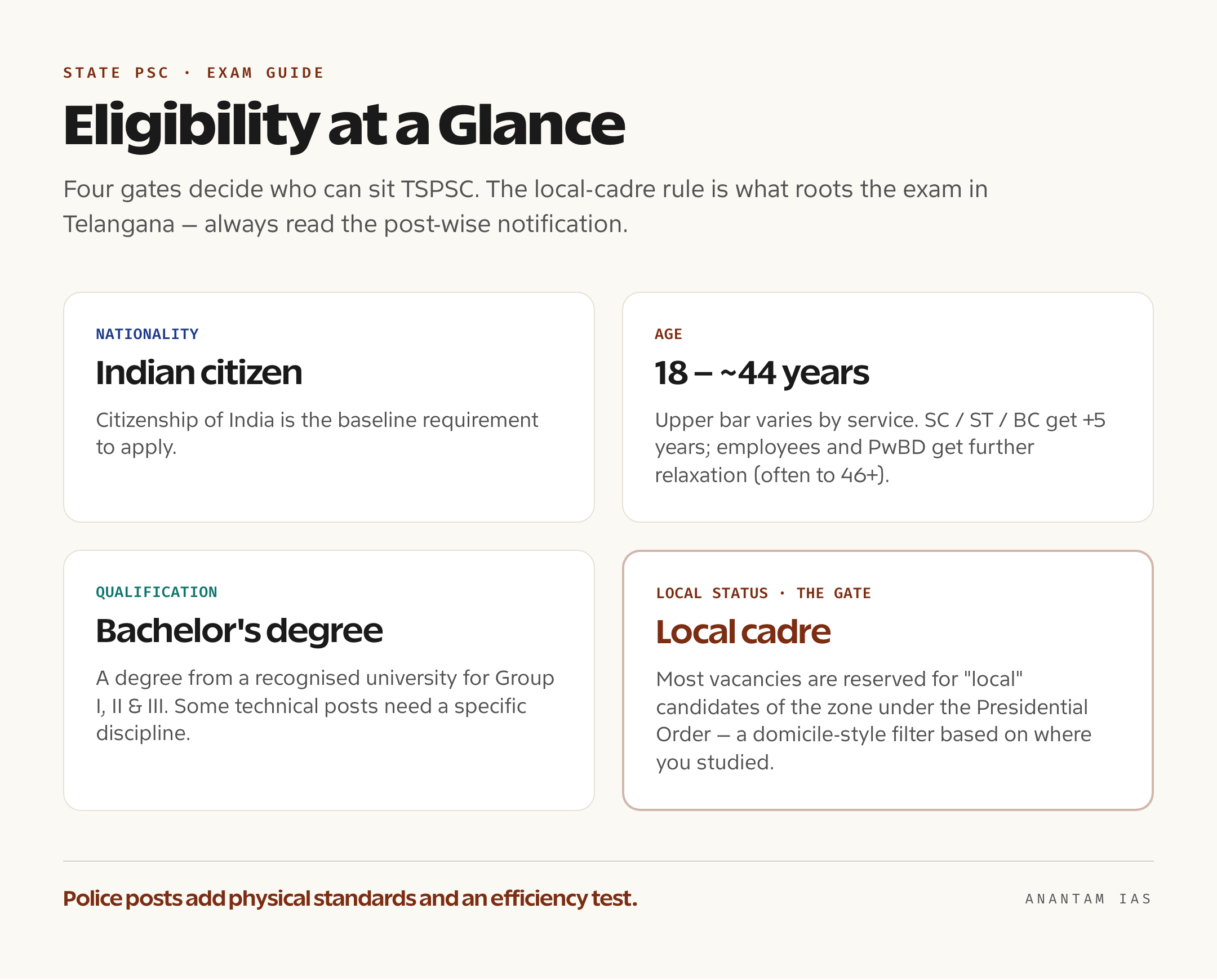
Eligibility for TSPSC turns on four things — nationality, age, education, and the local/non-local rules that root the recruitment in Telangana. The exact age and qualification rules vary slightly by Group and by post, so always cross-check the live notification on tspsc.gov.in for the year you’re applying.
Nationality: You must be an Indian citizen.
Age: TSPSC’s general window runs from 18 to an upper limit of around 44 years for most posts (reckoned as of 1 July of the relevant year), though the upper bar varies by service — police posts such as DSP have their own narrower band. SC, ST and BC candidates typically receive an extra five years, and state government employees and persons with benchmark disabilities get further concessions, pushing the effective upper limit higher (up to 46 and beyond for specific categories). Because TSPSC states age slabs post by post, read the notification’s eligibility table rather than assuming a single number.
Educational qualification: A bachelor’s degree from a recognised university is the baseline for Group I, II and III. Some posts ask for a specific discipline — an engineering or technical degree for certain technical services, for instance — so check the post-wise requirement. Final-year students can usually apply provided they produce the degree certificate by the prescribed date. Police posts add physical standards and a physical efficiency test.
Local / non-local status: Telangana follows a local-cadre system under the Presidential Order, and a large share of direct-recruitment vacancies are reserved for “local” candidates of the relevant zone, based on where you studied. This local-area rule is the practical equivalent of a domicile filter — non-local candidates compete for a much smaller open pool, which is what keeps TSPSC a Telangana-rooted exam.
TSPSC Syllabus
The TSPSC syllabus rests on a General Studies spine that overlaps heavily with UPSC and other state PSCs — history, polity, geography, economy, science and current affairs — layered with a deliberate, high-weight tilt toward Telangana. If you’ve already built an NCERT foundation, the national GS portion is largely familiar. The Telangana-specific layer, and especially the statehood movement, is where most marks are actually won or lost.
Prelims Syllabus
The Group I Prelims paper covers General Studies and Mental Ability: current affairs of regional, national and international importance; international relations; general science and its everyday applications; the history and cultural heritage of India and Telangana; Indian polity and governance; the Indian and Telangana economy and planning; the geography of India and Telangana; and logical reasoning, data interpretation and basic numeracy. Note how Telangana is woven into the history, economy and geography heads from the very first stage — it is never a separate afterthought.
Mains Syllabus
The Group I Mains spreads across its six descriptive papers along the same GS spine, but at far greater depth and with answer-writing in play: a General Essay paper; History, Culture and Geography (Indian and Telangana); Indian Society, Constitution and Governance; Economy and Development (with strong emphasis on Telangana’s economy, agriculture and welfare schemes); Science and Technology with Data Interpretation; and a full paper on the Telangana Movement and State Formation. Group II and III Mains carry the same themes in objective form — General Studies and General Abilities, History/Polity/Society, Economy and Development, and (for Group II) Telangana Movement and State Formation.
State-Specific Focus
This is the real differentiator, and it is more pronounced in TSPSC than in almost any other state PSC. TSPSC gives the Telangana Movement and State Formation a dedicated paper at Group I (and Group II), covering the whole arc — the Telangana peasant armed struggle of the late 1940s, the 1969 separate-Telangana agitation, the long political mobilisation that followed, and the movements that culminated in statehood in 2014. Around it sits Telangana’s own history and culture, its geography and river systems, its economy and agriculture, and its flagship welfare schemes and governance reforms. A candidate who treats this as optional will struggle; a candidate who masters it has a decisive edge over outsiders.
TSPSC Preparation Strategy
TSPSC rewards a sources-disciplined, Telangana-first approach. The exam draws so directly from the state’s own history and policy that the right reading list matters more than the volume of coaching material. Here’s how to build it.
Build the GS Foundation With NCERTs
Where the syllabus overlaps with national-level GS — Indian polity, modern history, geography, economy, science — start with NCERTs (classes 6-12) and a standard polity reference. This is the same foundation that powers UPSC and every state PSC, so if you’ve prepared for one of those, much of this layer is already done. You can read how the broader state-services landscape works in the PCS full form guide and weigh the all-India versus state route in UPSC vs State PCS.
Master the Telangana Movement Layer
Treat the Telangana Movement and State Formation as a full subject, not background reading — it carries its own 150-mark paper at Group I. Build dedicated notes on the peasant armed struggle, the 1969 agitation, the leaders and organisations of the renewed movement, and the political-administrative steps to statehood in 2014. Pair it with Telangana geography, the state economy and agriculture, and the current welfare schemes and governance reforms. This is high-frequency, high-yield and uniquely TSPSC.
Track Telangana Current Affairs
Read current affairs through a state lens as well as a national one. Follow Telangana government decisions, budgets and welfare programmes alongside the national news cycle, because TSPSC rewards candidates who know the state’s policy landscape in detail — and that knowledge compounds directly into the economy, polity and movement papers.
Drill PYQs and Practise Answer Writing
Solve previous-year papers for the Group you’re targeting to learn TSPSC’s question style — fact-dense, state-heavy and direct. For the objective papers, remember the negative marking (one-third at Group I Prelims, 0.25 at Group II/III) and calibrate your guessing accordingly. For Group I Mains, build a daily answer-writing habit and sit full-length mocks; you can sharpen that craft with the techniques in UPSC Mains answer writing. Revise on a fixed cycle so the high-volume Telangana and GS content stays retrievable under exam pressure.
Posts, Salary & Career
Group I unlocks the senior state-cadre jobs — Deputy Collector, Deputy Superintendent of Police (DSP), Commercial Tax Officer, Regional Transport Officer, District Registrar and Municipal Commissioner (grade) among them. A Group I officer’s pay sits on the Telangana Revised Pay Scales at a senior level, broadly comparable to other states’ Deputy Collector cadres once allowances are added; a Deputy Collector can rise through the state administrative service and, with time and selection, into the IAS cadre.
Group II fills degree-level executive and supervisory posts across departments — roles such as Assistant Commercial Tax Officer, Sub-Registrar, Assistant Section Officer in the Secretariat and Excise Sub-Inspector — secure, pensionable and with clear promotion ladders. Group III recruits a further band of degree-level posts in revenue, panchayat-raj and allied departments. Across all Groups, Telangana’s local-cadre reservation under the Presidential Order, together with SC, ST, BC and EWS quotas, shapes both who is eligible and how the merit list resolves.
Books for TSPSC Group 1 and 2
Most of what you read for UPSC transfers to TSPSC Group 1 and 2: polity, economy, modern history and the NCERT base. What does not transfer is the Telangana section, and that is where the selection is decided. One state book, read three times, beats five read once.

Know Your State: Telangana 2026 — Arihant
- 292 pages, Arihant, 2026 edition
- Telangana movement, history, geography, economy and polity
- For TGPSC Group 1, 2 and the allied exams

Lucent's General Knowledge 2026 — English (15th revised edition)
- 460 pages, Lucent Publications
- Static GK in the compressed, list-heavy format state PSC prelims reward
- Overrated for UPSC, right for this exam
- Indian Polity, M. Laxmikanth (Amazon.in). The polity questions are the same exam everywhere.
- Lucent’s General Knowledge (Amazon.in). Overrated for UPSC, right for the static questions here.
- Indian Economy, Ramesh Singh (Amazon.in). Read the concept chapters; the state budget goes on top.
- A Brief History of Modern India, Spectrum (Amazon.in). The freedom-struggle questions come straight from here.
- Know Your State: Telangana 2026 — Arihant (Amazon.in): the Telangana-specific section for Group 1 and 2.
- NCERTs, Classes 6 to 12, for history, geography and science. Free from NCERT; nothing to buy.
Skip the coaching compilations until you have finished these. They summarise books you have not read yet.
Frequently Asked Questions
What is the difference between TSPSC Group I, Group II and Group III?
Group I leads to the most senior posts like Deputy Collector and DSP and runs as a three-stage exam — an objective screening Prelims, a 900-mark descriptive Mains across six papers, and an interview. Group II is an objective four-paper exam for 600 marks covering degree-level executive and supervisory posts, while Group III is a three-paper objective exam for 450 marks for a further band of degree-level posts; both are decided on the written Mains plus verification, with no descriptive answer-writing.
Is there negative marking in TSPSC exams?
Yes. The Group I Prelims deducts one-third of a mark for each wrong answer, while the Group II and Group III objective papers deduct 0.25 mark per wrong answer. The descriptive Group I Mains papers carry no negative marking. Because the penalties differ, calibrate your guessing — be more cautious in Group I Prelims than in the lower Groups.
Why is the Telangana movement so important for TSPSC?
Because TSPSC devotes an entire 150-mark paper to the Telangana Movement and State Formation at Group I, and it forms a full paper at Group II as well. The statehood struggle — from the 1940s peasant armed struggle through the 1969 agitation to the formation of the state in 2014 — is examined in depth, so it is the highest-yield, most distinctively TSPSC topic you can master.
How much does TSPSC preparation overlap with UPSC?
A large share of the General Studies content — history, polity, geography, economy, environment, science and technology — overlaps closely with UPSC and other state PSCs, so an NCERT-and-standard-reference foundation transfers directly. The unique TSPSC investment is the Telangana layer: the statehood movement, the state’s history, geography, economy and welfare schemes, plus the local-cadre rules — content no national syllabus will give you.
Tell Google you want more of this.
Add Anantam IAS as a preferred sourceOne tap, and this site shows up more often in your own Top Stories, AI Overviews and AI Mode. Remove it any time.