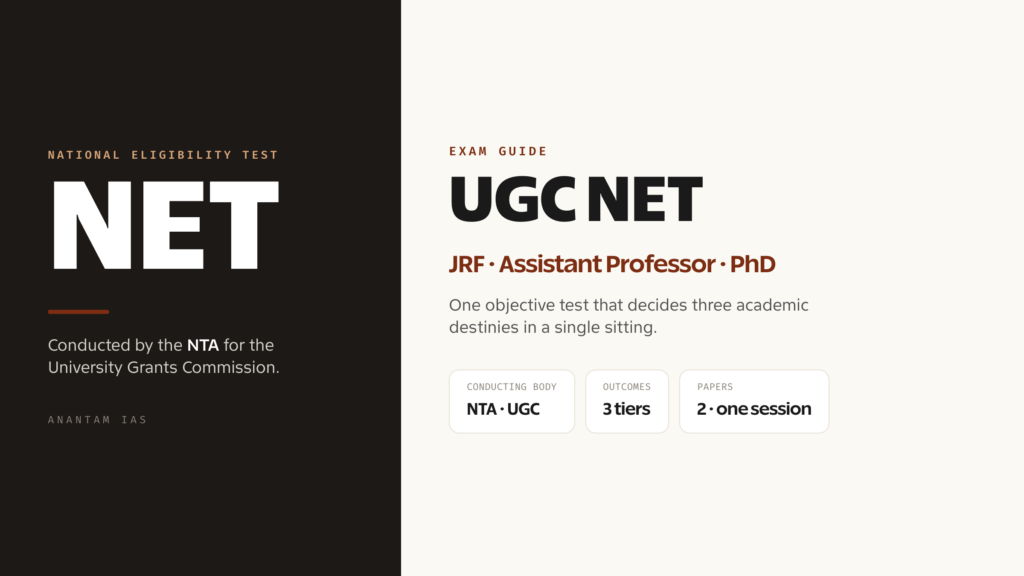
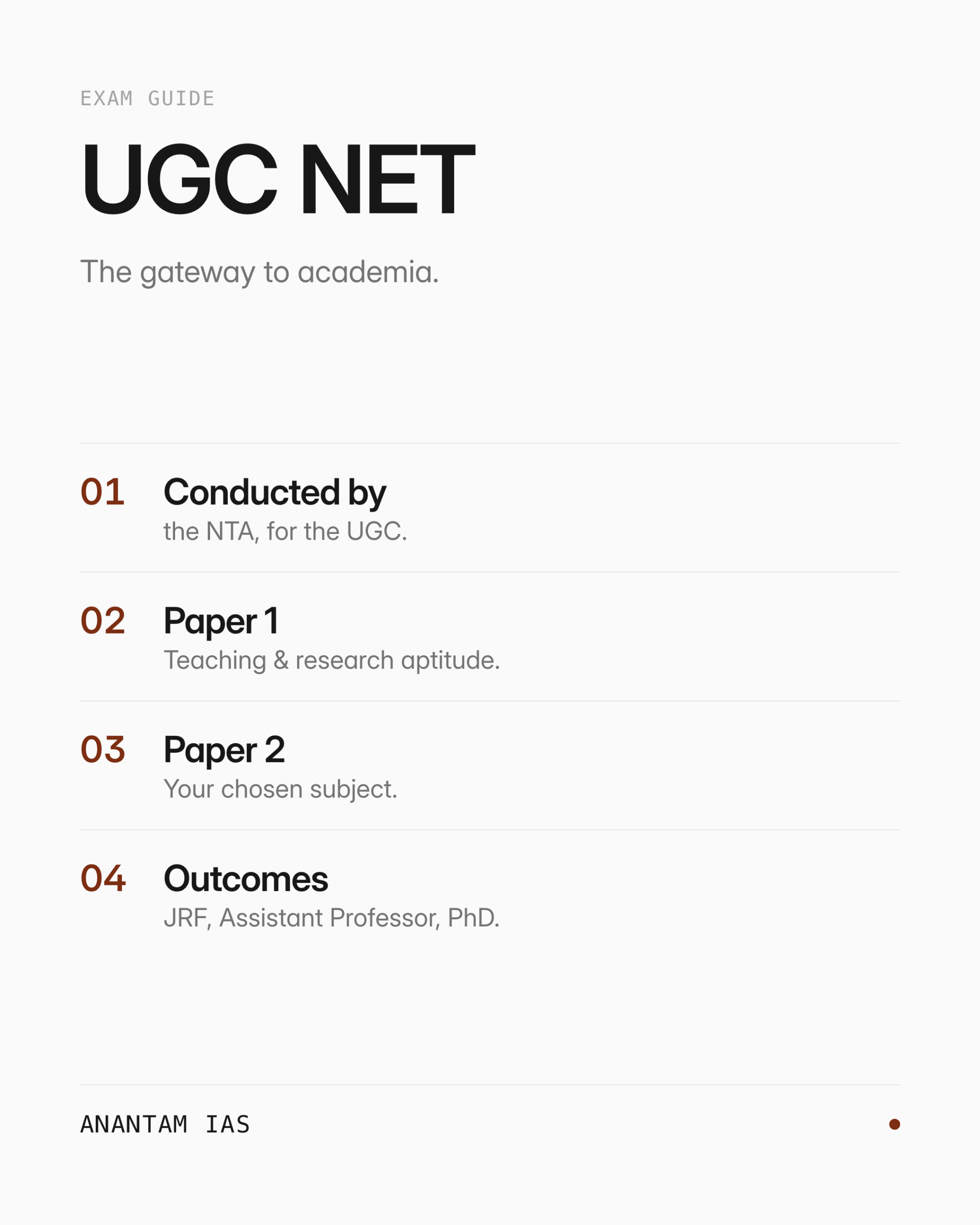
The UGC NET is the gateway exam for almost anyone who wants to teach in an Indian university or build a career in academic research. It is the National Eligibility Test conducted by the National Testing Agency (NTA) on behalf of the University Grants Commission, and a single sitting now decides three different academic destinies at once.
If you hold a master’s degree and you’re drawn to teaching, research, or a doctorate, this is the exam that opens the door. It is held twice a year, it has no negative marking, and one of its two papers is the same for every candidate regardless of subject. That structure makes it one of the more learnable national exams once you understand how it works.
What Is UGC NET?
UGC NET stands for University Grants Commission National Eligibility Test. The University Grants Commission is the statutory body that funds and sets standards for higher education in India, and the NET is the test it uses to certify who is qualified to teach at the college and university level. Since 2018 the exam has been administered by the NTA as a computer-based test.
A qualifying score does three things. It establishes eligibility for appointment as an Assistant Professor in universities and colleges. It can win you the Junior Research Fellowship (JRF), a funded research fellowship for those who score in the top band. And since the June 2024 cycle, the same score is also used for admission to PhD programmes — the UGC merged the separate PhD entrance route into NET, so the test now feeds directly into doctoral admissions.
Key Facts
- Conducting authority: National Testing Agency (NTA), for the University Grants Commission.
- What it certifies: Assistant Professor eligibility, Junior Research Fellowship (JRF), and PhD admission eligibility.
- Frequency: Twice a year, typically in June and December.
- Mode: Computer-based test (CBT), bilingual (English and Hindi).
- Subjects: Around 85 subjects in Paper 2 (expanded toward 87 in recent notifications).
- Scale: Several lakh candidates appear each cycle; in the June 2024 result roughly 1.7 lakh qualified across the three categories, so it is competitive but far broader than the civil-services funnel.
UGC NET Exam Pattern
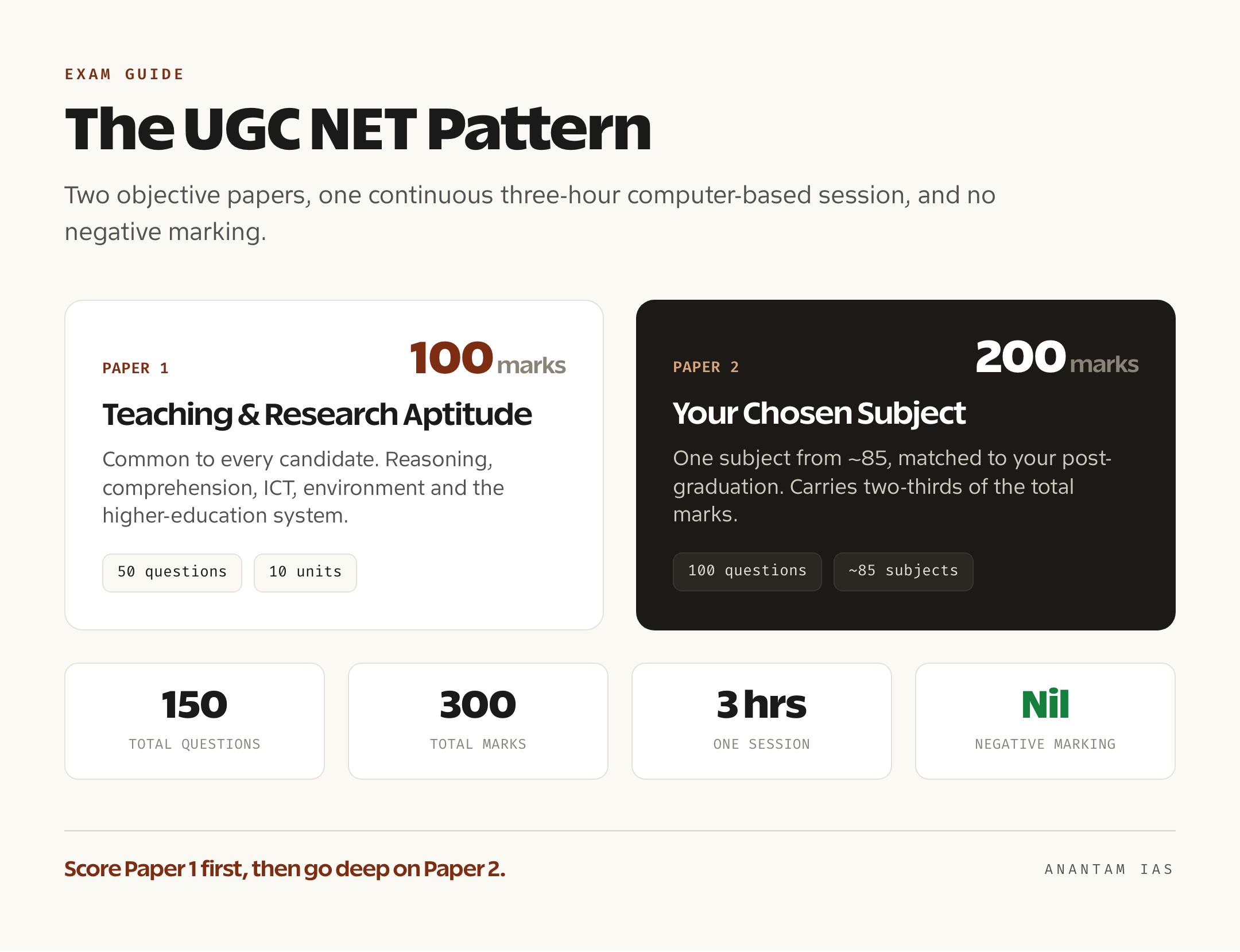
The pattern is refreshingly simple compared with multi-stage recruitment exams. There is a single computer-based session with two papers, taken back to back, and there is no interview or personality test. Both papers are objective and there is no negative marking — every question is worth two marks and a wrong answer costs nothing.
Paper 1 — Teaching and Research Aptitude
Paper 1 is common to all candidates and is the same regardless of which subject you pick. It carries 50 questions for 100 marks and tests general teaching and research aptitude. The official syllabus covers ten units: teaching aptitude, research aptitude, reading comprehension, communication, reasoning (including mathematical reasoning and logical reasoning), data interpretation, information and communication technology (ICT), people-development-and-environment, and the higher-education system in India. Because it’s identical for everyone and largely skill-based rather than memory-heavy, Paper 1 is the most reliably scoring part of the exam.
Paper 2 — Subject Paper
Paper 2 is the subject paper. You choose one subject from the NTA list — Commerce, History, Political Science, Education, Computer Science, English, Economics and dozens more — and answer 100 questions for 200 marks drawn only from that subject. The rule is that your Paper 2 subject should match your post-graduation specialisation, or a closely related field if your exact discipline isn’t listed. This paper is where deep, sustained subject preparation pays off, and it carries twice the weight of Paper 1.
Single Session and Timing
Both papers are attempted in one continuous three-hour (180-minute) session with no fixed break between them — you manage the time across all 150 questions and 300 total marks yourself. Unlike UPSC, there’s no prelims-then-mains ladder and no descriptive writing; it is one objective sitting that produces your result. That single-stage design is why many working professionals and final-year master’s students are able to attempt it.
UGC NET Eligibility
Eligibility for UGC NET turns mainly on your degree, with an age limit that applies only to the fellowship.
Educational qualification. You need a master’s degree (or equivalent) with at least 55% marks for general-category candidates, with a relaxation to 50% for SC, ST, OBC (non-creamy-layer), PwD, and certain other categories. Final-year and final-semester master’s students can also apply, on the condition that they complete the degree within the stipulated window. In line with the National Education Policy, candidates holding a four-year undergraduate degree are now permitted to appear and even compete for JRF and PhD admission, which is a recent and significant widening of the eligibility pool.
Age limit. For Assistant Professor eligibility there is no upper age limit — you can qualify at any age. The age cap applies only to the JRF, where the upper limit is 30 years, calculated as on the first day of the month in which the exam concludes. Relaxations push that ceiling higher: five years for SC/ST/PwD/women candidates and transgender applicants, three years for OBC-NCL, and additional relaxation for those with relevant research or teaching experience and for armed-forces service.
Attempts and nationality. There is no limit on the number of attempts — you can sit the exam as many times as you remain eligible, which suits candidates who clear Assistant Professor eligibility but keep trying for JRF before they age out. The exam is open to Indian nationals, and there is no domicile restriction since it’s a national-level test.
UGC NET Syllabus
The syllabus splits cleanly along the two papers, and the NTA publishes detailed unit-wise syllabi for every subject on its portal.
Paper 1 Syllabus
Paper 1 covers ten compulsory units that every candidate faces: Teaching Aptitude; Research Aptitude; Comprehension; Communication; Mathematical Reasoning and Aptitude; Logical Reasoning; Data Interpretation; Information and Communication Technology (ICT); People, Development and Environment; and Higher Education System. The questions test understanding and reasoning rather than rote recall, so a candidate from any background can master it with structured practice.
Paper 2 Syllabus
Paper 2 has a separate, subject-specific syllabus for each of the roughly 85 subjects, released by the UGC and revised periodically to align with the National Education Policy. These syllabi are dense — typically ten units spanning the full breadth of a master’s curriculum in that discipline. You prepare only the syllabus of your chosen subject, but you prepare it thoroughly, because every one of the 200 marks comes from it.
Choosing Your Subject
Subject choice is one of the most consequential decisions in this exam. The default is the subject of your post-graduation. Where your exact specialisation isn’t listed, the UGC allows you to choose the closest related subject. Switching to an unfamiliar subject just because its cut-off looks lower is rarely worth it — the depth required in Paper 2 means your existing master’s-level knowledge is your biggest asset.
UGC NET Preparation Strategy
A focused candidate can clear UGC NET in a single cycle of disciplined preparation. The strategy follows the structure of the exam itself.
Master Paper 1 First
Because Paper 1 is common, scoring, and skill-based, it’s the smartest place to start and the easiest place to lock in marks. Work through each of the ten units, but give extra time to research aptitude, the higher-education system, ICT, and people-development-and-environment, which carry predictable, factual questions. Reasoning and data interpretation reward practice over reading, so drill them regularly.
Build Deep Subject Mastery in Paper 2
Paper 2 carries two-thirds of the marks, so it deserves the bulk of your hours. Read the official UGC syllabus for your subject unit by unit, map each unit to standard postgraduate textbooks, and build concise notes you can revise quickly. Don’t rely on coaching summaries alone — the questions increasingly test conceptual depth and named theorists, works and frameworks within the discipline.
Solve Previous Year Questions
Previous year questions are the single most valuable resource for this exam. Working through past papers shows you the recurring themes, the depth of questioning, and the balance of factual versus applied items in both papers. Solve several years of PYQs for Paper 1 and for your subject, and treat each wrong answer as a syllabus gap to close.
Take Timed Mock Tests
Since the whole exam is one three-hour objective sitting, time management and accuracy decide outcomes. Take full-length timed mocks that mirror the real interface, review every mistake, and refine your attempt order so you bank the certain marks first. With no negative marking, the discipline here is to attempt everything while still finishing on time.
Revise and Track Current Awareness
Keep a running revision cycle for Paper 1 facts and Paper 2 frameworks, and stay alert to syllabus revisions, which the UGC has been issuing under the National Education Policy. Light current-awareness reading helps with the general-awareness slices of Paper 1 and with subjects where recent developments matter.
JRF, Career and Outcomes
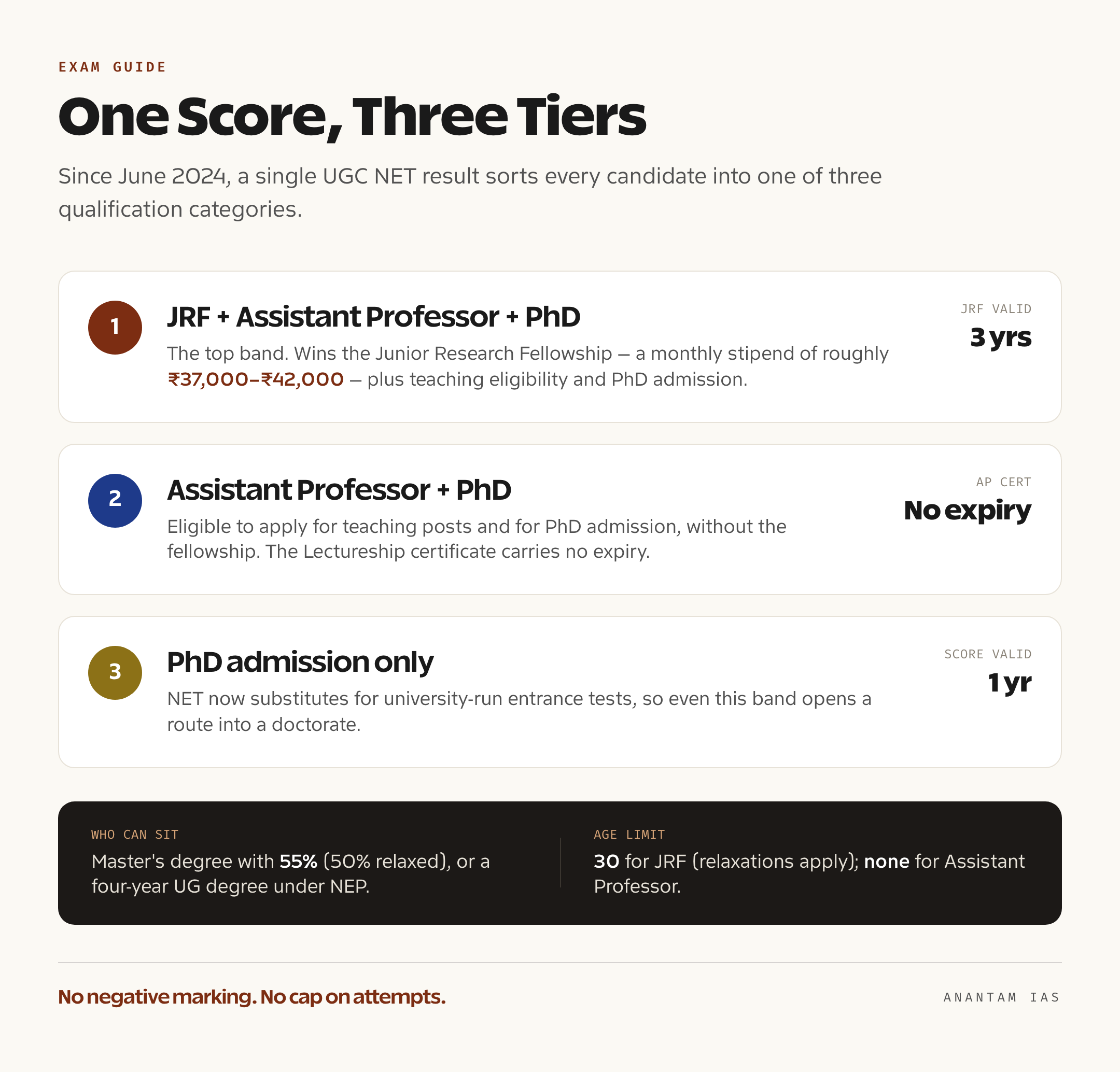
What makes UGC NET distinctive is that one result sorts candidates into three tiers, based purely on aggregate performance across Paper 1 and Paper 2. Since June 2024 the qualification categories are: eligible for JRF plus Assistant Professor plus PhD admission; eligible for Assistant Professor plus PhD admission (without JRF); and eligible for PhD admission only. Your category is decided by where your score falls relative to subject-and-category-wise cut-offs, which the NTA sets each cycle.
The Junior Research Fellowship is the top prize. JRF holders receive a monthly stipend — in the range of roughly ₹37,000 to ₹42,000 depending on the stage of research — to pursue a PhD, making full-time research financially viable. The JRF certificate is valid for three years from the date of the result, within which you must secure admission to a research programme to claim the fellowship.
Beyond the fellowship, NET qualification is the standard requirement for Assistant Professor recruitment across universities and colleges, and the Assistant Professor (Lectureship) eligibility certificate carries no expiry. For candidates who qualify only in the lower bands, the PhD-admission eligibility still has real value, since NET now substitutes for university-run entrance tests. So whether your goal is a teaching post, a funded doctorate, or simply a route into a PhD, the same exam serves all three ambitions.
Frequently Asked Questions
Is UGC NET only for becoming a college teacher?
No. A qualifying score certifies eligibility for Assistant Professor posts, but the same exam also awards the Junior Research Fellowship and, since June 2024, decides admission to PhD programmes. One test now serves three academic goals at once, so it suits aspiring teachers and aspiring researchers alike.
What is the difference between JRF and Assistant Professor qualification?
JRF is the higher tier, awarded only to candidates in the top scoring band, and it comes with a monthly research fellowship of roughly ₹37,000-₹42,000. Assistant Professor (Lectureship) eligibility is awarded to a wider band of qualifiers and certifies you to apply for teaching posts, but it carries no fellowship. JRF holders automatically also hold Assistant Professor eligibility.
Is there an age limit for UGC NET?
There is no upper age limit for Assistant Professor eligibility — you can qualify at any age. The age cap of 30 years applies only to the Junior Research Fellowship, with relaxations of three to five years (and more for some categories) for reserved candidates, women, and those with relevant experience.
Does UGC NET have negative marking?
No, UGC NET has no negative marking. Each question carries two marks and there is no penalty for a wrong answer, which means you should attempt every question rather than leave any blank. This is a key difference from many other competitive exams.
Tell Google you want more of this.
Add Anantam IAS as a preferred sourceOne tap, and this site shows up more often in your own Top Stories, AI Overviews and AI Mode. Remove it any time.