
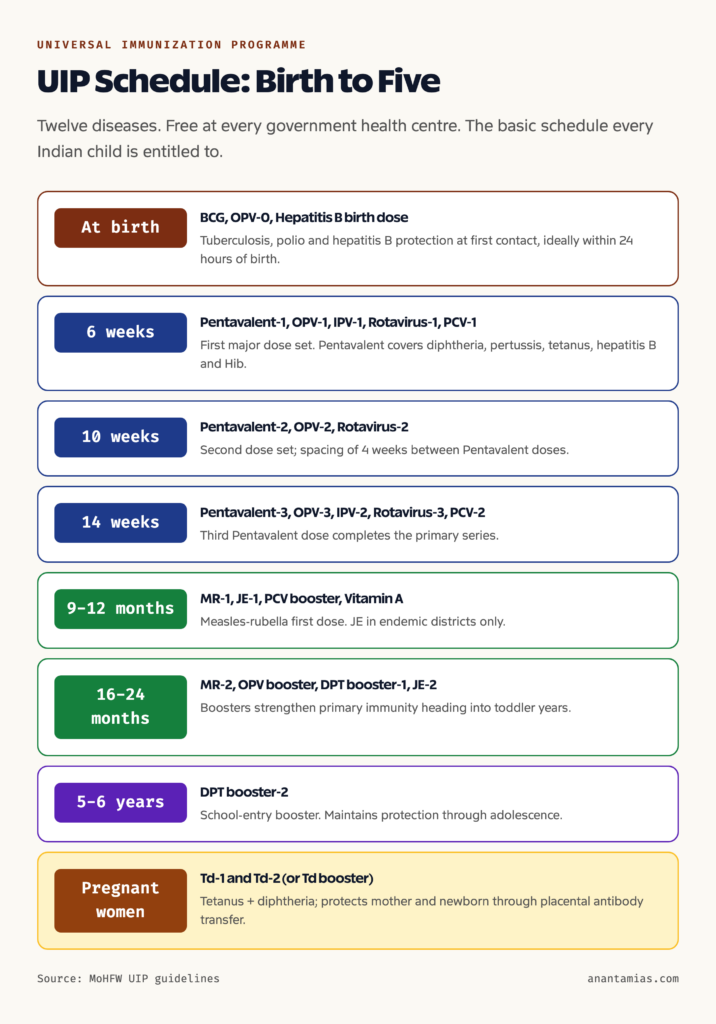
A child born in India today receives, free of charge, vaccines that protect against twelve different diseases by the time she reaches the age of five. The shots happen at the local public health centre, the sub-centre or, in many districts, during outreach sessions in the village itself. The system that makes this possible is the Universal Immunization Programme, the largest immunisation programme in the world by sheer numbers, covering more than 26 million infants and 30 million pregnant women every year.
The Universal Immunization Programme is not the kind of scheme that announces itself in headlines. It works by repetition, by maintaining cold chains, by training auxiliary nurse-midwives and accredited social health activists, by chasing down infants who missed their schedule, by monitoring stocks at the block level and by adding new vaccines as the evidence base allows. The programme has succeeded in eliminating wild polio from India, cutting infant mortality, and bringing tetanus, diphtheria and measles deaths down by orders of magnitude over four decades. It has also struggled, in pockets, with coverage gaps, with vaccine hesitancy and with the logistical problem of reaching the last child.
For UPSC, UIP shows up in GS-II governance as the flagship immunisation arm of the National Health Mission, in GS-III science and technology as a story about vaccine development and indigenisation, and in GS-I society as a marker of the long arc of public health in independent India.
Quick Facts: UIP at a Glance
- Full name: Universal Immunization Programme
- Launch year: 1985
- Nodal ministry: Ministry of Health and Family Welfare
- Integration: Operationalised under the National Health Mission (NHM)
- Diseases covered: 12+ vaccine-preventable diseases
- Annual beneficiaries: Approximately 26 million infants and 30 million pregnant women
- Status: Largest immunisation programme in the world by population covered
- Cost to beneficiary: Free at all government facilities
- Predecessor: Expanded Programme on Immunization, launched in 1978
- Mission Indradhanush: Coverage-intensification drive launched in 2014
- Pulse Polio Programme: Disease-specific mass campaign launched in 1995
- Polio status: India was certified polio-free by the WHO in 2014
What Is the Universal Immunization Programme?
The Universal Immunization Programme is the Government of India’s flagship public health programme that delivers free vaccinations to infants, young children and pregnant women across the country. It is run by the Ministry of Health and Family Welfare in coordination with state governments. At the operational level, vaccines reach beneficiaries through a network of district hospitals, community health centres, primary health centres, sub-centres, urban health posts and outreach sessions held in villages, slums and migrant settlements.
The programme has three core objectives. The first is to protect every child from a defined set of vaccine-preventable diseases by completing the full immunisation schedule. The second is to protect every pregnant woman, and through her the unborn child, against tetanus and diphtheria. The third is to maintain herd immunity at the population level, so that even children who could not be reached, or who could not respond to certain vaccines for medical reasons, are protected by the immunity of those around them.
UIP is described as universal because every child is, in principle, eligible regardless of income, geography, caste or religion. In practice, coverage varies by state, by district and by social group. The headline metric used to measure performance is full immunisation coverage among children aged 12 to 23 months, which means a child who has received all the recommended vaccines by the first birthday. India’s full immunisation coverage was around 62 percent in the early 2010s and rose to roughly 76 percent by the early 2020s, with continuing variation across states.
Background and Historical Context
The story begins with the Expanded Programme on Immunization, launched by the World Health Organization in 1974 and adopted in India in 1978. The original EPI in India focused on six diseases: tuberculosis, polio, diphtheria, pertussis, tetanus and, after some years, measles. Coverage in the first few years was modest, partly because the cold chain infrastructure was new and partly because public awareness of vaccination beyond smallpox eradication, certified in 1980, was uneven.
In 1985, the programme was renamed and broadened as the Universal Immunization Programme. The new name reflected an expanded ambition: the goal was not just to vaccinate eligible children but to do so universally, in every district, including those that had been hardest to reach. The relaunch coincided with a major expansion of cold chain investment, with district immunisation officers being appointed and with the scaling-up of the routine session-based delivery model.
The 1990s and 2000s saw the addition of new vaccines and the launch of disease-specific campaigns. The Pulse Polio Programme, launched in 1995, was a polio-specific mass-immunisation drive that used National Immunization Days to reach virtually every child under five with extra doses of oral polio vaccine. The drive was central to India’s eventual elimination of indigenous wild polio in 2011 and the WHO’s polio-free certification of the South-East Asia region in 2014.
The 2010s brought a second wave of expansion. Hepatitis B was added across all states. The Pentavalent vaccine, which combined diphtheria, pertussis, tetanus, hepatitis B and Haemophilus influenzae type b in a single shot, replaced the older DPT vaccine in a phased rollout from 2011. Rotavirus vaccine was introduced from 2016, the Measles-Rubella vaccine in 2017, and the Pneumococcal Conjugate Vaccine, or PCV, was rolled out nationally between 2017 and 2021. Mission Indradhanush, launched in December 2014, became the most prominent coverage-intensification effort, with periodic intensified rounds in low-coverage districts and urban slums. For broader public health context, see our coverage of mRNA vaccines, the Qdenga dengue vaccine and HPV vaccination for adolescent girls.
The UIP Vaccine Basket: What Is Covered
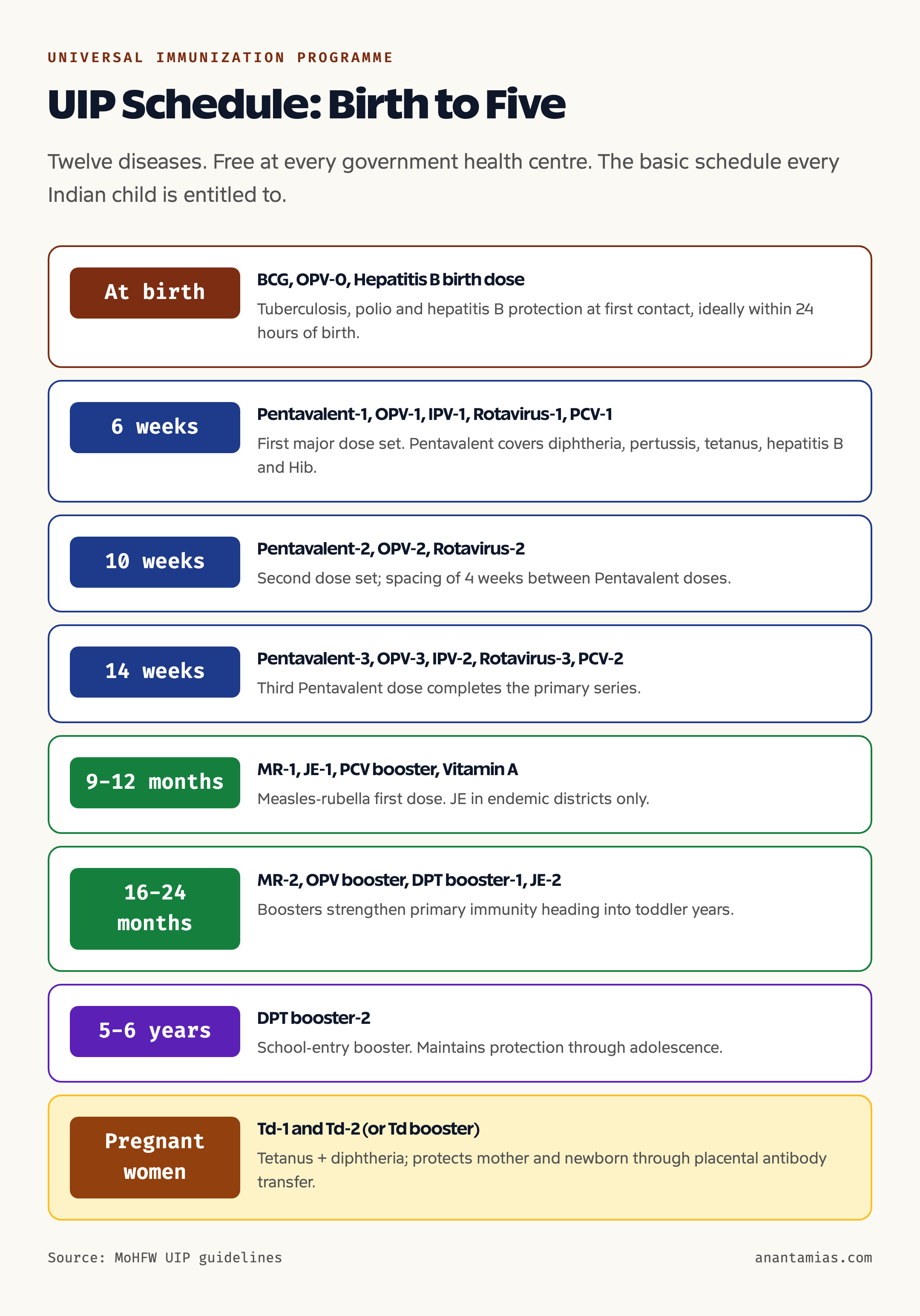
The current UIP basket includes vaccines against twelve vaccine-preventable diseases, with some vaccines covering multiple diseases in a single shot. For children, the schedule begins at birth and continues through the first two years of life, with booster doses up to age five. The vaccines for children include:
- BCG (Bacille Calmette-Guerin): Protects against tuberculosis. Administered as a single dose at birth or at first contact.
- OPV (Oral Polio Vaccine) and IPV (Inactivated Polio Vaccine): Protect against poliomyelitis. OPV is given at birth, six weeks, ten weeks and fourteen weeks; IPV is given alongside.
- Hepatitis B: Protects against hepatitis B virus. Given as a birth dose and as part of the Pentavalent vaccine.
- Pentavalent vaccine: A single shot covering diphtheria, pertussis (whooping cough), tetanus, hepatitis B and Haemophilus influenzae type b. Given at six, ten and fourteen weeks.
- Rotavirus vaccine: Protects against rotavirus diarrhoea. Given orally at six, ten and fourteen weeks.
- PCV (Pneumococcal Conjugate Vaccine): Protects against Streptococcus pneumoniae infections. Given at six and fourteen weeks, with a booster at nine months.
- Measles-Rubella (MR) vaccine: Protects against measles and rubella. Given at nine to twelve months and at sixteen to twenty-four months.
- Japanese Encephalitis (JE) vaccine: Given in endemic districts only, in two doses.
- DPT booster: Given between sixteen and twenty-four months and again at five to six years.
For pregnant women, UIP provides the Td (Tetanus and Diphtheria) vaccine, replacing the older Tetanus Toxoid. Td is given in two doses during the first pregnancy and as a booster in subsequent pregnancies. The vaccine protects the mother and, by transferring antibodies through the placenta, also protects the newborn against tetanus during the first weeks of life.
Key Features of the Programme
The UIP runs through a layered service-delivery model. At the state level, the State Immunization Officer is responsible for planning, supply chain and reporting. At the district level, the District Immunization Officer coordinates with block-level medical officers, who in turn supervise primary health centres and sub-centres. The actual vaccination is mostly delivered by Auxiliary Nurse Midwives (ANMs) at fixed sites and during outreach sessions, with Accredited Social Health Activists (ASHAs) mobilising the community and ensuring that every eligible child is brought to the session.
The cold chain is the spine of the programme. Vaccines must be stored at specific temperatures from manufacture to administration. The cold chain in India runs from the four central Government Medical Store Depots, through state-level vaccine stores, to district stores, to block-level stores, to sub-centres equipped with ice-lined refrigerators. The eVIN (Electronic Vaccine Intelligence Network) digital platform, rolled out from the mid-2010s, tracks vaccine stocks and cold chain temperatures in real time at over thirty thousand cold chain points. eVIN was a major upgrade to programme management and helped reduce stockouts dramatically.
Another structural feature is integration with maternal health. The Mother and Child Protection Card, issued at the first antenatal visit, records all immunisations alongside antenatal and postnatal visits, growth monitoring and danger signs. This integration means that a vaccination session is often also a session for nutrition counselling, growth monitoring and health education, multiplying the public health value of each contact.
Why It Matters: Public Health Outcomes
The most direct measure of UIP’s impact is the prevention of disease, disability and death. Estimates from the Ministry of Health and Family Welfare and from independent epidemiological studies suggest that the programme prevents around 5 lakh under-five deaths annually compared with what would happen without immunisation. The reduction in measles mortality, which once killed several lakh children a year in India, has been particularly dramatic. Diphtheria, pertussis and tetanus, all common causes of childhood death in the 1970s, have been brought down to a small fraction of historical levels.
The polio story is the most cited single success. India was once the global epicentre of polio, accounting for nearly half of all wild-virus polio cases worldwide as recently as 2009. The combination of routine UIP delivery and the Pulse Polio campaigns, with the active involvement of state governments, district magistrates and tens of thousands of vaccinators, eliminated indigenous wild polio by 2011. The WHO certified India polio-free, along with the rest of the South-East Asia region, in 2014. Maintaining polio-free status has required continued vigilance, including ongoing routine OPV doses and rapid response to any imported case.
UIP also matters because it is one of the most cost-effective public health interventions in the country’s portfolio. The cost per fully immunised child remains low compared with the morbidity and mortality averted, and the programme contributes directly to reducing under-five mortality, the SDG-3 indicator on which India has made significant progress.
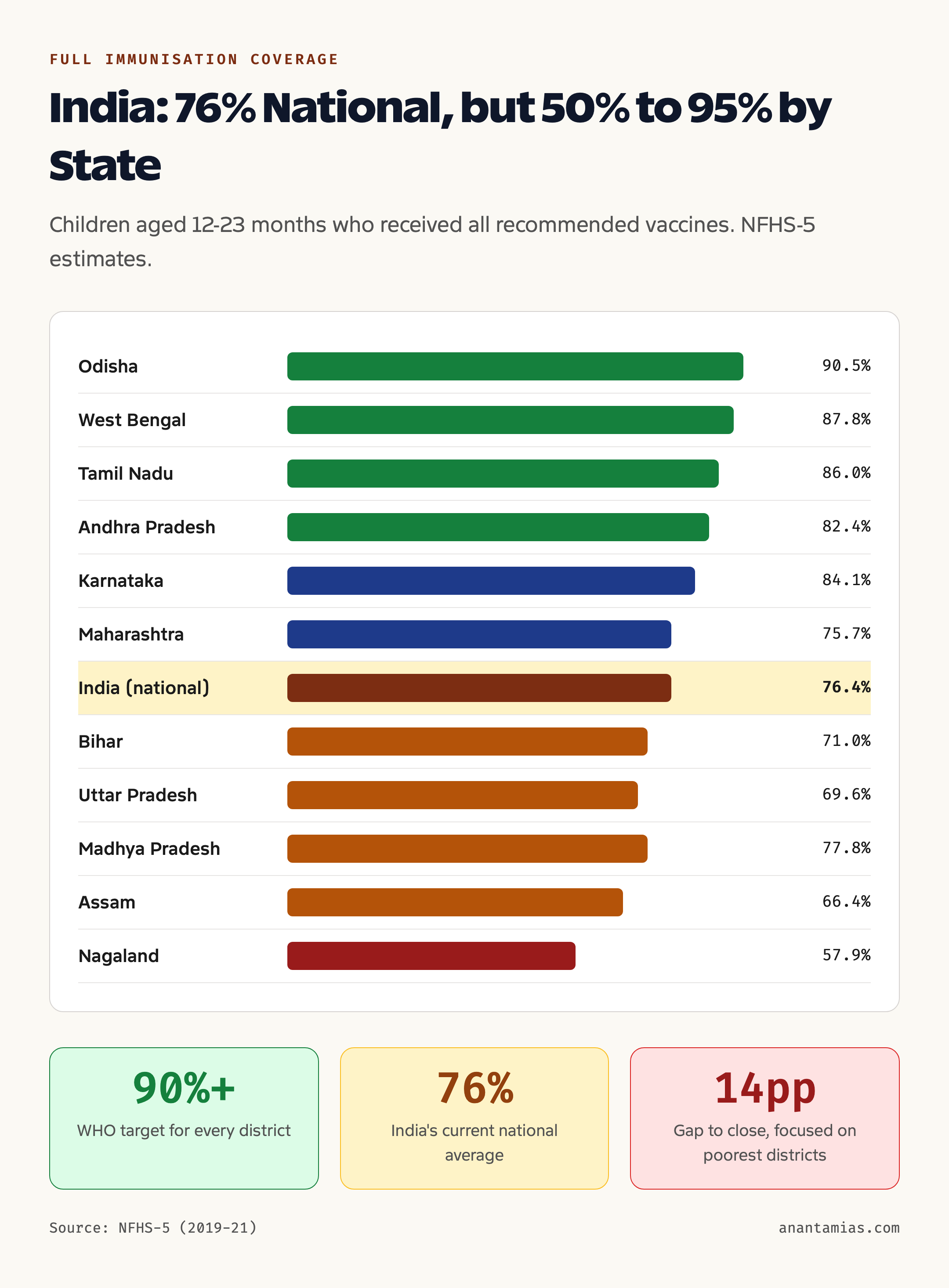
Comparative Snapshot: UIP, Mission Indradhanush, Pulse Polio
| Feature | UIP | Mission Indradhanush | Pulse Polio Programme |
|---|---|---|---|
| Nature | Routine national immunisation programme | Coverage-intensification drive within UIP | Disease-specific mass campaign |
| Launch year | 1985 | 2014 | 1995 |
| Nodal ministry | Health and Family Welfare | Health and Family Welfare | Health and Family Welfare |
| Primary objective | Routine immunisation against multiple diseases | Reach partially or non-immunised children rapidly | Eradicate poliomyelitis |
| Target group | Infants, children up to five, pregnant women | Partially or unimmunised children and pregnant women | All children under five |
| Diseases covered | 12+ vaccine-preventable diseases | Same as UIP | Polio only |
| Vaccine delivery | Fixed sites and outreach sessions | Door-to-door, special drives, camps | National Immunization Days, booth and house-to-house |
| Frequency | Continuous, year-round | Periodic intensified rounds | NIDs, especially in early years |
Challenges and Constraints
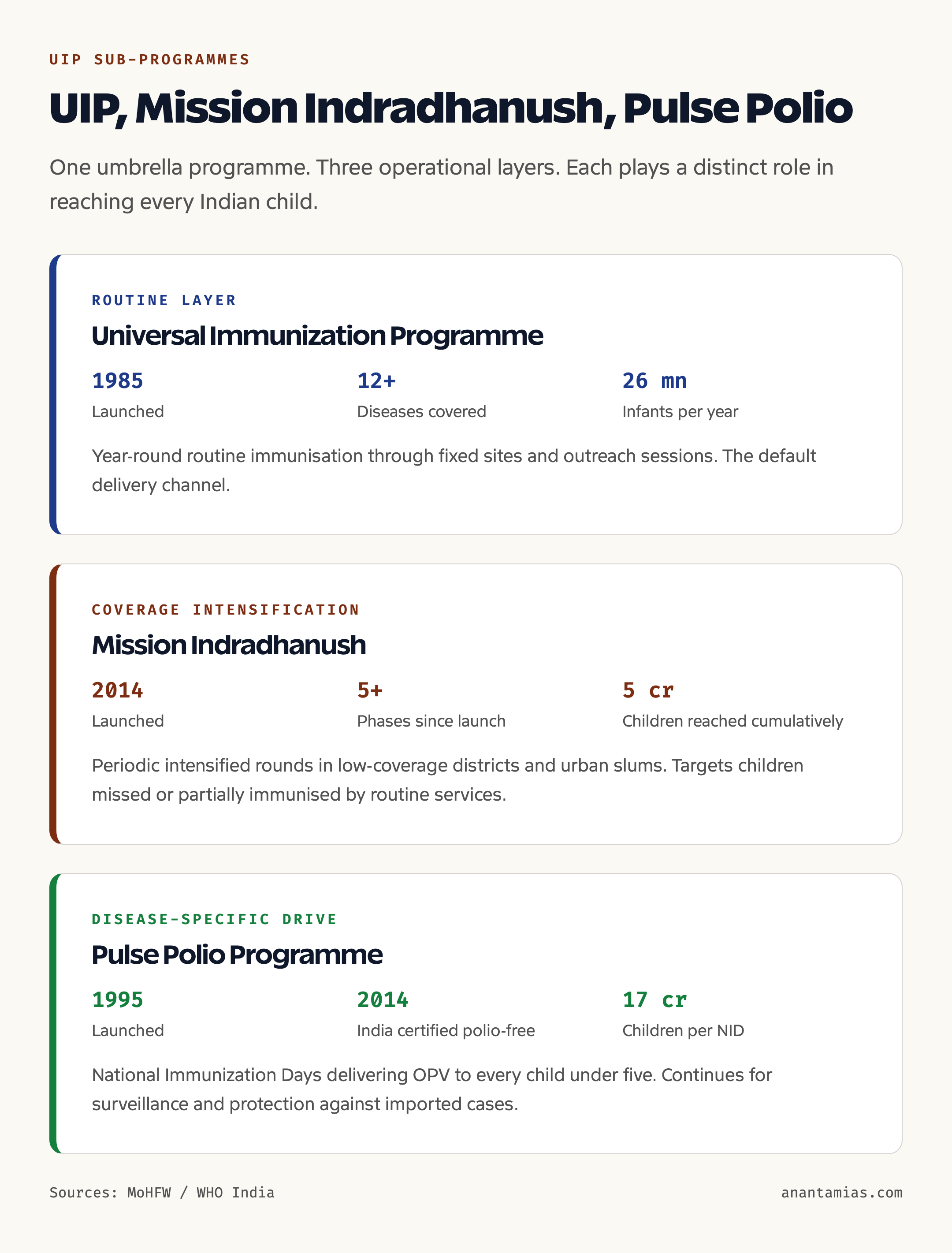
The first challenge is the gap between national average coverage and the worst-performing pockets. Even when national full immunisation coverage approaches 80 percent, several districts and several social groups, particularly in low-density tribal regions and dense urban slums, sit well below 50 percent. Reaching the last child in these geographies is logistically and politically harder than the next-to-last.
The second is vaccine hesitancy. While vaccine acceptance in India is much higher than in some Western countries, pockets of hesitancy exist around specific vaccines, particularly newer ones. Misinformation, including circulated rumours about side effects of HPV and MR vaccines, has at times slowed campaigns and required dedicated communication efforts. The programme has had to invest in trusted local messengers, community health workers, religious leaders and ASHAs to counter such misinformation.
The third is integration with the private sector. A significant fraction of vaccinations in urban India happens in private clinics and hospitals, often with non-UIP vaccines such as those against influenza, varicella and hepatitis A. Without robust reporting from the private sector, the national picture of vaccine coverage is incomplete. Initiatives to improve private-sector reporting and to integrate the Co-WIN platform with broader immunisation tracking are ongoing.
The fourth is the cold chain in last-mile contexts. Power outages, transport delays, equipment failures and, in some areas, natural disasters can break the cold chain. eVIN has narrowed but not eliminated this gap. Investment in solar-powered ice-lined refrigerators, in temperature monitoring devices and in cold chain handlers continues.
Prelims Pointers
- UIP was launched in 1985 as the successor to the Expanded Programme on Immunization (1978).
- It is the world’s largest immunisation programme by population covered.
- It is administered by the Ministry of Health and Family Welfare under the National Health Mission.
- The current basket protects against 12+ vaccine-preventable diseases.
- The Pentavalent vaccine combines DPT, hepatitis B and Hib in a single shot.
- Mission Indradhanush was launched in December 2014; Intensified Mission Indradhanush followed in 2017.
- The Pulse Polio Programme started in 1995.
- India was certified polio-free by the WHO in 2014.
- eVIN tracks vaccine stocks and cold chain temperatures in real time.
- The Td vaccine for pregnant women has replaced the older TT vaccine.
Mains Practice Questions
- Discuss the design and the public health outcomes of the Universal Immunization Programme. How has it contributed to the reduction of under-five mortality in India? (250 words, GS-II/III)
- Examine the role of Mission Indradhanush in addressing immunisation coverage gaps. What lessons does it offer for the design of other targeted public health interventions? (250 words, GS-II)
- India’s polio elimination is widely cited as a success of public-private partnership and political will. Critically evaluate the contribution of the Pulse Polio Programme and the role of state-level leadership. (150 words, GS-II)
- “Vaccine hesitancy is the next major frontier for the UIP.” Comment, with reference to the experience of recent vaccine introductions. (150 words, GS-II)
Way Forward
The next decade for the UIP is shaped by three priorities. The first is closing the equity gap. The aggregate national coverage figure conceals very large variations across districts and social groups. Targeted, data-driven interventions in low-coverage geographies, supported by strong local political ownership, are the only way to converge on the WHO target of 90 percent coverage in every district. Mission Indradhanush continues to be the main vehicle for this work and needs to be sustained.
The second is the addition of new vaccines as evidence grows. The HPV vaccination programme for adolescent girls, currently in pilot and rollout phases, will be a major addition to the basket. The dengue vaccine, the typhoid conjugate vaccine and a future malaria vaccine are also under consideration. Decisions on these additions are taken by the National Technical Advisory Group on Immunization, which evaluates disease burden, vaccine efficacy, cost-effectiveness and operational feasibility before recommending introduction.
The third is digital integration. Co-WIN, originally designed for the COVID-19 vaccination drive, is being adapted to support routine UIP delivery, with portable digital records that travel with the child and can be accessed across health facilities. Integration with the Ayushman Bharat Health Account would create a lifetime immunisation record for every Indian.
For students, UIP is best understood not as a single scheme but as a layered system that combines routine delivery, periodic campaigns, disease-specific drives and digital infrastructure. Connect it to the broader story of India’s health system and the role of public-sector vaccine manufacturers in keeping costs low and indigenous capability high.
Frequently Asked Questions
When was the Universal Immunization Programme launched and why?
The UIP was launched in 1985 as a renaming and expansion of the Expanded Programme on Immunization, which had operated in India since 1978. The relaunch reflected the goal of making vaccination available to every eligible child in every district, supported by major investment in cold chain and field staff. The programme is now operationalised under the National Health Mission.
Which diseases does UIP currently cover?
The current UIP basket protects against twelve or more vaccine-preventable diseases, including tuberculosis, polio, diphtheria, pertussis, tetanus, hepatitis B, Haemophilus influenzae type b, rotavirus diarrhoea, pneumococcal disease, measles, rubella and Japanese encephalitis in endemic districts. Additional vaccines have been added in phases over the past decade.
What is the Pentavalent vaccine?
The Pentavalent vaccine is a single shot that combines protection against five diseases: diphtheria, pertussis, tetanus, hepatitis B and Haemophilus influenzae type b. It replaced the older DPT-only vaccine in a phased rollout from 2011 onwards. The combined shot reduces the number of injections an infant needs and improves coverage of all five diseases.
What is Mission Indradhanush?
Mission Indradhanush is a coverage-intensification drive within the UIP, launched in December 2014. It uses periodic intensified rounds to reach children and pregnant women who have been missed or partially immunised by routine services. Subsequent versions, including Intensified Mission Indradhanush, have focused on specific districts and urban slums with persistently low coverage.
Is UIP free?
Yes. All vaccines under the UIP are provided free of cost at government health facilities and during outreach sessions. The Ministry of Health and Family Welfare procures the vaccines centrally and distributes them through the cold chain network to states and districts.
How was India declared polio-free?
India was declared free of indigenous wild polio in 2011 after sustained Pulse Polio rounds and routine UIP delivery brought the last endemic chains of transmission to zero. The World Health Organization certified the entire WHO South-East Asia Region, including India, polio-free in 2014. Continued routine OPV use and surveillance are needed to maintain this status, especially given polio cases in some neighbouring regions.
What is the role of ASHAs in immunisation?
Accredited Social Health Activists, or ASHAs, are community health workers who play a central role in mobilising eligible children and pregnant women to attend immunisation sessions. They maintain village-level lists of due beneficiaries, follow up with families that miss appointments, and report on coverage to the auxiliary nurse-midwives who administer the vaccines.
How does the cold chain work?
The cold chain is the temperature-controlled supply chain that keeps vaccines viable from manufacture to administration. It runs from central government medical store depots, through state, district and block-level stores, to sub-centres equipped with ice-lined refrigerators. eVIN, the Electronic Vaccine Intelligence Network, monitors stocks and temperatures in real time at thousands of points across the country.
What new vaccines are being considered for UIP?
The HPV vaccine for adolescent girls is currently being introduced in phases. Other candidates under evaluation include the dengue vaccine, the typhoid conjugate vaccine and, in the future, malaria vaccines. Decisions are taken by the National Technical Advisory Group on Immunization based on disease burden, evidence on vaccine performance, cost-effectiveness and operational considerations.
How does UIP fit with the National Health Mission?
The Universal Immunization Programme is one of the flagship vertical programmes within the broader National Health Mission. NHM provides the financial and managerial framework for state-level health systems strengthening, including the staffing and infrastructure that UIP depends on. The integration ensures that immunisation is delivered alongside antenatal care, child health services, nutrition counselling and other primary health care.
Tell Google you want more of this.
Add Anantam IAS as a preferred sourceOne tap, and this site shows up more often in your own Top Stories, AI Overviews and AI Mode. Remove it any time.





