Almost everyone who clears this exam failed it first. Read the interviews of the people whose photographs go up on coaching-centre walls and you find the same line again and again — a Prelims missed by two marks, a Mains that didn’t make the list, an interview that went nowhere, sometimes three or four times over before the year it finally worked. A UPSC failure is not the exception in this journey. For the overwhelming majority of serious aspirants, it is the journey.
That doesn’t make it hurt less. The morning a result confirms that a year of your life didn’t convert is one of the lonelier mornings there is. This guide is written for that morning and the weeks after it — honestly, without the hollow you-can-do-it noise. It covers the real odds, how to find the one thing that actually broke, how to come back without burning out, the cold maths of attempts and age, why a genuine Plan B is not surrender, and how to keep your mind intact through all of it.
The Honest Odds — and Why a Failure Isn’t a Verdict
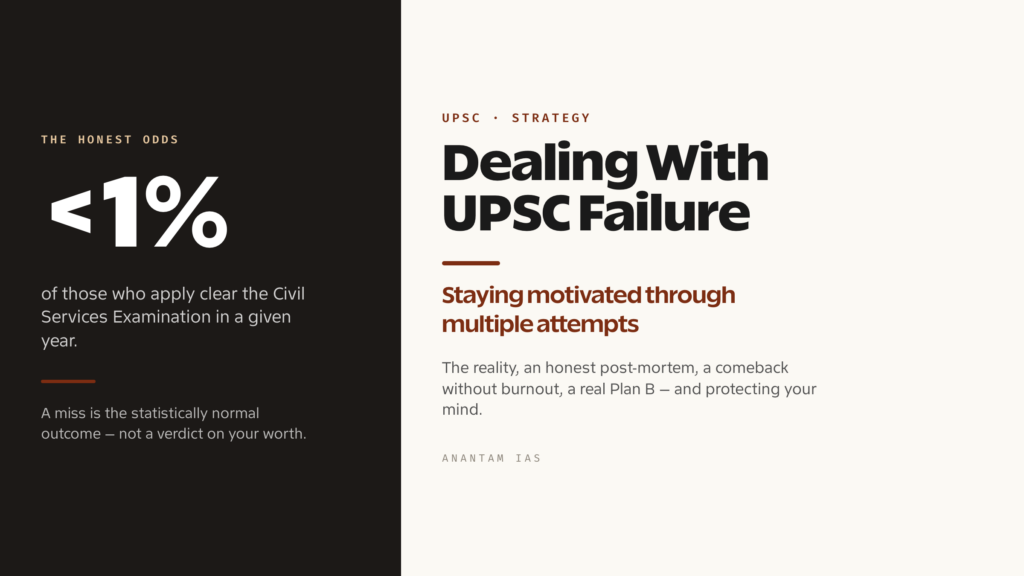
Start with the arithmetic, because false hope and false despair both come from getting it wrong. Roughly ten lakh candidates register for the Civil Services Examination each year, and a little over half actually sit the Prelims. Against that, the Union Public Service Commission notifies somewhere around a thousand vacancies across all services in a typical year. That puts the success rate at a fraction of a per cent — well under one in a thousand of those who apply, and around one in a hundred even of the dedicated few who reach the Mains. A miss at any stage is the statistically normal outcome, not a personal failing.
Sit with what that means. When something has a base rate that low, clearing it is not the default that you fell short of — it is a rare event that most strong, intelligent, hard-working people do not reach on a given attempt, and many never reach at all. The candidate who topped the list and the one whose roll number wasn’t on it are often separated by a handful of marks, a single essay topic that suited one and not the other, or one interview board on one afternoon. A Prelims cut-off you missed by three marks is a data point about a two-hour exam. It is not a verdict on your intelligence, your discipline, or your worth as a person. Those three things were never on the answer sheet.
This is the reframe that everything else depends on. The exam measures a narrow, specific skill — recalling and applying a vast syllabus under brutal time pressure on a fixed set of days — and it measures it imperfectly. Treating the result as a measurement of you is a category error, and it’s the error that does the real damage. You can take the failure completely seriously as feedback while refusing it entirely as a judgement.
The Post-Mortem: Find the One Thing That Broke
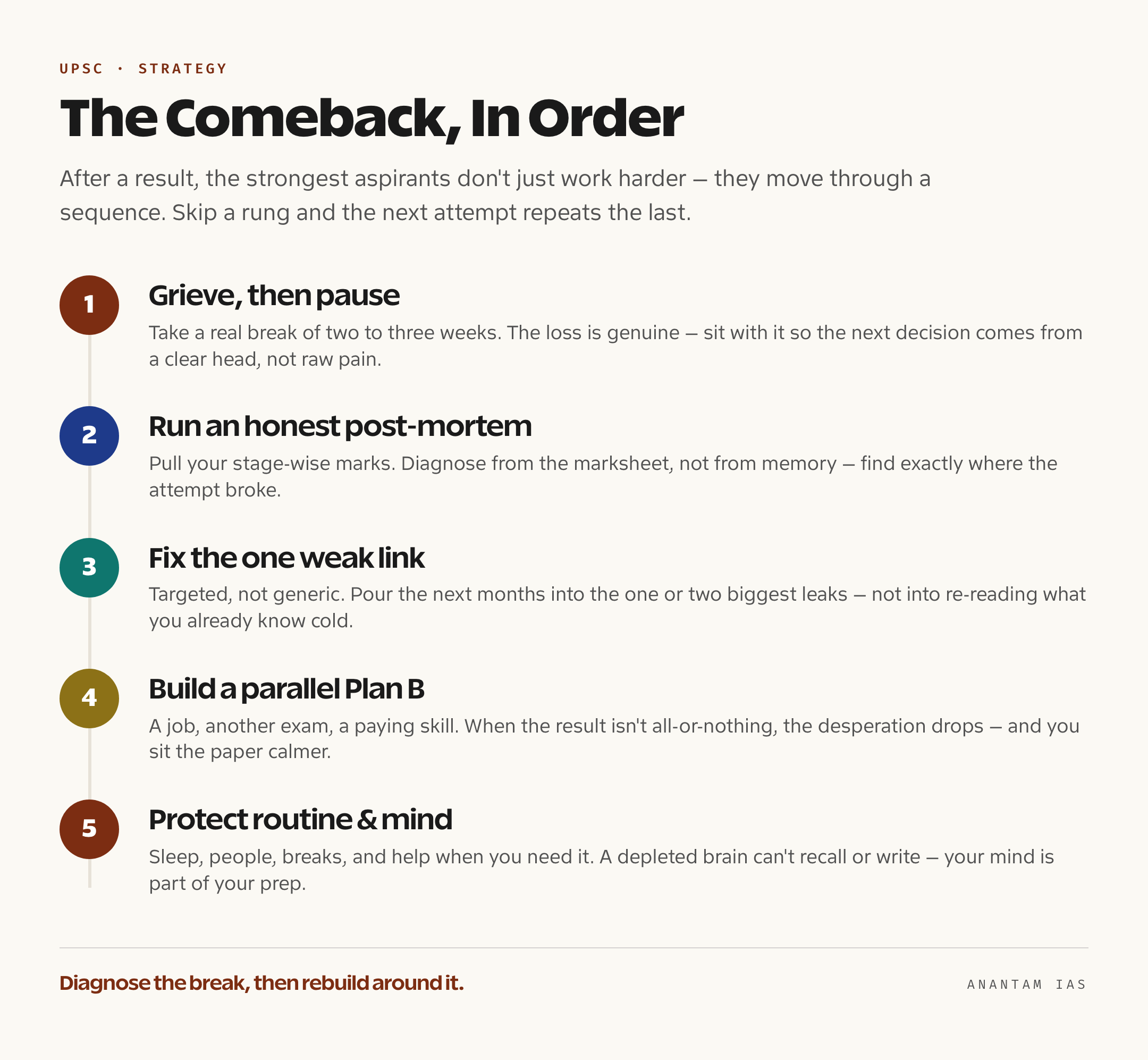
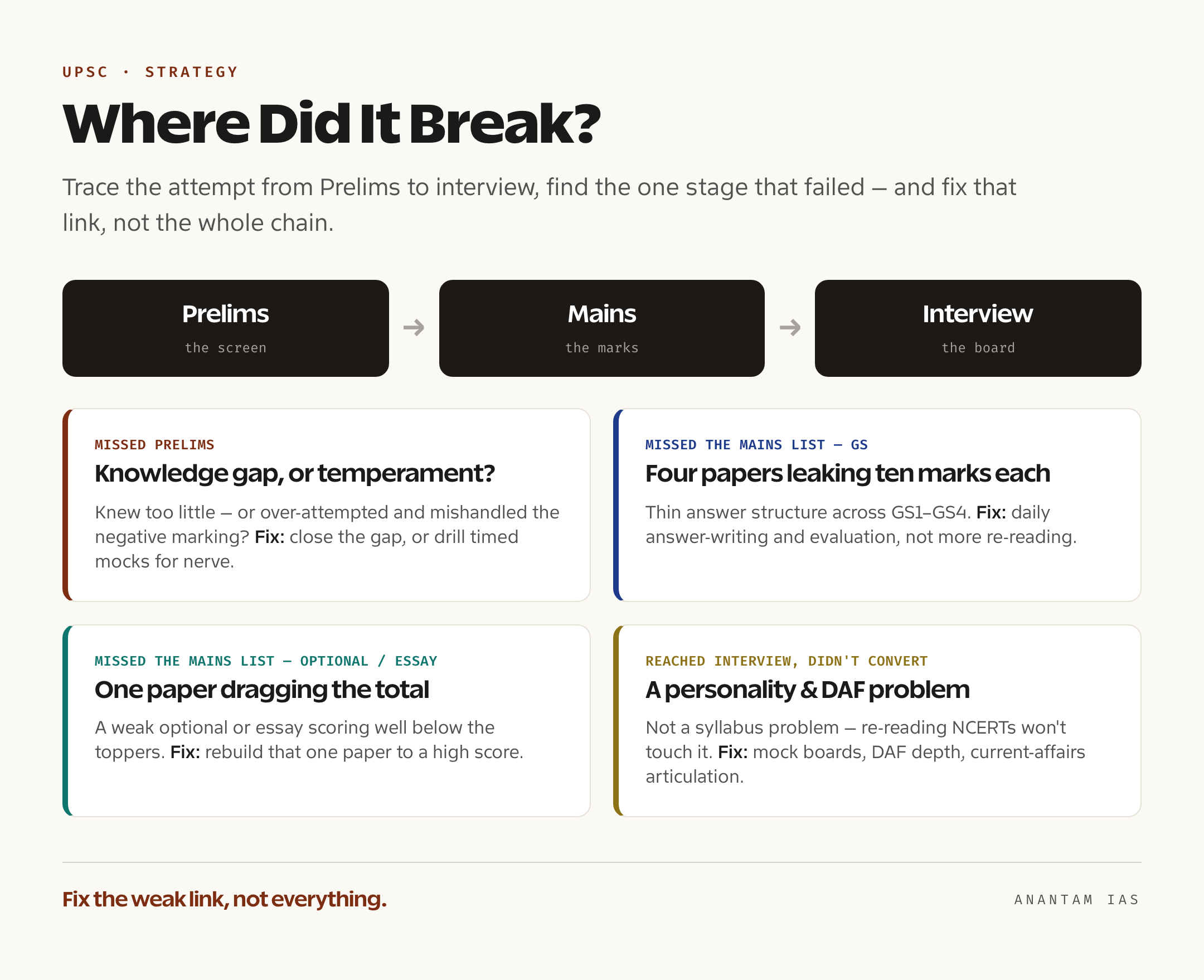
Before you re-register, before you re-buy the booklist, do the unglamorous work: find out where the attempt actually broke. Most aspirants skip this and lunge straight back into generic re-preparation — re-reading everything, re-watching everything, working harder at all of it. That’s how a second attempt fails the same way as the first. A serious comeback is targeted, not generic. It fixes the weak link, not the whole chain.
Be forensic. Pull your actual marks once the UPSC releases them — the Commission publishes stage-wise marks for candidates after the final result, and they are the most honest mirror you have. Then locate the break precisely. Did you miss Prelims? Separate a knowledge gap (you didn’t know enough) from an exam-temperament gap (you knew it but over-attempted, panicked, or mismanaged the negative marking). Did you clear Prelims but miss the Mains list? Drill into the General Studies papers versus the optional versus the essay — one of them is usually dragging, and the marksheet will tell you which. A weak optional that scores 240 when toppers in it score 320 is a different problem from four GS papers that each leak ten marks for thin answer-writing. Did you reach the interview and not convert? That’s a personality-test and DAF problem, not a syllabus problem, and re-reading NCERTs won’t touch it.
Name the one or two biggest leaks and resist the urge to fix everything. If your essay and your answer structure are the weak link, that’s where the next eight months go — not into re-reading polity you already know cold. Honest sourcing matters here too: don’t diagnose from memory or vibes, diagnose from the marksheet and from a couple of trusted mock evaluations. The candidate who can say “I lost it in GS2 and the essay” has already done more useful work than the one who says “I just need to study harder.”
Rebuilding Without Burning Out
There’s a temptation, the week after a result, to atone for the failure with punishment — fourteen-hour days, no rest, a martyr’s timetable that says this time I’ll suffer enough to deserve it. It almost never works. Burnout is not proof of commitment; it’s a productivity collapse with a noble-sounding name. The aspirants who come back strongest are usually the ones who first allowed themselves to grieve the loss properly — a real break of two or three weeks, away from the books, sometimes away from the city — before rebuilding.
The grief is legitimate, so don’t rush past it. You invested a year, often more, and the sunk cost is real — that’s exactly why the “I’ve already given so much, I can’t stop now” feeling is so powerful and so worth examining honestly rather than obeying blindly. Acknowledging the loss is not weakness; it’s what lets you make the next decision from a clear head instead of from raw, reactive pain.
When you do restart, restart targeted. Your post-mortem told you the weak link; build the new plan around closing it, and let the parts you already know coast on lighter revision. A focused six-month repair of answer-writing and one optional paper beats a frantic twelve-month re-run of the entire syllabus. If answer-writing is your gap, our guide to UPSC Mains answer writing breaks down the structure and practice routine that actually moves Mains marks. If the problem was less about content and more about a chaotic, lonely prep environment, the habits in our guide to UPSC preparation at home can help you rebuild a sustainable daily rhythm. And it’s worth reading how the people who eventually cleared it actually worked — the patterns in our UPSC topper strategy guide are less about superhuman hours and more about revision, answer practice, and not changing sources every fortnight.
Attempts, Age and Having a Real Plan B
The honest conversation no one wants to start: the attempts run out. For the General category the limit is six attempts up to the age of 32; OBC candidates get nine attempts up to 35; SC and ST candidates have unlimited attempts within the age ceiling of 37; and benchmark-disability candidates get extended attempts as notified. Confirm the exact numbers against the current UPSC notification, since relaxations vary by category — but know your personal maths. If you’re a General-category aspirant on your fourth attempt at 29, you have a hard, finite runway, and pretending otherwise helps no one. Knowing the count isn’t pessimism; it’s the information you need to plan like an adult.
That maths is the strongest argument for a genuine Plan B — not a half-hearted backup you’ll resent, but a parallel track that means your life isn’t staked entirely on one binary result. This is the single biggest predictor of mental stability across multiple attempts. Aspirants who keep one foot in the wider world — a job, a profession, another competitive exam, a skill that pays — carry their setbacks far better than those for whom UPSC is the only door, because a Prelims miss doesn’t then become an existential collapse. Plenty of strong public careers run through the State PSCs, the banking and SSC route, the judiciary, teaching, the corporate world, or the development sector, and many people who built one of those later say the “failure” redirected them somewhere they’re genuinely happier.
A Plan B also quietly improves your UPSC performance, because the desperation comes down. When the exam is the only thing standing between you and a future, every Prelims becomes life-or-death and the pressure corrodes your actual exam-day calm. When it’s one good path among two or three, you sit the paper looser, and looser usually scores higher. Building the backup is not giving up on the dream. It’s what lets you keep chasing it without the chase destroying you.
Protecting Your Mental Health
The part of this exam no booklist covers: the toll it takes on the mind. Long isolation, the relentless comparison — that batchmate who cleared, the cousin who “settled” years ago, the strangers’ selection posts in your feed — the family hopes you carry, and the society that quietly keeps score, all of it compounds. Anxiety, low mood, sleeplessness and burnout are common among aspirants, and treating them as character flaws rather than predictable load is its own kind of damage. Protecting your mind is not separate from your preparation. It is your preparation, because a depleted brain doesn’t learn, recall, or write under pressure.
The basics are unglamorous and they work. Hold a routine even when motivation is gone — the routine carries you on the days willpower can’t. Protect sleep as a non-negotiable, because under-slept revision is mostly theatre. Keep people in your life: a couple of human conversations a day, family you don’t perform for, one or two friends who aren’t tracking your attempt count. Take real breaks and move your body, because the walk you think you can’t afford is often what saves the study hours around it. And cut the comparison at the source — mute the feeds that turn other people’s results into a daily wound. Your timeline is not your worth, and it is certainly not theirs.
When it goes beyond ordinary stress — persistent hopelessness, panic, an inability to function, or any thought of harming yourself — that is a medical situation and it deserves medical help, not more discipline. There is no shame in it, and asking for help is a sign of strength, not weakness. India’s national mental-health helpline, Tele-MANAS, is free and runs round the clock on 14416 (or 1-800-891-4416), set up under the Ministry of Health for exactly this. A counsellor or psychiatrist is as legitimate a part of your support system as a mentor or a test series. Reach out early, talk to someone you trust, and remember that the goal of all of this was always a good life — and you are not required to destroy the life to chase the result.
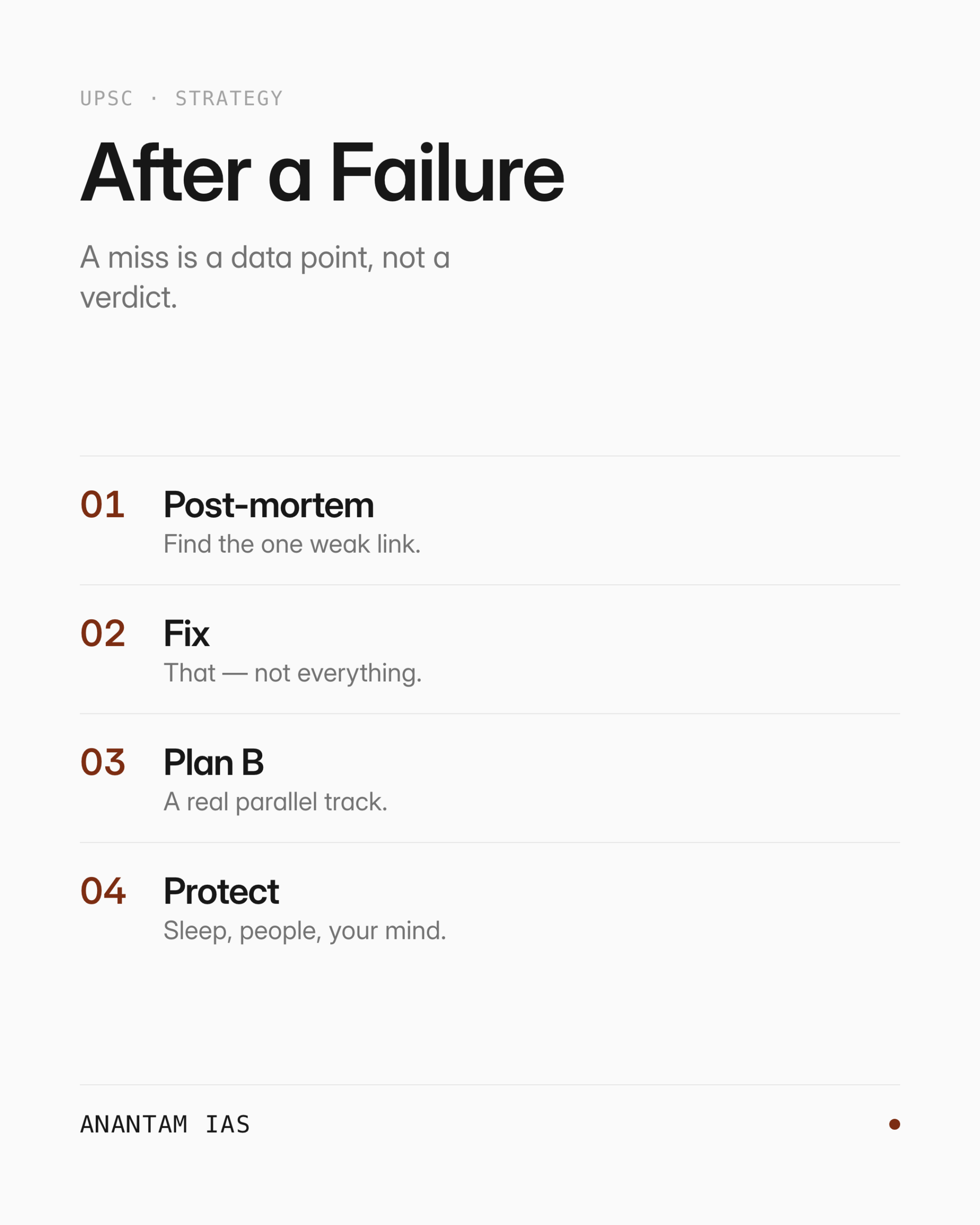
Hold both truths at once. Continuing is honourable when you have a clear diagnosis of what broke, the attempts and the appetite to fix it, and a Plan B that keeps you whole. And choosing to move on is equally honourable — not a defeat but a decision, often the braver one, made by people who go on to thrive elsewhere and rarely regret reclaiming their years. Whichever you choose, choose it from a clear and rested mind. That, more than any number of attempts, is what a good outcome actually looks like.
Frequently Asked Questions
How many times can you realistically attempt UPSC?
It depends on your category. General-category candidates get six attempts up to age 32, OBC candidates get nine up to 35, and SC/ST candidates have unlimited attempts within the age limit of 37, with further relaxation for benchmark-disability candidates. Always verify against the latest UPSC notification, since age and attempt relaxations can change. Knowing your exact personal count is the first step to planning realistically rather than drifting from attempt to attempt.
Is failing UPSC the end of my career?
Not remotely. The success rate is a fraction of a per cent, so the overwhelming majority of serious, capable aspirants don’t clear it — and a great many of them go on to strong careers in the State PSCs, banking and SSC services, law, teaching, the corporate world, or the development sector. The skills you built — discipline, broad knowledge, analytical writing — transfer widely. A UPSC miss closes one door; it doesn’t lock the building.
How do I stay motivated after multiple failures?
Motivation is unreliable, so don’t run on it — run on routine, a targeted plan, and a clear reason. After a failure, first grieve the loss and take a real break, then do an honest post-mortem so the next attempt fixes the actual weak link instead of repeating the last one. Keep a Plan B so the exam isn’t all-or-nothing, protect your sleep and your relationships, and measure progress against your own last attempt, not against other people’s results.
When should I quit preparing for UPSC?
There’s no universal answer, but a few honest signals matter: you’ve exhausted or nearly exhausted your attempts, you can’t identify a fixable weak link anymore, the preparation is seriously harming your mental or financial health, or you’ve found a path you’re genuinely drawn to. Moving on is a legitimate, often brave decision, not a defeat — make it from a rested, clear head rather than a single bad result, and ideally talk it through with people you trust or a counsellor before you decide.
Tell Google you want more of this.
Add Anantam IAS as a preferred sourceOne tap, and this site shows up more often in your own Top Stories, AI Overviews and AI Mode. Remove it any time.