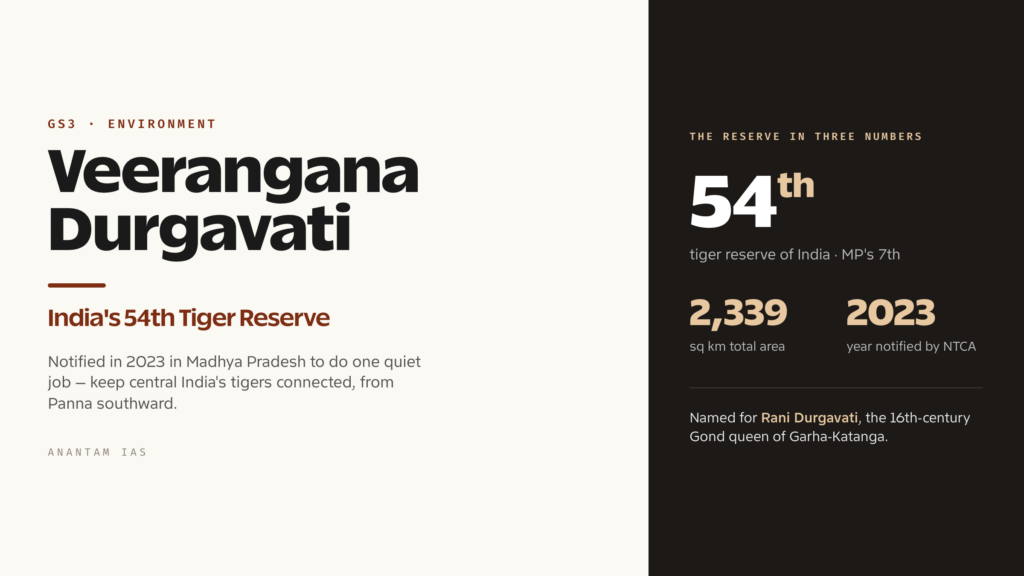
Veerangana Durgavati Tiger Reserve is India’s 54th tiger reserve, notified by the National Tiger Conservation Authority in 2023, and was Madhya Pradesh’s seventh. It spans about 2,339 sq km across the Sagar, Damoh and Narsinghpur districts, assembled mainly from the Nauradehi and Rani Durgavati wildlife sanctuaries, and exists chiefly to keep central India’s tiger populations connected. It is no longer the newest, though: Madhav National Park in Shivpuri became India’s 58th tiger reserve in March 2025, taking Madhya Pradesh’s tally to nine — the most of any state.
Pick almost any map of India’s tiger landscape and you’ll find the famous names first — Bandhavgarh, Kanha, Pench, Panna. Veerangana Durgavati doesn’t shout like those. It’s a working reserve, notified in 2023 to do one unglamorous job: keep the tigers of central India connected to each other. And that job, not its star power, is exactly why it matters.
The National Tiger Conservation Authority notified it as India’s 54th tiger reserve and Madhya Pradesh’s seventh, stitched together mainly from the old Nauradehi and Rani Durgavati wildlife sanctuaries across the districts of Sagar, Damoh and Narsinghpur. The name honours Rani Durgavati, the sixteenth-century Gond queen who died defending the kingdom of Garha-Katanga. So the reserve carries two stories at once — a conservation story about corridors and dispersal, and a regional memory about a queen who never surrendered.
What the Reserve Is and Where It Sits
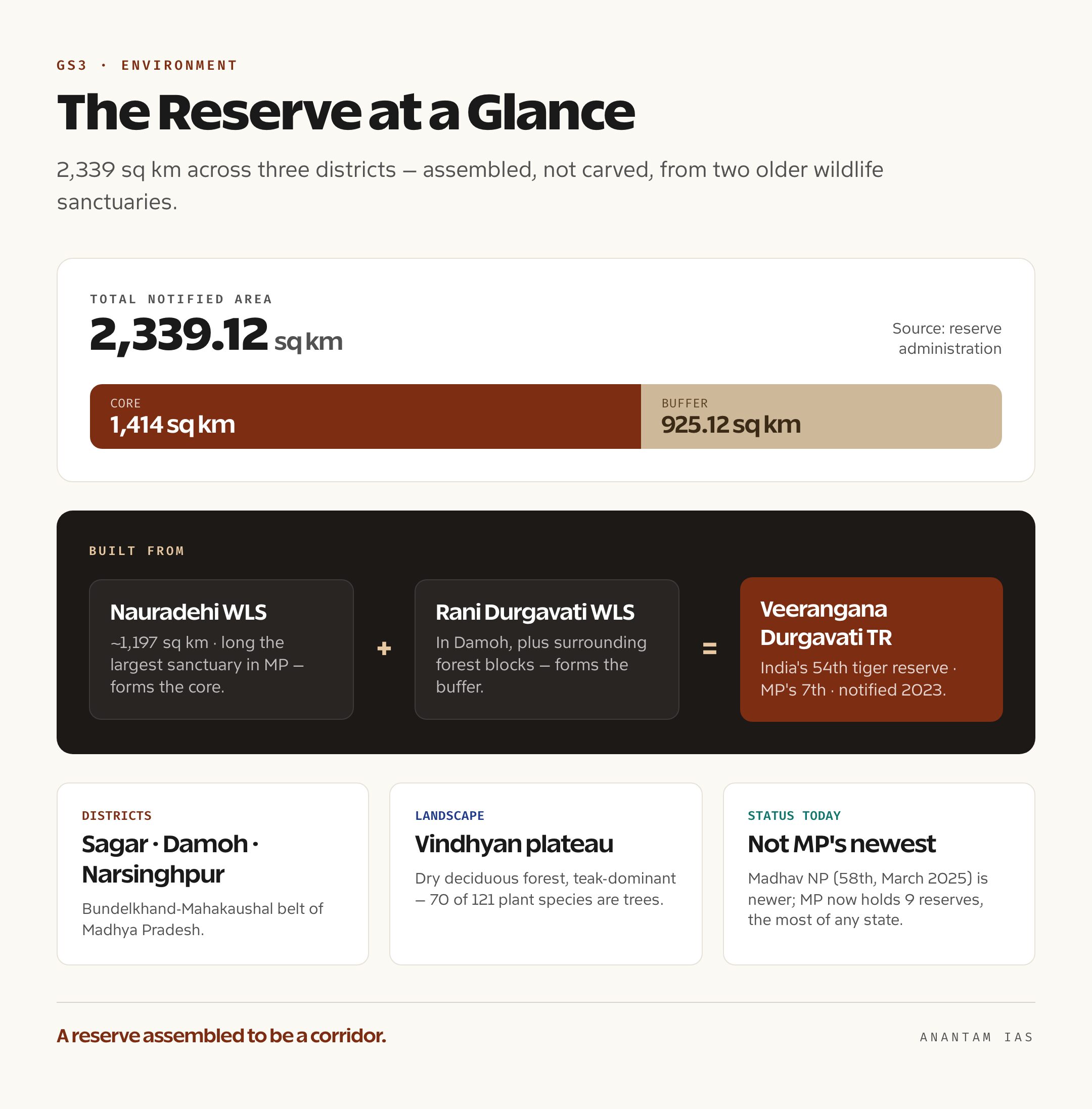
Veerangana Durgavati Tiger Reserve covers roughly 2,339 square kilometres in all — to be exact, 2,339.12 sq km, split into a 1,414 sq km core and a 925.12 sq km buffer, according to the reserve’s own administration. That makes it one of the larger tiger reserves in central India by sheer footprint, even though its tiger numbers are still building up.
It was assembled, not freshly carved out of untouched wilderness. The backbone is the Nauradehi Wildlife Sanctuary, which at about 1,197 sq km was long the largest sanctuary in Madhya Pradesh. To that the government added the Rani Durgavati (Veerangana Durgavati) Wildlife Sanctuary in Damoh and surrounding forest blocks that now form the buffer. The reserve straddles the Sagar, Damoh and Narsinghpur districts of the Bundelkhand-Mahakaushal belt, sitting on the Vindhyan plateaus of central India.
One point worth getting right, because exam questions love to trip people here. Veerangana Durgavati was the seventh tiger reserve in Madhya Pradesh and the 54th in the country when it was notified in 2023 — but it is no longer the state’s newest. In March 2025 the NTCA declared Madhav National Park in Shivpuri as India’s 58th tiger reserve, which became Madhya Pradesh’s ninth. So the correct framing today is: Durgavati is India’s 54th reserve and was MP’s seventh; Madhav is the newer arrival. Madhya Pradesh now holds nine tiger reserves in total, more than any other state.
The Queen Behind the Name
The reserve is named after Rani Durgavati, and that choice is doing real work, not just decoration. She was born in 1524 into the Chandel dynasty and married Dalpat Shah of the Gond kingdom of Garha-Katanga — the prosperous forest realm, said to have held tens of thousands of villages, that covered much of present-day Madhya Pradesh. When her husband died, she ruled as regent for her infant son, Vir Narayan, and is remembered for tanks, temples and a steady, capable administration.
Her end is the part everyone in the region knows. In 1564 Akbar’s general, Asaf Khan, marched on Gondwana with a far larger force. Durgavati fought from elephant-back and won the first engagement, but Mughal artillery turned the second. Wounded by arrows and facing capture, she took her own dagger to her own life on 24 June 1564 rather than surrender — a day still marked locally as Balidan Diwas. Naming a tiger reserve after her ties modern conservation to that older idea of defending a homeland, and it foregrounds the Gond tribal heritage that still shapes the villages around these forests. For a UPSC candidate, that’s a neat bridge between GS-I medieval history and GS-III environment.
The Landscape, Flora and Fauna
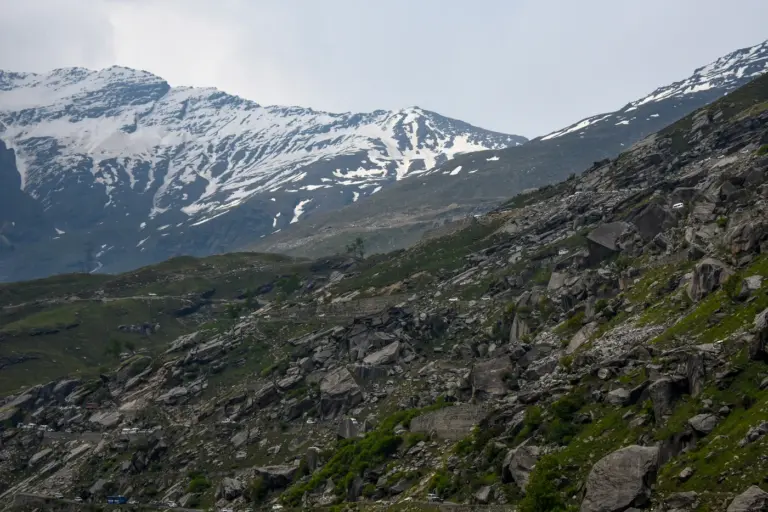
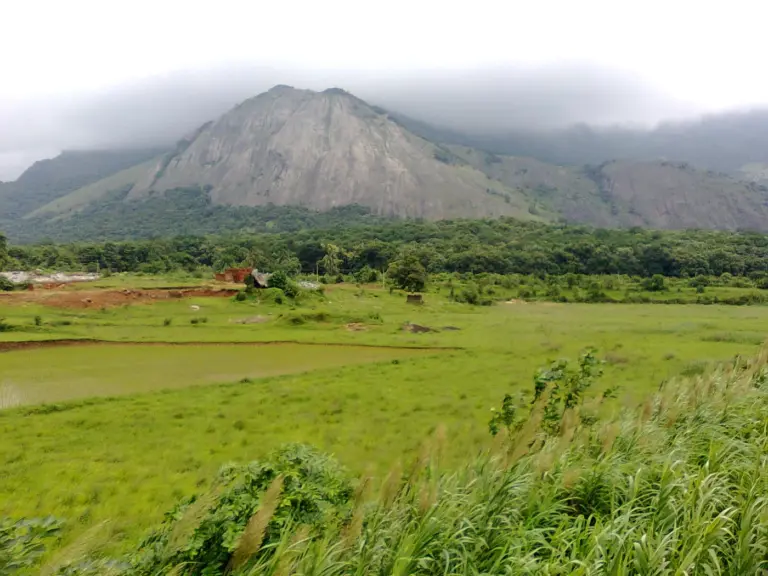
The reserve lies in the central Indian highlands, on the Vindhyan range and its plateaus, and its vegetation is classic Bundelkhand dry country — tropical mixed dry deciduous forest, with teak (Tectona grandis) the dominant tree and patches of sal, mixed with grasslands, scrub and rocky outcrops on the plateau tops. The Wikipedia entry drawing on survey data records that trees make up 70 of the 121 plant species catalogued here, which tells you how wooded the core is. Seasonal streams and small rivers thread the landscape and feed the waterholes that wildlife crowds in the dry months.
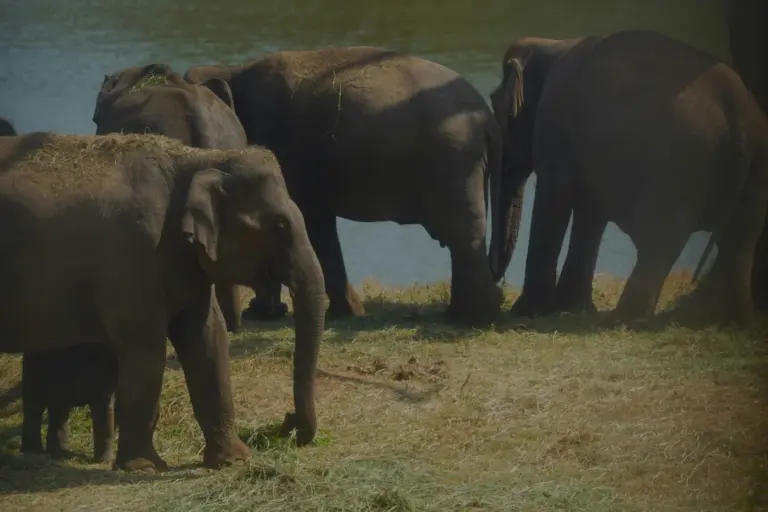
The animal list reads like a who’s who of central Indian fauna. Tigers and leopards are the headline predators, alongside the Indian wolf, striped hyena, jackal and sloth bear. Herbivores include nilgai, chinkara, chital, sambar, the four-horned antelope (chousingha) and the Indian gazelle. Surveys of the constituent sanctuaries have logged on the order of 18 mammal species, 177 birds, 16 fish and around 10 amphibians, which makes this a richer mixed-habitat reserve than its low profile suggests. The open scrub-and-grassland mosaic, in particular, is the feature that later made the reserve interesting for more than just tigers.
But the tiger story here has a recent edge to it. Nauradehi, the reserve’s core, actually lost its tigers for years before they returned — first through natural dispersal and then with help. So this isn’t a long-settled population. It’s a habitat being deliberately re-stocked and reconnected, which is precisely the point of the next section.
Why It Exists: The Panna-Durgavati Corridor
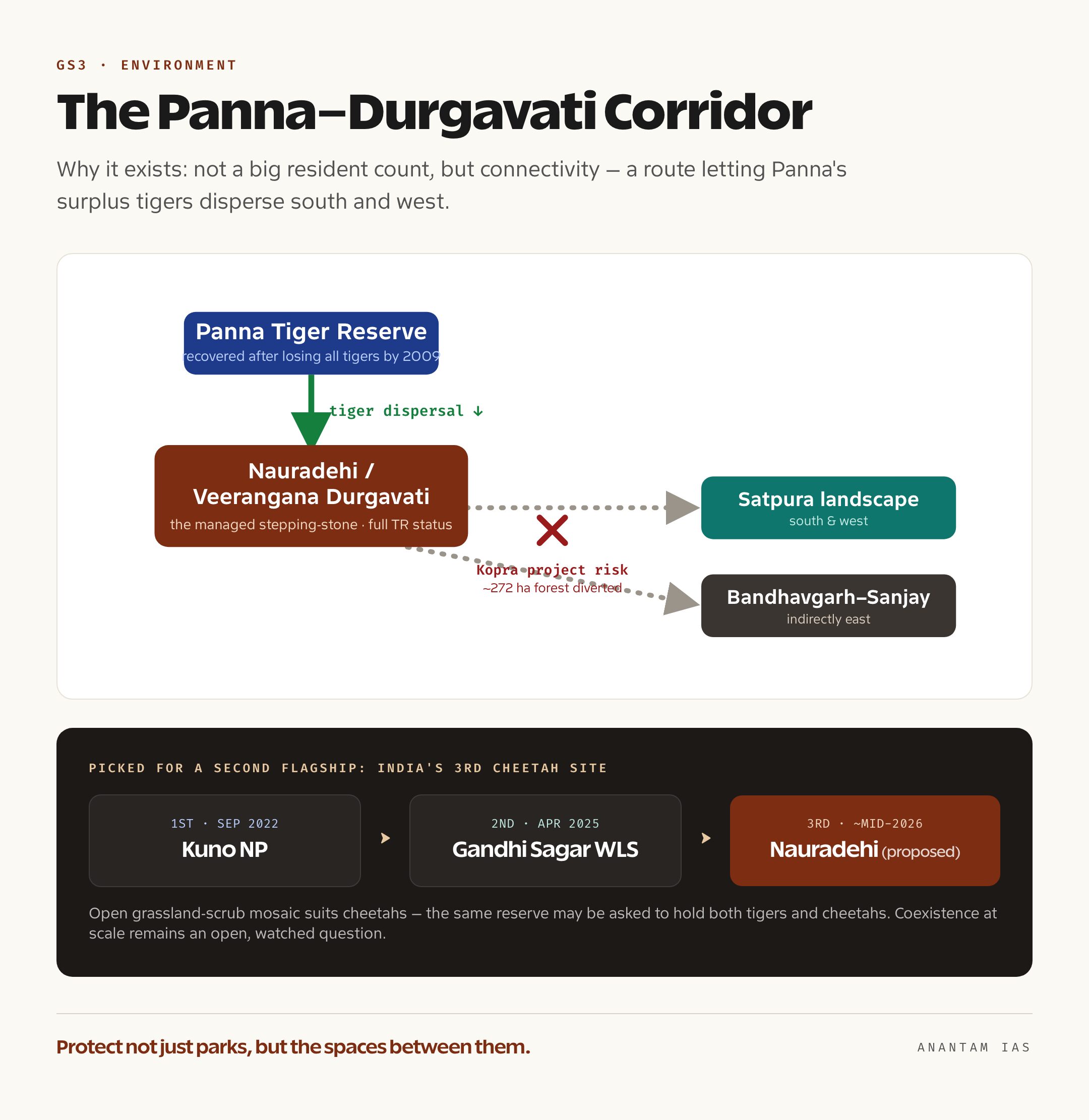
Here’s the heart of it. Veerangana Durgavati’s real value isn’t a big resident tiger count — it’s connectivity. The reserve was designed as a green corridor linking the Panna Tiger Reserve in the north to the wider central Indian tiger landscape running south and west toward Satpura, and indirectly east toward the Bandhavgarh-Sanjay forests. Tigers don’t live in islands well; isolated populations inbreed and crash. Corridors let young animals disperse, find territory and keep the gene pool mixing.
Panna makes the case vivid. That reserve famously lost all its tigers to poaching by 2009, was repopulated through reintroduction, and recovered so strongly that its surplus tigers began dispersing outward — historically straight through the Nauradehi landscape. Giving that landscape full tiger-reserve status under Project Tiger does three things: it puts the corridor under stronger legal protection, it unlocks dedicated central funding, and it creates a managed stepping-stone so Panna’s wanderers have somewhere safe to settle. A state-backed plan to develop a formal green corridor between Panna and Durgavati is meant to make that dispersal route continuous rather than a gamble through farmland and highways.
So when you read “tiger corridor,” read it literally. The reserve is infrastructure for tiger movement. Its success is measured less by how many tigers it holds than by how freely tigers can pass through it — and that is a genuinely modern, landscape-scale way of thinking about conservation, a shift from protecting parks to protecting the spaces between them.
The Cheetah Question and the Challenges Ahead
Because of that open grassland-scrub mosaic and relatively low human density, Veerangana Durgavati has been picked for a second flagship experiment. Madhya Pradesh is the focal state for Project Cheetah — the first African cheetahs arrived at Kuno National Park in September 2022, and Gandhi Sagar Wildlife Sanctuary received its first cheetahs in April 2025. The Madhya Pradesh government has cleared Nauradehi within this reserve as the state’s third cheetah site, with enclosures under construction and a release targeted for around mid-2026. If it goes ahead, the same reserve will be asked to hold both tigers and cheetahs — apex predators that historically occupy different niches, the tiger in forest, the cheetah in open country. Whether they can coexist at scale is an open, watched question.
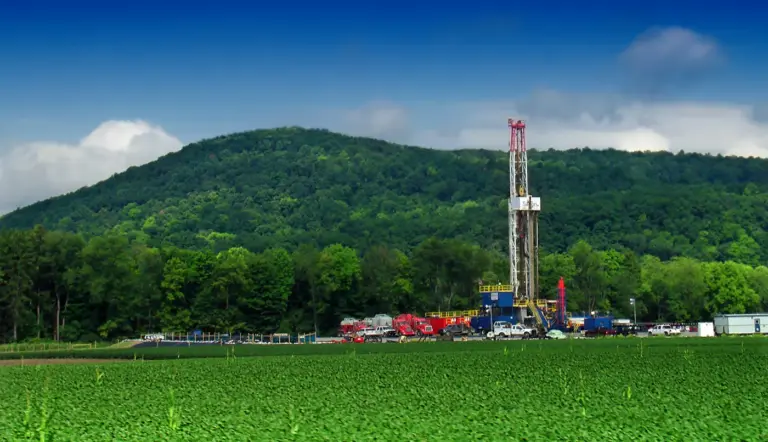
That ambition sits on top of the ordinary, hard problems of a young reserve. Village relocation from the core has to be voluntary, fair and properly compensated. The prey base needs building up before it can support more big cats. Water security in the dry Bundelkhand summer means engineered waterholes. Human-wildlife conflict simmers on the farming periphery. And the corridor itself is fragile: the Kopra irrigation project, which proposes earthen dams on the Byarma and Kopra rivers, involves diverting roughly 272 hectares of reserve forest and threatens around a dozen villages, with conservationists warning it could fragment the very Nauradehi-Panna link the reserve was created to protect. So the way forward is the standard but demanding one — finalise and fund the Tiger Conservation Plan, secure the corridor against linear infrastructure and submergence, augment prey and water, and resolve relocation with people, not against them. India’s tiger numbers have climbed to an estimated 3,682 in the 2022 All India Tiger Estimation, with Madhya Pradesh alone holding 785 and keeping its “Tiger State” crown. Reserves like Durgavati are how the country moves from counting tigers to connecting them.
For Your Mains Answer
This reserve is a clean GS-III environment example — biodiversity, conservation, and the Project Tiger and Project Cheetah programmes — with a GS-I medieval-history hook through Rani Durgavati. It also folds into questions on tribal/forest rights, the Forest Conservation Act and development-versus-conservation trade-offs. Treat it as a case study that lets you argue the bigger point about landscape-scale, corridor-based conservation rather than just listing facts.
How to Build the Answer
Open with the function, not the trivia: this reserve exists to connect tiger populations, not just to add a name to the list. Then layer in the specifics — its origin from Nauradehi and Rani Durgavati sanctuaries, the Panna corridor, the cheetah proposal, and the live threat from the Kopra project. Close on the shift from protecting parks to protecting the spaces between them. That arc — function, structure, current developments, challenge, big idea — answers almost any “discuss India’s approach to tiger/landscape conservation” prompt.
Common Mistakes to Avoid
Don’t call it India’s or MP’s “newest” tiger reserve — Madhav National Park (58th, March 2025) overtook it. Don’t confuse the reserve with the standalone sanctuary; the reserve is the larger notified unit built from several sanctuaries. Don’t overstate the cheetah plan as done — it’s under development. And don’t drown the answer in figures; two or three anchors are enough.
A Compact Answer Spine
54th tiger reserve, MP’s seventh, notified 2023 → built from Nauradehi + Rani Durgavati sanctuaries, ~2,339 sq km across Sagar-Damoh-Narsinghpur → purpose is the Panna-Durgavati corridor for tiger dispersal → proposed third cheetah site after Kuno and Gandhi Sagar → threats: Kopra irrigation diversion, relocation, prey base → way forward: secure the corridor, fund the conservation plan.
Diagram or Flowchart Idea
Draw a simple corridor sketch: a box for Panna at the top, an arrow labelled “tiger dispersal” running down through a box marked “Nauradehi / Veerangana Durgavati,” and further arrows branching toward Satpura and the Bandhavgarh-Sanjay landscape. Mark a small “X” on the corridor labelled “Kopra project risk.” It earns marks fast and makes the connectivity point visually.
A Balanced-Conclusion Line
Reserves like Veerangana Durgavati show that India’s next conservation gains lie not in more fences but in joining the ones it already has — provided development pressures like the Kopra diversion don’t sever the very corridors these reserves were created to defend.
How to Use Data Without Cramming
Pick load-bearing numbers and attribute them in-prose: “India’s 54th tiger reserve” (NTCA, 2023), “Madhya Pradesh’s 785 tigers in the 2022 estimation,” “a 1,414 sq km core in a 2,339 sq km reserve.” Naming the source as you cite it reads as command of the subject, not memorisation.
FAQ
Where is Veerangana Durgavati Tiger Reserve and how big is it? It lies in the Sagar, Damoh and Narsinghpur districts of Madhya Pradesh, in the central Indian Vindhyan highlands. It covers about 2,339 sq km in total — a 1,414 sq km core and a 925 sq km buffer — built mainly from the Nauradehi and Rani Durgavati wildlife sanctuaries.
Is it India’s or Madhya Pradesh’s newest tiger reserve? No, not anymore. It was India’s 54th tiger reserve and MP’s seventh when notified in 2023, but Madhav National Park in Shivpuri became India’s 58th tiger reserve and MP’s ninth in March 2025. Madhya Pradesh now has nine tiger reserves, the most of any state.
Why was the reserve created? Mainly to protect a corridor. It links the Panna Tiger Reserve to the wider central Indian tiger landscape, letting tigers disperse safely so populations stay genetically connected. Panna’s recovery after its tigers were wiped out by 2009 made securing this dispersal route a priority.
What is the cheetah connection? Madhya Pradesh has cleared Nauradehi, within this reserve, as the state’s third cheetah site after Kuno National Park (2022) and Gandhi Sagar (2025), with a release targeted for around mid-2026. Its open grassland-scrub mosaic suits cheetahs, though tiger-cheetah coexistence at scale remains untested.
Practice Questions
Prelims MCQs
- Veerangana Durgavati Tiger Reserve is located in which state?
(a) Chhattisgarh
(b) Madhya Pradesh
(c) Maharashtra
(d) Rajasthan.
Answer: (b) It lies in the Sagar, Damoh and Narsinghpur districts of Madhya Pradesh. - Veerangana Durgavati Tiger Reserve was carved primarily out of which sanctuary?
(a) Kuno
(b) Gandhi Sagar
(c) Nauradehi
(d) Ranthambhore.
Answer: (c) Its core is the former Nauradehi Wildlife Sanctuary, once the largest sanctuary in Madhya Pradesh. - The reserve is primarily designed to act as a tiger corridor connected to which tiger reserve?
(a) Jim Corbett
(b) Panna
(c) Sundarbans
(d) Periyar.
Answer: (b) It links the Panna Tiger Reserve to the wider central Indian tiger landscape for tiger dispersal. - Rani Durgavati, after whom the reserve is named, was a queen of which kingdom?
(a) Vijayanagara
(b) Ahom
(c) Garha-Katanga (Gondwana)
(d) Marwar.
Answer: (c) She ruled the Gond kingdom of Garha-Katanga and died fighting Akbar’s general Asaf Khan in 1564. - As per the 2022 All India Tiger Estimation, which state holds the most tigers and is called the “Tiger State”?
(a) Karnataka
(b) Uttarakhand
(c) Maharashtra
(d) Madhya Pradesh.
Answer: (d) Madhya Pradesh held an estimated 785 tigers, the highest of any state, out of India’s 3,682.
Mains Practice Questions
- “India’s next gains in tiger conservation lie not in creating more reserves but in connecting existing ones.” Critically examine this statement with reference to corridor reserves like Veerangana Durgavati. (15 marks, 250 words)
- Discuss the rationale, ecological benefits and risks of designating Veerangana Durgavati Tiger Reserve as a third habitat for reintroduced cheetahs in India. (15 marks, 250 words)
- Development projects such as the Kopra irrigation scheme increasingly collide with newly notified protected areas. Examine the trade-offs using the case of Veerangana Durgavati Tiger Reserve. (15 marks, 250 words)
- Evaluate the evolution of Project Tiger from a species-recovery programme in 1973 to a landscape-scale, corridor-based conservation strategy today. (15 marks, 250 words)
- How can the relocation of forest-dwelling communities from tiger reserve core areas be carried out in a manner that is both ecologically effective and just? Illustrate with central Indian examples. (10 marks, 150 words)
Tell Google you want more of this.
Add Anantam IAS as a preferred sourceOne tap, and this site shows up more often in your own Top Stories, AI Overviews and AI Mode. Remove it any time.