The health of women in India is at once a measure of social justice, a determinant of human capital, and a constitutional obligation under Article 21. India has cut maternal mortality from 130 per lakh live births (2014-16) to 97 (2018-20) — an 8.4% annual decline — and yet 57% of women aged 15-49 are still anaemic (NFHS-5), and the country ranks 129/146 on the Global Gender Gap Index 2024. Women's health is a UPSC GS-I (society, gender) and GS-II (health, vulnerable sections, government schemes) staple, and the syllabus increasingly demands engagement with mental health, menstrual health, non-communicable diseases, and reproductive autonomy alongside the older maternal-child health frame.
This guide walks through definitions, the sociological lens, the Indian context, the constitutional/legal anchor, government initiatives, the NFHS-5 data picture, 2024-26 challenges, and the way forward.
Defining Women's Health
The WHO defines women's health as the physical, mental, and social well-being of women — not merely the absence of disease — across the life course. Reproductive health is one component, defined by the 1994 Cairo International Conference on Population and Development (ICPD) as "a state of complete physical, mental and social well-being in all matters relating to the reproductive system, its functions and processes."
Reproductive rights include:
- The right to be informed.
- Access to safe, effective, affordable, and acceptable methods of family planning.
- Access to appropriate health services for safe pregnancy and childbirth.
- Right to a healthy infant.
But women's health is broader: it includes adolescent health, mental health, nutrition, occupational health, NCDs (cancer, diabetes, cardiovascular disease), violence-related health, and healthy ageing.
Sociological Lens
- Émile Durkheim: Health is a social fact; women's health reflects collective conscience and norms.
- Talcott Parsons: The "sick role" is socially structured; women's role conflict often delays health-seeking.
- Pierre Bourdieu: Health-seeking is conditioned by cultural capital — caste, class, education shape access.
- Amartya Sen: "Missing women" — sex-selective practices and neglect produce demographic distortion. India's sex ratio at birth has improved from 919 (NFHS-3) to 929 (NFHS-5) but remains skewed.
- Veena Das, Carolyn Sargent, Naomi Pfeffer: Feminist medical anthropology — body is the site of politics, gender, ritual.
- Jean Drèze and Sen: Capability approach — health as a foundational capability for women's freedom.
The Life-Course Framework for Women's Health
| Life Stage | Key Health Issues | Indicators |
|---|---|---|
| Infancy & childhood (0-9) | Sex selection, malnutrition, immunisation | SRB 929 (NFHS-5); under-5 mortality 32 |
| Adolescence (10-19) | Anaemia, menstrual health, child marriage, mental health | 59.1% adolescent anaemia |
| Reproductive age (15-49) | Maternal health, contraception, abortion, NCDs, IPV | MMR 97 (2018-20); CPR 66.7% |
| Older women (60+) | Osteoporosis, NCDs, dementia, widowhood, elder abuse | LASI 2020 data |
India's Context: Persistent and Emerging Challenges
1. Maternal and Child Health
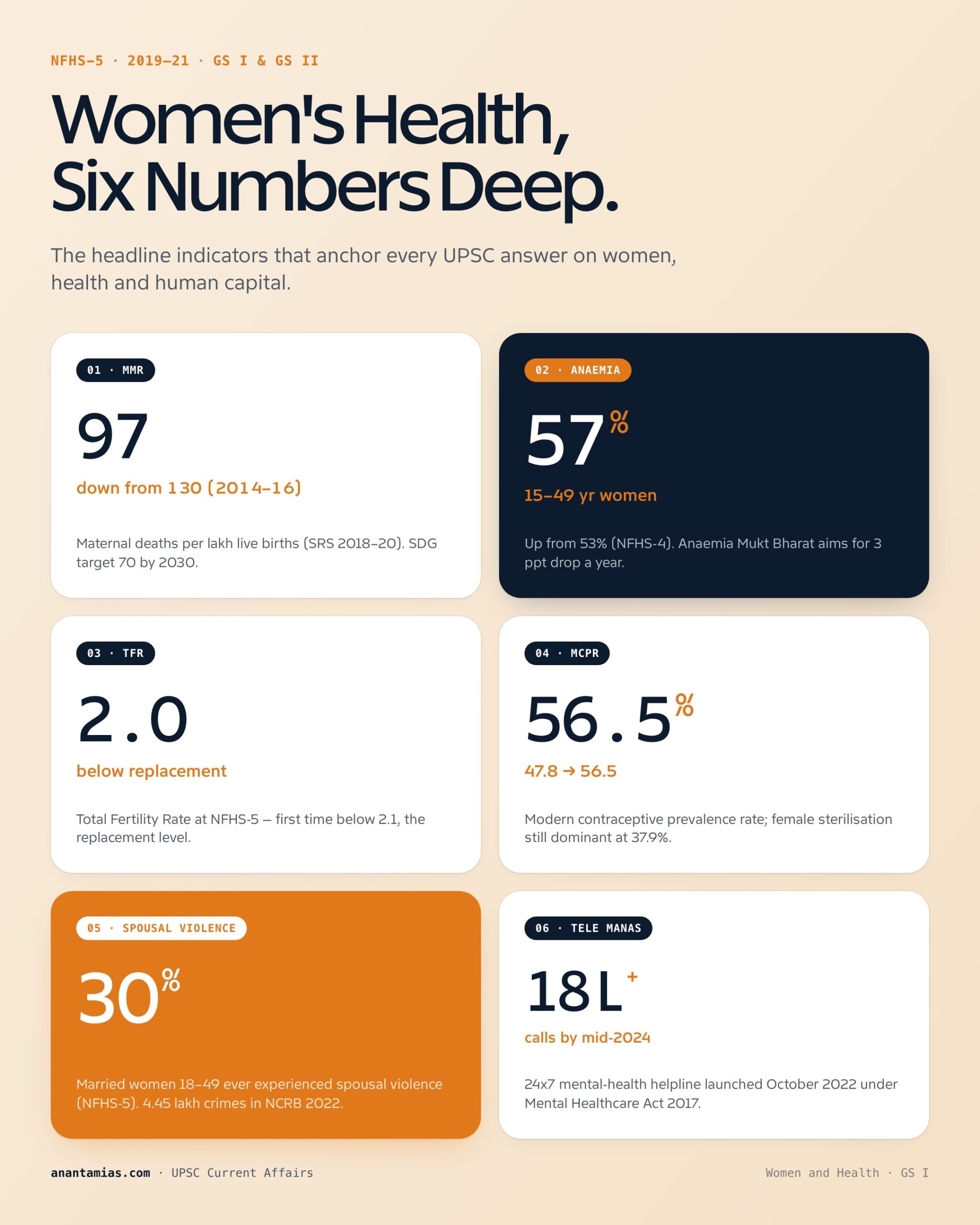
- MMR: 97 per lakh live births (SRS 2018-20) — down from 130 (2014-16). Target: SDG 70 by 2030.
- Institutional deliveries: 88.6% (NFHS-5) — up from 78.9% (NFHS-4).
- Antenatal care (4+ visits): 58.1% (NFHS-5).
- Caesarean section rate: 21.5% (NFHS-5) — well above WHO 10-15% optimum.
- Total Fertility Rate: 2.0 (NFHS-5) — below replacement for the first time.
2. Anaemia Pandemic
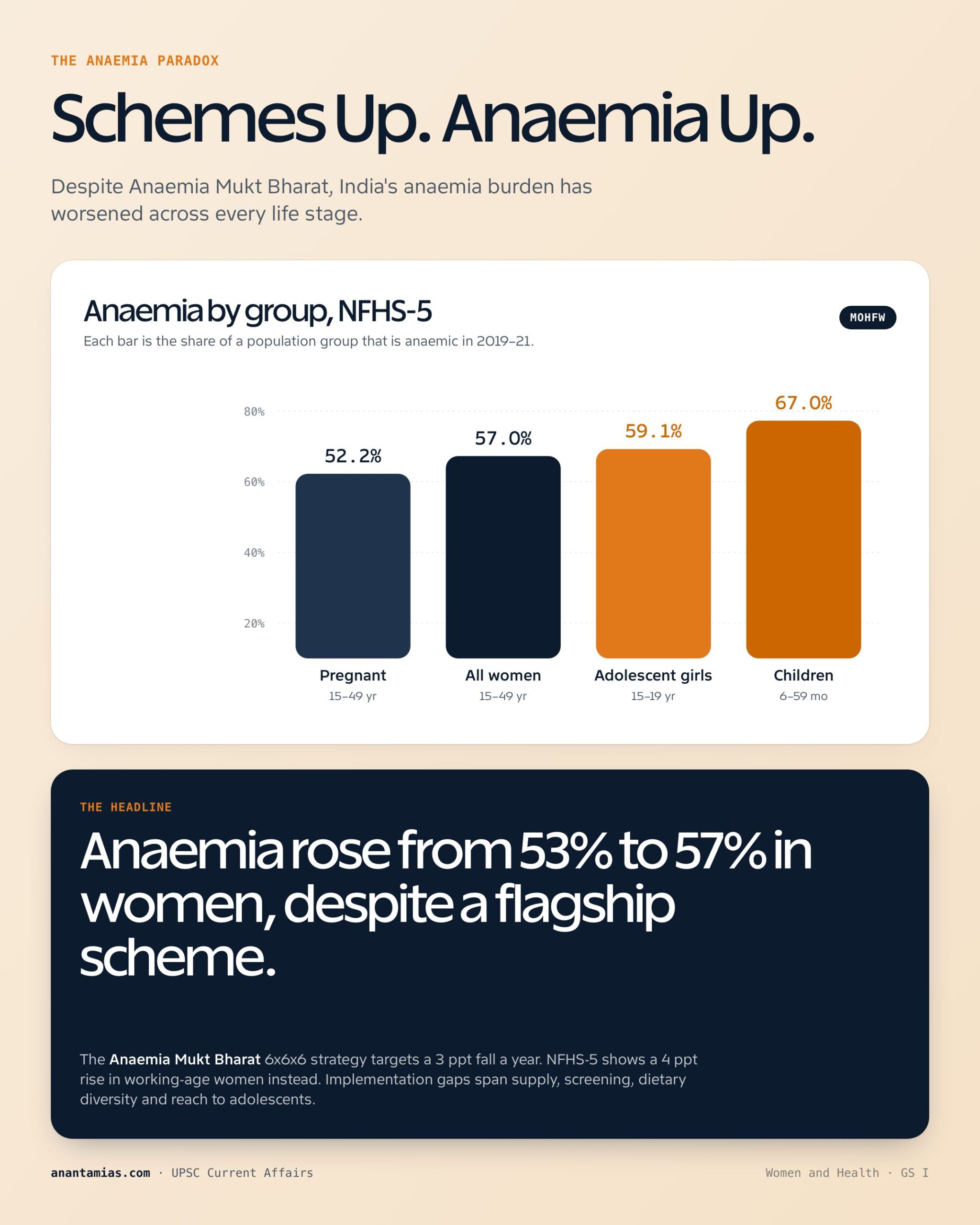
- 57% of women 15-49 anaemic (NFHS-5) — up from 53% (NFHS-4).
- 52.2% of pregnant women anaemic.
- 67% of children 6-59 months anaemic.
The Anaemia Mukt Bharat strategy (6x6x6 — six target groups, six interventions, six institutional mechanisms) aims to reduce anaemia by 3 percentage points per year.
3. Reproductive Health & Family Planning
- Modern contraceptive prevalence rate (mCPR): 56.5% (NFHS-5) — up from 47.8% (NFHS-4).
- Female sterilisation dominant (37.9%) — gender burden of contraception lies on women.
- Unmet need for family planning: 9.4% (NFHS-5).
- Medical Termination of Pregnancy (MTP) Amendment Act 2021: Extended gestation limit from 20 to 24 weeks for vulnerable categories; included unmarried women in some categories. X v. NCT of Delhi (2022 SC) extended unmarried women's right to safe abortion.
4. Adolescent Health
- 59.1% adolescent girls (15-19) anaemic.
- 23.3% women aged 20-24 married before 18 (NFHS-5) — child marriage.
- Menstrual hygiene: 64% of women 15-24 use hygienic menstrual method (NFHS-5), up from 57.6% (NFHS-4).
5. Mental Health
- National Mental Health Survey 2015-16: 13.7% lifetime prevalence — women report higher prevalence of depression and anxiety than men.
- Gender gap in mental health treatment: women face stigma, household role constraints, financial dependence.
- Mental Healthcare Act 2017 enshrined the right to mental healthcare and decriminalised suicide.
- Tele MANAS (October 2022) — 24×7 mental health helpline; over 18 lakh calls handled by mid-2024.
6. Non-Communicable Diseases (NCDs)
- Breast cancer: Most common cancer among Indian women (ICMR 2022); rising in metros.
- Cervical cancer: Second most common; HPV vaccine included in national programme (Budget 2024-25 announced rollout for 9-14-year-olds).
- Cardiovascular disease: Leading cause of female mortality.
- Diabetes: 11.9% women aged 15-49 have high blood sugar (NFHS-5).
- Obesity: 24% of women 15-49 are overweight/obese (NFHS-5) — co-existing with under-nutrition.
7. Violence and Health
- 30% of married women aged 18-49 have ever experienced spousal violence (NFHS-5).
- NCRB 2022: 4,45,256 crimes against women.
- WHO classifies intimate partner violence as a public health emergency.
8. Occupational and Environmental Health
- 41.7% female LFPR (PLFS 2023-24) — many in informal, hazardous occupations: bidi rolling, agri-pesticide exposure, domestic work.
- Indoor air pollution from biomass cooking; PMUY (Ujjwala) reaching 10.3 crore beneficiaries (2024) reduces this load.
Constitutional and Legal Framework
| Provision | Coverage |
|---|---|
| Article 14 | Equality |
| Article 15(3) | Special provisions for women & children |
| Article 21 | Right to life and dignity (incl. reproductive autonomy) |
| Article 39(a), 42, 47 | Equal pay, just/humane work, public health |
| Article 51A(e) | Renouncing practices derogatory to dignity of women |
| Maternity Benefit (Amendment) Act 2017 | 26 weeks paid leave |
| Pre-Conception and Pre-Natal Diagnostic Techniques Act 1994 | Prohibits sex-selective abortion |
| MTP (Amendment) Act 2021 | Extended abortion rights |
| POSH Act 2013 | Workplace harassment |
| Sexual Harassment of Women at Workplace (Prevention, Prohibition and Redressal) Act 2013 | |
| Surrogacy (Regulation) Act 2021 | Altruistic surrogacy |
| ART (Regulation) Act 2021 | Assisted reproductive tech |
| Mental Healthcare Act 2017 | Right to mental healthcare |
Key Judgments
- Suchita Srivastava v. Chandigarh Admn. (2009): Reproductive autonomy is part of personal liberty.
- X v. NCT of Delhi (2022): Unmarried women have right to abortion up to 24 weeks.
- Justice K.S. Puttaswamy (2017): Right to privacy includes bodily integrity, reproductive choice.
Government Initiatives
- Janani Suraksha Yojana (2005) — cash for institutional delivery.
- Janani Shishu Suraksha Karyakram (2011) — free delivery, drugs, diagnostics.
- Pradhan Mantri Matru Vandana Yojana 2.0 (2022) — ₹5,000-6,000 conditional cash for first/second child (girl).
- Pradhan Mantri Surakshit Matritva Abhiyan (2016) — 9th of every month for free ANC.
- LaQshya — labour room quality.
- Mission Indradhanush 5.0 (2023) — universal immunisation.
- POSHAN 2.0 / Saksham Anganwadi (2021) — convergence of nutrition schemes.
- Anaemia Mukt Bharat (2018).
- Beti Bachao Beti Padhao (2015, 2.0 in 2024).
- Mission Shakti (2022) — Sambal + Samarthya umbrella.
- HPV vaccine rollout announced in Union Budget 2024-25 for 9-14 year girls.
- Tele MANAS (2022) — mental health.
- PM-JAY (Ayushman Bharat 2018; renamed PMJAY-Vatsalya for senior citizens 70+ in 2024) — cashless secondary/tertiary care up to ₹5 lakh.
- PM-ABHIM (2021) — public health infrastructure ₹64,180 crore over 5 years.
NFHS-5 (2019-21) Snapshot for Women's Health
| Indicator | Value | NFHS-4 → NFHS-5 |
|---|---|---|
| MMR (SRS 2018-20) | 97 | 130 → 97 |
| Total Fertility Rate | 2.0 | 2.2 → 2.0 |
| Modern CPR | 56.5% | 47.8 → 56.5 |
| Institutional delivery | 88.6% | 78.9 → 88.6 |
| Anaemia (women 15-49) | 57.0% | 53 → 57 |
| C-section rate | 21.5% | 17.2 → 21.5 |
| Hygienic menstrual method | 64% | 57.6 → 64 |
| Spousal violence | 29.3% | 31.2 → 29.3 |
| Sex Ratio at Birth | 929 | 919 → 929 |
| Female overweight (15-49) | 24% | 20.6 → 24 |
Sociological Determinants
| Determinant | Pathway |
|---|---|
| Patriarchy | Decision-making in family, son preference |
| Caste | Dalit, Adivasi women have worst maternal indicators |
| Class | OOP expenditure pushes ~7% women into poverty annually |
| Region | Bimaru states still high MMR; Kerala, TN best performers |
| Education | Literacy directly correlates with CPR, ANC visits |
| Religion | Custom-based access barriers; tribal/Adivasi remoteness |
| Disability | Compound disadvantage in reproductive services |
2024-26 Challenges
- Anaemia paradox: rising despite schemes.
- Out-of-pocket expenditure: still 39.4% of total health spending (NHA 2019-20) — high for women's care.
- Mental health stigma: 80% treatment gap (NMHS 2015-16).
- Climate change & heat stress: pregnant women, lactating women at higher risk.
- Digital divide in tele-health: rural women under-access platforms.
- Privatisation of obstetric care: rising C-section rates.
- Triple burden: domestic work + paid work + caregiving.
- Trans health: NALSA (2014) recognised trans persons; coverage in PMJAY but capacity limited.
Way Forward
- Strengthen primary health care — Health & Wellness Centres (now Ayushman Arogya Mandirs) — 1.7 lakh+ operational by 2024.
- Convergence: NHM + Saksham Anganwadi + Jal Jeevan Mission.
- HPV vaccine scale-up (Budget 2024-25 announcement).
- Mental health parity: Tele MANAS in 36 states/UTs; integrate into NHM.
- Women community health workers: 10.5 lakh ASHAs as backbone.
- Disaggregated data: NFHS-6 (2024-25), NCRB, PLFS by gender, caste, disability.
- Address social determinants: child marriage, education, women's economic empowerment.
- Climate-resilient health infrastructure especially in tribal districts.
- Adopt Lancet Citizens' Commission on Reimagining India's Health System (2021) recommendations.
Mains Hook
"Improvements in women's health in India have been substantial in maternal mortality but uneven across nutrition, mental health, and non-communicable diseases." Critically examine in light of NFHS-5 and recent policy interventions. (GS-I/GS-II, 250 words, 15 marks)
Prelims Pointers
- MMR: 97 per lakh (SRS 2018-20).
- TFR: 2.0 (NFHS-5).
- Anaemia 15-49 women: 57% (NFHS-5).
- mCPR: 56.5% (NFHS-5).
- Cairo ICPD: 1994 — reproductive health framework.
- MTP Amendment: 2021, gestation limit 24 weeks for special categories.
- Mental Healthcare Act: 2017.
- Tele MANAS: launched October 2022.
- PMMVY 2.0: 2022.
- Anaemia Mukt Bharat: 2018, 6x6x6 strategy.
- Maternity Benefit Amendment: 2017, 26 weeks leave.
- Ayushman Arogya Mandir: 1.7 lakh+ HWCs operational.
- HPV vaccine: announced in Budget 2024-25.
- Surrogacy & ART Acts: 2021.
Women's health is the most exam-friendly intersection of GS-I (society, gender), GS-II (health policy, schemes), and GS-III (human capital, demographic dividend). UPSC answers should integrate NFHS-5 data + Article 21 jurisprudence + scheme architecture + sociological lens for full marks.
Tell Google you want more of this.
Add Anantam IAS as a preferred sourceOne tap, and this site shows up more often in your own Top Stories, AI Overviews and AI Mode. Remove it any time.