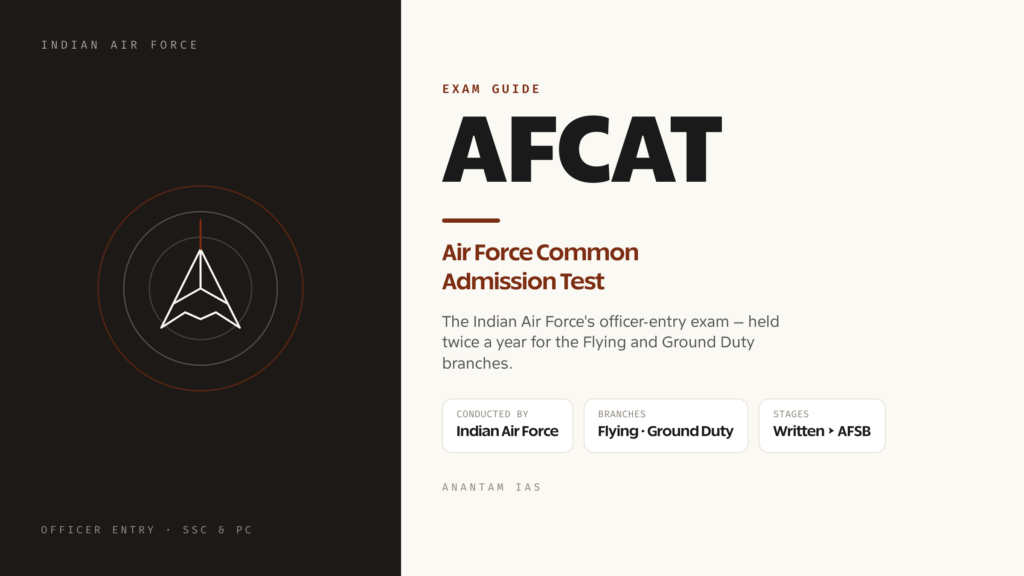
The Air Force Common Admission Test (AFCAT) is the gateway to a commission as an officer in the Indian Air Force. It’s the written entrance the IAF runs to fill its Flying branch and its Ground Duty branches — the people who fly the aircraft, engineer them, run the logistics, and keep the force in the air. If you want to wear the blue uniform without going through the National Defence Academy, AFCAT is the graduate route in.
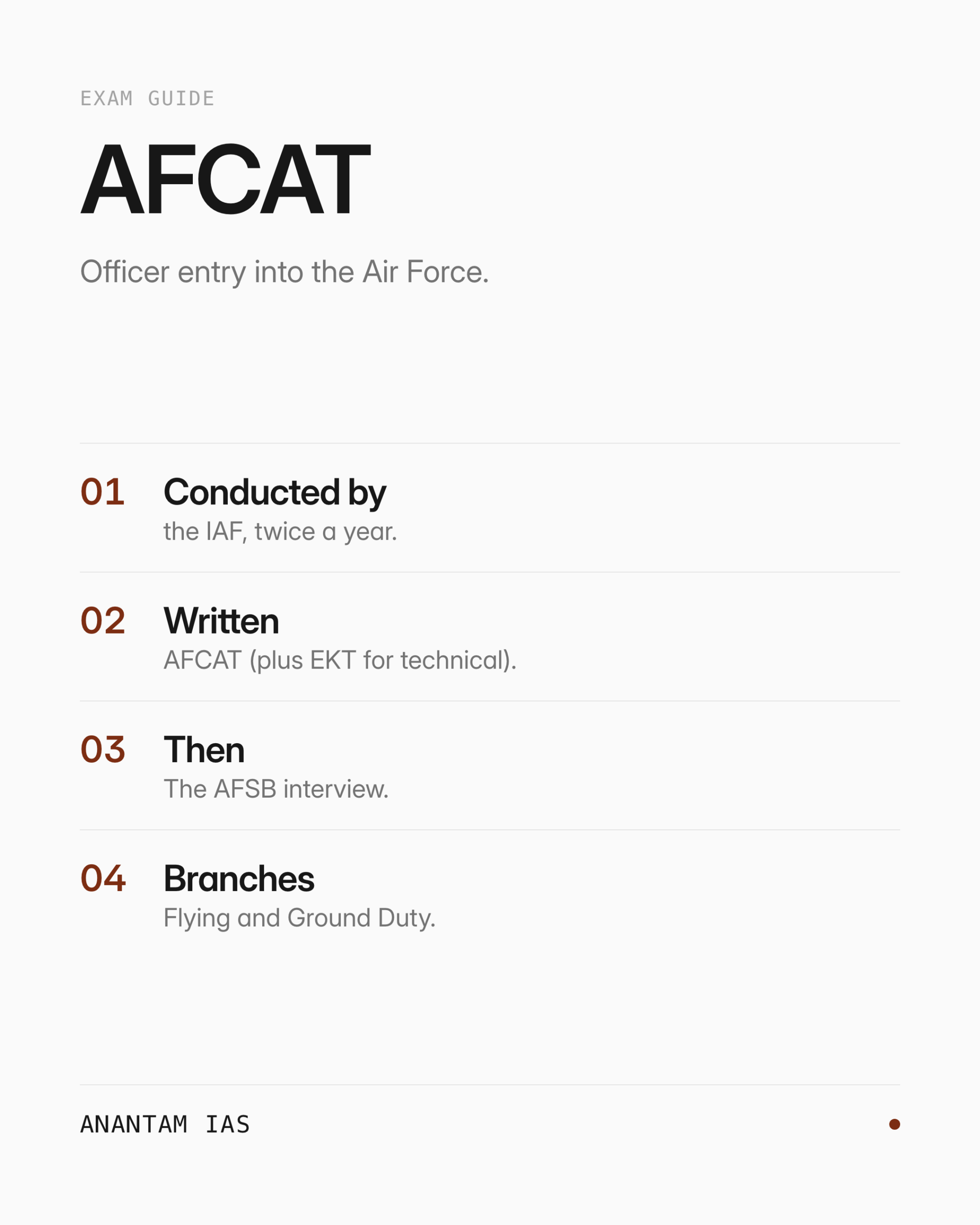
The IAF conducts AFCAT twice a year, as AFCAT 1 and AFCAT 2, so there are two chances annually to clear it. The test itself is only the first gate — clearing it earns you a call to the Air Force Selection Board, a five-day assessment that decides far more than the written marks ever do. This guide walks through the written pattern and the EKT, the AFSB and pilot-aptitude testing, eligibility across branches, the syllabus, and a study plan that holds up.
What Is AFCAT?
The Air Force Common Admission Test is the Indian Air Force’s own officer-entry examination, conducted by the IAF (with the online test delivered through C-DAC) twice a year. It recruits for a Short Service Commission across all branches, and for a Permanent Commission in the Flying branch — a Short Service Commission runs for an initial fourteen years, while a Permanent Commission is a full career to retirement. The exam opened the Flying branch to women some years ago, and current cycles invite both men and women to apply for Flying and the Ground Duty branches alike.
AFCAT feeds three officer streams. The Flying branch trains fighter, transport, and helicopter pilots. The Ground Duty (Technical) branch splits into the Aeronautical Engineering (Electronics) and (Mechanical) sub-streams — the officers who maintain and manage aircraft, avionics, and weapon systems. The Ground Duty (Non-Technical) branch covers Administration, Logistics, Accounts, Education, Meteorology, and similar specialisations that run the force’s support machinery. Technical-branch aspirants sit an extra paper, the Engineering Knowledge Test, on the same day.
Key Facts
- Conducting authority: Indian Air Force, with the online test administered through C-DAC — applications open on the careerindianairforce.cdac.in / afcat.cdac.in portal.
- Branches recruited: Flying, Ground Duty (Technical), and Ground Duty (Non-Technical), for Short Service Commission (and Permanent Commission for Flying).
- Frequency: Twice a year — AFCAT 1 (notified around December, tested around January-February) and AFCAT 2 (notified mid-year, tested around August-September).
- Scale of competition: Lakhs of candidates register each cycle against a few hundred vacancies, with the Flying branch carrying the fewest seats and the toughest medical bar.
AFCAT Exam Pattern
AFCAT runs as a single online objective test, followed — for technical candidates only — by the Engineering Knowledge Test. There’s no separate “Prelims and Mains” structure as in UPSC; the written exam is one paper that screens you for the AFSB, and the real multi-stage assessment happens at the selection board. The marking is generous on correct answers and punishing on wrong ones, so accuracy beats reckless attempting.
Written Test (AFCAT Paper)
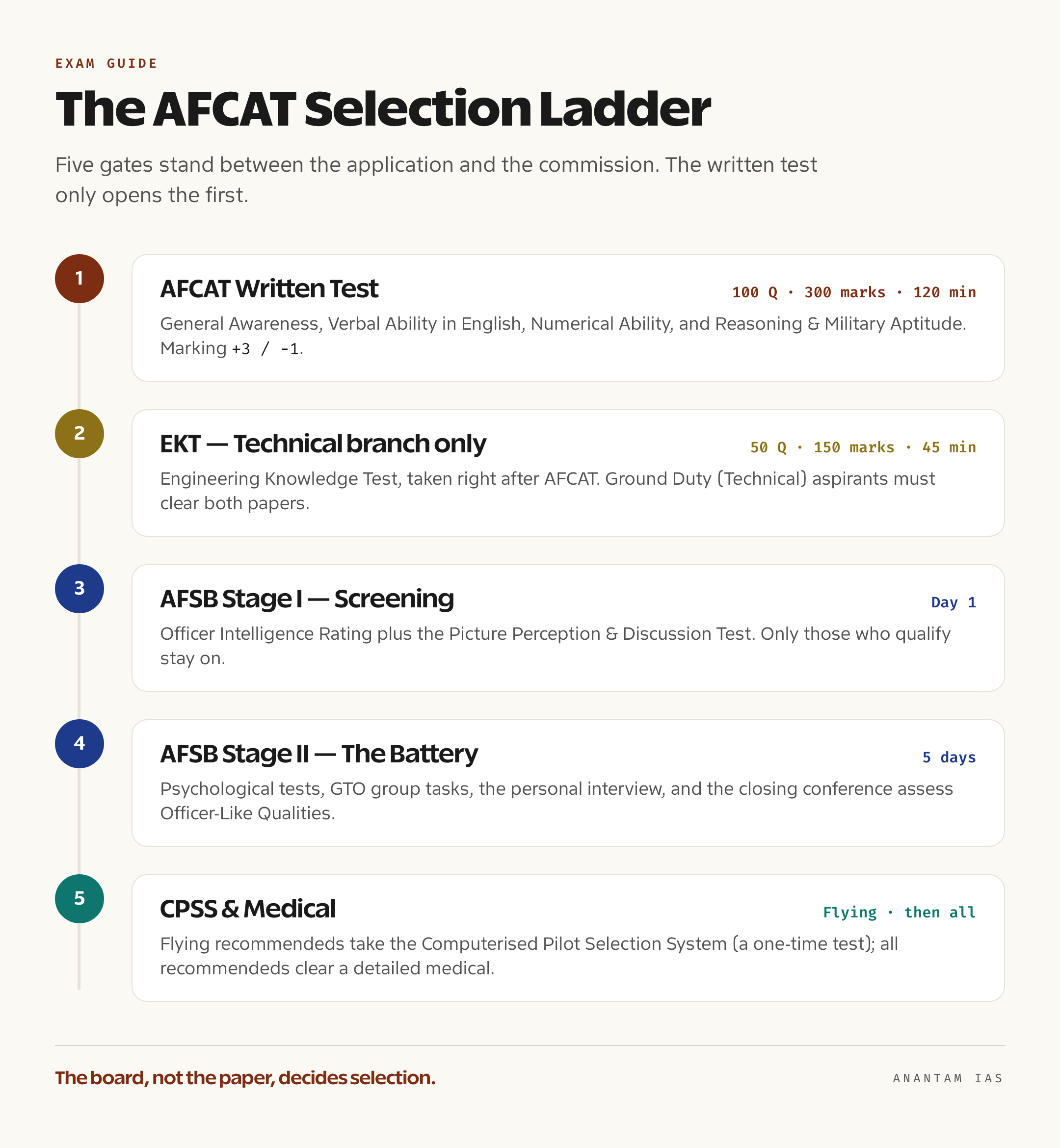
The AFCAT paper has 100 questions for 300 marks across a two-hour (120-minute) window, with no sectional time limit — you can move through the four sections in any order. The questions span four areas: General Awareness, Verbal Ability in English, Numerical Ability, and Reasoning and Military Aptitude. In recent cycles the spread runs roughly to 30 English questions, 25 each in General Awareness and Reasoning, and 20 in Numerical Ability, though the IAF doesn’t bind itself to a fixed split. The marking scheme is +3 for every correct answer and −1 for every wrong one, with nothing deducted for an unattempted question — so this negative marking is the single biggest reason to guess only when you can narrow the options.
EKT (Engineering Knowledge Test)
Candidates applying for the Ground Duty (Technical) branch sit a second paper immediately after the AFCAT test — the Engineering Knowledge Test, 50 questions for 150 marks in 45 minutes, with the same +3/−1 marking. The EKT checks core engineering fundamentals plus the discipline-specific knowledge for the chosen sub-stream (Computer Science, Electronics and Communication, Electrical, or Mechanical). You have to clear both the AFCAT and the EKT to be considered for the technical branch; flying and non-technical aspirants skip the EKT entirely.
AFSB Interview
Clearing the written cut-off earns a call to the Air Force Selection Board (AFSB) — a five-day assessment modelled on the SSB, held at centres such as Dehradun, Mysuru, Gandhinagar, Varanasi, and Kanchrapara. Stage I, on day one, is a screening filter — an Officer Intelligence Rating test plus a Picture Perception and Discussion Test (PPDT); only those who qualify stay on. Stage II, spread across the following days, is the full battery: a psychological test, the Group Testing Officer (GTO) outdoor and group tasks, and a personal interview, closed by a conference. Flying-branch recommendeds then take the Computerised Pilot Selection System (CPSS) — the successor to the older Pilot Aptitude Battery Test (PABT) — which screens raw flying aptitude and is a one-time, pass-or-fail test. Recommended candidates finish with a detailed medical examination before any merit list is drawn.
AFCAT Eligibility
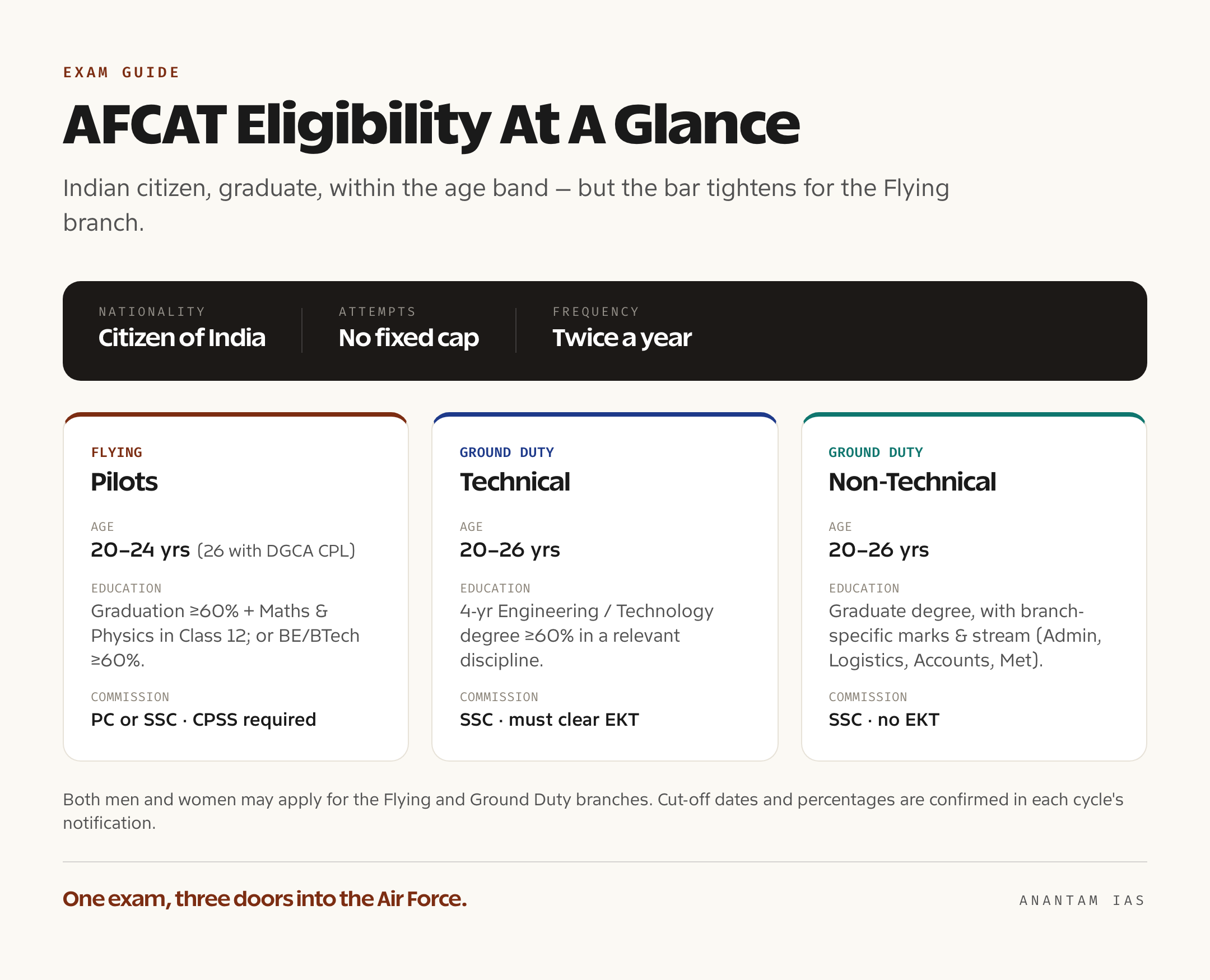
AFCAT eligibility turns on four things — citizenship, age, marital status, and your degree — and the bars differ by branch. The Flying branch sets the narrowest age window and the steepest medical standard; the Ground Duty branches are more forgiving on both.
You must be a citizen of India. The age limits are calculated as on a cut-off date in the year the course begins: the Flying branch runs 20 to 24 years, extendable to 26 for holders of a valid DGCA commercial pilot licence, while both Ground Duty branches run 20 to 26 years. Candidates are normally unmarried at entry. On education, the Flying branch needs a minimum three-year graduation with at least 60 per cent, plus a pass in Maths and Physics at the Class 12 level (a BE/BTech with 60 per cent also qualifies); the Ground Duty (Technical) branch needs a four-year engineering or technology degree with 60 per cent in the relevant discipline, again with Maths and Physics at Class 12; and the Ground Duty (Non-Technical) branch needs a graduate degree, with branch-specific marks and, for some specialisations like Accounts or Meteorology, a relevant stream. Unlike UPSC, AFCAT sets no fixed cap on attempts — you can keep appearing as long as you’re within the age and qualification bar. Always confirm the exact cut-off dates and percentages in the specific notification, since the IAF revises them between cycles.
AFCAT Syllabus
The AFCAT syllabus is broad rather than deep — it samples school-and-college-level English, aptitude, reasoning, and general knowledge instead of any one specialist subject. There’s no separate Prelims and Mains syllabus; the four written sections below are the whole written exam, and the EKT adds an engineering layer for technical candidates only.
Written Syllabus (Four Sections)
General Awareness is the widest net — history, geography, civics, art and culture, environment and ecology, Indian polity and economy, basic science, sports, current national and international affairs, and, importantly, defence and IAF-specific general knowledge. Verbal Ability in English tests comprehension, error detection, sentence completion, synonyms and antonyms, the cloze test, idioms and phrases, analogies, sentence rearrangement, and one-word substitution. Numerical Ability stays at roughly Class 10 level — decimals and fractions, simplification, percentages, average, ratio and proportion, profit and loss, simple interest, time-speed-distance, and the area of basic shapes. Reasoning and Military Aptitude covers verbal and non-verbal reasoning — analogies, pattern and series completion, rotated and embedded figures, and spatial-aptitude items that lean toward the kind of visual-reasoning a future officer needs.
EKT Syllabus
The Engineering Knowledge Test syllabus has a common engineering-fundamentals block — engineering mathematics, engineering physics, and engineering drawing — plus a specialist block for the candidate’s chosen sub-stream. The Computer Science stream covers analog and digital electronics, computer networks, and information technology; Electronics and Communication adds telecommunication and antenna systems; Electrical and Electronics covers control engineering and electrical machines; and Mechanical covers thermodynamics, fluid mechanics, and the theory of machines. Only Ground Duty (Technical) aspirants need this section.
AFCAT Preparation Strategy
AFCAT rewards a layered approach — build speed in the three aptitude-heavy sections, keep a running current-affairs file for General Awareness, drill past papers under the clock, and treat AFSB preparation as a parallel track from day one, not an afterthought. Here’s the sequence that works.
Build Speed In English, Numerical And Reasoning
These three sections carry the bulk of the 300 marks and reward practice more than knowledge. Run timed sets daily — vocabulary and grammar for English, the Class 10 arithmetic shortcuts for Numerical Ability, and figure-series and spatial drills for Reasoning. Because the +3/−1 marking punishes wrong answers, train yourself to skip a question you can’t narrow to two options rather than gamble blind.
Keep A Current-Affairs And Defence File
General Awareness is where most candidates leak marks, and it leans noticeably toward defence — IAF aircraft and operations, ranks and structure, exercises, and recent inductions. Build a running file from a daily newspaper and a monthly current-affairs digest, and add a defence layer the way you’d track any beat. Our guide to the Indian Air Force ranks and hierarchy is a quick way to lock down the insignia and structure questions that recur in this section.
Work The Past Papers Under The Clock
Previous AFCAT papers are the single best guide to its difficulty and question style — the IAF repeats themes, especially in reasoning and defence GK. Solve every available year as a full two-hour mock, then review your wrong answers to find the patterns. Technical aspirants should run a parallel set of EKT mocks so the extra 45-minute paper doesn’t ambush them on exam day.
Prepare For The AFSB From Day One
The written test is only the gate; the AFSB decides selection. Start working on the psychological tests, the Thematic Apperception and Word Association exercises, group-discussion fluency, and physical fitness for the GTO ground tasks well before your results arrive. Officer-Like Qualities can’t be crammed in the week before — they’re built over months. If you’re comparing the officer-entry routes into the armed forces, our CDS syllabus guide shows how the Combined Defence Services exam runs its own SSB on much the same lines.
Revise In Tightening Loops
In the final fortnight, stop adding new material and revise what you have in tightening loops — formula sheets for the quant and reasoning sections, your current-affairs and defence notes, and EKT fundamentals for technical candidates. The aspirant who revises three times beats the one who read three times as much once.
Branches, Training and Career
A clearance through AFCAT and the AFSB leads to officer training, not a desk posting. Selected candidates report to the Air Force Academy at Dundigal near Hyderabad for pre-commission training — roughly 74 weeks for the Flying and Technical branches and around 52 weeks for the Non-Technical branch — after which they’re commissioned as Flying Officers. Flying-branch trainees then move on to specialised flying training on the IAF’s trainer fleet before streaming to fighters, transports, or helicopters.
The career ladder climbs through Flying Officer, Flight Lieutenant, Squadron Leader, Wing Commander, Group Captain, and on toward the Air-rank flag officers — a structure our Indian Air Force ranks and hierarchy guide maps in full. Pay follows the defence pay matrix with the Military Service Pay component, flying and technical allowances, and the usual armed-forces benefits. The Flying branch offers a Permanent Commission to retirement; the Ground Duty branches enter on a Short Service Commission of fourteen years, with later chances to convert to a Permanent Commission in eligible streams. To see where AFCAT sits among India’s wider officer-entry routes, read our overview of the different types of government exams.
Frequently Asked Questions
Is AFCAT tougher than NDA or CDS?
They test different stages of life rather than different difficulty levels. NDA is a post-Class-12 entry, CDS and AFCAT are graduate entries, and AFCAT’s written paper is widely seen as moderate — broad general knowledge and Class-10 aptitude rather than deep subject expertise. What makes AFCAT genuinely hard is the funnel after the written test: the five-day AFSB and, for flying, the one-time CPSS, where the large majority of qualified candidates are screened out.
Can women apply for the AFCAT Flying branch?
Yes. The Indian Air Force opened the Flying branch to women, and current AFCAT cycles invite both men and women to apply for Flying as well as the Ground Duty (Technical and Non-Technical) branches. Women officers in the Flying branch fly fighters, transports, and helicopters alongside their male counterparts.
How many times can I attempt AFCAT?
There’s no fixed cap on the number of attempts — AFCAT is held twice a year, and you can keep appearing as long as you stay within the age limit for your branch (20-24 years for Flying, 20-26 for Ground Duty) and meet the educational bar. The practical limit is the age window, not an attempt count.
What is the EKT and who has to take it?
The Engineering Knowledge Test is a second written paper — 50 questions for 150 marks in 45 minutes — taken immediately after the AFCAT test, but only by candidates applying for the Ground Duty (Technical) branch. It checks engineering fundamentals plus your chosen sub-stream, and you must clear both AFCAT and EKT to be considered. Flying and Non-Technical aspirants don’t sit it.
Tell Google you want more of this.
Add Anantam IAS as a preferred sourceOne tap, and this site shows up more often in your own Top Stories, AI Overviews and AI Mode. Remove it any time.