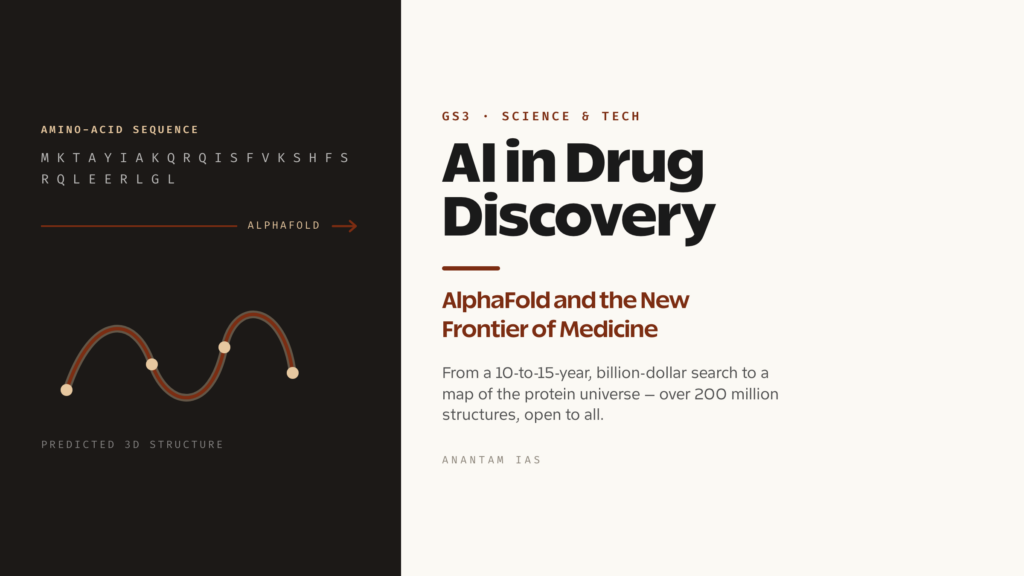
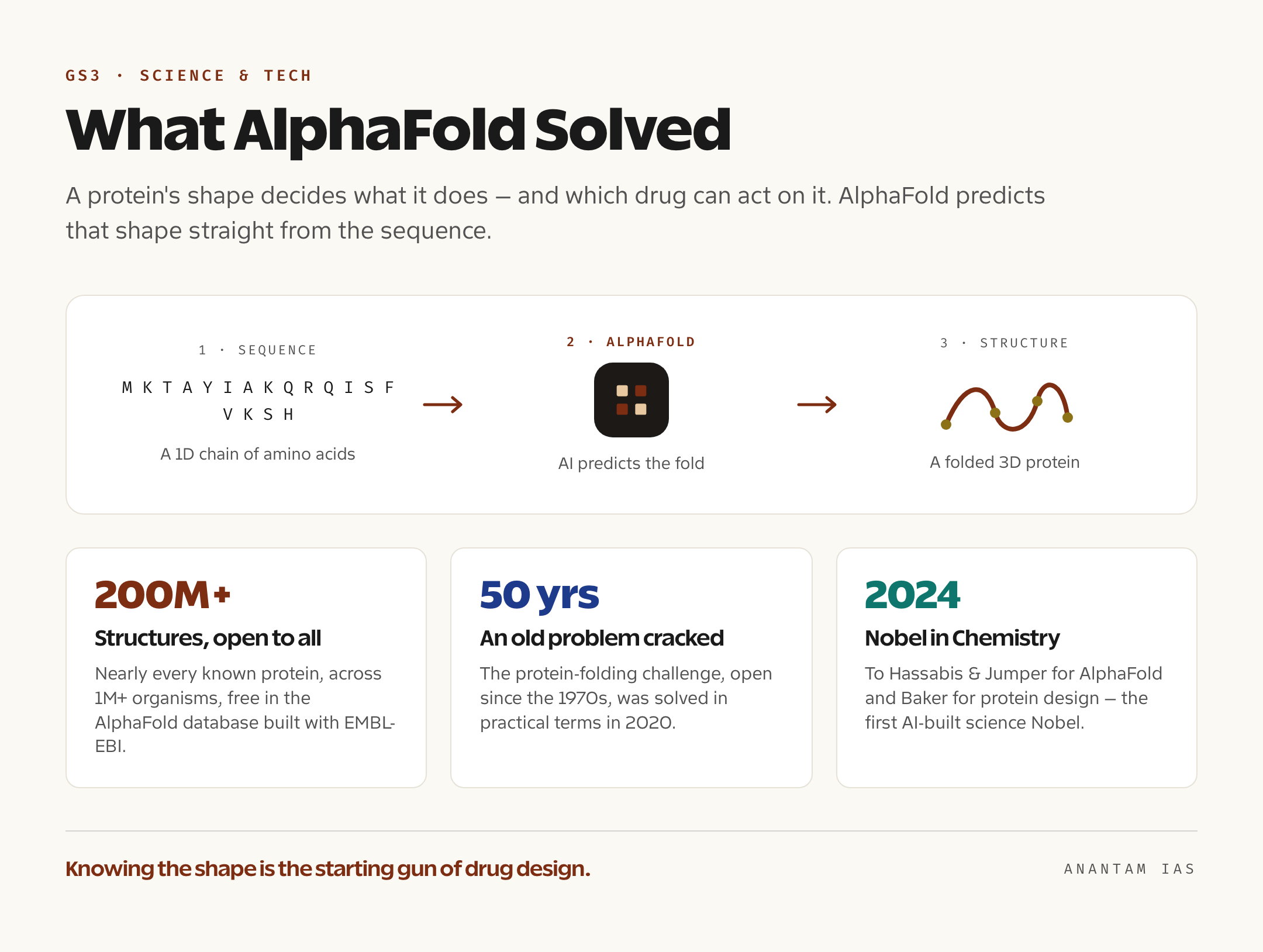
For half a century, one question quietly defended the gates of biology: given a chain of amino acids, what shape will it fold into? Proteins are the machines of life, and a protein’s shape decides what it does — and which drug can switch it on or off. Working that shape out in the lab could take a doctoral student years per protein. Then, in 2020, an AI system called AlphaFold did it in hours, for almost any protein, with accuracy that rivalled the slow experimental methods. In October 2024 the work won the Nobel Prize in Chemistry — the first time a breakthrough built on artificial intelligence took the world’s most prestigious science award. The 50-year protein-folding problem was, in practical terms, solved.
That single advance sits at the heart of a larger shift that should matter to every UPSC aspirant tracking science and technology. Drug discovery has been one of the slowest, costliest and most failure-prone activities humans attempt — and AI is now compressing each stage of it. For a country like India, the “pharmacy of the world” that still imports most of its new molecules and bulk drug inputs, the stakes are not academic. AI in drug discovery touches the GS3 themes of indigenous innovation, intellectual property, health security and emerging technology all at once, and it rewards a candidate who can explain not just the hype but the hard limits underneath it.
Why Drug Discovery Was So Slow, So Costly and So Prone to Failure
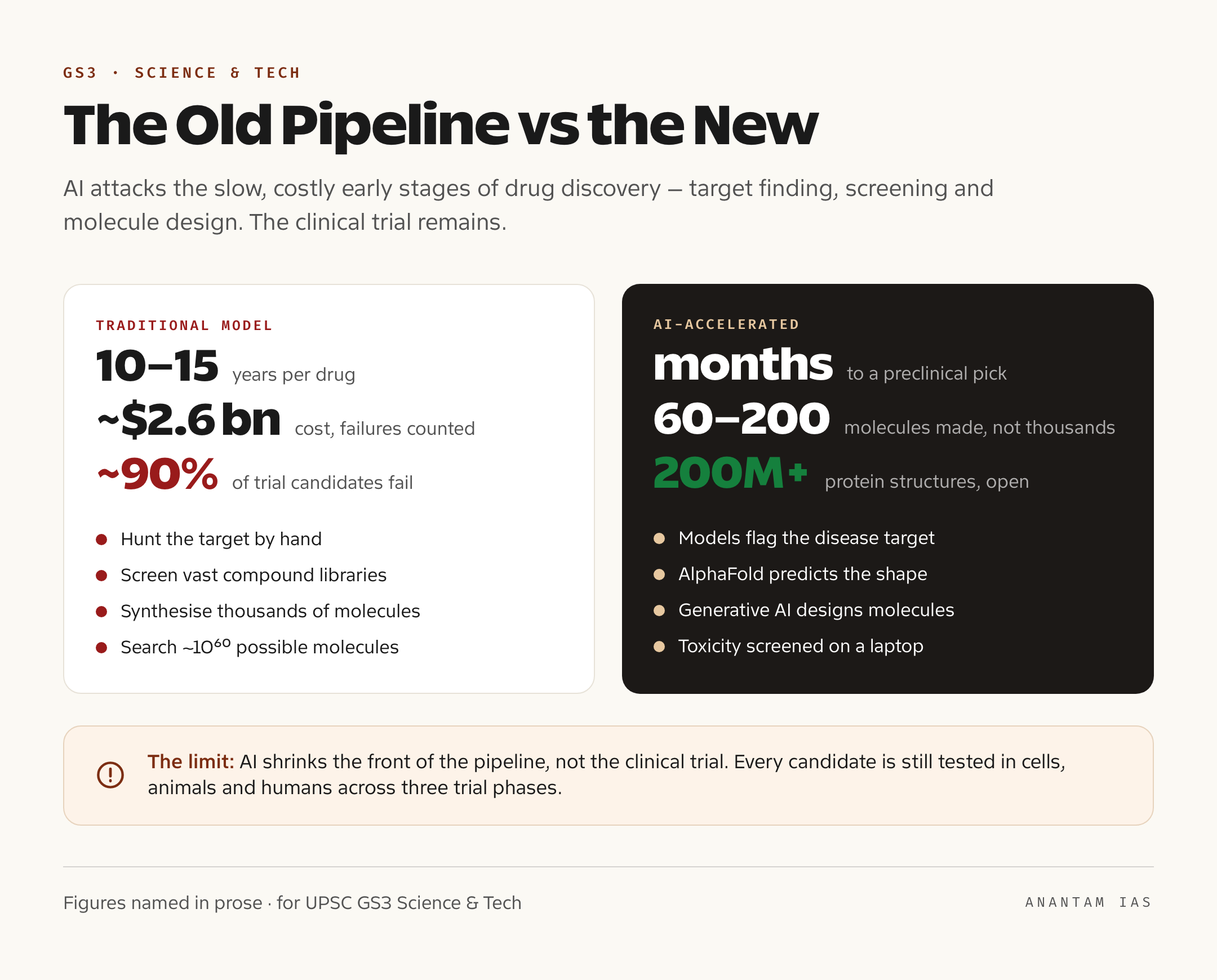
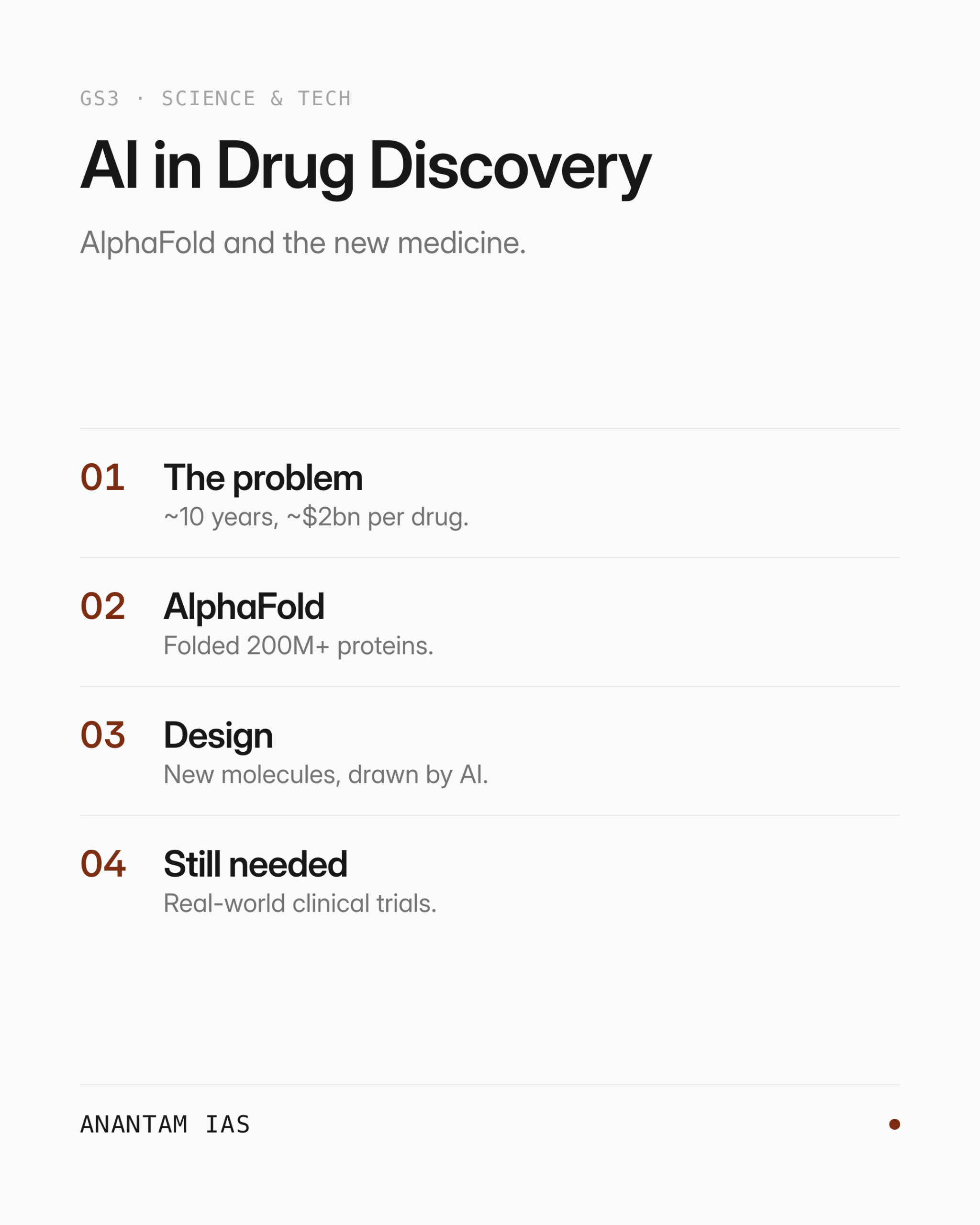
Start with the problem AI is trying to fix, because the scale of it explains everything that follows. Bringing one new medicine from idea to pharmacy shelf has typically taken about 10 to 15 years and, by the most widely cited industry estimate, around $2.6 billion when the cost of all the failures along the way is counted in. That money does not buy certainty. Roughly nine out of ten drug candidates that enter human clinical trials fail before approval — about 40 to 50 per cent of them because the drug simply does not work well enough, around 30 per cent because it proves too toxic, and the rest for poor drug-like behaviour in the body or weak commercial logic. It is one of the worst success rates in any field of engineering.
Why so brutal? The pipeline is a long relay of distinct stages, and a stumble at any one ends the race. First comes target identification — finding the specific protein or gene in the body whose malfunction drives a disease. Then hit discovery — screening enormous libraries of chemical compounds to find a few that bind to that target. Then lead optimisation — chemically tweaking those hits, molecule by molecule, to make them more potent and safer, a craft that can mean synthesising thousands of compounds by hand. Then preclinical testing in cells and animals, and finally the three phases of human clinical trials. The chemical space a drug hunter is searching is almost unimaginably vast — the number of small, drug-like molecules that could in principle exist runs to something like 10 to the power of 60, far more than there are atoms in the solar system. Searching that haystack by trial and error, one synthesised needle at a time, is exactly why the old model is so slow.
How AI Changes the Game, Stage by Stage
AI does not replace the pipeline — it attacks each slow stage with pattern-recognition at a scale no human team can match. The clearest victory is in protein structure. AlphaFold, built by Google DeepMind, learns from the tens of thousands of protein structures painstakingly solved over decades and predicts the folded shape of a new protein straight from its amino-acid sequence. Its 2024 Nobel, shared by Demis Hassabis and John Jumper of DeepMind together with David Baker of the University of Washington for the related work of designing entirely new proteins, recognised exactly this. The practical payoff lives in the AlphaFold Protein Structure Database, built with Europe’s EMBL-EBI, which now offers free, open access to more than 200 million predicted structures — covering very nearly every protein known to science, across more than a million organisms. Work that “would take hundreds of millions of years” of lab time, as DeepMind put it, is now a search-box query, and the database has been used by over two million researchers in 190-plus countries. Knowing a target protein’s shape is the starting gun of drug design, and AI handed it to the whole world at once.
From there AI reshapes the rest of the chain. In target identification, models trained on genomics and disease data sift through biological networks to flag which proteins are worth pursuing. In what is called generative chemistry or de novo molecule design, AI does the reverse of screening: instead of testing a fixed library, it invents new candidate molecules from scratch, generating chemical structures tuned to bind a given target — the same generative principle that powers today’s text and image models, redirected at chemistry. (For the underlying technology, see our explainer on generative AI and large language models.) AI also speeds virtual screening, computationally ranking millions of compounds before a single one is made, and it predicts ADMET — a drug’s absorption, distribution, metabolism, excretion and toxicity — early, so candidates likely to poison the liver are killed on a laptop rather than in a costly trial.
The proof is no longer theoretical. The clearest milestone comes from Insilico Medicine, whose drug rentosertib (earlier ISM001-055) — a treatment for the lung-scarring disease idiopathic pulmonary fibrosis — had both its biological target and its molecule discovered using generative AI, and then reported genuinely positive results in a Phase IIa human trial published in Nature Medicine. The company says its AI-designed candidates have moved from project start to a preclinical pick in roughly 12 to 18 months, synthesising only about 60 to 200 molecules per project rather than thousands. DeepMind, for its part, spun off a dedicated drug venture, Isomorphic Labs, and its newer AlphaFold 3 predicts not just protein shapes but how proteins lock together with the small molecules, DNA and RNA that drugs must engage. The direction of travel is unmistakable: faster, cheaper, and far more candidates explored.
The Limits: Why AI Has Not Abolished the Clinical Trial
But the honest answer — and the one that earns marks — is that AI has shrunk the front of the pipeline, not the whole of it. A predicted protein structure is a hypothesis, not a fact; AlphaFold is strikingly accurate for many proteins yet shakier for flexible, disordered or membrane-bound ones, and it tells you a static shape, not how that machine actually moves and behaves inside a living cell. A molecule an algorithm calls promising still has to be physically synthesised, tested in cells, then in animals, and then — unavoidably — in humans across the three phases of clinical trials that consume most of a drug’s decade-and-a-billion. AI can make a better bet at the casino; it cannot skip the game. Biology’s sheer complexity, the gulf between a cell in a dish and a whole human body, means the ultimate test of safety and efficacy remains slow, expensive and human.
The deeper constraint is data. AI is only as good as what it learns from, and biomedical data is often scarce, messy, biased toward well-studied diseases, and locked inside proprietary corporate silos. Models trained mostly on data from one population may predict poorly for another — a real risk for India’s diverse genetics. There is a genuine risk of hype, too: a candidate that looks brilliant in silico can still fail in the body, and a wave of money has poured in faster than long-term clinical results have come out. And the technology raises hard governance questions — who owns an AI-invented molecule, how a regulator validates a black-box prediction, and how to stop the same generative tools being misused to design toxins. So the realistic verdict is the balanced one: AI is a powerful accelerator of the riskiest, slowest early stages, a genuine breakthrough — but not yet a shortcut past the clinic.
India’s Stake: From Generic Powerhouse to Drug Innovator
For India, this is where opportunity and anxiety meet. India is the world’s largest supplier of generic medicines by volume — the “pharmacy of the world” — yet it has historically been a copier of off-patent drugs rather than an inventor of new ones, and it still imports a large share of the active pharmaceutical ingredients its factories depend on. AI offers a rare leapfrog: the chance to move up the value chain into discovering novel molecules without first building the multi-billion-dollar lab infrastructure the West spent decades on. The raw ingredients are falling into place. India has a deep pool of computing and software talent, a vast pharmaceutical industry, and — crucially — its own genomic data. The Genome India project has sequenced the genomes of more than 10,000 Indians to build a national reference, and the earlier IndiGen effort added thousands more, the kind of population-specific data that lets AI models tune drugs for Indian biology rather than borrowing assumptions from elsewhere. (We cover this dataset in detail in our piece on genome sequencing and the Genome India project.)
The state is moving, if cautiously. The Council of Scientific and Industrial Research runs an AI-driven drug-discovery programme across labs such as the CDRI in Lucknow, the NCL in Pune and the IICT in Hyderabad, with a particular focus on repurposing existing drugs for neglected and tropical diseases that big global pharma ignores — a natural fit for AI, which is good at spotting new uses for known molecules. The government’s BioE3 policy — short for “Biotechnology for Economy, Environment and Employment”, cleared in 2024 — explicitly names AI and data science as pillars of a planned biomanufacturing push, backed by a network of Bio-AI hubs and biofoundries. And there is an early symbol of intent: PEPR124, described as India’s first AI-discovered drug candidate, repurposed for the rare muscle-wasting disorder Duchenne muscular dystrophy, was licensed to a therapeutics company in 2025. None of this yet rivals the scale of American or Chinese AI-pharma, and India’s regulatory and data-governance frameworks are still catching up. But the combination of cheap, AI-driven discovery and India’s strength in affordable manufacturing points at a genuinely powerful proposition — drugs for the diseases of the poor, designed and made in India. It is the same convergence of computing and biology that runs through the new wave of gene therapy, and India intends to be in it.
For Your Mains Answer
This is a high-value topic for GS Paper 3, under “developments in science and technology” and “indigenisation of technology”, with strong overlaps into health, intellectual property and the new biotechnology economy. It can also supply a crisp, modern example for the Essay paper on technology, self-reliance or the promise-versus-peril of AI. The skill examiners reward is the one this article models: pair the headline breakthrough (AlphaFold, the Nobel) with the honest limits (clinical trials, data, hype), and always land the India angle.
How to Build the Answer
Open with the problem, not the technology — the 10-to-15-year, ~$2.6-billion, ~90-per-cent-failure reality of drug discovery. Then show how AI attacks each stage: target identification, protein-structure prediction (AlphaFold, 200M structures, 2024 Nobel), generative molecule design, virtual screening and toxicity prediction. Pivot to a balanced critique — predictions are hypotheses, clinical trials remain unavoidable, data is scarce and biased, hype and governance are real. Close on India: generic giant to potential innovator, Genome India data, CSIR’s programme, the BioE3 policy. That arc — problem, transformation, limits, India — fits almost any question on the topic.
Common Mistakes to Avoid
Don’t claim AI has “made drug discovery instant” or “abolished clinical trials” — it accelerates the early stages only. Don’t confuse AlphaFold (which predicts protein shape) with the AI that designs the drug molecule; they are different tools at different stages. Don’t forget attribution of the breakthrough — the 2024 Chemistry Nobel went to Hassabis and Jumper (AlphaFold) and Baker (protein design). And don’t treat this as a foreign story; the marks lie in connecting it to India’s pharma strength, genomic data and BioE3 push.
A Compact Answer Spine
Drug discovery = slow, costly, failure-prone (~10-15 yrs, ~$2.6 bn, ~90% trials fail) → AI attacks each stage: target ID + protein folding (AlphaFold, 200M structures, free database, 2024 Nobel) + generative de novo molecule design + virtual screening + ADMET/toxicity prediction → proof: AI-designed candidates like rentosertib in clinical trials → limits: predictions are hypotheses, trials unavoidable, data scarce/biased, hype + IP + safety governance → India: generic powerhouse to innovator, Genome India data, CSIR AI programme, BioE3 policy, drugs for neglected diseases → verdict: powerful accelerator, not a shortcut past the clinic.
Diagram or Flowchart Idea
Draw a simple horizontal pipeline — Target → Hit → Lead → Preclinical → Trials — and above it mark where AI compresses each early box (a thick arrow over the first three), leaving the clinical-trial box untouched to show the limit. A second tiny sketch: a one-line amino-acid sequence with an arrow to a folded 3D blob, labelled “AlphaFold”. Two clean visuals carry the whole argument.
A Balanced-Conclusion Line
A line that lands the marks: “AI has not replaced the chemist or the clinical trial — it has handed them a map of the protein universe and a faster way to search it, and for India the real prize is using that map to design affordable drugs for diseases the world has long neglected.”
How to Use Data Without Cramming
You need only four or five anchors, not a textbook: ~10-15 years and ~$2.6 billion per drug, ~90 per cent clinical-trial failure, 200 million-plus AlphaFold structures, and the 2024 Chemistry Nobel. Attribute them plainly — “the AlphaFold database, built with EMBL-EBI” — rather than scattering numbers loose.
Frequently Asked Questions
What problem did AlphaFold actually solve?
The protein-folding problem — predicting a protein’s three-dimensional shape from its one-dimensional amino-acid sequence. A protein’s shape determines its function and which drugs can act on it, and working it out experimentally could take years per protein. AlphaFold, built by Google DeepMind, predicts those shapes computationally with near-experimental accuracy, and its open database now holds over 200 million predicted structures. The achievement won a share of the 2024 Nobel Prize in Chemistry.
Does AI mean new drugs can now be made in months instead of years?
Not the whole drug. AI dramatically speeds the early, riskiest stages — finding the target, predicting protein shape, designing and screening candidate molecules — cutting years off that front end. But every promising candidate still has to be synthesised, tested in cells and animals, and then proven safe and effective in humans across three phases of clinical trials, which remain slow and expensive. AI makes a better bet; it cannot skip the trial.
What is generative chemistry or de novo molecule design?
It is AI inventing entirely new candidate molecules from scratch, rather than screening an existing library. The same generative principle behind AI that writes text or creates images is redirected at chemistry: the model proposes novel chemical structures tuned to bind a chosen disease target, with desirable properties like potency and low toxicity built in. AI-designed molecules produced this way, such as rentosertib for lung fibrosis, are already in human clinical trials.
Where does India stand in AI drug discovery?
India is the world’s largest generic-medicine maker but historically a copier rather than an inventor of new drugs. AI offers a chance to leapfrog into discovery. India has strong computing talent, population-specific genomic data from the Genome India and IndiGen projects, a CSIR programme using AI to repurpose drugs for neglected diseases, and the BioE3 policy naming AI as a pillar of its biomanufacturing push. The first Indian AI-discovered drug candidates are emerging, though the ecosystem is still young.
Practice Questions
Prelims MCQs
- AlphaFold, recognised by the 2024 Nobel Prize in Chemistry, is best described as a system that does which of the following?
(a) Edits genes using CRISPR
(b) Predicts the three-dimensional structure of a protein from its amino-acid sequence
(c) Sequences the human genome
(d) Manufactures generic medicines
Answer: (b) AlphaFold predicts a protein’s folded 3D shape from its sequence, solving the long-standing protein-folding problem. - With reference to the traditional drug-discovery process, consider the following statements.
1. It typically takes about 10 to 15 years to bring a new drug to market.
2. Roughly 90 per cent of candidates entering clinical trials fail.
3. The clinical-trial stage can be skipped if an AI predicts a molecule is safe. Which are correct?
(a) 1 and 2 only
(b) 2 and 3 only
(c) 1 and 3 only
(d) 1, 2 and 3
Answer: (a) Statements 1 and 2 are correct; clinical trials in humans cannot be skipped, whatever an AI predicts. - The AlphaFold Protein Structure Database, which offers open access to predicted protein structures, was developed by Google DeepMind in partnership with which body?
(a) The World Health Organization
(b) EMBL’s European Bioinformatics Institute (EMBL-EBI)
(c) The US National Institutes of Health
(d) CSIR
Answer: (b) The database was built with EMBL-EBI and holds more than 200 million predicted structures. - “De novo molecule design” in AI drug discovery refers to which of the following?
(a) Screening an existing fixed library of compounds
(b) Generating entirely new candidate molecules from scratch to bind a target
(c) Sequencing a patient’s genome
(d) Manufacturing a drug at industrial scale
Answer: (b) Generative AI invents new chemical structures tuned to a target, rather than only screening known compounds. - Which of the following is an Indian initiative or asset relevant to AI-driven drug discovery? 1. The Genome India project.
2. CSIR’s AI-driven drug-discovery programme.
3. The BioE3 policy. Select the correct answer.
(a) 1 only
(b) 1 and 2 only
(c) 2 and 3 only
(d) 1, 2 and 3
Answer: (d) All three support India’s move toward AI-enabled biotechnology and drug discovery.
Mains Practice Questions
- “Artificial intelligence has transformed the early stages of drug discovery but not the clinical trial.” Critically examine this statement with suitable examples. (15 marks, 250 words)
- Explain how the prediction of protein structures by AI systems such as AlphaFold marks a turning point for biology and medicine. What are its limitations? (15 marks, 250 words)
- India is the “pharmacy of the world” but largely a maker of generic drugs. Discuss how artificial intelligence and indigenous genomic data could help India become a discoverer of new medicines. (15 marks, 250 words)
- Discuss the ethical, regulatory and data-related challenges raised by the use of artificial intelligence in drug discovery. (10 marks, 150 words)
- Evaluate the role of government initiatives such as the BioE3 policy and CSIR’s programmes in building India’s capacity for AI-driven biotechnology and drug discovery. (15 marks, 250 words)
Tell Google you want more of this.
Add Anantam IAS as a preferred sourceOne tap, and this site shows up more often in your own Top Stories, AI Overviews and AI Mode. Remove it any time.