Disclosure: this guide contains Amazon affiliate links. As an Amazon Associate, Anantam IAS earns from qualifying purchases — at no extra cost to you.
Anthropology Optional for UPSC: Why It’s Popular
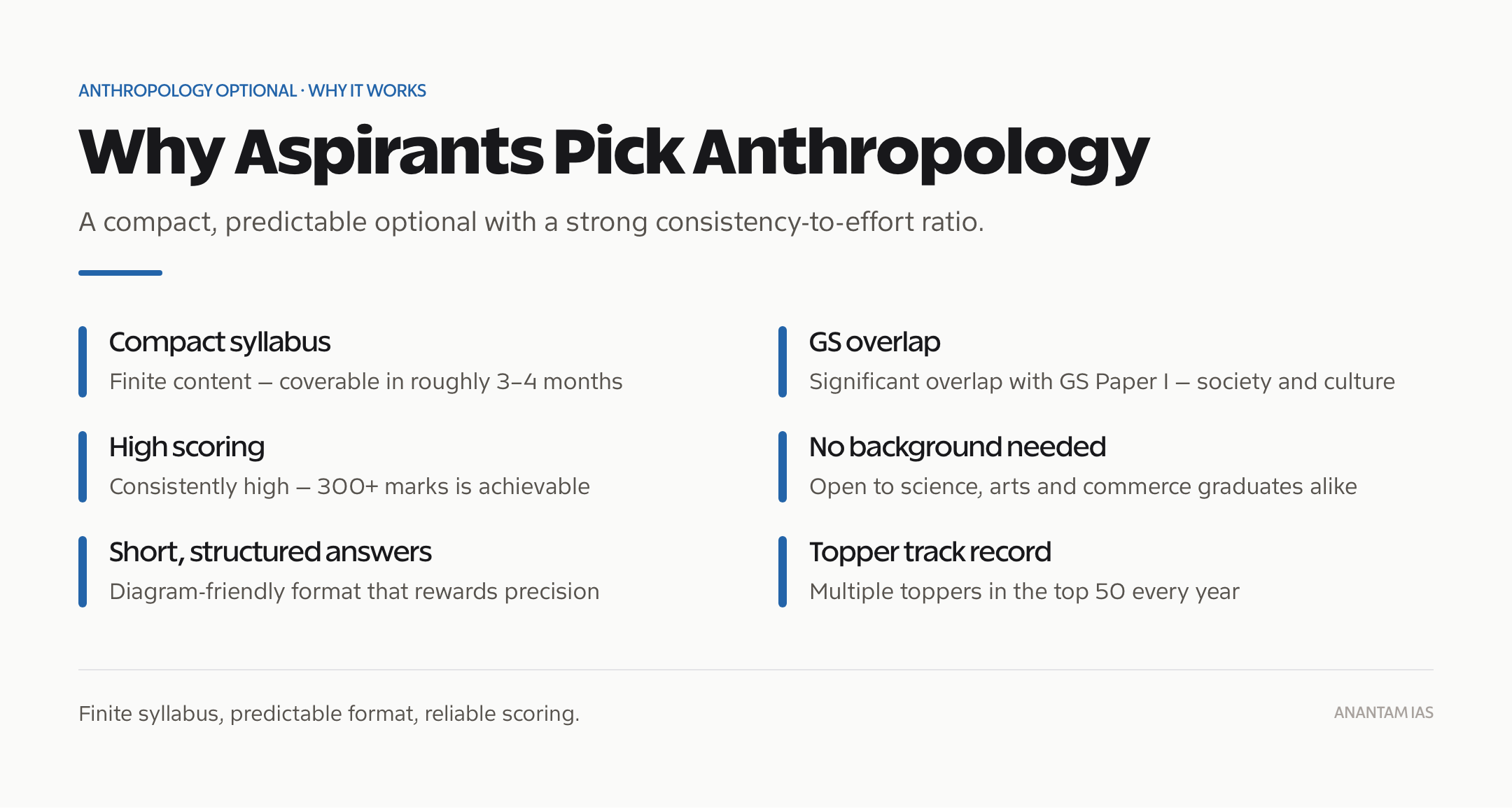
Anthropology has consistently been one of the most popular optional subjects for UPSC Civil Services Examination. With a compact syllabus, high scoring potential, and significant overlap with General Studies, Anthropology offers a strategic advantage that few other optionals can match. Over the years, multiple UPSC toppers — including several top 10 rankers — have chosen Anthropology, cementing its reputation as a reliable scoring optional.
Why Choose Anthropology Optional?
The popularity of Anthropology as a UPSC optional isn’t accidental. Several concrete factors drive this choice.
Key Advantages
| Factor | Detail |
|---|---|
| Syllabus Size | Compact — can be covered in 3–4 months |
| GS Overlap | Significant overlap with GS Paper I (Society, Culture) |
| Scoring Trend | Consistently high — 300+ marks achievable |
| Background Needed | None — science, arts, or commerce students can prepare |
| Answer Length | Short, structured answers work well |
| Competition | High popularity means more study material available |
| Topper Track Record | Multiple toppers in top 50 every year |
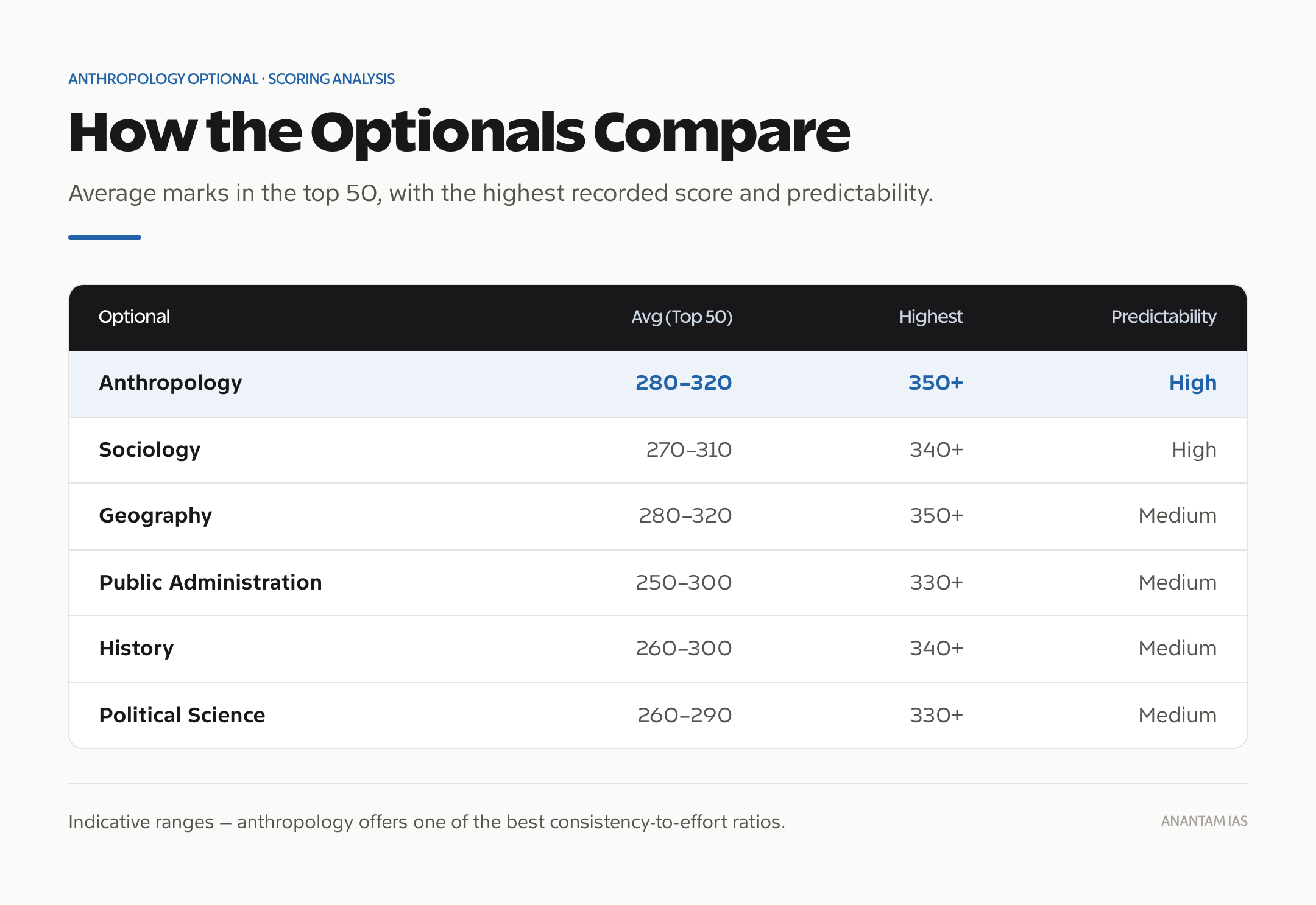
Scoring Analysis: Anthropology vs Other Optionals
| Optional Subject | Average Marks (Top 50) | Highest Recorded | Predictability |
|---|---|---|---|
| Anthropology | 280–320 | 350+ | High |
| Sociology | 270–310 | 340+ | High |
| Geography | 280–320 | 350+ | Medium |
| Public Administration | 250–300 | 330+ | Medium |
| History | 260–300 | 340+ | Medium |
| Political Science | 260–290 | 330+ | Medium |
Anthropology offers one of the best consistency-to-effort ratios. The syllabus is finite, the answer format is predictable, and the scoring pattern is reliable.
UPSC Optional Subjects: Complete Guide
Anthropology Optional Syllabus
The Anthropology syllabus has two papers, each worth 250 marks.
Paper I: Physical and Social Anthropology
Section A: Physical/Biological Anthropology
- Meaning, scope, and development of Anthropology
- Relationship with other disciplines (Sociology, Psychology, History, Economics)
- Human evolution — Darwinism, Neo-Darwinism, synthetic theory
- Primate taxonomy, behaviour, and human evolution timeline
- Fossil evidence — Australopithecus, Homo erectus, Neanderthal, Homo sapiens
- Biological basis of life — DNA, genes, chromosomes, mutations
- Human genetics — blood groups, genetic disorders, population genetics
- Racial classification — morphological and genetic approaches
- Anthropometry and forensic anthropology
Section B: Social/Cultural Anthropology
- Society, culture, and their interrelationship
- Marriage, family, and kinship systems
- Economic anthropology — modes of exchange, formalist vs substantivist debate
- Political anthropology — bands, tribes, chiefdoms, states
- Religion — animism, totemism, magic, witchcraft (E.B. Tylor, Bronislaw Malinowski, Claude Lévi-Strauss)
- Anthropological theories — Evolutionism, Diffusionism, Functionalism, Structuralism, Culture and Personality
Paper II: Indian Anthropology
Section A: Indian Context
- Prehistoric cultures of India — Palaeolithic, Mesolithic, Neolithic, Chalcolithic
- Indus Valley Civilization from anthropological perspective
- Ethno-archaeology in Indian context
- Demographic profile of India — population growth, fertility, mortality
- Caste system — varna, jati, dominant caste (M.N. Srinivas)
- Tribe-caste continuum (Surajit Sinha)
- Sacred complex and nature-man-spirit complex
- Impact of Hinduism, Buddhism, Islam, Christianity on tribal societies
- Village studies in India — Robert Redfield, McKim Marriott, M.N. Srinivas
Section B: Tribal India
- Scheduled Tribes — definition, constitutional provisions, distribution
- Problems of tribal communities — land alienation, displacement, health
- Tribal development approaches — isolation, assimilation, integration
- Tribal movements and their significance
- Tribal welfare programmes — Forest Rights Act, PESA, Fifth and Sixth Schedule
- PVTGs (Particularly Vulnerable Tribal Groups)
- Linguistic and racial diversity of India
Anthropology Preparation Strategy

Physical Anthropology — P. Nath (2026-27 edition)
- 807 pages, Higher Publishers, 2026-27 edition
- Human evolution, genetics, growth and the biological half of Paper 1
- The physical-anthropology standard in every optional booklist
Phase 1: Foundation (Months 1–2)
Start with a single comprehensive textbook to build conceptual clarity.
Recommended Starting Books:
| Book | Author | Covers |
|---|---|---|
| An Introduction to Social Anthropology | D.N. Majumdar & T.N. Madan | Social anthropology basics |
| Physical Anthropology | P. Nath | Biological anthropology |
| Indian Anthropology | Nadeem Hasnain | Paper II foundation |
Read each topic once without making notes. Focus on understanding concepts, not memorizing facts. The goal is to develop a mental framework of the entire syllabus.
Phase 2: Deep Study & Notes (Months 3–4)
Now create comprehensive notes — topic-by-topic, aligned with the UPSC syllabus. This is the most critical phase.
Advanced Books:
| Book | Author | Use For |
|---|---|---|
| Social Anthropology | Victor Barnouw | Theoretical depth |
| Tribal India | Nadeem Hasnain | Paper II tribes section |
| Indian Society | S.C. Dube | Village and caste studies |
| IGNOU Material | IGNOU | Concise, exam-oriented |
Note-Making Strategy:
- One topic per page (both sides)
- Include: definition, key thinkers, theories, diagrams, Indian examples
- Use flowcharts for evolutionary sequences
- Create comparison tables for competing theories
- Add UPSC previous year question tags to relevant topics
Phase 3: Answer Writing (Months 5–6)
This phase determines the final score. Anthropology answers have a specific structure that UPSC expects:
Answer Structure:
- Define the concept (1–2 lines)
- Explain the theory/framework
- Add a diagram/flowchart where applicable
- Give examples (preferably from Indian tribal context for Paper II)
- Mention key thinkers with their contributions
- Brief critical evaluation or contemporary relevance
Practice Pattern:
- Write 4–5 answers daily (150-word and 250-word formats)
- Time yourself — 8 minutes for 150-word, 15 minutes for 250-word
- Get answers evaluated by a mentor or peer group
Phase 4: Revision & Previous Years (Month 7 onwards)
Revise notes at least 3–4 times before the exam. Solve all previous year questions from 2013 onwards (post syllabus restructuring).
UPSC Mains Answer Writing: Strategy & Tips
Important Thinkers for Anthropology
Knowing key anthropologists and their contributions is non-negotiable. UPSC directly asks about their theories.

Indian Anthropology — Nadeem Hasnain (Palaka Prakashan)
- 425 pages, Palaka Prakashan, 2022 edition
- Indian anthropology for Paper 2: tribes, caste, village studies, thinkers
- The Paper 2 book almost every Anthropology optional candidate owns
| Thinker | Key Contribution | Paper |
|---|---|---|
| E.B. Tylor | Animism, cultural evolution | Paper I |
| Lewis Henry Morgan | Stages of cultural evolution | Paper I |
| Bronislaw Malinowski | Functionalism, Trobriand Islands | Paper I |
| A.R. Radcliffe-Brown | Structural-functionalism | Paper I |
| Claude Lévi-Strauss | Structuralism, binary oppositions | Paper I |
| Franz Boas | Historical particularism, cultural relativism | Paper I |
| M.N. Srinivas | Dominant caste, Sanskritization | Paper II |
| André Béteille | Inequality and social stratification | Paper II |
| S.C. Dube | Village studies methodology | Paper II |
| Verrier Elwin | Tribal welfare, isolation vs integration | Paper II |
| G.S. Ghurye | Caste, scheduled tribes | Paper II |
| Surajit Sinha | Tribe-caste continuum | Paper II |
| L.P. Vidyarthi | Nature-man-spirit complex, sacred geography | Paper II |
Diagrams: The Secret Weapon
Anthropology is one of the few optionals where diagrams significantly boost marks. Evolution timelines, skull morphology comparisons, kinship diagrams, and tool typology charts demonstrate visual understanding.
Must-Practice Diagrams:
- Human evolution timeline with fossil hominids
- Primate taxonomy tree
- Skull comparison (Australopithecus vs Homo erectus vs Homo sapiens)
- Stone tool typology (Acheulean, Mousterian, Levallois)
- Kinship notation systems
- Caste-tribe continuum model
- Demographic transition model
Practice drawing these neatly and quickly. In the exam, a well-labelled diagram can replace 50–60 words of explanation.
Common Mistakes to Avoid
- Ignoring Paper II: Many candidates focus heavily on Paper I (theoretical) and underprepare Paper II (Indian context). Both papers carry equal marks.
- Skipping diagrams: Anthropology without diagrams is like Geography without maps. Examiners expect visual representations.
- Neglecting tribal case studies: Paper II demands specific examples of tribal groups, their problems, and development initiatives. Generic answers score poorly.
- Over-reliance on coaching notes: Coaching material provides a framework, but reading original sources (at least select chapters from recommended books) adds depth that distinguishes top answers.
- Ignoring current affairs linkage: Tribal displacement, forest rights, PVTGs, genetic studies — current developments must be integrated into answers for contemporary relevance.
Anthropology and GS Overlap
One major advantage of Anthropology is its overlap with General Studies papers:
| GS Topic | Anthropology Connection |
|---|---|
| GS I — Indian Society | Caste, tribes, kinship, social change |
| GS I — Culture | Art, literature, religious practices |
| GS II — Governance | Tribal governance, PESA, Fifth Schedule |
| GS II — Social Justice | Tribal welfare, SC/ST issues |
| GS IV — Ethics | Cultural relativism, moral development |
| Essay | Society, culture, development themes |
This overlap means preparation for Anthropology simultaneously strengthens GS answers — an efficiency that saves valuable time.
Best Books for UPSC Mains GS Papers
Frequently Asked Questions
Is Anthropology optional good for beginners with no social science background?
Yes. Anthropology doesn’t require prior academic background in the subject. Engineering, medical, and commerce graduates have scored 300+ marks in this optional. The concepts are intuitive, the syllabus is well-defined, and ample beginner-friendly material is available.
How long does it take to prepare Anthropology optional?
With dedicated daily study of 3–4 hours, the entire Anthropology syllabus can be covered in 4–5 months. An additional 2 months for answer writing practice and revision brings the total to 6–7 months. Candidates who’ve already covered GS basics can finish faster due to syllabus overlap.
What marks can one realistically expect in Anthropology?
A well-prepared candidate can expect 280–320 marks (out of 500) in Anthropology. Exceptional candidates with strong answer writing and diagram skills have crossed 340. The key is consistent answer practice and thorough revision rather than reading more and more sources.
Is Anthropology becoming too competitive as an optional?
While Anthropology’s popularity means more candidates choose it, this doesn’t reduce individual scoring potential. UPSC evaluates answers on merit, not on a curve relative to other Anthropology candidates. High popularity also means better study material, more peer groups, and established preparation frameworks.
Should one join coaching for Anthropology optional?
Coaching provides structure and evaluated answer writing — both valuable. However, several toppers have prepared Anthropology through self-study using standard books, IGNOU material, and online resources. The decision depends on individual learning style and access to quality study material.
Tell Google you want more of this.
Add Anantam IAS as a preferred sourceOne tap, and this site shows up more often in your own Top Stories, AI Overviews and AI Mode. Remove it any time.