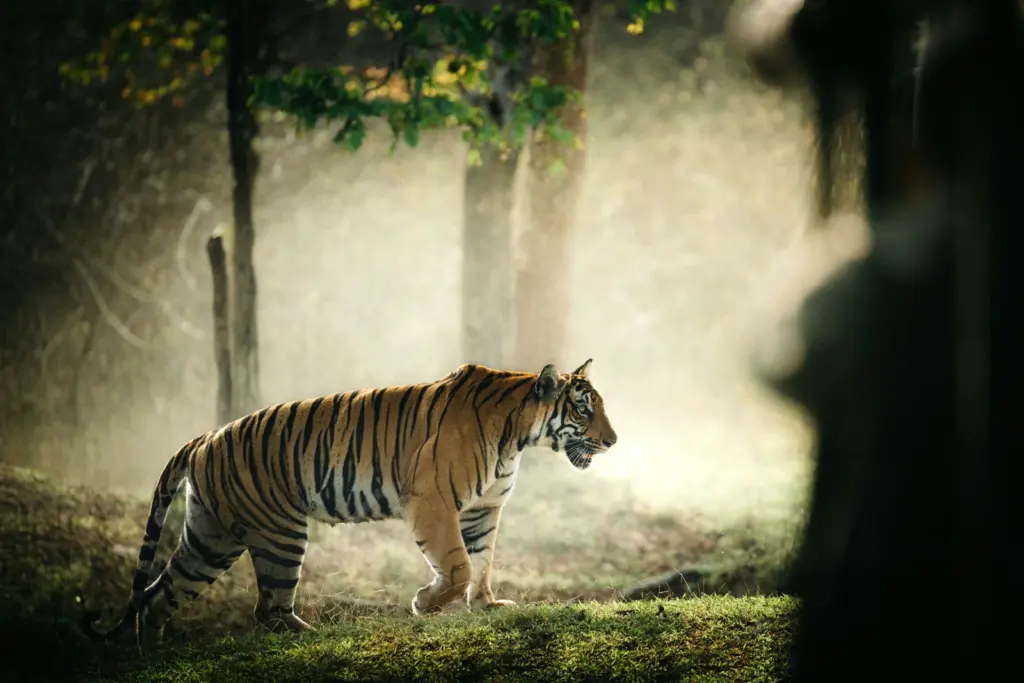
If you want the best odds of actually seeing a wild tiger in India, most guides will point you to one place: Bandhavgarh. That reputation isn’t marketing. Bandhavgarh packs one of the highest densities of tigers of any reserve in the country into a relatively compact core, which is why a two-day safari here has a genuinely good chance of a sighting where other parks might leave you with pug marks and a story. For an aspirant, that same fact makes Bandhavgarh the reserve you reach for whenever an answer needs a concrete example of successful tiger conservation, or of what “high density” actually means on the ground.
But Bandhavgarh is more than a tiger statistic. It carries a two-thousand-year-old hilltop fort, a place in the Ramayana legend, and a single, world-changing biological event: the capture, in these forests, of the tiger from whom nearly every white tiger on earth is descended. Learn Bandhavgarh properly and you get a rare three-in-one example, ecology, history and heritage stacked in one small stretch of the Vindhyas.
Where Bandhavgarh is, and what the terrain is like
Bandhavgarh lies in the Umaria district of Madhya Pradesh, in the eastern Vindhyan hill ranges where the plateau breaks into ridges, valleys and steep sandstone cliffs. It sits in the same tiger-rich belt of central India as Kanha and Pench, and that central-Indian setting shapes everything about the park’s ecology.
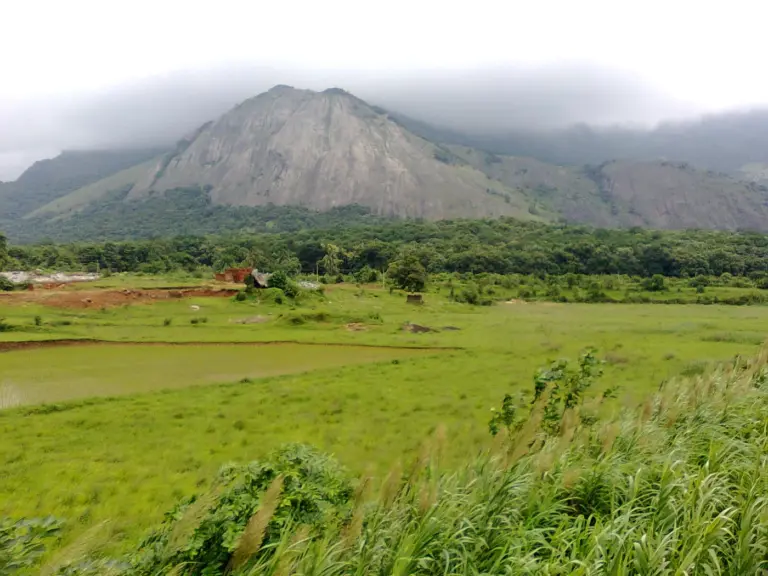
The terrain is a mosaic, and the mosaic is the point. Steep sandstone hills, said to number 32 in the old accounts, rise above wide, flat-bottomed valleys and open grassland meadows locally called *bohera*. The slopes carry mixed forest dominated by sal trees, with stretches of bamboo and mixed deciduous woodland lower down, and perennial streams thread the valleys. This patchwork of dense forest for cover, open meadow for grazing prey, and reliable water is close to ideal tiger habitat: it concentrates deer and other prey in the grasslands, and gives tigers thick forest and rocky cover from which to hunt. When you’re explaining why one reserve holds so many tigers, Bandhavgarh’s terrain is the clean answer, good cover plus abundant prey in a compact area equals high density.
The reserve as a whole, core and buffer together, covers roughly 1,536 square kilometres, with a core critical tiger habitat of about 716 square kilometres. It’s drained by small rivers and streams of the Son basin rather than the Narmada, and it sits south of the main Vindhya range escarpment that separates north India from the Deccan.
The Bandhavgarh fort and the Ramayana connection
The feature that sets Bandhavgarh apart from a purely natural park is the ancient Bandhavgarh fort, perched on a flat-topped sandstone hill that rises steeply above the forest at the heart of the reserve. The fort is old, with parts dated to around two thousand years ago, and the hill has been occupied and fortified by successive dynasties across the centuries, so it carries temples, rock-cut caves, inscriptions and old water tanks scattered across its summit.
The name itself comes from legend. Bandhavgarh is read as “brother’s fort”, from *bandhav* (brother) and *garh* (fort). Local tradition holds that Rama gave this hill fort to his brother Lakshmana so that he could keep watch over Lanka after the epic war of the Ramayana, which is why a figure of Lakshmana, worshipped here as Shesh Shaiya, sits below the fort. Like all such associations it’s legend rather than documented history, but it’s the reason the site carries cultural weight alongside its ecology, and it’s a memorable hook.
For much of the recent past the whole area was the private hunting reserve of the Maharajas of Rewa, the princely rulers whose game preserve these forests were. That royal ownership matters for two reasons. It kept the forest relatively intact and stocked with game right up to the twentieth century, which is part of why tiger numbers here stayed strong; and it sets up the single most famous event in Bandhavgarh’s story, which happened while the Rewa royals still ruled these jungles.
The white tiger of Rewa: where Mohan came from
Nearly every white tiger you have ever seen in a zoo, anywhere in the world, traces back to one animal captured in this region, and that fact belongs to Bandhavgarh’s landscape. In 1951, Maharaja Martand Singh of Rewa caught a white tiger cub during a hunt in the forests of this Rewa territory and named him Mohan.
Here’s the biology that makes it exam-worthy, because the white tiger is widely and wrongly described. A white tiger is not a separate species, and it is not an albino. It’s an ordinary Bengal tiger carrying a rare recessive gene that suppresses the orange pigment, leaving a white coat with dark stripes and, usually, blue eyes. Because the trait is recessive, it only shows when a cub inherits the gene from both parents, which is why white tigers are so rare in the wild. Mohan was bred in captivity at Rewa, and by pairing his descendants back to one another, breeders fixed the white trait, so the world’s captive white tigers today are essentially one inbred family line descended from that single Rewa cub.
That last point carries a lesson worth making in an answer. The whiteness that makes these tigers a zoo attraction is the product of deliberate inbreeding, and it comes with a cost: white tigers commonly carry health defects, from crossed eyes to spinal and immune problems, precisely because the gene pool was narrowed to a handful of related animals. So Bandhavgarh’s white-tiger story isn’t just a charming origin tale; it’s a real case study in the difference between a natural genetic rarity and a human-engineered one, and in the ethics of breeding animals for a single cosmetic trait.
From royal shikargah to Project Tiger reserve
Bandhavgarh’s shift from hunting ground to protected reserve is a compact history of Indian conservation, and the two dates are worth fixing.
The Rewa royals handed the forest over to the state, and in 1968 Bandhavgarh was declared a national park, giving it legal protection under India’s emerging wildlife framework. The park was later brought under the country’s flagship conservation programme, becoming a tiger reserve in 1993 under Project Tiger, the initiative launched in 1973 to pull the Bengal tiger back from the brink. The core national park was progressively enlarged and a buffer added, giving the reserve its present two-layer structure.
That structure, and the legal architecture behind it, is standard across the country and worth carrying. Every tiger reserve has an inviolate core managed as critical tiger habitat and a surrounding multiple-use buffer, a model coordinated nationally by the National Tiger Conservation Authority (NTCA). National parks and reserves draw their legal teeth from the Wildlife Protection Act of 1972, which created the categories of protected area, and tiger reserves specifically operate under the Project Tiger framework that Bandhavgarh joined in 1993. If you can place Bandhavgarh inside that system, national park under the 1972 Act, tiger reserve under Project Tiger and the NTCA, you’re answering the institutional question and not just naming a park.
The following profile gathers the facts most often tested, in one place, so you can revise the reserve at a glance.
| Feature | Detail |
|---|---|
| Location | Umaria district, Madhya Pradesh, eastern Vindhyan hills |
| National park | Declared in 1968 |
| Tiger reserve | Notified under Project Tiger in 1993 |
| Area | About 1,536 sq km overall; core critical tiger habitat about 716 sq km |
| Terrain | Sandstone hills, sal forest, bamboo, grassy valleys, perennial streams |
| Famous for | High tiger density, Bandhavgarh fort, origin of the white tiger |
The safari zones and what “high density” looks like on the ground
Bandhavgarh is managed for tourism as a set of separate zones, and knowing the layout helps you picture how a reserve balances protection with the visitor pressure that funds it. The core is split into three main tourism zones, Tala, Magadhi and Khitauli, with Tala being the oldest, most celebrated and historically the most tiger-productive of them, the stretch around the fort hill where the park first built its reputation. A ring of buffer zones such as Dhamokhar, Johilla and Panpatha absorbs additional visitors and gives the core some breathing room.
Zoning like this is not just administrative tidiness; it’s a conservation tool. By capping the number of vehicles allowed into each zone per session and rotating pressure across several gates, managers keep tourism from crowding the tigers while still letting the reserve earn the tourist revenue and local employment that give a park its political staying power. It also concentrates sightings: because tiger density in the Tala core is so high, a single well-known tigress and her territory can be seen by generations of visitors, which is part of how Bandhavgarh became a household name. The lesson to carry into an answer is that a modern tiger reserve is engineered as much for managed human access as for the animals, and that getting that balance right is what separates a functioning reserve from a paper one.
Biodiversity beyond the tiger
Bandhavgarh is famous for its tigers, but a good answer resists making it a one-animal park. The reserve is a full central-Indian ecosystem, and the tiger sits at the top of it precisely because everything below is healthy.
The forests hold a strong population of leopards, along with sloth bears, dhole (the Indian wild dog), jackals, foxes and smaller cats. The prey base, the reason tiger density is so high, is built on large herds of chital (spotted deer) and sambar, together with nilgai, wild boar, chinkara and gaur (Indian bison, reintroduced here after local extinction). Langurs and rhesus macaques move through the canopy, and the grasslands and water bodies draw a rich birdlife, from raptors and vultures to storks, peafowl and woodpeckers, along with reptiles including the odd python and a range of smaller fauna.
One conservation detail is worth naming, because it shows management at work. The gaur, India’s massive wild bovine, had gone locally extinct in Bandhavgarh, and it was reintroduced by translocating animals from Kanha, a rare and closely watched example of restoring a large herbivore to a habitat it had vanished from. That kind of active intervention, moving prey species to rebuild an ecosystem, is a reminder that a modern reserve is not simply fenced and left alone; it is managed, monitored and sometimes rebuilt piece by piece.
The takeaway for an answer is that Bandhavgarh’s tiger numbers are a symptom of ecological health, not a lucky accident. A dense, well-fed prey population supports a dense predator population; protect the grassland and the deer, and the tigers largely look after themselves. That predator-prey logic is the core idea to carry from any tiger-reserve example, and Bandhavgarh illustrates it about as cleanly as any park in India.
How Bandhavgarh fits India’s tiger-reserve network
Bandhavgarh is one node in a national network, and it helps to know where that network stands. India now has 58 tiger reserves, spread across the tiger-bearing states, and Madhya Pradesh, the “Tiger State”, holds more tigers than any other, which is why so many of the country’s marquee reserves, Kanha, Pench, Panna, Satpura and Bandhavgarh among them, sit within its borders.
That clustering is not a coincidence. The central-Indian highlands, the Vindhya and Satpura belt, form one of the country’s most important tiger landscapes, with reserves close enough that they can, in principle, be linked by corridors that let tigers disperse between them. Bandhavgarh is part of that landscape alongside the neighbouring Kanha national park, and the most recent addition to the state’s roster is Madhav, notified as India’s 58th tiger reserve. If you’re revising the country’s protected areas, keep Bandhavgarh in its family: a central-Indian, Madhya Pradesh reserve, one of the densest, within the wider list of tiger reserves in India and the broader national parks of India.
Bandhavgarh’s high density also feeds a live conservation debate: what to do when a reserve fills up. A park that breeds tigers faster than it can hold them becomes a source population, producing surplus animals that must either disperse through corridors or be translocated to under-stocked reserves elsewhere. When those corridors are broken by roads, mines, railway lines or farmland, the surplus tigers have nowhere to go, and young males in particular spill into the buffer and beyond, where they collide with people and cattle. That is why human-wildlife conflict tends to rise around the most successful reserves, not the weakest ones, and why maintaining forest corridors between the central-Indian parks matters as much as protecting the cores themselves. Bandhavgarh has been part of exactly that conversation, which makes it a useful example not just of conservation success but of the new problems success creates.
How to study Bandhavgarh for the exam
Anchor the hard facts first, because that’s where factual questions land: Bandhavgarh is in Umaria district, Madhya Pradesh, in the Vindhyan hills; it became a national park in 1968 and a tiger reserve in 1993 under Project Tiger; it holds one of India’s highest tiger densities; it carries the ancient Bandhavgarh fort; and it lies in the region where the white tiger Mohan was captured in 1951.
Then hold the three angles that make Bandhavgarh versatile. The ecology angle: high density explained by good terrain and a strong prey base, the predator-prey logic of a healthy park. The conservation angle: its place under the 1972 Wildlife Protection Act and Project Tiger, and its role as a source population that raises the corridor-and-translocation question. And the heritage angle: the fort, the Ramayana legend and the white tiger, which let you connect an environment answer to history and culture. Being able to switch between those three is what turns a single fact into a flexible tool.
For Mains, deploy Bandhavgarh as evidence rather than as a topic. It backs answers on the success and limits of Project Tiger, on habitat and prey as the real drivers of predator numbers, on the ethics of breeding animals like the white tiger, and on the corridor problem in a landscape of clustered reserves. For sourcing, lean on the NTCA, the Madhya Pradesh forest department and the national tiger estimation reports for figures, and treat the tiger count of any single park as an approximate, moving number rather than a fixed one. What scores is the reasoning, why the density is high, why the white tiger matters, why success brings its own problems, not a memorised headcount.
Frequently Asked Questions
Where is Bandhavgarh Tiger Reserve located?
In the Umaria district of Madhya Pradesh, in the eastern Vindhyan hill ranges of central India. It lies in the same tiger-rich belt as Kanha and Pench, and its terrain of sandstone hills, sal forest and grassy valleys makes it prime tiger habitat.
Why is Bandhavgarh famous?
For having one of the highest densities of tigers of any reserve in India, which gives visitors an unusually good chance of a sighting. It is also known for the ancient Bandhavgarh fort at its heart and for being the region from which the world’s captive white tigers are descended.
What is the story of the white tiger of Bandhavgarh?
In 1951, Maharaja Martand Singh of Rewa captured a white tiger cub named Mohan in these forests. A white tiger is not a separate species or an albino; it is a Bengal tiger with a rare recessive gene that removes the orange colour. Nearly all captive white tigers today descend from Mohan through deliberate inbreeding.
When did Bandhavgarh become a national park and a tiger reserve?
It was declared a national park in 1968 and was brought under Project Tiger as a tiger reserve in 1993. It was earlier the private hunting reserve of the Maharajas of Rewa.
What is the Bandhavgarh fort?
An ancient hill fort, parts of it around two thousand years old, standing on a flat-topped sandstone hill in the middle of the reserve. Legend links it to the Ramayana, holding that Rama gave the fort to his brother Lakshmana, which is the source of the name “brother’s fort”.
What wildlife other than tigers lives in Bandhavgarh?
Leopards, sloth bears, dhole, jackals and smaller cats, with a prey base of chital, sambar, nilgai, wild boar, gaur and langurs, plus a rich birdlife and reptiles. This healthy prey population is the reason tiger density is so high.
How many tiger reserves does India have?
India has 58 tiger reserves, with the most recent additions notified in Madhya Pradesh, the state that holds the largest tiger population and several of the country’s flagship reserves.
Practice Questions
1. Bandhavgarh Tiger Reserve is located in which state?
a) Maharashtra
b) Madhya Pradesh
c) Rajasthan
d) Chhattisgarh
Answer: b) Madhya Pradesh
2. The white tiger is best described as:
a) a distinct species of tiger
b) an albino Bengal tiger
c) a Bengal tiger with a rare recessive gene affecting coat colour
d) a hybrid of the tiger and the snow leopard
Answer: c) a Bengal tiger with a rare recessive gene affecting coat colour
3. Bandhavgarh was brought under Project Tiger as a tiger reserve in which year?
a) 1968
b) 1973
c) 1993
d) 2007
Answer: c) 1993
4. Consider the following about Bandhavgarh:
- It was once the private hunting reserve of the Maharajas of Rewa.
- It contains an ancient hill fort linked in legend to the Ramayana.
- It is known for one of the highest tiger densities among Indian reserves.
Which of the statements are correct?
a) 1 and 2 only
b) 2 and 3 only
c) 1 and 3 only
d) 1, 2 and 3
Answer: d) 1, 2 and 3
5. The high density of tigers in Bandhavgarh is best explained by:
a) the absence of any human settlement in the region
b) a mosaic of forest cover and grassland with an abundant prey base
c) the reintroduction of tigers from Africa
d) its status as a biosphere reserve
Answer: b) a mosaic of forest cover and grassland with an abundant prey base
Mains-style questions
- “The high tiger density of Bandhavgarh is a symptom of ecological health, not a stroke of luck.” Discuss with reference to the reserve’s terrain and prey base.
- The white tiger of Bandhavgarh illustrates the difference between a natural genetic rarity and a human-engineered one. Examine, including the ethical concerns it raises.
- Trace the transformation of Bandhavgarh from a princely hunting reserve to a Project Tiger reserve, and place it within India’s legal framework for wildlife protection.
- A successful tiger reserve becomes a “source population” that creates new management problems. Discuss with reference to Bandhavgarh and the role of corridors and translocation.
- Evaluate the significance of the central-Indian highlands, including Bandhavgarh, as one of India’s most important tiger landscapes.
Bandhavgarh earns its place in your notes because it refuses to be a single fact. It’s the reserve where you’re most likely to meet a wild tiger, and also the forest where a princely hunt in 1951 produced the ancestor of every white tiger in captivity; it’s a Project Tiger success story and, in the same breath, a warning about inbreeding and about what to do when a park succeeds too well. Carry the location, the two dates, the fort, the white tiger and the predator-prey logic, and you’re holding an example that works in an environment answer, a history answer and a culture answer alike.
Tell Google you want more of this.
Add Anantam IAS as a preferred sourceOne tap, and this site shows up more often in your own Top Stories, AI Overviews and AI Mode. Remove it any time.