
The BRICS host country for 2026 is India, which holds the rotating chairship and hosts the 18th BRICS Summit in New Delhi on 12–13 September 2026, under the theme "Building for Resilience, Innovation, Cooperation and Sustainability". It is India's fourth turn in the chair, after 2012, 2016 and 2021. The previous host was Brazil, which chaired through 2025 and held the 17th summit in Rio de Janeiro on 6–7 July 2025, the first after the bloc's major expansion. This guide explains BRICS, the 2024 expansion, the chairship rotation, what Rio settled and what New Delhi inherits, and the grouping's relevance for UPSC International Relations.
| BRICS 2025 — at a glance | Detail |
|---|---|
| Host / Chair | Brazil (assumed the rotating chairship on 1 January 2025) |
| Summit | 17th BRICS Summit |
| Venue & dates | Rio de Janeiro, 6–7 July 2025 |
| Host leader | President Luiz Inácio Lula da Silva |
| Key outcome | Rio de Janeiro Declaration |
| Newest full member | Indonesia (admitted January 2025) |
| Next chair (2026) | India — will host the 18th Summit |
What Is BRICS
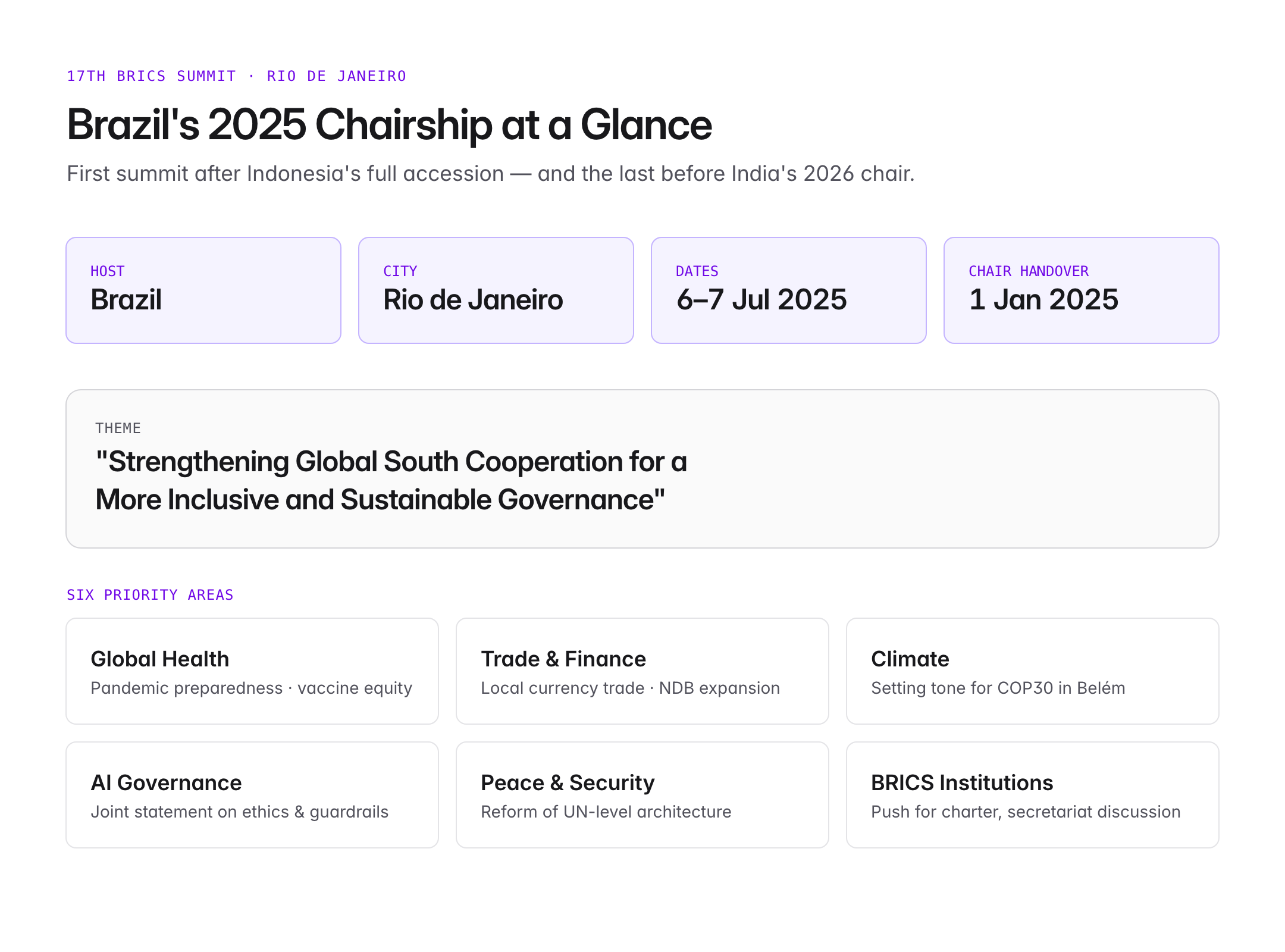
BRICS is an intergovernmental grouping of major emerging economies originally comprising Brazil, Russia, India, China, and South Africa.
- The acronym BRIC was coined by Goldman Sachs economist Jim O'Neill in 2001.
- The first BRIC foreign ministers' meeting was held in 2006, and the first full summit in Yekaterinburg, Russia in 2009.
- South Africa joined in 2010, making the group BRICS.
- BRICS has no charter or permanent secretariat; it operates through annual summits, ministerial meetings, and working groups.
The 2024 Expansion
At the 15th BRICS Summit in Johannesburg (2023), the members agreed to admit six new countries from 1 January 2024.
- Egypt, Ethiopia, Iran, UAE joined in 2024.
- Saudi Arabia was invited but has not formally confirmed full membership.
- Argentina (under President Javier Milei) declined to join.
- In 2025, Indonesia was confirmed as a full member, becoming the first Southeast Asian country in BRICS.
The expanded bloc is often called BRICS+ or the BRICS Plus format, with additional "partner countries" added in 2024–25 (including Belarus, Bolivia, Cuba, Kazakhstan, Malaysia, Nigeria, Thailand, Uganda, Uzbekistan, and Vietnam).
India's 2026 Chairship
India took over the chair from Brazil on 1 January 2026, its fourth turn after 2012, 2016 and 2021. The 18th summit is set for New Delhi on 12–13 September 2026 under the theme "Building for Resilience, Innovation, Cooperation and Sustainability". Working-group meetings across health, energy, space and youth have run through the year ahead of the leaders' summit.
Brazil's 2025 Chairship
Brazil took over the chair from Russia (which hosted the Kazan Summit in October 2024) on 1 January 2025.
Theme: "Strengthening Global South Cooperation for a More Inclusive and Sustainable Governance."
Priority areas announced by Brazil:
- Global health cooperation
- Trade, investment, and finance
- Climate change
- Artificial intelligence governance
- Reform of multilateral peace and security architecture
- Institutional development of BRICS
17th BRICS Summit, Rio de Janeiro
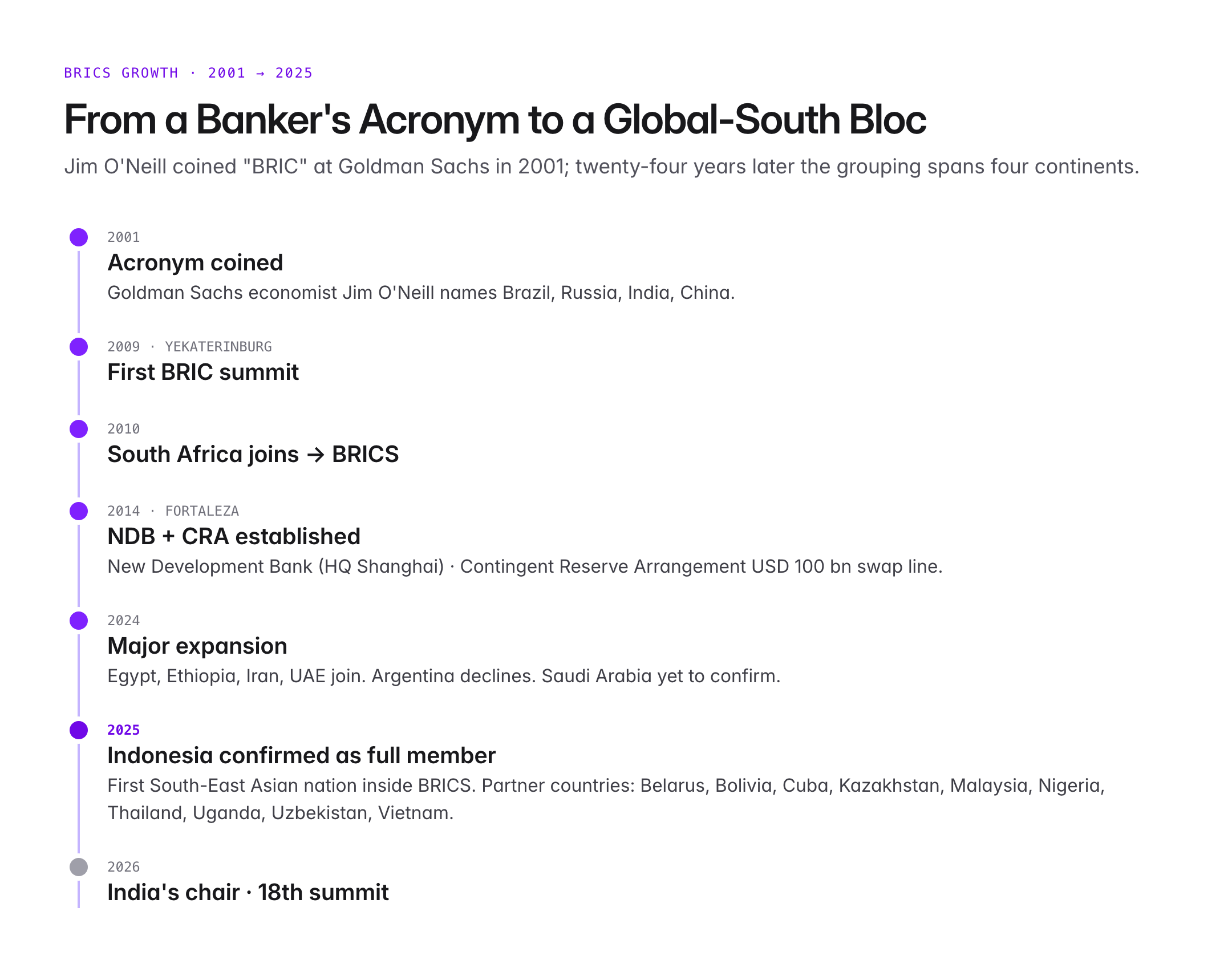
The 17th BRICS Summit was held in Rio de Janeiro on 6–7 July 2025, hosted by Brazilian President Luiz Inácio Lula da Silva. Key highlights:
- Adoption of the Rio de Janeiro Declaration.
- Endorsement of a BRICS Leaders' Statement on Climate Finance ahead of COP30 in Belém, Brazil.
- Joint statement on global governance of AI.
- Discussions on local currency trade, payment systems, and the role of the New Development Bank (NDB).
- Indonesia participated for the first time as a full member.
- Prime Minister Narendra Modi represented India and held bilateral meetings on the sidelines.
New Development Bank and Financial Architecture
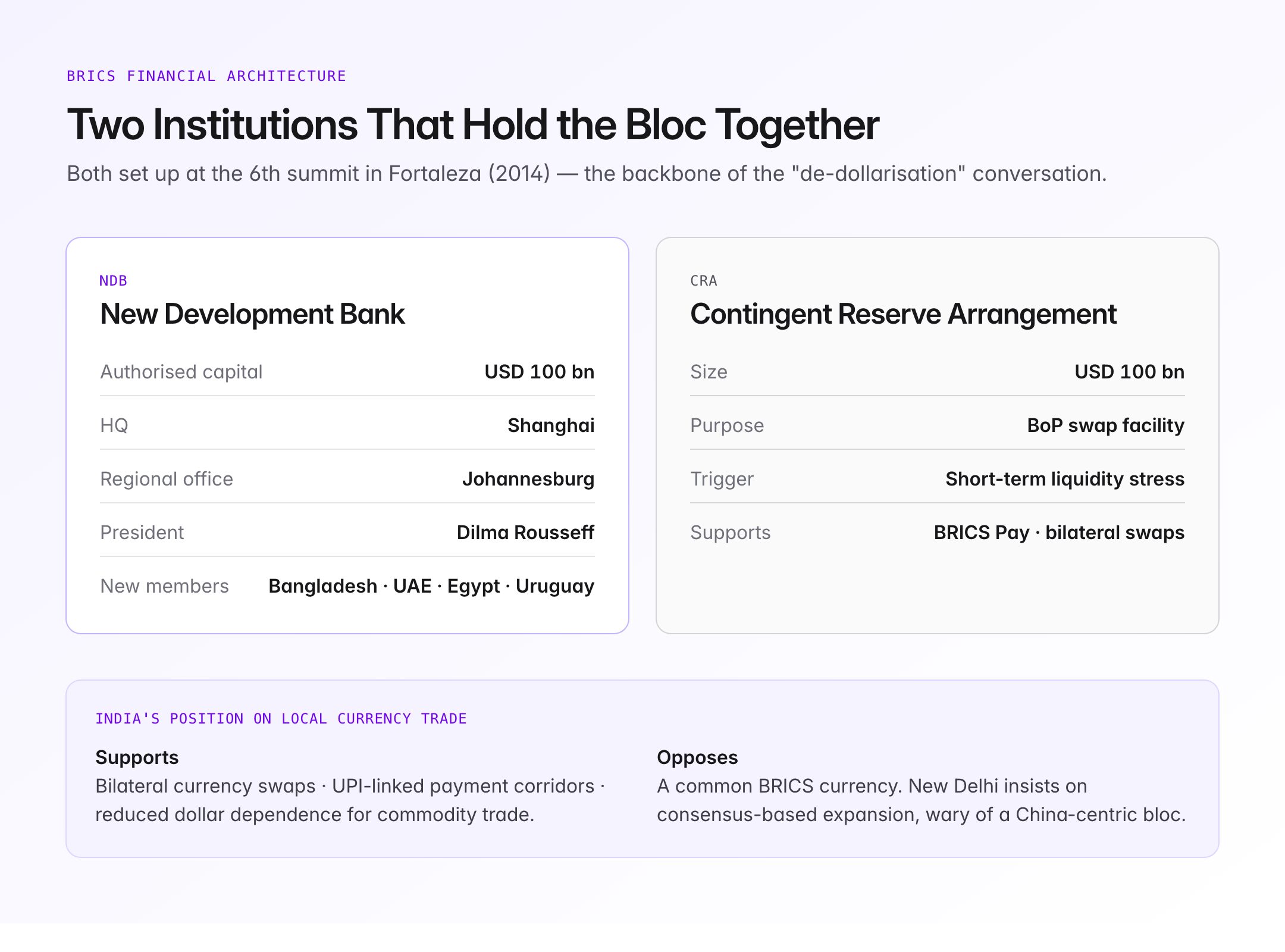
A central BRICS institution is the New Development Bank (NDB), established at the 6th BRICS Summit in Fortaleza (2014) and headquartered in Shanghai, China, with a regional office in Johannesburg.
- Initial authorised capital: USD 100 billion.
- Provides infrastructure and sustainable development financing to BRICS and other emerging economies.
- Bangladesh, UAE, Egypt, and Uruguay have joined as new members of the NDB.
- Current President (2023–) is Dilma Rousseff, former President of Brazil.
The Contingent Reserve Arrangement (CRA), also set up in 2014, is a USD 100 billion swap facility to help members with short-term balance of payments pressures.
Local Currency Trade and "De-dollarisation"
A recurring theme under Russia's 2024 chairship and carried into Brazil's 2025 agenda is the push for trade in local currencies.
- BRICS members explored cross-border payment systems and the BRICS Pay initiative.
- Discussions on a potential BRICS common currency have been raised publicly by Russia and Brazil but remain aspirational; India has clarified it has no plan to back a common BRICS currency.
- Emphasis on bilateral currency swaps, reduced reliance on the US dollar for oil and commodity trade, and strengthening of UPI-linked payment corridors (India's export).
India and BRICS
India is a founding member and has chaired BRICS multiple times (latest: 2021).
- India will chair BRICS in 2026 and host the summit next year.
- Indian priorities include counter-terrorism, reformed multilateralism, digital public infrastructure (UPI, Aadhaar-style systems), and Global South solidarity.
- India has opposed the idea of a BRICS common currency but supports local currency trade settlements.
- On expansion, India insisted on consensus-based criteria, wary of BRICS becoming a China-centric bloc.
Challenges Facing BRICS
- Heterogeneity of members — democracies and autocracies, surplus and deficit economies.
- India–China border tensions complicating deeper security cooperation.
- Russia's isolation after the Ukraine war and sanctions impact BRICS image.
- Iran-Saudi dynamics and West Asian rivalries now inside BRICS.
- Lack of institutional capacity — no charter, secretariat, or dispute mechanism.
- Risk of perception as anti-Western bloc, which India has consistently resisted.
BRICS Chairship Rotation
| Year | Host | Summit |
|---|---|---|
| 2022 | China (virtual) | 14th |
| 2023 | South Africa (Johannesburg) | 15th |
| 2024 | Russia (Kazan) | 16th |
| 2025 | Brazil (Rio de Janeiro) | 17th |
| 2026 | India (New Delhi) | 18th, 12–13 September |
Significance of the Rio Summit
- First summit after Indonesia's full accession, expanding the bloc's Asian footprint.
- Positions BRICS as a voice of the Global South in an era of contested global governance.
- Sets the tone for COP30 climate negotiations in Belém later in 2025.
- Strengthens discussion on AI governance, digital public goods, and climate finance.
- Hands the chairship to India in 2026, giving New Delhi agenda-setting powers.
UPSC Relevance
Prelims focus:
- BRICS 2025 host: Brazil; summit held in Rio de Janeiro, 6–7 July 2025.
- Original BRICS members and 2024–25 new entrants (Egypt, Ethiopia, Iran, UAE, Indonesia).
- New Development Bank – HQ Shanghai; President Dilma Rousseff.
- Contingent Reserve Arrangement – USD 100 billion.
- 2026 chair: India.
Mains GS angle (GS Paper II – International Relations):
- BRICS as a platform for reform of global governance (UN, IMF, World Bank).
- India's balancing act between BRICS, Quad, and G20.
- De-dollarisation, local currency trade, and implications for the international monetary system.
- BRICS expansion: opportunities and strategic risks for India.
Sample PYQ angle: UPSC has asked about BRICS's institutional mechanisms, the NDB, and India's role. Expect analytical questions on BRICS expansion, Global South solidarity, and local currency trade.
Tell Google you want more of this.
Add Anantam IAS as a preferred sourceOne tap, and this site shows up more often in your own Top Stories, AI Overviews and AI Mode. Remove it any time.