Champaner pavagadh is the World Heritage Site that most lists mention and few notes explain. The Champaner-Pavagadh Archaeological Park in Gujarat’s Panchmahal district joins a volcanic hill crowned by the Kalika Mata temple with the ruins of a sultan’s capital at its foot, and UNESCO inscribed it in 2004 as the only complete and unchanged Islamic pre-Mughal city. That one phrase is the reason it is on the list.
The confusion usually starts with the two names. Pavagadh is the hill and its old Rajput fortress; Champaner is the city below it that Mahmud Begada rebuilt after 1484. Keep that split in mind and the rest of the site, from the Jami Masjid to the pilgrim path, falls into place.
Where Champaner-Pavagadh Is
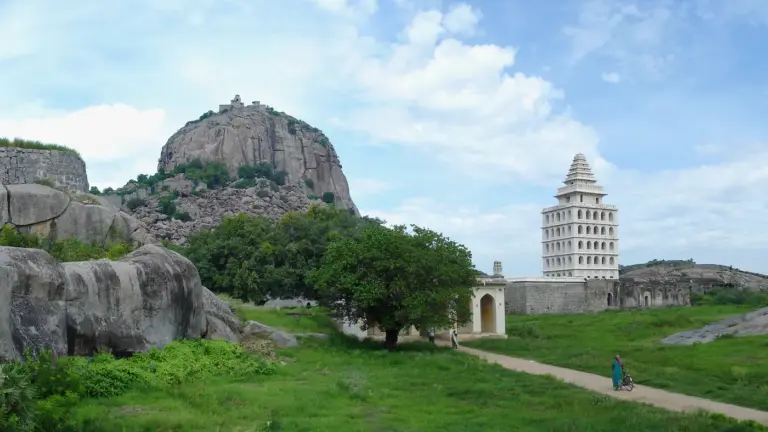
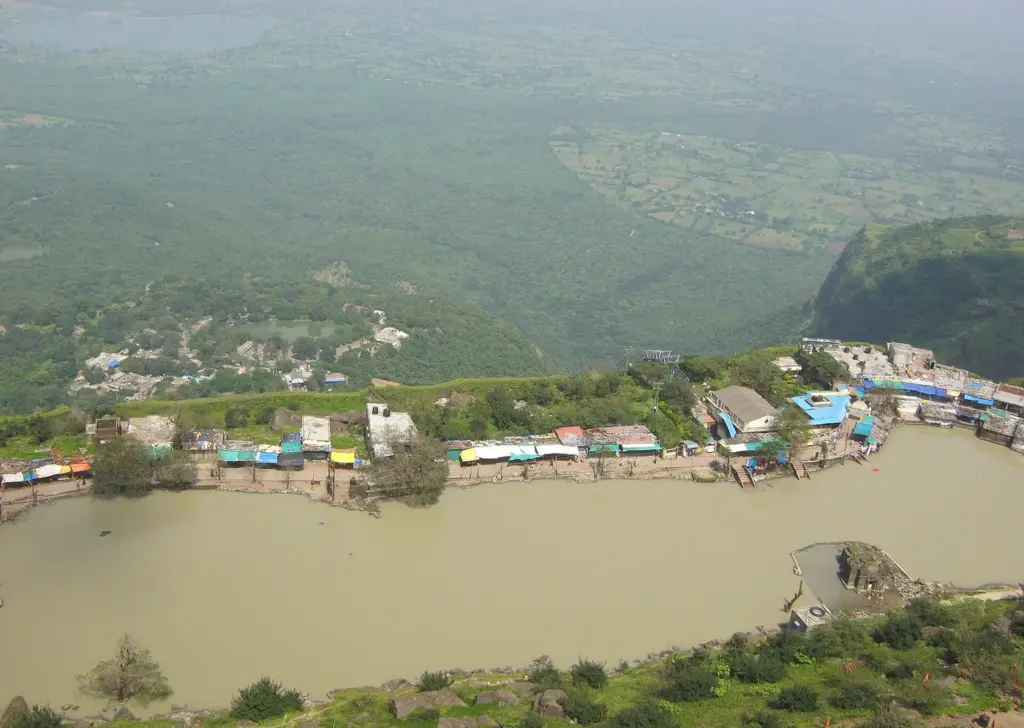
Champaner Pavagadh sits in the Panchmahal district of Gujarat, around Pavagadh Hill, a volcanic formation that rises 800 m above the surrounding plains. The lower hillocks, escarpments and plateaus around it are all products of the same volcanic eruptions and lava flows, and the park is spread across that landscape rather than packed into one walled site.
The basic facts of the property:
- Components: 12 separate areas, with fortifications, palaces, religious buildings, residential precincts and water installations.
- Area: 1,328.89 ha, with a buffer zone of 2,911.74 ha.
- Periods: remains run from prehistoric chalcolithic sites to medieval buildings.
- Living parts: the village of Champaner and the Kalika Mata temple are both inside the property and in daily use.
- The name: Pavagadh is popularly explained as a “stronghold of the wind”, the gloss the Prime Minister used at the temple in 2022.
The advisory body’s evaluation notes that the area was inhabited in the chalcolithic period and then seems to have been abandoned until about 400 AD. The history that matters for exams starts much later.
From Rajput Hill Fortress to Sultanate Capital
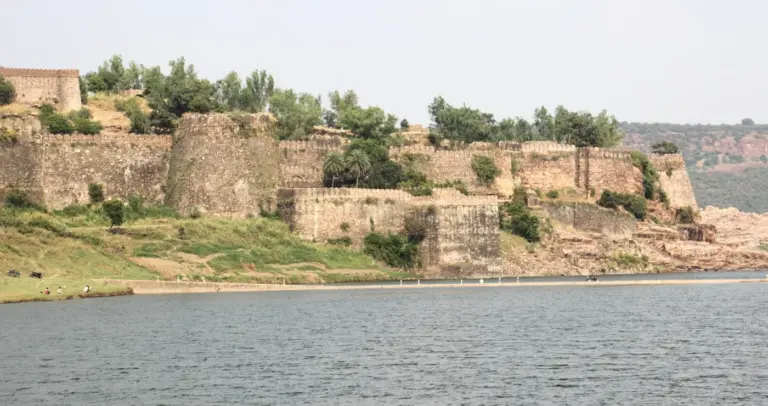
Pavagadh was a Rajput stronghold for about two centuries before Mahmud Begada, Sultan of Gujarat, took it in 1484 and built his capital at its foot. The city he made lasted as a capital for barely half a century, and that short life is the key to why it survives.
The Solankis and the Khichi Chauhans
The ASI describes Pavagadh as a famous Hindu fortress under the Solanki kings of Gujarat and then the Khichi Chauhans. The Khichi Chauhan Rajputs conquered the area in the 13th century and did three things that still shape the site:
- They built their first settlement on top of Pavagadh Hill.
- They raised fortification walls along the plateau below it.
- They built temples and water-retention systems, among the most important early remains.
The oldest temple on the hill, dedicated to Lakulisa, dates to the 10th-11th century, and other Hindu and Jain temples belong to the 13th-15th centuries.
Mahmud Begada’s Siege of 1484
Mahmud Begada, who ruled the Gujarat Sultanate from 1458 to 1511, took the hill fortress in 1484. Gujarat Tourism records that the siege lasted 20 months and that the Rajput defenders chose death over surrender.
What Begada did next is the important part. He did not rebuild on the summit. He built a new capital at the foot of the hill, renamed it Muhammadabad and moved his court there from Ahmedabad.
- The city had a fortified Royal Enclosure, with palaces, gardens, a royal mosque and administrative buildings.
- A second precinct, Jahanpanah, was his capital proper.
- Paved streets led from the fortifications to the city center, with bridges and retaining walls where the ground demanded them.
- Begada invited a well-known Persian landscape designer to lay out his palace gardens.
Humayun and the Abandonment
The glory was short. In 1535 the Mughal emperor Humayun captured Champaner, and the capital of Gujarat returned to Ahmedabad. UNESCO dates the end of Champaner’s time as a capital to 1536, after which it was abandoned.
Nothing large was built there afterwards. When the British took the area in 1807, only about 500 people were reported to be living in Champaner.
Picture the city as a photograph taken in the year the sultans left: streets, mosques and walls fixed at one moment, without the later layers that bury most medieval cities. The comparison has an honest limit. Most of the photograph is still in the envelope, because the capital is largely buried and unexcavated, and only the main buildings and forts stand exposed.
Architecture: Where Hindu Craft Met Sultanate Design
Champaner’s mosques are the core of its architectural value. They were built with the skills of local builders trained in temple construction, for patrons who wanted Islamic forms, and UNESCO says the result, above all in the Jami Masjid, “became a model for later mosque architecture in India”.
Two terms help here. Trabeate construction means post and lintel, columns carrying flat beams, the way Indian temples were built. Arcuate construction means arches and domes, the Islamic import. The advisory body’s evaluation describes Champaner’s buildings as combining the earlier column-beam-dome system with large domes, a mix it calls a forerunner of Mughal architecture. The Indo-Islamic architecture note sets this in the longer story, and the Mughal architecture note shows where it went next.
The Jami Masjid
The Jami Masjid, or Great Mosque, stands just outside the east gate of the citadel and is the building UNESCO singles out. What to notice:
- A carved entrance porch leading into a courtyard ringed by a pillared corridor.
- A prayer hall with two tall central minarets, several domes and finely latticed stone windows.
- About 172 pillars and minarets rising to roughly 30 m.
- Rich stone carving throughout, the clearest sign of builders who knew temple craft.
Its criterion in the listing says the blend of Hindu and Muslim architecture here comes from the significant period of the regional sultanates, the same era that produced the Bahmani kingdom in the Deccan.
The Other Mosques
The ASI notes five mosques in good condition. Each has a feature worth one line in revision.
| Mosque | What to notice |
|---|---|
| Jami Masjid | The largest; carved porch, two central minarets, latticed windows |
| Saher ki Masjid | Inside the citadel; probably the private royal mosque |
| Kevda Masjid | Narrow stairs lead up to the roof and minarets |
| Nagina Masjid | No minarets; exquisite geometric carving, especially on the adjoining tomb |
| Lila Gumbaj ki Masjid | Stands on a high platform with a fluted central dome |
The Brick Minar ki Masjid, a rare brick tomb with twin chimney-like minarets, stands about a kilometer west of the group.
City Planning and Water
Champaner is as much a lesson in town planning as in architecture. The advisory body’s evaluation lists what the excavated parts show:
- Residential areas for both wealthy and ordinary households, with gardens and water channels built into the design.
- Shops and commercial streets, some with underground storage.
- Pavilions and public gardens, for which Champaner was known.
- Tanks, reservoirs, dams and many kinds of wells, several still in use.
- Houses with running water, and gardens decorated with channels.
Water here served pleasure as well as survival. In the 15th century the system fed gardens and pavilions as well as daily needs, which says a good deal about the confidence of a court that expected to stay.
The Kalika Mata Temple and Pavagadh’s Living Pilgrimage
The Kalika Mata temple on the summit is what keeps Champaner Pavagadh alive as a place rather than a ruin. UNESCO describes it as a Brahmanical temple of the goddess who guards the hill, an important living shrine that draws pilgrims from Gujarat and beyond throughout the year.
The pilgrimage is part of why the site was listed:
- Criterion (vi) recognizes Champaner-Pavagadh as a place of worship and continuous pilgrimage for Hindu believers.
- The Patha, or pilgrim route, climbs from the plateau to the summit over thousands of steps and many gates, and the advisory body called it the “soul of Champaner”.
- Gujarat Tourism records thousands of devotees gathering during Navratri.
- Heritage Jain temples also stand on the hill, and Jain temple trusts are among the property’s owners.
A tradition holds that the right toe of the goddess Kalika fell on Pavagadh, which places it among the sites counted as Shakti Peethas. The advisory body’s evaluation records that legend as an important intangible part of the site while noting it cannot be treated as part of its documented history. That is the right way to hold it in an answer as well.
On 18 June 2022, the Prime Minister inaugurated the redeveloped Kalika Mata temple and hoisted the flag on its summit. In his address he said the flag had not flown there for five centuries, and he noted that a ropeway now makes the climb easier for elderly and disabled pilgrims.
The site therefore carries two kinds of heritage at once. UNESCO’s own listing notes the contrast: a small number of visitors at the centrally protected monuments below, and a large number at the shrine above. Managing a crowded temple on top of a quiet, largely buried city is the site’s central challenge.
Champaner-Pavagadh at a Glance
These are the facts worth writing on a revision card.
| Item | Detail |
|---|---|
| Location | Panchmahal district, Gujarat |
| Landform | Pavagadh Hill, volcanic, 800 m above the plains |
| Inscribed | 2004 |
| Criteria | (iii), (iv), (v) and (vi) |
| Area | 1,328.89 ha, buffer zone 2,911.74 ha |
| Components | 12 separate areas |
| Rajput phase | Khichi Chauhans from the 13th century |
| Captured | 1484, by Mahmud Begada, after a 20-month siege |
| New name | Muhammadabad |
| Capital of Gujarat until | 1536 |
| Mughal capture | 1535, by Humayun |
| Key mosque | Jami Masjid |
| Living shrine | Kalika Mata temple on the summit |
| Individually protected monuments | 39 |
Conservation and Management Today
Champaner Pavagadh is protected by central and state law and managed by a dedicated authority, but its sheer spread and its many owners make management harder than at a single monument. That structure is the part worth knowing.
The legal and administrative framework:
- Protection under the Ancient Monuments and Archaeological Sites and Remains Act (1958), its amendments and the Gujarat Ancient Monuments and Archaeological Sites and Remains Act (1965).
- The Champaner-Pavagadh World Heritage Area Management Authority Act (2006), which set up an authority chaired by Gujarat’s Chief Secretary, with the Director General of the ASI among its members.
- 39 monuments and sites individually protected.
- An Integrated Management Plan, developed and adopted as the World Heritage Committee recommended.
The ownership list shows why coordination matters. The property belongs in parts to the ASI, the Gujarat State Forest Department, the State Department of Archaeology, the State Revenue Department, the Jai Kalika Temple Trust, Jain temple trusts, a Fakir sect trust and private owners.
Two further points complete the picture:
- When the site was evaluated for listing, the advisory body found no management plan, no management structure and not even a proper inventory. The 2006 Act and the management plan came after inscription.
- Conservation has been deliberately light. Most monuments and remains have been left largely as found, so that future researchers can study and reinterpret them, with minimal restoration only where stability was at risk.
Criterion (v) names the risks directly: the site is vulnerable to abandonment, forest takeover and modern life.
How Champaner-Pavagadh Is Tested and How to Revise It
Objective questions on Champaner Pavagadh usually test the district, the year and the UNESCO phrase about the pre-Mughal city. Mains questions go further, into syncretic architecture, regional sultanates and the management of living heritage.
For Prelims, fix these:
- Panchmahal district, Gujarat, inscribed in 2004.
- Four criteria: (iii), (iv), (v) and (vi).
- “The only complete and unchanged Islamic pre-Mughal city.”
- Mahmud Begada took Pavagadh in 1484; Humayun took Champaner in 1535.
- Pavagadh is the hill; Champaner is the city below it.
For Mains, three angles carry the most weight:
- Syncretic architecture: the Jami Masjid as a meeting of temple craft and mosque design.
- A short-lived capital: why a city abandoned early can preserve more than one lived in continuously.
- Living versus archaeological heritage: a busy shrine above, a buried city below and a management authority in between.
The full list of India’s properties is in the UNESCO World Heritage Sites in India note, and the World Heritage Day note is a natural hook for a current-affairs question on sites like this one.
Final Remarks
Champaner pavagadh is really two sites wearing one name: a hill that has been sacred and defended for centuries, and a capital that lived for barely fifty years and was then left alone. The second fact is what makes it rare, and it is the one to lead with in an answer.
Get the names, the 1484 and 1535 dates and the four criteria settled first, then spend a little time on the Jami Masjid and the management authority, because those two give you material for almost any Mains question the site can support. That is all from my side on Champaner-Pavagadh. I hope it helps you revise it with confidence.
Frequently Asked Questions
Where is Champaner-Pavagadh Archaeological Park?
It is in the Panchmahal district of Gujarat, around Pavagadh Hill, a volcanic formation that rises 800 m above the surrounding plains. The property is made up of 12 separate areas covering 1,328.89 ha.
When was Champaner-Pavagadh declared a World Heritage Site?
UNESCO inscribed Champaner-Pavagadh Archaeological Park in 2004 under criteria (iii), (iv), (v) and (vi). It is recognized as the only complete and unchanged Islamic pre-Mughal city.
Who built Champaner?
Sultan Mahmud Begada of Gujarat built the city at the foot of Pavagadh after capturing the hill fortress in 1484. He renamed it Muhammadabad and moved his capital there from Ahmedabad.
Why is Champaner called an unchanged pre-Mughal city?
Champaner served as Gujarat’s capital only until 1536 and was then abandoned, so it was never rebuilt in later styles. Its streets, mosques and walls survive largely as they were, with most of the city still buried and unexcavated.
What is the Jami Masjid of Champaner known for?
The Jami Masjid blends Hindu craftsmanship with Islamic mosque design, with a carved porch, a pillared courtyard, two central minarets and latticed stone windows. UNESCO says it became a model for later mosque architecture in India.
Is the Kalika Mata temple at Pavagadh a Shakti Peetha?
Tradition holds that the right toe of the goddess Kalika fell on Pavagadh, which is why it is counted among the Shakti Peethas. UNESCO’s advisory body records the legend as intangible heritage rather than documented history.
Why was Champaner abandoned?
The Mughal emperor Humayun captured Champaner in 1535, and the capital of Gujarat returned to Ahmedabad. UNESCO dates the end of Champaner’s role as capital to 1536, after which the city was deserted.
What is the difference between Champaner and Pavagadh?
Pavagadh is the hill, with the older Rajput fortress and the Kalika Mata temple on top. Champaner is the city at its foot that Mahmud Begada built as his capital after 1484.
Practice Questions
Prelims MCQs
Q1. Champaner-Pavagadh Archaeological Park is located in which district of Gujarat?
(a) Kutch
(b) Panchmahal
(c) Patan
(d) Junagadh
Answer: (b) UNESCO places the property in the Panchmahal district of Gujarat.
Q2. Who captured Pavagadh in 1484 and made Champaner his capital?
(a) Ahmad Shah I
(b) Mahmud Begada
(c) Bahadur Shah
(d) Muzaffar Shah II
Answer: (b) Mahmud Begada took the fortress in 1484 and built his capital, renamed Muhammadabad, at its foot.
Q3. UNESCO describes Champaner-Pavagadh as:
(a) the largest Mughal garden city
(b) the only complete and unchanged Islamic pre-Mughal city
(c) the oldest Harappan port in Gujarat
(d) the first capital of the Delhi Sultanate in western India
Answer: (b) This phrase from UNESCO’s description is the core of the site’s value.
Q4. Consider the following statements: 1. Pavagadh Hill is a volcanic formation. 2. The Kalika Mata temple stands in Champaner town at the foot of the hill. 3. Champaner remained the capital of Gujarat until 1536. Which of the statements given above are correct?
(a) 1 only
(b) 1 and 3 only
(c) 2 and 3 only
(d) 1, 2 and 3
Answer: (b) The Kalika Mata temple is on the summit of Pavagadh, not in the town below.
Q5. In which year was Champaner-Pavagadh Archaeological Park inscribed on the World Heritage List?
(a) 1987
(b) 2004
(c) 2014
(d) 2017
Answer: (b) It was inscribed in 2004 under criteria (iii), (iv), (v) and (vi).
Mains Questions
- Champaner-Pavagadh represents a blend of Hindu and Islamic architecture. Discuss with reference to the Jami Masjid. (10 marks, 150 words)
- A capital abandoned early can preserve more of its past than one lived in continuously. Examine with reference to Champaner. (10 marks, 150 words)
- Managing living religious heritage alongside archaeological remains poses distinct challenges. Discuss with reference to Pavagadh. (15 marks, 250 words)
- Assess the contribution of the regional sultanates to Indian architecture, with reference to Gujarat. (15 marks, 250 words)
- Water management was central to the planning of medieval Indian cities. Illustrate with reference to Champaner. (10 marks, 150 words)
Tell Google you want more of this.
Add Anantam IAS as a preferred sourceOne tap, and this site shows up more often in your own Top Stories, AI Overviews and AI Mode. Remove it any time.