

A District Collector is an IAS officer, typically at Pay Level 12 of the 7th Pay Commission (basic pay ₹78,800 per month). After Dearness Allowance (60% of basic from January 2026) and other allowances, cash in-hand comes to roughly ₹1,52,000–₹1,84,000 a month, on top of a rent-free government bungalow, an official vehicle with driver, and household staff that push the effective package well above the cash figure. Senior Collectors of major districts move up to Level 13 (₹1,23,100) or Level 14 (₹1,44,200).
| Item | Detail |
|---|---|
| Post | District Collector / District Magistrate (IAS) |
| Pay Level (7th CPC) | Level 12 (rises to Level 13–14 for senior/major districts) |
| Basic pay | ₹78,800 per month (Level 12) |
| Dearness Allowance | 60% of basic (from January 2026) |
| Cash in-hand | ≈ ₹1,52,000–₹1,84,000 per month |
| Key perks | Rent-free bungalow, official vehicle with driver, staff; security by threat perception |
| Recruitment | UPSC Civil Services Examination → IAS |
| Next promotion | Divisional Commissioner (Level 13) |
District Collector Salary: Pay Scale, Allowances & Perks
A District Collector (also called District Magistrate or DM) earns a basic pay between ₹78,800 and ₹1,44,200 per month under the 7th Pay Commission, depending on seniority and pay level. But the salary number alone doesn’t capture the picture. The Collector’s real package — government bungalow, vehicle with driver, personal staff, and security — is worth several times the cash pay.
The District Collector is an IAS officer. Most Collectors are between 9 and 20 years of service. The post carries Level 12, 13, or 14 in the 7th CPC pay matrix depending on the officer’s service stage and state.
District Collector Pay Under 7th Pay Commission
The IAS pay matrix has a defined progression. Collectors sit in the middle-upper tiers of this matrix.
Pay Level Mapping for Collector/DM Post
| Pay Level | Post Grade | Basic Pay Range | Typical IAS Service Years |
|---|---|---|---|
| Level 12 | Senior Time Scale / DM Grade | ₹78,800 – ₹2,09,200 | 9–16 years |
| Level 13 | Junior Administrative Grade | ₹1,23,100 – ₹2,15,900 | 16–24 years |
| Level 14 | Selection Grade / DM of major district | ₹1,44,200 – ₹2,18,200 | 24+ years |
Most IAS officers get their first Collector posting at Level 12, around year 9–12 of service. Senior IAS officers posted as Collector of a major district (state capital, metro district) may draw Level 13 or Level 14 pay.
State Government Pay Scales
Not all Collectors draw central-equivalent pay. Each state has its own pay revision. States that have implemented 7th CPC-equivalent revisions pay comparable to the above matrix. Some states with older revisions pay somewhat less.
States with higher-than-average Collector pay: Maharashtra, Karnataka, Tamil Nadu, Telangana, Gujarat — these states have implemented pay revisions with higher multipliers on top of the 7th CPC baseline.
Uttar Pradesh, Bihar, Rajasthan, Madhya Pradesh — larger states where Collector cadre is more numerous, following 7th CPC equivalent but without premium additions in most cases.
Full Salary Breakdown: Collector In-Hand Pay
Let’s build the actual monthly take-home for a Collector at Level 12 in a state capital.
Monthly Salary Calculation (Level 12, State Capital)
| Component | Amount (₹/month) |
|---|---|
| Basic Pay (Level 12, mid-scale) | 1,00,000 (approx.) |
| DA @ 60% (Jan 2026) | 60,000 |
| HRA (if not in govt. bungalow) | 24,000–27,000 |
| OR — Government Bungalow | Provided (HRA not paid) |
| NPA / Other Service Allowances | 2,000–5,000 |
| Sumptuary Allowance | 3,000–5,000 |
| Gross Salary | ~1,65,000–1,97,000 |
| NPS Deduction (10% of basic) | 10,000 |
| Other deductions | 2,000–3,000 |
| Net In-Hand (cash) | ~₹1,52,000–1,84,000 |
This is the cash component. The non-cash perquisites — bungalow, vehicle, staff — add substantially to the effective compensation.
HRA vs Government Accommodation
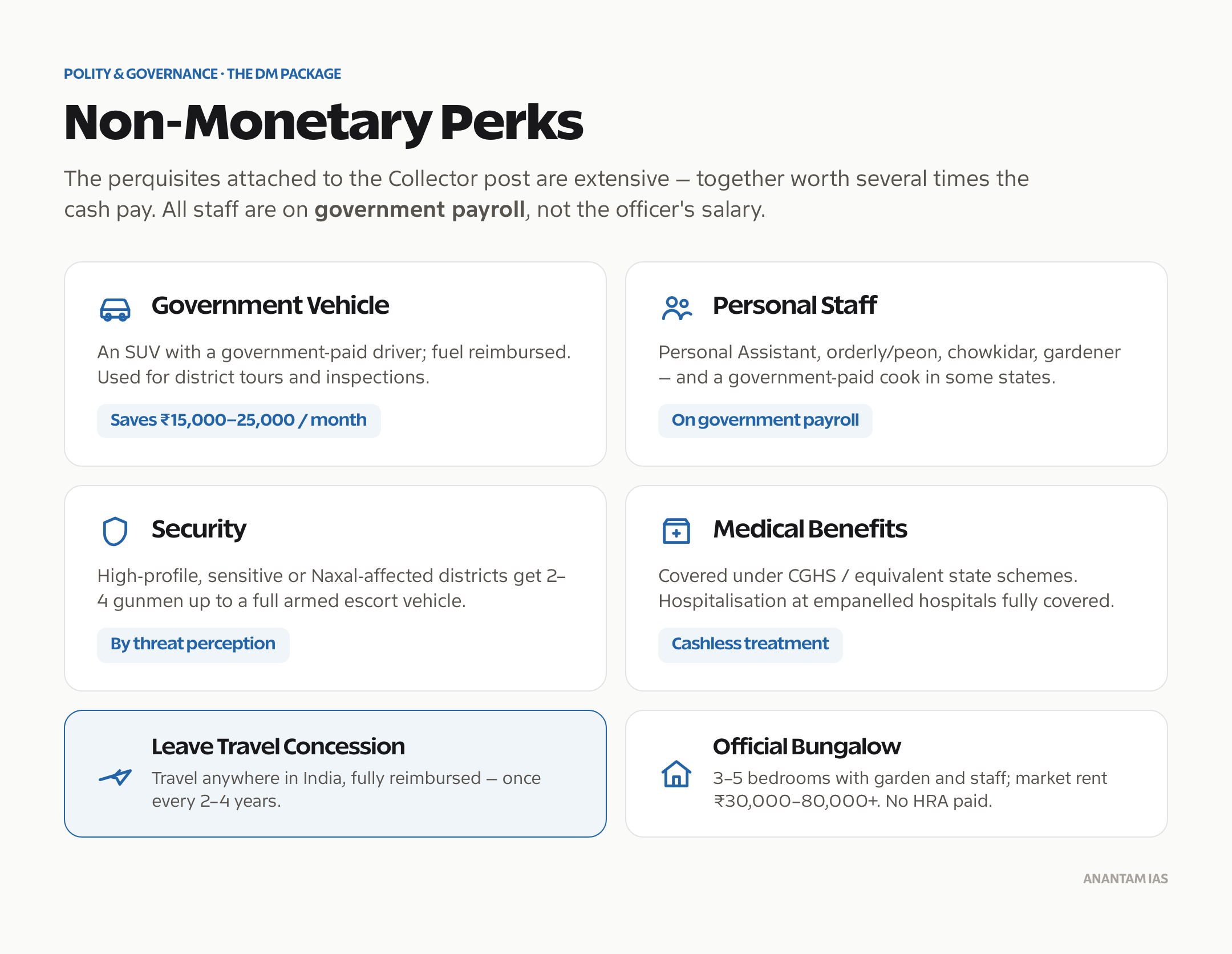
Most Collectors get an official bungalow or residence at the district headquarters. In this case, no HRA is paid. But the bungalow itself — a large government-maintained property — is worth ₹30,000–₹80,000 in equivalent market rent, sometimes more in major cities.
The bungalow typically has:
- 3–5 bedrooms
- Office/study room
- Guest room
- Government-maintained garden and compound
- Cook and household staff (orderly, chowkidar) provided
This is a standard of living that cash salary alone can’t replicate in a major Indian city.
Non-Monetary Perks of a District Collector
The perquisites attached to the Collector post are extensive. They’re part of why the post is as prestigious as it is.
Government Vehicle
Every Collector gets a government vehicle — typically a Toyota Fortuner, Tata Safari, or equivalent. A driver is provided and is on government pay. Fuel is reimbursed or provided. In rural districts, a second official vehicle may be available for field visits.
The vehicle isn’t just for commuting. District-level tours, inspection visits, field assessments — all happen by official vehicle. Practical savings: ₹15,000–₹25,000 per month in avoided transport costs.
Personal Staff
The Collector’s office provides personal staff:
- Personal Assistant (PA): For correspondence and scheduling
- Orderly/Peon: Personal helper at office and residence
- Chowkidar: Security/watchman at the bungalow
- Cook (in some states): Government-paid cook at the official residence
- Gardener: Maintains the compound
These staff members are on government payroll — not the Collector’s personal salary. The practical value is significant.
Security
High-profile postings — state capital district, sensitive border areas, Naxal-affected districts — come with personal security. This ranges from 2–4 gunmen to a full escort vehicle with armed police depending on threat perception.
Security isn’t a universal perk for all Collector postings. Rural, peaceful districts may not have security details. But politically sensitive or high-profile districts routinely provide it.
Medical Benefits
IAS officers are covered under the Central Government Health Scheme (CGHS) in Delhi and equivalent state health schemes elsewhere. Hospitalisation at government empanelled hospitals is fully covered. Many states also allow private hospital treatment with cashless facilities.
LTC (Leave Travel Concession)
IAS officers can travel to any part of India under LTC, fully reimbursed, once in 2 years (or once every 4 years for travel anywhere in India, with home town trips in between). For a family of four, this can mean ₹50,000–₹1,00,000 in reimbursed travel every 2–4 years.
SDM Salary: Sub Divisional Magistrate Pay & Career
Powers of a District Collector
Understanding what a Collector does explains why the post commands such prestige.
Executive and Administrative Powers
The Collector is the head of district administration. All government departments at the district level — Public Works, Health, Education, Agriculture, Revenue — coordinate under the Collector. In practice, the Collector sets priorities, resolves inter-departmental conflicts, and represents the state government at the district level.
Key executive functions:
- Law and order oversight — coordinates with the Superintendent of Police
- Disaster management — District Disaster Management Authority chairperson
- Election duty — District Election Officer, responsible for free and fair elections in the district
- Coordination of central and state government schemes at district level
Revenue Powers
The Collector heads the district revenue administration. All revenue officers (SDMs, Tehsildars, Patwaris) report up through the Collector. Land records, land acquisition, tenancy disputes, property tax administration — all fall under revenue administration.
Land acquisition is one of the most sensitive functions. Under the 2013 LARR Act (Right to Fair Compensation and Transparency in Land Acquisition, Rehabilitation and Resettlement Act), the Collector plays the central role in determining compensation, conducting Social Impact Assessments, and overseeing rehabilitation.
Magisterial Powers
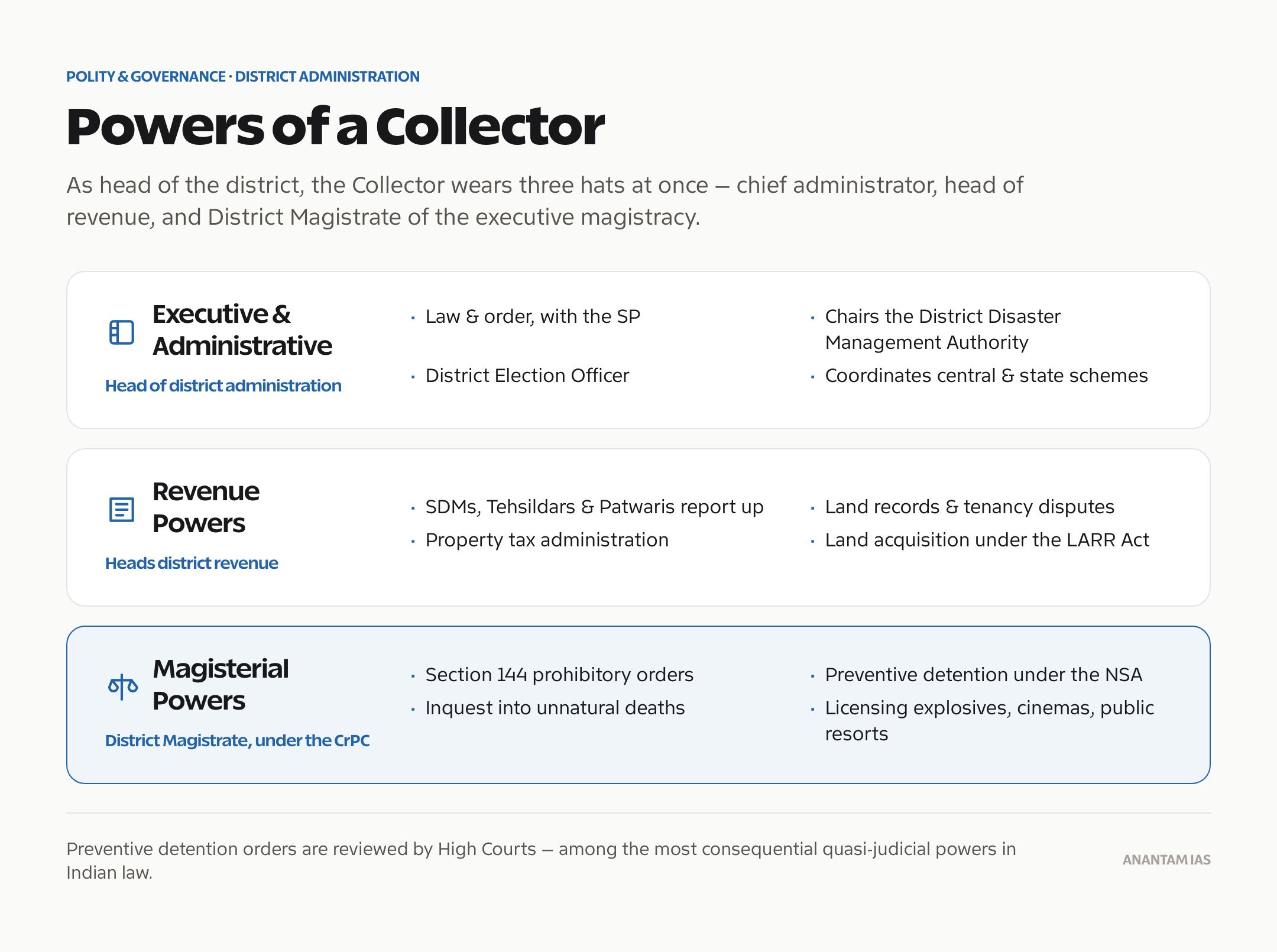
The Collector is the District Magistrate — the head of Executive Magistracy in the district. Key powers under the CrPC (Code of Criminal Procedure):
- Section 144 orders (prohibitory orders — banning assembly, movement)
- Preventive detention under the National Security Act (NSA) and state security laws
- Inquest into unnatural deaths
- Powers over licensing of explosives, cinema halls, places of public resort
The DM role also interfaces with judicial authority. The Collector signs preventive detention orders that are reviewed by High Courts — making it one of the most consequential quasi-judicial powers in Indian law.
Career Progression After Collector
The Collector posting is a stepping stone. What comes next shapes the long arc of an IAS officer’s career.
IAS Progression: From Collector to Secretary
| Stage | Typical Post | Service Years | Pay Level |
|---|---|---|---|
| Sub-Divisional Magistrate | SDM / Joint Magistrate | 1–5 years | Level 10 |
| District Collector | DM / Collector | 9–16 years | Level 12 |
| Commissioner | Divisional Commissioner | 16–22 years | Level 13 |
| Secretary (State) | Principal Secretary (State Govt.) | 22–30 years | Level 14 |
| Secretary (GoI) | Secretary to Government of India | 30–35 years | Level 17 |
| Cabinet Secretary | Apex of IAS career | 35–37 years | Level 18 |
Divisional Commissioner is typically the next significant field posting after Collector. The Commissioner oversees 3–8 districts, coordinates between Collectors, and handles larger administrative issues at the division level.
Secretary to State Government: After field postings, many IAS officers move to secretariat roles — heading departments at the state capital. Secretary-level posts involve policy making, legislative work, and budget management.
Secretary to Government of India: Top IAS officers serve as Secretaries in central government ministries — Finance, Home, External Affairs, DOPT. This is the pinnacle of the service.
Central Deputation
Every IAS officer spends a portion of their career on central deputation — posted at central government ministries in Delhi. The DOPT (Department of Personnel and Training) manages these postings. Central deputation exposes officers to national-level policy work, often more intellectually demanding than district-level administration.
Popular central deputation postings: Finance Ministry, NITI Aayog, PMO (Prime Minister’s Office), MHA (Ministry of Home Affairs), and public sector undertakings at senior levels.
Collector Salary vs Other Senior Officers
| Post | Pay Level | Approx. In-Hand (Cash) | Key Perks |
|---|---|---|---|
| District Collector (IAS, Level 12) | Level 12 | ₹1,45,000–1,75,000 | Bungalow, vehicle, staff, security |
| SP (IPS, Senior Scale) | Level 12 | ₹1,40,000–1,65,000 | Bungalow, vehicle, security |
| Commissioner of Income Tax (IRS) | Level 14 | ₹1,60,000–1,90,000 | Vehicle, accommodation |
| SDM (Level 10–11) | Level 10–11 | ₹95,000–1,25,000 | Vehicle, smaller accommodation |
| IFS Officer (Director level) | Level 12 | ₹1,40,000–1,70,000 + foreign allowance | Embassy housing, foreign posting |
| Central Govt. Secretary (GoI) | Level 17 | ₹2,25,000+ | Type VII bungalow in Delhi, Z+ security possible |
The Collector’s cash salary at Level 12 is comparable to IPS SP and IRS CIT. But the combination of bungalow + vehicle + staff + security makes the actual value of the package higher than cash-only comparisons suggest.
IFS Salary: Indian Foreign Service Pay & Perks
How to Become a District Collector
There’s one primary route.
UPSC Civil Services Examination
The Collector post is an IAS post. You become a Collector by:
- Clearing UPSC CSE (Prelims + Mains + Personality Test)
- Getting IAS allocation (top ~100–200 ranks depending on year)
- Completing probation training at LBSNAA, Mussoorie
- Serving as SDM/Joint Magistrate in initial years
- Getting posted as Additional DM/Collector
- Full Collector posting: typically year 9–12 of IAS service
Some states allow senior PCS (State Civil Service) officers to be posted as Collector in specific districts. But for most major districts and for assured Collector posting, IAS is the definitive route.
Ranks required: There’s no fixed rank cutoff for IAS. Typically, ranks within the top 500–700 in UPSC CSE qualify for IAS — the exact number varies yearly based on vacancies. The top 100–200 ranks generally get cadre preferences in major states like UP, Maharashtra, or Tamil Nadu.
How to Crack UPSC CSE in First Attempt
Frequently Asked Questions
What is the monthly salary of a District Collector?
A District Collector at Pay Level 12 (mid-scale) earns approximately ₹1,45,000–₹1,75,000 in cash (in-hand) per month. This includes basic pay of approximately ₹1,00,000, DA at current rates, and other allowances. Additionally, the Collector receives a government bungalow (worth ₹30,000–₹80,000 equivalent rent), official vehicle with driver, and household staff.
Is a Collector and District Magistrate (DM) the same person?
Yes. The Collector and DM are the same IAS officer. The designation differs based on the function being exercised. As u0022Collector,u0022 the officer handles revenue administration and taxes. As u0022District Magistrate,u0022 the officer exercises executive magisterial powers under the CrPC. In most states, both roles are combined in a single post.
How many years of IAS service are needed to become a Collector?
An IAS officer typically gets their first Collector/DM posting between year 9 and year 16 of service, depending on the state cadre and vacancies. Some fast-track states post officers earlier. The posting duration is typically 2–3 years before transfer.
Does a Collector get security cover?
Security is provided based on threat perception, not automatically to all Collectors. Officers posted in Naxal-affected districts, border areas, or politically sensitive districts typically receive security cover. Routine postings in peaceful districts may not have a security detail.
What is the highest salary an IAS officer can earn?
The Cabinet Secretary — the seniormost IAS officer in India — draws ₹2,50,000 per month (Pay Level 18, Apex Scale). This is the highest pay in the central government civilian hierarchy, excluding constitutional posts. Secretary to Government of India at Level 17 draws ₹2,25,000 basic. These are fixed pay positions without incremental progression.
Tell Google you want more of this.
Add Anantam IAS as a preferred sourceOne tap, and this site shows up more often in your own Top Stories, AI Overviews and AI Mode. Remove it any time.






