Opens in a new tab
Join Anantam IAS Channel on Telegram

Daily Digest · Saturday

1 August 2026 Current Affairs for UPSC

6 current affairs published on Saturday, 1 August 2026

1 August 2026 Current Affairs for UPSC — every Why-in-News article AnantamIAS published on Saturday, 1 August 2026, broken down with Why in News?, the exact GS paper it feeds, sub-topic mapping, MCQ-ready facts and a UPSC-style practice question. 6 articles in total, covering Polity, Economy, Environment, S&T, IR, Geography, History, Society and Internal Security — the same Why-in-News + GS-paper-mapping + practice-question format the Compass uses across every daily digest on the site.

Daily current affairs for UPSC is where new material enters your prep stream. Read this 1 August 2026 digest end-to-end in 25–35 minutes, attempt the practice question at the foot of each article (it's MCQ for some, 10/15-marker for others), then bookmark the entries that fall inside your active revision window. Everything stays cross-linked: tap any subject pill to jump to that subject's hub, or use the table of contents above to skip straight to a specific story.

Use this page three ways. Read sequentially for a one-sitting scan of everything that mattered on 1 August 2026. Download the 1 August 2026 PDF below for offline study or print revision. Or use the August 2026 Current Affairs compilation to see this day in the month's full context. For the previous day's reading, see 31 July 2026 Current Affairs; the next day's is 2 August 2026 Current Affairs.

Why we publish daily current affairs separately from the monthly compilation: daily is learning, monthly is revision. Use the daily page to add fresh material to your notes the day it breaks; come back to the August 2026 compilation 60 days before Prelims when the noise has settled and only the lasting takeaway is worth re-reading.

HFSS Foods Near Schools: Karnataka Tightens the Healthy-Food Zone

Open article →Download PDF

Why in News?

The Karnataka Food Safety and Drug Administration issued a July 24 advisory prohibiting the sale, free distribution, advertisement and promotion of foods high in fat, sugar and salt within school and college campuses and a 50-metre radius around them.

  • The advisory was issued on July 24, 2026 and covers sale, free supply, advertising and promotion of HFSS products.
  • Educational institutions must display warning signboards prominently and prevent restricted sales within 50 metres of their premises.
  • Nearby hotels, bakeries, canteens and stalls must hold the required FSSAI licence or registration and follow hygiene standards.
  • A July State-wide drive inspected 134 institutions and establishments; officials collected 53 food samples for laboratory analysis.
  • Schools were advised to favour millets, pulses, eggs, fruits and vegetables, local seasonal produce and freshly prepared meals.
  • The measure treats the food environment, not personal choice alone, as a determinant of children’s nutrition and later non-communicable disease risk.
  • It tests whether a national food standard can become effective through State Food Authorities, schools, local bodies and street-level inspection.
  • It also raises a policy-design question: restrictions work best when paired with affordable healthy substitutes, clear nutrient criteria and nutrition literacy.

UPSC Relevance

Prelims Relevance

  • The Food Safety and Standards Authority of India is the national food regulator created under the Food Safety and Standards Act, 2006.
  • The 2020 school-food regulations apply to pre-primary, primary, secondary, day-care and boarding schools covered by their definition of school.
  • They restrict foods high in saturated fat, trans-fat, added sugar or sodium on school campuses and to schoolchildren within 50 metres of the school gate.
  • The restriction covers sale, free sale, marketing and advertising; it is wider than a canteen-only ban.
  • A school serving food itself must be registered as an FBO; contracted food businesses must be registered or licensed under food-safety law.
  • A Food Safety Display Board shows the registration or licence number, key hygiene requirements and a consumer-feedback mechanism.

Mains Relevance

GS Paper 2

  • Assess preventive public health through regulation of children’s food environments rather than dependence on individual awareness alone.
  • Examine child nutrition as part of health, education, dignity and equality of opportunity under the social-justice syllabus.

GS Paper 3

  • Discuss the regulatory balance between public-health safeguards, food-business compliance and proportionate enforcement.
  • Connect diet-related risk with the economic burden of non-communicable diseases and the value of early prevention.

Essay

  • A healthy choice is meaningful only when the surrounding choice architecture makes it available, affordable and visible.
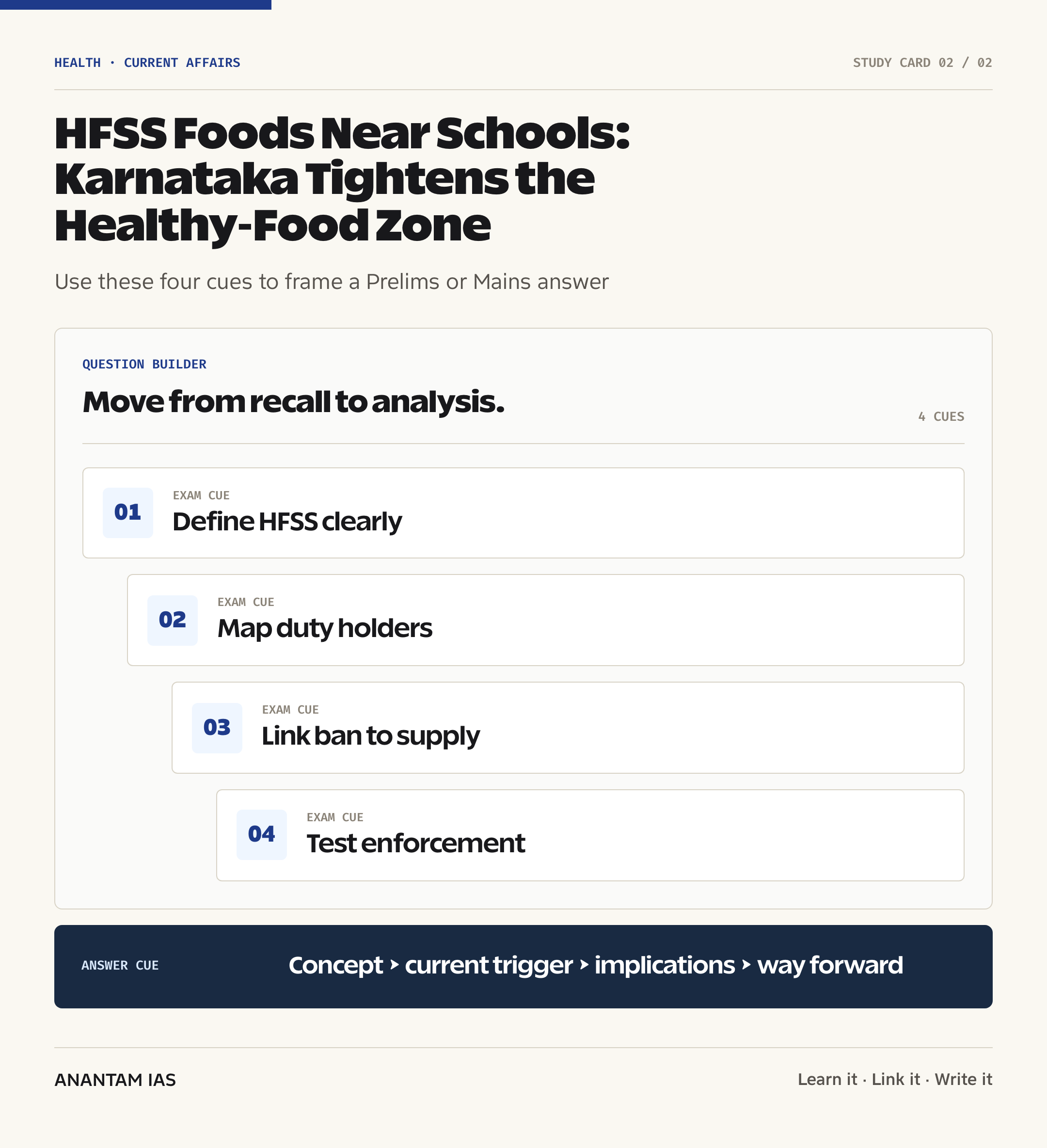
HFSS Foods Near Schools: Karnataka Tightens the Healthy-Food Zone revision visual
Revision visual for HFSS Foods Near Schools: Karnataka Tightens the Healthy-Food Zone.

Background and Context

What HFSS Means

HFSS is a policy shorthand for foods whose nutrient profile is high in fats, salt or sugar, but the legal test must follow the wording and standards of.

  • India’s school-food rules refer specifically to products high in saturated fat, trans-fat, added sugar or sodium, which is more precise than the everyday label junk food.
  • HFSS classification focuses on nutrient composition, not whether a product is packaged, foreign, branded or sold by a large company.
  • A broad food-category ban can misclassify products, so enforcement needs clear nutrient thresholds, labels, sampling protocols and reasoned orders.
  • The health concern is repeated exposure to energy-dense, nutrient-poor options that can displace balanced meals during a formative stage of life.
  • This topic complements the ICMR-NIN processed-food framework, which separates the degree of processing from nutritional quality.

The 2020 National Framework

The Food Safety and Standards (Safe Food and Balanced Diets for Children in School) Regulations, 2020 create duties for schools, food businesses and enforcement authorities.

  • A school authority that supplies meals must secure FBO registration; a school hiring a caterer must check that the operator is registered or licensed.
  • On-campus food businesses must meet sanitary and hygienic practices, display food-safety information and provide trained supervision where required.
  • The rules bar restricted products on the school campus and prohibit their sale or marketing to schoolchildren within 50 metres from the gate in any direction.
  • The marketing ban reaches free samples, coupons, rewards, sponsorships and branding on school property, not merely conventional advertisements.
  • Schools are encouraged to work towards an Eat Right Campus based on safe food, balanced diets, local seasonal food and reduced food waste.

Karnataka's Operational Push

Karnataka’s advisory converts the national framework into a visible compliance programme covering educational institutions and nearby food establishments.

  • The State advisory extends its operational directions across schools and colleges, while the central 2020 regulations are titled and defined around schoolchildren and schools.
  • Managements must use warning boards and check campus vendors; Food Safety Officers must inspect establishments near educational institutions.
  • The direction to nearby bakeries, hotels, canteens and stalls to obtain licences or registration addresses informality as well as food composition.
  • The 134 inspections and 53 samples create an evidence trail, but sanctions should follow laboratory results and due process rather than labels alone.
  • The State’s meal advice favours cereals, millets, pulses, dairy, eggs, fruits and vegetables and asks institutions to avoid reheated oils.

Why the School Food Environment Matters

Children’s diets reflect the availability, price, placement and promotion of food around them, making the school food environment a public-health intervention point.

  • Children spend a substantial part of the day at school, so repeated exposure can shape preferences and habits that continue into adulthood.
  • WHO’s 2026 school-food guideline supports nutrition standards for foods served or sold and nudges that make healthier choices easier.
  • WHO also recommends comprehensive mandatory protection from HFSS marketing because marketing affects children’s food choices, attitudes and dietary intake.
  • Healthy diets support learning, concentration and attendance, while long-term prevention can reduce avoidable non-communicable disease costs.
  • India faces a double burden of malnutrition: undernutrition and micronutrient gaps can coexist with overweight, obesity and metabolic risk.

Way Forward

Make the Rule Measurable

  • Publish a plain-language nutrient-profile protocol, illustrative product list, sampling method and appeal process for consistent decisions.
  • Geo-tag school gates and covered establishments so the 50-metre zone is clear to vendors, parents and enforcement teams.
  • Report inspections, test outcomes and corrective action in aggregated form through a public dashboard without naming children.

Conclusion

  • Karnataka’s advisory is best understood as an implementation test for preventive health governance .
  • Lasting impact will depend on precise standards, fair inspection and attractive healthy food.

UPSC Practice Questions

Prelims MCQ 1

With reference to India’s school-food regulations, consider the following statements:

  1. They were framed under the Food Safety and Standards Act, 2006.
  2. Their HFSS restriction is confined to food sold inside school canteens.
  3. A notified local body may help ensure compliance with the 50-metre rule.

How many of the above statements are correct?

(a) Only one (b) Only two (c) All three (d) None

Answer: (b) Only two

Explanation:

Statements 1 and 3 are correct. The 2020 regulations operate under the 2006 Act, and a notified municipal body, local body or panchayat may help enforce the external zone. Statement 2 is wrong because the restriction also reaches schoolchildren within 50 metres of the gate.

Prelims MCQ 2

Which institution is India’s national food-safety regulator?

(a) National Institute of Nutrition (b) Food Corporation of India (c) Food Safety and Standards Authority of India (d) Central Board of Indirect Taxes and Customs

Answer: (c) Food Safety and Standards Authority of India

Explanation:

FSSAI is the national regulator established under the Food Safety and Standards Act, 2006. NIN conducts nutrition research, while FCI primarily manages procurement, storage and distribution of foodgrains.

UPSC Mains Questions

  1. Regulating HFSS foods near schools is a test of preventive health as well as regulatory capacity. Analyse how nutrient standards, healthy alternatives, nutrition literacy and coordinated enforcement can convert a spatial restriction into durable gains for child health. (250 words)
  2. India’s school-food framework distributes responsibility across FSSAI, State Food Authorities, education departments, school managements and local bodies. Examine the strengths and accountability gaps of this multi-level design, with reference to Karnataka’s recent advisory and the challenge of enforcing the external food zone. (250 words)

Sources: Food Safety and Standards Authority of India and The Hindu.

Frequently Asked Questions

What are HFSS foods?

HFSS foods are foods high in fat, salt or sugar. India’s school-food regulations use the more specific formulation of products high in saturated fat, trans-fat, added sugar or sodium. The classification should rest on nutrient standards and evidence, not simply.

What does Karnataka’s advisory prohibit?

The July 24 advisory prohibits sale, free distribution, advertising and promotion of covered HFSS products on school and college campuses and within a 50-metre radius. It also directs institutions to display warnings, requires nearby food businesses to meet licensing.

Why is the 50-metre rule important?

The 50-metre zone extends child protection beyond the formal campus to the immediate food environment. It reduces the contradiction between nutrition education inside school and aggressive availability or promotion just outside the gate. Its impact depends on clear mapping, local-body.

Who enforces school food rules?

Enforcement is shared. FSSAI supplies the national regulatory framework; State Food Authorities conduct surveillance and inspections; school authorities control campus food; education departments can act on institutional non-compliance; and notified municipal bodies or panchayats may help enforce the rule around.

Does a ban alone improve nutrition?

A restriction can reduce exposure, but it won’t automatically produce a balanced diet. Schools also need affordable local meals, safe water, hygienic kitchens, nutrition education and student acceptance. Clear nutrient criteria matter because vague category labels can encourage inconsistent.
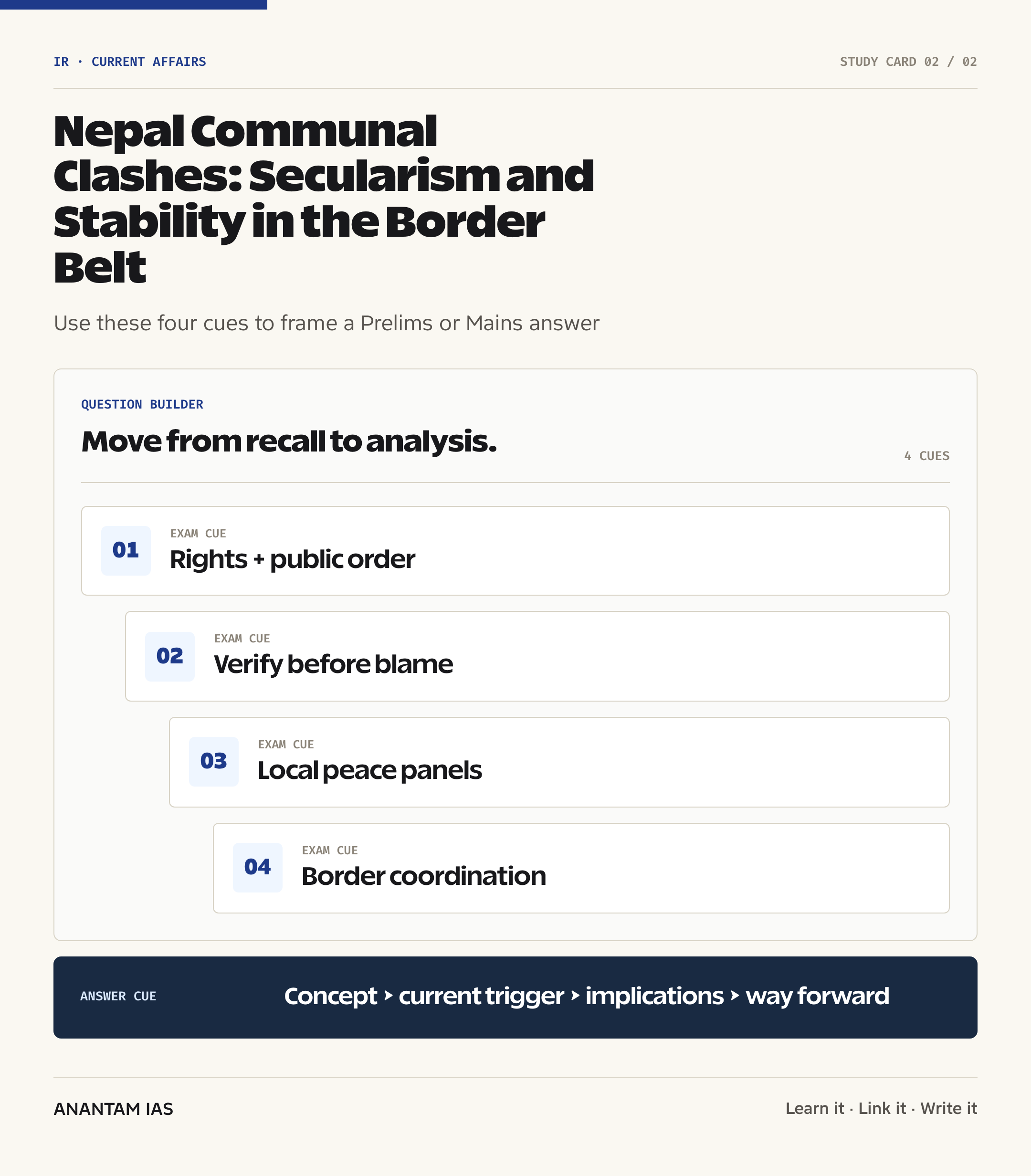

Nepal Communal Clashes: Secularism and Stability in the Border Belt

Open article →Download PDF

Why in News?

The Hindu examined recurring Hindu-Muslim tensions in Nepal’s southern plains after a fresh clash in Sunsari district , which borders the Indian State of Bihar.

  • The immediate trigger reported by police was an objection to loudspeakers used by a religious procession; the available official account does not establish a larger conspiracy or assign collective guilt to either community.
  • The confrontation escalated after more people gathered with sticks, bamboo poles, stones and spears, showing how a local dispute can rapidly become a crowd-control emergency.
  • Authorities deployed additional Nepal Police and Armed Police Force personnel, separated the groups and opened talks with community representatives.
  • The district administration urged residents to avoid rumours and cooperate with public-order measures, underlining the role of information integrity during communal tension.
  • The episode occurred in the Tarai-Madhesh border belt, where dense kinship, trade and mobility links make local stability relevant to both Nepal and India.
  • The clash tests the practical meaning of Article 4 of Nepal’s Constitution, which describes the country as secular and inclusive, alongside Article 26 on freedom of religion.
  • It connects civil liberties with public order: religious practice is protected, but violence, intimidation and breaches of public peace are not.
  • For India, the issue concerns a close neighbour with an open border and deep people-to-people contacts, not an invitation to interfere in Nepal’s domestic politics.

UPSC Relevance

Prelims Relevance

  • Article 4 defines Nepal as an independent, indivisible, sovereign, secular, inclusive, democratic, socialism-oriented, federal democratic republican State.
  • The explanation to Article 4 links secularism with religious and cultural freedoms, including protection of religion and culture handed down from time immemorial.
  • Article 18 guarantees equality before law and bars discrimination in the application of general laws on grounds including religion, race, caste, language and region.
  • Article 26 protects the freedom to profess, practise and protect one’s religion according to conviction, subject to specified constitutional limits.
  • Article 26 also protects the operation of religious sites and trusts, while allowing their regulation by law.
  • Nepal’s Constitution permits restrictions on expression that may harm harmonious relations among different religions or communities or incite an offence.

Mains Relevance

GS Paper 2

  • Constitutional secularism, equality and religious freedom under Articles 4, 18 and 26 of Nepal’s Constitution.
  • Balancing freedom of religion, freedom of expression and assembly with proportionate public-order restrictions.

GS Paper 1

  • Communalism as a process in which an immediate dispute is framed as conflict between entire religious communities.
  • The role of local institutions, trusted intermediaries and social cohesion in diverse border societies.

Essay

  • A secular Constitution acquires meaning through equal protection and everyday administrative fairness, not through labels alone.
Nepal Communal Clashes: Secularism and Stability in the Border Belt revision visual
Revision visual for Nepal Communal Clashes: Secularism and Stability in the Border Belt.

Background and Context

What Is Verified About the Sunsari Clash?

The incident record supports a limited factual account, while several broader claims circulating around it remain allegations or interpretation.

  • The clash occurred at night in Kaptanganj, ward 3 of Dewanganj Rural Municipality, during the annual Bolbam pilgrimage in the Hindu month of Shrawan.
  • Police said devotees returning from the Koshi Barrage were playing loud music when members of another community objected; a verbal dispute then escalated into physical violence.
  • Nepali media reported one death and 22 injuries, including injuries to Nepal Police and Armed Police Force personnel.
  • Police warning shots preceded live firing by Armed Police Force personnel, but authorities had not established why live rounds were used or how many were fired when the first detailed report was published.
  • This distinction matters: the proximate trigger is documented, but claims about organised direction, cross-border instigation or the intent of whole communities require separate evidence.

Nepal's Constitutional Secularism

Nepal’s 2015 Constitution places secularism inside a wider commitment to inclusion, equality, religious freedom and social harmony.

  • Article 4 calls Nepal secular and inclusive; its explanation gives secularism a Nepal-specific meaning that combines religious and cultural freedom with protection of inherited religion and culture.
  • Article 18 requires equality before law and equal protection, and it recognises Muslims among groups for whom protective, empowering or developmental provisions may be made.
  • Article 26(1) protects every person’s freedom to profess, practise and protect religion according to conviction.
  • Article 26(2) protects religious denominations’ right to operate and protect religious sites and trusts, subject to lawful regulation.
  • Article 26(3) withholds protection from conduct that breaches public peace, harms another’s religion or violates public health, decency and morality; religious freedom isn’t a defence for violence.

Secularism, Public Order and Equal Citizenship

A rights-based response must protect religious observance and public peace without assuming that the two are inherently opposed.

  • Authorities may regulate procession routes, sound levels, timing and assembly through clear, neutral and previously announced rules.
  • The same rules should apply across communities; selective permissions or selective enforcement can convert an administrative dispute into a claim of unequal citizenship.
  • Public-order restrictions should be necessary, time-bound and proportionate, with access to essentials, medical care and legal review preserved during curfew.
  • Police use of force needs a documented chain of command, graduated response, medical assistance and an independent review when live ammunition causes death or serious injury.
  • Victim protection and prosecution should be based on individual conduct and evidence, not religious identity, neighbourhood or online accusation.

Why Local Disputes Become Communal

Communal escalation is best understood as a sequence of governance failures and social reactions, not as an automatic feature of religious diversity.

  • A dispute over a loudspeaker, route, flag, social-media post or place of worship can become a symbolic contest when political entrepreneurs frame it as an attack on an entire faith.
  • Rumours spread faster when police information is delayed, contradictory or inaccessible in the languages used by local communities.
  • Retaliatory mobilisation expands the number of participants and makes it harder for community leaders to separate verified injury from accumulated grievance.
  • Heavy-handed or visibly unequal enforcement can weaken trust in institutions, while impunity for vandalism or hate speech can encourage copycat action.
  • This is an analytical risk chain, not a finding that every element caused the Sunsari incident; investigation must establish the facts in that case.

Way Forward

Establish the Incident Record

  • Complete an independent, time-bound inquiry into the sequence of violence and police firing, preserve video and ballistic evidence, and publish findings that protect witnesses and due process.
  • Prosecute assault, arson, vandalism, weapon possession and incitement on the basis of individual evidence, irrespective of religious affiliation.
  • Use advance route coordination, sound limits, liaison officers and written conditions for major religious processions and gatherings.
  • Train police in graduated crowd control, de-escalation, first aid and clear command responsibility for any use of firearms.

Conclusion

  • The Sunsari clash is a test of whether Nepal can turn constitutional commitments into equal protection, disciplined policing and credible accountability.
  • For India, the durable interest is a stable and inclusive Nepal and a trusted open border .

UPSC Practice Questions

Prelims MCQ 1

With reference to the Constitution of Nepal, consider the following statements:

  1. Article 4 describes Nepal as a secular and federal democratic republican State.
  2. Article 18 bars discrimination in the application of general laws on the ground of religion.
  3. Article 26 makes the freedom of religion absolute and removes all public-order limitations.

How many of the above statements are correct?

(a) Only one (b) Only two (c) All three (d) None

Answer: (b) Only two

Explanation:

Statements 1 and 2 are correct. Article 26 protects religious freedom but excludes conduct that breaches public peace or violates specified constitutional limits, so Statement 3 is incorrect.

Prelims MCQ 2

Article 7 of the 1950 India-Nepal Treaty of Peace and Friendship is chiefly associated with:

(a) Reciprocal privileges concerning residence, property, trade, commerce and movement (b) Creation of a common currency and central bank (c) Merger of the two countries’ armed forces (d) Delimitation of the India-Nepal-China tri-junction

Answer: (a) Reciprocal privileges concerning residence, property, trade, commerce and movement

Explanation:

Article 7 provides reciprocal privileges of a similar nature in residence, property ownership, participation in trade and commerce, movement and related matters. It creates neither a monetary union nor a common military.

UPSC Mains Questions

  1. Nepal’s recent communal clashes show that constitutional secularism depends on impartial local administration as much as formal rights. Examine how Nepal can reconcile religious freedom, equality and public order while preventing rumours and retaliatory mobilisation from converting local disputes into enduring communal conflict.
  2. Instability in Nepal’s southern plains has implications for India because of the open border and dense social ties, yet Nepal’s internal order remains a sovereign responsibility. Discuss the principles and practical mechanisms that should guide a cooperative, proportionate and non-intrusive Indian response.

Sources: Nepal Law Commission, Constitution of Nepal and The Hindu.

Frequently Asked Questions

What happened in Sunsari?

A dispute over loud music during a Bolbam religious procession in Kaptanganj escalated into violence on 26 July 2026. Nepali police accounts reported one death after Armed Police Force firing and 22 injuries, including 13 security personnel. An investigation was.

Is Nepal constitutionally secular?

Yes. Article 4 of the Constitution describes Nepal as a secular, inclusive and federal democratic republican State. Its explanation connects secularism with religious and cultural freedoms, including protection of inherited religion and culture. Articles 18 and 26 add equality guarantees.

What does Article 26 protect?

Article 26 protects every person’s freedom to profess, practise and protect religion according to conviction. It also protects religious denominations’ operation of religious sites and trusts, subject to lawful regulation. The right does not cover conduct that breaches public peace.

Why does the border belt matter?

The Tarai-Madhesh is linked with adjoining Indian districts through families, markets, transport, work and pilgrimage. Local unrest can interrupt movement and heighten anxiety on both sides. But lawful mobility is a core social and economic asset, so security measures should.

How should communal rumours be handled?

Authorities should publish frequent multilingual updates that distinguish confirmed facts from allegations, identify false claims and give practical safety directions. Police should preserve digital evidence and pursue unlawful incitement through due process. Targeted action is preferable to blanket communication shutdowns.

Court Livestream Archives: Access Controls Meet the Open-Justice Principle

Open article →Download PDF

Why in News?

On July 31, 2026 , the Supreme Court of India said it intended to frame a protocol governing how online users may post or circulate livestreamed court proceedings.

  • The July 24 interim order barred posting, reposting, extraction, modification, dissemination, monetisation, recording or review of livestreamed proceedings on social media or digital platforms without prior permission from the relevant court registry.
  • The order was passed in a petition filed by journalist Harshita Grover over selective clips, decontextualised circulation, trolling and commercial exploitation; it expressly said ordinary news reporting would not be affected.
  • Activists Anjali Bhardwaj and Amrita Johri argued that a broad circulation restraint reverses the open-justice principle and that authenticated court archives should remain accessible for fair and accurate public use.
  • The Court allowed their application to be considered and invited suggestions for a protocol; Meta, WhatsApp, High Courts and Bar bodies were also part of the consultative setting reported on July 31.
  • Chief Justice Surya Kant orally indicated that the objective was to prevent misuse and commercial exploitation, not to make the rule-making exercise adversarial.
  • This matters in the context of Article 19(1)(a): the right to speech includes the right to know and receive information about public judicial proceedings.
  • It also engages Article 21, because accessible proceedings can make access to justice real for litigants and citizens who cannot physically attend court.
  • The design problem is one of proportionality: restrictions should target demonstrable harms while preserving the public value of authentic, contextual records.

UPSC Relevance

Prelims Relevance

  • Open justice is the general principle that judicial proceedings should ordinarily be open to public observation, subject to narrow exceptions for privacy, safety and the administration of justice.
  • In Swapnil Tripathi v. Supreme Court of India (2018), the Court linked livestreaming with open justice, access to justice and the public’s right to receive information.
  • Article 19(1)(a) protects freedom of speech and expression; Supreme Court jurisprudence treats the right to know and receive information as one of its facets.
  • Article 21 protects life and personal liberty and has been read to include meaningful access to justice and fair procedure.
  • Article 145(1) empowers the Supreme Court, with the President’s approval and subject to parliamentary law, to make rules regulating its practice and procedure.
  • Article 145(4) requires Supreme Court judgments to be delivered in open court; it does not by itself create an unlimited right to rebroadcast every hearing.

Mains Relevance

GS Paper 2

  • Judiciary and governance: transparency, institutional accountability, public confidence and access to justice in a digital court system.
  • Fundamental rights: reconciling Article 19(1)(a), Article 21, privacy and fair-trial interests through proportionate safeguards.

GS Paper 4

  • Public-institution ethics: openness as a check on power, paired with duties of accuracy, context and non-exploitation.
  • Digital responsibility: distinguishing public-interest scrutiny from deceptive editing, harassment and monetised outrage.

Essay

  • Sunlight strengthens institutions only when the public can reach reliable, contextual information.
Court Livestream Archives: Access Controls Meet the Open-Justice Principle revision visual
Revision visual for Court Livestream Archives: Access Controls Meet the Open-Justice Principle.

Background and Context

What the July orders changed

The controversy moved from a case about abusive reuse to a wider debate over the architecture of public access.

  • On July 24, 2026, a three-judge Bench led by the Chief Justice prohibited unauthorised posting, reposting, extraction, modification, dissemination, monetisation, recording or review of court livestreams on digital platforms.
  • Prior permission was tied to the Secretary General of the Supreme Court or the concerned Registrar General of a High Court, making registry approval the interim access control.
  • The Court distinguished reuse of recordings from news reporting, which the order said would remain unaffected; the practical boundary between reporting and clip-based dissemination still needs clarity.
  • The petition identified genuine harms: selective clips may detach oral remarks from submissions, case facts and later clarification, while edited media can intensify trolling and reputational injury.
  • The July 31 hearing shifted attention toward an enduring protocol, including preservation of official archives and terms for authorised access or reuse.

Constitutional foundation of open justice

Open justice treats public observation as a structural safeguard, not as courtroom entertainment.

  • In Swapnil Tripathi (2018), the Supreme Court accepted livestreaming of cases of constitutional and national importance under a court-controlled framework.
  • The judgment connected the public’s right to witness proceedings with Article 19(1)(a), which includes receiving information, and Article 21, which gives substance to access to justice.
  • Open hearings support public confidence, permit faithful reporting, educate citizens about legal development and reduce the need for litigants to travel merely to watch proceedings.
  • The principle is not absolute. Courts may protect minors, survivors, witnesses, confidential business information, privileged communication and proceedings where publicity would harm justice.
  • A useful UPSC distinction is between an open court, public access to the hearing, and unrestricted republication of every audiovisual fragment; the second may be regulated without extinguishing the first.

What the Model Rules already provide

The e-Committee’s Model Rules show that access and safeguards can be built into the same system.

  • The official Model Rules for Live-Streaming and Recording of Court Proceedings were released for stakeholder input in 2021 and draw on Swapnil Tripathi.
  • Rule 5 makes streaming the general position subject to defined exclusions, while the Bench’s decision is to be guided by an open and transparent judicial process.
  • The feed may carry a ten-minute delay; a judge may pause it; personal data can be muted or redacted; and sensitive categories such as sexual offences, child protection and in-camera proceedings are excluded.
  • Rule 7 says recordings will be archived, permits courts to upload them wholly or partly, and creates an application route for copies not placed online.
  • Archived data should ordinarily remain for at least six months, stored in encrypted form with a hash value; vetted recordings are usually contemplated for posting within three days.

Why an official archive matters

A trusted archive can reduce both information scarcity and the power of misleading fragments.

  • A complete authorised version lets viewers check whether a viral clip omitted a qualification, a party’s response or the Bench’s final direction.
  • Searchable case metadata, hearing dates and stable URLs create provenance, which means a user can trace a clip to its official source and context.
  • Captions, transcripts and accessible players widen access for persons with disabilities, students, journalists and citizens facing linguistic or geographic barriers.
  • An archive also supports judicial accountability: public officials, including judges and lawyers, know that courtroom conduct can be examined in full rather than remembered selectively.
  • Related Anantam IAS notes on emergency access to constitutional courts show the same governance lesson: an access right needs an operational channel, not only a constitutional statement.

Way Forward

Build public-by-default archives

  • Publish the vetted full recording, case number, Bench, hearing date and relevant order on a stable official archive, except where a reasoned exclusion applies.
  • Set clear retention periods longer than a bare operational minimum for matters of constitutional or lasting public importance.
  • Provide captions, transcripts, language support and disability access so openness is substantive, not merely technical.

Conclusion

  • The choice is not between unrestricted virality and a closed courtroom.
  • For constitutional governance, the strongest solution is a trusted official archive backed by precise, proportionate and reviewable safeguards.

UPSC Practice Questions

Prelims MCQ 1

With reference to live streaming of court proceedings in India, consider the following statements:

  1. The Supreme Court has linked the right to receive information about public court proceedings with Article 19(1)(a).
  2. Article 145(4) expressly requires every hearing before the Supreme Court to be live streamed.
  3. The e-Committee Model Rules contemplate archival retention and restricted access to recordings not uploaded online.

How many of the above statements are correct?

(a) Only one (b) Only two (c) All three (d) None

Answer: (b) Only two

Explanation:

Statements 1 and 3 are correct. Article 145(4) concerns delivery of Supreme Court judgments in open court; it does not command livestreaming of every hearing.

Prelims MCQ 2

Which one of the following best describes the status of archived recordings under the e-Committee Model Rules?

(a) They automatically replace the signed court record (b) They must be kept permanently in every case (c) They are not the official record unless the Bench directs otherwise (d) They may be commercially republished without court permission

Answer: (c) They are not the official record unless the Bench directs otherwise

Explanation:

The Model Rules distinguish archival data from the official record. They also contemplate controlled access, court copyright and restrictions on unauthorised or commercial reuse.

UPSC Mains Questions

  1. The open-justice principle cannot be reduced either to unrestricted circulation or to physical access inside a courtroom. Examine this statement in light of the Supreme Court’s proposed protocol for livestream archives, with reference to Articles 19(1)(a) and 21.
  2. Design a proportionate governance framework for reuse of livestreamed judicial proceedings. Discuss how official archives, privacy safeguards, platform duties and reviewable permission rules can protect both public accountability and the integrity of justice.

Sources: Supreme Court e-Committee Model Rules and The Hindu.

Frequently Asked Questions

What is the open-justice principle?

Open justice means that court proceedings are ordinarily visible to the public so judicial power can be scrutinised and fairly reported. It supports confidence, accountability and legal education. Courts may still limit access where privacy, witness safety, child protection, confidentiality.

What did the Supreme Court say on July 31?

The Court said it intended to frame a protocol for online posting and circulation of livestreamed proceedings. It invited suggestions while considering activists’ objections to the July 24 interim restrictions. The reported aim was to prevent misuse and commercial exploitation.

What was the July 24 interim restriction?

It prohibited unauthorised posting, reposting, extraction, modification, dissemination, monetisation, recording or review of livestreamed judicial proceedings on social media and digital platforms without permission from the concerned court registry. The order expressly stated that it would not affect news reporting.

Why is Swapnil Tripathi important?

In Swapnil Tripathi v. Supreme Court of India (2018), the Court accepted court-controlled livestreaming as an instrument of open justice. It linked public access to the right to receive information under Article 19(1)(a) and meaningful access to justice under Article.

How long do Model Rules retain archives?

The e-Committee Model Rules say archived data should ordinarily be retained for at least six months, subject to special directions in a case and practice directions of the concerned Chief Justice. They also contemplate encrypted storage with a specific hash.

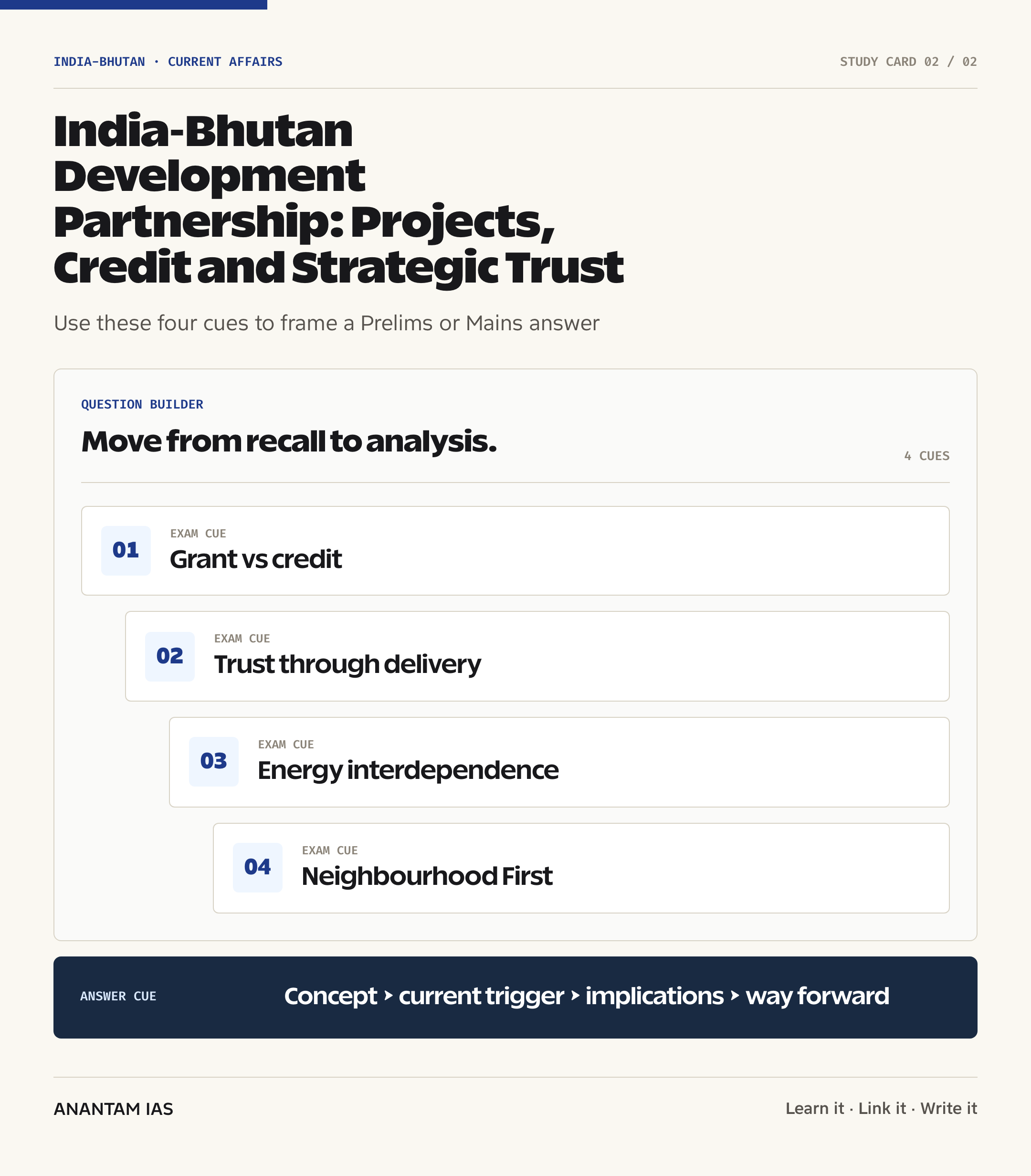
India-Bhutan Development Partnership: Projects, Credit and Strategic Trust

Open article →Download PDF

Why in News?

At the fifth India-Bhutan Development Cooperation Talks in Thimphu on 30-31 July 2026 , Foreign Secretary Vikram Misri and Bhutanese Foreign Secretary Pema Lektup Dorji reviewed India’s support for Bhutan’s 13th Five-Year Plan .

  • The new 12 PTA projects cover infrastructure, healthcare, agriculture, urban amenities and disaster management.
  • The cumulative approved portfolio now stands at 82 PTA projects worth ₹6,860 crore under Bhutan’s 13th Plan.
  • India’s total committed support for the 2024-29 Plan is ₹10,000 crore across project aid, local projects, economic stimulus and budget support.
  • The two sides inaugurated Thimphu Ecological Park and Olakha Park and handed over 45 electric vehicles to Bhutan.
  • An AIIMS New Delhi-KGUMSB MoU was exchanged for research and exchange programmes in health education and training.
  • This matters in the context of India’s Neighbourhood First approach, where timely delivery can convert geographic proximity into durable goodwill.
  • The blend of grants and concessional credit shows that development partnership is moving beyond isolated projects toward long-term productive capacity.
  • Energy cooperation creates mutual interdependence: Bhutan gains investment and export revenue, while India gains clean power and a stable Himalayan partner.

UPSC Relevance

Prelims Relevance

  • Bhutan’s 13th Five-Year Plan covers 2024-29; India has committed ₹10,000 crore in support.
  • Project Tied Assistance funds agreed medium-to-large projects linked to identified sectors and implementation outcomes.
  • High Impact Community Development Projects are smaller, short-gestation works implemented mainly through local governments.
  • The other support windows are the Economic Stimulus Programme and Programme Grant, the latter functioning as direct budgetary support.
  • A Line of Credit is repayable financing on agreed terms; it isn’t the same as grant assistance.
  • The ₹4,000-crore energy LoC is to be operationalised through the EXIM Bank of India and the Royal Government of Bhutan.

Mains Relevance

GS Paper 2

  • Use the case to explain Neighbourhood First, asymmetric interdependence and the role of demand-driven development cooperation in building trust with smaller neighbours.
  • Assess how project delivery, high-level political contact and respect for Bhutanese priorities strengthen India’s strategic credibility in the eastern Himalaya.

GS Paper 3

  • Connect the energy LoC to cross-border electricity trade, renewable integration, grid connectivity and regional energy security.
  • Evaluate Himalayan infrastructure through the lenses of disaster resilience, ecological safeguards, financing quality and lifecycle maintenance.

Essay

  • Trust between unequal neighbours is built through consultation, reliability and restraint, not financial scale alone.
India-Bhutan Development Partnership: Projects, Credit and Strategic Trust revision visual
Revision visual for India-Bhutan Development Partnership: Projects, Credit and Strategic Trust.

Background and Context

The Institutional Foundation of India-Bhutan Ties

The relationship rests on a treaty framework, frequent political engagement and a habit of joint consultation.

  • The India-Bhutan Friendship Treaty of 2007 updated the 1949 treaty and affirms perpetual peace, friendship and close cooperation on national interests.
  • The treaty also states that neither country will allow its territory to be used for activities harmful to the security and interests of the other.
  • Regular contacts among the King of Bhutan, the two prime ministers, foreign ministers and officials help prevent routine implementation issues from becoming political distrust.
  • The latest talks were co-chaired by the two Foreign Secretaries, reflecting an institutional process rather than a one-off announcement.
  • India and Bhutan also work in wider regional settings; their bilateral confidence supports practical cooperation within BIMSTEC’s regional agenda.

How the ₹10,000-Crore Plan Support Is Structured

India’s commitment is divided among instruments designed for different scales and policy purposes.

  • Of the ₹10,000 crore committed for 2024-29, ₹7,000 crore is earmarked for Project Tied Assistance, ₹1,000 crore for HICDPs, ₹1,500 crore for the Economic Stimulus Programme and ₹500 crore for Programme Grant.
  • PTA projects support larger sectoral priorities such as health, education, agriculture, infrastructure, energy, urban development and capacity building.
  • HICDPs, historically also called Small Development Projects, focus on quick local benefits such as water supply, irrigation, farm roads and community facilities.
  • The Economic Stimulus Programme seeks to revive Bhutan’s domestic economy through support for priority sectors, enterprises, skills and employment.
  • The Programme Grant is direct budgetary support, giving Bhutan policy space within its own expenditure priorities.

What the Fifth Plan Talks Added

The July 2026 meeting paired approval of new works with a review of funds already committed and released.

  • The 12 new PTA projects worth ₹332 crore take the approved PTA portfolio to 82 projects worth ₹6,860 crore.
  • The MEA recorded releases of ₹1,250 crore for ESP, ₹735.20 crore for HICDPs and ₹200 crore as Programme Grant.
  • Reviewing utilisation is as important as announcing allocations because absorptive capacity, procurement, terrain and coordination can slow Himalayan projects.
  • The two parks in Thimphu show an urban public-goods dimension, while the 45 electric vehicles connect development aid with cleaner mobility.
  • The health MoU links AIIMS New Delhi with Khesar Gyalpo University of Medical Sciences of Bhutan for research, education and exchange, adding institutional depth beyond physical construction.

Grant Assistance and Line of Credit Are Different

UPSC answers should separate non-repayable assistance from repayable development finance.

  • A grant doesn’t create a repayment obligation and is suited to public goods, community works and budget support where direct financial returns may be limited.
  • A Line of Credit is a borrowing window with agreed terms, purpose and disbursement conditions; the borrower repays the amount according to the contract.
  • The new ₹4,000-crore concessional LoC is intended for energy projects and is operationalised through EXIM Bank of India.
  • Concessional finance can support productive assets, but appraisal must test project viability, repayment capacity, tariff assumptions and construction risk.
  • The distinction helps avoid a common error: adding a credit line to plan grants and describing the whole amount as aid.

Way Forward

Deliver the Approved Portfolio Well

  • Create joint milestone dashboards for the 82 PTA projects, with early escalation of land, procurement, design and contractor bottlenecks.
  • Publish outcome indicators for health, agriculture, urban services and disaster management, not just financial utilisation figures.
  • Protect operation and maintenance budgets so completed assets remain useful after the construction phase.

Conclusion

  • The July 2026 outcomes show why India-Bhutan relations are best understood as an ecosystem of treaties, political trust, development delivery and economic interdependence.
  • For India, the real strategic return won’t come from announcing the largest figure.

UPSC Practice Questions

Prelims MCQ 1

With reference to India’s support for Bhutan’s 13th Five-Year Plan, consider the following statements:

  1. The Plan period is 2024-29.
  2. Project Tied Assistance and High Impact Community Development Projects are both components of the support package.
  3. Programme Grant is a credit line that must be repaid through electricity exports.

How many of the above statements are correct?

(a) Only one (b) Only two (c) All three (d) None

Answer: (b) Only two

Explanation:

Statements 1 and 2 are correct. Programme Grant is direct budgetary support, not a repayable electricity-linked credit line.

Prelims MCQ 2

The ₹4,000-crore India-Bhutan umbrella Line of Credit agreement announced in July 2026 is primarily intended for:

(a) Energy projects in Bhutan (b) A common regional currency (c) Defence equipment purchases (d) Contributions to the SAARC Development Fund

Answer: (a) Energy projects in Bhutan

Explanation:

The agreement between the Royal Government of Bhutan and EXIM Bank of India operationalises a concessional LoC for energy projects.

UPSC Mains Questions

  1. India’s development partnership with Bhutan works through grants, concessional credit, institution-building and political consultation. Examine how these instruments can strengthen strategic trust while preserving Bhutanese ownership, fiscal prudence and environmental safeguards. Use the July 2026 Plan Talks as an example. (250 words)
  2. Energy interdependence is both an anchor and a source of risk in India-Bhutan relations. Discuss the economic and strategic gains from cross-border power cooperation, and suggest measures to address project delays, geological uncertainty, ecological stress, financing risks and changing electricity markets. (250 words)

Sources: Ministry of External Affairs, Government of India and The Indian Express.

Frequently Asked Questions

What were the July 2026 Plan Talks?

They were the fifth India-Bhutan Development Cooperation Talks for Bhutan’s 13th Five-Year Plan. The two foreign secretaries reviewed India’s ₹10,000-crore support package, approved 12 new projects, examined fund utilisation and witnessed exchanges covering an energy credit line and health education.

What is Project Tied Assistance?

Project Tied Assistance funds identified medium-to-large development projects agreed by India and Bhutan. The projects are tied to approved purposes and implementation plans in sectors such as health, education, agriculture, infrastructure, energy, urban development and capacity building, unlike untied direct.

Is the ₹4,000-crore LoC a grant?

No. A Line of Credit is repayable financing under agreed terms, although concessional conditions can make it cheaper than ordinary commercial borrowing. The July 2026 umbrella agreement between Bhutan and EXIM Bank of India is intended to finance energy projects.

Why is energy central to India-Bhutan ties?

Bhutan can use energy projects to generate revenue, infrastructure and technical capacity, while India gains access to clean electricity and a stable cross-border power partner. The relationship is mutually beneficial, but it also requires careful treatment of construction risk, tariffs.

How does development cooperation create strategic trust?

Trust grows when projects reflect Bhutanese priorities, funds arrive predictably, construction is completed well and citizens receive visible benefits. Transparent financing, local capacity building and respect for Bhutan’s sovereignty matter more than the headline value of assistance. Reliable delivery.

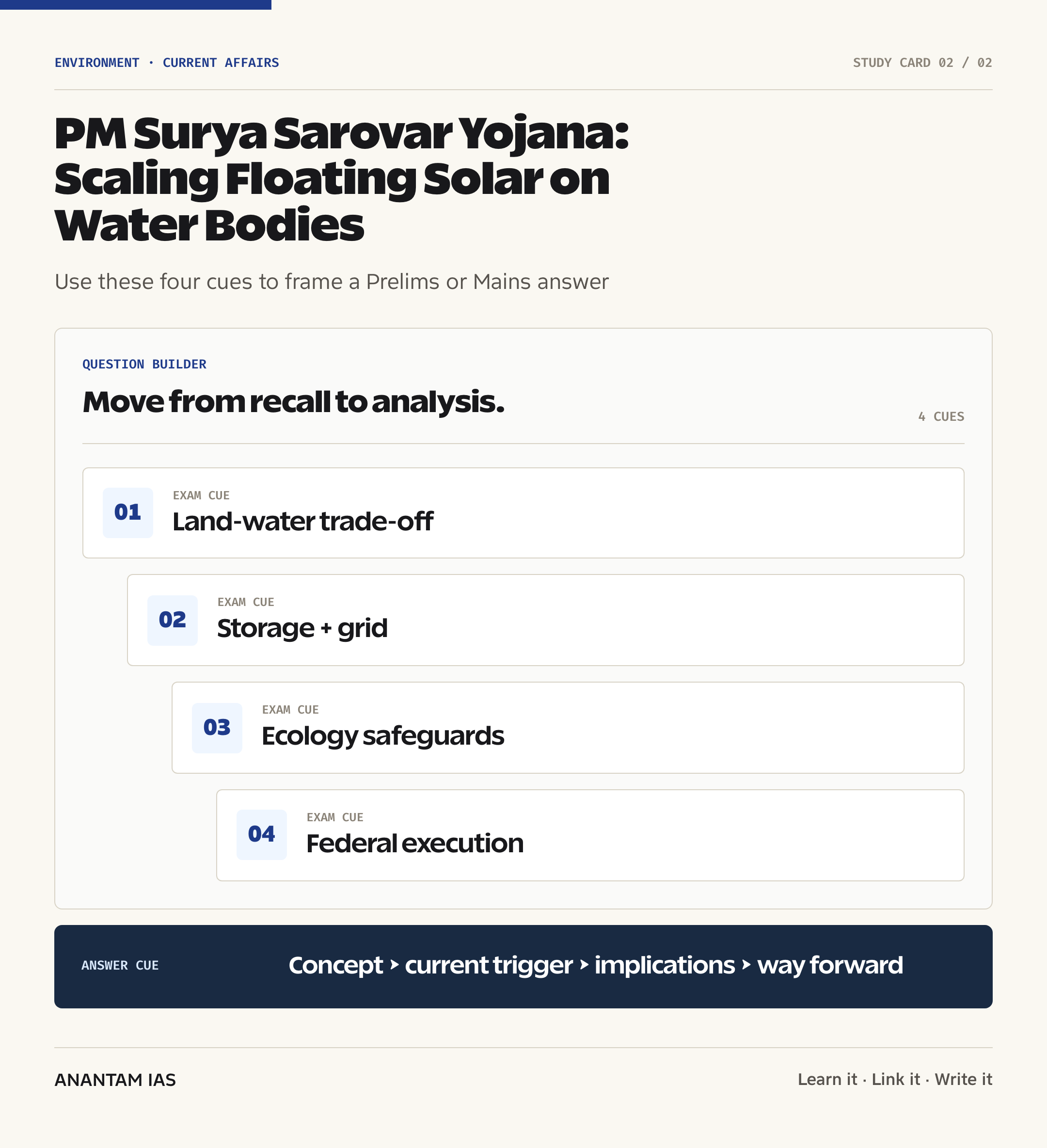
PM Surya Sarovar Yojana: Scaling Floating Solar on Water Bodies

Open article →Download PDF

Why in News?

The Union Cabinet approved the Pradhan Mantri Surya Sarovar Yojana (PM-SSY) on 31 July 2026 to develop floating solar photovoltaic projects with co-located energy storage across reservoirs and suitable inland water bodies.

  • Projects will be sanctioned from FY 2026-27 to FY 2030-31, while financial-support disbursement may continue up to FY 2032-33.
  • Eligible projects can receive central financial assistance of ₹1 crore per MW after successful commissioning.
  • Each project may receive up to ₹50 lakh for feasibility work such as bathymetry, hydrography and environmental studies.
  • The scheme aims to raise India’s floating-solar capacity from about 700 MW by adding 5,000 MW.
  • PIB projects about 10 million tonnes of annual CO2 reduction and 16,000-17,000 full-time-equivalent jobs across the value chain.
  • The policy matters in the context of India’s 500 GW non-fossil electricity-capacity target by 2030 and the land pressure created by utility-scale renewable projects.
  • It links renewable-energy expansion with water governance, because reservoirs are multipurpose ecological and livelihood systems rather than vacant surfaces.
  • Mandatory storage shifts the policy question from adding intermittent capacity to building more dispatchable renewable electricity and a more reliable grid.

UPSC Relevance

Prelims Relevance

  • Floating solar photovoltaic (FSPV) systems mount solar modules on buoyant platforms anchored or moored on reservoirs, ponds or other suitable water bodies.
  • PM-SSY is a Central scheme for 5,000 MW of FSPV paired with at least two-hour energy storage.
  • The programme’s minimum storage scale is 10,000 MWh: 5,000 MW multiplied by two hours.
  • The implementing policy ministry is the Ministry of New and Renewable Energy; project selection and execution involve specialised renewable-energy agencies and State-level water and power authorities.
  • The National Institute of Solar Energy (NISE) assessed India’s floating-solar potential at about 102.18 GWp across reservoirs and suitable inland water bodies.
  • Bathymetry measures underwater depth and topography, while hydrography studies the physical features and behaviour of water bodies relevant to project design.

Mains Relevance

GS Paper 3

  • Renewable-energy transition, climate mitigation, energy security and the role of storage-backed solar in grid reliability.
  • Benefits and environmental risks of deploying infrastructure on reservoirs, including effects on water quality, aquatic ecology, fisheries and dam operations.

GS Paper 2

  • Centre-State coordination across energy, irrigation, environment and local-governance institutions for projects on shared water assets.
  • Use of transparent appraisal, public consultation and cumulative-impact assessment to reconcile national climate goals with local rights and livelihoods.

Essay

  • The energy transition succeeds when innovation solves one scarcity without creating another.
PM Surya Sarovar Yojana: Scaling Floating Solar on Water Bodies revision visual
Revision visual for PM Surya Sarovar Yojana: Scaling Floating Solar on Water Bodies.

Background and Context

How Floating Solar Works

Floating solar adapts conventional photovoltaic generation to a water-based platform, but the supporting engineering is site-specific.

  • Solar modules sit on buoyant floats connected into arrays, while anchoring and mooring systems restrain movement caused by wind, waves and changing water levels.
  • Cables carry electricity from the floating array to inverters and grid-connection equipment on shore or on dedicated platforms.
  • Reservoir operation changes the engineering design: water-level variation affects cable length, anchor loads, access routes and maintenance planning.
  • Water can cool modules and improve operating efficiency, while the water surface can reduce dust deposition compared with arid ground-mounted sites.
  • The technology’s additional floats, anchors, specialised cables and marine-grade components make it costlier and more complex than ordinary ground-mounted solar.

Scheme Architecture and Incentives

PM-SSY uses commissioning-linked support and project-preparation grants to address both capital cost and early-stage uncertainty.

  • The programme combines 5,000 MW of FSPV with co-located energy storage of at least two hours for every supported project.
  • The ₹1-crore-per-MW CFA becomes available only after successful commissioning, tying public support to completed capacity rather than proposals alone.
  • The separate ₹50-lakh feasibility grant recognises that reliable depth, water-level, environmental and geotechnical data are prerequisites for bankable designs.
  • Sanctions run through FY 2030-31, giving agencies a phased pipeline, while disbursement up to FY 2032-33 accounts for construction and commissioning time.
  • The all-India scope allows States with large reservoirs but limited inexpensive land to diversify their solar portfolios.

Why Land and Storage Matter

The scheme responds to two structural limits of rapid solar expansion: land conflict and variable generation.

  • Large ground-mounted projects require contiguous land and can create disputes involving agriculture, grazing, biodiversity, rehabilitation and transmission corridors.
  • Using existing reservoirs and industrial ponds can reduce direct land acquisition, but shore facilities, transmission lines and access roads still have a land footprint.
  • Solar output peaks during daylight and falls rapidly in the evening, creating a balancing challenge commonly discussed as the evening ramp.
  • A two-hour energy storage system can shift part of daytime generation to later demand periods and provide grid-support services, depending on project design and dispatch rules.
  • Storage does not make solar continuously available; its value depends on charge-discharge cycles, degradation, power rating, market signals and grid needs.

National Potential and Strategic Gains

The supported capacity is a small share of assessed potential, making the scheme a market-building intervention rather than a complete deployment plan.

  • NISE estimated about 102.18 GWp of technical potential after considering suitable reservoirs and inland water bodies; technical potential is not the same as economically or environmentally deployable capacity.
  • Adding 5,000 MW would be more than seven times the current base of roughly 700 MW, helping developers build operating experience and supply chains.
  • Domestic demand can support manufacturing of flotation systems, modules, cells, storage systems, cables and anchoring components under Aatmanirbhar Bharat.
  • Geographic diversification can place solar generation closer to demand centres and hydropower or irrigation infrastructure, subject to available grid evacuation.
  • PIB estimates 16,000-17,000 full-time-equivalent jobs, but durable employment will depend on domestic value addition, operations and maintenance, and skills development.

Way Forward

Apply a Water-Body Suitability Framework

  • Screen sites for ecological sensitivity, reservoir purpose, water-level variation, extreme-weather exposure, grid access and livelihood dependence before tendering.
  • Exclude protected, biodiversity-rich or heavily livelihood-dependent zones where mitigation cannot reduce impacts to acceptable levels.
  • Begin with conservative array coverage and require adaptive management based on water-quality and ecosystem monitoring.
  • Create common national protocols while allowing State regulators and reservoir managers to tighten standards for local conditions.

Conclusion

  • PM Surya Sarovar Yojana is a strategic attempt to expand solar capacity without repeating the land footprint of conventional parks.
  • Its success will depend on treating reservoirs as living multipurpose systems , not unused real estate.

UPSC Practice Questions

Prelims MCQ 1

With reference to the Pradhan Mantri Surya Sarovar Yojana, consider the following statements:

  1. It targets 5,000 MW of floating solar photovoltaic capacity.
  2. Supported projects must include energy storage of at least two hours.
  3. Central financial assistance is payable only before project commissioning.

How many of the above statements are correct?

(a) Only one (b) Only two (c) All three (d) None

Answer: (b) Only two

Explanation:

Statements 1 and 2 are correct. The scheme targets 5,000 MW with at least two-hour storage. The ₹1-crore-per-MW CFA is provided after successful commissioning, so Statement 3 is incorrect.

Prelims MCQ 2

In the context of floating solar projects, bathymetry is primarily used to:

(a) Measure underwater depth and topography (b) Estimate the carbon content of solar modules (c) Forecast electricity demand at substations (d) Determine the chemical composition of battery cells

Answer: (a) Measure underwater depth and topography

Explanation:

Bathymetry maps underwater depth and terrain. It informs anchoring, mooring, cable routing and safe placement of floating arrays.

UPSC Mains Questions

  1. The Pradhan Mantri Surya Sarovar Yojana seeks to address land scarcity and renewable-energy intermittency together. Examine its potential contribution to India’s energy transition and discuss the ecological, social and institutional safeguards needed for projects on multipurpose water bodies.
  2. Floating solar with co-located battery storage can diversify India’s renewable-energy geography, but technical capacity is not equivalent to sustainable deployable capacity. Analyse this statement with reference to grid integration, reservoir governance, project economics and aquatic ecosystems.

Sources: PIB, Ministry of New and Renewable Energy and The Hindu.

Frequently Asked Questions

What is PM Surya Sarovar Yojana?

It is a Central scheme approved in July 2026 to develop 5,000 MW of floating solar photovoltaic projects on reservoirs and suitable inland water bodies. Every supported project must include co-located energy storage of at least two hours, taking the.

What is the scheme’s total outlay?

The Union Cabinet approved a total outlay of ₹5,070 crore. Eligible projects may receive central financial assistance of ₹1 crore per MW after commissioning, while up to ₹50 lakh per project can support feasibility studies, environmental work, bathymetry, hydrography and.

Why is battery storage mandatory?

Solar generation is variable and concentrated in daylight hours. At least two hours of storage can shift some electricity to later demand periods, support ramping and improve grid reliability. The practical benefit will depend on dispatch rules, battery efficiency, degradation.

How much floating-solar potential does India have?

The National Institute of Solar Energy estimated about 102.18 GWp of technical potential across reservoirs and suitable inland water bodies. This is a screening estimate, not a deployable target. Economic viability, reservoir operations, ecological sensitivity, grid access and livelihood dependence.

Does floating solar have environmental risks?

Yes. Large arrays may affect light penetration, water temperature, dissolved oxygen, habitats, fisheries and access to water. Project impacts vary by site and coverage. Baseline studies, conservative coverage limits, biodiversity buffers, water-quality monitoring, public consultation and decommissioning plans are essential.

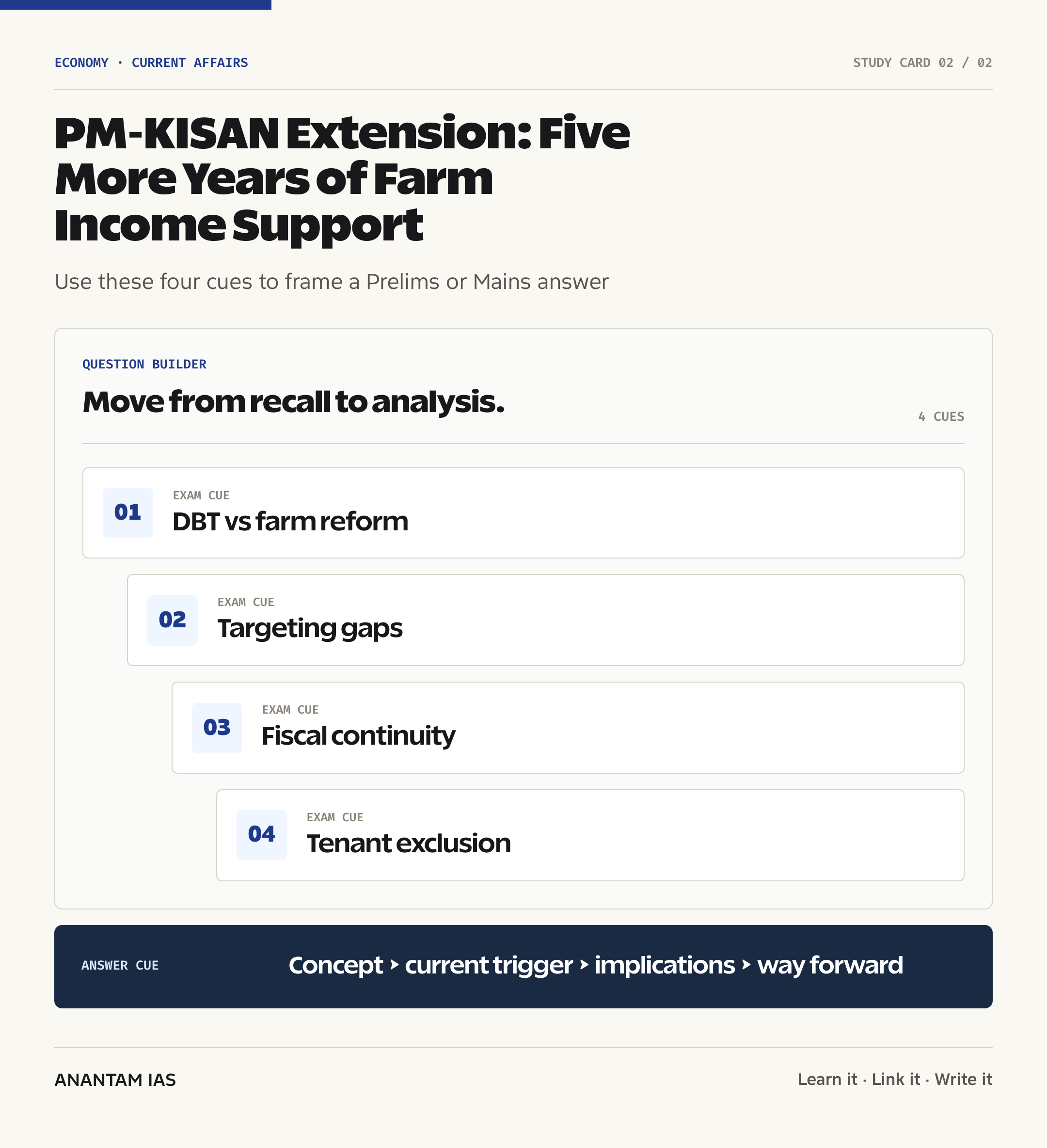
PM-KISAN Extension: Five More Years of Farm Income Support

Open article →Download PDF

Why in News?

The Union Cabinet has approved continuation of the Pradhan Mantri Kisan Samman Nidhi (PM-KISAN) for five financial years, from 2026-27 to 2030-31 .

  • The continuation covers five years, from FY 2026-27 through FY 2030-31.
  • The Cabinet-approved financial envelope is ₹3.15 lakh crore, an arithmetic average of about ₹63,000 crore a year across the approved period.
  • The official statement said over ₹4.47 lakh crore had already reached farmer bank accounts through 23 instalments.
  • The 23rd instalment transferred ₹18,984 crore to more than 9.49 crore farmers, according to the Cabinet statement reported by The Indian Express.
  • The official PM-KISAN portal continues to describe the benefit as ₹6,000 per year in three equal instalments for eligible landholding farmer families.
  • The decision matters in the context of farm-income volatility: a predictable cash transfer can help meet seasonal input expenses even when crop prices, rainfall or yields are uncertain.
  • It also matters for fiscal policy: a five-year outlay improves budget visibility, but the transfer must be assessed for adequacy, targeting quality and opportunity cost.
  • The extension places renewed attention on land-record-based eligibility, which can exclude tenants, sharecroppers and women cultivators who farm without recorded title.

UPSC Relevance

Prelims Relevance

  • PM-KISAN is a Central Sector Scheme with 100% funding by the Union government.
  • The scheme became operational from 1 December 2018 and was formally launched on 24 February 2019.
  • Eligible landholding farmer families receive ₹6,000 a year in three equal instalments of ₹2,000.
  • For the scheme, a farmer family is defined as husband, wife and minor children who collectively own cultivable land as per state or Union Territory records.
  • The benefit is transferred directly to bank accounts through DBT; eKYC is mandatory for registered beneficiaries.
  • State and Union Territory administrations identify eligible families, verify records and upload beneficiary details, while the Centre finances the benefit.

Mains Relevance

GS Paper 3

  • Assess direct income support as an instrument for farm welfare, agricultural investment and reduction of dependence on informal credit.
  • Examine whether a flat ₹6,000 annual transfer remains adequate amid rising input costs and regional differences in cultivation expenses.

GS Paper 2

  • Analyse Centre-State administrative coordination in a fully centrally funded scheme whose beneficiary identification depends on state land and family records.
  • Discuss how digital welfare delivery can reduce leakage while also creating exclusion through faulty land records, Aadhaar mismatches, failed eKYC or bank-account errors.

Essay

  • A welfare state must combine predictable support with capabilities that help citizens become less vulnerable.
PM-KISAN Extension: Five More Years of Farm Income Support revision visual
Revision visual for PM-KISAN Extension: Five More Years of Farm Income Support.

Background and Context

What PM-KISAN is designed to do

PM-KISAN provides a modest, predictable income supplement rather than compensation linked to a particular crop, loss or market price.

  • The scheme is crop-neutral: payment does not depend on what a farmer grows, the area sown in a season or whether produce is sold through a notified market.
  • The current benefit is ₹6,000 per year, paid as three ₹2,000 instalments at roughly four-month intervals into the beneficiary’s bank account.
  • Because it is a Central Sector Scheme, the Union bears the benefit cost; states and Union Territories perform the critical identification and verification work.
  • The transfer is intended to support agricultural inputs and household liquidity, especially before sowing, without the delay and discretion associated with physical distribution.
  • A concise scheme overview is available in the site’s PM-KISAN study notes.

How the DBT chain works

The delivery architecture separates beneficiary verification from payment execution while linking both through a digital trail.

  • States and Union Territories identify eligible farmer families from land and family records, verify the particulars and upload them to the scheme portal.
  • Fund Transfer Orders move through the Public Financial Management System (PFMS) and the banking network so the amount reaches the beneficiary account directly.
  • Aadhaar seeding and eKYC help detect duplicates and establish identity, while validated bank details are needed to prevent payment rejection.
  • The official operational guidelines assign states responsibility for correcting incomplete bank data and reconciling failed transactions, making local administrative capacity decisive.
  • The wider AgriStack architecture can improve record interoperability, but any integration needs consent, correction and grievance safeguards.

Scale and evidence cited with the extension

The Cabinet statement paired the future outlay with cumulative transfer and evaluation data to support continuation.

  • More than ₹4.47 lakh crore had been transferred to farmer bank accounts through 23 instalments since the scheme began.
  • During the COVID-19 pandemic, the statement said more than ₹1.71 lakh crore was disbursed, showing the value of an existing payment rail during an economy-wide shock.
  • Women farmers had received more than ₹1.06 lakh crore, and the statement described nearly one in four beneficiaries as a woman.
  • A Development Monitoring and Evaluation Office assessment cited in the statement found that over 92% of beneficiaries reported using assistance for agricultural activities or investment.
  • The same assessment said about 85% reported improved agricultural income and lower dependence on informal credit; these are beneficiary-reported outcomes, not a claim that the transfer alone caused every improvement.

Why five-year continuity matters

Policy continuity changes both household expectations and the government’s medium-term budget commitments.

  • For farmers, a known payment calendar provides predictable liquidity that can be planned around seed, fertiliser, labour or other seasonal expenses.
  • For the Union, a ₹3.15 lakh crore envelope makes the scheme a continuing component of expenditure through 2030-31 rather than a one-year budget choice.
  • The arithmetic average of about ₹63,000 crore per year is a planning indicator; actual annual spending will depend on verified beneficiary numbers and payment success.
  • A longer horizon also creates a window to improve beneficiary databases, grievance handling and payment reliability instead of treating each instalment as an isolated event.
  • But continuation should not freeze the design: periodic evaluation must test adequacy, inclusion, agricultural use and regional variation.

Way Forward

Protect eligible farmers from administrative exclusion

  • Create assisted eKYC and bank-correction camps at panchayat level before every instalment cut-off, with special outreach to older farmers and remote villages.
  • Give every withheld or failed payment a specific reason code, a simple correction workflow and a time-bound appeal that can be tracked by the farmer.
  • Synchronise land mutation, death, inheritance and family records regularly while preserving human review for disputed or exceptional cases.

Conclusion

  • The five-year extension makes PM-KISAN a durable part of India’s farm-support architecture through 2030-31 .
  • Its next phase should be judged by more than the ₹3.15 lakh crore outlay.

UPSC Practice Questions

Prelims MCQ 1

With reference to PM-KISAN, consider the following statements:

  1. It is a Central Sector Scheme funded fully by the Union government.
  2. It provides ₹6,000 per year in three equal instalments to eligible landholding farmer families.
  3. State and Union Territory administrations identify and verify eligible beneficiary families.

How many of the above statements are correct?

(a) Only one (b) Only two (c) All three (d) None

Answer: (c) All three

Explanation:

All three statements are correct. PM-KISAN is fully funded by the Union, pays ₹6,000 annually in three instalments, and relies on states and Union Territories for beneficiary identification and verification.

Prelims MCQ 2

Which one of the following best describes the main eligibility anchor under PM-KISAN?

(a) Cultivation of a crop notified for Minimum Support Price (b) Ownership of cultivable land recorded by the State or Union Territory (c) Possession of a Kisan Credit Card with an outstanding crop loan (d) Enrolment under the Pradhan Mantri Fasal Bima Yojana

Answer: (b) Ownership of cultivable land recorded by the State or Union Territory

Explanation:

Eligibility is anchored to the landholding farmer family recorded in state or Union Territory land records, subject to exclusions. Crop choice, KCC borrowing and PMFBY enrolment are not the core eligibility tests.

UPSC Mains Questions

  1. The five-year extension of PM-KISAN provides fiscal continuity but also renews questions about adequacy and inclusion. Examine the scheme’s role in farm-income support, and discuss the reforms needed to cover vulnerable cultivators without weakening accountability.
  2. Direct Benefit Transfer can reduce leakage while still excluding eligible citizens through weak underlying records. Analyse this tension with reference to PM-KISAN’s land, identity and banking architecture, and suggest a rights-respecting grievance framework.

Sources: PM-KISAN portal, Ministry of Agriculture and Farmers Welfare and The Indian Express.

Frequently Asked Questions

What did the Cabinet approve for PM-KISAN?

The Union Cabinet approved continuation of PM-KISAN for five financial years, from 2026-27 to 2030-31, with a total outlay of ₹3.15 lakh crore. The decision provides a medium-term fiscal framework for continuing direct income support to eligible landholding farmer families.

How much does a PM-KISAN family receive?

The official PM-KISAN portal lists an annual benefit of ₹6,000 for each eligible landholding farmer family. It is paid in three equal instalments of ₹2,000 through Direct Benefit Transfer into the beneficiary’s bank account, subject to verification, eKYC and the.

Is PM-KISAN funded by states?

No. PM-KISAN is a Central Sector Scheme with 100% funding from the Union government. States and Union Territories still perform essential administrative functions: identifying farmer families, validating land and family records, uploading beneficiary data, authorising payment batches and correcting incomplete.

Why can tenant farmers miss PM-KISAN?

PM-KISAN eligibility is linked to ownership of cultivable land in state or Union Territory records. A tenant, oral lessee or sharecropper may actually cultivate and bear production risk while the title remains with somebody else. Without a recognised cultivation record.

What did the cited evaluation find?

The Cabinet statement cited a DMEO, NITI Aayog evaluation in which more than 92% of beneficiaries reported using assistance for agricultural activities or investment. About 85% reported improved agricultural income and lower dependence on informal credit. These are beneficiary-reported findings.