Opens in a new tab
Join Anantam IAS Channel on Telegram

Daily Digest · Tuesday

11 August 2026 Current Affairs for UPSC

8 current affairs published on Tuesday, 11 August 2026

11 August 2026 Current Affairs for UPSC — every Why-in-News article AnantamIAS published on Tuesday, 11 August 2026, broken down with Why in News?, the exact GS paper it feeds, sub-topic mapping, MCQ-ready facts and a UPSC-style practice question. 8 articles in total, covering Polity, Economy, Environment, S&T, IR, Geography, History, Society and Internal Security — the same Why-in-News + GS-paper-mapping + practice-question format the Compass uses across every daily digest on the site.

Daily current affairs for UPSC is where new material enters your prep stream. Read this 11 August 2026 digest end-to-end in 25–35 minutes, attempt the practice question at the foot of each article (it's MCQ for some, 10/15-marker for others), then bookmark the entries that fall inside your active revision window. Everything stays cross-linked: tap any subject pill to jump to that subject's hub, or use the table of contents above to skip straight to a specific story.

Use this page three ways. Read sequentially for a one-sitting scan of everything that mattered on 11 August 2026. Download the 11 August 2026 PDF below for offline study or print revision. Or use the August 2026 Current Affairs compilation to see this day in the month's full context. For the previous day's reading, see 10 August 2026 Current Affairs; the next day's is 12 August 2026 Current Affairs.

Why we publish daily current affairs separately from the monthly compilation: daily is learning, monthly is revision. Use the daily page to add fresh material to your notes the day it breaks; come back to the August 2026 compilation 60 days before Prelims when the noise has settled and only the lasting takeaway is worth re-reading.

Meta’s Muse Glimmer Release Reopens the Open-Weight AI Governance Debate

Open article →Download PDF

Why in News?

Meta released Muse Glimmer on 10 August 2026 as a 30-billion-parameter, open-weight multimodal model designed for local agentic work on consumer-grade hardware.

  • Meta’s official release describes Muse Glimmer as a dense 30B model that accepts text and images and produces text, with an emphasis on planning, tool use, coding, result checking and recovery from failed steps.
  • The official model materials specify a context window of about 131,000 tokens and support for more than 100 languages, making the model relevant to multilingual and long-context applications.
  • Meta provides model weights under the Apache License 2.0, a permissive software licence that allows use, modification and distribution subject to its notice, copyright and patent-related terms.
  • Meta says a roughly four-bit version keeps the language-model weights below 20 GB, allowing deployment within a 24 GB memory envelope while leaving room for the cache, perception encoder and decoding components.
  • The accompanying official model card and research note document intended agentic uses, technical characteristics, evaluations and limitations. These disclosures help scrutiny, but they do not by themselves independently verify every benchmark or downstream deployment.
  • Downloading weights can let universities, start-ups and public institutions run or adapt a model without sending every prompt to the provider’s cloud, improving experimentation, data control and bargaining power.
  • The same adaptability weakens a provider’s technical control after release. Fine-tuning, tool access and autonomous execution can change the risk profile far beyond the behaviour tested in the original model card.
  • For India, the issue connects digital public infrastructure, domestic AI capacity, language inclusion, competition policy, data protection, cyber security and public procurement rather than fitting into a single ministry or law.

UPSC Relevance

Prelims Relevance

  • Model weights are learned numerical parameters produced during training; they are different from source code, training datasets and inference infrastructure.
  • An open-weight model makes its weights available under stated terms, but it is not automatically open source in the complete software-and-data sense.
  • Muse Glimmer is a multimodal model because it can process more than one input modality: text and images. Its stated output modality is text.
  • A context window is the amount of tokenized information a model can consider in one interaction; it is not the same as factual memory or guaranteed accuracy.
  • Quantization reduces the numerical precision used to represent model parameters, usually lowering memory and compute requirements with a possible performance trade-off.
  • Speculative decoding uses a smaller drafting component to propose token blocks that the main model checks, aiming to improve inference speed without simply accepting unverified draft output.

Mains Relevance

GS Paper 3

  • Assess how open-weight foundation models affect indigenous innovation, compute access, cyber security, research capacity and the diffusion of dual-use capabilities.
  • Explain the technical-policy distinction among open weights, open-source software, open training data and reproducible AI research.

GS Paper 2

  • Examine how India can allocate responsibility among model developers, deployers, public procurers and users without imposing a single undifferentiated compliance burden.
  • Connect AI governance with privacy, non-discrimination, consumer protection, competition, administrative accountability and access in Indian languages.

Essay

  • Technological openness can distribute the capacity to innovate, but public accountability must travel with the capacity to act.
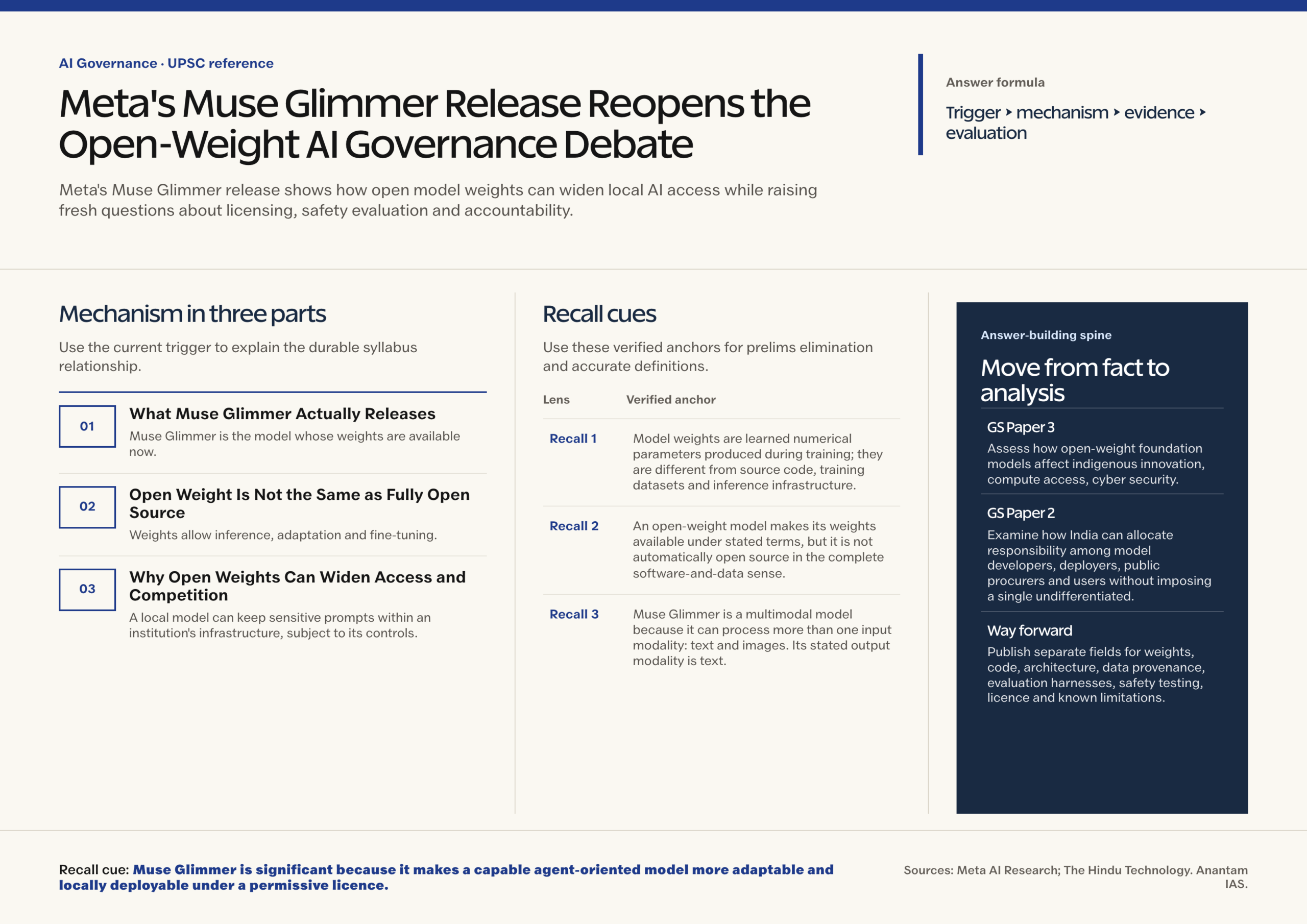
Mindmap explaining Meta's Muse Glimmer Release Reopens the Open-Weight AI Governance Debate for UPSC revision
Revision mindmap: Meta's Muse Glimmer Release Reopens the Open-Weight AI Governance Debate. Open the full-size image for details.

Background and Context

What Muse Glimmer Actually Releases

The governance analysis must begin with the exact release rather than the loose label of open AI.

  • Muse Glimmer is the model whose weights are available now. Meta describes it as a dense, approximately 30-billion-parameter model optimized for local agentic workloads.
  • Its input capabilities cover text and images, while the output is text. It may analyse an image within an agent workflow, but that does not make it an image-generation model.
  • The release targets planning, coding, tool calling, verification and recovery. These are system-level tasks in practice, since a usable agent also needs a harness, permissions, tools and an execution environment.
  • Meta’s four-bit deployment claim concerns memory efficiency. Quantization can make local use practical, but local deployment still requires compatible software, adequate hardware, security configuration and operator competence.
  • The announced future release of Muse Spark 1.2 weights is a separate proposition. Policy notes should distinguish an accomplished release from a stated future plan.

Open Weight Is Not the Same as Fully Open Source

Openness has several layers, and each layer supports a different form of scrutiny or reuse.

  • Weights allow inference, adaptation and fine-tuning. Code shows how a system is implemented. Training data helps assess provenance, consent, bias and reproducibility. None automatically supplies the others.
  • The Apache 2.0 licence gives broad permissions over the released material and contains notice and patent terms. The licence does not certify that training data were lawfully sourced, that outputs are accurate or that a deployment.
  • A release can be open-weight yet incomplete for scientific reproduction if the full dataset, filtering process, training recipe, compute configuration and evaluation harness are unavailable.
  • The better policy vocabulary is a disclosure matrix: weights, architecture, code, data documentation, evaluation methods, licence, security controls and downstream restrictions should each be stated separately.
  • This avoids treating openness as a binary badge and lets regulators or public buyers compare models on evidence relevant to the intended use.

Why Open Weights Can Widen Access and Competition

Open weights change who can experiment, where inference happens and how much leverage users retain over a provider.

  • A local model can keep sensitive prompts within an institution’s infrastructure, subject to its controls. This may help research labs, hospitals, courts or firms with confidentiality needs, though suitability must be tested for each use.
  • Developers can adapt a released model for Indian languages, domain terminology and low-connectivity settings without waiting for every feature to be offered through a foreign cloud interface.
  • Multiple hosts and derivative models can reduce vendor lock-in and create price and service competition. Open access to weights can also make independent red-teaming and comparative evaluation easier.
  • Access to weights does not erase the compute divide. Training frontier systems, producing high-quality datasets and running large deployments still require capital, chips, energy and specialist talent.
  • India’s policy goal should be usable capability: shared compute, benchmark infrastructure, language datasets, skilling and procurement standards, not model downloads alone.

Risk Moves from the Provider to the Deployment Ecosystem

Once weights can be copied and modified, governance must follow the chain from original developer to adapter, host, deployer and end user.

  • Open weights can support beneficial security research, but modified systems may also remove safeguards or automate harmful tasks. The relevant question is not whether openness is safe in the abstract, but which capability, actor and deployment.
  • Agentic systems deserve special attention because tool permissions can turn a mistaken answer into an external action. Least-privilege access, sandboxing, human approval for high-impact steps and tamper-resistant logs become central controls.
  • A model card is a baseline disclosure. Independent evaluation should test local languages, hallucination, bias, cyber misuse, tool-use reliability and performance after quantization or fine-tuning.
  • Responsibility should track control. A base-model developer controls training and release documentation; a fine-tuner controls adaptation; a deployer controls data, tools, interface, monitoring and the decision context.
  • Rules that treat every small researcher like a frontier developer could entrench large firms. A risk-tiered approach can protect research while placing stronger duties on high-capability or high-impact deployments.

Way Forward

Use a Layered Disclosure Standard

  • Publish separate fields for weights, code, architecture, data provenance, evaluation harnesses, safety testing, licence and known limitations.
  • Make model cards versioned and machine-readable so updates, derivative models and withdrawn claims can be traced.
  • Combine capability testing with deployment factors such as tool access, user scale, sensitive data, autonomy, sector and reversibility of harm.
  • Create accredited independent testing capacity for Indian languages, cyber safety, bias, hallucination and tool-use reliability.

Conclusion

  • Muse Glimmer is significant because it makes a capable agent-oriented model more adaptable and locally deployable under a permissive licence.
  • India’s strongest response is neither a blanket ban nor blind celebration.

UPSC Practice Questions

Prelims MCQ 1

With reference to open-weight artificial-intelligence models, consider the following statements:

  1. Access to model weights automatically includes access to the complete training dataset.
  2. Quantization can reduce the memory needed to run a model.
  3. A model card is a disclosure document rather than a government safety certification.

How many of the above statements are correct?

(a) Only one (b) Only two (c) All three (d) None

Answer: (b) Only two

Explanation:

Statements 2 and 3 are correct. Quantization uses lower-precision representations to reduce memory needs, and a model card communicates documented characteristics and limits. Releasing weights does not automatically release the training dataset.

Prelims MCQ 2

Which one of the following best describes speculative decoding in a large language model?

(a) Encrypting model weights before they are downloaded (b) Replacing all model evaluation with human voting (c) Letting a smaller component propose tokens that a larger model verifies (d) Converting text prompts into training data without consent

Answer: (c) Letting a smaller component propose tokens that a larger model verifies

Explanation:

Speculative decoding seeks faster inference by allowing a draft component to propose token sequences while the main model verifies which proposals can be accepted.

UPSC Mains Questions

  1. Open-weight AI can democratize innovation, yet openness alone does not guarantee transparency or safety. Discuss with reference to the release of Meta’s Muse Glimmer.
  2. How should India distribute accountability among foundation-model developers, fine-tuners and deployers in an agentic AI ecosystem? Suggest a risk-based framework.

Sources: Meta AI Research and The Hindu Technology.

Frequently Asked Questions

What did Meta release in August 2026?

Meta released the weights for Muse Glimmer, a dense 30-billion-parameter multimodal model designed for agentic tasks and local deployment. Meta also said it planned to release Muse Spark 1.2 weights later. The completed Glimmer release and the future Spark plan.

Is Muse Glimmer open source?

It is safest to call Muse Glimmer open-weight. Its weights are available under Apache 2.0, but access to weights does not automatically mean that all training data, training code, filtering decisions and compute details needed for full reproduction are available.

What does the Apache License 2.0 permit?

Apache 2.0 broadly permits use, modification and redistribution of licensed material, including commercial use, subject to conditions such as preserving required notices and marking modified files. It also contains an express patent licence. It does not certify a model’s accuracy.

Why does quantization matter for AI access?

Quantization represents weights at lower numerical precision, cutting memory and often reducing compute needs. Meta says its roughly four-bit Muse Glimmer configuration keeps language-model weights below 20 GB for a 24 GB memory envelope. Actual usability still depends on hardware.

Why are agentic models a distinct governance concern?

An agentic system can plan, call tools and take actions across multiple steps. A wrong answer may become an external action if the system has email, code, payment or database permissions. Least-privilege access, sandboxing, approval gates, logs and incident response.
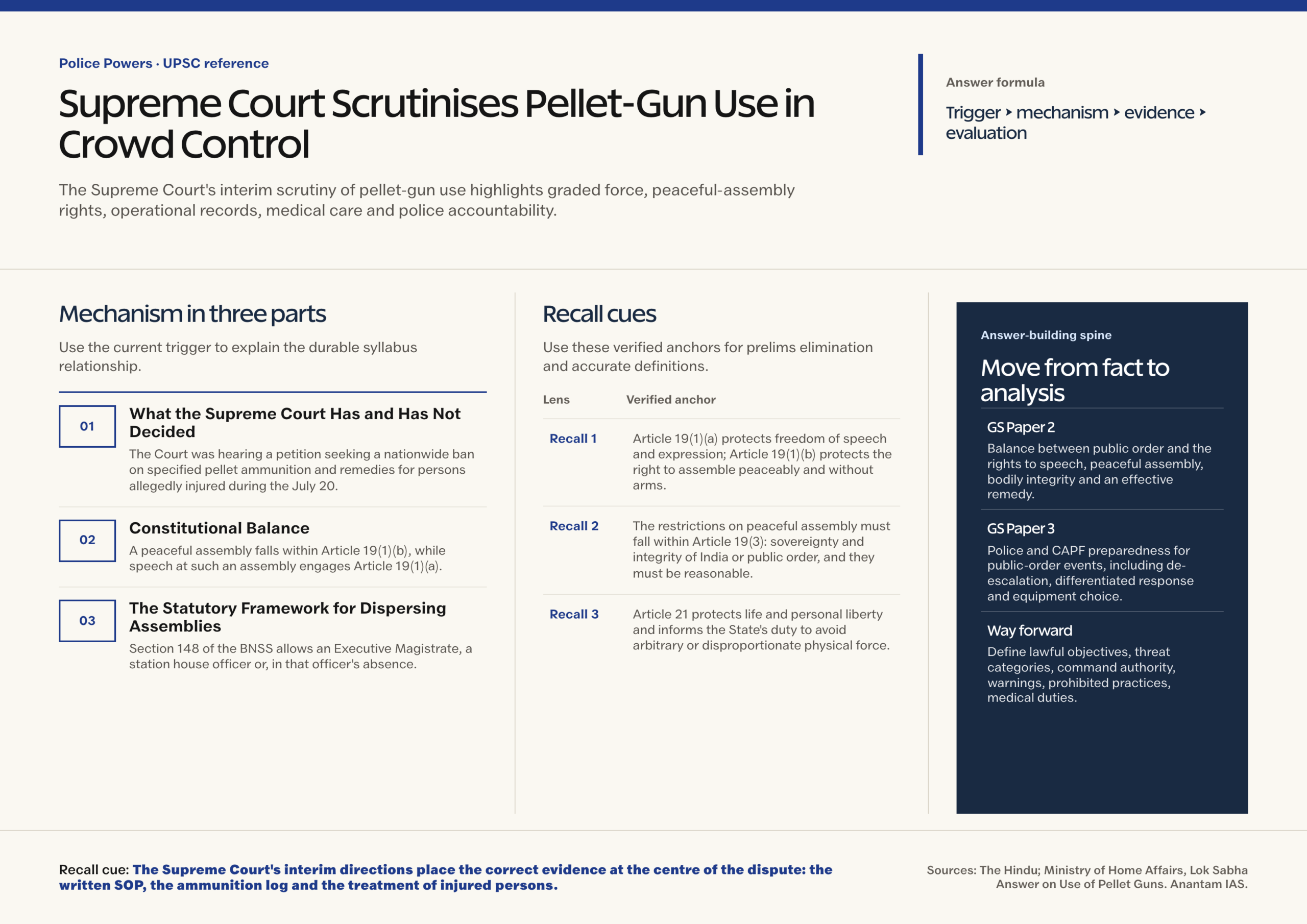
Supreme Court Scrutinises Pellet-Gun Use in Crowd Control

Open article →Download PDF

Why in News?

The Supreme Court, while hearing an Article 32 public-interest petition concerning alleged pellet injuries during a July 20 protest near Jantar Mantar in Delhi, called for closer scrutiny of the rules and records governing the police response.

  • The petition was instituted by former Central Information Commissioner and retired police officer Yashovardhan Azad along with persons claiming pellet injuries; it seeks restrictions on wholly or partly metallic pellet ammunition, treatment, rehabilitation and compensation.
  • A Bench led by Chief Justice of India Surya Kant, with Justice Joymalya Bagchi, referred during the hearing to a Bureau of Police Research and Development advisory that contemplates pellet-gun use only in exceptional situations.
  • The Court asked Delhi Police to place its pellet-gun SOP on record and asked the Union government to preserve the ammunition log of the RAF unit deployed during the protest.
  • The direction to preserve logs is evidentiary. It can help establish what ammunition was issued, expended and returned, but it does not by itself settle who ordered firing, whether warnings were given or whether the force.
  • The Delhi government was asked to ensure adequate treatment for the petitioners and other similarly placed injured persons while the legal questions remain under examination.
  • The State has a duty to maintain public order, but Articles 19(1)(a) and 19(1)(b) protect speech and peaceful assembly, subject to reasonable restrictions under Articles 19(2) and 19(3).
  • A weapon described as less-lethal can still cause death, permanent eye damage or other serious injury. Its label cannot replace a threat-specific assessment of legality, necessity and proportionality.
  • The controversy shows why a graded response must be demonstrable through warnings, command records, deployment plans, video, medical evidence and ammunition accounting rather than asserted after the event.

UPSC Relevance

Prelims Relevance

  • Article 19(1)(a) protects freedom of speech and expression; Article 19(1)(b) protects the right to assemble peaceably and without arms.
  • The restrictions on peaceful assembly must fall within Article 19(3): sovereignty and integrity of India or public order, and they must be reasonable.
  • Article 21 protects life and personal liberty and informs the State’s duty to avoid arbitrary or disproportionate physical force.
  • An Article 32 petition directly invokes the Supreme Court’s jurisdiction for enforcement of fundamental rights.
  • The Rapid Action Force is a specialised riot-control component of the Central Reserve Police Force, a Central Armed Police Force under the Union Ministry of Home Affairs.
  • Sections 148 to 151 of the Bharatiya Nagarik Suraksha Sanhita, 2023 form part of the statutory framework on dispersal of assemblies, use of civil force, deployment of armed forces and sanction or good-faith protections.

Mains Relevance

GS Paper 2

  • Balance between public order and the rights to speech, peaceful assembly, bodily integrity and an effective remedy.
  • Judicial review of executive force through legality, necessity, proportionality and procedural safeguards.

GS Paper 3

  • Police and CAPF preparedness for public-order events, including de-escalation, differentiated response and equipment choice.
  • Command responsibility, interoperable deployment records and after-action review in internal-security operations.

Essay

  • The legitimacy of State power depends not only on its legal authority but also on restraint, transparency and the ability to account for each coercive act.
Mindmap explaining Supreme Court Scrutinises Pellet-Gun Use in Crowd Control for UPSC revision
Revision mindmap: Supreme Court Scrutinises Pellet-Gun Use in Crowd Control. Open the full-size image for details.

Background and Context

What the Supreme Court Has and Has Not Decided

The procedural posture is central to reading the development correctly.

  • The Court was hearing a petition seeking a nationwide ban on specified pellet ammunition and remedies for persons allegedly injured during the July 20 protest. The pleadings and factual allegations remain subject to response and examination.
  • Its reference to exceptional situations arose while discussing the existing BPRD advisory. It should not be converted into a blanket judicial approval of pellet guns or a finding that the Delhi incident met the exceptional-situation threshold.
  • Seeking an SOP helps the Court compare the written escalation rules with the alleged sequence on the ground. Preserving the ammunition log protects potentially decisive evidence from loss or alteration.
  • The medical-treatment direction is an interim protective measure. It addresses immediate harm without prejudging final liability, compensation or the validity of the challenged weapon policy.
  • The final questions may include whether the weapon or ammunition presents an unwarranted risk, whether the operational safeguards are adequate and whether those safeguards were followed in the specific deployment.

Constitutional Balance: Assembly, Public Order and Bodily Integrity

Public-order authority and constitutional rights must be read together, not as rival absolutes.

  • A peaceful assembly falls within Article 19(1)(b), while speech at such an assembly engages Article 19(1)(a). The Constitution permits reasonable restrictions, including in the interest of public order, but a restriction and its enforcement remain open.
  • An assembly’s legal status and the force used against individuals are separate inquiries. Even when dispersal is legally authorised, the means, timing, target, duration and intensity of force must answer a legitimate operational need.
  • Article 21 sharpens the inquiry when policing creates a foreseeable risk of death, blindness or lasting bodily injury. State action must follow fair procedure and cannot be arbitrary.
  • In In Re: Ramlila Maidan Incident (2012), the Supreme Court treated disproportionate execution of a public-order direction as unlawful and emphasised the rights to speech and peaceful gathering.
  • In Anita Thakur v. Government of J&K (2016), the Court recognised the State’s power to control an unruly assembly but held that force continuing beyond what the situation required could amount to police excess and support.

The Statutory Framework for Dispersing Assemblies

The BNSS supplies legal powers, conditions and safeguards; it does not create an unrestricted licence to injure.

  • Section 148 of the BNSS allows an Executive Magistrate, a station house officer or, in that officer’s absence, a police officer not below sub-inspector rank to command an unlawful assembly, or an assembly of five or.
  • If the assembly does not disperse after the command, or shows a determination not to disperse, the specified authority may use force to disperse it and, where necessary, arrest and confine participants. The statutory purpose limits.
  • Section 149 addresses the more exceptional deployment of armed forces when an assembly cannot otherwise be dispersed and dispersal is necessary for public security. It requires a District Magistrate or another authorised Executive Magistrate who is.
  • Section 149(3) expressly requires the officer to use as little force and cause as little injury as is consistent with the statutory task. Section 150 covers manifest danger to public security when communication with an Executive.
  • Whether a particular RAF deployment engages each part of this chapter depends on the operational facts and legal classification. The safer analytical point is that command authority, necessity, minimum injury and records cannot be assumed merely.

Graded Response Is a Decision System, Not a Weapon List

A defensible escalation model links each step to the behaviour and threat actually observed.

  • The first layer is preparation: liaison with organisers, route and exit planning, public communication, visible command, protective equipment, medical support and separation of peaceful participants from persons committing violence.
  • The second layer is de-escalation: intelligible warnings, time and a safe path to comply, dialogue, barriers and targeted intervention against identifiable offenders where feasible.
  • Force, when unavoidable, should be differentiated rather than indiscriminate. A crowd is not a single actor; peaceful participants, bystanders, journalists, children and violent individuals may face very different levels of risk and responsibility.
  • A less-lethal label does not establish proportionality. The question is whether a chosen device, range, aiming practice, number of rounds and target area were suitable for the threat and less harmful than workable alternatives.
  • Escalation must also be reversible. Once the threat falls or an objective is achieved, force must stop. Medical assistance and scene preservation should begin without waiting for litigation.

Way Forward

Publish a Rights-Compliant National Use-of-Force Framework

  • Define lawful objectives, threat categories, command authority, warnings, prohibited practices, medical duties, reporting thresholds and review mechanisms across police and CAPF deployments.
  • State clearly that a weapon’s presence in an inventory does not make its use necessary or proportionate in a particular event.
  • Require periodic legal and medical review of weapons whose dispersal pattern creates a high risk of indiscriminate or permanent injury.

Conclusion

  • The Supreme Court’s interim directions place the correct evidence at the centre of the dispute: the written SOP, the ammunition log and the treatment of injured persons.
  • For governance, the lasting test is whether every escalation can be explained as lawful, necessary, proportionate and directed at a concrete threat.

UPSC Practice Questions

Prelims MCQ 1

With reference to the Bharatiya Nagarik Suraksha Sanhita, 2023, consider the following statements:

  1. Section 148 deals with dispersal of certain assemblies by use of civil force.
  2. Under Section 149, any police constable may independently requisition the armed forces to disperse an assembly.
  3. Section 149 requires an armed-force officer acting on a valid requisition to use as little force and cause as little injury as is consistent with the statutory task.

How many of the above statements are correct?

(a) Only one (b) Only two (c) All three (d) None

Answer: (b) Only two

Explanation:

Statements 1 and 3 are correct. Section 149 requires the District Magistrate or another Executive Magistrate authorised by the District Magistrate, who is present, to requisition armed-forces assistance when its statutory conditions are met; it does not give that power to any police constable.

Prelims MCQ 2

Which one of the following best expresses the principle of proportionality in crowd-control operations?

(a) Any force listed in an SOP is constitutional once an assembly is declared unlawful. (b) The same level of force should be used against every person in a crowd to ensure uniformity. (c) Force must pursue a lawful objective, be necessary in the circumstances and avoid harm excessive to the concrete threat. (d) A less-lethal weapon can never engage the right to life under Article 21.

Answer: (c) Force must pursue a lawful objective, be necessary in the circumstances and avoid harm excessive to the concrete threat.

Explanation:

Proportionality is not satisfied merely by inventory status or an SOP. The lawful objective, available alternatives, level of threat, manner of use and foreseeable harm all matter. Less-lethal weapons can still cause death or serious injury.

UPSC Mains Questions

  1. The legality of dispersing an assembly and the proportionality of the force used are distinct constitutional questions. Discuss with reference to India’s public-order framework.
  2. Why are command records, ammunition logs and medical evidence essential to accountability in crowd-control operations? Suggest an auditable use-of-force architecture for India.

Sources: The Hindu and Ministry of Home Affairs, Lok Sabha Answer on Use of Pellet Guns.

Frequently Asked Questions

Did the Supreme Court approve pellet guns for routine crowd control?

No. During an interim hearing, the Court referred to a BPRD advisory under which pellet-gun use is contemplated only in exceptional situations. It sought Delhi Police’s SOP and preservation of the RAF ammunition log. The Court had not finally decided.

Why did the Supreme Court order preservation of the ammunition log?

The log may show the type and quantity of ammunition issued, used and returned by the deployed unit. It can protect the factual record while the case proceeds. It is one part of the evidence and must be read with.

What does graded response mean in crowd control?

A graded response links each escalation to the actual threat: planning and dialogue first, clear warnings and safe dispersal routes, targeted action where feasible, and only the minimum necessary force. It also requires stopping force when the threat falls, providing.

Which constitutional rights are involved in pellet-gun crowd control?

Articles 19(1)(a) and 19(1)(b) protect speech and peaceful assembly, subject to reasonable restrictions including public order. Article 21 protects life and personal liberty. Article 32 provides a route to the Supreme Court for enforcement of fundamental rights, including claims concerning.

What do Sections 148 and 149 of the BNSS provide?

Section 148 governs commands to disperse certain assemblies and the use of civil force when statutory conditions are met. Section 149 addresses armed-forces assistance when an assembly cannot otherwise be dispersed and public security requires it. It expressly requires as.

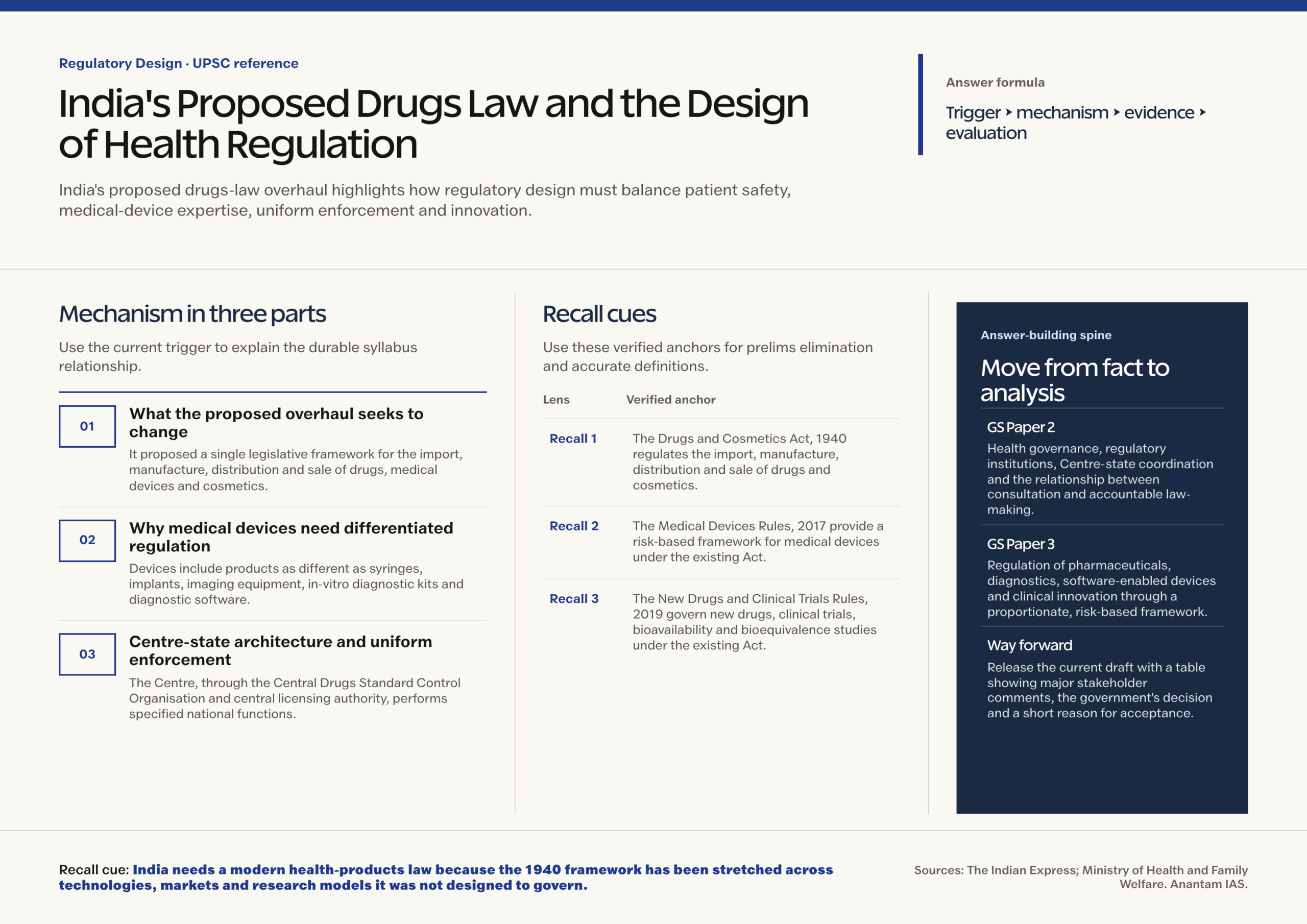
India’s Proposed Drugs Law and the Design of Health Regulation

Open article →Download PDF

Why in News?

The Indian Express reported on 11 August 2026 that pharmaceutical and medical-device groups had objected to the latest proposed overhaul of India’s drugs law, arguing that important stakeholder suggestions were not reflected in the measure.

  • The measure under discussion belongs to the continuing Drugs, Medical Devices and Cosmetics Bill process. The authoritative text publicly released by the Union Health Ministry is the 2022 draft; a December 2023 Rajya Sabha answer called.
  • The 2022 draft proposed to repeal the Drugs and Cosmetics Act, 1940 and consolidate rules for quality, safety, efficacy, performance, clinical trials and clinical investigations.
  • Its design kept drugs, devices and cosmetics inside one umbrella law but created a separate Medical Devices Technical Advisory Board, device-testing centres and a dedicated device chapter.
  • The current disagreement should be read as a debate over consultation, institutional capacity and proportionate compliance. Industry objections do not by themselves establish that a safeguard is unnecessary, while a public-health objective does not excuse unclear.
  • Until Parliament enacts a replacement and it is brought into force, the operative central statute remains the Drugs and Cosmetics Act, 1940, supported by instruments such as the Medical Devices Rules, 2017, New Drugs and.
  • Medicines are chemical or biological products, while devices range from low-risk dressings to implants, diagnostic software and life-support systems. A common public-health purpose does not remove their different risk profiles and evidence pathways.
  • India’s federal regulatory structure divides functions between the Centre and states. A new law must reduce uneven enforcement without making every decision dependent on one overburdened central office.
  • The central policy test is a three-way balance among patient safety, predictable compliance and timely access to useful innovation. Weak surveillance can harm patients; excessive or poorly targeted compliance can delay access and burden smaller.

UPSC Relevance

Prelims Relevance

  • The Drugs and Cosmetics Act, 1940 regulates the import, manufacture, distribution and sale of drugs and cosmetics; specified medical devices are covered through the statutory definition of drugs and subordinate rules.
  • The Medical Devices Rules, 2017 provide a risk-based framework for medical devices under the existing Act.
  • The New Drugs and Clinical Trials Rules, 2019 govern new drugs, clinical trials, bioavailability and bioequivalence studies under the existing Act.
  • The 2022 draft defined a medical device separately and proposed a dedicated Medical Devices Technical Advisory Board alongside the Drugs Technical Advisory Board.
  • The draft proposed central and state drug laboratories as well as central and state medical-device testing centres.
  • A proposed consultative committee chaired by the Drugs Controller General of India was intended to promote uniform administration across the Union and states.

Mains Relevance

GS Paper 2

  • Health governance, regulatory institutions, Centre-state coordination and the relationship between consultation and accountable law-making.
  • Patient safety as a state capacity question involving inspections, laboratories, transparent recalls, adverse-event reporting and reasoned enforcement.

GS Paper 3

  • Regulation of pharmaceuticals, diagnostics, software-enabled devices and clinical innovation through a proportionate, risk-based framework.
  • Balancing domestic manufacturing and ease of doing business with quality assurance, traceability and post-market surveillance.

Essay

  • Good regulation is neither maximum control nor minimum control; it is the credible matching of oversight to risk.
Mindmap explaining India's Proposed Drugs Law and the Design of Health Regulation for UPSC revision
Revision mindmap: India's Proposed Drugs Law and the Design of Health Regulation. Open the full-size image for details.

Background and Context

What the proposed overhaul seeks to change

The published 2022 draft was designed as a replacement statute, not a narrow amendment to the 1940 Act.

  • It proposed a single legislative framework for the import, manufacture, distribution and sale of drugs, medical devices and cosmetics, together with clinical trials of new drugs and clinical investigations of investigational devices.
  • The draft stated the regulatory objectives of quality, safety, efficacy and, for devices, performance. This matters because device evaluation may depend on engineering performance, software reliability and use conditions, not only a pharmaceutical-style composition test.
  • It also brought newer market channels and research activity into the statutory design, including online sale of drugs, clinical research organisations and compensation-related obligations in trials and investigations.
  • A replacement law would still require detailed rules, standards, laboratories, trained personnel and interoperable data. Broad statutory powers cannot substitute for operational capacity.

Why medical devices need differentiated regulation

A unified umbrella can coexist with product-specific pathways, but only if the differences are real in institutions and procedures.

  • Devices include products as different as syringes, implants, imaging equipment, in-vitro diagnostic kits and diagnostic software. Their risks depend on intended use, invasiveness, duration of contact and failure consequences.
  • The draft’s separate device definition, advisory board, testing centres and device chapter acknowledged this distinction. It did not simply rename every device as a conventional medicine.
  • Industry groups have repeatedly asked for a completely separate device law and regulator. Supporters say this would build engineering expertise and proportionate rules; critics must still answer how a separate system would coordinate with hospitals, drugs.
  • The sound design test is functional: low-risk products should not face the same burden as implants, but high-risk devices must face clinical evidence, traceability, incident reporting and effective recall requirements.

Centre-state architecture and uniform enforcement

India’s drug-regulation problem is partly legal and partly federal-administrative.

  • The Centre, through the Central Drugs Standard Control Organisation and central licensing authority, performs specified national functions, while state regulators undertake major licensing, inspection and enforcement work under the existing framework.
  • A medicine manufactured in one state may be distributed nationwide. Uneven laboratory capacity, inspection practice or enforcement can turn one state’s regulatory weakness into a national patient-safety risk.
  • The 2022 draft proposed a consultative committee with central and state representatives to secure greater uniformity. A committee can coordinate policy, but it needs shared databases, standard inspection protocols, clear escalation rules and time-bound communication.
  • Centralisation is not automatically uniformity. If the central authority lacks specialist staff or timely processes, shifting more approvals upward can create bottlenecks without improving outcomes.

Clinical research, compensation and public trust

Clinical regulation must protect participants before, during and after a study.

  • The draft prohibited clinical trials of new or investigational drugs and clinical investigations of investigational devices without permission from the central licensing authority, subject to prescribed conditions.
  • It addressed medical management and compensation for trial- or investigation-related injury or death and contemplated penalties where compensation was not paid. These safeguards need transparent causality assessment and accessible remedies.
  • Ethics-committee approval, informed consent and pre-market evidence are necessary but not sufficient. Rare or long-term harms may emerge only after a product reaches a much larger population.
  • Public confidence depends on publication of regulatory decisions, adverse-event signals, inspection outcomes and recall notices in usable form, while protecting legitimate personal and confidential information.

Way Forward

Publish a clause-by-clause consultation record

  • Release the current draft with a table showing major stakeholder comments, the government’s decision and a short reason for acceptance, modification or rejection.
  • Separate technical questions from distributive choices so Parliament can see where evidence ends and policy judgment begins.
  • Guarantee dedicated device expertise, risk-based classification, specialist testing and clear pathways for software and combination products.
  • Define Centre-state roles, joint inspections, cross-border enforcement and appeal mechanisms to reduce duplication and regulatory gaps.

Conclusion

  • India needs a modern health-products law because the 1940 framework has been stretched across technologies, markets and research models it was not designed to govern.
  • The reported industry opposition should prompt better scrutiny, not a simple choice between business and safety.

UPSC Practice Questions

Prelims MCQ 1

With reference to the publicly released draft Drugs, Medical Devices and Cosmetics Bill, 2022, consider the following statements:

  1. It proposed a separate Medical Devices Technical Advisory Board.
  2. It proposed central and state medical-device testing centres.
  3. It proposed that online sale of drugs could take place only under a licence or permission issued in the prescribed manner.

How many of the above statements are correct?

(a) Only one (b) Only two (c) All three (d) None

Answer: (c) All three

Explanation:

All three features appear in the Ministry of Health and Family Welfare’s 2022 draft. The draft distinguished device regulation institutionally while retaining drugs, devices and cosmetics within one proposed statute.

Prelims MCQ 2

Which one of the following correctly describes India’s current legal position while the replacement Bill remains pending?

(a) The 2022 draft automatically repealed the Drugs and Cosmetics Act, 1940 (b) Medical devices are wholly unregulated by central law (c) The Drugs and Cosmetics Act, 1940 and subordinate rules continue to operate (d) Only state governments may regulate clinical trials

Answer: (c) The Drugs and Cosmetics Act, 1940 and subordinate rules continue to operate

Explanation:

A draft does not become law on publication. The 1940 Act and rules including the Medical Devices Rules, 2017 and New Drugs and Clinical Trials Rules, 2019 continue to form the operative framework until lawfully replaced.

UPSC Mains Questions

  1. A unified law for drugs, medical devices and cosmetics can improve coordination but may also blur product-specific risks. Examine the institutional design needed to reconcile these concerns.
  2. India’s pharmaceutical regulation is as much a state-capacity challenge as a legislative challenge. Discuss with reference to Centre-state coordination, testing and post-market surveillance.

Sources: The Indian Express and Ministry of Health and Family Welfare.

Frequently Asked Questions

What is the exact name of the proposed replacement law?

The authoritative Ministry text released for consultation is titled the Drugs, Medical Devices and Cosmetics Bill, 2022. A December 2023 Rajya Sabha answer referred to the revised proposal as the draft Drugs, Medical Devices and Cosmetics Bill, 2023. The fresh.

Has the Drugs and Cosmetics Act, 1940 already been repealed?

No. Publication or circulation of a draft Bill does not repeal an existing statute. The 1940 Act and its subordinate rules remain operative unless Parliament enacts a replacement, the President gives assent and the new law commences according to its.

Why do medical-device groups seek differentiated regulation?

Medical devices are engineered products with varied risk classes, failure modes and performance evidence. Industry groups argue that a device-specific regulator or law would better reflect these features. Patient protection still requires rigorous clinical evidence for high-risk products, incident reporting.

What major device-specific institutions did the 2022 draft propose?

The draft proposed a Medical Devices Technical Advisory Board, central and state medical-device testing centres, designated device officers and a dedicated chapter on medical devices. These provisions sought to recognise device-specific expertise while retaining an umbrella statute for drugs, devices.

How should UPSC answers assess the industry-government dispute?

Avoid treating either side’s claim as conclusive. Test the proposal against patient safety, proportionality, administrative capacity, Centre-state coordination, transparency and innovation. Recommend a published response to consultation, risk-based pathways, lifecycle surveillance and strong sanctions for conduct that creates serious harm.

AI Model Distillation and the Military Security Risk

Open article →Download PDF

Why in News?

The Hindu, carrying a Reuters investigation, reported that researchers linked to Chinese military and security institutions had used outputs from leading United States AI models developed by OpenAI and Anthropic to help train domestic systems for defence-related tasks.

  • Reuters said it reviewed more than 80 Chinese academic papers and patents, including material assembled by the Jamestown Foundation, and independently identified additional military-linked case studies.
  • The documents reportedly described applications such as intelligence analysis, cyber operations and compact computer-vision systems for unmanned platforms. These are reported research uses and proposals; public documents do not establish that every cited system has entered.
  • One reported 2024 study associated with the People’s Liberation Army’s National University of Defense Technology described shrinking an image-processing model for use aboard an unmanned aerial vehicle, where local processing could support video analysis when communications.
  • OpenAI and Anthropic have separately said that distillation is a legitimate method when authorised, while large-scale extraction intended to imitate a provider’s capabilities can violate access rules or terms of service.
  • The central policy problem is not that model distillation is inherently military or unlawful. It is that a general-purpose efficiency technique can also lower the cost of reproducing selected strategic capabilities outside the original provider’s safeguards.
  • Export controls traditionally regulate physical items such as advanced chips and manufacturing equipment. Model outputs are digital, reproducible and accessible through services, resellers or intermediaries, making end-use control harder.
  • A distilled model may be smaller, cheaper and capable of operating on local hardware. For military users, local inference can reduce dependence on a remote provider and remain available in contested or disconnected environments.
  • Distillation transfers selected behaviour, not the teacher’s complete internal model, training data or reliability. Capability claims must be tested task by task and under realistic operational conditions.

UPSC Relevance

Prelims Relevance

  • In knowledge distillation, a teacher model supplies targets or outputs used to train a student model, commonly to obtain a smaller or more efficient system.
  • A student may learn from soft targets, such as a teacher’s probability distribution across classes, which can contain more information than a single hard label.
  • For generative AI, teacher-produced answers, reasoning traces or preference comparisons can become synthetic training data for a student system.
  • Model distillation differs from model-weight theft: the student is trained from observed outputs or permitted internal signals rather than necessarily copying the teacher’s parameter file.
  • Model distillation also differs from dataset distillation, which seeks a compact synthetic dataset that can train a model efficiently.
  • A smaller model can reduce memory, energy and latency requirements, making edge deployment on drones, vehicles or field devices more practical.

Mains Relevance

GS Paper 3

  • Model distillation as an efficiency technique, its role in edge AI and the difference among capability transfer, model copying and ordinary fine-tuning.
  • Dual-use risks involving military sensing, cyber operations, intelligence analysis and autonomous platforms.

GS Paper 2

  • Need for international rules, confidence-building and cooperation on military AI without blocking legitimate scientific and civilian use.
  • Institutional design for procurement review, legal accountability, human control and auditability in high-risk public systems.

Essay

  • Technology diffuses not only through machines and blueprints but also through services, outputs and learned behaviour.
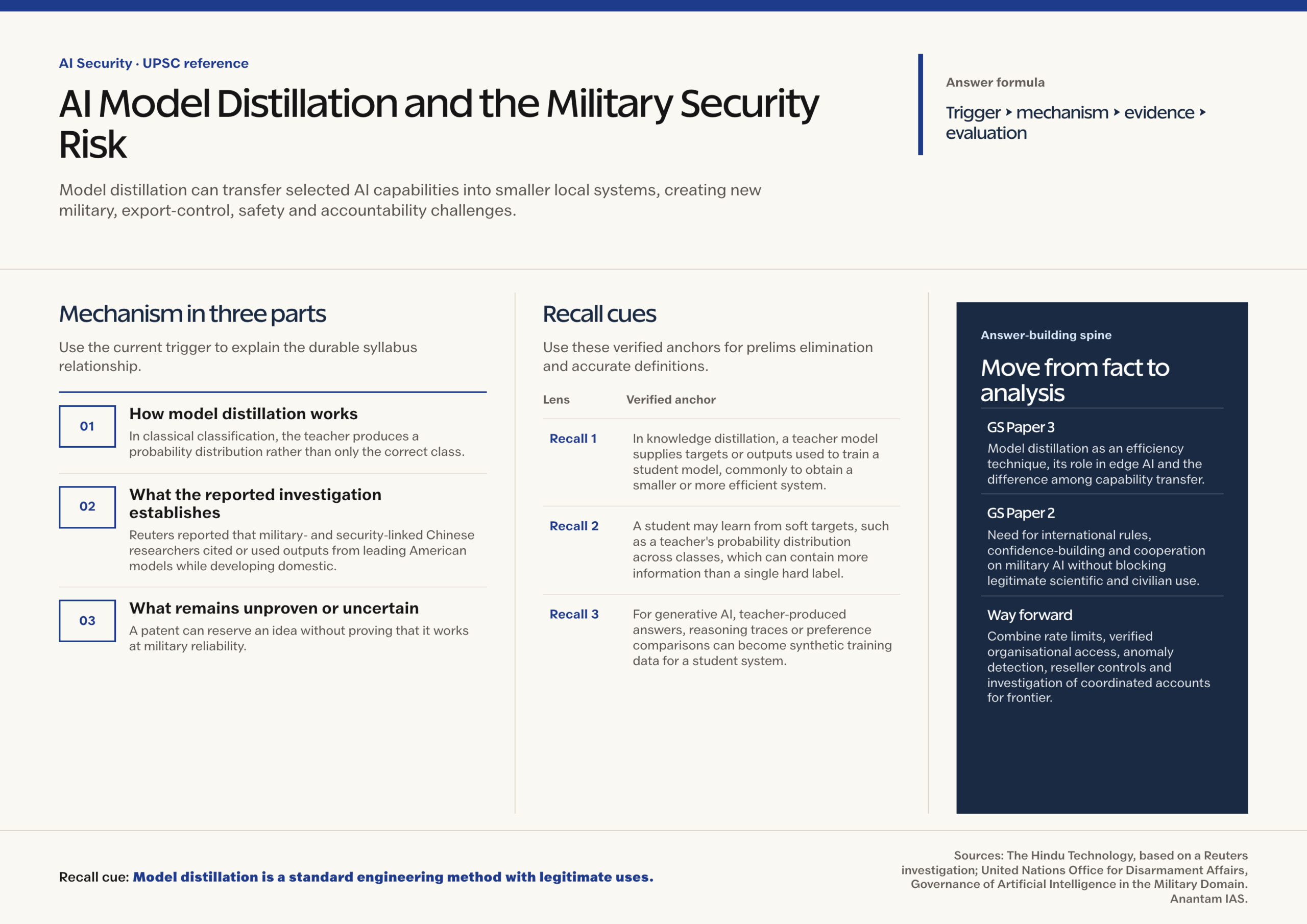
Mindmap explaining AI Model Distillation and the Military Security Risk for UPSC revision
Revision mindmap: AI Model Distillation and the Military Security Risk. Open the full-size image for details.

Background and Context

How model distillation works

Distillation is best understood as supervised capability transfer from a teacher to a student, not as pouring an entire model into a smaller container.

  • In classical classification, the teacher produces a probability distribution rather than only the correct class. Those relative probabilities reveal which alternatives the teacher considers similar, giving the student a richer learning signal than a hard label.
  • In generative systems, developers can query a capable teacher across a carefully designed prompt set, collect its answers and train a student on the resulting synthetic examples. Preference data and iterative feedback may be added.
  • When the model owner conducts this process on its own system, it may use internal logits, hidden representations or controlled output sets. An external actor usually has only black-box access and must learn from repeated queries.
  • The student is commonly smaller or more specialised. It may trade broad knowledge for lower latency, memory use and inference cost on a defined task such as image recognition, language translation or code analysis.

What the reported investigation establishes

The investigation provides documentary evidence of a research pattern, but each claim must remain tied to what the underlying papers and patents actually show.

  • Reuters reported that military- and security-linked Chinese researchers cited or used outputs from leading American models while developing domestic systems. Its review covered more than 80 papers and patents rather than relying on a single demonstration.
  • The cited work reportedly spans language-model tasks and compact perception systems. This shows interest in transferring capability into locally controlled systems across more than one technical domain.
  • A reported UAV example illustrates the operational attraction of compression: a smaller vision system may analyse sensor data on board, reducing latency and dependence on a communications link.
  • The evidence supports the claim that military-linked research is exploring or applying distillation. It should not be stretched into a claim that a named frontier model directly controls weapons or that all reported prototypes are deployed.

What remains unproven or uncertain

Research papers, patents, prototypes and operational systems represent different levels of maturity.

  • A patent can reserve an idea without proving that it works at military reliability. A paper can demonstrate performance on a benchmark without establishing resilience to deception, weather, electronic warfare or unfamiliar terrain.
  • Public reporting does not reveal the complete query sets, training pipelines, evaluation results or deployment status for every case. It cannot quantify how much capability came from a foreign model rather than domestic data, open models.
  • Distillation normally preserves selected performance, not full equivalence. A compact model can lose rare-case competence, calibrated uncertainty and refusal behaviour even while appearing strong on routine tasks.
  • Military affiliation and military relevance are important indicators, but they do not by themselves show that a system was authorised for combat use. Analysis must keep capability, intent and deployment separate.

Why smaller local models matter to defence users

Military value often comes from reliable availability at the edge rather than from possessing the largest possible model.

  • A local model can operate with lower bandwidth and without sending sensitive imagery, coordinates or intelligence questions to a foreign cloud service. This supports data control and operational security.
  • Lower compute and energy requirements make deployment more feasible on unmanned aircraft, ground vehicles, ships, portable cyber systems and command posts with constrained power and hardware.
  • Specialisation can improve speed on a narrow task, but it also creates brittleness. A model trained for a known sensor or threat profile may fail when an adversary changes camouflage, language, network behaviour or environmental conditions.
  • The strategic effect is capability diffusion: actors that cannot train a frontier system from scratch may still acquire useful slices of its behaviour at lower cost.

Way Forward

Secure model access by risk

  • Combine rate limits, verified organisational access, anomaly detection, reseller controls and investigation of coordinated accounts for frontier services.
  • Create documented pathways for legitimate compression, research and safety evaluation so that enforcement has a clear boundary.
  • Record provenance for prompts, teacher outputs, filters, human review, fine-tuning data and model versions.
  • Test accuracy, calibration, robustness, cyber security and safety after every material distillation or update, not only before initial deployment.

Conclusion

  • Model distillation is a standard engineering method with legitimate uses.
  • The policy response must be equally precise.

UPSC Practice Questions

Prelims MCQ 1

With reference to knowledge distillation in artificial intelligence, consider the following statements:

  1. It commonly uses outputs from a teacher model as learning targets for a student model.
  2. It necessarily produces a student with the same parameter values as the teacher.
  3. It can be used to create a smaller model suited to resource-constrained devices.

How many of the above statements are correct?

(a) Only one (b) Only two (c) All three (d) None

Answer: (b) Only two

Explanation:

Statements 1 and 3 are correct. Distillation trains a student from signals supplied by a teacher and often improves deployment efficiency. It does not require copying the teacher’s parameter values, and the student may use a different size or architecture.

Prelims MCQ 2

Which one of the following best explains why model distillation can complicate controls centred only on advanced AI chips?

(a) It removes all need for computing hardware (b) It automatically reveals a teacher model’s source code (c) It can transfer selected behaviour through digital outputs into a smaller locally trained model (d) It guarantees that the student will pass every safety evaluation

Answer: (c) It can transfer selected behaviour through digital outputs into a smaller locally trained model

Explanation:

Distillation still requires data and compute, and it neither reveals source code automatically nor guarantees safety. Its control challenge is that useful behaviour can be learned from remotely obtained outputs even when access to frontier training hardware is constrained.

UPSC Mains Questions

  1. Explain model distillation and examine why it creates a regulatory gap between controls on advanced computing hardware and controls on digital AI capability.
  2. Military applications of distilled AI models illustrate both the value and danger of edge computing. Discuss with reference to reliability, accountability and meaningful human control.

Sources: The Hindu Technology, based on a Reuters investigation and United Nations Office for Disarmament Affairs, Governance of Artificial Intelligence in the Military Domain.

Frequently Asked Questions

What is model distillation?

Model distillation is a training method in which a student model learns from outputs or other signals produced by a teacher model. It is often used to create a smaller, cheaper or more specialised system. The student learns selected behaviour.

Is model distillation the same as stealing a model?

No. Distillation is a legitimate technique when the model owner authorises it or when licences permit the use. It becomes a security or contractual concern when actors use deceptive access, prohibited automated extraction or restricted outputs to imitate capabilities without.

Why is a distilled model useful for military systems?

A compact model can require less memory, power and bandwidth, allowing local processing on drones, vehicles or field devices. That can lower latency and reduce reliance on cloud connectivity. The same compactness does not guarantee robustness, safety or lawful use.

What did the reported Chinese research prove?

Reuters’ review reported a broad pattern of military- and security-linked researchers using or citing outputs from leading American AI systems in domestic defence-related research. It supports concern about capability transfer. It does not prove that every paper or patent became.

Can export controls on chips stop model distillation?

Chip controls can raise the cost of training and running large systems, but they do not by themselves prevent remote queries, synthetic-data collection or student training on less advanced local hardware. Providers and states need complementary controls covering accounts, cloud.

Vote Delay in Pakistan-Occupied Kashmir: Security, Connectivity and Democratic Process

Open article →Download PDF

Why in News?

The final phase of the 2026 legislative election in Pakistan-occupied Kashmir was held on 10 August after polling in sensitive areas had been deferred amid protests, clashes, road disruption and security concerns.

  • Regional election officials conducted the assembly election in three phases, citing security concerns and heavy monsoon conditions that complicated campaigning and public gatherings.
  • Polling in parts of the Poonch region was moved to 10 August. Associated Press reported that voting proceeded in four constituencies that day under tightened security.
  • The campaign followed weeks of protests and clashes involving the Jammu and Kashmir Joint Awami Action Committee, which had called for a boycott. The regional administration had proscribed the group under its anti-terror law.
  • Mobile internet and other communications had faced prolonged restrictions. Amnesty International said the blackout impeded independent verification of violence and asked authorities to restore access for media and observers.
  • Claims about deaths and responsibility varied across protesters, officials and media reports. The communications restrictions made definitive independent verification difficult, so unverified totals should not be presented as settled fact.
  • An election is not judged only by whether votes are cast. Information access, candidate outreach, observer access, public order and transparent results are also parts of a credible democratic process.
  • Security restrictions can be legitimate when they are lawful, necessary and proportionate, but broad or prolonged blackouts may damage accountability and public trust.
  • For India, terminology matters. The official position is that the entire Union Territories of Jammu and Kashmir and Ladakh are integral parts of India and that Pakistan is in illegal and forcible occupation of Indian territory.

UPSC Relevance

Prelims Relevance

  • Pakistan-occupied Jammu and Kashmir is the terminology consistent with India’s official territorial position; Pakistan uses a different administrative name for part of the territory.
  • The Line of Control is a military control line arising from the 1972 Simla Agreement framework; it is not an internationally recognised boundary between India and Pakistan.
  • India’s Parliament unanimously adopted a resolution on Jammu and Kashmir in 1994, and the Government of India cites it while restating the country’s territorial position.
  • The Indian government has stated that Pakistan is in illegal occupation of approximately 78,000 square kilometres of Indian territory in the Union Territories of Jammu and Kashmir and Ladakh.
  • Under the so-called Sino-Pakistan Boundary Agreement of 1963, Pakistan ceded 5,180 square kilometres of Indian territory in Pakistan-occupied Jammu and Kashmir and Ladakh to China; India does not accept that cession.
  • A communications shutdown may affect political speech, campaigning, journalism, emergency access and independent verification, not merely personal internet use.

Mains Relevance

GS Paper 2

  • India-Pakistan relations, India’s territorial position and the distinction between a control line and a recognised international boundary.
  • Democratic-process analysis: how security, connectivity, campaign access and verifiable information shape the credibility of elections.

GS Paper 3

  • Internal-security measures and their second-order effects on banking, education, emergency communication, journalism and public trust.
  • Information blackouts as a challenge to situational awareness, misinformation control and independent fact verification.

Essay

  • Security and liberty are not always zero-sum choices; democratic governance must protect life while keeping restrictions narrow, reviewable and accountable.
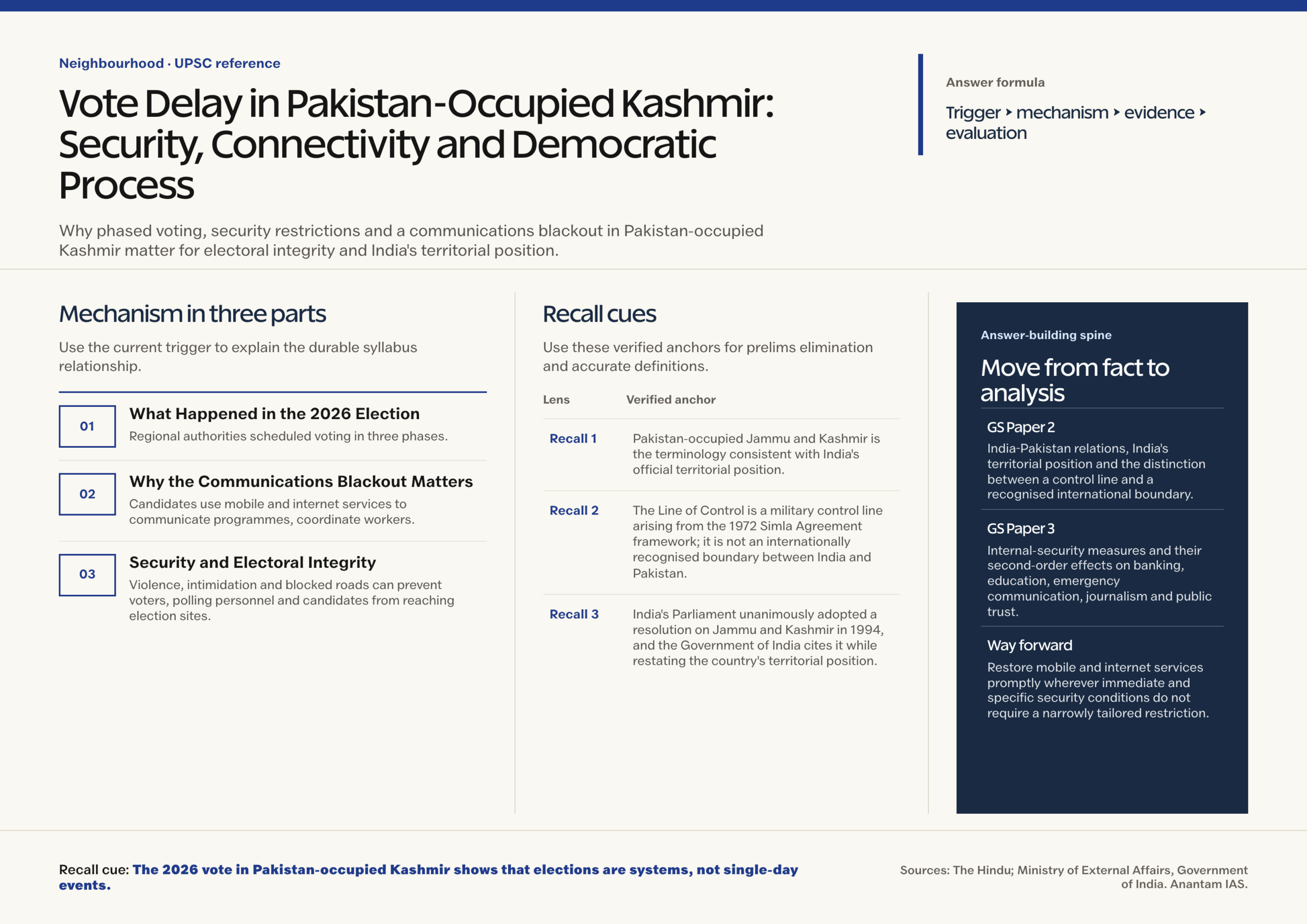
Mindmap explaining Vote Delay in Pakistan-Occupied Kashmir: Security, Connectivity and Democratic Process for UPSC revision
Revision mindmap: Vote Delay in Pakistan-Occupied Kashmir: Security, Connectivity and Democratic Process. Open the full-size image for details.

Background and Context

What Happened in the 2026 Election

The election unfolded against an unusually difficult security and information environment.

  • Regional authorities scheduled voting in three phases. Officials attributed the phased design to security concerns and heavy monsoon rains that complicated campaigning and large gatherings.
  • Protests led by the Jammu and Kashmir Joint Awami Action Committee had preceded the polls. Protest demands included political and economic grievances, while one major dispute concerned reserved legislative seats for people displaced from the Indian.
  • The regional government proscribed the committee on 5 June 2026 under the first schedule of its Anti-Terrorism Act, 2014. Rights groups disputed the use of anti-terror powers against a protest movement, while authorities cited public-order and.
  • Voting in some sensitive constituencies was deferred. On 10 August, voters went to the polls in four Poonch-region constituencies in the final reported phase, with security tightened around polling stations.
  • The governing Pakistan Muslim League-N had already secured a majority from seats decided in the first two phases. That fact made the delayed contests politically relevant but did not make their conduct democratically unimportant.

Why the Communications Blackout Matters

Connectivity is part of the operating infrastructure of a modern election.

  • Candidates use mobile and internet services to communicate programmes, coordinate workers, respond to false claims and reach geographically dispersed voters. A prolonged shutdown can produce unequal campaign access even when it applies across a region.
  • Voters need timely information about polling dates, changed locations, road access, security instructions and results. Restrictions can make a formally announced postponement harder to understand on the ground.
  • Journalists and independent observers depend on communications to transmit evidence, check claims and compare accounts. Amnesty International stated that the blackout severely impeded independent verification of the full extent of the reported violence.
  • Communications restrictions also affect non-electoral services. Reports from the region described disruption to banking, education, business activity and access to online processes, showing why a shutdown’s effects extend beyond political speech.
  • A blackout can suppress false information temporarily, but it may also create an information vacuum in which unverifiable claims spread through informal channels. Authorities should explain the legal basis, geographic scope, duration and review mechanism of.

Security and Electoral Integrity

Public safety is essential to voting, but security measures must support rather than hollow out participation.

  • Violence, intimidation and blocked roads can prevent voters, polling personnel and candidates from reaching election sites. A limited postponement may be justified when credible threats make free polling impossible.
  • The integrity test is procedural: Was the decision taken by a competent authority? Were reasons recorded? Was the revised schedule communicated equally? Could candidates and voters prepare? Were counting and complaints handled transparently?
  • A security justification should be assessed through necessity and proportionality. Authorities should use the least restrictive effective measure, limit it to affected places and periods, and restore normal access promptly.
  • Independent observation becomes more valuable during unrest because official and protester narratives may diverge sharply. Observer and media access helps separate verified facts from claims about casualties, coercion or rigging.
  • UPSC answers should avoid assuming that a delayed poll is automatically illegitimate or that holding it automatically proves legitimacy. The quality of the decision, communication, access and remedy determines the democratic assessment.

India's Official Territorial Position

The article’s terminology follows the Government of India’s stated position and does not imply acceptance of Pakistan’s administrative claims.

  • The Ministry of External Affairs has stated that the entire Union Territories of Jammu and Kashmir and Ladakh have been, are and shall be an integral part of India.
  • India describes Pakistan as being in illegal and forcible occupation of Indian territory. In an official parliamentary answer, the government placed the area under Pakistan’s illegal occupation at approximately 78,000 square kilometres.
  • India also rejects the so-called 1963 China-Pakistan Boundary Agreement under which Pakistan ceded 5,180 square kilometres of Indian territory to China.
  • The Line of Control marks the areas under the respective military control of India and Pakistan. Calling it an international boundary would misstate India’s position and the legal-political character of the line.
  • A careful answer can analyse elections and rights in the territory without endorsing another state’s nomenclature or administration. Use attribution when describing Pakistani institutions and retain India’s official terminology in the analytical frame.

Way Forward

Restore Verifiable Public Communication

  • Restore mobile and internet services promptly wherever immediate and specific security conditions do not require a narrowly tailored restriction.
  • Publish clear orders stating the legal basis, exact area, start and end time, review authority and available remedy for any continuing restriction.
  • Provide redundant public channels for polling changes, emergency services and verified results so voters are not dependent on a single network.

Conclusion

  • The 2026 vote in Pakistan-occupied Kashmir shows that elections are systems, not single-day events.
  • For UPSC answers, the strongest approach combines India’s clear territorial position with careful source attribution.

UPSC Practice Questions

Prelims MCQ 1

With reference to India’s official position on territories under Pakistan’s occupation, consider the following statements:

  1. India regards the entire Union Territories of Jammu and Kashmir and Ladakh as integral parts of India.
  2. India recognises the Line of Control as the international boundary between India and Pakistan.
  3. India does not accept the cession of Indian territory to China under the 1963 China-Pakistan Boundary Agreement.

How many of the above statements are correct?

(a) Only one (b) Only two (c) All three (d) None

Answer: (b) Only two

Explanation:

Statements 1 and 3 are correct. India maintains that Jammu and Kashmir and Ladakh are integral parts of India and rejects the 1963 cession. The Line of Control is not recognised by India as an international boundary.

Prelims MCQ 2

Which one of the following best explains why a prolonged communications blackout can affect electoral integrity?

(a) It automatically cancels every election held during the restriction (b) It transfers election management from civilian to military authorities (c) It can restrict campaigning, voter information, media reporting and independent verification (d) It prevents an election commission from changing a polling date under any circumstances

Answer: (c) It can restrict campaigning, voter information, media reporting and independent verification

Explanation:

Connectivity supports several parts of a modern election. A shutdown does not automatically cancel a poll, but it can create unequal access, weaken transparency and obstruct independent checking of claims.

UPSC Mains Questions

  1. Security is necessary for elections, but security measures can also weaken electoral credibility. Discuss with reference to polling delays and communications restrictions.
  2. Explain India’s official territorial position on Pakistan-occupied Jammu and Kashmir. Why is precise terminology important in foreign-policy analysis?

Sources: The Hindu and Ministry of External Affairs, Government of India.

Frequently Asked Questions

Why was voting conducted in phases in Pakistan-occupied Kashmir?

Regional election officials cited security concerns and heavy monsoon conditions. Protests, clashes and road disruption had affected the campaign environment. Polling in some sensitive areas was deferred, and four Poonch-region constituencies voted in the final reported phase on 10 August.

Did the communications blackout make the election invalid?

A blackout does not by itself produce an automatic legal verdict on an election. It does raise serious electoral-integrity concerns because candidates, voters, journalists and observers may lose access to information. The assessment depends on legality, necessity, proportionality, duration, transparency.

Why should reported casualty figures be treated cautiously?

Different actors reported different totals and assigned responsibility differently. Media and rights groups noted that disrupted communications impeded independent verification. A careful answer should attribute claims, identify what is confirmed and avoid presenting contested figures as settled facts until.

What terminology does India use for the territory?

India uses Pakistan-occupied Jammu and Kashmir or related official formulations and states that Pakistan is in illegal and forcible occupation of Indian territory. This note uses that frame while attributing the names used by Pakistani institutions only when needed to.

Is the Line of Control an international boundary?

No. The Line of Control marks the areas under the respective military control of India and Pakistan under the post-1971 framework associated with the Simla Agreement. India does not treat it as an internationally recognised boundary or as altering its.

India-Bangladesh Security Talks Test a Fragile Diplomatic Reset

Open article →Download PDF

Why in News?

India’s external-intelligence chief Parag Jain met Bangladesh Prime Minister Tarique Rahman’s defence adviser, retired Brigadier General A.K.M.

  • The Dhaka meeting reversed the direction of the March 2026 outreach, when Bangladesh’s military-intelligence chief visited New Delhi and met senior Indian security officials. Reciprocal visits suggest that the channel is becoming more regular rather than.
  • Security engagement is important because the two countries share a long and densely inhabited border, riverine stretches, transport links and common exposure to terrorism, organised crime, trafficking and irregular movement.
  • The substance of intelligence discussions was not publicly detailed. Any claim about operational commitments beyond the reported meeting would be speculative.
  • The talks came days after Dhaka renewed criticism of India’s handling of Sheikh Hasina’s presence and sought action under the bilateral extradition framework. That dispute remains a legal and political issue distinct from routine security cooperation.
  • The immediate test is whether both governments can practise issue-based compartmentalisation: manage a serious disagreement without suspending border coordination, intelligence liaison and diplomatic communication.
  • Stable India-Bangladesh ties affect the security and connectivity of India’s eastern and northeastern states as well as Bangladesh’s trade, energy access and regional options.
  • The engagement illustrates how neighbourly relations are managed through several parallel institutions: political leadership, diplomatic missions, national-security officials, home ministries and border forces.
  • Extradition is not an automatic political handover. A treaty request is examined through the applicable treaty, domestic law, supporting documents and available grounds for refusal.

UPSC Relevance

Prelims Relevance

  • The Research and Analysis Wing is India’s external-intelligence organisation and functions under the Cabinet Secretariat; it is different from the Intelligence Bureau, which has a domestic intelligence mandate.
  • India’s Ministry of External Affairs identifies itself as the Central Authority for extradition matters, with its Consular, Passport and Visa Division serving as the nodal point.
  • India and Bangladesh signed their bilateral Extradition Treaty on 28 January 2013; it entered into force on 23 October 2013.
  • Under the treaty, extraditable conduct must generally be punishable under the laws of both states by imprisonment for at least one year. The legal categories or names of the offences need not be identical.
  • The treaty allows a request to be refused for an offence of a political character, but expressly excludes several violent and terrorism-related offences from that exception.
  • Article 10 requires extradition requests to travel through the diplomatic channel and specifies supporting material, including an arrest warrant for an accused person.

Mains Relevance

GS Paper 2

  • India’s Neighbourhood First policy and the need for political sensitivity, sovereign equality and reliable dispute-management mechanisms.
  • The role of embassies, security advisers, home ministries and leader-level diplomacy in rebuilding trust after a political transition.

GS Paper 3

  • Cross-border terrorism, trafficking, smuggling, counterfeit currency, cyber threats and the security of critical transport and energy links.
  • The value and risks of intelligence liaison, including timely threat exchange, verification, confidentiality and political oversight.

Essay

  • Geography makes cooperation a permanent necessity even when politics makes trust temporary.
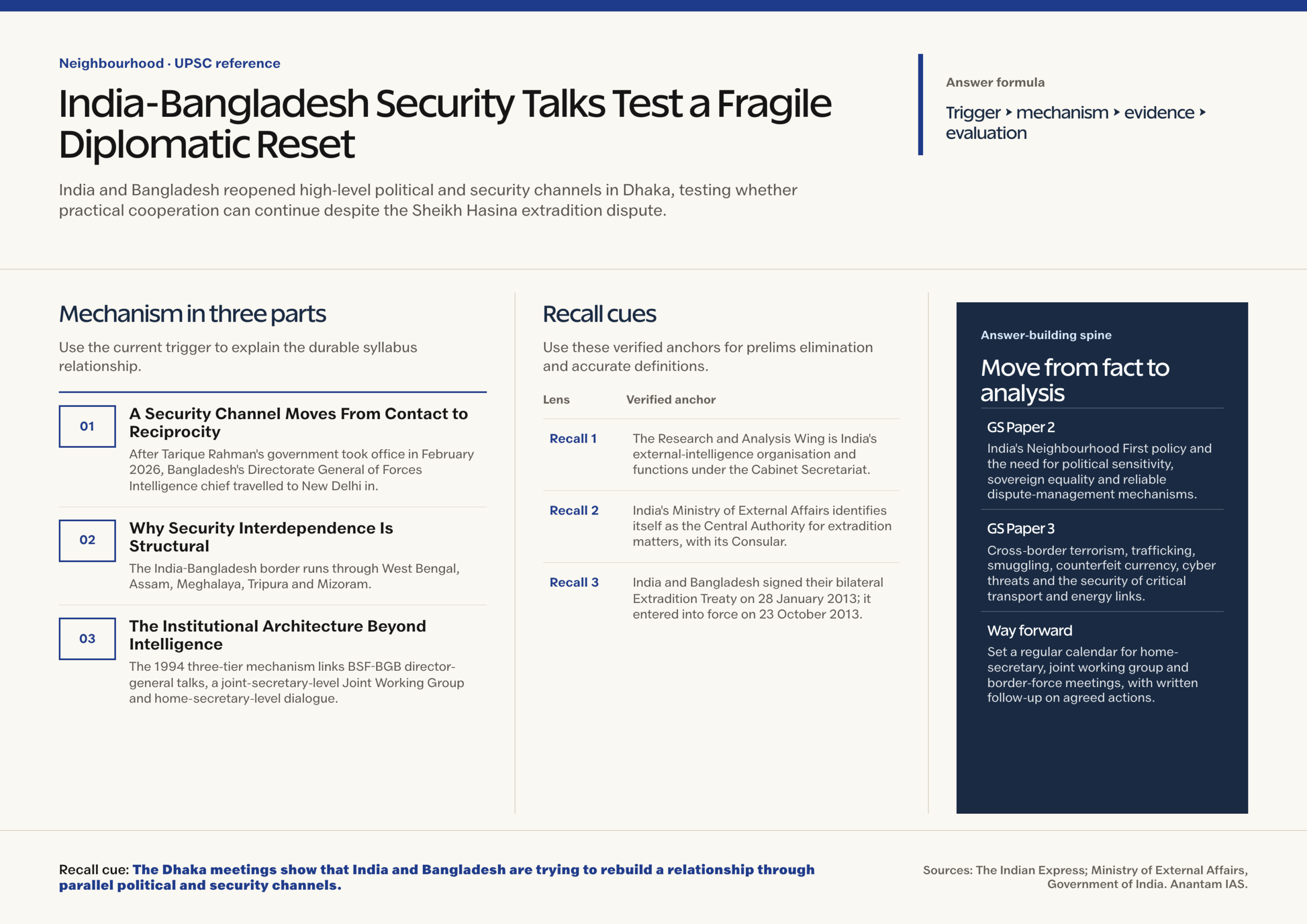
Mindmap explaining India-Bangladesh Security Talks Test a Fragile Diplomatic Reset for UPSC revision
Revision mindmap: India-Bangladesh Security Talks Test a Fragile Diplomatic Reset. Open the full-size image for details.

Background and Context

A Security Channel Moves From Contact to Reciprocity

The latest visit matters because it follows a sequence of contacts rather than appearing in isolation.

  • After Tarique Rahman’s government took office in February 2026, Bangladesh’s Directorate General of Forces Intelligence chief travelled to New Delhi in March and met R&AW chief Parag Jain and other senior Indian security officials.
  • In July, Shamsul Islam represented Bangladesh at the BIMSTEC national-security chiefs’ meeting in New Delhi and met India’s National Security Adviser Ajit Doval on the sidelines.
  • Jain’s Dhaka visit adds reciprocity and continuity. It gives both sides a channel for communicating sensitive concerns without forcing every issue into public diplomacy.
  • Intelligence liaison can support early warning and de-escalation, but its value depends on verified information, agreed red lines and confidence that shared material will be protected.
  • A useful liaison channel separates strategic warning from unverified allegation. Each side should be able to ask for corroboration, identify the legal authority for action and record which agency is responsible for follow-up.

Why Security Interdependence Is Structural

The bilateral security agenda flows from geography and cannot be switched off without costs to both countries.

  • The India-Bangladesh border runs through West Bengal, Assam, Meghalaya, Tripura and Mizoram. Settlements, rivers, farms and family links make it a human landscape rather than a simple line of control.
  • Transnational threats include trafficking in persons, narcotics and arms; smuggling; forged documents; irregular movement; organised criminal networks; extremist recruitment and misuse of digital platforms.
  • For India, a cooperative Bangladesh helps prevent hostile actors from exploiting territory near the Northeast. For Bangladesh, cooperation supports border order, trade flows, energy connectivity and access to a large neighbouring market.
  • Effective policy must distinguish lawful mobility from criminal movement. Over-securitisation can harm legitimate travellers and border livelihoods, while weak enforcement benefits organised networks.
  • Riverine and densely settled stretches complicate surveillance and incident attribution. Local commander hotlines, shared verification of an incident’s location and prompt return of inadvertently crossing civilians can prevent a tactical episode from becoming a diplomatic crisis.

The Institutional Architecture Beyond Intelligence Talks

Security cooperation rests on several formal layers, not on one discreet meeting.

  • The 1994 three-tier mechanism links BSF-BGB director-general talks, a joint-secretary-level Joint Working Group and home-secretary-level dialogue. These levels can escalate unresolved operational questions without immediately politicising them.
  • The Coordinated Border Management Plan encourages coordinated patrolling, information exchange and action against cross-border crime. Border-force conferences provide a recurring venue to address fencing, vulnerable stretches and incidents involving civilians or personnel.
  • The bilateral toolkit also includes arrangements concerning terrorism and organised crime, illicit narcotics, human trafficking, fake currency, maritime cooperation and transfer of sentenced persons.
  • BIMSTEC adds a regional layer. Its national-security dialogue can connect bilateral concerns to wider Bay of Bengal challenges such as terrorism, violent extremism, cyber risk and maritime insecurity.
  • The levels perform different jobs. Border commanders handle immediate incidents; the Joint Working Group can reconcile procedures across departments; home secretaries can settle policy questions; and political leaders can provide authority when a dispute exceeds the.

Extradition Is a Legal Process, Not a Diplomatic Shortcut

The Hasina dispute is politically charged, but the applicable framework contains defined legal tests and procedures.

  • The 2013 treaty creates a reciprocal obligation to extradite persons accused, convicted or wanted to enforce a judicially pronounced penalty for an extraditable offence, subject to the treaty’s conditions.
  • The treaty applies dual criminality: the conduct must be punishable in both states, although each legal system may classify or name it differently.
  • A request must be made through diplomatic channels and supported by prescribed documents. In India, the Ministry of External Affairs examines the request under the treaty and the Extradition Act, 1962.
  • The requested state can examine grounds for refusal, evidentiary sufficiency and procedural protections. The existence of a treaty does not make surrender immediate or remove the role of domestic authorities.
  • Keeping treaty analysis separate from intelligence cooperation reduces the danger that either side treats security coordination as leverage for a particular legal outcome.

Way Forward

Institutionalise the Renewed Contact

  • Set a regular calendar for home-secretary, joint working group and border-force meetings, with written follow-up on agreed actions.
  • Create secure points of contact for urgent threat information and require confirmation before operational action is taken on shared intelligence.
  • Use diplomatic missions to connect security discussions with political guidance and prevent competing official messages.

Conclusion

  • The Dhaka meetings show that India and Bangladesh are trying to rebuild a relationship through parallel political and security channels .
  • The strongest path is institutional: keep border and intelligence cooperation regular, handle extradition through law, and measure progress through safer borders and reliable official conduct.

UPSC Practice Questions

Prelims MCQ 1

With reference to the India-Bangladesh Extradition Treaty, consider the following statements:

  1. An extraditable offence generally involves conduct punishable in both states by imprisonment for at least one year.
  2. The laws of both states must classify and name the relevant offence in exactly the same manner.
  3. The Ministry of External Affairs is India’s Central Authority under the treaty.

How many of the above statements are correct?

(a) Only one (b) Only two (c) All three (d) None

Answer: (b) Only two

Explanation:

Statements 1 and 3 are correct. Article 2 applies dual criminality but says the two legal systems need not place the conduct in the same category or use the same terminology. Article 4 designates India’s Ministry of External Affairs as the Central Authority.

Prelims MCQ 2

Which one of the following correctly describes the three-tier India-Bangladesh mechanism for security and border-management issues?

(a) Coast guard commanders, foreign ministers and prime ministers (b) District magistrates, commerce secretaries and finance ministers (c) BSF-BGB directors general, a joint-secretary-level Joint Working Group and home secretaries (d) Army chiefs, BIMSTEC secretariat and national parliaments

Answer: (c) BSF-BGB directors general, a joint-secretary-level Joint Working Group and home secretaries

Explanation:

The Ministry of Home Affairs records a three-tier mechanism established in 1994: border-force director-general talks, a Joint Working Group at joint-secretary level and home-secretary-level talks.

UPSC Mains Questions

  1. India-Bangladesh relations demonstrate that security interdependence can outlast political trust. Discuss with reference to the recent revival of high-level security engagement.
  2. Extradition treaties create a legal framework but not an automatic right to surrender. Explain the distinction and assess its diplomatic significance in South Asia.

Sources: The Indian Express and Ministry of External Affairs, Government of India.

Frequently Asked Questions

What was the immediate trigger for the latest India-Bangladesh security discussion?

R&AW chief Parag Jain met Bangladesh Prime Minister Tarique Rahman’s defence adviser A.K.M. Shamsul Islam in Dhaka on 10 August 2026. Indian High Commissioner Dinesh Trivedi also met the prime minister, showing that political and security contacts were moving in.

Why is intelligence cooperation important between India and Bangladesh?

The neighbours face connected risks involving terrorism, trafficking, narcotics, arms smuggling, forged documents and cyber-enabled crime. Timely, verified intelligence can help disrupt networks and prevent escalation, especially along a long, populated border, but it needs confidentiality, oversight and clear limits.

Does the 2013 extradition treaty make extradition automatic?

No. The treaty creates obligations subject to defined offences, prescribed documents, domestic legal procedure and grounds for refusal. The requested state examines the request under the treaty and its own law. A political demand by itself does not complete the.

What is dual criminality in extradition law?

Dual criminality means that the underlying conduct must be punishable in both the requesting and requested states. Under the India-Bangladesh treaty, the two legal systems do not have to give the offence the same name or place it in the.

What is the Coordinated Border Management Plan?

It is an India-Bangladesh operational framework for more coordinated border management by the BSF and BGB. It supports communication, coordinated action and efforts against illegal cross-border activities while sitting alongside formal director-general, joint working group and home-secretary talks.

Jammu Border Demographic Study and Evidence-Based Security Governance

Open article →Download PDF

Why in News?

The Hindu reported that the Union government’s High-Level Committee on Demographic Changes reached Jammu to study claims of demographic change in areas near the border with Pakistan.

  • The Ministry of Home Affairs constituted the national committee on 26 May 2026 under retired Supreme Court judge Justice Prakash Prabhakar Naolekar.
  • Its members include the Census Commissioner, retired civil servant Durga Shankar Mishra, retired police officer Balaji Srivastava and economist Shamika Ravi; the Joint Secretary (Foreigners-I), MHA, is Member Secretary.
  • The committee has a one-year reporting period, extendable by the MHA by up to six months if needed.
  • On 1 July 2026, the committee told the Union Home Minister that it would visit States and Union Territories for first-hand inputs and had prepared a questionnaire for administrations before field visits.
  • The Jammu visit should be read as part of that nationwide process. No public committee report or verified Jammu-specific conclusion had been announced at the time of writing.
  • Population change has several components: births, deaths, internal migration, international migration, changes in administrative boundaries and differences in enumeration. Security claims need to distinguish among them.
  • Jammu’s border setting raises legitimate questions about infiltration and document fraud, but residence, migration or community identity by themselves are not proof of unlawful entry.
  • The latest completed decennial Census remains Census 2011. Administrative records can provide newer signals, but they were created for different purposes and cannot silently replace a transparent population methodology.

UPSC Relevance

Prelims Relevance

  • The High-Level Committee on Demographic Changes was constituted by the Ministry of Home Affairs in May 2026 and is chaired by a retired Supreme Court judge.
  • The Census Commissioner is a member, linking the inquiry to India’s official population-statistics system.
  • The committee is an executive body; it is not a constitutional or statutory commission and its recommendations do not themselves change law.
  • The committee’s terms of reference are nationwide and cover demographic change, illegal immigration, border management, identification systems and Centre-State coordination.
  • The Immigration and Foreigners Act, 2025 came into force on 1 September 2025 and regulates entry, stay, registration and related matters concerning foreigners.
  • Section 36 of the 2025 Act repealed four earlier central laws, including the Foreigners Act, 1946, while saving compatible prior actions and instruments.

Mains Relevance

GS Paper 3

  • Border management, illegal immigration, document fraud and the relationship between demographic evidence and internal-security risk assessment.
  • Need to integrate human intelligence, lawful databases, border surveillance and district administration without treating identity as a proxy for threat.

GS Paper 2

  • Centre-UT coordination across citizenship, immigration, police, land, civil registration and welfare systems.
  • Procedural fairness, reasoned decisions, privacy safeguards and accessible review when nationality or residence status is disputed.

Essay

  • Security becomes durable when the state can distinguish a verified threat from a socially amplified suspicion.
Mindmap explaining Jammu Border Demographic Study and Evidence-Based Security Governance for UPSC revision
Revision mindmap: Jammu Border Demographic Study and Evidence-Based Security Governance. Open the full-size image for details.

Background and Context

Committee mandate, composition and present status

The panel is conducting a nationwide inquiry and is still gathering evidence; its mandate should not be confused with a completed factual determination.

  • The Union government announced a high-powered demography mission in August 2025, approved the proposal in September 2025 and formally constituted the committee in May 2026.
  • The official terms ask it to examine possible causes of demographic change, analyse deviations from broader trends and recommend policy, legislative and administrative measures.
  • They also ask for proposals on lawful identification, detention and deportation of illegal immigrants, stronger border management and better coordination between the Union and State governments.
  • The July 2026 PIB update said the committee would collect questionnaires from States and Union Territories, visit them and consult Union ministries. The reported Jammu visit fits this fieldwork plan.
  • Until a report or verified interim findings are published, phrases such as ‘demographic change in Jammu’ describe a claim under examination, not an established committee conclusion.

How demographic change should be measured

A population trend is an accounting result whose causes must be decomposed before a security inference is made.

  • At the simplest level, population at the end of a period equals the opening population plus births, minus deaths, plus inward migration and minus outward migration.
  • Researchers should compare consistent geographic units and time periods. A new ward, changed district boundary or altered enumeration practice can create an apparent shift without equivalent movement on the ground.
  • Census tables, the Civil Registration System, Sample Registration System, electoral rolls, school enrolment, ration records, land registration and police data answer different questions. They have different coverage, definitions and error patterns.
  • Administrative records may contain duplication, delayed deletion or exclusion. A mismatch across databases is a lead for verification, not automatic proof that a person is a foreigner.
  • Analysis should publish definitions, base populations, denominators, confidence limits and alternative explanations. Community shares without absolute numbers can exaggerate a small numerical change.

Border-security relevance without demographic profiling

A border district needs sharper security capability, but population category and security threat are not interchangeable concepts.

  • Cross-border infiltration can support terrorism, smuggling, espionage or organised crime, while irregular migration can create separate questions of documentation and legal status.
  • Effective enforcement begins with specific indicators: border-crossing evidence, forged documents, unexplained identity chains, trafficking networks, suspicious financial links or corroborated intelligence.
  • Religion, language, occupation, poverty, tenancy or migration from another Indian State cannot by themselves establish foreign nationality or hostile intent.
  • Collective profiling wastes investigative capacity by producing false positives, weakens community trust and may discourage residents from sharing useful local intelligence.
  • A better model is risk-based and behaviour-led: focus on routes, facilitators, fraudulent document supply chains and verified anomalies, followed by individualised legal process.

Legal and constitutional framework

Immigration control is a Union responsibility, but every coercive decision still needs legal authority, accurate identity work and fair procedure.

  • The Seventh Schedule places citizenship, naturalisation and aliens, and admission, emigration and expulsion in the Union List. The Ministry of Home Affairs leads the central framework.
  • The Immigration and Foreigners Act, 2025 consolidates rules on entry, visas, registration, stay and removal. It came into force on 1 September 2025 and replaced four older central statutes.
  • A committee can recommend changes, but investigation, detention, prosecution or removal must rest on the applicable Act, rules, orders and delegated authority rather than on the committee’s existence.
  • Articles 14 and 21 protect persons against arbitrary state action. Article 19 rights are textually reserved to citizens, an important distinction in questions involving foreigners.
  • Nationality disputes need documented notice, an opportunity to respond, reasoned findings, competent review and consular coordination where relevant. Indefinite or identity-blind detention is not a substitute for a workable removal process.

Way Forward

Publish an evidence protocol

  • Use consistent boundaries, multiple years and several independent datasets; separate natural increase, internal migration and international migration.
  • Invite peer review from demographers, statisticians, security experts and constitutional-law scholars before causal claims are finalised.
  • Target crossing routes, traffickers, forged-document networks, corrupt facilitators and finance rather than broad community categories.
  • Create joint district teams with clear jurisdiction, recorded evidence standards and periodic supervisory review.

Conclusion

  • The Jammu visit gives the High-Level Committee an opportunity to show what evidence-based border governance looks like.
  • A credible state can be firm against illegal entry and document fraud without treating mobility or identity as guilt.

UPSC Practice Questions

Prelims MCQ 1

With reference to the High-Level Committee on Demographic Changes constituted in 2026, consider the following statements:

  1. It was constituted by the Ministry of Home Affairs.
  2. The Census Commissioner is one of its members.
  3. It is a constitutional body whose recommendations automatically have the force of law.

How many of the above statements are correct?

(a) Only one (b) Only two (c) All three (d) None

Answer: (b) Only two

Explanation:

Statements 1 and 2 are correct. The MHA constituted the executive committee and included the Census Commissioner. It is not a constitutional body, and its recommendations require separate lawful action before they can alter rights, duties or institutions.

Prelims MCQ 2

Which one of the following laws currently provides India’s consolidated central framework for entry, stay, registration and related regulation of foreigners?

(a) Foreigners Act, 1946 (b) Registration of Foreigners Act, 1939 (c) Immigration and Foreigners Act, 2025 (d) Citizenship Act, 1955 alone

Answer: (c) Immigration and Foreigners Act, 2025

Explanation:

The Immigration and Foreigners Act, 2025 came into force on 1 September 2025. Its repeal-and-saving provision replaced four earlier central laws, including the Foreigners Act, 1946 and Registration of Foreigners Act, 1939.

UPSC Mains Questions

  1. Demographic change in a border region is a hypothesis to be tested, not a security conclusion in itself. Discuss the evidence needed to distinguish natural increase, internal migration and illegal cross-border movement.
  2. Examine how India can strengthen identification and border management while protecting lawful residents from profiling, data errors and arbitrary coercion.

Sources: The Hindu National and Press Information Bureau, Ministry of Home Affairs.

Frequently Asked Questions

What is the High-Level Committee on Demographic Changes?

It is an executive committee constituted by the Ministry of Home Affairs on 26 May 2026. Chaired by retired Supreme Court judge Justice Prakash Prabhakar Naolekar, it is examining possible causes and consequences of demographic changes and may recommend policy.

Has the committee proved demographic change caused by illegal immigration in Jammu?

No public committee report establishing that conclusion had been released when this note was prepared. The reported Jammu visit is part of evidence gathering. Any causal finding must separate births, deaths, internal migration, cross-border movement, boundary changes and data errors.

Why is the Jammu visit relevant to internal security?

Jammu includes areas near the border with Pakistan, where infiltration, smuggling, terrorism and document fraud are legitimate security concerns. The policy challenge is to identify specific unlawful networks through corroborated evidence without treating residents, migrants or communities as presumptively suspect.

Which law now regulates foreigners in India?

The Immigration and Foreigners Act, 2025 has been in force since 1 September 2025. It consolidates provisions on passports or travel documents, visas, registration, entry and stay, and repealed four earlier central laws while saving compatible actions already taken under.

Why cannot one database establish illegal immigration?

Electoral rolls, ration cards, school records, land records and civil registration systems have different purposes and error patterns. A mismatch may reflect spelling, mobility, delayed updating or exclusion. A high-stakes nationality finding needs original documents, corroboration, field inquiry and lawful.

Tribunals Reforms Bill: A New Appointments Panel and the Independence Question

Open article →Download PDF

Why in News?

The Lok Sabha passed the Tribunals Reforms Bill, 2026 by voice vote on August 10, 2026.

  • The Bill was introduced and passed in the Lok Sabha on the same day. It had not become law at the time of writing because passage by the Rajya Sabha and presidential assent were still required.
  • It would repeal the Tribunals Reforms Act, 2021 and establish a five-member National Tribunals Commission comprising a Chairperson, two Judicial Members and two Technical Members.
  • The Commission would constitute separate Search-cum-Selection Committees for appointing tribunal Chairpersons and Members, while the Central Government would make the final appointments.
  • The Bill prescribes a uniform five-year term, subject to an upper age of 70 years for a tribunal Chairperson and 67 years for a Member.
  • The First Schedule brings 16 tribunal categories within the framework, including the CAT, AFT, NGT, ITAT, NCLAT, NCDRC, TDSAT and debt recovery tribunals.
  • Tribunals decide specialised disputes but exercise adjudicatory power comparable in important respects to courts. Their design must balance domain expertise and speed with independence, fairness and effective judicial review.
  • The executive is frequently a litigant before tribunals. Appointment control, short tenure, uncertain reappointment and dependence on a sponsoring ministry can create a perceived or real conflict of interest.
  • The central UPSC issue is not whether tribunals should exist, but whether their institutional architecture protects separation of powers while delivering specialised justice efficiently.

UPSC Relevance

Prelims Relevance

  • Article 323A permits Parliament to provide for administrative tribunals concerning recruitment and service conditions of persons appointed to public services and posts connected with the Union, states or specified authorities.
  • Article 323B permits the appropriate legislature to create tribunals for specified matters such as taxation, foreign exchange, industrial and labour disputes, land reforms and elections to legislatures.
  • The National Tribunals Commission proposed by the Bill is a statutory body, not a constitutional body.
  • The Commission Chairperson must have been a Supreme Court Judge or a High Court Chief Justice. A Judicial Member must have been a High Court Chief Justice or Judge.
  • A Technical Member must possess ability, integrity and standing plus at least 25 years of special knowledge and experience in one or more specified fields.
  • The proposed tenure for tribunal Chairpersons and Members is five years, with upper age limits of 70 and 67 years, respectively.

Mains Relevance

GS Paper 2

  • Assess tribunal independence through the lenses of separation of powers, rule of law and judicial independence.
  • Examine whether a common commission can reduce fragmented appointments, vacancies and dependence on sponsoring ministries.

GS Paper 2

  • Compare the Bill’s selection structure with Supreme Court principles requiring meaningful judicial primacy where tribunals substitute for courts.
  • Evaluate delegated legislation because important service and assessment details would be prescribed later.

Essay

  • Institutions earn legitimacy through fair outcomes, transparent processes and accountable administration.
Mindmap explaining Tribunals Reforms Bill: A New Appointments Panel and the Independence Question for UPSC revision
Revision mindmap: Tribunals Reforms Bill: A New Appointments Panel and the Independence Question. Open the full-size image for details.

Background and Context

Why India Uses Tribunals

Tribunals are specialised adjudicatory bodies designed to complement courts in technically complex or high-volume fields.

  • They operate in areas such as service matters, taxation, company law, securities, telecom, environmental disputes, consumer protection and debt recovery. Their promise is expertise, procedural flexibility and speed.
  • A tribunal is not automatically equivalent to an executive department. When it decides disputes and affects legal rights, its members must be able to decide without pressure from the government, regulated entities or other interested parties.
  • Articles 323A and 323B, inserted by the 42nd Constitutional Amendment, provide an express constitutional basis for particular categories of tribunals, although several tribunals also arise under ordinary legislation outside those provisions.
  • In L. Chandra Kumar v. Union of India (1997), the Supreme Court held that judicial review by High Courts under Articles 226 and 227 and by the Supreme Court under Article 32 forms part of the.

From Rationalisation to the 2021 Framework

The present Bill is part of a longer effort to consolidate tribunals and standardise appointments and service conditions.

  • The Statement of Objects and Reasons says the Union began tribunal rationalisation in 2015. The Finance Act, 2017 abolished or merged some tribunals and authorised central rules on appointments, tenure and qualifications.
  • The Tribunals Reforms (Rationalisation and Conditions of Service) Ordinance, 2021 was promulgated on April 4, 2021 and was replaced by the Tribunals Reforms Act, 2021.
  • The 2021 law created common arrangements for appointments and service conditions. It prescribed a four-year term and a minimum entry age of 50, provisions that attracted constitutional challenge because they departed from prior judicial directions.
  • Repeated litigation shows that tribunal reform concerns selection, secure tenure, finances and protection from influence by an executive that may itself be a litigant.

The Supreme Court's Constitutional Baseline

A line of Madras Bar Association judgments has treated tribunal independence as part of the wider guarantee of judicial independence.

  • The Bill’s official statement records that in Madras Bar Association v. Union of India, reported as (2026) 2 SCC 1, the Supreme Court struck down provisions of the 2021 Act as contrary to separation of.
  • The Court’s November 19, 2025 judgment also directed establishment of a National Tribunals Commission that is independent, possesses professional expertise, uses transparent processes and provides an oversight mechanism for selection and appointment.
  • Earlier judgments stressed that the executive cannot dominate selection when it is often a litigant before tribunals. Judicial participation, secure tenure and insulation from parent ministries reduce the risk of institutional bias.
  • Constitutional scrutiny looks beyond labels to effective control over appointments, funding, staffing and removal.

Design of the National Tribunals Commission

The Bill creates a common institution for selection support, oversight and tribunal data, headquartered in New Delhi.

  • The Commission would have a Chairperson and four Members: two Judicial Members and two Technical Members. The Chairperson must be a former Supreme Court Judge or High Court Chief Justice.
  • The Central Government would appoint all five. It must consult the Chief Justice of India before appointing the Chairperson and Judicial Members; the Bill does not prescribe a collegium or selection committee for appointing the Commission.
  • Its statutory functions are to conduct tribunal selections through Search-cum-Selection Committees, review tribunal performance, prepare an annual report, oversee inquiries into complaints, and develop the National Tribunals Data Grid.
  • A Central Government-appointed Secretary-rank officer would head the Secretariat. Government grants would fund the Commission after parliamentary appropriation, while its accounts would be audited by the Comptroller and Auditor-General of India and laid before Parliament.
  • Its annual activity report would be laid before both Houses of Parliament.

Way Forward

Protect the Commission at the Entry Point

  • Create a transparent, plural selection process for the Commission’s Chairperson and Members, publish eligibility and evaluation criteria, and record reasons for appointments.
  • Translate consultation with the CJI into a clear procedure that secures effective judicial participation, not a formality.
  • Give the Commission predictable funding, professional staffing and control over common infrastructure while retaining CAG audit and parliamentary reporting.
  • Place vacancy calendars, selection status, sanctioned strength, case disposal and pendency on the National Tribunals Data Grid in accessible formats.

Conclusion

  • The Tribunals Reforms Bill, 2026 marks a shift from fragmented tribunal administration towards a common commission, standard selection machinery, five-year tenure and shared data oversight.
  • The final constitutional test will be functional.

UPSC Practice Questions

Prelims MCQ 1

With reference to the Tribunals Reforms Bill, 2026, consider the following statements:

  1. The proposed National Tribunals Commission consists of a Chairperson, two Judicial Members and two Technical Members.
  2. The Commission itself makes the final appointment of tribunal Chairpersons and Members.
  3. The Commission is assigned the function of developing and maintaining a National Tribunals Data Grid.

How many of the above statements are correct?

(a) Only one (b) Only two (c) All three (d) None

Answer: (b) Only two

Explanation:

Statements 1 and 3 are correct. The Commission conducts selection through Search-cum-Selection Committees, but the Central Government makes appointments on the committees’ recommendations.

Prelims MCQ 2

Which one of the following correctly describes the tenure proposed for tribunal Chairpersons and Members under the Tribunals Reforms Bill, 2026?

(a) Four years, with an upper age of 67 for both (b) Five years, with an upper age of 70 for both (c) Five years, with upper ages of 70 for a Chairperson and 67 for a Member (d) Six years, without any upper age limit

Answer: (c) Five years, with upper ages of 70 for a Chairperson and 67 for a Member

Explanation:

Clause 17 provides a five-year term, subject to age 70 for a tribunal Chairperson and age 67 for a tribunal Member, whichever is earlier.

UPSC Mains Questions

  1. The independence of tribunals depends as much on their administrative design as on the legal powers they exercise. Examine in the context of the Tribunals Reforms Bill, 2026. (250 words)
  2. Discuss how the proposed National Tribunals Commission seeks to balance judicial participation, technical expertise and executive accountability in tribunal appointments. (250 words)

Sources: Digital Sansad, Lok Sabha and The Indian Express.

Frequently Asked Questions

What is the Tribunals Reforms Bill, 2026?

It is a Bill passed by the Lok Sabha on August 10, 2026 to repeal the 2021 tribunal law, create a National Tribunals Commission, standardise selection and service arrangements, provide five-year tribunal terms and make consequential changes to the laws.

Has the Tribunals Reforms Bill, 2026 become law?

No. At the time of writing, it had been passed only by the Lok Sabha. It would need to complete the remaining parliamentary process and receive the President’s assent before becoming an Act, followed by commencement through government notification.

What would the National Tribunals Commission do?

The Commission would organise selections through Search-cum-Selection Committees, review tribunal performance, oversee inquiries into complaints against tribunal Chairpersons and Members, prepare an annual report and develop and maintain the National Tribunals Data Grid.

Who would appoint tribunal Chairpersons and Members?

Search-cum-Selection Committees constituted by the Commission would assess candidates and recommend names. The Central Government would make the final appointments. The Bill gives the government three months from receipt of a recommendation to complete an appointment.

Why is tribunal independence a constitutional concern?

Tribunals exercise adjudicatory power and often hear disputes in which the government is a party. Executive dominance over appointments, tenure, funding or removal can compromise actual or perceived impartiality, engaging separation of powers, judicial independence and the rule of law.