Opens in a new tab
Join Anantam IAS Channel on Telegram

Daily Digest · Wednesday

12 August 2026 Current Affairs for UPSC

7 current affairs published on Wednesday, 12 August 2026

12 August 2026 Current Affairs for UPSC — every Why-in-News article AnantamIAS published on Wednesday, 12 August 2026, broken down with Why in News?, the exact GS paper it feeds, sub-topic mapping, MCQ-ready facts and a UPSC-style practice question. 7 articles in total, covering Polity, Economy, Environment, S&T, IR, Geography, History, Society and Internal Security — the same Why-in-News + GS-paper-mapping + practice-question format the Compass uses across every daily digest on the site.

Daily current affairs for UPSC is where new material enters your prep stream. Read this 12 August 2026 digest end-to-end in 25–35 minutes, attempt the practice question at the foot of each article (it's MCQ for some, 10/15-marker for others), then bookmark the entries that fall inside your active revision window. Everything stays cross-linked: tap any subject pill to jump to that subject's hub, or use the table of contents above to skip straight to a specific story.

Use this page three ways. Read sequentially for a one-sitting scan of everything that mattered on 12 August 2026. Download the 12 August 2026 PDF below for offline study or print revision. Or use the August 2026 Current Affairs compilation to see this day in the month's full context. For the previous day's reading, see 11 August 2026 Current Affairs; the next day's is 13 August 2026 Current Affairs.

Why we publish daily current affairs separately from the monthly compilation: daily is learning, monthly is revision. Use the daily page to add fresh material to your notes the day it breaks; come back to the August 2026 compilation 60 days before Prelims when the noise has settled and only the lasting takeaway is worth re-reading.

Solar Eclipse: Orbital Geometry, Observation and Eye Safety

Open article →Download PDF

Why in News?

A total solar eclipse will occur on August 12, 2026.

  • NASA’s eclipse catalogue gives the instant of greatest eclipse as about 17:47 UTC, or about 11:17 p.m. IST, on August 12.
  • The total phase will last less than two minutes for most observers in the path. The calculated maximum is about 2 minutes 18 seconds near the centre line.
  • Totality crosses parts of the Arctic, Greenland, Iceland and Spain; partial phases extend across much of Europe, parts of North America and Africa, and adjoining ocean regions.
  • Only observers inside the Moon’s narrow umbra see totality. Observers in the broader penumbra see a partial eclipse.
  • Direct viewing is safe without a solar filter only during the brief total phase, for an observer who is inside the path of totality and only while the Sun’s bright face is completely covered.
  • A solar eclipse occurs only near new moon, when the Moon passes between the Sun and Earth and its shadow falls on Earth.
  • Every new moon does not produce an eclipse because the Moon’s orbital plane is inclined by about 5 degrees to the ecliptic. Most months, the Moon and its shadow pass above or below the required alignment.
  • The difference between total, annular and partial eclipses depends on alignment and the changing apparent angular sizes of the Sun and Moon.

UPSC Relevance

Prelims Relevance

  • A solar eclipse occurs when the Moon passes between the Sun and Earth; it can occur only at the new-moon phase.
  • The ecliptic is the plane of Earth’s orbit around the Sun. The Moon’s orbital plane is tilted by about 5 degrees to it.
  • The two points where the Moon’s orbit crosses the ecliptic are the ascending node and descending node.
  • An eclipse season occurs when the Sun is close enough to a lunar node for a new moon or full moon to produce the required near-straight alignment.
  • The umbra is the dark central part of the Moon’s shadow where the solar disk is completely covered; the penumbra produces a partial eclipse.
  • An annular eclipse occurs when the Moon appears too small to cover the solar disk completely, leaving a bright ring. It is not safe to view without a proper filter at any stage.

Mains Relevance

GS Paper 1

  • Explain eclipse paths using Earth’s rotation, the Moon’s moving shadow and the difference between umbra and penumbra.
  • Use orbital inclination and lunar nodes to show why new moon is necessary but not sufficient for a solar eclipse.

GS Paper 3

  • Discuss eclipses as opportunities to study the solar corona, atmospheric response, ionospheric change and public participation in science.
  • Use eye-safety communication as a case study in translating scientific standards into practical public-health advice.

Essay

  • Prediction turns fear into understanding: eclipses show how science replaces superstition with testable geometry.
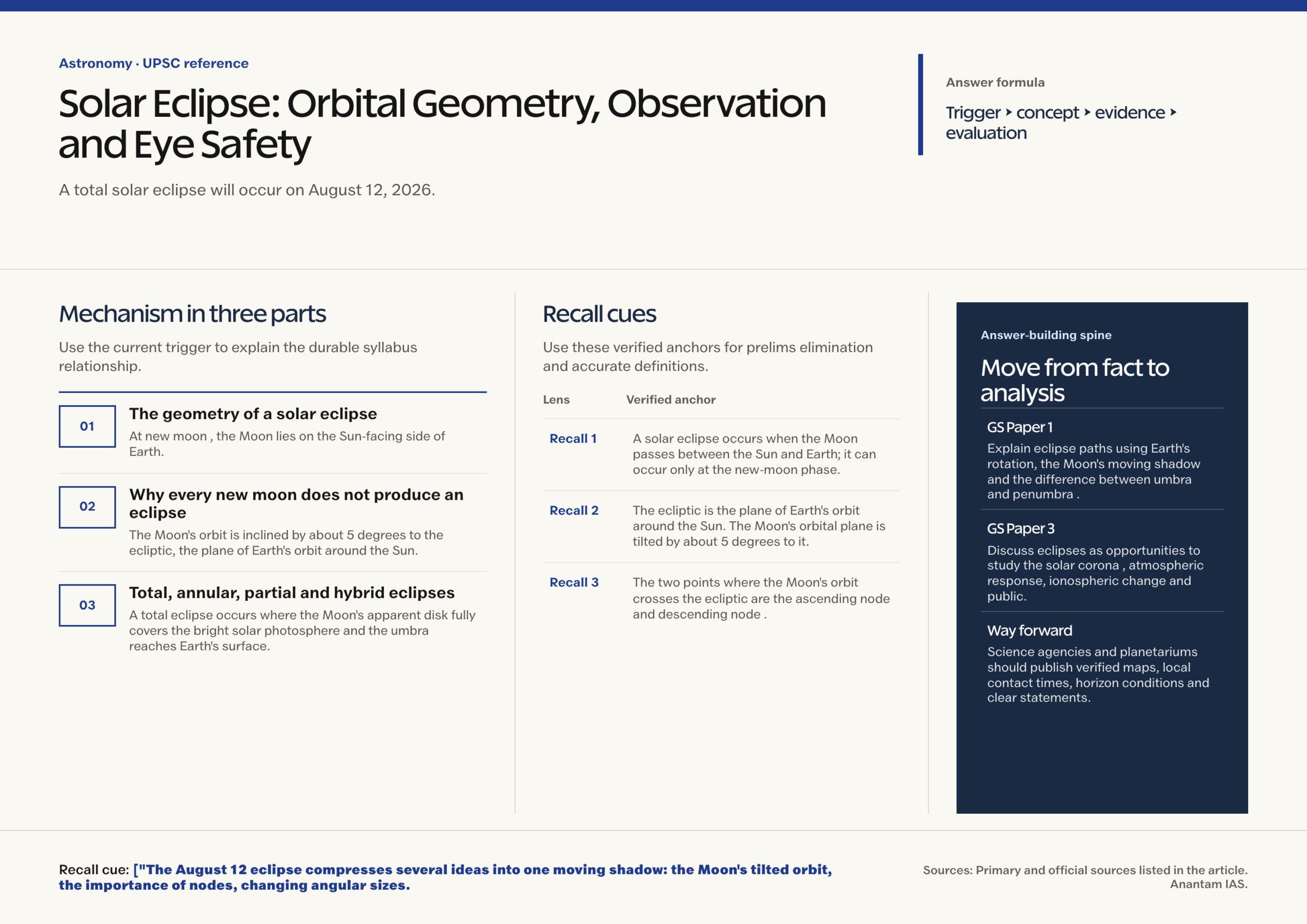
Mindmap explaining Solar Eclipse: Orbital Geometry, Observation and Eye Safety for UPSC revision
Revision mindmap: Solar Eclipse: Orbital Geometry, Observation and Eye Safety. Open the full-size image for details.

Background and Context

The geometry of a solar eclipse

A solar eclipse is a shadow event created by a near-straight Sun-Moon-Earth alignment.

  • At new moon, the Moon lies on the Sun-facing side of Earth. If it is also close to one of its orbital nodes, it can pass across the Sun as seen from part of Earth.
  • The Moon blocks a cone of sunlight. Its darkest central shadow, the umbra, traces a narrow path over Earth’s surface; observers inside it see the solar photosphere fully covered.
  • The surrounding penumbra is much wider because only part of the solar disk is blocked there. This is why millions can see a partial eclipse while a much smaller population experiences totality.
  • Earth’s rotation and the Moon’s orbital motion make the shadow sweep from west to east across the surface, producing different local start, maximum and end times.
  • The August 2026 path lies far from India. NASA’s listed regions of total and partial visibility do not include the Indian subcontinent.

Why every new moon does not produce an eclipse

The three bodies align in longitude every month, but they usually do not align in the same orbital plane.

  • The Moon’s orbit is inclined by about 5 degrees to the ecliptic, the plane of Earth’s orbit around the Sun.
  • For most new moons, the Moon passes apparently north or south of the Sun and its shadow misses Earth.
  • An eclipse becomes possible when a new moon occurs close to the ascending or descending node, where the lunar orbit crosses the ecliptic.
  • Periods when the Sun is close enough to a node are called eclipse seasons. NASA describes two broad opportunities each year, with more than one solar or lunar eclipse possible within a season.
  • The nodes themselves slowly regress, so the timing of eclipse seasons shifts through the calendar rather than staying fixed to one month.

Total, annular, partial and hybrid eclipses

Alignment determines whether an eclipse occurs, while apparent size and shadow reach help determine its type.

  • A total eclipse occurs where the Moon’s apparent disk fully covers the bright solar photosphere and the umbra reaches Earth’s surface.
  • An annular eclipse occurs when the Moon appears slightly smaller, commonly because it is farther from Earth in its elliptical orbit. The central observer sees a bright ring of photosphere around it.
  • A partial eclipse is seen from the penumbra, where only part of the solar disk is covered. It can also be the only eclipse type when the umbra misses Earth.
  • A hybrid eclipse changes between annular and total along its path because Earth’s curved surface changes the observer’s distance from the Moon’s shadow tip.
  • The Sun is about 400 times wider than the Moon but also about 400 times farther away, producing the similar apparent sizes that make total solar eclipses possible.

Reading the August 12, 2026 eclipse path

An eclipse map is a geography of a moving shadow, not merely a list of countries.

  • NASA places totality over a small remote region of northern Russia, then Greenland and Iceland, followed by Spain and the extreme northwest of Portugal near evening.
  • The partial phase covers a much wider area, including parts of North America, most of Europe, northwestern Africa and sections of the Arctic, Atlantic and Pacific oceans.
  • For most places in the path of totality, full coverage lasts less than two minutes. Near the centre line, the calculated maximum is about 2 minutes 18 seconds.
  • The eclipse has a magnitude of 1.039. Solar-eclipse magnitude is the fraction of the Sun’s diameter covered by the Moon at the instant of greatest eclipse, not the fraction of solar area covered.
  • A place may have daylight and still miss an eclipse because it lies outside the penumbra. Visibility requires both the Sun above the local horizon and the observer inside the Moon’s moving shadow.

Way Forward

Make location-specific information the public default

  • Science agencies and planetariums should publish verified maps, local contact times, horizon conditions and clear statements about regions where the event is not visible.
  • Media reports should distinguish totality, partial visibility and non-visibility instead of using one dramatic headline for every location.
  • Schools can pair the event with scale models showing nodes, tilted orbital planes and shadow cones.

Conclusion

  • The August 12 eclipse compresses several ideas into one moving shadow: the Moon’s tilted orbit, the importance of nodes, changing angular sizes, Earth’s rotation and the narrow geography of totality.
  • Its clearest public lesson is practical.

UPSC Practice Questions

Prelims MCQ 1

With reference to solar eclipses, consider the following statements:

  1. A solar eclipse can occur only during the new-moon phase.
  2. The Moon’s orbital plane is inclined by about 5 degrees to the ecliptic.
  3. Observers in the penumbra experience totality.

How many of the above statements are correct?

(a) Only one (b) Only two (c) All three (d) None

Answer: (b) Only two

Explanation:

Statements 1 and 2 are correct. Totality is seen within the Moon’s umbra; the penumbra produces a partial eclipse, so statement 3 is incorrect.

Prelims MCQ 2

Which one of the following is the safest method for observing the partial phase of a solar eclipse?

(a) Looking through very dark ordinary sunglasses (b) Looking through binoculars while wearing eclipse glasses (c) Using a verified ISO 12312-2 solar viewer for unmagnified viewing (d) Viewing the Sun through exposed photographic film

Answer: (c) Using a verified ISO 12312-2 solar viewer for unmagnified viewing

Explanation:

A properly sourced viewer conforming to ISO 12312-2 is designed for direct, unmagnified solar viewing. Ordinary sunglasses and film are unsafe, while binoculars require a special solar filter over the front aperture.

UPSC Mains Questions

  1. Why does every new moon not produce a solar eclipse? Explain with reference to the ecliptic, lunar nodes and eclipse seasons.
  2. Distinguish total, annular and partial solar eclipses using shadow geometry and apparent angular size.

Sources: The Hindu and NASA Science.

Frequently Asked Questions

Will the August 12, 2026 solar eclipse be visible in India?

No. NASA’s official visibility regions for the August 12 eclipse do not include India. Totality crosses parts of northern Russia, Greenland, Iceland, Spain and extreme northwestern Portugal, while the partial eclipse covers much of Europe, parts of North America and.

Why is there no solar eclipse at every new moon?

The Moon’s orbital plane is tilted by about 5 degrees to the ecliptic, the plane of Earth’s orbit around the Sun. At most new moons, the Moon passes apparently above or below the Sun and its shadow misses Earth. An.

What is the difference between the umbra and penumbra?

The umbra is the dark central part of the Moon’s shadow where the bright solar disk is completely covered and observers see totality. The penumbra surrounds it and blocks only part of the Sun, producing a partial eclipse. Because the.

What is a Saros cycle?

A Saros is 223 synodic months, about 18 years, 11 days and 8 hours, after which the Sun, Earth and Moon return to a similar eclipse geometry. The extra eight hours rotate Earth about one-third of a turn, so the.

Can ordinary sunglasses be used to watch a solar eclipse?

No. Ordinary sunglasses, however dark, transmit far too much solar radiation. For direct unmagnified viewing of any partial phase, use a verified solar viewer conforming to ISO 12312-2. An alternative is indirect projection, such as a pinhole projector used with.
Tribal Outbreak Response and the Last-Mile Health Gap

Open article →Download PDF

Why in News?

The Indian Express reported that six children had died and around 100 had fallen ill over the preceding month in four remote, Baiga-dominated villages of Balaghat district in Madhya Pradesh.

  • The affected children, aged between one and 13 years, were from Adori, Kundeksa, Bondari and Korka villages in the Baihar area.
  • Reported symptoms included high fever, rashes or red spots, stomach pain and ulcers, but this symptom combination is not enough to identify a pathogen or disease.
  • The district health department said it learnt about the deaths only after three children had already died, revealing a serious delay in event detection and escalation.
  • Health workers faced forested and hilly terrain, difficulty locating cases, and families who were reluctant to disclose illness or allow hospital admission. Officials later used police assistance to complete referrals.
  • Samples were sent to an ICMR bacterial-infection research institute in Kolkata and the ICMR-National Institute of Virology in Pune, while a Jabalpur Medical College team investigated the outbreak.
  • An outbreak is not only a biomedical event. Its outcome depends on how quickly unusual illness is noticed, reported, verified, sampled, treated and referred.
  • Remote tribal habitations face a compound disadvantage: distance to facilities, seasonal access, weak transport, staff shortages, language differences, livelihood schedules and memories of disrespectful care can reinforce one another.
  • Coercion may secure an urgent transfer, but repeated reliance on police can deepen mistrust. A resilient system must build community consent and confidence before an emergency.

UPSC Relevance

Prelims Relevance

  • The Baiga are a Particularly Vulnerable Tribal Group found in Madhya Pradesh and some other central and eastern Indian states.
  • There are 75 PVTG communities identified across 18 states and one Union Territory under PM-JANMAN’s coverage framework.
  • The Integrated Disease Surveillance Programme was launched in 2004 to detect and respond to outbreaks quickly and now operates under the National Health Mission.
  • IDSP has surveillance units at the Central, State and district levels, with Rapid Response Teams investigating rising illness trends and suspected outbreaks.
  • The Integrated Health Information Platform supports surveillance reporting; its community-based surveillance route allows reporting of outbreak-prone diseases and unusual health events.
  • Mobile Medical Units under NHM are meant to take healthcare to remote, difficult, underserved and unreached populations; they are not primarily patient-transfer vehicles.

Mains Relevance

GS Paper 2

  • Public-health capacity, primary care, disease surveillance and referral systems in remote tribal regions.
  • Health equity, cultural competence and the State’s responsibility to make essential services physically and socially accessible.

GS Paper 3

  • Disaster-style incident management for outbreaks, including early warning, logistics, laboratories, risk communication and data quality.
  • Use of digital surveillance and geospatial microplanning without substituting dashboards for frontline detection and human trust.

Essay

  • The distance between a citizen and the State is measured not only in kilometres, but also in language, trust and time to care.
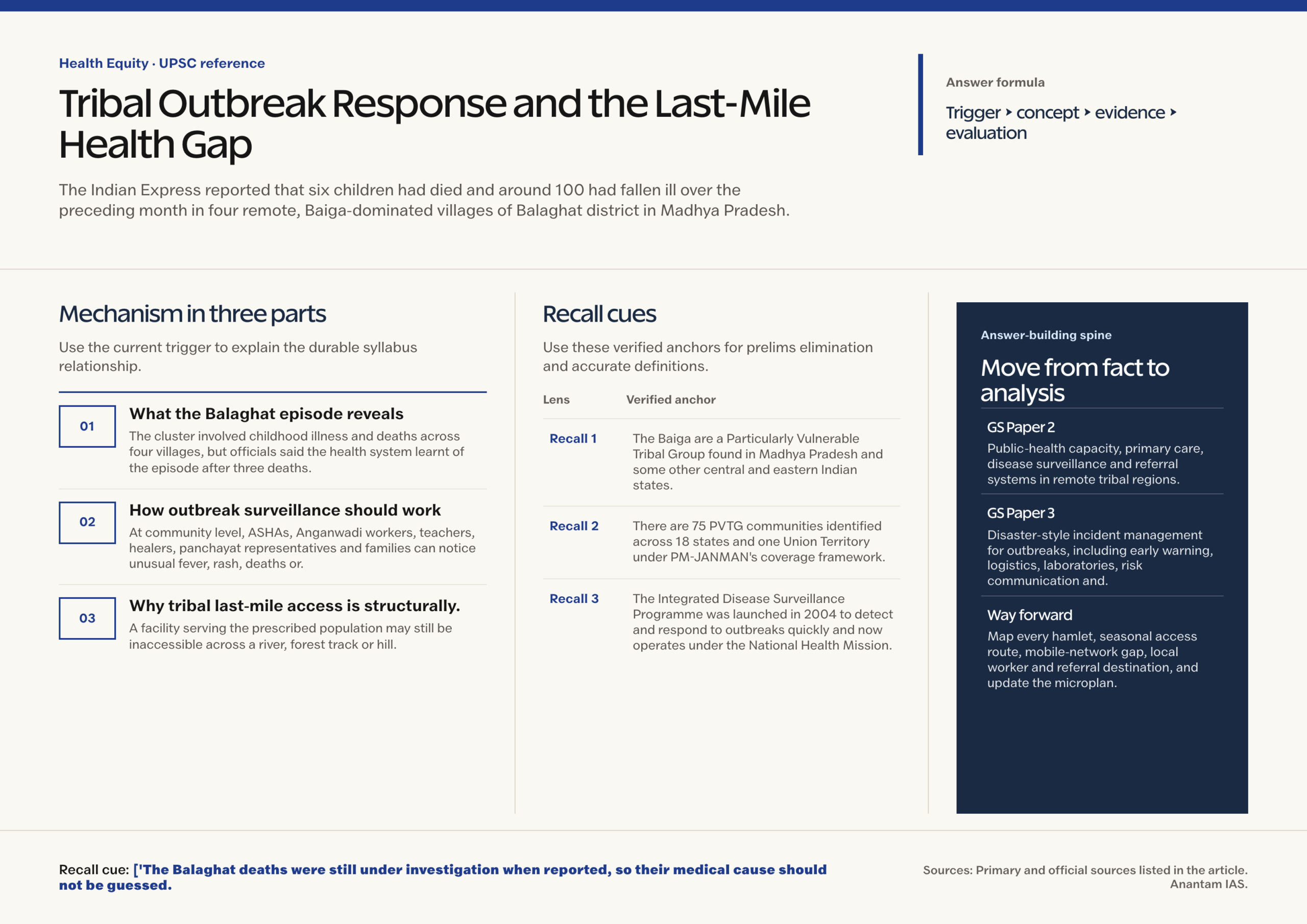
Mindmap explaining Tribal Outbreak Response and the Last-Mile Health Gap for UPSC revision
Revision mindmap: Tribal Outbreak Response and the Last-Mile Health Gap. Open the full-size image for details.

Background and Context

What the Balaghat episode reveals

The sequence of events points to a system failure before it points to a specific disease.

  • The cluster involved childhood illness and deaths across four villages, but officials said the health system learnt of the episode after three deaths. This is an event-detection gap: severe events occurred before a formal alert.
  • Officials had to search hilly and forested settlements for affected children. A district may have facilities on paper while scattered hamlets remain outside routine visits, mobile connectivity and reliable transport routes.
  • Families were reportedly reluctant to disclose cases or accept admission. That response cannot be reduced to ignorance. It may reflect fear of unfamiliar institutions, indirect costs, language barriers, livelihood disruption, past treatment experiences and different understandings.
  • Faith healing was reported during the episode. The public-health task is not to ridicule belief, but to prevent delay by working with trusted community members and clearly explaining danger signs, treatment and the right to accompany.
  • The age range and distribution across several settlements make a complete case search essential. Investigators must include children treated at home, those who recovered, recent deaths and clinically similar illness in neighbouring habitations, because hospital records.

How outbreak surveillance should work

Surveillance is a cycle from signal to action, not a weekly reporting form.

  • At community level, ASHAs, Anganwadi workers, teachers, healers, panchayat representatives and families can notice unusual fever, rash, deaths or absenteeism. A simple channel must carry that event-based signal to the health system immediately.
  • The district surveillance unit should verify the alert, develop a working case definition, make a line list, search actively for additional cases, map cases by place and onset date, and deploy a Rapid Response Team when.
  • Clinical care cannot wait for final laboratory results. Teams use syndrome-based precautions, stabilisation and referral while collecting correctly labelled specimens and documenting onset, vaccination, exposure and treatment history.
  • Laboratory findings must be interpreted with epidemiology. A positive result may not explain every case, while a negative result may reflect timing, sample quality or the wrong test panel.
  • Daily analysis should guide action: new cases, severe cases, deaths, admissions, recoveries, affected hamlets, referral delays and supply gaps. Surveillance is successful only when it changes field decisions.

Why tribal last-mile access is structurally different

Standard population norms can miss communities separated by terrain, forests and travel time.

  • A facility serving the prescribed population may still be inaccessible across a river, forest track or hill. Time to care, seasonal access and the location of each habitation are better operational measures than population totals.
  • Households may lose wages, forest-produce collection time or food security when a caregiver accompanies a child to a distant hospital. Free treatment does not remove transport, accommodation, communication and opportunity costs.
  • Language and communication affect consent, adherence and safety. Instructions on samples, isolation, discharge and medicines must be delivered in a language and form the family understands.
  • Vacancies, rapid staff turnover and weak accommodation reduce continuity. When every visit involves a new team, the system struggles to establish the relationships needed for early disclosure.
  • Tribal health also depends on water, nutrition, roads, telecom and education. An outbreak response needs administrative convergence because the determinants of exposure and delayed care lie beyond the health department.

Trust is public-health infrastructure

A technically correct referral can fail if the family does not trust the messenger, destination or process.

  • Local ASHAs and other community workers can translate both language and institutional intent. Their role should begin during routine care, not after an outbreak has already become fatal.
  • Health teams should explain why admission is advised, where the child will go, who may accompany the child, what care is free, and how the family will receive updates. Procedural clarity reduces fear.
  • Community leaders, women’s groups and trusted traditional practitioners can help communicate danger signs and encourage timely referral. Engagement should not endorse harmful delay; it should create a bridge to evidence-based care.
  • Police assistance may be necessary where a child’s life faces immediate danger, but it should remain an exceptional, legally accountable step. Routine dependence on force can convert a health encounter into a conflict with the State.
  • After the emergency, teams should return with results, explain what was found, acknowledge uncertainty and address grievances. Without feedback, communities supply data but receive no trustworthy account in return.

Way Forward

Create habitation-level early warning

  • Map every hamlet, seasonal access route, mobile-network gap, local worker and referral destination, and update the microplan before monsoon and other high-risk periods.
  • Train ASHAs, Anganwadi workers, teachers and selected community volunteers to report clusters and deaths through a low-bandwidth channel with a clear escalation deadline.
  • Audit zero-reporting: silence from an inaccessible village should trigger contact, not be assumed to mean zero illness.

Conclusion

  • The Balaghat deaths were still under investigation when reported, so their medical cause should not be guessed.
  • The answer is a habitation-level system of surveillance, trusted local communication, regular outreach and closed-loop referral .

UPSC Practice Questions

Prelims MCQ 1

With reference to tribal health and disease surveillance in India, consider the following statements:

  1. The Baiga are included among the Particularly Vulnerable Tribal Groups.
  2. The Integrated Disease Surveillance Programme operates under the National Health Mission.
  3. Mobile Medical Units under NHM are designed primarily as ambulances for inter-facility patient transfer.

How many of the above statements are correct?

(a) Only one (b) Only two (c) All three (d) None

Answer: (b) Only two

Explanation:

Statements 1 and 2 are correct. Baiga are a PVTG, and IDSP continues under NHM. MMUs take primary healthcare to remote and underserved populations; NHM guidance does not define them primarily as patient-transfer vehicles.

Prelims MCQ 2

In an outbreak investigation, which one of the following best describes a line list?

(a) A list of all medicines stocked at a district hospital (b) A case-wise table recording key clinical, demographic, place and time information (c) A statutory list of diseases that can be diagnosed without laboratory tests (d) A roster of only the members of a Rapid Response Team

Answer: (b) A case-wise table recording key clinical, demographic, place and time information

Explanation:

A line list organises information for each suspected or confirmed case, commonly including identity code, age, residence, symptom onset, clinical status, exposure, sample and outcome. It helps investigators describe the outbreak and identify patterns.

UPSC Mains Questions

  1. A disease outbreak in a remote tribal habitation is as much a test of trust and access as of laboratory capacity. Discuss.
  2. Examine how habitation-level surveillance, Mobile Medical Units and closed-loop referral can reduce avoidable deaths in Particularly Vulnerable Tribal Group areas.

Sources: The Indian Express and National Health Mission, Mobile Medical Unit Guidelines.

Frequently Asked Questions

What caused the illness in the Balaghat villages?

The cause had not been confirmed when the report was published. Children had fever and several other symptoms, and samples were sent to specialised ICMR laboratories. Those facts support an outbreak investigation, not a definitive diagnosis. Naming a disease before.

Who are the Baiga?

The Baiga are an Adivasi community included in the official list of Particularly Vulnerable Tribal Groups. They live across parts of central and eastern India, including Madhya Pradesh. PVTG status signals the need for focused development support, but communities should.

What is the role of IDSP during an outbreak?

The Integrated Disease Surveillance Programme collects and analyses disease and event information to identify rising trends quickly. District and State surveillance units verify alerts, and Rapid Response Teams investigate suspected outbreaks, support case finding and sampling, recommend control measures and.

Why might families resist hospital referral?

Reasons can include distance, transport and wage costs, language barriers, fear of unfamiliar institutions, lack of caregiver support, previous disrespectful encounters and different beliefs about illness. A safe response explains the need for referral, reduces practical costs, permits communication and.

Can Mobile Medical Units solve the tribal health-access gap?

MMUs can bring regular primary care, medicines, diagnostics, immunisation and surveillance closer to remote habitations. They cannot replace ambulances, laboratories, staffed fixed facilities or referral hospitals. Their strongest role is as one predictable layer in a network with community workers.

SC/ST Atrocities Relief: Building a Victim-Support System

Open article →Download PDF

Why in News?

An internal government task force headed by the Secretary, Social Justice and Empowerment has proposed amendments to the SC/ST (Prevention of Atrocities) Rules , including inflation-linked enhancement of relief and rehabilitation amounts and counselling for accused persons, victims and their.

  • The task force submitted its report to the government on July 31, 2026. It had been constituted in December 2025 with the approval of the Union Social Justice Minister.
  • The Hindu reported that the present statutory relief scale ranges from ₹85,000 to ₹8.25 lakh, according to the offence and degree of harm; these amounts were fixed in 2016.
  • The task force proposed dedicated relief and rehabilitation cells in States and Union Territories and transmission of FIRs and chargesheets to the concerned government officials within 24 hours.
  • The National Commission for Scheduled Tribes separately suggested livelihood protection for tribal people dispossessed of land during prolonged litigation and checks on retaliatory counter FIRs filed after atrocity complaints.
  • The recommendations are not yet law. The Union government has said it will consult State and Union Territory governments and other stakeholders before finalising amendments.
  • An FIR and a criminal trial cannot by themselves restore medical costs, lost income, housing, education, safety or mental well-being. Relief is part of justice, not charity after justice.
  • Inflation erodes fixed compensation, but merely revising a schedule is insufficient if district officials delay identification, sanction, phased payment or rehabilitation planning.
  • Caste atrocities can be accompanied by local power imbalances, economic dependence and threats. A counter-case may be genuine or retaliatory; the answer is independent scrutiny, not automatic acceptance or rejection.

UPSC Relevance

Prelims Relevance

  • The Scheduled Castes and Scheduled Tribes (Prevention of Atrocities) Act, 1989 came into force on January 30, 1990 and provides for prevention, Special Courts, victim relief and rehabilitation.
  • The Act’s Section 3 principally specifies atrocities committed by a person who is not a member of an SC or ST against a member of an SC or ST.
  • Section 15A creates rights of victims and witnesses, including dignity, protection against intimidation, timely notice of court proceedings and a right to be heard in proceedings such as bail.
  • The statutory definition of a victim includes physical, mental, psychological, emotional or monetary harm and harm to property; it also includes specified relatives, legal guardians and legal heirs.
  • The 2016 Amendment Rules expanded the number of offences carrying prescribed relief from 22 to 47 and set minimum amounts between ₹85,000 and ₹8.25 lakh according to the offence.
  • Rule 12(4), read with the Schedule, provides for relief to victims, family members and dependants; official guidance requires admissible relief to be paid within seven days and in the prescribed phases.

Mains Relevance

GS Paper 2

  • Evaluate the gap between formal legal protection and last-mile delivery of relief, rehabilitation, witness protection, legal assistance and psychosocial care.
  • Examine cooperative federalism in a central protective statute whose police, prosecution, district administration and service-delivery functions operate mainly through States.

GS Paper 4

  • Discuss dignity, empathy, non-discrimination and public-service accountability when officials respond to a traumatised complainant facing a local power imbalance.
  • Use counter FIRs as an ethics case on impartial investigation: officials must prevent intimidation without prejudging either complaint.

Essay

  • Justice is not complete when the offender is punished; it is complete when the survivor can live safely and with dignity.
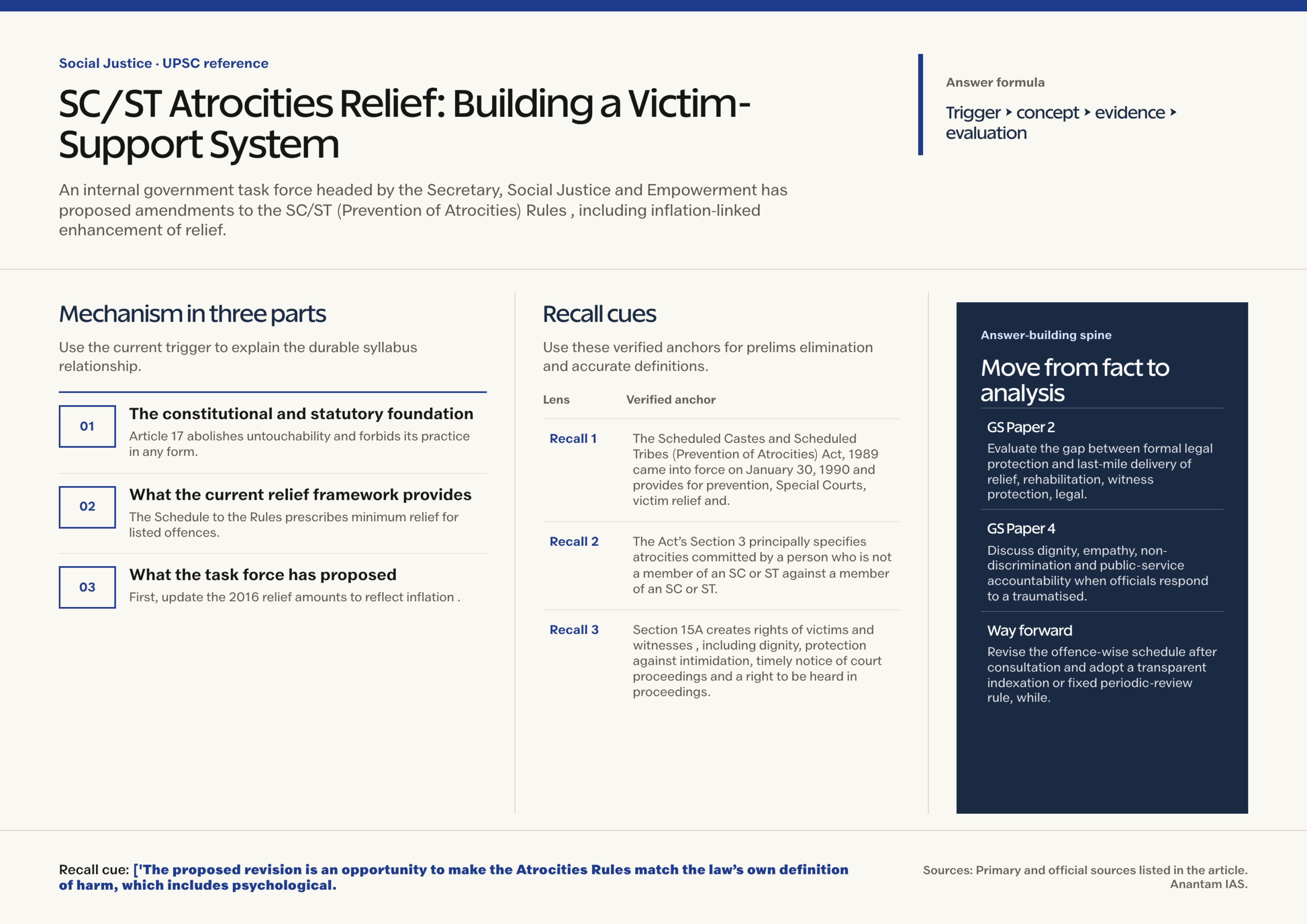
Mindmap explaining SC/ST Atrocities Relief: Building a Victim-Support System for UPSC revision
Revision mindmap: SC/ST Atrocities Relief: Building a Victim-Support System. Open the full-size image for details.

Background and Context

The constitutional and statutory foundation

The Atrocities Act is a special criminal law built on the Constitution’s rejection of caste hierarchy.

  • Article 17 abolishes untouchability and forbids its practice in any form. Article 15 prohibits caste discrimination, while Article 21 protects life and dignity.
  • Article 46 directs the State to promote the educational and economic interests of Scheduled Castes, Scheduled Tribes and other weaker sections and protect them from social injustice and exploitation.
  • The Protection of Civil Rights Act, 1955 punishes practices arising from untouchability. The 1989 Atrocities Act addresses a wider set of caste-targeted offences, institutional duties, special trials and victim support.
  • Section 3 covers acts such as caste humiliation in specified circumstances, social or economic boycott, dispossession or interference with land and forest rights, forced labour, sexual offences and obstruction of access to public places, subject to.
  • The 2015 amendment, effective from January 26, 2016, enlarged the offence list, strengthened Special and Exclusive Special Courts and inserted Chapter IVA on victims’ and witnesses’ rights.

What the current relief framework provides

Relief under the Rules is a legally structured entitlement linked to the offence and stage of the case.

  • The Schedule to the Rules prescribes minimum relief for listed offences. The 2016 scale runs from ₹85,000 to ₹8.25 lakh, with higher amounts for graver harm such as death, rape, gang rape, severe.
  • Payment is commonly divided across procedural stages such as registration of the FIR, filing of the chargesheet and conclusion of trial. The exact phasing varies by the scheduled offence.
  • Rule 12 places operational responsibility on the District Magistrate, Sub-Divisional Magistrate or Executive Magistrate to make arrangements for immediate relief, while the Schedule determines the minimum monetary entitlement.
  • Rule 11 also covers facilities such as travelling and maintenance expenses for victims, dependants and witnesses during investigation, inquiry and trial.
  • Section 15A allows a Special Court or Exclusive Special Court to order protection, travel, maintenance, socio-economic rehabilitation and relocation where required.

What the task force has proposed

The recommendations target both the value of relief and the administrative machinery that delivers it.

  • First, update the 2016 relief amounts to reflect inflation. A durable amendment could provide periodic indexation or mandatory review rather than waiting a decade for an ad hoc revision.
  • Second, establish special relief and rehabilitation cells in every State and Union Territory. Such a cell can track each case from FIR to payment, medical care, shelter, livelihood support and court-linked protection.
  • Third, require FIRs and chargesheets to reach concerned government officials within 24 hours. Early information can trigger relief without forcing a survivor to carry papers from the police station to welfare offices.
  • Fourth, introduce counselling for victims, dependants and accused persons. Survivor counselling should be trauma-informed, voluntary and confidential; counselling of an accused may address behaviour and prevention but cannot dilute criminal accountability.
  • The proposals remain recommendations under government review. The Ministry has committed to consultation and stated that amendments must remain consistent with the parent Act and must not weaken protection, investigation, relief or rehabilitation.

Why compensation alone does not equal rehabilitation

A survivor may receive a sanctioned amount yet remain unsafe, displaced, indebted or unable to participate in the case.

  • Immediate needs can include emergency medical treatment, safe shelter, food, transport, replacement of documents, funeral costs and protection from renewed violence.
  • Medium-term recovery may require psychological care, school continuity, livelihood restoration, land access, accessible legal aid and support for repeated interactions with police and courts.
  • Trauma can affect memory, sleep, work, relationships and the ability to narrate events consistently. Trauma-informed procedures reduce repeated questioning and avoid treating distress as unreliability.
  • Dependants and witnesses can also face threats and income loss. Section 15A recognises them because successful prosecution depends on a safe environment in which people can testify without coercion.
  • A district case plan should identify one responsible officer, services required, deadlines and consent. Cash, counselling and protection must be coordinated without making one service conditional on acceptance of another.

Way Forward

Index relief and guarantee prompt payment

  • Revise the offence-wise schedule after consultation and adopt a transparent indexation or fixed periodic-review rule, while allowing States to provide higher amounts.
  • Trigger the first instalment through secure digital transmission of the FIR to the district cell, with a seven-day dashboard and written reasons for every delay.
  • Separate immediate relief from final adjudication: early support should follow the statutory threshold and must not be treated as a finding of guilt.

Conclusion

  • The proposed revision is an opportunity to make the Atrocities Rules match the law’s own definition of harm, which includes psychological, emotional, monetary and property loss.
  • A credible reform should combine time-bound entitlements, trauma-informed services and procedural accountability .

UPSC Practice Questions

Prelims MCQ 1

With reference to the Scheduled Castes and Scheduled Tribes (Prevention of Atrocities) Act, 1989, consider the following statements:

  1. Section 15A places a duty on the State to protect victims, their dependants and witnesses against intimidation and violence.
  2. A preliminary inquiry is mandatory before an FIR can be registered under the Act.
  3. A victim has a right to timely notice of court proceedings, including bail proceedings.

How many of the above statements are correct?

(a) Only one (b) Only two (c) All three (d) None

Answer: (b) Only two

Explanation:

Statements 1 and 3 are correct under Section 15A. Statement 2 is incorrect because Section 18A says no preliminary inquiry is required for registration of an FIR under the Act.

Prelims MCQ 2

Which one of the following pairs is correctly matched?

(a) National Commission for Scheduled Castes — Article 338A (b) National Commission for Scheduled Tribes — Article 338A (c) Abolition of untouchability — Article 16 (d) Promotion of educational and economic interests of weaker sections — Article 32

Answer: (b) National Commission for Scheduled Tribes — Article 338A

Explanation:

The NCST is established under Article 338A. The NCSC is under Article 338, untouchability is abolished by Article 17, and Article 46 directs the State to promote the educational and economic interests of weaker sections.

UPSC Mains Questions

  1. Punishment is necessary but insufficient in responding to caste atrocities. Examine the case for a survivor-centred system of relief, rehabilitation, protection and counselling under the SC/ST (Prevention of Atrocities) framework. (250 words)
  2. The effectiveness of a central social-justice law depends on State and district capacity. Discuss with reference to the proposed amendments to the SC/ST (Prevention of Atrocities) Rules. (250 words)

Sources: The Hindu and Department of Social Justice and Empowerment.

Frequently Asked Questions

What has the government task force recommended?

It has proposed inflation-linked enhancement of relief, dedicated relief and rehabilitation cells in States and Union Territories, counselling for accused persons, victims and dependants, and delivery of FIRs and chargesheets to concerned officials within 24 hours. The recommendations are under.

How much relief is currently prescribed for atrocity victims?

The 2016 schedule prescribes minimum relief ranging from ₹85,000 to ₹8.25 lakh according to the offence and degree of injury or harm. Payment stages differ by offence. Official guidance requires admissible relief within seven days, while the Rules and Section.

Why is counselling part of the proposal?

Caste violence can cause psychological and emotional harm to victims and dependants alongside bodily, property and income loss. Qualified, voluntary and confidential counselling can support recovery and participation in the justice process. Counselling for an accused may aid prevention or.

What is a counter FIR in this context?

It is a separate complaint filed against the original complainant or associated persons after an atrocity FIR. It may allege a genuine cross-offence or may be retaliatory. The NCST has suggested checks of linked police final reports so procedure and.

What rights do victims have under Section 15A?

Section 15A requires fairness, respect and dignity; protection against intimidation, coercion and violence; timely notice of court and bail proceedings; an opportunity to be heard; and access to protective and rehabilitative measures through Special Courts. Its scope includes victims, dependants.

NCDC Bill and the Reform of Cooperative Development Finance

Open article →Download PDF

Why in News?

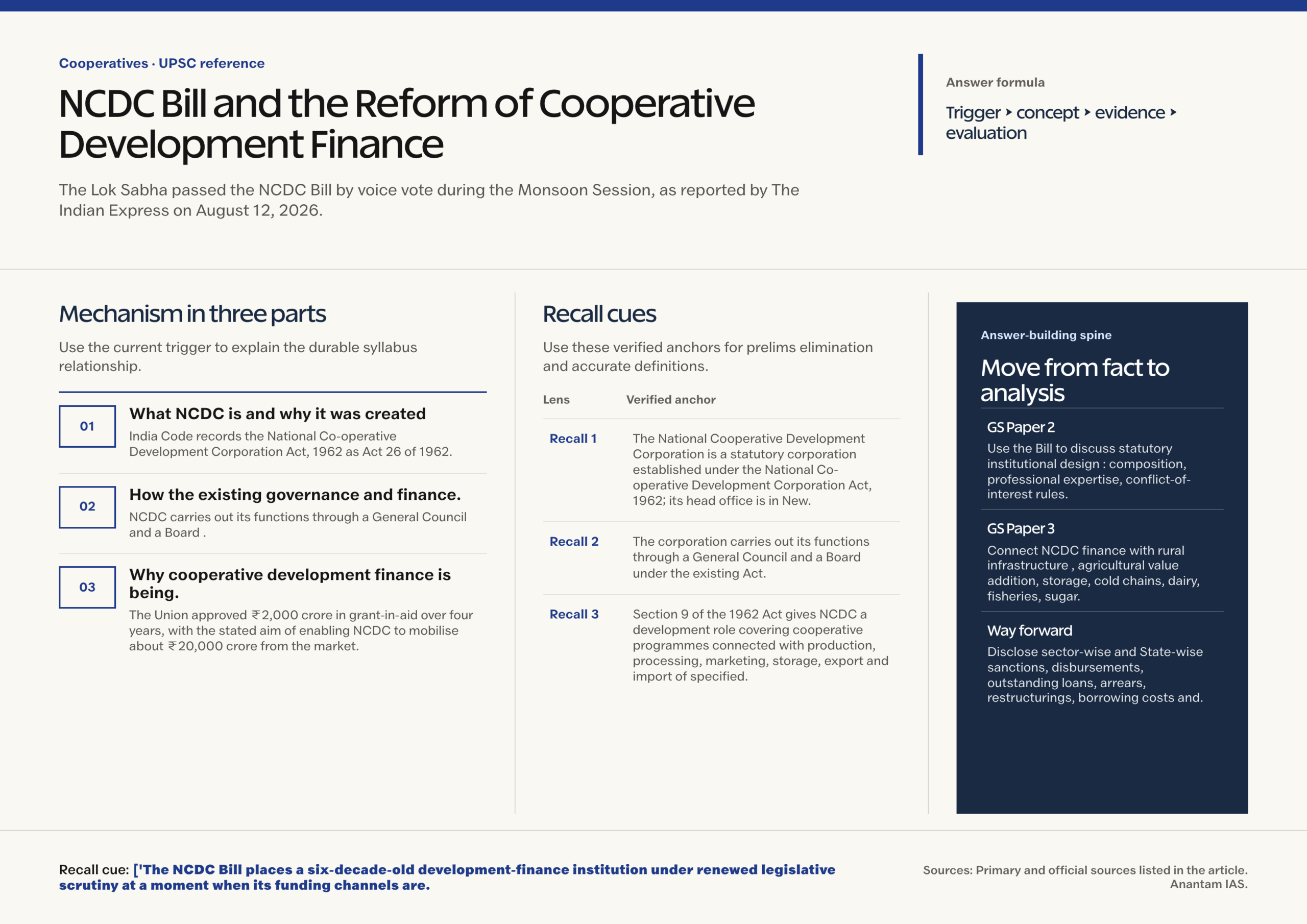
The Lok Sabha passed the NCDC Bill by voice vote during the Monsoon Session, as reported by The Indian Express on August 12, 2026.

  • The Lok Sabha cleared the Bill by a voice vote; it must still complete the remaining constitutional stages before any enacted provisions can replace or amend the existing law.
  • The existing corporation was established under the National Co-operative Development Corporation Act, 1962, which received assent on August 31, 1962 and came into force on March 14, 1963.
  • NCDC operates under the administrative control of the Ministry of Cooperation and provides financial assistance directly to cooperatives or through State governments.
  • The reform debate must be judged on three tests: whether it widens useful access to finance, preserves professional appraisal and recovery discipline, and strengthens transparent, federal governance.
  • The text finally enacted, rather than speeches or headline descriptions, will determine the corporation’s revised powers, governance structure and accountability safeguards.
  • Cooperatives pool member capital and distribute benefits among users, but many cannot raise long-tenure funds for storage, processing, dairy, fisheries, health or other infrastructure. NCDC helps bridge this patient-capital gap.
  • Official July 2026 data show a cooperative ecosystem of more than 8.5 lakh societies with about 30 crore members. The quality of its development-finance architecture has wide livelihood and public-policy consequences.
  • A statutory lender can correct market failures, but weak project selection, politically directed credit or opaque restructuring can transfer risk to public finances. Governance is inseparable from credit expansion.

UPSC Relevance

Prelims Relevance

  • The National Cooperative Development Corporation is a statutory corporation established under the National Co-operative Development Corporation Act, 1962; its head office is in New Delhi.
  • The corporation carries out its functions through a General Council and a Board under the existing Act.
  • Section 9 of the 1962 Act gives NCDC a development role covering cooperative programmes connected with production, processing, marketing, storage, export and import of specified produce, goods, livestock, commodities and services.
  • The law allows assistance through loans and subsidies for approved cooperative programmes, subject to its statutory design and schemes.
  • The existing Act provides for Central government grants, borrowing powers, an NCDC fund, annual reporting, accounts and audit, Central directions, delegation, rules and regulations.
  • NCDC is under the Ministry of Cooperation; it is not a cooperative bank and does not perform the Reserve Bank of India’s monetary or banking-regulation functions.

Mains Relevance

GS Paper 2

  • Use the Bill to discuss statutory institutional design: composition, professional expertise, conflict-of-interest rules, delegated powers, reporting and legislative oversight.
  • Examine cooperative federalism because ordinary cooperatives are primarily a State subject, while NCDC is a Union statutory development-finance institution that often works through State governments.

GS Paper 3

  • Connect NCDC finance with rural infrastructure, agricultural value addition, storage, cold chains, dairy, fisheries, sugar, textiles, services and working capital.
  • Evaluate the trade-off between cheaper, wider credit and prudent appraisal, repayment capacity, asset quality and contingent fiscal liabilities.

Essay

  • Cooperation is neither charity nor conventional private enterprise; it converts shared ownership into economic capability.
Mindmap explaining NCDC Bill and the Reform of Cooperative Development Finance for UPSC revision
Revision mindmap: NCDC Bill and the Reform of Cooperative Development Finance. Open the full-size image for details.

Background and Context

What NCDC is and why it was created

The 1962 law created a specialised corporation to plan, promote and finance economic activity organised on cooperative principles.

  • India Code records the National Co-operative Development Corporation Act, 1962 as Act 26 of 1962. It established NCDC as a body corporate with perpetual succession and the capacity to hold property, contract, sue and be sued.
  • Its statutory purpose extends beyond crop loans. It supports cooperative activity in production, processing, marketing, storage and trade, with later amendments widening the range of eligible commodities and services.
  • The corporation can prepare programmes, assist State plans and finance approved projects. Assistance may be routed through State governments or, where the legal and scheme conditions permit, provided directly to cooperative societies.
  • This makes NCDC a development-finance institution. It can fund assets and working capital that commercial lenders may consider too small, dispersed, long-gestation or institutionally complex.
  • NCDC must not be confused with NABARD. NABARD is the apex development bank for agriculture and rural development with refinancing and supervisory roles defined by its own statute; NCDC is a statutory corporation focused on.

How the existing governance and finance architecture works

The existing Act separates broad representation, executive management and financial accountability across several statutory mechanisms.

  • NCDC carries out its functions through a General Council and a Board. The existing composition combines Union institutions, State and Union Territory representation, banking and cooperative-sector representatives.
  • Its resources flow into a statutory fund. The Act provides for Central grants, borrowing and other receipts, while expenditures must serve authorised functions.
  • The corporation submits programmes of activities and financial estimates and prepares returns and reports. Its accounts and audit are governed by Section 17, which includes a role for auditors appointed with prior approval of the Comptroller.
  • The Central government may issue directions under the Act. This can align NCDC with national policy, but sound governance also requires documented appraisal, transparent delegation and protection against credit decisions driven by short-term political incentives.
  • Any new framework should keep a clear chain from public support to market borrowing to end-use lending, so Parliament, governments, cooperatives and members can see who bears each risk.

Why cooperative development finance is being scaled up

Policy changes in 2025-26 sought to give NCDC cheaper and deeper access to funds for on-lending.

  • The Union approved ₹2,000 crore in grant-in-aid over four years, with the stated aim of enabling NCDC to mobilise about ₹20,000 crore from the market.
  • The Ministry of Cooperation reported that ₹500 crore was released in 2025-26 and ₹250 crore in 2026-27 by July 2026. On the back of this support, NCDC had disbursed more than ₹10,672 crore up to May 2026.
  • The funds are intended for long-term and working-capital needs across sectors such as dairy, poultry, fisheries, sugar, textiles, food processing, storage, cold chains, labour cooperatives and women-led cooperatives.
  • RBI’s January 19, 2026 clarification made eligible bank lending to NCDC for permitted on-lending count towards priority sector lending. The measure can broaden NCDC’s funding pool and lower intermediation constraints.
  • Leverage magnifies both development impact and governance risk. If a relatively small fiscal grant supports much larger market mobilisation, disclosure of borrowing costs, maturity mismatches, sector concentration, arrears and recoveries becomes essential.

The federal question in cooperative reform

The Constitution protects space for State cooperative law while allowing national institutions to support cross-state and development objectives.

  • Entry 32 of the State List covers incorporation, regulation and winding up of cooperative societies, subject to the constitutional field for institutions whose objects are not confined to one State.
  • The 97th Constitutional Amendment added the right to form cooperative societies to Article 19(1)(c), inserted Article 43B and added Part IXB. In 2021, the Supreme Court held that Part IXB could not govern State cooperatives without.
  • NCDC does not erase this division merely because it is a Union corporation. Its effectiveness depends on State departments, registrars, cooperative banks and member societies that identify projects, supervise institutions and resolve local constraints.
  • A good reform framework should use national finance to complement State capacity, not convert funding conditions into indirect control over matters reserved to States.
  • Consultative programme design, published eligibility criteria and State-wise outcome reporting can reduce both regional imbalance and the perception of discretionary allocation.

Way Forward

Publish a complete risk and results dashboard

  • Disclose sector-wise and State-wise sanctions, disbursements, outstanding loans, arrears, restructurings, borrowing costs and maturity profiles in machine-readable form.
  • Report member-level outcomes, project utilisation and jobs or income created, not only the volume of credit released.
  • Create a public methodology for classifying stressed projects and evaluating whether restructuring protects a viable cooperative or merely postpones recognition of loss.

Conclusion

  • The NCDC Bill places a six-decade-old development-finance institution under renewed legislative scrutiny at a moment when its funding channels are expanding.
  • The reform will be credible only if wider finance comes with professional appraisal, federal partnership and member-facing accountability .

UPSC Practice Questions

Prelims MCQ 1

With reference to the National Cooperative Development Corporation (NCDC), consider the following statements:

  1. It is a statutory corporation established under a law enacted in 1962.
  2. It performs its functions through a General Council and a Board under the existing law.
  3. It is a cooperative bank regulated by the Reserve Bank of India.

How many of the above statements are correct?

(a) Only one (b) Only two (c) All three (d) None

Answer: (b) Only two

Explanation:

Statements 1 and 2 are correct under the National Co-operative Development Corporation Act, 1962. NCDC is a statutory development corporation, not a cooperative bank, so statement 3 is incorrect.

Prelims MCQ 2

Which one of the following best describes the constitutional position of cooperative societies in India?

(a) All cooperative societies are regulated exclusively by Parliament (b) Cooperative societies are principally a State subject, while Parliament has a field concerning multi-state cooperative institutions (c) Cooperative societies are listed only in the Concurrent List (d) The Constitution makes no reference to cooperative societies

Answer: (b) Cooperative societies are principally a State subject, while Parliament has a field concerning multi-state cooperative institutions

Explanation:

Entry 32 of the State List covers cooperative societies within the State field. Parliament legislates for multi-state cooperative societies within the Union’s constitutional competence; Article 19(1)(c), Article 43B and Part IXB also refer to cooperatives.

UPSC Mains Questions

  1. A larger lending mandate for the National Cooperative Development Corporation must be matched by stronger risk governance and member-facing accountability. Discuss.
  2. Explain the constitutional and administrative issues that arise when a Union development-finance institution supports cooperatives that are primarily regulated by States.

Sources: The Indian Express and India Code, Government of India.

Frequently Asked Questions

What is the National Cooperative Development Corporation?

NCDC is a statutory corporation established under the National Co-operative Development Corporation Act, 1962. It plans, promotes and finances cooperative development programmes in areas such as production, processing, marketing, storage and services. It operates under the Ministry of Cooperation and.

Why is the NCDC Bill important for UPSC preparation?

The Bill connects statutory governance, cooperative federalism, rural credit and public financial accountability. It allows a candidate to discuss how institutional design affects inclusive growth, why State participation matters in cooperative policy, and how expanded borrowing and lending powers should.

Is NCDC a bank like NABARD?

No. NCDC is a statutory corporation that finances cooperative development programmes. NABARD is an apex development bank created under a separate law, with refinancing, development and supervisory functions in rural finance. NCDC also is not a cooperative bank and does.

How does NCDC raise money for cooperative lending?

The 1962 Act provides for Central government grants, borrowing and a statutory fund. The Union has approved ₹2,000 crore grant-in-aid over four years to help NCDC mobilise about ₹20,000 crore from the market. Eligible bank lending to NCDC for permitted.

Are cooperative societies controlled by the Union government?

Not as a general rule. Cooperative societies are principally within Entry 32 of the State List, while Parliament legislates for multi-state cooperative societies in its constitutional field. A Union institution such as NCDC can finance and promote cooperative development, but.

Illegal Loan Apps and India’s Digital Lending Safeguards

Open article →Download PDF

Why in News?

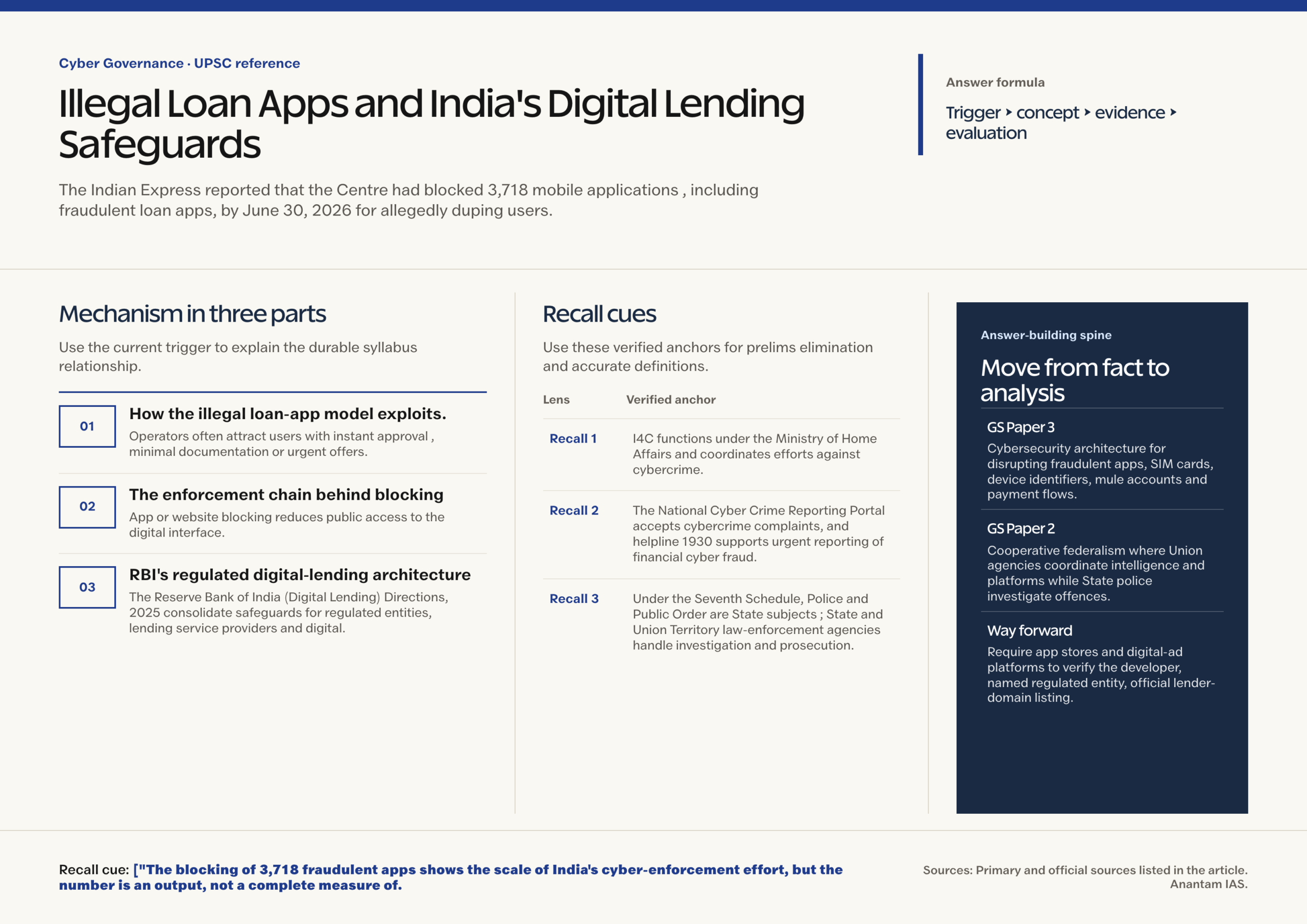
The Indian Express reported that the Centre had blocked 3,718 mobile applications , including fraudulent loan apps, by June 30, 2026 for allegedly duping users.

  • In a Lok Sabha reply, the government said the Indian Cyber Crime Coordination Centre (I4C) had acted under Sections 69A and 79(3)(b) of the Information Technology Act, 2000.
  • The figure of 3,718 refers to mobile apps blocked for alleged fraud; it includes fraudulent loan apps but should not be read as a count of loan apps alone.
  • Police inputs had also led to the blocking of more than 15.75 lakh SIM cards and 5.77 lakh IMEI numbers, targeting communication channels and devices used in cybercrime.
  • The I4C-run Citizen Financial Cyber Fraud Reporting and Management System, launched in 2021, had helped save more than Rs 11,158 crore across over 32.80 lakh complaints by June 30, 2026.
  • The national cybercrime helpline 1930 and the National Cyber Crime Reporting Portal provide rapid reporting channels, while investigation and prosecution remain primarily with State and Union Territory police.
  • An illegal loan app is not merely a consumer-credit problem. It can combine deceptive advertising, unlawful data access, coercive recovery, identity theft, mule accounts and rapid movement of stolen funds.
  • Blocking an app can reduce immediate reach, but mirror websites, sideloaded Android packages, renamed apps and new accounts allow operators to reappear. Enforcement must follow the entire fraud chain.
  • RBI rules apply to regulated entities such as banks and NBFCs and to the lending service providers they engage. A criminal app falsely claiming an association with a lender may sit outside that regulated chain, requiring.

UPSC Relevance

Prelims Relevance

  • I4C functions under the Ministry of Home Affairs and coordinates efforts against cybercrime.
  • The National Cyber Crime Reporting Portal accepts cybercrime complaints, and helpline 1930 supports urgent reporting of financial cyber fraud.
  • Under the Seventh Schedule, Police and Public Order are State subjects; State and Union Territory law-enforcement agencies handle investigation and prosecution.
  • Section 69A of the IT Act empowers the Central Government or an authorised officer to direct blocking of public access to information on specified statutory grounds, subject to prescribed procedure and safeguards.
  • Section 79 concerns conditional safe-harbour protection for intermediaries; subsection 79(3)(b) addresses failure to remove or disable access after legally cognisable actual knowledge.
  • A Regulated Entity in digital lending may be a bank, cooperative bank, NBFC or housing finance company covered by RBI directions.

Mains Relevance

GS Paper 3

  • Cybersecurity architecture for disrupting fraudulent apps, SIM cards, device identifiers, mule accounts and payment flows.
  • Financial-sector regulation, consumer protection and the trade-off between digital credit inclusion and predatory lending.

GS Paper 2

  • Cooperative federalism where Union agencies coordinate intelligence and platforms while State police investigate offences.
  • Due process, transparency and proportionality in online blocking, alongside intermediary responsibility.

Essay

  • Technology can widen access to credit, but trust depends on whether institutions can make convenience compatible with dignity, privacy and accountability.
Mindmap explaining Illegal Loan Apps and India's Digital Lending Safeguards for UPSC revision
Revision mindmap: Illegal Loan Apps and India's Digital Lending Safeguards. Open the full-size image for details.

Background and Context

How the illegal loan-app model exploits borrowers

Fraudulent lending applications turn a short loan journey into a combined credit, privacy and coercion risk.

  • Operators often attract users with instant approval, minimal documentation or urgent offers. The interface may obscure the actual lender, total cost, tenure, processing deductions or recovery terms.
  • Some apps seek intrusive access to contacts, call logs, files, photographs or device functions. Stolen personal data can support harassment, impersonation, identity theft or pressure on a borrower’s family and colleagues.
  • A small amount may be disbursed after an upfront deduction, while repayment demands reflect a much larger nominal amount. Repeated refinancing can trap a borrower in a cycle of short-tenure, high-cost debt.
  • Collection agents may use threats, manipulated images or mass messages to contacts. Such conduct converts a financial dispute into cyber-enabled extortion and intimidation.
  • Illegal apps can be distributed through social-media links or sideloaded APK files, so removal from an official app store does not by itself end access.

The enforcement chain behind blocking

Effective action must disable several layers used by the same criminal network.

  • App or website blocking reduces public access to the digital interface. Section 69A requires an authorised decision on specified grounds, reasons recorded in writing, and compliance with the 2009 Blocking Rules.
  • Intermediary action under Section 79(3)(b) concerns removal or disabling of unlawful material after legally valid notice or a court order, consistent with the Supreme Court’s reading of actual knowledge in Shreya Singhal v. Union of India.
  • Blocking SIM cards and IMEIs targets communication identities and devices used to contact victims, though criminals may replace them. Accurate attribution is essential to avoid harming legitimate users.
  • Freezing suspect beneficiary or mule accounts can interrupt the movement of proceeds. Rapid reporting matters because stolen funds may pass through several accounts within minutes.
  • Evidence preservation, FIR registration, arrests, charge sheets and prosecution depend mainly on State and Union Territory law-enforcement agencies because Police and Public Order are State subjects.

RBI's regulated digital-lending architecture

RBI focuses on the regulated lender and its agents, while criminal enforcement addresses actors outside that chain.

  • The Reserve Bank of India (Digital Lending) Directions, 2025 consolidate safeguards for regulated entities, lending service providers and digital lending apps. A bank or NBFC remains responsible when it outsources customer acquisition, servicing or recovery.
  • Loan disbursal should ordinarily move directly into the borrower’s bank account, and repayment should move directly into the regulated entity’s account. Pass-through or pool accounts controlled by unrelated third parties are a warning sign.
  • Fees payable to an LSP are to be paid by the regulated entity, not separately collected by the LSP from the borrower. The lender must disclose the all-inclusive APR and provide a standardised Key Fact Statement.
  • The Key Fact Statement should identify key costs, recovery mechanism, grievance officer and cooling-off period. A charge omitted from the KFS cannot be imposed later during the loan term.
  • Digitally signed documents, including the KFS, sanction letter, terms and account statements, should automatically reach the borrower’s verified email or SMS channel. This creates an evidence trail beyond the app screen.

Data protection and recovery safeguards

A legitimate loan journey should collect only what is needed and should not weaponise a borrower’s phone.

  • RBI requires need-based data collection with prior, explicit consent and an audit trail. Borrowers should be able to permit or deny specific uses, restrict third-party disclosure, revoke consent and request deletion where applicable.
  • Digital lending apps in the regulated chain must not access phone resources such as contacts, call logs, telephony functions, files or media. One-time access to camera, microphone or location may be taken only when needed for.
  • The regulated entity must publish details of its apps, LSPs and the activities assigned to them. Recovery-agent details must be communicated when the loan is sanctioned and when recovery responsibility changes.
  • The app or lender should provide a visible grievance channel. If a regulated entity does not resolve a complaint under the applicable timeline, the borrower may use RBI’s Complaint Management System where the complaint falls within.
  • These protections help distinguish a compliant digital loan from an illegal app, but a directory entry is a verification aid, not a promise that every loan is affordable or suitable for every borrower.

Way Forward

Build a verified-app and advertising chain

  • Require app stores and digital-ad platforms to verify the developer, named regulated entity, official lender-domain listing and grievance contact before permitting a lending app or advertisement.
  • Use RBI’s DLA directory as a starting checkpoint and display the limits clearly: the directory records associations reported by regulated entities and is not an approval of individual loan products.
  • Create rapid channels for lenders to report impersonating apps, domains and advertisements and for platforms to preserve evidence while restricting access.

Conclusion

  • The blocking of 3,718 fraudulent apps shows the scale of India’s cyber-enforcement effort, but the number is an output, not a complete measure of safety.
  • A durable response combines precise takedowns, accountable regulated lending, privacy safeguards, financial tracing and fast victim reporting .

UPSC Practice Questions

Prelims MCQ 1

With reference to India’s framework against fraudulent digital lending, consider the following statements:

  1. The Indian Cyber Crime Coordination Centre functions under the Ministry of Home Affairs.
  2. Police and Public Order are subjects in the Union List of the Seventh Schedule.
  3. RBI’s public Digital Lending Apps directory helps users verify an app’s reported association with a regulated entity.

How many of the above statements are correct?

(a) Only one (b) Only two (c) All three (d) None

Answer: (b) Only two

Explanation:

Statements 1 and 3 are correct. I4C is under the Ministry of Home Affairs, and RBI’s DLA directory records associations reported by regulated entities. Police and Public Order are State List subjects, so statement 2 is incorrect.

Prelims MCQ 2

Which one of the following is required under RBI’s digital-lending safeguards for regulated entities?

(a) Repayment through a pool account controlled by any app developer (b) Unrestricted access by lending apps to a borrower’s contact list (c) Upfront disclosure of the Annual Percentage Rate in the Key Fact Statement (d) Automatic increase in a borrower’s credit limit without specific consent

Answer: (c) Upfront disclosure of the Annual Percentage Rate in the Key Fact Statement

Explanation:

RBI requires the all-inclusive APR to be disclosed upfront in the KFS. Repayment ordinarily goes directly to the regulated entity, intrusive phone-resource access is restricted, and credit limits cannot be automatically increased without explicit consent.

UPSC Mains Questions

  1. Illegal loan apps expose the limits of treating cyber fraud, consumer credit and data protection as separate regulatory problems. Discuss with reference to India’s institutional response.
  2. App blocking is necessary but insufficient against networked financial cybercrime. Examine the additional telecom, banking, platform and policing measures required for durable deterrence.

Sources: PIB, Ministry of Home Affairs and The Indian Express.

Frequently Asked Questions

Were all 3,718 blocked applications illegal loan apps?

No. The government’s figure covers mobile applications blocked for allegedly duping users and says the set included fraudulent loan apps. The available official statement does not identify all 3,718 as lending applications, so the number should not be presented as.

Does RBI approve individual loan apps?

RBI regulates banks, NBFCs and other covered entities, not an app as a stand-alone lender licence. Its public DLA directory helps users check whether a regulated entity has reported an association with an app. Users should also confirm that association.

What should a borrower check before taking a digital loan?

Identify the bank or NBFC, verify the app’s association, read the Key Fact Statement, compare the APR and total repayment, check the grievance officer and reject unnecessary permissions. Disbursal and repayment should ordinarily occur directly between the borrower and the.

What should a victim do after losing money through a fraudulent loan app?

Call 1930 immediately and file a detailed complaint at cybercrime.gov.in. Keep the transaction ID, bank or wallet details, app link, phone numbers, messages, screenshots and loan documents ready. Notify the bank or regulated lender at the same time so it.

How does Section 69A differ from Section 79 of the IT Act?

Section 69A provides a statutory power to direct blocking of public access on specified grounds, subject to procedure and safeguards. Section 79 provides conditional safe harbour to intermediaries; subsection 79(3)(b) concerns loss of protection when unlawful material is not removed.

Lie Detector Tests: Mental Privacy and Constitutional Limits

Open article →Download PDF

Why in News?

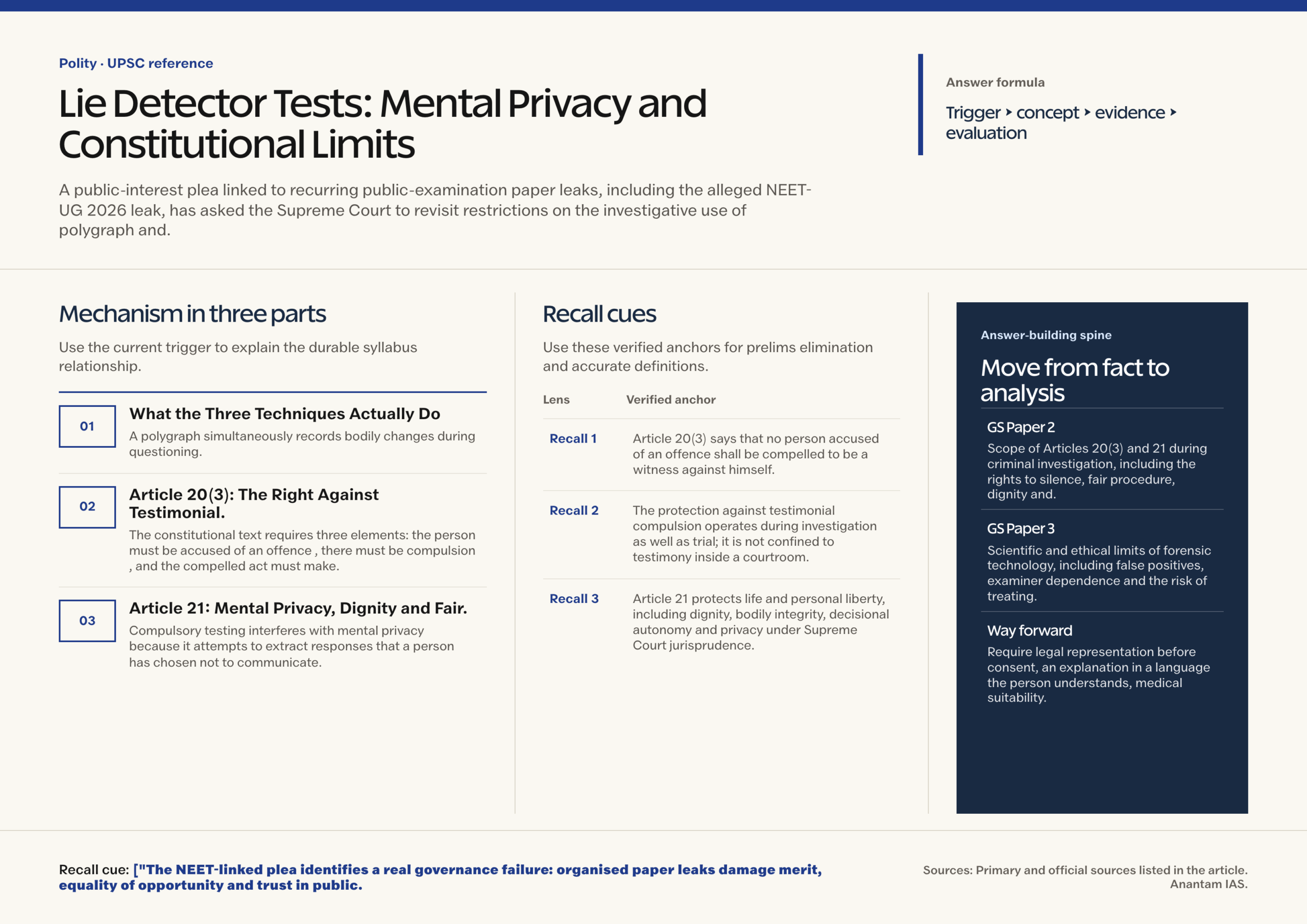
A public-interest plea linked to recurring public-examination paper leaks, including the alleged NEET-UG 2026 leak, has asked the Supreme Court to revisit restrictions on the investigative use of polygraph and Brain Electrical Activation Profile tests.

  • The petition seeks a national investigation framework and faster trials for organised paper-leak offences, while arguing that selected deception-detection techniques could help identify syndicate organisers.
  • It reportedly accepts that compulsory narco-analysis remains impermissible but asks the Court to reconsider the treatment of polygraph and BEAP techniques in serious paper-leak investigations.
  • A petition is an argument placed before a court, not a judicial determination. Unless the Supreme Court modifies its precedent, investigators remain bound by Selvi and the consent safeguards it adopted.
  • The controversy creates a classic GS Paper 2 conflict: the State’s duty to investigate organised crime versus the individual’s rights to silence, dignity, fair trial and mental privacy.
  • Exam fraud can harm equality of opportunity and public trust, but the seriousness of an offence does not itself suspend constitutional protections.
  • The real policy choice is not between civil liberties and effective investigation. It is between coercive shortcuts of uncertain reliability and evidence-led investigation built on digital, financial, documentary and witness trails.
  • The issue also anticipates wider debates over neurotechnology, emotion recognition and AI-based deception claims, all of which may attempt to infer private mental states from bodily or neural signals.

UPSC Relevance

Prelims Relevance

  • Article 20(3) says that no person accused of an offence shall be compelled to be a witness against himself.
  • The protection against testimonial compulsion operates during investigation as well as trial; it is not confined to testimony inside a courtroom.
  • Article 21 protects life and personal liberty, including dignity, bodily integrity, decisional autonomy and privacy under Supreme Court jurisprudence.
  • A polygraph records physiological variables such as respiration, blood pressure, pulse and skin conductivity; it does not directly read a lie or establish guilt.
  • Narco-analysis uses a drug-induced state to lower inhibitions during questioning, while BEAP records brain responses to stimuli associated with information or experience.
  • In Selvi v State of Karnataka (2010), the Supreme Court held that no individual may be forcibly subjected to narco-analysis, polygraph or BEAP techniques.

Mains Relevance

GS Paper 2

  • Scope of Articles 20(3) and 21 during criminal investigation, including the rights to silence, fair procedure, dignity and mental privacy.
  • Role of judicial precedent, informed consent and procedural safeguards in limiting coercive State power.

GS Paper 3

  • Scientific and ethical limits of forensic technology, including false positives, examiner dependence and the risk of treating physiological arousal as deception.
  • Better investigation of organised paper leaks through digital forensics, financial tracing, chain-of-custody controls and inter-agency coordination.

Essay

  • A constitutional democracy is tested most seriously when efficiency appears to conflict with liberty.
Mindmap explaining Lie Detector Tests: Mental Privacy and Constitutional Limits for UPSC revision
Revision mindmap: Lie Detector Tests: Mental Privacy and Constitutional Limits. Open the full-size image for details.

Background and Context

What the Three Techniques Actually Do

The label ‘lie detector’ creates more certainty than the underlying technologies can support.

  • A polygraph simultaneously records bodily changes during questioning. Stress, fear, confusion, illness and the testing environment can affect those signals, so physiological arousal cannot be equated mechanically with lying.
  • In narco-analysis, a drug is administered to place the subject in a lowered-inhibition state. The subject may become suggestible, and responses may mix memory, imagination and cues supplied by the examiner.
  • A BEAP test, sometimes described as brain mapping, records electrical brain responses when a person encounters selected stimuli. Recognition or familiarity is not the same as participation in a crime.
  • All three techniques depend on test design, examiner choices and interpretation. Their scientific limitations reinforce, but do not replace, the independent constitutional objection to compelled mental extraction.

Article 20(3): The Right Against Testimonial Compulsion

Article 20(3) protects an accused person from being forced to supply personal knowledge that can be used against that person.

  • The constitutional text requires three elements: the person must be accused of an offence, there must be compulsion, and the compelled act must make the person a witness against himself or herself.
  • The protection reaches the investigation stage because compelled answers can shape the prosecution long before trial. Section 180(2) of the BNSS supplies a related statutory safeguard during police questioning.
  • Indian law distinguishes testimonial evidence, which communicates personal knowledge, from many forms of physical evidence such as fingerprints, handwriting specimens or bodily samples. Selvi placed involuntarily generated polygraph and BEAP responses on the testimonial side.
  • The right is not a licence to obstruct collection of independently existing evidence. Investigators may lawfully gather documents, devices, financial records, fingerprints, biological samples and other material under applicable procedure.

Article 21: Mental Privacy, Dignity and Fair Procedure

Selvi treated the mind as a protected domain, not merely another location that investigators may search by using technology.

  • Compulsory testing interferes with mental privacy because it attempts to extract responses that a person has chosen not to communicate. It also compromises decisional autonomy over whether to speak or remain silent.
  • Article 21 requires State interference with liberty to follow fair, just and reasonable procedure. A court order cannot cure a method that violates a substantive constitutional guarantee.
  • The judgment connected forced tests with human dignity and the prohibition on cruel, inhuman or degrading treatment. Those concerns apply to suspects and witnesses as well as formally accused persons when personal liberty is invaded.
  • The nine-judge ruling in K.S. Puttaswamy v Union of India (2017) later confirmed privacy as intrinsic to life and liberty and emphasised bodily integrity and autonomy.

The Selvi Rule and the Consent Safeguards

The Supreme Court did not create a general licence for these tests; it left a narrow voluntary route guarded against coercion.

  • No person may be forced to undergo narco-analysis, polygraph or BEAP testing, whether in a criminal investigation or otherwise. An asserted public interest does not dilute the right against self-incrimination.
  • If an accused volunteers, the person must have access to a lawyer, receive an explanation of physical, emotional and legal implications, and have consent recorded before a Judicial Magistrate.
  • The Magistrate must examine the reality of consent, including the nature and length of detention. The person must be represented and told that the statement has the status of a police statement, not a confession made.
  • The test should be conducted by an independent agency, with the lawyer present, and the medical and factual process must be documented. Similar safeguards apply across the three techniques.
  • A test report is not substantive proof of truth or guilt. At most, a fact independently discovered from information arising out of a lawfully voluntary test may enter evidence under the discovery rule, and it still.

Way Forward

Keep Consent Free, Informed and Judicially Verified

  • Require legal representation before consent, an explanation in a language the person understands, medical suitability screening and a cooling-off opportunity to withdraw.
  • Record the Magistrate’s inquiry and the examination process so later courts can evaluate whether consent was real rather than produced by threat, inducement or custodial pressure.
  • Treat refusal as the exercise of a right, not as evidence of guilt or a ground for adverse publicity.

Conclusion

  • The NEET-linked plea identifies a real governance failure: organised paper leaks damage merit, equality of opportunity and trust in public institutions.
  • Selvi supplies the correct starting point.

UPSC Practice Questions

Prelims MCQ 1

With reference to the Supreme Court’s decision in Selvi v State of Karnataka (2010), consider the following statements:

  1. Involuntary administration of polygraph and BEAP tests violates the protection against self-incrimination.
  2. A voluntary test result is by itself admissible as proof of guilt.
  3. Information leading to a subsequently discovered fact may be admissible, subject to the discovery rule and other legal safeguards.

How many of the above statements are correct?

(a) Only one (b) Only two (c) All three (d) None

Answer: (b) Only two

Explanation:

Statements 1 and 3 are correct. Selvi bars compulsory tests and holds that test results are not independently admissible even after consent. A fact discovered with the help of information from a voluntary test may be proved within the narrow discovery rule.

Prelims MCQ 2

Which one of the following best describes a polygraph examination?

(a) It directly records whether each answer is true or false (b) It reads stored memories from the brain without asking questions (c) It records physiological responses that an examiner interprets during questioning (d) It produces a confession automatically admissible before a criminal court

Answer: (c) It records physiological responses that an examiner interprets during questioning

Explanation:

A polygraph records variables such as respiration, cardiovascular activity and skin conductivity. These are indicators of physiological arousal, not direct measurements of truth, and the legal result cannot automatically prove guilt.

UPSC Mains Questions

  1. The constitutional bar on compelled lie-detector tests protects both the reliability of criminal justice and the dignity of the individual. Discuss with reference to Articles 20(3) and 21. (150 words)
  2. Public-examination fraud requires swift and technically capable investigation, but investigative efficiency cannot become a ground for diluting mental privacy. Examine. (250 words)

Sources: Indian Express Explained and Supreme Court of India, Selvi v State of Karnataka (2010).

Frequently Asked Questions

Can police force an accused to undergo a polygraph test?

No. In Selvi v State of Karnataka, the Supreme Court held that no individual may be forcibly subjected to polygraph, narco-analysis or BEAP testing. Compulsory administration violates the right against self-incrimination and personal liberty, including mental privacy. A court or.

Are voluntary lie-detector test results admissible in court?

The results are not by themselves admissible as proof because the subject does not exercise conscious control over the responses. If a properly voluntary test supplies information that leads to discovery of a material fact, the distinctly related portion may.

What is mental privacy in this context?

Mental privacy protects a person’s control over thoughts, memories and responses that have not been voluntarily communicated. Selvi held that forcibly extracting such responses through investigative technology is an unjustified intrusion into personal liberty and dignity. The idea is also.

Does Article 20(3) protect only statements made during trial?

No. The protection against testimonial compulsion extends to the investigative stage because information forcibly obtained during questioning can incriminate the accused and shape the prosecution. BNSS Section 180(2) also protects a person examined by police from being compelled to answer.

How is a polygraph different from narco-analysis and BEAP?

A polygraph records physiological arousal during questions. Narco-analysis uses a drug-induced, lowered-inhibition state during questioning. BEAP records electrical brain responses to selected stimuli. None directly proves deception or guilt, and each raises separate scientific concerns alongside the common constitutional objection.

NASA-ISRO Moon Base Programme: India’s Next Space-Cooperation Choice

Open article →Download PDF

Why in News?

NASA invited ISRO to join its Moon Base programme during the ninth India-US Civil Space Joint Working Group meeting held at ISRO headquarters in Bengaluru on August 5–6, 2026, according to a US Embassy statement reported by The Hindu and.

  • The US statement linked the invitation to the two countries’ existing partnership under the Artemis Accords, which India signed in June 2023.
  • The two sides also agreed to intensify discussions on open sharing of scientific data, a named principle of the Artemis Accords and a practical requirement for multinational lunar science.
  • NASA describes Moon Base as a long-term initiative for sustained human presence, scientific activity and commercial operations near the lunar South Pole.
  • NASA’s announced early architecture relies on robotic cargo landers, surface instruments, autonomous and crewed rovers, communications, navigation and later human-support infrastructure rather than one self-contained ‘base’ mission.
  • No publicly reported document yet specifies India’s contribution, financing, procurement rights, data access, technology-transfer terms, schedule or decision-making role. These details must be negotiated before participation can be evaluated.
  • The real policy question is not whether India should cooperate in space. It is which contribution advances India’s own roadmap while preserving freedom to design, operate and learn from critical systems.
  • Participation could give Indian instruments, scientists and industry repeated access to lunar missions, but a narrow payload-supplier role may produce less capability than co-development of complete subsystems.
  • The lunar South Pole is scientifically attractive because permanently shadowed regions may preserve water ice and other volatiles; it is operationally difficult because of extreme temperatures, difficult terrain, long shadows and limited communications.

UPSC Relevance

Prelims Relevance

  • The Artemis Accords are non-binding political commitments for civil-space cooperation; they are not a United Nations treaty and do not replace the 1967 Outer Space Treaty.
  • India signed the Artemis Accords in June 2023. Their principles include peaceful purposes, transparency, interoperability, emergency assistance, registration, release of scientific data, heritage preservation, space resources, deconfliction and orbital-debris mitigation.
  • Article II of the Outer Space Treaty bars national appropriation of the Moon and other celestial bodies by sovereignty claim, use, occupation or other means.
  • The Outer Space Treaty requires due regard for other states’ interests and consultation where an activity may cause potentially harmful interference.
  • NASA’s Moon Base is centred on the lunar South Pole and is designed as a sequence of robotic and crewed missions with international and commercial participation.
  • NASA’s Commercial Lunar Payload Services, or CLPS, buys delivery services from commercial providers for science and technology payloads sent to the Moon.

Mains Relevance

GS Paper 3

  • Assess how international cooperation can accelerate indigenous capability in lunar landing, surface mobility, communications, navigation, power, life support, robotics and sample science.
  • Distinguish access to a foreign-led mission from technology absorption: India gains most when its institutions and firms design, qualify, operate and retain knowledge of mission-critical systems.

GS Paper 2

  • Use the case to examine India-US strategic and scientific cooperation, minilateral rule-making and India’s preference for issue-based partnerships rather than exclusive blocs.
  • Evaluate lunar governance through the Outer Space Treaty, the Artemis Accords, open-data commitments, safety zones, non-appropriation and equitable access to space resources.

Essay

  • Scientific autonomy is strengthened not by isolation but by partnerships that expand a country’s capacity to choose.
Mindmap explaining NASA-ISRO Moon Base Programme: India’s Next Space-Cooperation Choice for UPSC revision
Revision mindmap: NASA-ISRO Moon Base Programme: India’s Next Space-Cooperation Choice. Open the full-size image for details.

Background and Context

What NASA’s Moon Base programme is

Moon Base is best understood as an evolving lunar infrastructure programme, not a single habitat launched in one mission.

  • NASA says its objective is sustained scientific, human and commercial activity near the lunar South Pole, with the Moon serving as a proving ground for deeper-space exploration and eventual human missions to Mars.
  • The first announced missions are robotic. NASA’s May 2026 update described cargo landers carrying instruments and rovers to gather operational data and reduce risk before crewed surface activity.
  • Moon Base I is targeted no earlier than fall 2026 for the Shackleton Connecting Ridge. Its announced payloads include an instrument to study thruster-plume interaction with lunar soil and a laser retroreflector for precise positioning.
  • Moon Base II is planned to carry more than 1,100 pounds of cargo, including a rover, while Moon Base III includes the Lunar Vertex investigation and payload participation from the European Space Agency and the Korea.
  • NASA has also contracted crew-capable lunar terrain vehicles and is developing MoonFall, a planned 2028 mission of four hopping drones to image difficult terrain near candidate landing areas.

Why the lunar South Pole matters

The South Pole combines high scientific value with severe engineering constraints.

  • Some polar craters contain permanently shadowed regions that receive little or no direct sunlight. These cold traps can preserve water ice and other volatiles delivered or produced over long periods.
  • Water can support science and, if extraction proves technically and economically viable, may contribute to drinking water, oxygen and hydrogen-oxygen propellant. Resource potential is not the same as a proven reserve or an immediately usable supply.
  • Elevated ridges can receive longer periods of sunlight than nearby depressions, which may help solar-power planning, while line-of-sight to Earth and lunar-orbit relays shapes communications architecture.
  • Low Sun angles create long shadows; rough terrain complicates landing and mobility; abrasive regolith threatens seals and mechanisms; radiation, vacuum and large temperature swings raise reliability requirements.
  • India’s Chandrayaan-1 helped establish evidence of lunar water-related signatures, Chandrayaan-3 achieved a soft landing in the southern high latitudes, and planned polar missions give ISRO a credible science and operations base for negotiations.

India-US space cooperation already has working models

The invitation rests on an institutional relationship that predates Moon Base.

  • The India-US Civil Space Joint Working Group brings together ISRO, NASA and other relevant agencies to review cooperation in Earth observation, planetary science, human spaceflight, space weather and related fields.
  • NISAR shows how complementary contributions can produce a jointly integrated mission: NASA supplied the L-band synthetic aperture radar and key payload elements, while ISRO supplied the S-band radar, spacecraft bus, launch vehicle and associated services.
  • Indian astronaut Shubhanshu Shukla’s Axiom-4 mission and training links with NASA added operational human-spaceflight experience before India’s independent Gaganyaan crewed mission.
  • Joint work need not follow one template. A science instrument, a data partnership, a complete rover subsystem, a communications service or a crew-support contribution each creates a different balance of risk, learning and control.
  • India should use NISAR as a benchmark for clear work-sharing, joint governance, scientific access and visible domestic capability rather than assume that participation alone guarantees technology transfer.

How Moon Base fits India’s lunar roadmap

India’s own sequence gives it both bargaining power and a test for relevance.

  • Chandrayaan-3 proved soft landing and rover operation in the lunar southern high latitudes. Chandrayaan-4 is designed to add lunar ascent, orbital rendezvous and sample return, capabilities with direct value for a larger exploration architecture.
  • The ISRO-JAXA LUPEX mission is aimed at investigating lunar polar volatiles and surface conditions. Its science can inform where and how future systems operate without treating suspected ice as an established commercial resource.
  • Gaganyaan develops crew safety, life support, human-rated launch and recovery for low-Earth orbit. The Bharatiya Antariksh Station would extend duration, docking, maintenance and microgravity operations before India attempts a crewed lunar landing.
  • A Moon Base contribution should fill a real capability gap in this sequence. Candidate areas include precision navigation, surface communications, polar instruments, autonomous rovers, thermal management, regolith-dust mitigation and biological research.
  • The strongest project would be useful to the multinational base and reusable in India’s 2040 crewed-lunar objective. A contribution that cannot be independently tested, upgraded or applied elsewhere offers weaker strategic value.

Way Forward

Negotiate a capability-based contribution

  • Create a joint options study comparing polar science, navigation, communications, surface robotics, power and crew-health contributions against cost, schedule, readiness and reuse in Indian missions.
  • Prefer co-development of an end-to-end subsystem with Indian design authority, qualification work and mission operations over a small payload with little domestic learning.
  • Define intellectual-property rights, export-control boundaries, liability, procurement access, data rights, interface ownership and failure responsibility before committing public funds.

Conclusion

  • NASA’s invitation is a strategic opening, not a ready-made answer.
  • India’s best course is selective, capability-building cooperation : join where the programme advances Chandrayaan, Gaganyaan, BAS and the 2040 lunar goal; retain independent options; and use its seat at the table to press for peaceful, transparent and inclusive lunar governance.

UPSC Practice Questions

Prelims MCQ 1

With reference to the Artemis Accords, consider the following statements:

  1. They are a legally binding treaty adopted by the United Nations General Assembly.
  2. They support interoperability and the open release of scientific data.
  3. They envisage temporary safety zones for notification and coordination to avoid harmful interference.

How many of the above statements are correct?

(a) Only one (b) Only two (c) All three (d) None

Answer: (b) Only two

Explanation:

Statements 2 and 3 are correct. The Artemis Accords are non-binding political commitments implemented through cooperative arrangements, not a UN treaty. They promote interoperability, scientific-data release and coordination through temporary safety zones consistent with due regard and free access.

Prelims MCQ 2

Which one of the following best describes the main technological objective of India’s Chandrayaan-4 mission?

(a) Placing the first Indian space station in lunar orbit (b) Mapping Earth with dual-frequency synthetic aperture radar (c) Collecting lunar samples and returning them safely to Earth (d) Carrying an Indian crew to the lunar surface

Answer: (c) Collecting lunar samples and returning them safely to Earth

Explanation:

ISRO describes Chandrayaan-4 as a lunar sample-return mission. It is intended to demonstrate sample collection, ascent from the lunar surface, docking or transfer operations needed for return, and safe delivery of protected samples to Earth.

UPSC Mains Questions

  1. NASA’s invitation to ISRO to join the Moon Base programme can strengthen India’s space capability only if participation is aligned with an independent national roadmap. Discuss. (250 words)
  2. Examine how the Artemis Accords seek to translate principles of the Outer Space Treaty into operational rules for sustained lunar activity. What concerns should India address while participating? (250 words)

Sources: The Hindu and The Indian Express.

Frequently Asked Questions

Has India formally joined NASA’s Moon Base programme?

NASA has invited ISRO to join, according to a US Embassy statement reported after the August 5–6, 2026 Civil Space Joint Working Group meeting. The public reports do not identify a signed mission agreement, a confirmed Indian contribution, funding, schedule.

Is NASA’s Moon Base the same as the Artemis programme?

Moon Base is part of NASA’s broader Artemis exploration strategy. Artemis covers crewed and uncrewed missions and the systems used to return humans to the Moon and prepare for Mars. Moon Base focuses on building sustained surface capability near the.

Why is NASA interested in ISRO as a partner?

ISRO brings lunar-science and mission experience from Chandrayaan, polar-exploration plans through LUPEX, growing human-spaceflight capability and a record of joint engineering through NISAR. India can contribute instruments, robotics, communications, navigation or operations, although the agencies have not publicly announced which.

Do the Artemis Accords permit countries to own parts of the Moon?

No. The Accords reaffirm the Outer Space Treaty, whose Article II bars national appropriation of the Moon by sovereignty claim, use or occupation. The Accords support extraction and use of space resources in accordance with the treaty, but resource ownership.

How could Moon Base participation support India’s 2040 lunar goal?

A well-chosen contribution could give India repeated experience in polar navigation, surface mobility, communications, power, thermal control, life support, dust mitigation or crew health. The value depends on Indian participation in design, testing and operations, and on whether the subsystem.