Opens in a new tab
Join Anantam IAS Channel on Telegram

Daily Digest · Sunday

20 September 2026 Current Affairs for UPSC

9 current affairs published on Sunday, 20 September 2026

20 September 2026 Current Affairs for UPSC — every Why-in-News article AnantamIAS published on Sunday, 20 September 2026, broken down with Why in News?, the exact GS paper it feeds, sub-topic mapping, MCQ-ready facts and a UPSC-style practice question. 9 articles in total, covering Polity, Economy, Environment, S&T, IR, Geography, History, Society and Internal Security — the same Why-in-News + GS-paper-mapping + practice-question format the Compass uses across every daily digest on the site.

Daily current affairs for UPSC is where new material enters your prep stream. Read this 20 September 2026 digest end-to-end in 25–35 minutes, attempt the practice question at the foot of each article (it's MCQ for some, 10/15-marker for others), then bookmark the entries that fall inside your active revision window. Everything stays cross-linked: tap any subject pill to jump to that subject's hub, or use the table of contents above to skip straight to a specific story.

Use this page three ways. Read sequentially for a one-sitting scan of everything that mattered on 20 September 2026. Download the 20 September 2026 PDF below for offline study or print revision. Or use the September 2026 Current Affairs compilation to see this day in the month's full context. For the previous day's reading, see 19 September 2026 Current Affairs; the next day's is 21 September 2026 Current Affairs.

Why we publish daily current affairs separately from the monthly compilation: daily is learning, monthly is revision. Use the daily page to add fresh material to your notes the day it breaks; come back to the September 2026 compilation 60 days before Prelims when the noise has settled and only the lasting takeaway is worth re-reading.

Deep-sea discovery, environmental responsibility

Open article →Download PDF

Why in News ?

India is expanding deep-sea mineral exploration while balancing economic, technological, and strategic ambitions against crucial ecological preservation and governance responsibilities.

UPSC Relevance

Prelims

Mains

GS1, Distribution of Key Natural Resources across the world 

GS3, Conservation, Environmental Pollution and Degradation, Environmental Impact Assessment.

India’s Footprint in the Deep-Sea Sphere

  • ISA Contracts: India holds 3 International Seabed Authority (ISA) exploration contracts covering ~95,000 sq km across the Central Indian Ocean Basin, Central Indian Ridge, and Carlsberg Ridge.
  • Resource Potential: Exploration has identified an estimated 366 million tonnes of polymetallic nodules containing key strategic metals like nickel, copper, cobalt, and manganese.
  • Technological Milestones: Development of deep-sea mining machines tested at ~5,270 m depth by NIOT and the MATSYA-6000 human submersible under the Deep Ocean Mission.
  • Biodiversity Research: Surveys across 19 seamounts studied ~1,300 deep-sea organisms, identifying nearly 23 species new to science.

Deep-Sea Initiatives of India

  • Deep Ocean Mission (DOM): Flagship national initiative for ocean technology, underwater robotics, and environmental impact assessments.
  • Samudrayaan Project: Manned mission developing the MATSYA-6000 submersible to carry aquanauts safely to ocean depths.
  • Baseline Surveys: Ecological mapping across seamounts to evaluate benthic habitats prior to potential exploitation.
  • Pioneer Investor Status: Granted pioneer investor status by the UN/ISA in 1987 for deep-seabed exploration.
  • Polymetallic Sulphides Exploration: 15-year ISA contract for exploring hydrothermal sulphides along 10,000 sq km of mid-oceanic ridges.
  • Low Temperature Thermal Desalination (LTTD): NIOT technology converting deep ocean cold water to fresh drinking water in coastal/island regions like Lakshadweep.
  • Ocean Thermal Energy Conversion (OTEC): Offshore renewable energy projects utilizing oceanic temperature gradients.
  • Autonomous Observation Networks: INCOIS deployment of deep-sea Slocum gliders and biogeochemical Argo floats for climate and ocean tracking.

Importance of Deep-Sea Missions Across Various Spheres

  • Blue Economy & Mineral Security: Provides access to essential transition metals (nickel, cobalt, copper, manganese) for battery storage, EV manufacturing, and green technology.
  • Strategic & Geopolitical Sovereignty: Strengthens India’s leadership in the Indian Ocean Region (IOR) and secures non-land-based raw material supply chains.
  • Scientific & Technological Advancement: Drives indigenous innovation in extreme-pressure engineering, deep-sea robotics, extremophile (deep sea microbes) bioprospecting, and oceanographic/monsoon modeling.
  • Ecological & Environmental Governance: Aligns with Mission LiFE, SDGs, and Nature-based Solutions, positioning India as a global leader in ocean conservation and ecological stewardship.

Arguments Against Conventional Deep-Sea Mining 

  • Capability vs. Necessity: Technological capability to mine does not grant automatic ecological permission.
  • Irreversible Ecological Damage: Seabed mining physically disrupts delicate benthic ecosystems that are poorly understood and impossible to restore.
  • Alternative Solutions: Strategic mineral demands can be met via recycling, circular economy practices, substitution, and lower consumption under Mission LiFE.
  • Redefining Progress: True scientific maturity involves knowing where to refrain from exploitation and preserving natural capital.
  • Leadership Opportunity: India can establish global leadership in ecological governance by framing the ocean floor as a precious ecological asset rather than a mineral site.

Broader Challenges of Deep-Sea Missions

  • Extreme Physical Conditions: Extreme hydrostatic pressure (>600 atm), dark and near-freezing environments, and severe saltwater corrosion.
  • Environmental Degradation: Massive sediment plumes choking marine species, acoustic disruption, and heavy metal bioaccumulation in ocean food webs.
  • High Economic & Capital Costs: Massive capital requirements for deep-water vessels, submersibles, and specialized equipment with uncertain commercial viability.
  • Complex International Regulation: Navigating International Seabed Authority (ISA) compliance, legal uncertainties, and international common heritage mandates.

India must align its Deep Ocean Mission with sustainable development goals (SDG 14 – Life under water), advancing a responsible Blue Economy that balances technological innovation and resource security with deep-sea ecological preservation.

Practice MCQ 

Q. Consider the following statements regarding India’s Deep Ocean Mission (DOM) and deep-sea exploration initiatives:

  1. The MATSYA-6000 is an indigenously developed human submersible designed to carry aquanauts to depths of 6,000 meters under the Samudrayaan project.
  2. India holds exploration contracts granted by the International Seabed Authority (ISA) for polymetallic nodules in the Central Indian Ocean Basin.
  3. The Deep Ocean Mission is implemented by the Ministry of Environment, Forest and Climate Change (MoEFCC) as the nodal agency.
  4. India’s exploration activities in international seabed areas extend to polymetallic sulphides along the mid-oceanic ridges.

Which of the statements given above are correct?

(a) 1 and 3 only

(b) 2 and 4 only

(c) 1, 2, and 4 only

(d) 2, 3, and 4 only

Answer: C

Practice Question

​”India’s technological advancements under the Deep Ocean Mission reflect its growing blue economy ambitions, yet they present a critical dilemma between mineral security and deep-sea ecological preservation.” Discuss.( 10 marks)


Secularism is a ‘modern’ concept, does not fit India’s tradition, says RSS chief

Open article →Download PDF

Why in News ?

RSS chief has claimed secularism to be incompatible with Indian tradition.

UPSC Relevance

Mains, 

GS1, Secularism

GS2, Indian Constitution—Historical Underpinnings, Evolution, Features, Amendments, Significant Provisions and Basic Structure.

Comparison of the Indian Constitutional Scheme with that of Other Countries.

Definition and Core Concept of Secularism

Secularism is the political and social principle of separating government, state affairs, and public policy from religious institutions and religious dogma. Under a secular framework, the state remains neutral in matters of faith, ensuring equal treatment and legal protection for all individuals regardless of their religious beliefs or non-belief, while safeguarding individual freedom of thought, conscience, and worship.

Origin of Secularism in the West amidst modernity

  • The Protestant Reformation (16th Century): Martin Luther’s challenge to the Catholic Church broke the singular political and spiritual hegemony of the Papacy. The theological distinction between spiritual and worldly domains planted early seeds for political neutrality toward religion.
  • European Wars of Religion (16th – 17th Century): Devastating conflicts, such as the Thirty Years’ War, compelled European states to seek non-sectarian forms of governance capable of maintaining civic order among competing Christian denominations, culminating in the Peace of Westphalia (1648).
  • The Enlightenment Era (17th – 18th Century): Philosophers such as John Locke (A Letter Concerning Toleration) and Voltaire championed individual liberty, reason over religious dogma, and the structural separation of church authority from civil government.
  • Constitutional Codification (Late 18th Century):
    • United States (1791): The First Amendment prohibited the federal establishment of religion and guaranteed free exercise.
    • France (1789): The French Revolution established anti-clerical state policies, eventually evolving into Laïcité (formal state-church separation under the 1905 law).
  • Coining of the Term (1851): British reformer George Jacob Holyoake explicitly coined the term “secularism” to describe a social order devoted to improving human well-being through material means, science, and reason, without promoting or condemning religion.

Secularism in the Indian Constitution

  • Initial Omission of the Word “Secular” – When the Constitution of India was adopted in 1949, the word “secular” was intentionally omitted from the Preamble, though its principles were deeply embedded within the document. Key reasons for the initial omission by the Constituent Assembly (notably Dr. B.R. Ambedkar and Jawaharlal Nehru) include:
    • Implicit Protection via Fundamental Rights: The framers believed that Fundamental Rights (Articles 14–28) already provided comprehensive guarantees for equal treatment and religious freedom, making an explicit label in the Preamble redundant.
    • Avoidance of Rigid Western Concepts: Western secularism strictly mandates a “wall of separation” between church and state. Indian leaders required a flexible model based on Sarva Dharma Sambhava (equal respect for all religions) that permitted state intervention for progressive social reform (e.g., abolishing untouchability, reforming personal laws).
    • Post-Partition Sensitivity: Following the trauma of Partition, framers preferred establishing practical, actionable constitutional rights over introducing ideologically contentious labels.
  • The word was formally added to the Preamble by the 42nd Constitutional Amendment Act of 1976.

Constitutional & Statutory Provisions reflecting Secular principles

  • Preamble: Guarantees “liberty of thought, expression, belief, faith, and worship” and explicitly asserts India as a Secular Republic.
  • Article 14: Guarantees equality before the law and equal protection of the laws.
  • Articles 15 & 16: Prohibits state discrimination based on religion in public spaces and employment.
  • Articles 25–28 (Right to Freedom of Religion):
    • Article 25: Guarantees freedom of conscience and the right to freely profess, practice, and propagate religion.
    • Article 26: Grants religious denominations autonomy to manage their religious affairs.
    • Article 27: Prohibits compelling citizens to pay taxes dedicated to promoting any specific religion.
    • Article 28: Prohibits religious instruction in wholly state-funded educational institutions.
  • Articles 29 & 30: Protects the cultural and educational rights of religious and linguistic minorities, including the right to establish and administer educational institutions.
  • Article 44 (Directive Principles): Urges the state to secure a Uniform Civil Code for citizens across the country.
  • Article 51A(e): Enjoins a Fundamental Duty on citizens to promote harmony and brotherhood transcending religious divides.
  • Representation of the People Act, 1951 (Section 123): Classifies electoral appeals based on religion or promoting sectarian enmity as corrupt electoral practices.
  • Places of Worship (Special Provisions) Act, 1991: Preserves the religious character of places of worship as they existed on August 15, 1947.
  • Judicial Precedent (S.R. Bommai v. Union of India, 1994): The Supreme Court held that secularism is part of the “Basic Structure” of the Constitution, making it immune to repeal or destruction by parliamentary amendments.

Indian Secularism vs. Western Secularism

DimensionWestern SecularismIndian Secularism
Core PhilosophyMutual exclusion / strict separation (“wall of separation”).Equal respect and equal distance toward all faiths (Sarva Dharma Sambhava / Principled Distance).
State InterventionStrictly forbidden in religious affairs; state cannot alter religious practice.Allowed and encouraged for social reform (e.g., banning untouchability, temple entry reforms).
Rights FocusFocuses predominantly on individual rights and freedom from church authority.Dual focus on individual freedom of conscience and collective rights for religious minorities.
Financial/State SupportPublic funding or tax revenue cannot aid religious institutions or schools.State can provide non-discriminatory financial aid to religious minority educational institutions.
Historical ContextBorn out of conflict between Church and Nation-State.Designed to preserve unity and social cohesion in a deeply multi-religious, post-Partition society.

Unique sociological conditions in India necessitated this model.

  1. Pervasive Social Hierarchies: Indian religious traditions historically governed personal law, customs, and social order. Strict non-intervention would have shielded oppressive practices like untouchability and gender discrimination from statutory reform.
  2. Extreme Religious Pluralism: As the birthplace of Hinduism, Buddhism, Jainism, and Sikhism, and home to large populations of Muslims, Christians, and Zoroastrians, India could not function under a cold exclusion of religion.
  3. Protection of Minorities: affirmative rights (such as managing minority educational institutions) were necessary to prevent majoritarian assimilation and instill confidence among minority groups post-Partition.
  4. Public Nature of Religion: Religion in India is deeply tied to community life and identity rather than remaining strictly a private affair.

Alignment with Indian Ethos

Proponents argue that secularism is deeply congruent with Indian tradition:

  • Historical Pluralism: Ancient Indian philosophy emphasises Ekam Sat Vipra Bahudha Vadanti (“Truth is one, sages call it by various names”), mirroring state neutrality toward diverse paths.
  • Prerequisite for National Unity: State neutrality provides the necessary foundation for keeping a multi-religious country united without imposing a singular doctrine.

Critique and Debates

  • Alien Western Framework: Critics contend that transplanting Western secular models ignores India’s public and cultural relationship with spiritual traditions.
  • Allegations of Minoritism / Pseudo-Secularism: Political critiques often argue that practical implementation has sometimes led to electoral vote-bank politics or disproportionate accommodations under personal laws.
  • Asymmetry in State Regulation: Pointed criticism exists regarding state administrative control over Hindu temples and religious trusts alongside the complete institutional autonomy granted to non-Hindu institutions under Article 30.
  • Cultural Disconnect: When state secularism translates into hostility or indifference toward indigenous traditions and cultural heritage, it is frequently criticized as being out of touch with the popular ethos.

In conclusion, secularism as an institutional commitment to equal respect for all faiths (Sarva Dharma Sambhava) reflects Indian pluralistic values, while debates persist over its specific administrative and political implementations.

Practice MCQ 

Q. Consider the following statements regarding the concept of Secularism in India:

  1. Unlike Western secularism, the Indian model permits state intervention in religious practices for social reform.
  2. The term ‘Secular’ was part of the original Preamble in 1949.
  3. The Supreme Court recognized secularism as part of the Basic Structure in the S.R. Bommai case.

Which of the statements given above is/are correct? 

(a) 1 and 2 only 

(b) 1 and 3 only 

(c) 2 and 3 only 

(d) 1, 2, and 3

Answer: (b) 1 and 3 only

Practice Question 

Critically evaluate whether Indian secularism’s principle of ‘principled distance’ successfully balances social reform with religious freedom. ( 15 marks)

DDU-GKY 2.0: From Training Allocation to Sustained Rural Employment

Open article →Download PDF

Why in News?

On 19 September 2026, the Ministry of Rural Development announced plans to begin DDU-GKY 2.0 training batches across most States and Union Territories from October, following a review of implementation readiness.

  • States were asked to accelerate target allocation to implementing agencies and prepare to commence batches within October.
  • The review examined pending state treasury integration with the scheme’s digital system, with completion advised by 30 September.
  • The announcement concerns planned training; it does not establish that the proposed batches have already started or produced placements.
  • A training place becomes useful only when relevant skills and employment opportunities connect; enrolment alone cannot demonstrate a livelihood improvement.
  • State capacity and implementing-agency performance determine whether centrally designed placement conditions become verifiable employment outcomes.
  • For a related institutional approach, see PM-SETU’s industry-linked ITI clusters; DDU-GKY focuses on placement-linked training for poor rural youth.

UPSC Relevance

Prelims Relevance

  • DDU-GKY: placement-linked skilling for poor rural youth.
  • Centrally Sponsored Scheme under the rural livelihoods framework.
  • Project Implementing Agencies and State/UT implementation.
  • Placement requirements, post-placement support and employment tracking.

Mains Relevance

GS Paper 2

  • Accountability in decentralised delivery of a Centrally Sponsored Scheme.
  • Rural youth, livelihood diversification and barriers to employment retention.

GS Paper 3

  • Industry-linked skills and measurement of sustained employment outcomes.

Essay

  • Training as a bridge to economic opportunity rather than an end in itself.

Background and Context

From approved targets to functioning training batches

The immediate implementation task is to convert allocated training places into prepared centres, suitable courses and actual participation by eligible rural youth.

  • DDU-GKY provides placement-linked skill training for poor rural youth as a Centrally Sponsored Scheme. Its livelihood purpose is to connect training with work, rather than treat attendance or certification as the final achievement.
  • State and Union Territory authorities allocate targets to Project Implementing Agencies and oversee delivery. A sanctioned target authorises planned activity; it is not evidence that a candidate has received training or secured employment.
  • The September review found different stages of state readiness and called for faster allocation and mobilisation. October commencement remains a planned implementation stage, so progress must be checked against actual batch starts and participation.
  • Treasury integration connects the training system’s financial processes with state payment arrangements. The ministry reviewed pending integration and advised completion before October; the announcement does not establish that every participating state has finished it.
  • Digital monitoring can make project stages visible, but recorded progress must match real delivery. A dashboard entry for an allocated place, an enrolled trainee and a completed course represents three different administrative facts.

Why the scheme links training to employment

The revised framework puts employer demand and sustained placement into the delivery model, creating a test beyond the number of courses completed.

  • The ministry’s July parliamentary reply explains that skill-gap studies and demand assessment guide sector choices. Implementing agencies must justify proposed training sectors instead of assuming that any available course will produce jobs.
  • Industry partnerships connect curriculum and delivery with employer needs. The ministry identifies employer tie-ups, consultations and placement drives as mechanisms; these arrangements still require scrutiny of the work offered and its suitability for trainees.
  • The revised framework links batch payments to a successful mandatory placement period of six months. This is an accountability condition for delivery, not a guarantee that every enrolled candidate will receive permanent employment.
  • Placement requirements cover at least 70% of trained candidates, including at least 50% in wage employment. These are programme obligations, not evidence that the forthcoming October batches have already achieved those employment outcomes.
  • Post-placement tracking continues beyond the first job offer. Counselling, migration support, grievance redressal and opportunities to update skills matter because joining a workplace and remaining productively employed are separate stages of livelihood improvement.

Measure sustained livelihoods, not administrative activity

The useful comparison is between a system that counts training outputs and one that tests whether people can retain suitable, income-generating work.

  • An output measure records an activity such as course completion. An employment outcome asks whether the person obtained and sustained work; the two measures answer different questions and should not be substituted for each other.
  • Placement verification should distinguish an offer from actual employment and continuing work. Independent checks and candidate feedback can reduce the risk that documentation looks complete while the promised livelihood benefit fails to materialise.
  • Retention barriers may continue after technical training ends. Relocation costs, workplace conditions and family responsibilities can affect a candidate’s ability to remain employed; support should respond to the actual obstacle rather than merely repeat counselling.
  • Payment incentives can encourage agencies to follow candidates after training, but verification quality remains important. Agencies should not be rewarded for records that obscure unsuitable placements, interrupted employment or a trainee’s unresolved complaint.
  • Readiness and outcomes need separate reporting. States can track pending integrations and batch commencement immediately, while sustained employment requires later follow-up; premature success claims would confuse preparation with benefits actually received by rural youth.

Way Forward

Follow the candidate through implementation

  • Check centre and employer readiness before batch commencement, including whether the promised training matches realistic work opportunities.
  • Verify employment and retention using candidate feedback alongside implementing-agency records; distinguish placement requirements from demonstrated outcomes.
  • Resolve pending treasury connections and payment bottlenecks without marking incomplete integrations as finished.
  • Make grievance support accessible after relocation and track whether complaints about work conditions or promised support are actually resolved.

Conclusion

  • DDU-GKY 2.0’s October rollout should be judged through a sequence of verifiable outcomes: prepared training, relevant skills and sustained employment. Allocating targets begins that process; it does not establish success.
  • The policy lesson is accountability beyond certification. State systems, implementing agencies and employers must connect their responsibilities so that rural youth receive usable employment opportunities and support when the transition to work becomes difficult.

UPSC Practice Questions

Prelims MCQ 1

With reference to the announced October rollout of DDU-GKY 2.0, consider the following statements:

  1. Allocation of a training target itself proves that candidates have secured employment.
  2. The programme is placement-linked and serves poor rural youth.
  3. Pending integration with State Treasury systems was reviewed before the planned commencement of batches.

How many of the above statements are correct?

(a) Only one (b) Only two (c) All three (d) None

Answer: (b) Only two

Explanation:

Statements 2 and 3 are correct. A target allocation is an implementation input, not proof of completed training or employment.

Prelims MCQ 2

Which measure best tests whether placement-linked training produces its intended livelihood outcome?

(a) Number of publicity events held (b) Number of targets allocated before training (c) Number of course registrations alone (d) Verified employment and retention after training

Answer: (d) Verified employment and retention after training

Explanation:

Employment and retention assess the livelihood outcome, while allocations and registrations record earlier implementation stages.

UPSC Mains Questions

  1. Why is placement-linked skilling more demanding to administer than training delivery alone? Discuss with reference to DDU-GKY 2.0. (150 words)
  2. Examine how state readiness, employer participation and post-placement verification can improve rural youth employment outcomes. (150 words)

Sources: PIB, Ministry of Rural Development and PIB, parliamentary replies on DDU-GKY implementation.

Frequently Asked Questions

What is DDU-GKY?

DDU-GKY is a Centrally Sponsored Scheme providing placement-linked skill training for poor rural youth. It seeks to connect skills with sustainable livelihoods rather than regard enrolment or course completion as sufficient outcomes.

Have the announced October batches already started?

The September announcement sets out plans to commence training across most States and Union Territories from October. It reports preparation and review, not completed training or employment outcomes for those batches.

Why was treasury integration reviewed?

Pending connections between the scheme’s digital system and State Treasury systems were reviewed to facilitate online payments. States were advised to complete required integration; the release does not confirm universal completion.

How does placement differ from sustained employment?

Placement concerns a transition into work, while sustained employment requires follow-up on whether the candidate remains employed. The revised framework combines placement conditions with tracking, support and grievance redressal after training.

Electronic Interlocking: Route Safety and the Kavach Interface

Open article →Download PDF

Why in News?

Indian Railways approved electronic interlocking at seven stations in Solapur Division on 19 September 2026, supporting signalling modernisation and the future implementation of Kavach on the identified route.

  • The approved project covers seven stations in Central Railway’s Solapur Division; approval does not mean the equipment is commissioned.
  • Kavach, Automatic Block Signalling and Centralised Traffic Control works have also been sanctioned on the identified high-density route.
  • A separate Kavach 4.0 approval concerns Lucknow Division of North Eastern Railway; it is not part of the Solapur electronic-interlocking project.
  • Route-setting and train protection address different safety problems and should not be treated as interchangeable systems.
  • Modernisation must connect equipment, operating rules and verification; sanctioning expenditure alone does not demonstrate an operational safety outcome.

UPSC Relevance

Prelims Relevance

  • Electronic interlocking: computer-based control of the safety relationships between points and signals.
  • Points: movable track components that direct a train toward a selected route.
  • Kavach: India’s indigenous Automatic Train Protection system.
  • SPAD: Signal Passing at Danger.
  • Automatic Block Signalling: signalling concerned with train movements through successive track sections.

Mains Relevance

GS Paper 3

  • Complementary safety layers in railway infrastructure.
  • Technology adoption, commissioning and maintenance in high-density transport systems.

GS Paper 2

  • Distinguishing project approval from verified public-service delivery.

Background and Context

What electronic interlocking protects

Interlocking makes permission to move depend on the safe relationship between signals, points and the route a train will take.

  • Points guide trains between tracks at a junction. A signal permitting movement must correspond to the intended route; authorising a train while the points lead elsewhere would create an unsafe mismatch in operation.
  • Interlocking imposes dependencies between points and signals. Indian Railways’ signalling rules require the necessary route conditions before a signal can permit movement, rather than allowing each component to be operated independently of the others.
  • Conflicting routes cannot safely be authorised together. Where two proposed movements would conflict, interlocking prevents the associated permissions from being given simultaneously; this is a route-safety function, not merely an electronic display for operators.
  • Route locking protects the established movement against an unsafe alteration of the points. The purpose is to preserve the conditions under which permission was given while the relevant train movement is being carried out.
  • Electronic interlocking implements these safety relationships through computer-based signalling instead of conventional relay-based arrangements. PIB identifies improved control, fault detection and maintenance as benefits; the underlying need for safe route conditions remains unchanged.

How Kavach adds a train-protection layer

A safely established route still needs the approaching train to respect its movement permission and speed limits; automatic train protection addresses that operational problem.

  • Kavach is an indigenous Automatic Train Protection system. It supervises train movement and can apply brakes when required, adding protection where a train might otherwise exceed an applicable limit or pass a danger signal.
  • Signal Passing at Danger means a train passes a signal displaying danger without the required authority. Kavach is designed to help prevent this; interlocking alone should not be described as an onboard automatic braking system.
  • The Railways’ Kavach handbook describes stationary and onboard equipment. Relevant signalling information reaches the train-protection system, while onboard functions supervise movement and support brake intervention; this is not a claim of camera-based signal reading.
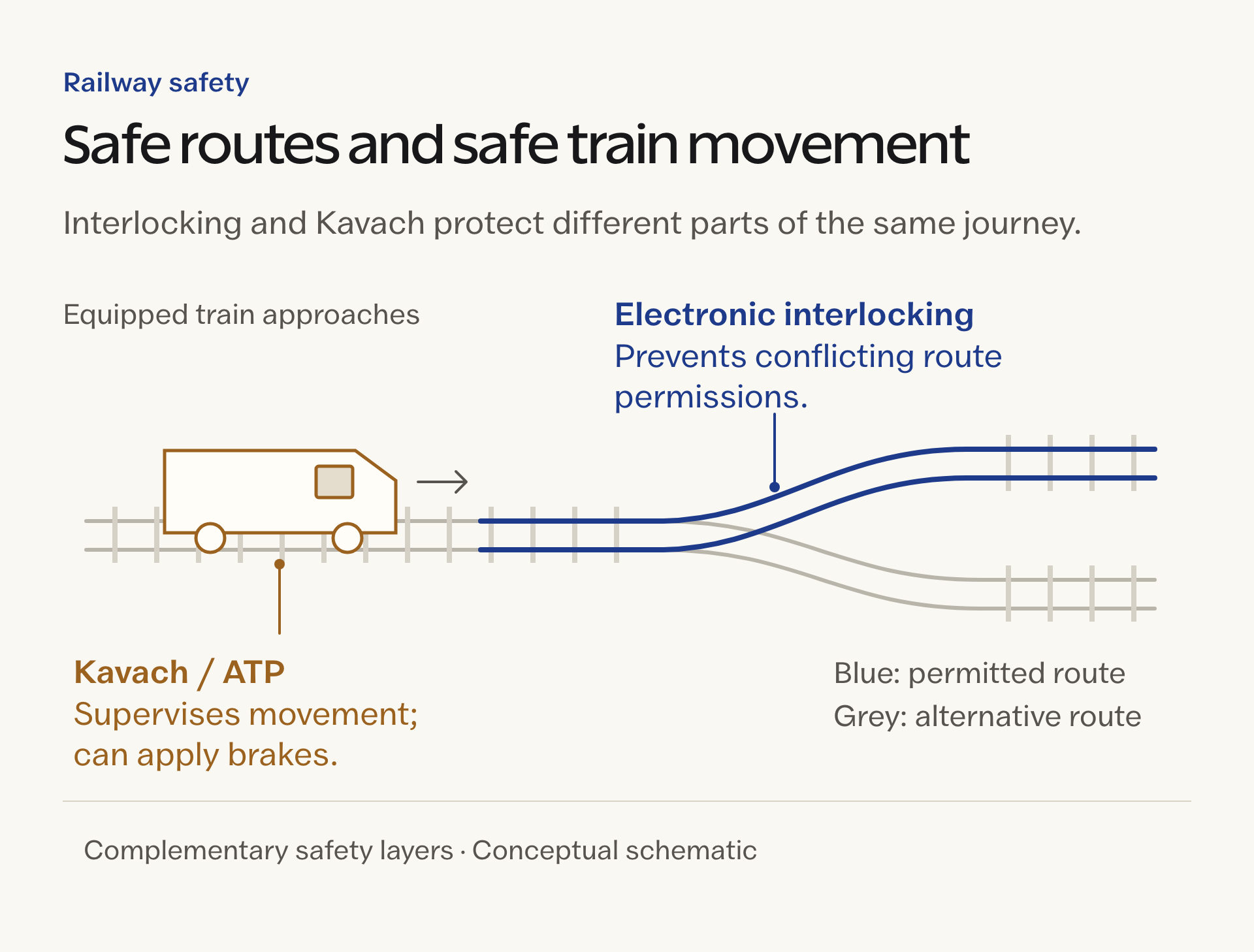
  • Interlocking and ATP are complementary: one establishes safe route permissions; the other helps enforce movement constraints on an equipped train. A route-setting improvement and a train-protection installation solve related but different operational safety problems.
  • Brake intervention does not justify calling a railway accident-proof. Safety also depends on correct installation, reliable equipment, operating conditions and maintenance; an ATP system cannot be treated as a substitute for the wider railway safety system.
Conceptual railway diagram locating electronic interlocking at the route fork and Kavach automatic train protection on the approaching equipped train
Electronic interlocking protects route permissions; Kavach adds train-movement supervision and brake intervention. Conceptual schematic.

What the Solapur approval does and does not establish

The development is a sanctioned signalling upgrade, so its future operational benefits must be separated from evidence that the system is already working.

  • The Solapur announcement concerns seven stations on an identified high-density route. It establishes approval for electronic-interlocking provision, not completed installation, commissioning or a verified reduction in railway incidents at those stations.
  • Kavach, Automatic Block Signalling and Centralised Traffic Control are separately sanctioned works on this route. Their mention explains the integration context; it does not mean the electronic-interlocking approval commissions all three systems together.
  • Automatic Block Signalling and central traffic management should not be collapsed into the interlocking function. Managing successive track sections and coordinating traffic are different tasks from preventing incompatible route permissions at a station or junction.
  • The Lucknow Division approval is a separate Kavach 4.0 project. It supplies contemporary context for ATP expansion, but cannot be counted as operational coverage or as evidence of commissioning in Solapur Division.
  • Implementation evidence should identify what has actually been installed, tested and brought into service. Public assessment needs these milestones because a sanction authorises work, whereas functioning safety protection depends on completing the engineering and operational process.

Way Forward

Verify the complete safety chain

  • Test route dependencies and interfaces before service, including failure conditions, rather than relying only on normal-operation demonstrations.
  • Train operating and maintenance staff for system faults and degraded working, with clear responsibilities for restoration.
  • Report approval, installation and commissioning separately so public coverage figures describe the stage actually achieved.

Conclusion

  • Electronic interlocking protects route-setting, while Kavach adds automatic train protection. Their value lies in complementary functions, not in treating every signalling upgrade as the same technology.
  • The Solapur decision is an approval. A sound infrastructure answer should connect its intended benefits with testing, commissioning and maintenance, rather than assume a sanctioned project is already delivering operational protection.

UPSC Practice Questions

Prelims MCQ 1

With reference to railway signalling and train protection, consider the following statements:

  1. Interlocking prevents conflicting route permissions from being authorised simultaneously.
  2. Kavach is an Automatic Train Protection system capable of brake intervention.
  3. Approval of electronic-interlocking works establishes that Kavach has been commissioned on the entire route.

How many of the above statements are correct?

(a) Only one (b) Only two (c) All three (d) None

Answer: (b) Only two

Explanation:

The first two describe distinct safety functions. Approval is not commissioning, and electronic interlocking and Kavach are not interchangeable projects.

Prelims MCQ 2

Which situation most directly illustrates the purpose of interlocking?

(a) Preventing simultaneous authorisation of conflicting routes (b) Setting ticket prices for a busy corridor (c) Replacing every train’s braking equipment (d) Measuring passenger demand at a station

Answer: (a) Preventing simultaneous authorisation of conflicting routes

Explanation:

Interlocking establishes safe dependencies between points, signals and routes, preventing incompatible movements from receiving permission together.

UPSC Mains Questions

  1. Explain how electronic interlocking and Automatic Train Protection provide complementary layers of railway safety. (150 words)
  2. Railway signalling modernisation requires more than project sanctions. Discuss the importance of interfaces, testing, commissioning and maintenance. (250 words)

Sources: PIB, Ministry of Railways and PIB, Ministry of Railways.

Frequently Asked Questions

What is electronic interlocking?

Electronic interlocking is computer-based signalling that maintains safe relationships between points, signals and routes. It prevents incompatible permissions and helps ensure that an authorised movement follows a safely established route.

How is Kavach different from interlocking?

Interlocking protects route-setting and signal permissions. Kavach supervises train movement and can apply brakes when required. The systems perform complementary tasks; one cannot be treated as a complete replacement for the other.

Does the Solapur announcement mean the system is operational?

No. It announces approval for electronic interlocking at seven stations. It does not establish completed installation or commissioning, and it should not be used as evidence of operational Kavach coverage.

Is the Lucknow Kavach approval part of the Solapur project?

No. The Lucknow Division Kavach 4.0 approval is a separate project in North Eastern Railway. The electronic-interlocking approval concerns Solapur Division in Central Railway; their implementation status must be assessed separately.

LPG Biometric Rule: Targeted Subsidies and Access Safeguards

Open article →Download PDF

Why in News?

On September 19, the Petroleum Ministry announced that biometric Aadhaar authentication will be required from October 1, 2026, to book domestic LPG refills at the regulated price with applicable subsidy.

  • Consumers who have already completed authentication do not need to repeat it.
  • Pending consumers can authenticate during delivery, at their distributor or through their oil marketing company’s mobile app.
  • Consumers unwilling or unable to authenticate can register that choice for market-priced 5 kg or 10 kg cylinders, without subsidy and subject to local availability.
  • The policy joins an identity check to access to an essential household fuel at its regulated selling price.
  • The exam issue is whether better targeting can coexist with practical access for genuine households facing authentication difficulties.

UPSC Relevance

Prelims Relevance

  • Biometric Aadhaar authentication and consumer identity verification
  • Oil marketing companies and domestic LPG distribution
  • Regulated retail selling price and applicable subsidy
  • Distinction between authentication, eligibility and physical fuel supply

Mains Relevance

GS Paper 2

  • Administrative exclusion in digitally mediated welfare delivery
  • Accountability, assisted access and grievance redress

GS Paper 3

  • Targeting household fuel support and preventing diversion

Essay

  • Administrative efficiency should be judged alongside the citizen’s ability to obtain essential services.

Background and Context

What changes for the consumer?

The announcement changes the conditions for booking refills at the regulated price; it does not say that all LPG supply ends without authentication.

  • The ministry’s announcement takes effect on October 1. Until that date, it is an announced access condition, not evidence that the new booking restriction is already operating across distributors.
  • For consumers who have already authenticated, refills continue as before. The announcement does not require a fresh biometric check from every household merely because the new effective date is approaching.
  • For consumers with authentication pending, booking at the regulated retail selling price with applicable subsidy becomes available once authentication is completed. This makes completion an operational gateway, rather than merely an informational update.
  • The stated completion channels include delivery staff using the company application, a distributor’s showroom and self-service mobile apps. These channels provide different ways to complete the same requirement; they are not separate subsidy entitlements.
  • The non-authentication option requires registering that choice with the oil marketing company through its available channels. Supply is then in specified smaller cylinders at market prices, without subsidy and subject to local availability.

Identity checks, targeting and subsidy access

Authentication addresses who is linked to a connection; the policy uses that check to strengthen the targeting of domestic fuel support.

  • The ministry links Aadhaar-authenticated identity to each consumer connection to help remove duplicate or ineligible connections. Its stated aim is to direct subsidised domestic LPG towards genuine households rather than unintended recipients.
  • A second stated objective is reducing diversion of domestic cylinders into commercial and industrial uses. The governance problem is the difference between fuel supplied for household consumption and fuel redirected to other users.
  • Authentication and eligibility answer different questions: identity verification establishes a match, while eligibility concerns qualification under applicable rules. Completing authentication does not create an identical subsidy entitlement for every consumer.
  • The release distinguishes the regulated selling price with applicable subsidy from the market-price alternative. A household’s ability to obtain some LPG is consequently different from its ability to obtain fuel on the regulated-price terms.
  • The ministry describes domestic LPG as sold below cost and explains compensation to oil marketing companies. This places the targeting decision within fuel-price support, not simply the administration of a cash-transfer database.

Where access safeguards matter

The relevant comparison is between access to regulated-price refills after authentication and the conditional market-price route without it.

  • The market-price route is a limited alternative, not a promise of an ordinary subsidised refill without authentication. Its smaller cylinder sizes, unsubsidised price and local availability condition all matter when assessing household access.
  • The ministry says the process is not intended to deny fuel to genuine households. That policy intention should be separated from measured outcomes: the announcement alone does not demonstrate that every difficulty has been resolved.
  • Administrative exclusion occurs when a genuine intended recipient cannot complete a required process. As the AgriStack tenant-inclusion debate illustrates, an unresolved record should not automatically establish ineligibility.
  • Offering several authentication channels can reduce dependence on one route. Their existence does not, by itself, prove that a household facing repeated failure can successfully use another route before needing its next refill.
  • The release does not announce a blanket exemption from authentication for ordinary subsidised booking. Assisted completion, time-bound complaints and reviews of unsuccessful cases are appropriate recommendations, but must not be presented as newly notified guarantees.

Way Forward

Measure access as well as completion

  • Record failed attempts, reasons and resolution times separately from completed authentications, so progress does not conceal unresolved genuine cases.
  • Provide assisted completion and clear escalation at delivery and distributor points, especially where self-service channels are difficult to use.
  • Explain the market-price alternative accurately, including cylinder sizes and local availability, rather than promising equivalent subsidised access.
  • Assess whether households can obtain their next refill, alongside aggregate authentication completion, before declaring the transition successful.

Conclusion

  • The LPG rule connects identity authentication with access to regulated-price fuel from October 1. Its announced purpose is better targeting, but genuine-household access remains the essential test of implementation.
  • A balanced answer should distinguish removing ineligible connections from preventing administrative exclusion. Recommend measurable assistance and complaint resolution without inventing exemptions or treating an announced rule as an already verified outcome.

UPSC Practice Questions

Prelims MCQ 1

With reference to the announced LPG authentication requirement, consider the following statements:

  1. Consumers who have already completed biometric Aadhaar authentication need not repeat it under this announcement.
  2. Consumers choosing not to authenticate are promised ordinary subsidised refills.
  3. The market-price alternative is subject to local availability.

How many of the above statements are correct?

(a) Only one (b) Only two (c) All three (d) None

Answer: (b) Only two

Explanation:

Statements 1 and 3 are correct. The specified alternative consists of market-priced 5 kg or 10 kg cylinders without subsidy, subject to local availability.

Prelims MCQ 2

Which situation best illustrates administrative exclusion in welfare delivery?

(a) Removing a confirmed duplicate connection (b) Detecting diversion to a commercial user (c) A genuine intended recipient being unable to complete a mandatory access process (d) A consumer voluntarily choosing an available unsubsidised product

Answer: (c) A genuine intended recipient being unable to complete a mandatory access process

Explanation:

Administrative exclusion concerns a genuine intended recipient being unable to obtain access because of process barriers, rather than removal of an ineligible claim.

UPSC Mains Questions

  1. How can identity authentication improve subsidy targeting without creating administrative exclusion? Discuss with reference to domestic LPG.
  2. Distinguish fuel availability from affordable access. What implementation indicators should guide the assessment of the announced LPG authentication requirement?

Source: PIB, Ministry of Petroleum and Natural Gas.

Frequently Asked Questions

When does the LPG biometric requirement take effect?

The ministry announced the requirement on September 19, with effect from October 1, 2026. It applies to booking domestic LPG refills at the regulated retail selling price with applicable subsidy.

Must already authenticated consumers complete the process again?

No. The announcement explicitly says consumers who have already completed biometric Aadhaar authentication need not repeat it. Their refill arrangements continue as before under the stated policy.

What is available without authentication?

Consumers unwilling or unable to authenticate can register that choice with their oil marketing company. The announced alternative is market-priced 5 kg or 10 kg cylinders without subsidy, subject to local availability.

Why is this a governance issue?

Identity checks can help target subsidies, but process barriers may exclude genuine households. The key governance question is whether assistance and complaint handling allow intended recipients to complete the requirement and access fuel.

Same-Sex Couple Protection: Adult Choice Beyond Marital Recognition

Open article →Download PDF

Why in News?

PTI reported on 20 September 2026 that an Allahabad High Court order dated 14 September directed police protection for an interfaith same-sex couple living together voluntarily.

  • The court interacted with the two adult women and recorded that their decision was free from pressure, fear or undue influence.
  • Police were directed to provide security if their relationship faced interference, after verifying adulthood and voluntary cohabitation.
  • The court distinguished the absence of marital recognition from the obligation to protect dignity and physical safety.
  • A constitutional freedom needs practical protection when family members or other people threaten those exercising it.
  • The important distinction is between choosing a partner and obtaining the legal status and consequences of marriage.

UPSC Relevance

Prelims Relevance

  • Article 21: protection of life and personal liberty.
  • Voluntary cohabitation and choice of partner.
  • Supriyo judgment: personal protection versus marital recognition.
  • High Court protection orders and police implementation.

Mains Relevance

GS Paper 2

  • Personal liberty, dignity and protection against private coercion.
  • Judicial enforcement of rights and accountable police response.

Essay

  • Individual dignity when social acceptance is absent.

Background and Context

What the reported protection order requires

The immediate issue was whether adults could live safely with their chosen partners, despite family objections and the absence of legally recognised marriage.

  • The women sought protection from family threats, according to the PTI report. Their petition concerned personal safety and interference with cohabitation, rather than an application to register their relationship as a marriage.
  • The court checked adulthood and voluntary choice through interaction with the couple. This distinction matters because a freely chosen relationship must be separated from coercion, which would require a different protective response.
  • The reported direction makes police responsible for security when interference occurs. It does not make relatives the decision-makers: their disagreement cannot substitute for the adults’ own account of the relationship and their wishes.
  • The couple’s different faiths form part of the reported facts. The protection principle concerns adult dignity and physical liberty; it does not depend on their religions matching or their families approving their choice.
  • The order date and reporting date differ: the decision was dated 14 September and reported on 20 September. The news is a reported judicial application of existing protections, not a newly enacted marriage law.

Personal liberty includes protection against coercion

Article 21 connects the freedom to make intimate choices with the state’s responsibility to protect people whose lives or liberty face threats.

  • Choice of partner is closely connected to privacy and dignity. A relationship does not lose these protections merely because others disapprove of it or because it lacks the statutory status associated with marriage.
  • In the Supreme Court’s Supriyo judgment, Justice Bhat’s opinion affirmed queer couples’ freedom to cohabit and treated protection against threats or coercion to life as a positive state obligation under Article 21.
  • A positive obligation means more than official non-interference. When credible threats arise, the state must provide protection; simply saying that the authorities have not themselves threatened the couple would miss the duty involved.
  • Consent verification serves a protective purpose when it establishes whether adults are acting freely. It should not become a test of whether officers, relatives or local communities personally approve of the relationship.
  • The practical concern is equal access to protection. A couple facing hostility needs an effective response to the threat, rather than a debate over whether their private choices fit prevailing social expectations.

Protection does not confer marital status

The central comparison is between safeguarding an existing personal liberty and creating a legally recognised relationship with the rights attached to marriage.

  • A protection order directs authorities to safeguard people against interference or violence. It does not, by itself, register a marriage, amend marriage legislation or grant every entitlement available to legally married spouses.
  • Marital recognition concerns a legal status and its consequences across different laws. A court can protect adults’ lives and freedom without deciding that their relationship acquires all the legal incidents of marriage.
  • The Supriyo decision did not reinterpret the Special Marriage Act to permit same-sex marriage. Its refusal to provide that recognition did not remove queer persons’ freedom to choose partners and live together safely.
  • The two questions require different legal reasoning: immediate protection enforces existing personal freedoms, while recognition of a marital framework raises questions about statutory interpretation, institutional competence and the consequences of legal status.
  • For an examination answer, avoid treating non-recognition as prohibition. The reported Allahabad order illustrates why lack of marital status cannot justify attacks on dignity, physical safety or an adult’s voluntary choice of partner.

Way Forward

Make protection effective without coercion

  • Record threat complaints promptly and provide a clear contact for urgent follow-up, so an order produces an accessible protective response.
  • Verify age and voluntariness privately and sensitively, reducing opportunities for threatening relatives to pressure the people seeking help.
  • Protect personal information during implementation, particularly where disclosing a couple’s location could expose them to renewed threats.

Conclusion

  • Adult choice and physical safety do not depend on family acceptance or marital recognition. The reported order turns that distinction into a concrete responsibility for police when voluntary cohabitation faces interference.
  • A sound constitutional answer separates protection from legal status: enforcing liberty against threats does not automatically create marriage rights, while the absence of those rights cannot excuse failure to safeguard people.

UPSC Practice Questions

Prelims MCQ 1

With reference to the reported Allahabad High Court protection order, consider the following statements:

  1. The court considered whether the couple were adults living together voluntarily.
  2. The protection direction itself registered the couple’s relationship as a marriage.
  3. The absence of marital recognition permits interference with the physical safety of adult partners.

How many of the above statements are correct?

(a) Only one (b) Only two (c) All three (d) None

Answer: (a) Only one

Explanation:

Only the first statement is correct. The direction concerns safety and voluntary cohabitation; it neither registers a marriage nor permits threats because marital recognition is absent.

Prelims MCQ 2

Which distinction best explains the constitutional issue in the protection order?

(a) Family consent replaces individual consent. (b) Police protection necessarily creates marital status. (c) Protection of personal liberty is distinct from recognition of marriage. (d) An unrecognised marriage removes the right to personal safety.

Answer: (c) Protection of personal liberty is distinct from recognition of marriage.

Explanation:

Adults can receive protection against threats and interference without their relationship acquiring the legal status of marriage.

UPSC Mains Questions

  1. Explain why the protection of adult partners against coercion can be constitutionally required even when their relationship lacks marital recognition. (150 words)
  2. How can police implementation of judicial protection orders safeguard autonomy without allowing consent verification to become social policing? Discuss. (150 words)

Sources: The Hindu, PTI court report and Supreme Court of India, Supriyo judgment.

Frequently Asked Questions

What did the Allahabad High Court reportedly direct?

According to PTI, the court directed police to protect an adult interfaith same-sex couple if their voluntary cohabitation faced interference. The order was dated 14 September and reported on 20 September.

Did this order recognise same-sex marriage?

No. The reported order concerns dignity, physical safety and voluntary cohabitation. A direction to protect adults from threats does not itself register their relationship as a marriage or amend marriage legislation.

Why is Article 21 relevant?

Article 21 protects life and personal liberty. The Supreme Court’s Supriyo judgment connected queer couples’ freedom to cohabit with a state obligation to protect them against threats or coercion to their lives.

What should consent verification establish?

It should establish that the people concerned are adults and are choosing the relationship voluntarily. It should not become a demand for family permission or an assessment of whether officials approve of their choice.

SCL DMIS: Coordinating Wafer Fabrication From Orders to Packaging

Open article →Download PDF

Why in News?

The Semi-Conductor Laboratory (SCL), Mohali, launched its indigenous Device Manufacturing Integrated System (DMIS) for wafer-fabrication management at the concluding session of SEMICON India on 19 September 2026.

  • DMIS is a manufacturing execution system, according to the Ministry of Electronics and IT announcement.
  • Its modular, plug-and-play architecture supports management from order booking through wafer fabrication to final packaging.
  • The stated purpose is stronger shop-floor control and manufacturing efficiency; the release provides no measured performance improvement.
  • Semiconductor production needs both physical fabrication capability and reliable coordination of work inside the factory.
  • The relevant policy question is how manufacturing software supports operations, without confusing its launch with new chip-production capacity.

UPSC Relevance

Prelims Relevance

  • SCL: an autonomous body under MeitY, located in Mohali.
  • DMIS: Device Manufacturing Integrated System.
  • MES: manufacturing execution system linking production management with factory operations.
  • Wafer fabrication: manufacture of semiconductor structures on wafers.
  • Packaging: a distinct stage within the device-manufacturing chain.

Mains Relevance

GS Paper 3

  • Role of indigenous production-management software in semiconductor manufacturing.
  • Distinguishing announced capabilities from demonstrated industrial performance.

Background and Context

What the DMIS announcement establishes

The announcement concerns the management of production work inside a semiconductor facility, rather than a new chip design or fabrication process.

  • DMIS expands to Device Manufacturing Integrated System. PIB identifies it as an indigenous manufacturing execution system launched by SCL, placing it within factory operations rather than the design of a processor architecture.
  • The verified coverage runs from order booking through wafer fabrication to final packaging. These are connected management stages; the release does not describe the detailed sequence of physical operations performed on a wafer.
  • Modular, plug-and-play architecture is the architectural description provided. It indicates a system organised around connectable modules, but does not establish that every existing fabrication machine can connect without engineering work or configuration.
  • The launch identifies shop-floor control and manufacturing efficiency as its purposes. No baseline, comparison period or independently measured result is supplied, so a numerical productivity improvement cannot be inferred from the announcement alone.
  • The official release does not specify the deployment footprint, connected equipment or customer installations. Launch is the established development; universal adoption across Indian fabs is not a supported conclusion.

How a manufacturing execution system fits into production

The general MES concept explains why production software matters, but its usual functions must not be presented as a verified DMIS feature list.

  • A manufacturing execution system helps managers direct and follow production activity. NIST describes this role as guiding and reporting manufacturing operations, connecting an order with the work needed to fulfil it.
  • An enterprise planning system considers requirements such as orders, materials and resources across the business. An MES focuses more closely on executing production; this distinction helps separate business planning from factory-level operational coordination.
  • In general MES models, work instructions and schedules move toward production while results move back toward management. This information exchange helps connect what a factory intended to make with what its operations actually produced.
  • A production lot groups material for scheduling, dispatching or tracking. NIST manufacturing models use this concept to organise work; it explains production coordination without proving that DMIS has any particular lot-tracking module.
  • Consider a delayed production order: management needs to distinguish work awaiting processing from completed work. An MES can support such operational visibility in principle; this example illustrates the software category, not a demonstrated DMIS result.

Why software management is not physical fabrication capacity

A production-management system and a semiconductor factory perform different jobs, even when the software covers the factory from start to finish.

  • SCL describes its work as spanning design, fabrication, assembly, packaging and testing. This institutional context explains why coordination across stages matters; those physical capabilities should not be attributed to DMIS software itself.
  • Wafer fabrication produces semiconductor structures using a physical manufacturing process. Software can help organise production activity, but it does not replace fabrication equipment, materials, trained operators or the controlled conditions required to make devices.
  • Packaging is a distinct activity in SCL’s end-to-end device-manufacturing chain. Including it within a management system’s coverage means coordinating work across stages, rather than claiming that order-management software physically packages a semiconductor device.
  • Indigenous software can offer a route to domestic knowledge of production-management systems. Its practical value still depends on reliable operation, maintainability and integration; domestic origin alone does not demonstrate successful implementation at every facility.
  • For evaluation, distinguish announced scope from demonstrated outcomes. Evidence about operational use, integration and performance would strengthen later assessments; neither a new process node nor additional wafer-production capacity follows from this software launch.

Way Forward

Evaluate operational performance

  • Establish clear operational baselines before claiming efficiency gains, then compare production performance using consistent definitions.
  • Document interfaces and maintenance responsibilities so integration decisions reflect actual equipment and workflow requirements.
  • Publish verified deployment and performance evidence, while protecting sensitive manufacturing information and separating planned functions from operational ones.

Conclusion

  • DMIS brings attention to the software that coordinates semiconductor production. Its announced order-to-packaging scope is significant, but must remain distinct from claims about physical capacity or measured efficiency gains.
  • For an answer on industrial self-reliance, explain the operational layer: equipment makes production possible, while production-management software helps organise the work. Judge results through evidence of implementation and performance.

UPSC Practice Questions

Prelims MCQ 1

With reference to SCL’s Device Manufacturing Integrated System, consider the following statements:

  1. It was announced as an indigenous manufacturing execution system.
  2. Its announced management coverage extends from order booking to final packaging.
  3. Its launch establishes the commissioning of a new semiconductor process node.

How many of the above statements are correct?

(a) Only one (b) Only two (c) All three (d) None

Answer: (b) Only two

Explanation:

The announcement confirms the first two statements. A manufacturing execution system is production-management software; its launch does not establish a new fabrication process node.

Prelims MCQ 2

Which best describes the general role of a manufacturing execution system?

(a) Designing the instruction set of a processor (b) Coordinating and reporting production activity within manufacturing operations (c) Replacing all physical fabrication equipment (d) Determining monetary policy for industrial lending

Answer: (b) Coordinating and reporting production activity within manufacturing operations

Explanation:

An MES connects production management with factory operations. It is distinct from processor design, physical fabrication machinery and financial policy.

UPSC Mains Questions

  1. Explain the role of manufacturing execution systems in semiconductor production. How are they distinct from enterprise planning and physical fabrication equipment? (150 words)
  2. An indigenous production-management platform must be assessed through operational evidence. Discuss with reference to the launch of SCL’s DMIS. (250 words)

Sources: PIB, Ministry of Electronics and IT and Semi-Conductor Laboratory.

Frequently Asked Questions

What is SCL DMIS?

Device Manufacturing Integrated System is an indigenous manufacturing execution system launched by the Semi-Conductor Laboratory. Its announced scope covers management from order booking through wafer fabrication to final packaging.

Does DMIS manufacture chips by itself?

No. DMIS is production-management software. Physical fabrication and packaging still require equipment, materials and skilled operations. The announcement does not establish a new process node or additional wafer-production capacity.

What does a manufacturing execution system generally do?

An MES helps coordinate and report production activities. It connects production management with factory operations, supporting the execution of manufacturing orders. General MES capabilities should not automatically be attributed to DMIS.

Has the announcement established measurable efficiency gains?

No measured gain is provided in the release. Manufacturing efficiency is a stated purpose, but assessing actual improvement would require operational evidence, a baseline and a consistent comparison of production performance.

State Financing Review: Debt Transparency and Investible Projects

Open article →Download PDF

Why in News?

At a financing conference concluding on September 19, the Finance Ministry announced working groups with state participation to identify sectoral financing requirements and develop actionable recommendations.

  • The working groups will take forward thematic deliberations; the announcement is a follow-up mechanism, not a completed financing agreement.
  • The conference highlighted project preparation, private investment and states’ own capital expenditure as priorities.
  • A keynote speaker advocated state-specific debt sustainability assessments and fuller disclosure of off-budget borrowings, guarantees and arrears.
  • Those expert proposals are recommendations, not newly adopted borrowing limits or binding fiscal rules.
  • Development financing depends both on repayment capacity and on the quality of projects seeking money.
  • A narrow reading of budget borrowing can miss fiscal risks associated with entities, guarantees and payment obligations outside the headline figures.

UPSC Relevance

Prelims Relevance

  • Fiscal deficit as a flow and outstanding debt as a stock
  • Guarantees and contingent liabilities
  • Off-budget borrowing and state-owned entities
  • Capital expenditure and project preparation
  • Debt sustainability and fiscal transparency

Mains Relevance

GS Paper 3

  • Mobilising investment without obscuring fiscal risks
  • Project preparation and quality of public capital expenditure

GS Paper 2

  • Union-state cooperation and accountability in development financing

Essay

  • Credible public finance requires promises to remain visible before they become bills.

Background and Context

What the working groups are meant to do

The new development is a structured follow-up to a Union-state financing discussion, with sectoral requirements and recommendations as its stated outputs.

  • The Finance Ministry’s account says state-participating working groups will carry forward the conference themes. It does not announce that they have already produced reports, approved investments or secured funds for individual projects.
  • The discussions brought together public and private finance, including agriculture and the energy transition. Their common question was how to finance development at scale, rather than how to distribute a newly announced grant alone.
  • The stated approach recognises that government budgets alone cannot meet the entire financing requirement. Private capital was presented as complementary, while states were also encouraged to strengthen the quality and scale of their own investment.
  • Debt transparency featured in expert advice, including attention to off-budget borrowing, guarantees, arrears and state-owned entities. The release reports these views; reporting a proposal does not convert it into an adopted government rule.
  • The conference also discussed fiscal discipline and capital spending priorities. It did not establish a new universal state debt ceiling or mandate a numerical capital-expenditure ratio, so such claims would misstate its policy status.

Read the budget flow and the wider risk

The key comparison separates this year’s financing gap, accumulated debt and obligations that may create future pressure on the budget.

  • Fiscal deficit is a period’s expenditure minus receipts excluding borrowing. The Union Budget’s explanatory notes describe it as the government’s borrowing requirement; it is not the total debt accumulated over successive years.
  • Outstanding debt is a stock measured at a point in time. Reading it alongside the annual deficit helps distinguish an existing repayment burden from the additional financing pressure arising during the current budget period.
  • Off-budget borrowing may be raised through an entity while repayment depends on public resources. The analytical question is who ultimately services it; a separate borrower’s name does not, by itself, remove the state’s fiscal exposure.
  • A guarantee creates a potential obligation if its specified conditions are triggered. It differs from direct debt already owed by the government, but can still become a budget cost and deserves transparent reporting.
  • The RBI’s State Finances report recommends clearer reporting of liabilities, off-budget borrowings and guarantees. This supports a fuller assessment without pretending that every state-owned entity’s debt automatically belongs to the state government.

Why a financeable project needs preparation

More money is useful only when project design, delivery responsibilities and fiscal commitments are credible enough to support implementation.

  • The conference’s concluding assessment stressed credible project reports and a sound preparation pipeline. Identifying a sector’s need is an initial step; a lender or investor also needs a project that can actually be delivered.
  • Land, power and logistics were identified as enabling conditions for private investment. A financing proposal cannot substitute for these implementation requirements, and an attractive investment announcement is not evidence that they have been resolved.
  • A useful project appraisal should connect the proposed service to costs, delivery milestones and responsibility for repayment. These are practical evaluation questions, not additional rules announced by the conference or guaranteed investment outcomes.
  • Private participation should not make public commitments invisible. Where a project relies on state payments or guarantees, those obligations belong in the fiscal risk assessment even when private partners arrange part of the financing.
  • State-specific assessment matters because revenue capacity, existing obligations and project readiness differ. The keynote advocated assessing debt sustainability state by state; the release does not supply those assessments or classify individual states as sustainable.

Way Forward

Turn recommendations into accountable decisions

  • Give each working group a clear output and timeline, then publish which recommendations are accepted and which remain under consideration.
  • Disclose direct liabilities and contingent risks clearly, distinguishing guarantees from debt rather than combining unlike obligations without explanation.
  • Prepare credible project reports before seeking finance, including delivery responsibilities and the source of repayment or public support.
  • Assess fiscal space alongside project quality so ambitious financing does not conceal future budget commitments.

Conclusion

  • The working groups create a route from discussion to financing recommendations; they do not themselves create a new fiscal regime. The immediate task is to make their proposed outputs and subsequent decisions accountable.
  • A strong answer connects transparent obligations with credible investment projects. Separate deficit, debt and contingent risks, then explain why mobilisation of capital and the ability to service commitments must be assessed together.

UPSC Practice Questions

Prelims MCQ 1

With reference to public finance, consider the following statements:

  1. Fiscal deficit is an annual flow rather than the entire outstanding debt stock.
  2. A government guarantee can create a future fiscal obligation.
  3. Borrowing through a separate entity can never create fiscal exposure for a state.

How many of the above statements are correct?

(a) Only one (b) Only two (c) All three (d) None

Answer: (b) Only two

Explanation:

Statements 1 and 2 are correct. Entity borrowing can create exposure when repayment or support depends on public resources; a separate legal borrower does not automatically remove that risk.

Prelims MCQ 2

Which statement best describes the September 19 financing conference outcome?

(a) A new uniform debt ceiling became binding on all states (b) Every proposed project received financing approval (c) State-participating working groups were announced to develop financing recommendations (d) State guarantees were converted into direct Union government debt

Answer: (c) State-participating working groups were announced to develop financing recommendations

Explanation:

The ministry announced working groups to identify sectoral financing requirements and actionable recommendations. The release does not establish the other claimed outcomes.

UPSC Mains Questions

  1. Why should state debt assessments consider off-budget borrowing and contingent liabilities? Distinguish these from the annual fiscal deficit.
  2. Mobilising private capital and improving public project preparation are complementary tasks. Discuss in the context of state development financing.

Sources: PIB, Ministry of Finance and Reserve Bank of India, State Finances report.

Frequently Asked Questions

What did the financing conference announce?

It announced working groups with state participation to take forward thematic discussions, identify sectoral financing needs and develop actionable recommendations. It did not report completed financing approvals for all discussed projects.

How do fiscal deficit and debt differ?

Fiscal deficit concerns a government’s financing gap during a period, usually a financial year. Outstanding debt is the accumulated stock owed at a point in time; the two should not be used interchangeably.

Why do guarantees matter for state finances?

A guarantee can create a payment obligation when its specified conditions occur. Although it is not identical to direct debt, it can become a budget cost and requires clear fiscal-risk reporting.

Did the conference impose a new state borrowing rule?

The release describes expert proposals and announced working groups. It does not establish a new uniform debt ceiling or binding capital-expenditure ratio for states; recommendations must remain clearly separated from adopted rules.

UHPFRC Bridges: How Fibres Control Cracks and Enable Longer Spans

Open article →Download PDF

Why in News?

The Road Transport Ministry reported that Nagpur’s Indora Chowk–Dighori flyover, inaugurated on September 19, uses ultra-high-performance fibre-reinforced concrete to enable longer spans and reduce the supports required.

  • The ministry attributes longer spans between piers and faster construction to the use of UHPFRC technology.
  • The National Highways Authority of India constructed the flyover; its opening is an actual completed-project trigger.
  • The release does not disclose the bridge’s specific concrete mix or tested strength; general material properties must not be assigned to this structure.
  • Bridge design depends on how materials respond to compression, tension and cracking, not simply on choosing a stronger concrete label.
  • The exam value is the connection between material science, structural design and construction quality, rather than a local infrastructure record.

UPSC Relevance

Prelims Relevance

  • Ultra-high-performance fibre-reinforced concrete
  • Compression, tension and post-cracking tensile resistance
  • Dispersed fibres and structural reinforcement
  • Piers, spans and bridge load paths
  • Curing and material testing

Mains Relevance

GS Paper 3

  • Advanced materials and infrastructure reliability
  • Quality assurance and whole-life appraisal of public infrastructure

Essay

  • Infrastructure innovation succeeds when laboratory capability becomes dependable construction practice.

Background and Context

What the bridge announcement establishes

UHPFRC is an engineered cement-based composite; its value comes from combining a strong matrix with distributed fibres, rather than from a name alone.

  • The ministry’s release identifies UHPFRC as the technology used in the new flyover. It specifically connects the material to longer distances between successive piers and a reduced requirement for supports.
  • A span is the stretch of a bridge between supports. Enabling a longer span can change the arrangement of piers below the deck; it does not eliminate the need for a safe load path.
  • The ministry also links the technology to faster construction through the use of structural segments. That is a project-specific reported benefit, not proof that every fibre-concrete bridge can be built equally quickly.
  • The announcement supplies a real application for studying the material. However, it does not publish the flyover’s mix proportions, fibre content or laboratory results, so precise material-performance claims about this bridge would be unsupported.
  • The useful distinction is between material capability and completed structural design. A material may permit different member shapes or spans, but the actual arrangement must still satisfy loading, connection and construction requirements.

Why fibres matter after cracking

Concrete resists compression well, while tensile cracking creates a different problem: maintaining a reliable path for forces across the cracked region.

  • In a cementitious composite, the matrix binds the ingredients together. Distributed fibres add a reinforcing mechanism within that matrix; they should not be confused with a claim that a finished bridge contains no steel bars.
  • When a crack forms, fibres crossing it can bridge the opening and transfer tensile force between its faces. The important feature is resistance after cracking, not a promise that cracking will never occur.
  • The Federal Highway Administration’s technical note describes UHPC with sustained post-cracking tensile strength. It also identifies a dense pore structure that reduces liquid ingress; these are general material characteristics, not measurements from Nagpur.
  • The central comparison is with ordinary unreinforced concrete: a crack interrupts its tensile load path much more directly. Fibre bridging can retain resistance across that opening, subject to the actual composite’s measured behaviour.
  • Fibre distribution and orientation influence tensile behaviour. The FHWA explains that casting flow can align fibres, so a strong average material result does not remove the need to control how each member is produced.
Conceptual cross-sections compare ordinary unreinforced concrete with UHPFRC, showing embedded fibres crossing a crack and transferring tensile force.
Fibres can transfer tensile force across a crack; the conceptual comparison is not to scale and does not represent the Nagpur flyover’s material measurements.

What high performance does not guarantee

Better material properties create design opportunities, but construction control and project evidence determine whether those opportunities become dependable infrastructure.

  • Mixing and casting require attention to consistency and fibre dispersion. FHWA notes that mixing may demand more energy and that placement affects fibre orientation; treating the composite exactly like conventional concrete can miss these differences.
  • Curing protects the water needed for the cementitious reaction. Surface dehydration can damage performance and cause cracking, so the high-performance label cannot compensate for poor curing or careless treatment immediately after placement.
  • Tensile testing must distinguish first cracking from the resistance maintained afterwards. FHWA cautions that the load can continue increasing after cracking, making it misleading to treat one test reading as the entire material response.
  • Reduced liquid ingress supports durability, but it does not mean maintenance disappears. A bridge remains an assembled structure with connections and exposed components; the announcement does not establish that this project needs no future inspection.
  • A whole-life comparison should examine construction, inspection, repair and material use together. Neither automatic cost savings nor a universal low-carbon advantage follows from the UHPFRC label without a project-specific assessment.

Way Forward

Specify performance and verify execution

  • As with steel-slag road aggregates, require project-specific testing rather than relying on a material label; for UHPFRC, include the relevant post-cracking response.
  • Control mixing, casting and curing with documented procedures rather than relying on material branding.
  • Compare alternatives using whole-life performance, including inspection and repair needs, instead of only initial construction speed.
  • Publish accessible performance evidence so reported project benefits can be distinguished from general expectations about advanced concrete.

Conclusion

  • UHPFRC illustrates how fibres bridging cracks can expand concrete’s structural usefulness beyond compression. The Nagpur opening supplies the current-affairs trigger, while the underlying mechanism supplies the durable science lesson.
  • In an answer, connect material behaviour to span design and construction quality. Keep the ministry’s reported project benefits separate from general UHPC science, and avoid assuming crack-free, maintenance-free or universally low-carbon infrastructure.

UPSC Practice Questions

Prelims MCQ 1

With reference to fibre-reinforced high-performance concrete, consider the following statements:

  1. Fibres crossing a crack can help transfer tensile force across it.
  2. Fibre reinforcement guarantees that concrete cannot crack.
  3. Casting procedures can influence fibre orientation.

How many of the above statements are correct?

(a) Only one (b) Only two (c) All three (d) None

Answer: (b) Only two

Explanation:

Statements 1 and 3 are correct. Fibre reinforcement can sustain resistance after cracking; it does not guarantee the absence of cracks.

Prelims MCQ 2

In bridge engineering, a span most directly refers to:

(a) The distance of a bridge segment between supports (b) The quantity of steel fibres per concrete batch (c) The width of a crack after testing (d) The time required for curing

Answer: (a) The distance of a bridge segment between supports

Explanation:

A span is the bridge stretch between supports. Longer spans can alter the number and arrangement of piers, subject to structural design.

UPSC Mains Questions

  1. Explain how fibre reinforcement changes concrete’s behaviour after cracking. Why does this matter for bridge design?
  2. Advanced construction materials do not remove the need for quality assurance. Discuss with reference to UHPFRC infrastructure.

Sources: PIB, Ministry of Road Transport and Highways and US Federal Highway Administration.

Frequently Asked Questions

What is UHPFRC?

Ultra-high-performance fibre-reinforced concrete is an engineered cement-based composite containing distributed fibres. The combination supports high mechanical performance, including useful tensile resistance after cracking, when the material is properly designed and produced.

How do fibres help control cracks?

Fibres crossing a developing crack can transfer tensile force between its faces. This bridging action helps the composite retain resistance after cracking; it does not mean cracks become impossible.

Does UHPFRC automatically eliminate steel reinforcement?

No. Distributed fibres and structural steel bars serve related but distinct roles. Whether a particular reinforcement component can be changed depends on the validated structural design, not the material label alone.

What is verified about the Nagpur flyover?

The ministry reports that the inaugurated flyover uses UHPFRC and attributes longer spans and fewer supports to it. The release does not provide its exact mix composition or tested strength.