Join Anantam IAS Channel on Telegram

Daily Digest · Sunday

22 November 2026 Current Affairs for UPSC

3 current affairs published on Sunday, 22 November 2026

22 November 2026 Current Affairs for UPSC — every Why-in-News article AnantamIAS published on Sunday, 22 November 2026, broken down with Why in News?, the exact GS paper it feeds, sub-topic mapping, MCQ-ready facts and a UPSC-style practice question. 3 articles in total, covering Polity, Economy, Environment, S&T, IR, Geography, History, Society and Internal Security — the same Why-in-News + GS-paper-mapping + practice-question format the Compass uses across every daily digest on the site.

Daily current affairs for UPSC is where new material enters your prep stream. Read this 22 November 2026 digest end-to-end in 25–35 minutes, attempt the practice question at the foot of each article (it's MCQ for some, 10/15-marker for others), then bookmark the entries that fall inside your active revision window. Everything stays cross-linked: tap any subject pill to jump to that subject's hub, or use the table of contents above to skip straight to a specific story.

Use this page three ways. Read sequentially for a one-sitting scan of everything that mattered on 22 November 2026. Download the 22 November 2026 PDF below for offline study or print revision. Or use the November 2026 Current Affairs compilation to see this day in the month's full context. For the previous day's reading, see 21 November 2026 Current Affairs.

Why we publish daily current affairs separately from the monthly compilation: daily is learning, monthly is revision. Use the daily page to add fresh material to your notes the day it breaks; come back to the November 2026 compilation 60 days before Prelims when the noise has settled and only the lasting takeaway is worth re-reading.

Ethiopia Polio Response and Community Immunity Gaps

Open article →Download PDF

Why in News?

WHO reported that Ethiopia launched a polio vaccination campaign on November 21, 2026, following circulating variant poliovirus cases and with a plan to reconnect missed children to routine immunization.

  • The campaign aims to reach more than 11.3 million children; this is a target announced at launch.
  • The first round is scheduled for November 21–24, followed by another round in December.
  • WHO reported circulating variant poliovirus type 1 cases in Ethiopia during 2026, while the country remains free of wild poliovirus.
  • Teams will identify children who have missed routine vaccinations and link them with regular services.
  • Immunity gaps can persist within communities even when a country has made substantial progress against polio.
  • Campaign monitoring and surveillance answer different questions about service reach and the continued presence of disease.

UPSC Relevance

Prelims Relevance

  • Poliomyelitis is a vaccine-preventable disease that can cause paralysis.
  • Wild poliovirus and circulating variant poliovirus are distinct surveillance classifications.
  • Acute flaccid paralysis surveillance helps detect possible poliovirus transmission.
  • Routine immunization provides continuing vaccination services between campaigns.
  • Environmental surveillance complements surveillance based on illness reports.

Mains Relevance

GS Paper 2

  • Health service delivery and follow-up of children missed by routine programmes.
  • International cooperation in vaccination, monitoring and disease surveillance.

Background and Context

What the Polio Classifications Mean

The type of virus reported and the population’s protection are separate parts of assessing a public-health response.

  • Wild-polio-free status concerns wild poliovirus. WHO’s Ethiopia report also records circulating variant cases, showing why a country can retain that specific status while still needing an outbreak response and continued surveillance.
  • Circulating variant poliovirus is the classification used for the reported outbreak. WHO associates these outbreaks with gaps in community immunization, making sustained vaccination coverage central to preventing further illness and protecting children.
  • Reported cases describe the evidence identified by surveillance. The campaign launch on November 21 is a new response milestone; it does not establish that the first infection or detection occurred on that date.
  • Vaccination is the central prevention measure in WHO’s guidance. Public communication should explain the outbreak classification accurately and connect families with services, while avoiding claims that a campaign announcement proves transmission has ended.
  • Status terminology needs its full qualifier. The distinction also matters when reading disease-elimination assessments, although the surveillance criteria and response arrangements for different diseases must be evaluated separately.

How Campaigns Connect Children to Routine Care

A focused outbreak campaign can provide an opportunity to find children whom the regular health system has missed.

  • Outbreak campaigns concentrate effort within a defined period and area. Ethiopia’s announced rounds seek to close protection gaps, while the continuing routine programme remains responsible for regular vaccination services beyond those campaign dates.
  • Household outreach is part of the announced delivery approach. Teams are expected to identify missed children as they visit communities, connecting campaign contact with the broader task of restoring access to routine care.
  • Referral follow-up matters after identification. Recording a child as needing routine vaccines is an intermediate step; services must remain accessible so the household can complete the intended contact with the regular immunization programme.
  • Community participation supports delivery through familiar health workers, volunteers and local communication. WHO’s report identifies high population movement and immunity gaps as concerns, requiring attention to groups that routine arrangements may repeatedly miss.
  • Delivery support includes coordination, supervision and monitoring by national authorities and partners. The wider public-health cooperation agenda similarly depends on converting institutional commitments into services people can actually access.
What Monitoring Must Establish

A response needs evidence about whom it reached and whether transmission continues, with each result interpreted according to its purpose.

  • Campaign targets define intended reach. The announced child total cannot be reported as achieved coverage; that judgment requires information collected during and after implementation, including evidence about areas or households that were missed.
  • Independent monitoring can help assess delivery quality alongside programme reports. WHO described support for supervision and monitoring in Ethiopia, making verification of service reach part of the response rather than a conclusion established at launch.
  • Acute flaccid paralysis surveillance looks for illness signals that require investigation. It remains relevant alongside vaccination because the public-health system needs timely evidence to recognize possible continuing transmission and organize an appropriate response.
  • Environmental surveillance supplies another source of information about poliovirus circulation. WHO calls for it alongside illness surveillance, allowing the response to draw on complementary evidence instead of relying exclusively on reports of paralytic disease.
  • Routine-service linkage provides a further measure of follow-through. Officials can examine whether children identified as under-vaccinated subsequently reach regular services, connecting the short campaign to protection that depends on a functioning continuing programme.

Way Forward

Close the Gaps Found During Outreach

  • Track missed communities and arrange follow-up through local services.
  • Report achieved reach separately from campaign targets and planned rounds.
  • Maintain surveillance alongside vaccination and act on investigated findings.
  • Check routine-care referrals so identification leads to completed service contact.

Conclusion

  • Ethiopia’s response links focused outbreak vaccination with the continuing work of finding missed children, supporting routine services and maintaining surveillance.
  • For public-health governance, judge the response through verified reach and follow-up. A launch, a target and an achieved result describe different stages of implementation.

UPSC Practice Questions

Prelims MCQ 1

Which statement best describes Ethiopia’s polio situation in the WHO announcement?

(a) The campaign had already reached its full target at launch. (b) Wild-polio-free status rules out every other poliovirus outbreak. (c) The campaign announcement established the date of the first infection. (d) A country free of wild poliovirus can still report circulating variant poliovirus.

Answer: (d) A country free of wild poliovirus can still report circulating variant poliovirus.

Explanation:

WHO described Ethiopia as free of wild poliovirus while reporting circulating variant poliovirus type 1 cases during 2026.

Prelims MCQ 2

What is the purpose of linking children identified during a polio campaign with routine immunization services?

(a) To discontinue regular services after the campaign. (b) To help children receive routine vaccinations they have missed. (c) To treat the campaign target as achieved coverage. (d) To replace disease surveillance with attendance records.

Answer: (b) To help children receive routine vaccinations they have missed.

Explanation:

The announced programme includes identifying children with missed vaccinations and connecting them with regular services. Surveillance and campaign monitoring continue to serve separate purposes.

UPSC Mains Questions

  1. Explain how outbreak vaccination campaigns can strengthen routine immunization services. Discuss the role of follow-up and monitoring.
  2. Why must public-health authorities distinguish campaign targets, achieved coverage and disease-surveillance findings when assessing an outbreak response?

Sources: WHO Regional Office for Africa and WHO poliomyelitis questions and answers.

Frequently Asked Questions

What did Ethiopia launch on November 21?

Ethiopia launched a polio vaccination campaign with support from WHO and partners. The response also plans to identify children who have missed routine vaccinations and connect them with regular services.

Does wild-polio-free status rule out variant cases?

WHO reported that Ethiopia remains free of wild poliovirus while circulating variant poliovirus cases occurred during 2026. The classification of the virus matters when interpreting the country’s status.

Was the campaign target already achieved?

The launch announcement described intended reach. Achieved coverage requires evidence from implementation and monitoring, including whether teams reached eligible children and followed up on those initially missed.

Why does surveillance continue during vaccination?

Surveillance provides evidence about possible continuing poliovirus transmission. WHO calls for acute flaccid paralysis and environmental surveillance alongside vaccination, while campaign monitoring assesses how effectively services reached children.
NCG VISHWAS and Continuity in Cancer Care

Open article →Download PDF

Why in News?

The Health Ministry launched NCG VISHWAS in Mumbai on November 21, 2026, linking patient education with calls for stronger screening, referrals and continuity in cancer care.

  • NCG VISHWAS provides AI-enabled, clinician-reviewed educational videos on breast, cervical and oral cancers.
  • The videos use Hindi, Marathi, Tamil and English and cover prevention, diagnosis, treatment and long-term care.
  • The Ministry urged consent-based record linkage through ABHA and wider dissemination through healthcare workers and digital platforms. These were implementation recommendations accompanying the launch.
  • Continuity of care depends on a patient completing the next clinical step and the receiving team having relevant information.
  • Education, clinical services and financial protection address different obstacles. Each requires its own implementation and evaluation.

UPSC Relevance

Prelims Relevance

  • NCG is the National Cancer Grid, a network supporting cancer-care quality and collaboration.
  • Screening identifies people who may need further assessment.
  • Diagnosis establishes whether cancer is present through appropriate clinical evaluation and tests.
  • ABHA supports linking and sharing health records with patient consent.
  • AB PM-JAY provides eligible beneficiaries financial coverage under its rules.

Mains Relevance

GS Paper 2

  • Public health delivery across primary, secondary and tertiary facilities.
  • Digital health governance, informed consent and equitable access.

Background and Context

What Patient Education Contributes

The initiative addresses what patients and caregivers understand at each stage of cancer care.

  • Clinician-reviewed education can explain the purpose of investigations, treatment choices and follow-up. The launch describes videos as information support, while clinical teams remain responsible for evaluating an individual patient and advising care.
  • Language access matters when unfamiliar medical terms prevent patients from asking questions. Videos in familiar languages can support a consultation, while staff check whether the patient understands the next step and its purpose.
  • The National Cancer Grid brings hospitals, researchers and patient groups into a common network. Its role includes standardised protocols, quality assurance and professional capacity, providing a clinical base for reviewing educational material.
  • AI-enabled production requires clinical review, clear communication and regular correction when guidance changes. The announced initiative uses technology to convey information about cancer care, with no reported authority to diagnose patients independently.
  • Dissemination through member institutions is part of the initiative. Suggestions involving community workers and additional platforms describe possible expansion, so the launch alone cannot establish universal access or improved patient outcomes.

How Screening Connects to Treatment

A screening programme produces health benefits when people with abnormal findings receive timely assessment and appropriate care.

  • Screening looks for possible disease among eligible people before symptoms necessarily appear. As the WHO explains, an abnormal finding requires further tests to establish a diagnosis and guide any referral for treatment.
  • Referral connects the first point of contact with a facility able to investigate the finding. Sending a referral creates an opportunity for assessment, while attendance and completion determine whether that opportunity becomes care.
  • Diagnostic confirmation separates suspected disease from established cancer. This distinction matters for programme evaluation because a tally of screening encounters cannot reveal how many patients completed assessment or entered an appropriate treatment pathway.
  • Follow-up keeps the care pathway connected after the first visit. A practical system needs an identified receiving facility, understandable instructions and a way to detect missed appointments before patients disappear between service levels.
  • Patient education can help families understand why another visit is necessary even when symptoms are absent. Transport, appointment availability and clinical capacity still affect whether the recommended next step can actually be completed.

What Consent-Based Records Can Do

ABHA can connect information across facilities, while access to treatment and financial coverage retain their own requirements.

  • A longitudinal health record brings together information from successive encounters over time. When relevant reports are available, the receiving team can understand earlier findings and decisions while deciding what additional assessment is needed.
  • Patient consent governs sharing under ABDM. Official ABHA guidance allows selected records to be shared, so consent should explain the requested information and purpose in language that the patient can understand.
  • Record linkage and record access are distinct steps. A linked report becomes clinically useful only when the receiving provider can retrieve and interpret it through a functioning exchange with the required permission.
  • ABHA identification does not itself establish PM-JAY eligibility. This separates information continuity from household financial protection, which also depends on coverage rules and the expenses a family must pay.
  • Implementation evidence should track completed referrals, access to relevant reports and informed choices. These indicators complement clear decisions about healthcare claims without treating registrations or video views as proof of successful treatment.

Way Forward

Measure Completed Care Pathways

  • Assign referral responsibility and track whether patients complete diagnostic assessment after an abnormal screening result.
  • Offer assisted access for patients who need language support or cannot independently use digital health services.
  • Review educational material through clinical governance and record corrections as evidence or guidance changes.
  • Audit consent and data access alongside delays between screening, diagnosis and treatment.

Conclusion

  • NCG VISHWAS adds an education resource to cancer care. Its public-health value depends on whether patients understand and complete the clinical steps that follow screening.
  • For governance analysis, assess information continuity, service availability and financial protection separately, then examine whether they work together for the same patient.

UPSC Practice Questions

Prelims MCQ 1

With reference to NCG VISHWAS and ABHA, consider the following statements:

  1. NCG VISHWAS includes clinician-reviewed educational videos on cancer care.
  2. An ABHA number by itself establishes eligibility for AB PM-JAY.
  3. Sharing linked health records under ABDM involves patient consent.

How many of the above statements are correct?

(a) Only one (b) Only two (c) All three (d) None

Answer: (b) Only two

Explanation:

Statements 1 and 3 are correct. ABHA supports health-record linkage and exchange. Eligibility for PM-JAY is determined under the scheme’s separate rules.

Prelims MCQ 2

Which indicator most directly measures completion of the step following an abnormal cancer screening result?

(a) Number of educational videos uploaded (b) Total health-account registrations (c) Number of hospitals displaying a poster (d) Proportion of referred patients completing diagnostic assessment

Answer: (d) Proportion of referred patients completing diagnostic assessment

Explanation:

Completed diagnostic assessment measures whether a person with an abnormal screening result reaches the required next stage. The other indicators describe resources or registrations.

UPSC Mains Questions

  1. Explain how patient education and referral systems can improve continuity in cancer care. (150 words)
  2. Discuss the opportunities and governance requirements of consent-based digital health records in India. (250 words)

Sources: PIB, Ministry of Health and Family Welfare and PIB, ABHA clarification.

Frequently Asked Questions

What is NCG VISHWAS?

NCG VISHWAS is a patient-education initiative launched through the National Cancer Grid. Its clinician-reviewed, AI-enabled videos explain breast, cervical and oral cancer care in four languages.

Does a positive screening result confirm cancer?

An abnormal screening result identifies a need for further assessment. Appropriate diagnostic tests and clinical evaluation establish whether cancer is present and determine the next step in care.

Does ABHA provide PM-JAY coverage?

ABHA provides an identifier for linking health records and supporting consent-based exchange. Eligibility for PM-JAY financial coverage follows the scheme’s own criteria and does not arise merely from having an ABHA number.

Were universal record sharing and improved outcomes established at the launch?

The launch introduced the education initiative and urged stronger consent-based record linkage. Universal interoperability and improved treatment outcomes require implementation evidence, including completed referrals and follow-up.

Eastern Ghats Landslides and Rainfall-Triggered Slope Failure

Open article →Download PDF

Why in News?

The Hindu reported on November 22 that Odisha counted 92 landslides across six districts so far in 2026, citing a November 19 Assembly reply.

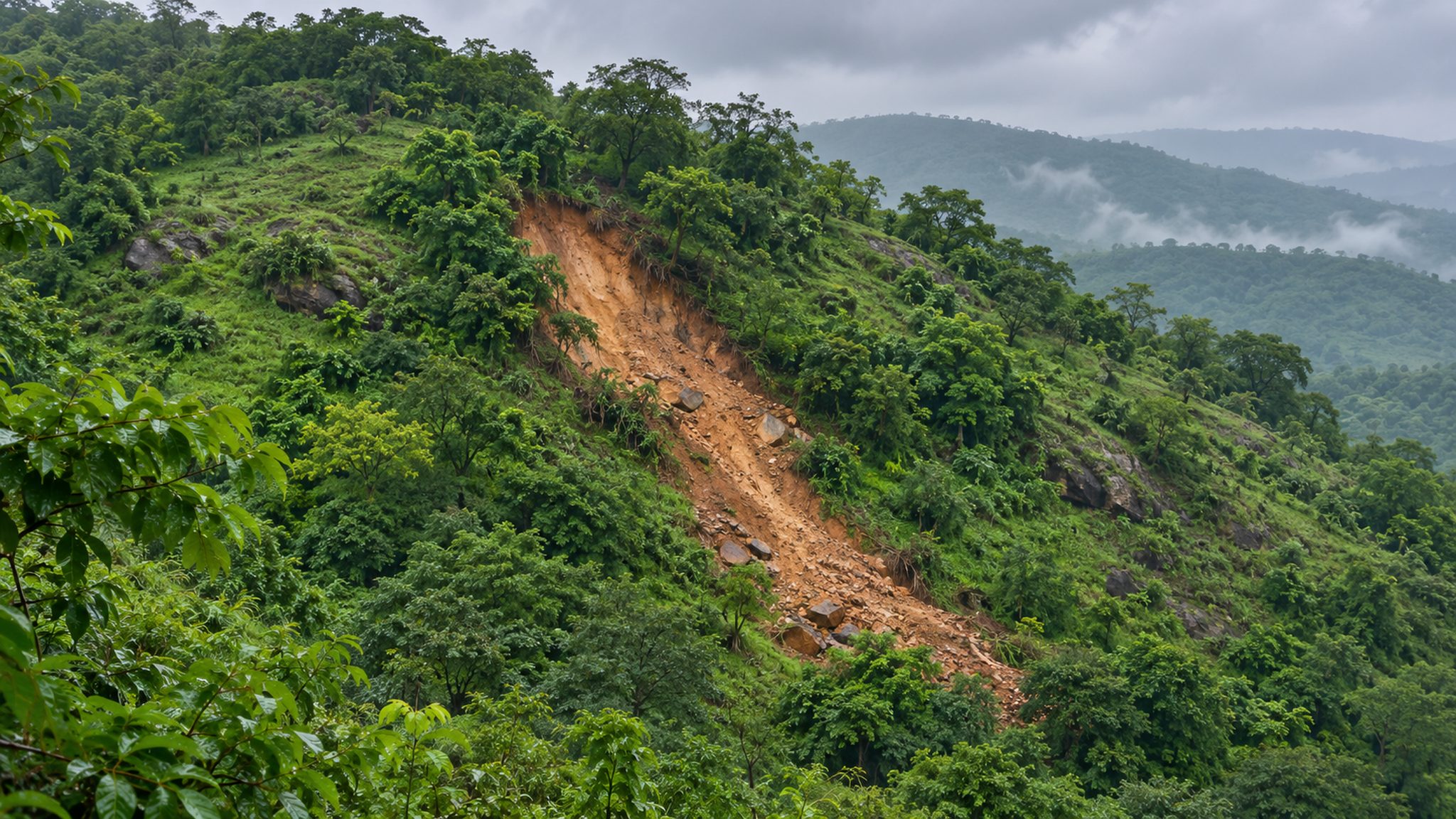
  • The disclosure followed destructive October 28 landslides in Ganjam and Kandhamal, with damaged roads isolating settlements.
  • The reported events affected homes, access routes and livelihoods in hill communities.
  • The November report brings attention to Eastern Ghats slope risk and the need to investigate vulnerable locations.
  • A rainfall trigger acts on terrain whose soil, rock and drainage conditions influence failure.
  • Damage also depends on exposure, including where people live and which roads connect them to essential services.

UPSC Relevance

Prelims Relevance

  • Landslide as downslope movement of rock, debris or soil.
  • Pore-water pressure within soil and its influence on stability.
  • Susceptibility, hazard and exposure as distinct assessment terms.
  • Drainage as a slope-management measure.

Mains Relevance

GS Paper 3

  • Connect rainfall and terrain assessment with settlement planning.
  • Explain why road disruption increases the consequences of slope failure.

Background and Context

Why Hill Settlements Face Unequal Risk

A landslide begins when earth material moves downhill, but the consequences depend on the route it takes and what lies below.

  • Local terrain matters even within the same hill range. Differences in slope steepness, curvature and geological material change how a hillside responds to a rainstorm passing across a wider area.
  • Landslides include falling rock, sliding masses and flowing debris. Movement can be rapid or slow, so one label covers events with different warning signs, travel distances and consequences for nearby communities.
  • Runout extends the affected area beyond the initial failure. Soil and rock moving into a valley or across a road can damage locations downhill from the slope where movement began.
  • Access disruption compounds the direct damage. Odisha’s reported road losses illustrate how a failed slope can interrupt treatment, relief delivery and rehabilitation even for households whose buildings remain standing.
  • Site investigations must establish the conditions at affected villages. A general explanation involving rainfall, altered slopes or vegetation cannot identify the contribution of each factor to a particular failure without evidence.

How Rainwater Can Weaken a Slope

Rain changes conditions inside the ground as well as on its surface, which explains why rainfall totals alone cannot describe stability.

  • Infiltration moves part of the rainfall into soil and fractures. The resulting water distribution depends on local materials and drainage, so neighbouring slopes can develop different subsurface conditions during one storm.
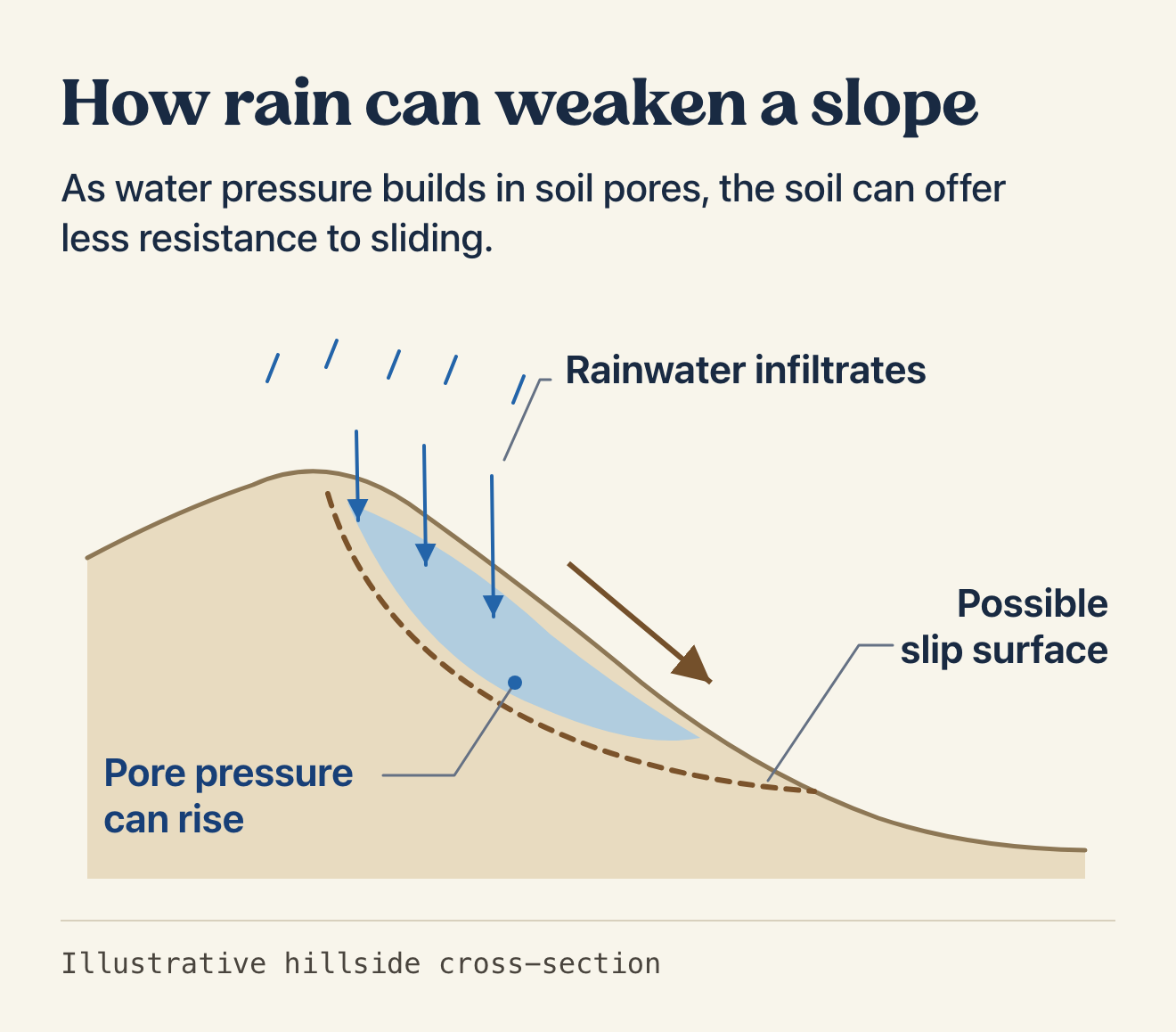
  • Pore-water pressure is pressure exerted by water within the spaces in soil. When it rises, the effective stress holding grains together can decrease, reducing resistance to sliding along a potential failure surface.
  • Gravity continues to pull material downhill while resisting forces change. Failure becomes possible when the available resistance becomes insufficient, which makes slope geometry and material strength relevant alongside the amount of rain.
  • Drainage conditions influence the movement and storage of water within a hillside. Engineers assess these pathways when choosing measures because a treatment that works on one slope may be unsuitable for another location.
  • Drainage management addresses this water pathway. NDMA guidance describes intercepting surface water and removing subsurface water, with measures selected through slope assessment and maintained so channels continue to carry water safely.
Cross-section of a hillside showing rain entering the soil, a zone of rising pore-water pressure and a possible downslope slip surface.
Rainwater can raise pore-water pressure and reduce a slope’s resistance to sliding. The cross-section illustrates the mechanism.

From Susceptibility to Risk Decisions

Mapping becomes useful when it connects the likelihood of slope failure with people, buildings and services that could be affected.

  • Susceptibility identifies terrain relatively prone to landsliding. It guides closer investigation, while a warning about possible failure during a storm requires additional information about changing conditions and the expected time window.
  • Exposure records people and assets within the possible impact area. Two similarly unstable slopes can create different levels of danger because settlements, roads and public facilities occupy different positions around them.
  • Vulnerability describes how severely exposed people or structures may be harmed. Limited evacuation access or dependence on a single road can increase the consequences even when the physical slide is relatively localized.
  • Planning can use both terrain and service information. The broader ecological planning approach connects development decisions to natural systems, while individual slope safety still requires evidence from that location.
  • Warnings need workable action arrangements. As with multi-hazard warning coverage, a message reaches practical value when people can understand it and use an available evacuation route or safe destination.

Way Forward

Investigate Slopes and Protect Access

  • Prioritize field assessment around damaged settlements and essential access routes, recording drainage, soil and rock conditions.
  • Keep drainage maintenance connected to engineering assessments so diverted water does not create a new downstream problem.
  • Plan evacuation and alternative access with communities whose health care and supplies depend on vulnerable roads.

Conclusion

  • Eastern Ghats landslide risk requires attention to water within slopes and the settlements around them. Rainfall provides a trigger, while local ground conditions shape how a particular hillside responds.
  • A useful disaster-management answer links susceptibility, exposure and vulnerability to concrete decisions about investigation, drainage, settlement location and access. Recorded incidents help identify priorities for this work.

UPSC Practice Questions

Prelims MCQ 1

Which statement about rainfall and landslides is correct?

(a) Every landslide requires complete soil saturation. (b) Equal rainfall produces identical stability on neighbouring slopes. (c) Rising pore-water pressure can reduce resistance to sliding. (d) Rainfall totals alone establish the precise time of failure.

Answer: (c) Rising pore-water pressure can reduce resistance to sliding.

Explanation:

Pore-water pressure affects effective stress and the resistance available within soil. Local materials and slope conditions also matter, and landslides can occur in partly saturated material.

Prelims MCQ 2

A road and a health centre lie below a slope prone to failure. Their presence in the possible impact area describes which component of disaster risk?

(a) Exposure (b) Rainfall intensity (c) Pore-water pressure (d) Rock weathering

Answer: (a) Exposure

Explanation:

Exposure concerns the people and assets located where a hazard can affect them. The likelihood of slope failure and the susceptibility of terrain are separate considerations.

UPSC Mains Questions

  1. Explain how rainfall can destabilize a hillside and discuss the role of drainage in reducing landslide risk.
  2. Using hill settlements as an example, distinguish susceptibility, exposure and vulnerability in disaster-risk planning.

Sources: The Hindu and National Disaster Management Authority.

Frequently Asked Questions

What is a landslide?

A landslide is the downslope movement of rock, soil or debris. Different forms include rockfalls, slides and debris flows, with movement ranging from slow deformation to rapid and destructive events.

Why can heavy rainfall trigger slope failure?

Rainwater can enter soil and change the pressure within its pores. Rising pore-water pressure can reduce resistance to movement, while gravity continues to pull slope material downhill.

Does all soil need to be saturated before a landslide?

Some landslides occur in partly saturated soil. Rainfall, soil moisture and pressure measurements together provide a fuller account of changing ground conditions than rainfall totals alone.

Why does a blocked hill road increase disaster impacts?

A damaged road can interrupt access to health care, supplies and relief. The resulting isolation can affect people beyond the houses directly struck by the moving soil or rock.