Opens in a new tab
Join Anantam IAS Channel on Telegram

Daily Digest · Saturday

23 August 2025 Current Affairs for UPSC

4 current affairs published on Saturday, 23 August 2025

23 August 2025 Current Affairs for UPSC — every Why-in-News article AnantamIAS published on Saturday, 23 August 2025, broken down with Why in News?, the exact GS paper it feeds, sub-topic mapping, MCQ-ready facts and a UPSC-style practice question. 4 articles in total, covering Polity, Economy, Environment, S&T, IR, Geography, History, Society and Internal Security — the same Why-in-News + GS-paper-mapping + practice-question format the Compass uses across every daily digest on the site.

Daily current affairs for UPSC is where new material enters your prep stream. Read this 23 August 2025 digest end-to-end in 25–35 minutes, attempt the practice question at the foot of each article (it's MCQ for some, 10/15-marker for others), then bookmark the entries that fall inside your active revision window. Everything stays cross-linked: tap any subject pill to jump to that subject's hub, or use the table of contents above to skip straight to a specific story.

Use this page three ways. Read sequentially for a one-sitting scan of everything that mattered on 23 August 2025. Download the 23 August 2025 PDF below for offline study or print revision. Or use the August 2025 Current Affairs compilation to see this day in the month's full context. For the previous day's reading, see 22 August 2025 Current Affairs; the next day's is 24 August 2025 Current Affairs.

Why we publish daily current affairs separately from the monthly compilation: daily is learning, monthly is revision. Use the daily page to add fresh material to your notes the day it breaks; come back to the August 2025 compilation 60 days before Prelims when the noise has settled and only the lasting takeaway is worth re-reading.

India China Ties Reset

Open article →Download PDF

image 73 1

AD 4nXdDfCYyzghT GX 16fWJvQkVmZseCM1O2jF9h Fl77tdVPSvtq7YcuQkP Jt7JGUZY8JF1OMuUXO1Ps 317 Qfh73vt4Mv0NQQ8KbzpDmfm6PTFkZfoYCk

Why in news:

Chinese Foreign Minister Wang Yi’s visit to India was the first ministerial visit from China since the two countries decided to disengage at the border last October. At his meeting with Prime Minister Narendra Modi on Tuesday, Wang said bilateral relations had experienced “ups and downs, and the lessons learned are worth remembering”. according to China’s Foreign Ministry readout.

UPSC Relevance:

 GS2, India and its Neighborhood- Relations.

UPSC Mains PYQ 2017:

Q: ‘China is using its economic relations and positive trade surplus as tools to develop potential military power status in Asia’, In the light of this statement, discuss its impact on India as her neighbor.

UPSC Mains PYQ 2024:

Q: ‘The West is fostering India as an alternative to reduce dependence on China’s supply chain and as a strategy to counter China’s political and economic dominance.” Explain this statement with examples. 

Evolution of India China Ties:

PhaseYearsKey Features/Details
1st phase1947 – 1959Nehru’s initial idealism towards cooperation with China Initial bonhomieHindi China bhai bhaiPanchsheel Agreement in 1954Until the Dalai Lama’s exile in India. 
2nd phase1959 – 1962Tibet issue – 1959Tensions mounted on Asylum to Dalai Lama by India and border disputeIndo – China War -1962Nehru’s disillusionment with ChinaPressure and Criticism from parliament on China Policy
3rd phase1962 – 1988Balance of power consideration– China-Pak-USA nexus- India-Soviet Friendship Treaty 1971
4th phase1988 – presentCombination of systemic and domestic factors- – Normalisation of ties – Rajeev Gandhi’s visit in 1988-Deng Xiaoping talked of Asian Century- Confidence building measure on boundary issues- Trade and connectivity- PM Manmohan – India and China can reshape the world together.- China surpassed India economically and became a threat to USA’s hegemony.- increasing regional assertion by China in Asia.
Recent times – More Pragmatic Approach– China–Pakistan’s ‘all weather friendship’- China’s proximity to Russia- China’s expanding presence in the Global South via  economic engagement, BRI, loans, infrastructure, which India failed to do.- India trying to hedge against uncertainties associated with the rise of China via:rapid economic growth (internal balance) tilting towards USA (external balance)

Recent years:

  • There was a sense of euphoria around India-China ties due to the 2019 meeting of PM Modi and President Xi . Just eight months later, Indian and Chinese troops clashed violently in Galwan in eastern Ladakh causing anger and anxiety in India.
  • Over the years there were reports of confrontations and pictures and reports of infrastructure building on both sides.
  • On the economic front, multiple Apps were banned and India pushed for Aatmanirbharta and supply chain resilience even as trade remained robust between both.
  • QUAD strengthened and there was growing strategic partnership between India and USA, even as India continued to engage in SCO and BRICS.
  • After several rounds of negotiations between diplomats and military leaders, there were troop withdrawals at some places. 
  • On October 21, the two sides agreed to complete the disengagement process in the last two remaining locations in Depsang and Demchok. President Xi and PM Modi met in Kazan on October 23 and decided to mend ties, followed by high level visits.

The Trump Effect on Relations:
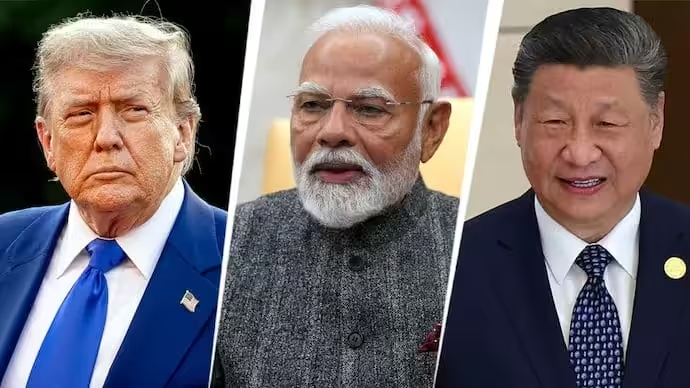
image 73 2

  • After Trump entered the White House and targeted China – and now India with his tariffs, the thaw between New Delhi and Beijing has progressed.
  • The Kailash Mansarovar Yatra has restarted, and India has begun to issue visas to Chinese nationals again.
  • Wang’s visit came ahead of PM Modi’s visit to Tianjin for the Shanghai Cooperation Organisation (SCO) leaders’ summit at the end of next month-his first such visit since 2018, when he attended the SCO summit in Qingdao. 

Twin-track movement – 10 point understanding to normalise ties:

  • The two sides have agreed to move forward on two fronts in a dual track strategy, without allowing one to impact the other.
    • border issues
    • bilateral ties 
  • The parallel engagement was agreed upon after the 1988 visit of then PM Rajiv Gandhi to China, and had been followed until 2020

Border Issues:
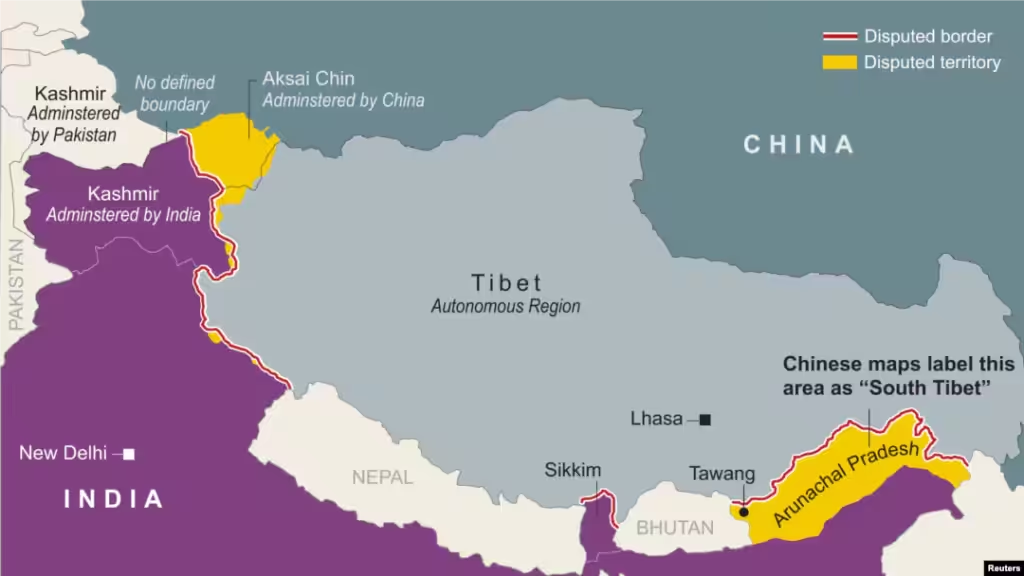
image 73

  • India and China have agreed to form at least three new border-related mechanisms.
  1. An Expert Group under the Working Mechanism for Consultation and Coordination on India-China Border Affairs (WMCC) to “explore Early Harvest in boundary delimitation”
  2. A Working Group under the WMCC to “advance effective border management” in order to maintain peace and tranquillity in the border areas
  3. “General Level Mechanisms in Eastern, and Middle Sectors, in addition to the existing General Level Mechanism in Western Sector, and holding an early meeting of the General Level Mechanism in the Western Sector.”
  • Agreed to use the border management mechanisms at the diplomatic and military levels to carry forward the process of “border management, and discuss de-escalation“, beginning with the principles and modalities.
  • There is agreement on the need to take a “political perspective” of the overall bilateral relationship while seeking a fair, reasonable and mutually acceptable framework for settlement of the boundary question.

Connectivity 

  •  Resume direct flight connectivity at the earliest, facilitate visas to tourists, businesses, media and other visitors

Trade

  • Re-open border trade through the designated trading points at Lipulekh Pass, Shipki La Pass, and Nathu La Pass
  • facilitate trade and investment flows through concrete measures.

Cross Border River 

  • On transborder rivers cooperation, the Chinese side agreed to “share hydrological information during emergency situations based on humanitarian considerations“.
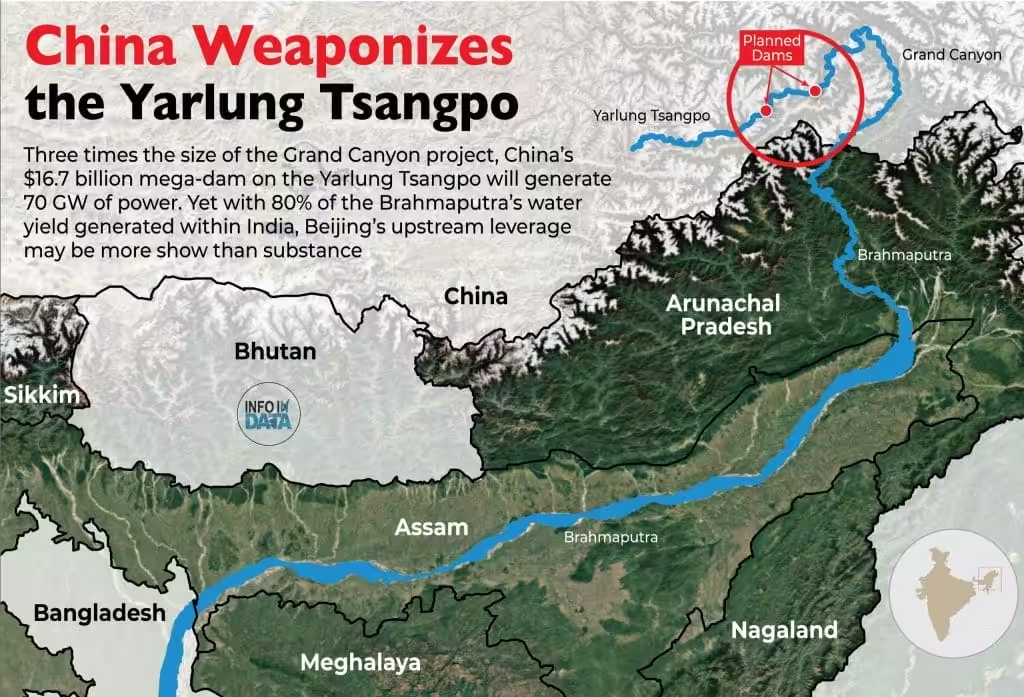
image 74 3

Other Issues of Convergence between India and China

  • Multilateralism – Both countries are active participants in regional and global organizations such as the Shanghai Cooperation Organisation (SCO), BRICS, the Asian Infrastructure Investment Bank (AIIB), and the New Development Bank (NDB). These bodies provide a platform for dialogue, cooperation, and mutual development projects.
  • Climate Change – India and China are part of the BASIC group, working together to advocate for the concerns of developing countries in global climate negotiations. They cooperate on renewable energy development and pollution control initiatives. Call for responsibility on historical emissions and climate finance.
  • Global South – India and China often collaborate to represent the interests of developing and underdeveloped countries particularly within the United Nations and climate forums (such as the BASIC group at UN climate summits) championing equity, development rights for poorer nations.

Addressing trust deficit – Issues of Confrontation remain

  1. The Conflicting Worldviews – China has a vision of  sino centric world order, considering China as the middle kingdom as visible in its conflicts across all borders and in South China Sea while India believes in a truly multilateral world based on rules and cooperation shaped by Vadudhaiva Kutumbakam. These world views are inherently conflictual.
  2. Border disputes– The repeated Chinese incursions on the border-Depsang in 2013, Chumar in 2014, Doklam in 2017, and the ongoing border standoff have impacted trust. At least 50,000 troops are still stationed in eastern Ladakh, and de-escalation and de-induction must happen along a time-bound roadmap. 
  3. Territorial Claims – China claims Arunachal Pradesh as part of “South Tibet.” In contrast, India considers Aksai Chin to be illegally occupied by China. These conflicting claims lead to ongoing diplomatic and military tensions.
  4. China-Pakistan Relations – China’s military cooperation with Pakistan was on display during Operation Sindoor, when the Chinese supplied weapons and live intelligence to the Pakistanis. The China-Pakistan Economic Corridor (CPEC), which runs through Pakistan-occupied Kashmir (POK), adds to India’s security worries.
  5. Transboundary River issue – India has concerns with regard to the mega dam that is being built on the Yarlung Tsangpo (Brahmaputra), which will have implications for lower riparian states.
  6. Geopolitical Rivalry – Strategic competition in the Indo-Pacific and China’s growing influence in South Asia contribute to India’s challenges. China’s efforts to weaken India’s influence in neighboring countries like Nepal, Sri Lanka, and the Maldives have led to confrontations on several fronts.
  7. Terrorism – India strongly raised the issue of terrorism in all its forms and manifestations, including cross-border terrorism, and recalled that one of the original objectives of the SCO was to counter the evil of terrorism. China has not been that vocal about terrorism and vetoed listing of various Pakistani Terrorists in UNSC. 
  8. Economic Imbalances –  India faces a significant trade deficit with China. The country is concerned about unfair trade practices, export controls, and restrictions that China imposes on key Indian imports like chemicals and electronics.
  9. Supply Chain dependence for critical minerals – India is concerned at China’s export restrictions on rare earths, tunnel boring machines, and fertilisers, which are key to India’s development, digital ambitions, renewable energy and food security.
  10. Non Acceptance of India’s strategic interests – China also keeps blocking India’s membership in the Nuclear Suppliers Group and permanent membership in UNSC.

Way Forward:

If the new dual track strategy is to be durable, the onus is on Beijing to address New Delhi’s concerns. As PM Modi told Wang Yi, India seeks stable, predictable and constructive relations with China for global peace and prosperity. India must ensure its strategic autonomy and not getting squeezed in great power game of  US- China or US- Russia. Congagement remains a reliable and pragmatic  strategy going ahead. India must engage China wherever possible (economically, climate change, multilateral institutions, voice of global south) and contain wherever necessary (maintaining its strategic depth in South Asia). India must walk softly but carry a stick big enough to keep the dragon at bay.

Piprahwa Relics

Open article →Download PDF

AD 4nXcGjnOPLe0 CuI2xsgMNpHV3m5DVcspbmZ2YsH50o4H7TRYN9ZntQQTaFaD7uo 7Ff MAzlYYKMMEbDNgQmobPL2X1I

AD 4nXdX6u8HEXrWWsro Qaru91DVK1 JGQwbrT0dhRu826XPGaVpUamvpJiLXIcDyXzCJnrDYpRDvrz8tLeBTz2V2fv FOcrk23vdS vpZvBf Uq5

Why in news:

Chief Minister Yogi Adityanath declaring during a recent session in the state Assembly the Piprahwa relics -repatriated to India recently, nearly 127 years after they were taken out of the country-would be brought back to Uttar Pradesh.

UPSC Relevance:

Ancient History, Art and Culture, Prelims

PYQ: 

With reference to ancient India, consider the following statements:

1. The concept of Stupa is Buddhist in origin.

2. Stupa was generally a repository of relics.

3. Stupa was a votive and commemorative structure in Buddhist tradition.

How many of the statements given above are correct?

(a) Only one

(b) Only two

(c) All three

(d) None

Background of the Piprahwa Relics:

  • The relics were discovered over 125 years ago at Piprahwa 
  • Found by British colonial estate manager William Claxton Peppé in 1898 during excavation of a stupa linked to Lord Buddha and the ancient Shakya kingdom.
  • Relics include bone fragments, soapstone and crystal caskets, a sandstone coffer, gold ornaments, and gemstones believed to be remains of Gautama Buddha.
  • Taken away under the Indian Treasure Trove Act, 1878; some were kept by Peppé and they were to be  auctioned in Hong Kong in May 2024 before Indian intervention.
  • Indian Ministry of Culture issued a legal notice demanding immediate cessation of the auction and repatriation of the relics to India.
  • The Ministry stated the relics are an “inalienable religious and cultural heritage of India and the global Buddhist community.”

Location & Historical Significance of Piprahwa Stupa:

  • Piprahwa village, in Siddharthnagar district (UP), is near the India-Nepal border.
  • Lies just south of Lumbini, the birthplace of Lord Buddha.
  • The site is linked to the Shakya kingdom (ancient Kapilvastu, Buddha’s childhood home).
  • Protected site under the Archaeological Survey of India (ASI).
  • Phases of Construction:The stupa was built in three phases
  1. Initially by the Sakyas soon after Buddha’s death as a simple mud structure.
  2. The second phase, with fired bricks and concentric circles of clay mortar, dates to the Mauryan period under Emperor Ashoka (~3rd century BCE).
  3. The third phase included raising the height, squaring the base, and construction of monastic buildings during the Kushan era (~1st-3rd century CE).

AD 4nXfeJBd7XWn WYAZtwrzVEsEOIfWpHzd9pqyv9wjE6BPAQWSOcnOJfUfspF1AOapXSj

Important EventDescription
Buddha’s Death (Parinirvana)Buddha passed away around 483 BCE in Kushinagar. His body was cremated as per his instructions.
Distribution of RelicsBuddha’s ashes were divided into eight portions by a Brahmin named Drona to avoid conflict among claimants.
Eight Clans/Groups Receiving RelicsKing Ajātasattu of Magadha, Licchavis of Vesāli, Sakyas of Kapilavastu, Bulis of Allakappa, Koliyas of Rāmagāma, Vethadipaka-Dronagramakas, Mallas of Pāvā, and Mallas of Kusinārā.
Additional Relics DistributionVessel used for cremation was given to Drona, and remaining ashes to Moriyas of Pipphalivana.
Building of StupasThe relic portions were placed in reliquaries and enshrined in hemispherical monuments called stupas.
King Ashoka’s RoleOver a century later, Emperor Ashoka redistributed relics in approximately 84,000 stupas across India.
Ramagrama StupaOnly stupa whose relics remain intact today; it was not disturbed by Ashoka’s redistribution.

Eight original stupas of Buddha:

  • Stupa at Kapilavastu (Piprahwa) – Relics of Buddha discovered here; connected to his home region (Sakya tribe).
  • Stupa at Rajagriha – One of the oldest stupas built after Buddha’s death, located in the ancient Magadha kingdom.
  • Stupa at Vaishali – Built by the Lichhavi republic, houses Buddha’s relics.
  • Stupa at Kushinagar – Marks the place of Buddha’s parinirvana (final nirvana after death).
  • Stupa at Ramagrama – The only original stupa untouched by Ashoka, located in Nepal, containing undisturbed relics.
  • Stupa at Allakappa – Built by the Bullies tribe.
  • Stupa at Pava – In the city where Buddha died.
  • Stupa at Vethapida – Constructed for relics given to a Brahmana of Vethadipa.

■ The Uttar Pradesh Government is working on transforming Piprahwa into a global Buddhist heritage and tourism hub, restoring Buddha’s relics to their original site, and developing modern facilities to attract pilgrims and international visitors. 

■ Tourist footfall has been rising steadily in Kapilvastu :

  • 2022: 26,805 visitors.
  • 2023: 70,006 visitors (double from 2022).
  • Jan–Mar 2025: 23,507 visitors already.
  • Projected ~1 lakh tourists by 2025-end.

Great Nicobar Project

Open article →Download PDF

WhatsApp Image 2025 08 23 at 07.18.31 575dc487

Why in news:

A tribal council from Great Nicobar Islands has submitted a complaint to Union Minister of Tribal Affairs Jual Oram, alleging that:

  • This claim was used to gain forest clearances for the ₹72,000 crore Great Nicobar infrastructure project which includes a transshipment port, airport, power plant, and township. The complaint argues that the due process under FRA(forest right act) was bypassed, and consent for forest land diversion was not properly obtained from the affected Nicobarese tribal communities.

UPSC Relevance:

Infrastructure projects and its impact on environment, Tribal rights, Environmental impact assessment.

UPSC PYQ 2016:

Q: Rehabilitation of human settlements is one of the important environmental impacts which always attracts controversy while planning major projects. Discuss the measures suggested for mitigation of this impact while proposing major developmental projects.

About Great Nicobar Project:

image 74 4
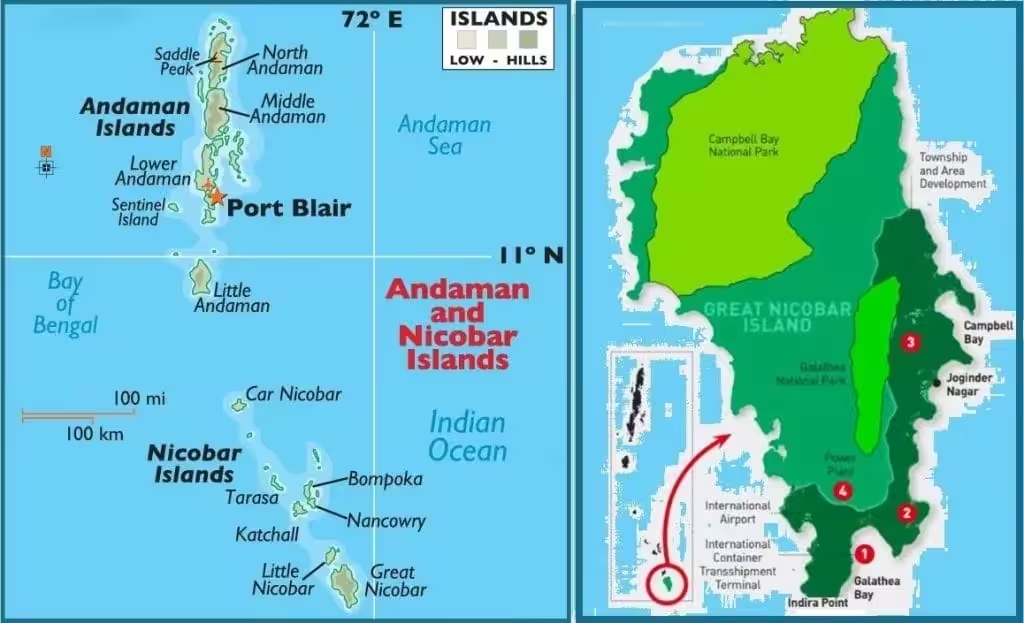
  • The ₹72,000 crore -crore project involves building of an integrated international container transshipment terminal, a township, a civil- and military-use airport and a 450 MVA gas- and solar-based power plant.
  • Spread over 166 sq km, it will require diversion of 130.75 sq km of forests, felling of over a million trees, as per official estimates.
  • The Andaman and Nicobar Islands Integrated Development Corporation Limited (ANIIDCO) is implementing the project.
  • The core aim has persisted since then — a port located near one of the world’s busiest international sea routes (the Malacca Strait) which will allow increased participation in global maritime trade.

What is the utility of the Great Nicobar Project?

  • Infrastructure Development: The project aims to build a transshipment terminal (port), along with airport, township and power infrastructure on Great Nicobar Island.
  • Efficient Sea trade: Because the island lies just ~90 km from the Strait of Malacca — one of the world’s busiest sea-routes — the port is expected to capture container traffic now routed via Colombo/Port Klang.
  • Revenue and Employment: It is projected to generate significant economic benefits: e.g., government estimate of ~₹ 30,000 crore annual revenue by 2040 and large employment.
  • Maritime Security: Strategically, the port + infrastructure strengthen India’s maritime reach in the Indian Ocean Region (IOR) and offer dual-use (civil + military) potential given the island’s location.

It also aligns with India’s “port-led development” vision, coastal economic zones and export-oriented growth.

What is the concept of port-led development in India?

Port-led development refers to using deep-sea ports as anchors of industrial, logistics, residential and export-oriented activity. It leverages coastal location, global shipping routes, container transshipment and hinterland connectivity. In India, this is pursued under schemes like Sagarmala (coastal economic zones, port modernisation) and inland linkages (rail/road) to maximise multiplier effects. The Great Nicobar project is a textbook example — a deep-water port close to major shipping lanes, master-planned township and infrastructure to make the island into a logistics hub/strategic node.

Why is there opposition?

The island of Great Nicobar is the southernmost tip of India and a part of the Andaman and Nicobar archipelago that comprises 600-odd islands. It is hilly and covered with lush rainforests that are sustained by around 3,500 mm of annual rainfall. The rainforests and beaches host numerous endangered and endemic species including the giant leatherback turtle, the Nicobar megapode, the Great Nicobar crake, the Nicobar crab-eating macaque, and the Nicobar tree shrew. It has an area of 910 sq km with mangroves and Pandan forests along its coast. The island is home to two tribal communities — the Shompen and the Nicobarese.

The mega project has been heavily criticised for its ecological costs and for potential violations of tribal rights.

  • Ecological sensitivity and threat to endangered species: The transshipment terminal is expected to be developed at Galathea Bay, one of the world’s largest nesting sites for the giant leatherback turtle. Both this species and the Nicobar megapode are listed in Schedule I of the Wildlife (Protection Act), 1972 — the highest level of protection for wild animals under Indian law (numerous species, especially endemic ones, are likely yet to be documented in Great Nicobar given the limited number of surveys conducted so far).
  • Legal issues: The island also falls under the Andaman & Nicobar (Protection of Aboriginal Tribes) Regulation, 1956 which safeguards tribe’s land. Over 853 sq km of 910 sq km is tribal reserve. Similarly, Tribal councils allege non-settlement of claims, Gram Sabha consent issues under FRA 2006. Further, many species in project area are Schedule I under WLPA 1972. Denotification of sanctuaries undermines protection.
  • Displacement and loss of ancestral land: Some of the land classified as “uninhabited” in NITI Aayog’s plan is also part of the Great Nicobarese’s ancestral land. Since their post-tsunami resettlement, they have repeatedly sought to return to these lands — only to be met with administrative apathy. Today, the mega project also stands in the way of their demands to return.
  • Health impacts on PVTGs: As for the Shompen, one of the biggest threats is disease. Since the Shompen have had little contact with the outside world, they haven’t yet developed immunity to infectious diseases that affect India’s general population. Some Shompen settlements also overlap with the areas the NITI Aayog has proposed to be used for the transshipment terminal.
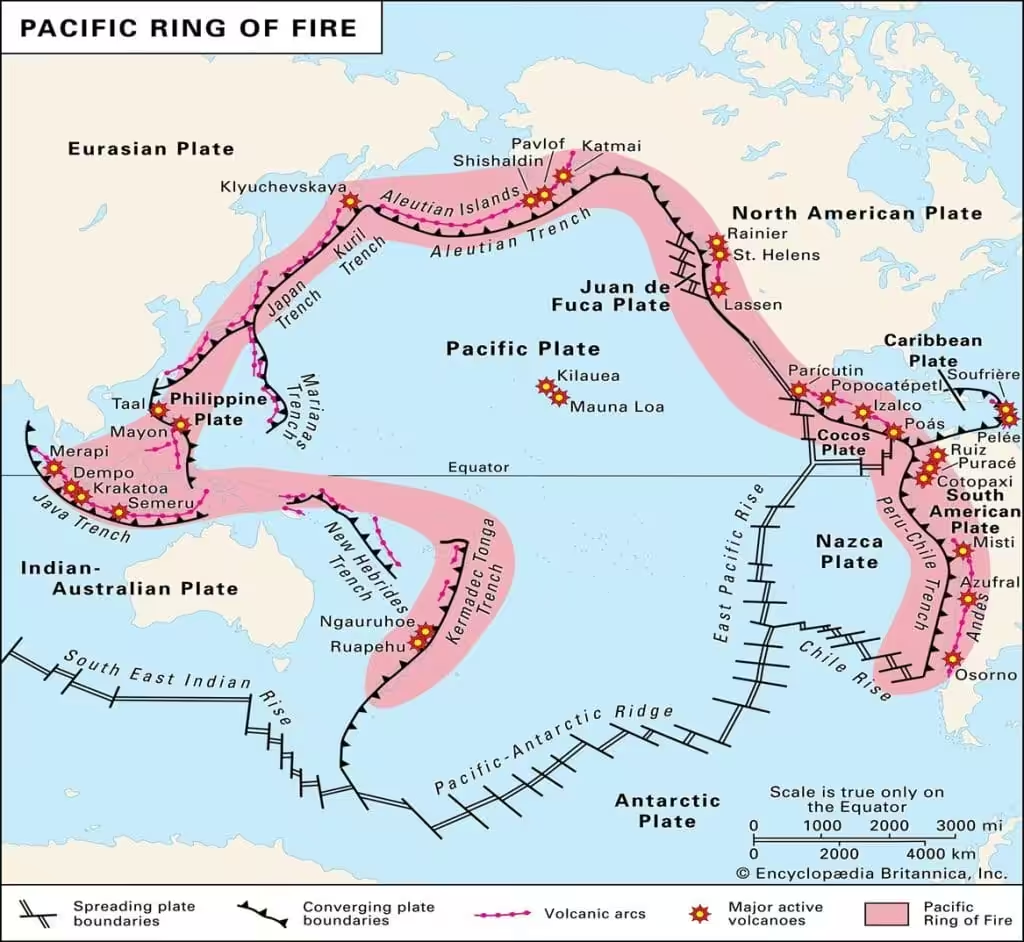
  • Disaster vulnerability: Researchers who work on disaster management have also raised concerns that proponents of the mega project have failed to adequately assess earthquake risk. The Andaman and Nicobar archipelago is located in the “ring of fire”: a seismically active region that experiences several earthquakes throughout the year. The area is in category V: the geographical zone with the most seismic hazard.
image 74 5

What can be a way ahead?

  • Adopt an integrated ‘island-wide sustainability framework’ where economic, ecological and tribal rights are balanced — use an ‘airshed’ or in this case an “island-ad threshold area” approach rather than ad-hoc approvals.
  • Ensure full compliance with FRA (Gram Sabha consent), FCA and WLPA provisions before further land/forest diversion — strengthen independent monitoring and transparent data release.
  • Harness green‐port technology, minimal footprint design and give priority to eco-tourism + low-impact logistics rather than large industrial township in ecologically sensitive zone.
  • Institutionalise long-term environmental and disaster-risk assessment (earthquake/tsunami) and adaptive design (mangrove restoration, setback from shoreline).
  • Expand tribal participation: Co-design development plans with Nicobarese & Shompen communities, ensure livelihoods and culture are safeguarded, and provide compensation + relocation only with consent.
  • Explore phased development: Start with low-impact segments, evaluate ecological/tribal outcome, then scale only if safe and sustainable.

Integrate this project with broader blue economy, coastal shipping, island connectivity in a way that offsets environmental cost (e.g., shifting freight from land to sea corridors, carbon-negative logistics).

    Next Generation Reforms in Bureaucracy

    Open article →Download PDF
    Screenshot 20250823 071359 Indian Express

    Why in News?

    PM Modi has proposed next generation reforms for development of India in his Independence Day speech. The author has put a case for next generation reforms for Bureaucracy also.

    UPSC Relevance :

    GS 2, Role of Civil Services in a Democracy.

    Mains PYQ :

    2017 – Initially Civil Services in India were designed to achieve the goals of neutrality and effectiveness, which seems to be lacking in the present context. Do you agree with the view that drastic reforms are required in Civil Services? Comment.

    2020 – “Institutional quality is a crucial driver of economic performance”. In this context suggest reforms in Civil Service for strengthening democracy.

    Characteristic of Indian Bureaucracy 

    Hierarchical Structure – The bureaucracy follows a rigid, top-down chain of command.  Authority and decision-making power flow from the top echelons, such as the Indian Administrative Service (IAS), down to the lower-level functionaries. This structure is meant to ensure clear lines of accountability and control.

    Rule-Bound Operations or Formalism – The system operates on a complex framework of rules, regulations, and standardized procedures. These written codes are intended to ensure impartiality and consistency in decision-making.

    Merit-Based Recruitment – Entry into the elite civil services is based on a competitive, merit-based examination (UPSC Civil Services Exam, SSC and State PSC Exams). 

    Permanence – Once appointed, civil servants have a secure tenure until retirement, which provides stability and political neutrality. This job security, however, can sometimes lead to a lack of accountability for poor performance. Article 311, strengthens this job security.

    Generalist Approach – Historically, Indian bureaucrats have been generalists, meaning they are trained to handle a variety of administrative roles across different departments (e.g., an IAS officer may serve in health, education, and finance ministries throughout their career). 

    Political Neutrality – Bureaucrats are expected to remain impartial and implement government policies irrespective of the ruling party.

    All-India Services – Allows Parliament to create one or more All-India Services (e.g., IAS, IPS) common to both the Union and States, further centralising bureaucracy’s structure.

    Reports and Data on Indian Bureaucracy

    • World Competitiveness Ranking (WCR) 2025 by Institute for Management Development
      • India ranks 41st out of 69 countries, slipping two spots from 39th in 2024. In government and business efficiency, India remains unchanged with ranks 45th and 25th, respectively.
    • Transparency International Corruption Perceptions Index (CPI) for 2024
      • India’s rank was 96 out of 180 countries, with a score of 38 out of 100. 

    Recent Reforms

    Lateral Entry 

    Lateral recruitment, at the levels of Joint Secretary, Director and Deputy Secretary in Government of India, has been undertaken since 2018 to appoint persons for specific assignments, keeping in view their specialized knowledge and expertise in the domain area. 

    • By July 2024, 63 appointments had been made through lateral entry out of which 35 appointments had been from the private sector. 
    • As of 2023 only 33% of Joint Secretaries were IAS at the central level, a significant change from near-total dominance a decade ago.

    Performance-Based Governance 

    The government is shifting away from a seniority-based promotion system. There is an increasing focus on accountability through performance-measured assessments. 

    • Mission Karmayogi (launched 2020) – A systemic shift toward “role-based” and citizen-centric service, focusing on enhanced training, e-governance, and digitized processes. Initiatives like SPARROW (for performance appraisal) and CPGRAMS (for grievance redressal) are modernizing service delivery.

    Digitisation

    • Increased Efficiency and Reduced Paperwork – Digital platforms have replaced manual, paper-heavy processes. For example, the e-Office initiative digitizes file movement within government ministries, drastically reducing the reliance on physical files and speeding up decision-making. Similarly, the e-Courts project has helped reduce case backlogs and delays. The Gatishakti portal has streamlined functioning of multiple ministries and departments.
    • Enhanced Transparency and Accountability – Online portals and digital systems create an audit trail, reducing opportunities for corruption and increasing public trust. Platforms like the e-Procurement system (Government e-Marketplace or GeM) ensure transparency in public tenders. The Right to Information (RTI) online portal also makes it easier for citizens to file and track requests, holding officials accountable.
    • Citizen-Centric Service Delivery – E-governance has brought government services closer to citizens, making them more accessible and convenient. Instead of visiting multiple government offices, citizens can now access a wide range of services from a single platform, like the UMANG (Unified Mobile Application for New-age Governance) app, which integrates over 1,600 services from central and state departments.
      • To bridge the digital divide, especially in rural areas, the government has set up Common Service Centres (CSCs). These are physical access points for delivering essential public services and information. Over 5.31 lakh CSCs are functional across the country.
      • CPGRAMS (Centralized Public Grievance Redress and Monitoring System) – Latest data from the Department of Administrative Reforms and Public Grievances (DARPG) shows significant progress in grievance redressal. As of July 2025, 4.44 lakh grievances have been redressed at the central level, and 2.35 lakh at the state level.
    • Improved Targeting of Welfare Schemes – The use of digital identity and payment systems with JAM trinity has revolutionized the delivery of subsidies and welfare benefits. It has helped eliminate “ghost beneficiaries” and reduce leakages in the system.

    Need of Next Generation Reforms

    1. Political Interference and Erosion of Neutrality

    Frequent Transfers – A common tactic used by political executives to exert control is the frequent transfer of officers. An honest and independent officer who refuses to comply with an illegal or inappropriate order may be transferred out of their post. This not only disrupts the continuity of administration but also creates a culture of fear and sycophancy.

    • Studies by the Centre for Policy Research have shown that the average tenure of an IAS officer in a single post is barely 16 months, far below the recommended norm of 3 years. Such short tenures prevent officers from undertaking long-term projects and holding a proper stake in their assigned work.

    Post-Retirement Appointments – The lure of lucrative post-retirement positions, such as governorships or appointments to various commissions, can influence the behavior of senior bureaucrats while they are in service. This can lead to a “collusive corruption” where a bureaucrat makes decisions favorable to their political masters in exchange for future rewards.

    Mental Health & Work Stress – Bureaucrats face high-pressure environments due to political interference and stress due to long working hours and public scrutiny.

    2. Lack of Specialization and efficiency

    Mismatched Roles – An officer with a background in history or literature might be appointed to head a technical ministry like the Ministry of Petroleum or the Ministry of Health. This lack of domain expertise often leads to a reliance on external consultants or a superficial understanding of complex policy matters, resulting in poor decision-making.

    Slow Lateral Entry – To address this, the government has introduced the Lateral Entry Scheme to bring in domain experts from the private sector and academia. While the intent is sound, its implementation has been slow, and it has faced legal and political challenges. As of 2023, only a few dozen such appointments have been made, which is a very small number compared to the scale of the bureaucracy.

    Poor performance appraisal system – A key challenge remains, with only an estimated 3% of bureaucrats facing performance reviews based on Key Performance Indicators (KPIs). Seniority based promotion remains the norm.

    3. The “File Culture” and Institutional inertia

    Even with the implementation of e-office, many departments still operate with physical files and outdated procedures. The fear of making a mistake or facing an inquiry often makes bureaucrats risk-averse, leading to a “noting-and-passing-the-buck” mentality where files are passed from one desk to another for approvals, resulting in significant delays.

    4. Issues with digitisation

    Digital Illiteracy – A significant portion of the population, especially in rural areas, lacks the digital literacy to access and use online government services. This makes them dependent on middlemen or Common Service Centres (CSCs), which can sometimes recreate the same issues of corruption and exploitation that e-governance was designed to eliminate.

    Cybersecurity Threats – As more government services and citizen data are moved online, the risk of cyberattacks, data breaches, and misuse of personal information increases. Ensuring robust cybersecurity and data privacy is a major challenge for the government, which often relies on outdated infrastructure and lacks skilled cybersecurity professionals.

    Deep Tech– The bureaucracy has integrated technology in rudimentary form until now and remains largely unequipped to leverage the opportunities and deal with the challenges associated with deep technologies like AI and Big Data due to lack of appropriate capacity building and training.

    5. Colonial hangover – highlighted by the author

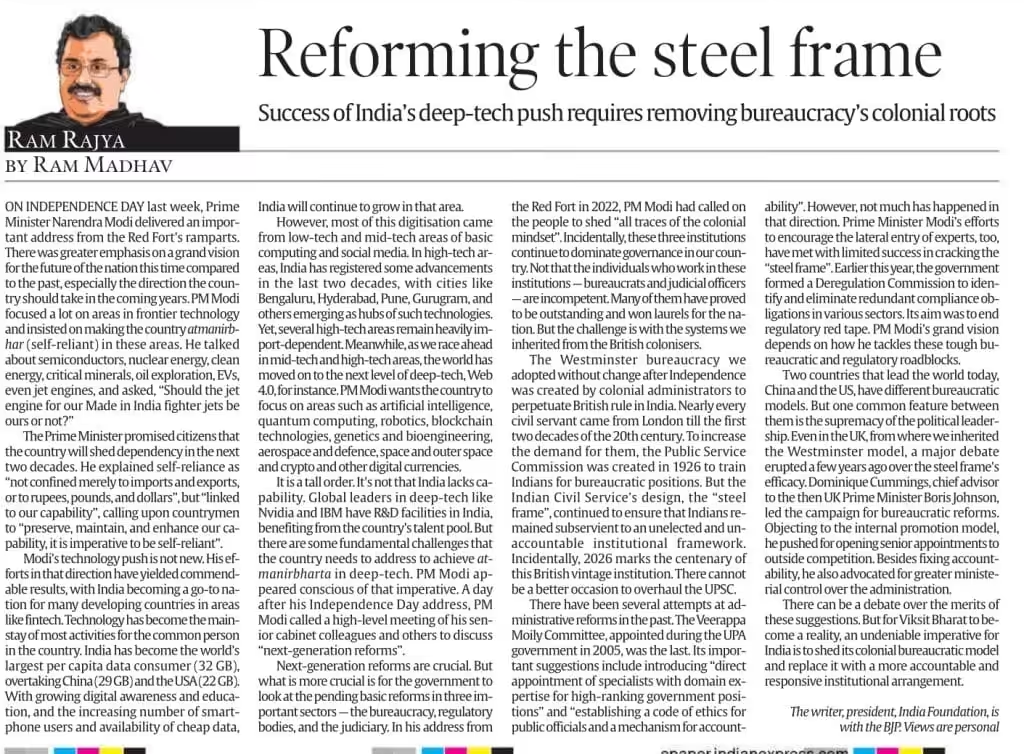
    The Westminster bureaucracy we adopted without change after Independence was created by colonial administrators to perpetuate British rule in India. Nearly every civil servant came from London till the first two decades of the 20th century. To increase the demand for them, the Public Service Commission was created in 1926 to train Indians for bureaucratic positions.

    But the Indian Civil Service’s design, the “steel frame“, continued to ensure that Indians re-mained subservient to an unelected and un-accountable institutional framework. As, 2026 marks the centenary of this British vintage institution, there cannot be a better occasion to overhaul the UPSC.

    6. New Gen Reforms for New Age Challenges

    In this globalized and interconnected world, complex challenges related to Climate Change, migration, economic uncertainties, pandemic await solutions that can be given only by a well equipped and modernised bureaucracy.

    Suggested Reforms

    1. Specialization and Lateral Entry

    Traditionally, the Indian Administrative Service (IAS) has followed a generalist approach, with officers handling a wide range of departments regardless of their expertise. Reforms propose greater specialization to improve policy implementation.

    • The Surjit Bhalla Committee and NITI Aayog have strongly advocated for lateral entry to induct professionals from the private sector and academia into key government roles.
    • The Veerappa Moily Committee, appointed during the UPA government in 2005, was the last. Its impor-tant suggestions include introducing “direct appointment of specialists with domain ex-pertise for high-ranking government positions”

    2. Performance-Based Accountability 

    Instead of promotions based solely on seniority, officers must be evaluated based on their performance and outcomes in a comprehensive manner.

    • The Second Administrative Reforms Commission (ARC) recommended replacing the Annual Confidential Reports (ACRs) with a Multi-Stakeholder Feedback system. This would involve feedback from superiors, peers, and subordinates, and even from the public in some cases.

    3. Ethical Governance – Cancelling the Babu culture

    The focus is on instilling a strong code of ethics and moving from a “provider” to a “partner” role with citizens. Focus should be on using power to serve public interest.

    • The Second ARC’s report on “Ethics in Governance” recommended a code of ethics for civil servants. It also advocated for strengthening the Centralized Public Grievance Redress and Monitoring System (CPGRAMS) and making the Right to Information (RTI) Act more effective.
    • The Veerappa Moily Committee also suggested for “establishing a code of ethics for public officials and a mechanism for accountability”

    4. Technological Integration and embracing Deep Tech

    Digitization is seen not just as a tool for efficiency but as a fundamental reform to dismantle red tape and improve service delivery. There must be technological training and capacity building for civil servants with periodic assessments.

    • The NITI Aayog has consistently pushed for the use of emerging technologies like AI, blockchain, and data analytics to enhance administrative processes.

    5. Rationalization of Services 

    There’s a proposal to streamline the complex structure of the civil services. NITI Aayog’s report on “Strategy for New India @ 75” proposed rationalizing the over 60 existing civil services into a few, more integrated services.

    6. Decentralisation & Local Governance Empowerment

    Strengthen the panchayat and municipal governance structure to reduce over-reliance on central authority. Provide financial autonomy and decision-making power to local governing bodies.

    7. Aligning the recruitment processes

    The merit based recruitment must test the skills and capability in problem solving, management and Technology.

    Case Studies – highlighted by Indian School of Public Policy

    UK’s Agile Public Administration Model

    • Cross-sector collaboration: Civil servants work closely with experts from academia, business, and think tanks.
    • Continuous training: Programmes like the Civil Service Fast Stream ensure skill upgradation and leadership development.
    • Policy flexibility: A focus on adaptive policymaking rather than rigid rule-following.

    Singapore’s Adaptive Bureaucracy – Singapore’s civil service is one of the most efficient in the world.

    • Meritocracy: The Public Service Commission (PSC) ensures that only the best candidates are selected through rigorous assessment.
    • Technology-Driven Governance: AI-powered services, automation, and e-governance platforms ensure smooth service delivery.
    • Flexible Policies: Bureaucratic structures are regularly reviewed to stay relevant to economic and social changes.

    Scandinavian Model – Transparency & Decentralisation

    • Highly decentralised administration: Local governments have significant autonomy in decision-making.
    • Transparent governance: Open access to government documents and strong anti-corruption laws.
    • Participatory governance: Their citizens actively engage in policymaking through public consultations.