Join Anantam IAS Channel on Telegram

Daily Digest · Tuesday

24 November 2026 Current Affairs for UPSC

7 current affairs published on Tuesday, 24 November 2026

24 November 2026 Current Affairs for UPSC — every Why-in-News article AnantamIAS published on Tuesday, 24 November 2026, broken down with Why in News?, the exact GS paper it feeds, sub-topic mapping, MCQ-ready facts and a UPSC-style practice question. 7 articles in total, covering Polity, Economy, Environment, S&T, IR, Geography, History, Society and Internal Security — the same Why-in-News + GS-paper-mapping + practice-question format the Compass uses across every daily digest on the site.

Daily current affairs for UPSC is where new material enters your prep stream. Read this 24 November 2026 digest end-to-end in 25–35 minutes, attempt the practice question at the foot of each article (it's MCQ for some, 10/15-marker for others), then bookmark the entries that fall inside your active revision window. Everything stays cross-linked: tap any subject pill to jump to that subject's hub, or use the table of contents above to skip straight to a specific story.

Use this page three ways. Read sequentially for a one-sitting scan of everything that mattered on 24 November 2026. Download the 24 November 2026 PDF below for offline study or print revision. Or use the November 2026 Current Affairs compilation to see this day in the month's full context. For the previous day's reading, see 23 November 2026 Current Affairs; the next day's is 25 November 2026 Current Affairs.

Why we publish daily current affairs separately from the monthly compilation: daily is learning, monthly is revision. Use the daily page to add fresh material to your notes the day it breaks; come back to the November 2026 compilation 60 days before Prelims when the noise has settled and only the lasting takeaway is worth re-reading.

QBUSE and the Effect of Industry Reclassification

Open article →Download PDF

Why in News?

On November 23, 2026, the National Statistics Office released QBUSE estimates for July–September, reporting enterprise growth alongside a classification change that affects comparisons between trade and services.

  • The bulletin estimates 9.47 crore establishments and 15.03 crore workers in the unincorporated non-agricultural sector during the reference quarter.
  • ASUSE 2026 adopted NIC 2025, replacing NIC 2008 and moving specified vehicle maintenance and repair activities from trade into other services.
  • MoSPI asks users to consider sampling variation, activity fluctuations and methodology changes when interpreting quarterly movements.
  • An apparent change in a sector can combine economic activity and statistical classification, making definitions essential to a sound comparison.
  • Enterprise surveys help identify the scale and composition of small-business employment, including working owners and unpaid family workers.

UPSC Relevance

Prelims Relevance

  • QBUSE is the Quarterly Bulletin on Unincorporated Sector Enterprises.
  • ASUSE provides the survey framework for the quarterly bulletin.
  • NIC classifies establishments by economic activity.
  • Other services now includes specified vehicle repair activities under the adopted classification.
  • Confidence intervals communicate statistical uncertainty around estimates.

Mains Relevance

GS Paper 3

  • Interpret enterprise growth with attention to sector coverage, workforce composition and classification changes.
  • Assess how statistical continuity affects employment analysis and small-enterprise policy.

Essay

  • Public decisions depend on understanding how economic categories are constructed and measured.

Background and Context

What the Quarterly Bulletin Covers

QBUSE describes establishments and workers in a defined part of the economy through the ASUSE survey framework.

  • Unincorporated establishments in the survey include proprietorships, partnerships other than limited liability partnerships, and specified co-operatives, societies and trusts. Their legal and ownership form determines eligibility alongside the activity coverage.
  • The covered activities fall within manufacturing, trade and other services, with construction excluded. This boundary matters when comparing the bulletin with a broad claim about all enterprises or all employment in the country.
  • Workers include working owners, hired employees and other workers, including unpaid family helpers. A larger estimated workforce can involve several forms of work, so employment quality requires examining its composition alongside the total.
  • Registration is reported as an enterprise characteristic within this survey population. An establishment registered with an authority can remain unincorporated, so registration status alone cannot establish its corporate form or the security of its workers.
  • The quarterly bulletin provides timely estimates, while annual ASUSE reports cover a wider set of indicators. The Economic Census and business-register discussion explains the related importance of reliable enterprise frames.

How Vehicle Repair Moves Between Sectors

A change in classification can move an establishment between categories even when the work performed inside it stays the same.

  • NIC 2025 is the classification used in ASUSE 2026. Earlier rounds used NIC 2008, making the change in coding rules relevant whenever an analyst compares current sector estimates with those earlier results.
  • Motor-vehicle maintenance and repair, previously counted under trade, is now included in other services. The release identifies motorcycle, moped, scooter and three-wheeler maintenance and repair among the activities affected by this reassignment.
  • Consider a motorcycle repair workshop performing the same repairs across both periods. Its statistical category can change under the new classification even if its staff, equipment and volume of work remain unchanged.
  • Services growth may reflect changes in actual activity alongside the reassignment of establishments. The bulletin does not quantify each contribution, so attributing the full increase to either mechanism would exceed the published evidence.
  • Comparable sector boundaries help distinguish structural change from a change in labels. An analyst should seek a mapping between old and new codes, and comparable estimates where available, before drawing a precise conclusion.

How to Read the Growth Estimates

A reliable interpretation checks the reference period, sampling uncertainty and survey scope before converting an estimate into a policy claim.

  • Year-on-year comparison uses the same quarter in successive years, helping account for seasonal patterns. That choice improves temporal comparison while leaving classification changes and other methodological differences to be examined separately.
  • Quarterly samples are smaller than the annual sample, and the release specifies geographic exclusions for the quarterly bulletin. Users should read the coverage notes and confidence intervals when assessing how widely findings can be applied.
  • The rural sampling frame is based on Census 2011, while urban frame blocks are updated periodically. Establishments are listed within selected areas before sampling, making the frame and field listing distinct parts of the design.
  • GDP estimates cover the whole economy, while QBUSE covers a defined unincorporated segment. Different coverage and measures mean their quarterly movements may diverge, even when both series correctly describe their respective populations.
  • Indicator choice determines the question a statistic can answer. The producer-price measurement note offers another example of checking an indicator’s coverage before using it to interpret economic change.

Way Forward

Preserve Comparability in Public Reporting

  • Publish accessible code mappings explaining which activities move between sectors when a classification changes.
  • Present comparable estimates where feasible and clearly identify differences that cannot be adjusted with available evidence.
  • Use workforce composition and uncertainty alongside headline totals when designing support for unincorporated enterprises.

Conclusion

  • QBUSE supplies timely evidence on unincorporated establishments, but the NIC transition changes how some activities appear within sector totals. The vehicle-repair example shows why a category shift needs explicit recognition.
  • Policy interpretation should combine the reported direction of change with coverage, workforce composition and comparability checks. The available release supports caution about sector growth without supplying a numerical adjustment for reclassification.

UPSC Practice Questions

Prelims MCQ 1

With reference to ASUSE 2026, consider the following statements:

  1. It adopted NIC 2025 in place of NIC 2008.
  2. Specified vehicle maintenance and repair activities moved from trade to other services.
  3. Its quarterly results cover construction establishments.

How many of the above statements are correct?

(a) Only one (b) Only two (c) All three (d) None

Answer: (b) Only two

Explanation:

The first two statements are correct. The bulletin covers the unincorporated segment of manufacturing, trade and services, excluding construction.

Prelims MCQ 2

Why should services growth in the latest QBUSE be interpreted with attention to NIC 2025?

(a) NIC 2025 removes all working owners from employment counts. (b) Every services establishment has become a limited liability partnership. (c) Some establishments are now classified under services after previously being counted under trade. (d) The quarterly sample is a census of all enterprises.

Answer: (c) Some establishments are now classified under services after previously being counted under trade.

Explanation:

Reassignment of specified repair activities affects sector comparisons. The release does not quantify the share of services growth attributable to that change.

UPSC Mains Questions

  1. Explain how changes in industrial classification can affect the interpretation of sectoral growth. Illustrate with the latest QBUSE.
  2. Discuss the value and limitations of quarterly enterprise surveys for assessing employment in India.

Sources: PIB, Ministry of Statistics and Programme Implementation and MoSPI QBUSE Press Note.

Frequently Asked Questions

What is QBUSE?

QBUSE is the Quarterly Bulletin on Unincorporated Sector Enterprises. It uses the ASUSE framework to provide quarterly estimates of the scale, composition and employment profile of covered unincorporated non-agricultural establishments.

What changed under NIC 2025?

ASUSE 2026 adopted NIC 2025. Specified motor-vehicle and motorcycle maintenance and repair activities that earlier fell under trade are now included in other services, affecting comparisons between those categories.

Does the bulletin show how much services growth came from reclassification?

The release identifies the classification change and cautions users about comparability. It does not provide a numerical decomposition separating the contribution of reassigned activities from changes in underlying activity.

Why can QBUSE and GDP show different movements?

QBUSE covers a specified unincorporated segment of manufacturing, trade and services, excluding construction. GDP covers the entire economy, so differences in scope and measurement can produce different quarterly movements.

SAMPADA Anaemia Findings and Blood Measurement Methods

Open article →Download PDF

Why in News?

On November 23, 2026, ICMR released SAMPADA anaemia findings based on venous blood testing, drawing attention to how measurement methods and micronutrient evidence shape national estimates.

  • SAMPADA 2023–25 provides nationally representative evidence across children, adolescents, adults, pregnant and lactating women, and older adults.
  • The release reports anaemia prevalence of about 42% among children aged 12–59 months and 56% among women of reproductive age.
  • The survey combines haemoglobin measurement with micronutrient and inflammation markers in a representative sub-sample, supporting investigation of possible causes.
  • Method comparability affects whether differences between surveys can be interpreted as changes in population health.
  • Cause-specific evidence helps public-health programmes address groups whose anaemia may arise through different nutritional and non-nutritional pathways.

UPSC Relevance

Prelims Relevance

  • SAMPADA expands to Survey for Assessment of Markers of Population Health, Activity, Diet and Anthropometry.
  • ICMR-NIN conducted the nationally representative cross-sectional survey.
  • Haemoglobin measures the blood indicator used to classify anaemia.
  • Serum ferritin helps assess iron status, with adjustment for inflammation.
  • CRP and AGP are inflammatory biomarkers included in the survey.

Mains Relevance

GS Paper 2

  • Use comparable survey methods to assess nutrition programmes.
  • Connect diagnostic quality with targeted public-health services.

Essay

  • The quality of measurement shapes the quality of public decisions.

Background and Context

What SAMPADA Measures

SAMPADA assesses anaemia and nutritional biomarkers across different stages of life, extending the evidence available for public-health planning.

  • Anaemia classification depends on haemoglobin concentration and the applicable age, sex and physiological category. The factsheet uses WHO thresholds specific to these groups, so one universal cut-off cannot describe every participant.
  • Cross-sectional evidence describes the population studied during the survey period. It provides estimates of prevalence, while a claim that a particular programme caused improvement requires a separate evaluation design and supporting evidence.
  • Life-course coverage includes older adults alongside children, adolescents and women. This matters because a nutrition programme designed around pregnancy and childhood alone would leave substantial health needs in other groups unexamined.
  • Sampling weights account for different chances of selection across survey stages. They help convert observations from sampled households into representative estimates, while the reported confidence intervals communicate uncertainty around those estimates.
  • Severity categories show that mild anaemia forms a large share of the recorded burden. Its prevalence supports prevention and early identification, alongside appropriate attention to the smaller groups with more severe anaemia.

Why Blood Measurement Methods Matter

Venous blood testing with automated analysers changes the measurement basis on which the new prevalence estimates rest.

  • Venous sampling collects blood from a vein for analysis. SAMPADA used automated analysers, while the factsheet identifies point-of-care devices as the approach used in previous national surveys, making methods central to comparison.
  • Quality assurance covered collection, laboratory analysis and data management. Standard procedures, field supervision and central validation help reduce avoidable measurement errors before individual readings become national estimates used for planning health services.
  • Comparability checks should examine blood collection, instruments, thresholds and population coverage before subtracting one survey estimate from another. A lower reported prevalence alone cannot establish the size of a directly comparable decline.
  • Survey timing also matters. SAMPADA measurements were collected during 2023–25 and released in 2026, so the findings describe that collection period and should be distinguished from a real-time reading of current prevalence.
  • Measurement validity is a recurring public-health issue. The discussion of energy measurement in a metabolic chamber illustrates why knowing what an instrument actually measures should precede interpreting its output.

What Iron and Inflammation Markers Add

Haemoglobin identifies anaemia, while additional biomarkers help investigate the conditions accompanying it and guide further public-health research.

  • Iron deficiency accounted for about half of anaemia cases among women, adolescent girls and children in the official release. This finding supports attention to both nutritional causes and other contributors across population groups.
  • Ferritin interpretation must account for inflammation. SAMPADA adjusted serum ferritin using CRP and AGP measurements through the BRINDA approach, allowing the survey to estimate iron deficiency with this potential distortion addressed.
  • Non-nutritional contributors identified in the release include infections, haemoglobin disorders and inflammation related to chronic disease. Their relevance explains why haemoglobin prevalence alone cannot specify the cause of every individual case of anaemia.
  • Vitamin B12 and folate deficiencies appeared at similar frequencies in anaemic and non-anaemic groups. That population-level pattern should guide further investigation, without being treated as proof about the cause of an individual case.
  • Diagnostic capacity determines whether more detailed evidence can support appropriate services. The WHO approach to matching tests with health-system capacity offers a related example of connecting testing quality with practical implementation.

Way Forward

Build Comparable and Actionable Evidence

  • Publish methodological comparisons that explain differences in measurement, thresholds and population groups before drawing conclusions about trends.
  • Use age-specific and cause-related findings to inform programme evaluation and identify where additional investigation is needed.
  • Strengthen laboratory quality assurance and referral capacity so population evidence can support reliable health services.

Conclusion

  • SAMPADA adds a stronger measurement basis and broader biological evidence to the national anaemia discussion. Its value lies in identifying population needs while making the limits of survey comparisons explicit.
  • Public-health interpretation should connect haemoglobin, iron status and inflammation evidence with the population studied. The resulting analysis can guide targeted action without claiming that one national estimate explains every cause or proves programme impact.

UPSC Practice Questions

Prelims MCQ 1

With reference to the SAMPADA survey, consider the following statements:

  1. It used venous blood samples and automated analysers for haemoglobin estimation.
  2. Serum ferritin estimates were adjusted for inflammation.
  3. A lower prevalence than an earlier survey, by itself, proves the effect of a particular nutrition programme.

How many of the above statements are correct?

(a) Only one (b) Only two (c) All three (d) None

Answer: (b) Only two

Explanation:

The first two statements describe the official methodology. Programme impact requires appropriate evaluation and comparable evidence beyond a difference in reported prevalence.

Prelims MCQ 2

Which of the following best describes the role of CRP and AGP in SAMPADA?

(a) They are used as inflammatory biomarkers when interpreting iron-status evidence. (b) They replace haemoglobin in defining all anaemia cases. (c) They directly measure household food expenditure. (d) They identify the individual cause of every anaemia case.

Answer: (a) They are used as inflammatory biomarkers when interpreting iron-status evidence.

Explanation:

CRP and AGP provide inflammation information used in adjusting serum ferritin for the estimation of iron deficiency.

UPSC Mains Questions

  1. Explain why differences in measurement methods matter when comparing anaemia prevalence across national surveys.
  2. Discuss how biological markers beyond haemoglobin can improve the design of public-health responses to anaemia.

Sources: PIB, Ministry of Health and Family Welfare and ICMR-NIN SAMPADA Factsheet.

Frequently Asked Questions

What is SAMPADA?

SAMPADA is the Survey for Assessment of Markers of Population Health, Activity, Diet and Anthropometry. ICMR-NIN conducted it during 2023–25 to generate nationally representative evidence on nutrition and health across the life course.

Why does venous blood sampling matter?

SAMPADA measured haemoglobin in venous blood using automated analysers. Its factsheet identifies this approach as supporting accuracy and reproducibility, making the collection and analysis method important when comparing results with earlier surveys.

Does lower reported anaemia prove a comparable decline?

A lower estimate requires careful comparison of measurement methods, thresholds, population coverage and survey timing. The difference alone cannot establish the size of a comparable decline or attribute it to a particular programme.

Why did SAMPADA measure inflammation markers?

Inflammation can affect interpretation of ferritin, a marker used to assess iron status. SAMPADA used CRP and AGP information to adjust serum ferritin before estimating the prevalence of iron deficiency.

Coal Mine Closure Guidelines and Escrow Accountability

Open article →Download PDF

Why in News?

The Ministry of Coal announced new coal mine closure guidelines on November 23, 2026, linking faster escrow reimbursement with evidence and verification of closure work.

  • The guidelines were issued on November 20 and take effect 30 days after issuance. Their commencement falls after this announcement.
  • The Coal Controller must allow withdrawal within one month of receiving a claim, with provision for test-checking claims.
  • The framework widens eligible agencies for periodic claim verification and incorporates guidance for underground coal gasification.
  • A dedicated closure fund helps connect revenue earned during extraction with the costs of restoring the site and supporting affected communities.
  • Faster reimbursement makes credible evidence of completed work important because the operator initially certifies annual claims.

UPSC Relevance

Prelims Relevance

  • Escrow account for mine closure funds.
  • Coal Controller and withdrawal decisions.
  • Progressive closure during mine operations.
  • Annual and periodic claims with different verification requirements.
  • Closure certificate after monitoring and audit.

Mains Relevance

GS Paper 3

  • Financing ecological restoration across the mining lifecycle.
  • Balancing faster administrative decisions with evidence and independent scrutiny.

GS Paper 2

  • Designing accountable regulation through defined responsibilities and documented decisions.

Essay

  • The responsibilities that remain after a resource has generated revenue.

Background and Context

Why Closure Needs Funding During Mining

Mine closure begins while extraction continues, with money and activities planned across the life of the site.

  • Mine closure covers securing and restoring a site during development, production and the period after mining ends. This lifecycle approach makes restoration a continuing obligation throughout the approved mining plan.
  • The operator must open an escrow account in a scheduled commercial bank before mining begins and make annual contributions. A tripartite agreement involves the Coal Controller Organisation in the funding arrangement.
  • A progressive closure plan addresses work undertaken during operations, while a final plan covers the remaining obligations. Revised final planning must account for monitoring data, updated costs and the available escrow balance.
  • Restoration may include vegetation, water bodies and habitat rehabilitation. Selecting suitable future uses requires site assessment, as the earlier SUVIKALP mine-repurposing note explains through its land-use suitability framework.
  • The guidelines require the operator to meet costs exceeding the escrow balance when final closure costs are higher. A dedicated account supports financing, while the underlying closure obligation continues to rest with the operator.

How Annual and Periodic Claims Differ

The reimbursement route changes with the claim year, creating different checks before the operator submits its claim.

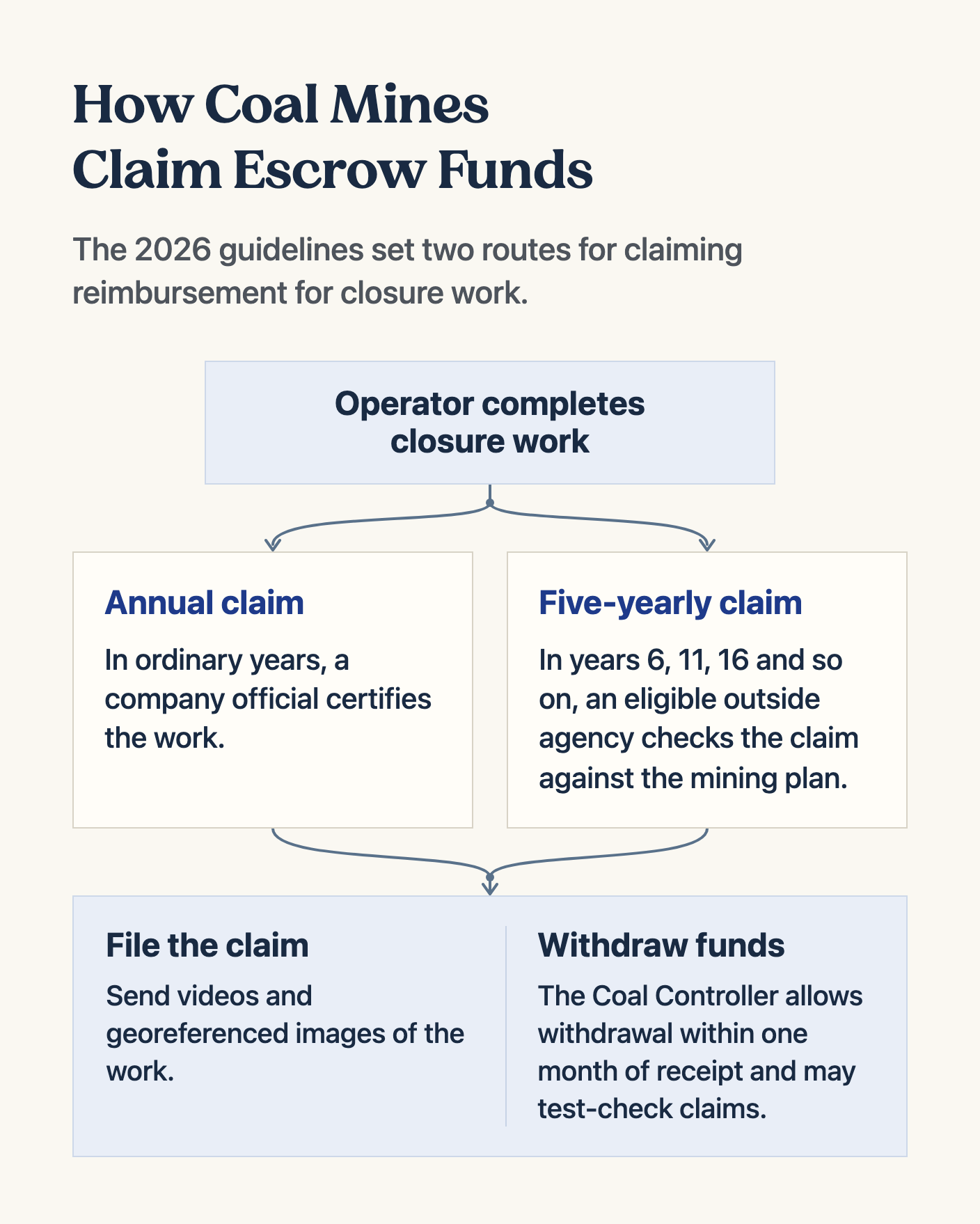
  • For an annual claim, an authorized company official self-certifies completed closure work. The claim can cover up to half the previous year’s deposit, excluding interest, and must remain tied to work performed.
  • In year 6, year 11, year 16 and subsequent five-year intervals, the claim uses a separate periodic route. The annual reimbursement route does not apply in those particular years.
  • Before a periodic claim is submitted, an eligible outside agency verifies it against the mining plan. Eligible bodies include CMPDIL, specified public engineering institutions and NEERI, alongside other centrally authorized agencies.
  • Both routes require videos and georeferenced images of completed work to accompany submission. These records connect the expenditure claim to a visible activity and its location, supporting scrutiny of the operator’s declaration.
  • The Coal Controller must allow withdrawal within one month after receipt and may test-check claims. Outside verification applies before periodic submissions, while annual claims begin with the company official’s self-certification.
Diagram comparing annual self-certification with five-yearly third-party verification, then showing the proof and withdrawal steps common to both coal mine closure claims.
Annual and five-yearly coal mine closure claims follow different verification routes before converging on common submission and withdrawal steps.

What Reimbursement Establishes

An escrow withdrawal addresses eligible expenditure, while final closure certification depends on completed obligations and post-closure assessment.

  • The closure certificate follows post-closure monitoring, an undertaking from the operator and a third-party audit. The auditor must check completion of activities listed in the final closure plan before certification proceeds.
  • The remaining escrow balance is reimbursed when the closure certificate is issued. This connects release of the final balance with a distinct completion decision after the earlier reimbursements for ongoing closure work.
  • Where planned activities appear unfulfilled, the Coal Controller may issue notice of intended forfeiture. The decision requires Central Government approval, providing an enforcement route when the operator fails to carry out closure obligations.
  • The new guidelines complement the existing statutory framework. Approval timelines and escrow arrangements should be read alongside applicable environmental, forest and safety requirements when assessing whether a project can proceed lawfully.
  • Underground coal gasification is recognized within the planning framework. Its incorporated guidance concerns mining methods, while the earlier surface gasification note addresses above-ground industrial conversion and project selection.

Way Forward

Make Closure Evidence Auditable

  • Compare georeferenced records with approved activities and expenditure claims so that location, work and payment can be reconciled.
  • Use test-check findings to identify recurring weaknesses in self-certification and to improve the quality of future claim scrutiny.
  • Track restoration and livelihood outcomes alongside reimbursements, including the condition of water bodies, revegetated land and assets intended for communities.

Conclusion

  • The guidelines connect closure finance with completed work through annual self-certification, periodic outside verification and documented claims. Their effectiveness depends on whether those checks establish that the promised activities were carried out.
  • A sound assessment follows the entire chain from annual deposits to final certification, including the operator’s continuing responsibility when available funds fall short of the cost of closure.

UPSC Practice Questions

Prelims MCQ 1

With reference to the 2026 coal mine closure guidelines, consider the following statements:

  1. Annual closure reimbursement claims are based on self-certification by an authorized company official.
  2. The periodic claim in the sixth year requires verification by an eligible outside agency before submission.
  3. The annual reimbursement route also applies in the sixth year alongside the periodic claim.

How many of the above statements are correct?

(a) Only one (b) Only two (c) All three (d) None

Answer: (b) Only two

Explanation:

Statements 1 and 2 are correct. The annual route does not apply in years when the separate periodic reimbursement route applies.

Prelims MCQ 2

Which event permits reimbursement of the remaining escrow balance under the final closure process?

(a) The first annual production report (b) Expiry of the mining equipment warranty (c) Issue of the mine closure certificate (d) Submission of an exploration proposal

Answer: (c) Issue of the mine closure certificate

Explanation:

The guidelines link reimbursement of the balance to issue of the mine closure certificate after the required monitoring, undertaking and third-party audit.

UPSC Mains Questions

  1. Explain how escrow arrangements can improve accountability for mine closure. Discuss the limitations of relying on expenditure records alone.
  2. Assess how differentiated verification of annual and periodic claims can balance administrative speed with environmental accountability.

Sources: PIB, Ministry of Coal and Ministry of Coal, Mining Plan and Mine Closure Guidelines 2026.

Frequently Asked Questions

When do the new coal mine closure guidelines take effect?

They were issued on November 20, 2026 and take effect 30 days after issuance. The Ministry announced them on November 23, so the announcement and commencement occur at different times.

What is a mine closure escrow account?

It is an account in a scheduled commercial bank dedicated to mine closure funds. The operator deposits annual contributions and claims reimbursement for eligible completed work under the prescribed procedures.

Who verifies periodic reimbursement claims?

Eligible agencies verify periodic claims before submission and compare them with the mining plan. They include CMPDIL, specified public engineering institutions, NEERI and other agencies authorized by the Central Government.

Does reimbursement certify that a mine is fully closed?

Final closure certification has its own requirements, including post-closure monitoring, an operator undertaking and a third-party audit of completed activities. Reimbursements during operations cover eligible closure work undertaken along the way.

Don’t use language to divide people

Open article →Download PDF

Why in news?

Tamil Nadu must decide its stand on Jawahar Navodaya Vidyalayas before the Supreme Court, reviving the debate on three-language formula.

UPSC Relevance

Prelims – Eighth Schedule, Articles 343-351, Three-language formula, NEP 2020, Jawahar Navodaya Vidyalayas

Mains, GS1, Salient features of Indian Society, Diversity of India; Post-independence consolidation and reorganisation within the country; Regionalism

GS2, Issues and Challenges Pertaining to the Federal Structure; Issues relating to Education

The issue

Jawahar Navodaya Vidyalayas (JNVs) are free residential co-educational schools run by the Union government for talented rural children, started in 1985-86. Under the scheme, the State gives 30 acres of land free in each district, while the Centre spends around ₹100 crore to set up each school and about ₹6 crore every year to run it.

  • Tamil Nadu’s stand: It is the only State that has not accepted JNVs. It argues that these schools follow a three-language formula, which goes against its two-language policy (Tamil and English) followed since 1968, and is seen as a way to bring back Hindi.
  • The Union’s stand: Tamil is compulsory in JNVs in Tamil Nadu up to Class X, and Tamil would be the medium of instruction up to Class VIII.
  • Supreme Court: The Court has asked the State to comply with its December 2025 order on allotting land. The case is to be heard next on December 14, 2026.
  • Ground reality: Tamil Nadu has 1,562 CBSE schools with about 15.9 lakh students (around 13% of all students), up from 908 schools in 2018-19. Schools offering three languages are 3% of schools but have nearly 11% of students. This shows that many parents are willing to choose a third language.

The author’s message is simple: language is a means of communication and knowledge, and should not be used as a tool to divide people.

India’s linguistic diversity

  • Census 2011 recorded 19,569 raw mother tongues, which were grouped into 121 languages.
  • Indian languages belong to four major families: Indo-Aryan, Dravidian, Austro-Asiatic and Tibeto-Burman. Smaller groups like Andamanese also exist.
  • Hindi is the mother tongue of about 43.6% of the population (Census 2011). No single language is the mother tongue of a majority of Indians.
  • The Eighth Schedule of the Constitution has 22 languages. It originally had 14.

Constitutional provisions on language (Part XVII)

ArticleProvision
Article 343Hindi in Devanagari script is the official language of the Union. English to continue for 15 years from 1950 (later extended by law).
Article 344Official Language Commission (every 10 years) and a Committee of Parliament on Official Language. First Commission headed by B.G. Kher (1955).
Article 345A State legislature may adopt one or more languages used in the State, or Hindi, as its official language.
Article 346Official language for communication between States, and between States and the Union.
Article 347President may direct recognition of a language spoken by a substantial section of a State’s population.
Article 348Language of the Supreme Court, High Courts, Acts and Bills is English until Parliament decides otherwise.
Article 350Every person can submit a representation for grievance in any language used in the Union or State.
Article 350AStates to provide facilities for primary education in the mother tongue to children of linguistic minorities (added by 7th Amendment, 1956).
Article 350BSpecial Officer for Linguistic Minorities appointed by the President.
Article 351Duty of the Union to promote the spread of Hindi, drawing on Hindustani and other languages of the Eighth Schedule.

Languages added to the Eighth Schedule later: Sindhi (21st Amendment, 1967); Konkani, Manipuri and Nepali (71st Amendment, 1992); Bodo, Dogri, Maithili and Santhali (92nd Amendment, 2003).

Role of language in nation building

1. Social dimension

  • Identity and dignity: Mother tongue gives a person self-respect and a sense of belonging. Recognising many languages tells every group that it has an equal place in the nation.
  • Link languages build bridges: Hindi in large parts of north and central India, and English across regions, help people move for work, study and trade. Migrant workers from Bihar in Tamil Nadu, or Malayali nurses in Delhi, often become bilingual or trilingual.
  • Multilingualism is a natural Indian trait: Most Indians use more than one language in daily life. This habit of switching languages makes Indians more open to other cultures.
  • Better learning outcomes: Studies, and NEP 2020, show that children learn best in their mother tongue in early years. This supports inclusion of tribal and rural children.

2. Political and constitutional dimension

  • Linguistic reorganisation strengthened unity: Many feared that States based on language would break India. In fact, the States Reorganisation Act, 1956 satisfied regional aspirations and reduced separatist feelings. It made States easier to govern in the people’s own language.
  • Flexible language compromise: The Constitution did not declare any ‘national language’. Hindi in Devanagari is the official language of the Union, and English continues as an associate official language. This balance (Munshi-Ayyangar formula) avoided conflict.
  • Accommodation over imposition: The Official Languages Act, 1963 (amended in 1967) allowed English to continue for official purposes indefinitely. This was a result of the assurance given to non-Hindi States.
  • Democratic participation: Members can speak in their mother tongue in Parliament and State legislatures (Articles 120 and 210). Simultaneous interpretation in 22 languages is now available in the Lok Sabha.
  • Rights of linguistic minorities: Articles 29 and 30 protect their language, script and culture, and allow them to run their own educational institutions.

3. Cultural dimension

  • Shared civilisational heritage: Ideas from the Bhakti movement travelled across languages, from Tamil Alvars and Nayanars to Kabir and Tulsidas in Hindi, and Tukaram in Marathi. Language carried a common cultural thread across India.
  • Classical languages: India has recognised 11 classical languages, starting with Tamil in 2004. Marathi, Pali, Prakrit, Assamese and Bengali were added in 2024.
  • Literature and cinema as bridges: Translations, Sahitya Akademi awards in 24 languages and pan-Indian cinema bring regional stories to the whole country.
  • Government initiatives: Ek Bharat Shreshtha Bharat (pairing of States), Kashi Tamil Sangamam, and Bhashini (AI-based translation tool under the National Language Translation Mission) use language to connect people.

4. Economic dimension

  • Knowledge of English has helped India gain in IT and services. Knowledge of regional languages is now valuable in local markets, digital content and governance services.

Challenges: tensions in the name of language

1. Three-language formula

StageKey feature
Kothari Commission (1964-66)Recommended the three-language formula to promote national unity.
National Policy on Education, 1968Adopted the formula: Hindi, English and a modern Indian language (preferably a southern one) in Hindi States; regional language, Hindi and English in non-Hindi States.
NPE 1986 / 1992Reiterated the formula.
NEP 2020More flexible: the three languages are the choice of States and students, as long as at least two are native to India. No language to be imposed on any State. Mother tongue or local language as medium preferably till Class 5.
  • Poor implementation: In practice, Hindi States rarely taught a southern or other Indian language seriously, often using Sanskrit instead. Non-Hindi States felt the burden fell mainly on them.
  • Perception of imposition: Even though NEP 2020 is flexible, States like Tamil Nadu see the formula as an indirect way to push Hindi.
  • Link with funds: Tamil Nadu’s refusal to sign the PM SHRI MoU linked to NEP led to Samagra Shiksha funds being held back, which the State called coercive federalism.
  • Resistance even in other States: In 2025, Maharashtra’s move to make Hindi the third language from Class 1 was rolled back after public protests, showing that the concern is not limited to the South.
  • Practical issues: Shortage of trained language teachers, extra load on students and lack of real choice in rural schools.

2. Fear of Hindi domination

  • Historical memory: Anti-Hindi agitations in Madras Presidency (1937-40) and Tamil Nadu (1965) shaped Dravidian politics and the two-language policy.
  • Unequal opportunity: Non-Hindi speakers fear disadvantage in central jobs, exams and official work if Hindi use grows.
  • Symbolic issues: Hindi-only names of schemes and laws, Hindi signboards, and statements calling Hindi the ‘national language’ create mistrust, though the Constitution gives no language that status.
  • Decline of smaller languages: Dominance of Hindi and English puts pressure on tribal and smaller languages. Many are listed as endangered.

3. Federal tensions

  • Education in the Concurrent List: After the 42nd Amendment (1976), education moved to the Concurrent List. States feel that central policies in education reduce their space.
  • Centrally sponsored schemes with conditions: Tying funds to adoption of national policies is seen as weakening cooperative federalism.
  • Identity politics: Language is often used for electoral gains, both by those who promote Hindi and those who oppose it. Emotional rhetoric pushes aside students’ real interests.
  • Demands for inclusion: Pending demands to include languages like Bhojpuri, Rajasthani and Tulu in the Eighth Schedule create new pressures.
  • Inter-State friction: Language-based tensions also appear in border areas, such as Belagavi (Karnataka-Maharashtra), and in attacks on migrant workers over language.

4. Judicial view

  • In State of Karnataka vs Associated Management of Primary Schools (2014), the Supreme Court held that the State cannot force mother tongue as the medium of instruction; choice of medium is part of freedom under Article 19(1)(a).
  • In the JNV case, the Court has asked Tamil Nadu to move beyond an anti-Hindi mindset, as the Tamil Nadu Tamil Learning Act, 2006 itself allows students to study their mother tongue as an optional subject.

Way forward

  • Choice, not compulsion: Follow the spirit of NEP 2020, where States and students choose the languages. Hindi should spread through attraction, not pressure.
  • Reciprocity: Hindi-speaking States should genuinely teach other Indian languages, especially southern and north-eastern ones. This will make the formula truly two-way.
  • Delink funds from language: Education funding should not depend on acceptance of language policy. Disputes can be solved through dialogue and bodies like the Inter-State Council.
  • Promote all Indian languages: Wider use of Bhashini, translation of higher education textbooks, and central exams in more regional languages.
  • Protect endangered languages: Document and teach tribal and smaller languages under schemes like SPPEL.
  • Students first: Decisions like JNVs should be judged by their benefit to rural children, not by political symbolism.

India’s many languages are a source of strength, not weakness. The idea of ‘unity in diversity’ works best when every language is respected and none is forced on others.

Practice MCQ

Q1. Consider the following statements:

  1. Article 350A directs every State to provide facilities for primary education in the mother tongue to children belonging to linguistic minority groups.
  2. Article 351 makes it the duty of the Union to promote the spread of the Hindi language.
  3. The Eighth Schedule originally contained 14 languages and now contains 22 languages.

How many of the statements given above are correct?

(a) Only one

(b) Only two

(c) All three

(d) None

Answer: (c)

Explanation: All three statements are correct. Article 350A was added by the 7th Amendment, 1956.

Q2. With reference to the three-language formula, consider the following statements:

  1. It was first adopted in the National Policy on Education, 1968, based on the Kothari Commission’s recommendations.
  2. NEP 2020 makes Hindi a compulsory language in all States.
  3. Under NEP 2020, at least two of the three languages learnt by children should be native to India.

Which of the statements given above are correct?

(a) 1 and 3 only

(b) 2 only

(c) 1 and 2 only

(d) 1, 2 and 3

Answer: (a)

Explanation: Statement 2 is incorrect. NEP 2020 clearly says no language will be imposed on any State.

Practice Question

“Language in India has been both a bridge that binds the nation and a fault line that tests its federal fabric.” Discuss in the context of the three-language formula and recent Centre-State tensions over language policy. (15 Marks)

Just verdict

Open article →Download PDF

Why in news?

On November 19, the ICJ applied ‘The Genocide Convention, 1948’ and  held Myanmar responsible for genocide against the Rohingya, the first such finding against any State. The court ordered that Myanmar must allow the safe, voluntary and dignified return of the Rohingya and pay compensation. The Gambia, backed by the 57-member Organisation of Islamic Cooperation (OIC), had filed the case on 11 November 2019. First time any State has been held responsible for genocide.

UPSC Relevance

Prelims – International Court of Justice, Genocide Convention, ICJ vs ICC, Rakhine State

Mains, GS2, Important International Institutions, agencies and fora – their structure and mandate.

The Genocide Convention, 1948

  • Adopted by the UN General Assembly on 9 December 1948. It was the first human rights treaty adopted by the UN.
  • Definition (Article II): Acts committed with intent to destroy, in whole or in part, a national, ethnical, racial or religious group. Political and social groups are not covered.
  • Five acts: Killing members of the group; causing serious bodily or mental harm; inflicting conditions of life meant to destroy the group; imposing measures to prevent births; forcibly transferring children to another group.
  • Article IX: Disputes between parties on the Convention can be taken to the ICJ. This was the basis of the Court’s jurisdiction in this case.
  • India: Ratified the Convention in 1959, but has no separate domestic law on genocide.

Facts about the International Court of Justice

  • Origin: Set up by the UN Charter in June 1945; began work in April 1946. It replaced the Permanent Court of International Justice (PCIJ) of the League of Nations. The Court marked its 80th anniversary in 2026.
  • Status: One of the six principal organs of the UN and its principal judicial organ. It is the only principal organ not located in New York.
  • Seat: Peace Palace, The Hague (Netherlands).
  • Legal basis: Chapter XIV (Articles 92-96) of the UN Charter and the Statute of the ICJ. All UN members are automatically parties to the Statute (Article 93).
  • Composition: 15 judges elected for nine years; they can be re-elected. One-third of the Court is elected every three years. No two judges can be from the same country.
  • Election: By an absolute majority in both the UN General Assembly and the Security Council, voting separately and simultaneously. The veto of permanent members does not apply.
  • Ad hoc judges: A State with no judge of its nationality on the bench can appoint an ad hoc judge for its case.
  • President: Elected by the judges for three years. The present President is Judge Iwasawa Yuji (Japan).
  • Official languages: English and French.
  • Contentious jurisdiction: Only States can be parties. The Court needs their consent, through a special agreement, a treaty clause (like Article IX of the Genocide Convention) or a declaration under the optional clause (Article 36(2) of the Statute).
  • Advisory jurisdiction: Gives advisory opinions on legal questions referred by UN organs and specialised agencies. These are not binding. Recent example: Advisory Opinion on the right to strike under ILO Convention No. 87 (May 2026).
  • Binding nature: Judgments are final, binding on the parties and cannot be appealed (Article 60 of the Statute).
  • Enforcement: The ICJ has no means to enforce its judgments. Under Article 94 of the UN Charter, the other party can approach the Security Council, where the veto can block action.
  • Recent election (November 2026): Five judges were elected for terms beginning February 2027. India did not field a candidate, so Judge Dalveer Bhandari’s exit will leave the Court without an Indian judge after 14 years.

ICJ vs ICC

BasisInternational Court of Justice (ICJ)International Criminal Court (ICC)
Set up byUN Charter, 1945 (began work in 1946)Rome Statute, 1998 (in force from 2002)
StatusPrincipal judicial organ of the UNIndependent treaty body, not a UN organ
Who is triedDisputes between States; State responsibilityIndividuals (for genocide, crimes against humanity, war crimes, aggression)
MembershipAll UN members are parties to its StatuteOnly States that ratify the Rome Statute (125 approx.)
SeatPeace Palace, The HagueThe Hague
IndiaParty (as a UN member)Not a party to the Rome Statute
Myanmar caseThe Gambia v. Myanmar (State responsibility for genocide)Investigation into deportation of Rohingya to Bangladesh (a member)

Limits of the verdict

  • No enforcement: Only the UN Security Council can enforce the ruling, but China and Russia, backers of Myanmar, can veto any action.
  • Politics over law: On the day of the verdict, China, Russia and the U.S. stressed the “immunities of State officials” at Shenzhen, signalling limits to pursuing leaders.
  • Regime legitimised: Former army chief Min Aung Hlaing, who called the Rohingya issue an “unfinished job”, became civilian President after elections widely seen as sham. Several countries, including India, continue to engage the regime.
  • Return is unsafe: With Rakhine in civil war and under Arakan Army control, safe and voluntary return is not possible today.

Implications for India

  • Neighbourhood interest: India shares a 1,643 km border with Myanmar. Instability in Rakhine affects projects like the Kaladan Multi-Modal Transit Transport Project (Sittwe port) and the Act East Policy.
  • Refugees: India hosts some Rohingya and is not a party to the 1951 Refugee Convention or its 1967 Protocol. The verdict adds moral pressure on deportation-related decisions and the principle of non-refoulement.
  • Balancing act: India has to balance engagement with Naypyitaw (security in the Northeast, countering China) and its support for a rules-based international order.
  • Bangladesh angle: The refugee burden on Bangladesh is a regional concern; India has given relief under Operation Insaniyat (2017).

Way forward

  • Lasting return needs a democratic, federal and plural Myanmar where the Rohingya get citizenship and equal rights.
  • Regional countries, including India and ASEAN, should push for dialogue among the regime, ethnic armed groups and democratic forces.
  • More humanitarian support for refugees in Bangladesh to prevent a deeper crisis.
  • Reform of the Security Council veto in cases of mass atrocities, as proposed by France and Mexico, needs wider support.

The verdict is a major step for international justice. But as the case shows, a court can declare the truth; only politics can deliver justice on the ground.

Practice MCQ

Q1. With reference to the International Court of Justice (ICJ), consider the following statements:

1. Its judges are elected by the UN General Assembly and the Security Council, and the veto of permanent members does not apply in these elections.

2. Only States can be parties in contentious cases before the Court.

3. A party dissatisfied with an ICJ judgment can appeal against it before the UN Security Council.

Which of the statements given above are correct?

(a) 1 and 2 only

(b) 2 and 3 only

(c) 1 and 3 only

(d) 1, 2 and 3

Answer: (a)

Explanation: ICJ judgments are final and without appeal (Article 60 of the Statute). Under Article 94 of the UN Charter, the Security Council can be approached only for enforcement, not as an appellate body.

Q2. With reference to the Convention on the Prevention and Punishment of the Crime of Genocide, 1948, consider the following statements:

1. It defines genocide as certain acts committed with intent to destroy, in whole or in part, a national, ethnical, racial or religious group.

2. Political groups are expressly protected under the Convention.

3. Disputes between the parties relating to the Convention can be submitted to the International Court of Justice.

Which of the statements given above is/are correct?

(a) 1 only

(b) 2 and 3 only

(c) 1, 2 and 3

(d) 1 and 3 only

Answer: (d)

Explanation: Political groups were deliberately left out of the definition in Article II. Article IX gives the ICJ jurisdiction over disputes between parties.

Fatal disagreement

Open article →Download PDF

Why in news?

COP31 in Antalya, Türkiye ended without a cover text, as countries disagreed on fossil fuel language and climate finance.

UPSC Relevance

Prelims – UNFCCC, CBDR-RC, Paris Agreement, NCQG, Loss and Damage Fund, CBAM

Mains, GS2, Important International institutions, agencies and fora; Effect of policies of developed countries on India’s interests

GS3, Conservation, environmental pollution and degradation; Mobilization of resources

What happened at COP31?

  • Cover text failed: The COP31 leadership (Türkiye as host and Australia leading negotiations) pushed a cover text early, with a headline target that 35% of global final energy consumption should come from electricity by 2035.
  • Fossil fuel deadlock: The European Union, supported by least developed countries, small island states and some South American countries (reportedly around 130 countries), objected because the text did not mention ‘fossil fuels’ or their phase-out.
  • Some progress: There was movement on the Just Transition agenda.
  • Finance stalled: No real progress was made on climate finance, the other major pillar of negotiations.

The editorial argues that developed countries must fulfil their promise to bear the cost of carbon emissions, given their historical responsibility. Without honest dialogue, COPs risk becoming a sideshow and dealing a blow to multilateralism.

Positions of developed and developing countries

IssueDeveloped countriesDeveloping countries
MitigationStronger and faster emission cuts by all major emitters; explicit fossil fuel phase-out.Developed countries should reach net zero much earlier and leave carbon space for others.
FinanceMobilise from all sources, including private and multilateral; widen contributor base.Public, grant-based finance from developed countries as a legal duty under Article 9.
ResponsibilityPresent and future emissions matter; China and India are big emitters now.Historical emissions and CBDR-RC must remain the basis.
Trade measuresCarbon border taxes like EU’s CBAM prevent ‘carbon leakage’.CBAM is a unilateral trade barrier that violates CBDR.
AdaptationLower priority compared to mitigation.Adaptation and loss and damage are urgent survival issues.

Causes behind the North-South disagreement

  • Historical responsibility: Developed countries are responsible for most cumulative emissions since the Industrial Revolution. The US and EU together account for nearly half, while India’s share is only around 3-4%. Developing countries argue that those who caused the problem must pay.
  • Equity and carbon space: India’s per capita emissions are about 2 tonnes, much lower than the global average and far below the US. Developing countries need ‘carbon space’ to remove poverty and provide energy access.
  • Dilution of CBDR: Since Paris, developed countries push for uniform obligations for all. They want large emitters like China, India and Gulf States to also contribute to finance, which developing countries see as shifting the burden.
  • Broken finance promises: The USD 100 billion goal was met only in 2022, two years late, and largely through loans rather than grants. This created a trust deficit.
  • Selective focus on fossil fuels: Developed nations push for coal phase-out, which hits India and others, while expanding their own oil and gas production. After the Russia-Ukraine war, several European countries increased gas imports and infrastructure.
  • Domestic politics in the West: The US withdrew from the Paris Agreement again (effective 2026). Economic slowdown, wars and defence spending have reduced aid budgets.
  • New energy demands: Rising power demand from AI and data centres, which nobody foresaw when UNFCCC was framed, is complicating fossil fuel transition plans.
  • Consensus-based decisions: At COPs, even a single country’s objection can block an outcome, making agreement hard.

Challenges arising from the disagreement

A. On climate goals

  • Weak ambition: Current NDCs put the world on a path of well above 1.5°C warming. Without collective targets, the 1.5°C goal is slipping away.
  • No agreement on fossil fuels: After COP28’s ‘transition away’ language, later COPs have failed to agree on a clear roadmap.
  • Unilateral measures: Carbon border taxes such as CBAM (definitive phase from 2026) can hurt exports of steel and aluminium from India and other developing countries.
  • Fragmentation: Countries are moving to small coalitions and club-based approaches instead of the UN process.

B. On climate finance

  • Huge gap: Developing countries need over a trillion dollars a year by 2030s. NCQG commits only USD 300 billion, and that too by 2035.
  • Quality of finance: Most climate finance is in the form of loans, adding to debt burden of poor countries. Grants are a small share.
  • No clear definition: There is no agreed definition of ‘climate finance’, allowing double counting with regular development aid.
  • Adaptation neglected: Most money goes to mitigation projects that bring returns. Adaptation, which is vital for vulnerable countries, gets far less.
  • Loss and Damage Fund underfunded: Pledges are a few hundred million dollars, against needs of hundreds of billions.
  • High cost of capital: Developing countries pay much higher interest rates for clean energy projects due to perceived risk.
  • Tech transfer: Intellectual property barriers make clean technologies costly for poorer nations.

C. Systemic

  • Erosion of trust and multilateralism: Repeated failures risk making COPs irrelevant, as the editorial warns.
  • Disproportionate impact: Small island states and least developed countries, which contributed least, face the worst impacts like sea-level rise, floods and droughts.

India’s stand and efforts

  • India supports CBDR-RC, climate justice and the idea of ‘carbon space’. It rejected the NCQG outcome at Baku as too little.
  • Updated NDC (2022): reduce emission intensity of GDP by 45% by 2030 from 2005 levels; about 50% of installed power capacity from non-fossil sources by 2030 (reached ahead of time); net zero by 2070.
  • India is among the leaders in solar installations and promotes initiatives like the International Solar Alliance, LiFE (Lifestyle for Environment) and Green Credit Programme.
  • India opposes unilateral trade measures like CBAM and supports a ‘just transition’ that does not hurt its development.

Way forward

  • Honour past promises: Developed countries must deliver predictable, grant-based public finance, with a clear roadmap from USD 300 billion towards USD 1.3 trillion.
  • Agree on a definition of climate finance: This will improve transparency and stop double counting.
  • Reform multilateral development banks: Lend more at lower cost, offer guarantees and currency risk cover to reduce cost of capital.
  • Debt relief: Debt-for-climate swaps and pause clauses during disasters for vulnerable countries.
  • Balanced fossil fuel transition: Developed countries should phase down first, including oil and gas, while developing countries follow a just, nationally decided pathway.
  • Technology sharing: Easier access to clean technologies, including through flexible intellectual property rules.
  • Open to all solutions: As the editorial suggests, experimental options like carbon capture should not be dismissed outright.
  • Strengthen Global South voice: Groups like BASIC, LMDC and G77 can push for fair outcomes. India can play a bridging role, as it did during its G20 presidency.
  • Good-faith dialogue: Rebuilding trust is the only way to keep multilateral climate action alive.

Climate change is a shared problem, but the responsibility to solve it is not equal. A fair deal on finance is the key to unlocking stronger climate goals.

Practice MCQ

Q1. With reference to the New Collective Quantified Goal (NCQG) on climate finance, consider the following statements:

  1. It was adopted at COP29 in Baku as the successor to the USD 100 billion goal.
  2. It sets a target of at least USD 300 billion per year by 2035, with developed countries taking the lead.
  3. It makes financial contributions by developing countries mandatory.

Which of the statements given above are correct?

(a) 1 only

(b) 1 and 2 only

(c) 2 and 3 only

(d) 1, 2 and 3

Answer: (b)

Explanation: Statement 3 is incorrect. Developing countries are only encouraged to contribute voluntarily.

Q2. Consider the following pairs:

  1. Kyoto Protocol — Binding emission targets only for developed countries
  2. Paris Agreement — Nationally Determined Contributions by all parties
  3. COP28, Dubai — Call for transitioning away from fossil fuels in energy systems

Which of the pairs given above are correctly matched?

(a) 1 only

(b) 2 and 3 only

(c) 1 and 3 only

(d) 1, 2 and 3

Answer: (d)

Explanation: All three pairs are correctly matched.

Practice Question

“The failure of recent COPs reflects a deep trust deficit between the developed and developing world.” Examine the causes of this divide over climate goals and finance, and suggest a way forward that upholds the principle of climate justice. (15 Marks)

Why did Maharashtra oppose FSSAI?

Open article →Download PDF

Why in news?

Maharashtra’s Food and Drug Administration (FDA) has decided to withdraw its petition in the Bombay High Court against the Food Safety and Standards Authority of India (FSSAI). The petition, had accused the Centre of creating a parallel enforcement system that weakened the State’s powers under the Food Safety and Standards Act, 2006. 

UPSC Relevance

Prelims – FSSAI, Food Safety and Standards Act 2006, licensing system, FSSAI initiatives

Mains, GS2, Statutory Bodies; Issues and Challenges Pertaining to the Federal Structure; Government Policies and Interventions

Constitutional basis of food safety

SubjectList
Adulteration of foodstuffs and other goods (Entry 18)Concurrent List
Public health and sanitation (Entry 6)State List

Since food adulteration is in the Concurrent List, both Parliament and State legislatures can make laws on it. But under Article 254, a central law (the FSS Act) prevails in case of conflict.

About FSSAI

  • Nature: Statutory body set up under the Food Safety and Standards Act, 2006.
  • Established: 2008 (operational from 2011, when the FSS Rules and Regulations came into force).
  • Administrative Ministry: Ministry of Health and Family Welfare.
  • Headquarters: New Delhi.
  • Composition: A Chairperson and 22 members, of whom one-third must be women. The Chief Executive Officer is the Member-Secretary. The Chairperson and CEO are appointed by the Central Government.
  • Main functions: Laying down science-based standards for food articles; regulating their manufacture, storage, distribution, sale and import; accrediting food testing labs; giving scientific advice to the Centre and States; and spreading awareness on food safety and nutrition.
  • Supporting bodies: Central Advisory Committee (coordination with States), Scientific Committee and Scientific Panels (on additives, contaminants, labelling etc.).
  • Rule-making: The Central Government makes Rules (Section 91). FSSAI makes Regulations with prior approval of the Central Government (Section 92). State Governments can make rules for State-level functions (Section 94).

Enforcement structure under the Act

LevelAuthorityRole
NationalFSSAIStandards, Central licences, import control, lab accreditation
StateCommissioner of Food Safety (Section 30)Head of enforcement in the State; can prohibit unsafe food for up to one year in public interest
DistrictDesignated OfficerIssues/cancels licences in the district; launches prosecution
Local areaFood Safety Officer (FSO)Inspection, sampling and seizure
AppealsAdjudicating Officer and Food Safety Appellate TribunalCivil penalties and appeals; further appeal to High Court

Licensing and registration 

CategoryWho qualifiesIssued by
RegistrationPetty food businesses with annual turnover up to ₹12 lakh (hawkers, small retailers, temporary stalls)State authority (Registering Authority)
State LicenceMedium businesses, turnover above ₹12 lakh and up to ₹20 croreState Food Safety authority
Central LicenceTurnover above ₹20 crore; importers and exporters; 100% EOUs; units at airports, seaports, railways; Central Govt agencies; operations in more than one State (head office)FSSAI

This licensing split is at the heart of the Maharashtra dispute – businesses with a Central licence come under central officers, while others are with State officials.

Penalties under the Act 

  • Unsafe food causing death: imprisonment of not less than 7 years, which may extend to life imprisonment, and fine of not less than ₹10 lakh.
  • Selling food not of the required quality: penalty up to ₹5 lakh (₹25,000 for petty manufacturers/sellers) and other penalties. 

Important FSSAI initiatives

InitiativeAbout
Eat Right IndiaUmbrella movement for safe, healthy and sustainable food (‘Sahi Bhojan, Behtar Jeevan’)
State Food Safety Index (SFSI)Ranks States on food safety parameters; released on World Food Safety Day (June 7)
+F logoIdentifies fortified foods (rice, wheat flour, edible oil, milk, salt)
Jaivik Bharat logoIdentity mark for certified organic food
RUCORepurpose Used Cooking Oil – converting used oil into biodiesel
FoSTaCFood Safety Training and Certification for food handlers
Food Safety on WheelsMobile food testing labs
Trans-fat limitIndustrially produced trans fat capped at 2% in oils and fats (from 2022)
Eat Right Station / Campus, Clean Street Food Hub, Hygiene RatingCertification schemes for railway stations, campuses, street food clusters and eateries

Why the issue matters

  • Federal balance: The Act was meant to keep enforcement with States while the Centre sets standards. Overlapping officers blur accountability.
  • Consumer protection: If State officials cannot act quickly against large Centre-licensed units, unsafe food may stay longer in the market.
  • Weak State capacity: Shortage of Food Safety Officers and testing labs in many States is a bigger problem than the jurisdiction question.
  • Ease of doing business: Uniform rules help firms that operate across States.

Way Forward

  • Clear protocol for joint or State-led inspection of Centre-licensed units in emergencies.
  • Wider consultation with States through the Central Advisory Committee before new regulations.
  • Central funding for State labs, more FSOs and digital tracking (FoSCoS) of inspections.

Practice MCQ

Q1. Consider the following statements:

1. The Food Safety and Standards Authority of India functions under the Ministry of Consumer Affairs, Food and Public Distribution.

2. ‘Adulteration of foodstuffs and other goods’ is a subject in the Concurrent List.

3. The Food Safety and Standards Act, 2006 repealed the Prevention of Food Adulteration Act, 1954.

Which of the statements given above are correct?

(a) 1 and 2 only

(b) 2 only

(c) 1 and 3 only

(d) 2 and 3 only

Answer: (d). Statement 1 is incorrect: FSSAI functions under the Ministry of Health and Family Welfare.

Q2. Consider the following pairs:

Initiative : Purpose

1. RUCO : Certification of organic food

2. FoSTaC : Training and certification of food handlers

3. Jaivik Bharat : Identifying trans-fat-free products

How many of the pairs given above are correctly matched?

(a) Only one

(b) Only two

(c) All three

(d) None

Answer: (a). Only pair 2 is correct. RUCO is about repurposing used cooking oil, and Jaivik Bharat is the logo for organic food.