3 current affairs published on Thursday, 26 March 2026
26 March 2026 Current Affairs for UPSC — every
Why-in-News article AnantamIAS published on Thursday, 26 March 2026, broken down with
Why in News?, the exact GS paper it feeds, sub-topic mapping, MCQ-ready facts and a
UPSC-style practice question. 3 articles in total, covering Polity, Economy, Environment, S&T, IR, Geography, History, Society and Internal
Security — the same Why-in-News + GS-paper-mapping + practice-question format the Compass uses across
every daily digest on the site.
Daily current affairs for UPSC is where new material enters your prep stream. Read this
26 March 2026 digest end-to-end in 25–35 minutes, attempt the practice question
at the foot of each article (it's MCQ for some, 10/15-marker for others), then bookmark the entries
that fall inside your active revision window. Everything stays cross-linked: tap any subject pill to jump
to that subject's hub, or use the table of contents above to skip straight to a specific story.
Use this page three ways. Read sequentially for a one-sitting scan of everything that
mattered on 26 March 2026. Download the
26 March 2026 PDF below for offline study or print revision. Or use
the March 2026 Current Affairs compilation
to see this day in the month's full context. For the previous day's reading, see
25 March 2026 Current Affairs;
the next day's is 27 March 2026 Current Affairs.
Why we publish daily current affairs separately from the monthly compilation: daily is learning,
monthly is revision. Use the daily page to add fresh material to your notes the day it breaks;
come back to the March 2026 compilation 60 days before Prelims when the
noise has settled and only the lasting takeaway is worth re-reading.
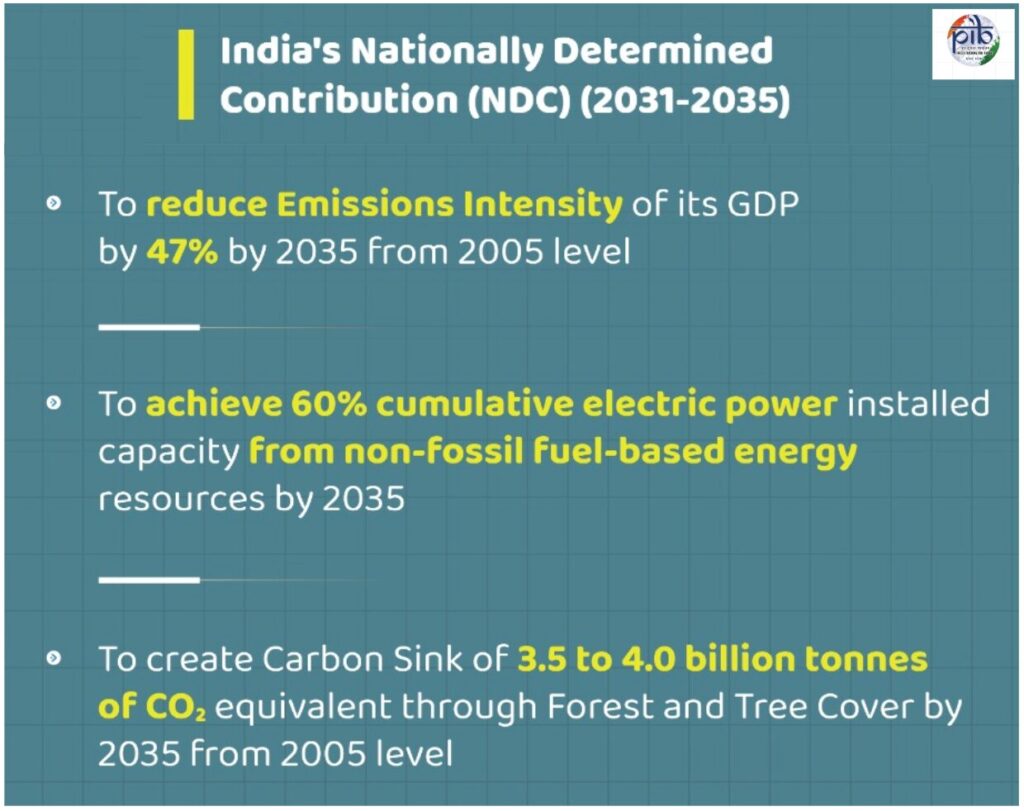
Recently, the Union Cabinet has approved India’s updated Nationally Determined Contribution (NDC) for 2031-2035. The new targets commit to enhanced climate ambition under the United Nations Framework Convention on Climate Change (UNFCCC) and the Paris Agreement.
UPSC Relevance: (GS-3 Environment and Ecology: International Agreements; Climate Change)
What are Nationally Determined Contributions (NDCs)?
NDCs are submitted every five years to the UNFCCC secretariat. They specify how much a country will reduce greenhouse gas (GHG) emissions and how it will adapt to climate change.
NDCs are climate action plans prepared by each country under the UNFCCC (United Nations Framework Convention on Climate Change) as part of the Paris Agreement (COP21).
The new NDC (2031-2035) enhances the climate pledges set in India’s first NDC (2015), which were further revised and updated in 2021-2022.
Table of Comparison across successive NDC commitments:
Targets
First NDC (2015)
Updated NDC (2022)
Updated NDC (2026)
Emission Intensity Reduction
Reduce emissions intensity of GDP by 33-35%below 2005 levels
Reduce the emissions intensity of GDP by 45% below 2005 levels by 2030
Target reduction in emissions intensity of GDP by 47% below 2005 levels by 2035
Share of Non-fossil fuels in installed electricity capacity
Achieve 40% of installed electric power capacity from non-fossil sources by 2030
Achieve 50% ofcumulative installed power capacity from non-fossil sources by 2030
Achieve 60% of cumulative installed electricity capacity from non-fossil sources by 2035
Carbon Sink (forests)
Create 2.5 to 3 billion tonnes of additional carbon sink through forest and tree cover
Same
Create a 3.5 to 4 billion tonnes of CO2 equivalent carbon sink through forest and tree cover by 2035 from the 2005 level
Other Climate Goals:
Apart from the three major commitments, the government laid out other climate goals, including:
Climate-friendly and cleaner path of economic development
Resilient infrastructure to combat climate change effects like sudden rain and cloudbursts
Promoting the Prime Minister’s Lifestyle for Environment (LiFE) mission that urges people to adopt sustainable daily habits
Developing low-cost, long-term finance mechanisms for green energy
Capacity building and research and development through technology and international collaborations.
UPSC Prelims PYQ (2016)
Q. With reference to the Agreement at the UNFCCC Meeting in Paris in 2015, which of the following statements is/are correct?
The Agreement was signed by all the member countries of the UN, and it will go into effect in 2017.
The Agreement aims to limit the greenhouse gas emissions so that the rise in average global temperature by the end of this century does not exceed 2°C or even 1.5°C above pre-industrial levels.
Developed countries acknowledged their historical responsibility in global warming and committed to donate $1000 billion a year from 2020 to help developing countries to cope with climate change.
Select the correct answer using the code given below.
(a) 1 and 3 only
(b) 2 only
(c) 2 and 3 only
(d) 1, 2 and 3
Answer: (b)
UPSC Mains PYQ (2021)
Q. Describe the major outcomes of the 26th session of the Conference of the Parties (COP) to the United Nations Framework Convention on Climate Change (UNFCCC). What are the commitments made by India in this conference?
The Supreme Court of India (March 2026) clarified that a person cannot retain Scheduled Caste (SC) status after converting to religions other than Hinduism, Sikhism, or Buddhism.
UPSC Relevance:
GS-I: Salient features of Indian society – caste system, communalism, regionalism. Role of religion in social structure.
GS-II: Welfare Schemes & Social Justice Reservation policy.
GS-IV (Ethics): Ethical dimensions: Equality vs. justice, balancing individual religious freedom with group rights.
What are Scheduled Castes?
Scheduled Castes (SCs) are communities historically subjected to untouchability and social discrimination in India.
They are notified by the President under Article 341 of the Constitution through the Constitution (Scheduled Castes) Order, 1950.
SCs are entitled to reservations in Parliament, State Legislatures, government jobs (15%), educational institutions, and protections under the SC/ST (Prevention of Atrocities) Act, 1989.
Buddhists included (following mass conversions by Ambedkarites)
Till date
Christians and Muslims EXCLUDED
Therefore, SC status is religion-linked (legally), not purely caste-based.
The Case: Chinthada Anand v. State of Andhra Pradesh
Appellant
Pastor Chinthada Anand — member of Madiga community (notified SC in AP), converted to Christianity
Incident
Alleged caste-based abuse and assault; filed FIR under SC/ST (Prevention of Atrocities) Act
AP HC (2025)
Quashed the FIR — held that Anand lost SC status upon conversion; the caste system is alien to Christianity
SC Verdict
March 24, 2026 — Bench of Justices Prashant Kumar Mishra & Manmohan upheld the AP HC ruling
What is Supreme Court’s 2026 Ruling?
Core Judgment
Supreme Court reiterates that SC status is restricted to Hindus, Sikhs, and Buddhists, excluding converts to other religions.
Reasoning of Court
Historical Context Argument
SC category created to address caste-based discrimination rooted in Hindu social structure.
Absence of Caste in Other Religions (Legal View)
Court assumes caste system is not institutionally present in Islam/Christianity.
Reservation Purpose
SC benefits are meant for:
Social stigma
Untouchability
Historical oppression Linked to specific socio-religious context
What was the Earlier Judicial Position?
Courts have consistently held:
Conversion leads to loss of SC benefits
Retaining SC benefits after conversion = “fraud on Constitution” (HC view)
However:
Some courts have also said Caste by birth may socially persist even after conversion
Constitutional Articles Involved
Article
Relevance
Article 14
Equality before law
Article 15(4)
Special provisions for backward classes
Article 16(4)
Reservation in jobs
Article 17
Abolition of untouchability
Article 25
Freedom of religion
Article 341
SC identification
Article 46
DPSP: State to promote educational & economic interests of weaker sections, SCs, STs and protect from social injustice
Comparison: SC vs ST
Feature
SC
ST
Religion-based restriction
YES
NO
Conversion impact
Loses status
No effect
Arguments IN FAVOUR of the Judgement (Denying SC status after conversion)
Constitutional validity SC status is defined under Article 341 of the Indian Constitution and the Constitution (Scheduled Castes) Order, 1950. These legally restrict SC recognition to specific religions, making the policy constitutionally valid.
Historical basis of caste oppression SC category was created to address untouchability rooted in Hindu social structure. Conversion is seen as a departure from that system, reducing the original basis for classification.
Targeted welfare approach Reservations are meant for specific historically disadvantaged groups. Expanding SC status to all converts may dilute benefits and reduce effectiveness of affirmative action.
Prevention of misuse Allowing SC status post-conversion may lead to strategic conversions while retaining benefits. This can distort the purpose of reservations and create unfair advantages.
Religious doctrine argument Islam and Christianity do not formally recognize caste hierarchies. Hence, legally, the basis for SC classification becomes weak after conversion.
Judicial consistency The Supreme Court of India has repeatedly upheld this position. Maintaining continuity ensures legal certainty and administrative clarity.
Administrative simplicity Religion-based classification makes identification easier. Including sociological factors across religions would complicate implementation and verification.
Arguments AGAINST (Supporting SC status after conversion)
Caste persists socially Even after conversion, caste-based discrimination continues in practice. Dalit Christians and Muslims still face exclusion, proving caste is social, not purely religious.
Violation of equality (Article 14) People of the same caste origin are treated differently based on religion. This creates unequal treatment and undermines substantive equality.
Restriction on religious freedom Under Article 25 of the Indian Constitution, individuals can freely convert. Losing SC benefits acts as a disincentive, indirectly restricting this freedom.
Contradicts abolition of untouchability Untouchability is abolished under Article 17 irrespective of religion. Denying protection to converted individuals ignores this constitutional mandate.
Policy inconsistency (SC vs ST) Scheduled Tribes retain status irrespective of religion, while SCs do not. This inconsistency raises questions about the logic of religion-based exclusion.
Arbitrary distinction between religions Sikhs and Buddhists were included later (1956, 1990) — the distinction between these religions and Christianity/Islam is arbitrary.
Double disadvantage Converted Dalits often remain socially marginalized but lose state benefits. This leads to further vulnerability rather than empowerment.
Ignoring empirical evidence Commissions like the Ranganath Misra Commission found caste discrimination persists across religions. The current policy does not reflect these findings.
Against secular principles Linking benefits to religion indirectly encourages individuals to remain within certain religions. This goes against the secular nature of the state.
Way Forward
Revisit the legal framework The Constitution (Scheduled Castes) Order, 1950 should be re-examined in light of present social realities. Parliament can amend it to make SC status more inclusive if needed.
Evidence-based policymaking Government should rely on empirical data on caste discrimination across religions. Findings of bodies like the Ranganath Misra Commission must be seriously evaluated.
Shift from religion to discrimination-based criteria Affirmative action should focus on actual experience of social exclusion rather than religious identity. This will ensure more just and targeted welfare.
Judicial clarity through Constitution Bench A larger bench of the Supreme Court of India can settle the issue comprehensively. This will reduce ambiguity and ensure uniform interpretation.
Balance equality and religious freedom Policy reforms must harmonize Article 14 of the Indian Constitution (equality) and Article 25 of the Indian Constitution (freedom of religion). No individual should be forced to choose between rights and benefits.
Explore alternative categorization Instead of extending SC status, a separate category or sub-quota can be considered for marginalized converts. This avoids dilution while ensuring inclusion.
Strengthen anti-discrimination laws Legal protection against caste discrimination should be enforced across religions. Laws must recognize that caste-based exclusion is a social reality beyond religion.
Periodic review mechanism Reservation policies should be periodically reviewed to reflect changing social conditions. Static classifications may not address dynamic inequalities.
Promote social reform alongside legal reform Legal changes alone are insufficient; awareness and social reform are needed to eliminate caste discrimination in all religions.
Ensure political consensus Given the sensitivity of the issue, reforms should be undertaken through broad political and social consensus to avoid polarization.
Conclusion:
The issue reflects a deeper conflict between legal formalism and social justice. While the current framework ensures targeted benefits, it fails to fully capture the continuing reality of caste-based discrimination across religions. A balanced approach requires data-driven reform and constitutional reinterpretation to ensure that affirmative action remains both just and inclusive
Practice Mains Questions:
“Denial of Scheduled Caste status after conversion raises concerns regarding equality and religious freedom.” Discuss with suitable arguments.
“Affirmative action policies must be guided not only by legal provisions but also by lived social realities.” Critically examine this statement in the context of caste-based reservations and religious conversion
Case Study: Ramesh, belonging to a Scheduled Caste Hindu family in rural Andhra Pradesh, converted to Christianity five years ago and became an active pastor in a local church. He continues to live in the same locality and faces social ostracisation and casteist slurs from dominant caste groups. Last month, he was physically assaulted and abused using his caste name. Ramesh approached the police seeking protection under the SC/ST (Prevention of Atrocities) Act, 1989. The police refused to register the case citing the recent Supreme Court judgment that SC status is lost upon conversion. (a) What are the ethical dilemmas involved in this situation from the perspective of the police officer? (b) As a District Collector, how would you balance the principles of secularism, social justice, and rule of law in handling such cases? Suggest a practical course of action. (c) Critically analyse whether rigid adherence to the 1950 SC Order in such cases upholds or undermines constitutional morality.
Unlike traditional small-molecule chemical drugs (e.g., paracetamol), biologics are highly specific, target particular receptors/proteins, and are sensitive to manufacturing processes.
Used for chronic/non-communicable diseases (NCDs): Cancer, rheumatoid arthritis, diabetes, autoimmune disorders, Alzheimer’s.
Global market growing rapidly due to rising NCD burden.
Biosimilars:
Highly similar (not identical) versions of approved biologics, produced after the original patent expires. They are “generic” equivalents but require rigorous similarity testing (not simple chemical copying).
Cheaper alternatives that improve access and affordability.
Why important for India? India is the “pharmacy of the world” (strong in generics), but weak in high-value biologics/biosimilars. Domestic production reduces import dependence and positions India as a global hub.
Problem with Traditional Drug Testing
Animal Testing (Traditional Method)
Drugs tested on animals (mice, monkeys) before human trials
Issue: Animals ≠ Humans biologically
Real Case Example: Northwick Park Tragedy
In 2006, drug theralizumab caused:
Severe immune reaction
Organ failure in humans
However, the same drug had shown no harmful effects in animal testing, especially in monkeys.
This incident demonstrated that animal models may fail to capture human-specific immune responses.
Why This Problem is Severe for Biologics
Biologcs interact with specific human receptors
These receptors may:
Not exist in animals
Function differently
Solution: Non-Animal Methodologies (NAMs)
What are NAMs?
Non-animal methodologies (NAMs) are advanced scientific techniques that use human cells, tissues, or computational models instead of animals. These methods aim to replicate human biological conditions more accurately.
Types of NAMs
1. Organoids
Organoids are miniature, lab-grown versions of human organs created from stem cells. They replicate key structural and functional features of real organs, allowing precise testing of drug effects.
Example: mini brain, liver
2. Organ-on-a-chip
An Organ-on-a-Chip (OOC) is a multi-channel microfluidic cell culture device —essentially credit-card sized chips with living human cells — designed to Mimic blood flow, tissue interaction and simulate the key activities, mechanics, and physiological responses of a living human organ or organ system in a controlled, in-vitro environment. These thumb-drive-sized devices contain hollow channels lined with living human cells and tissues, providing a more accurate model of human biology than traditional two-dimensional cell cultures or animal testing
Use: Lung-on-chip, gut-on-chip, heart-on-chip to test drug absorption, toxicity, and immune responses.
Practical Example
A breast cancer-on-chip model was developed to test CAR T-cell therapy, which is a cutting-edge biologic treatment. The model recreated the tumour environment, including blood vessels and immune interactions.
NAMs (breast cancer-on-chip) allow researchers to model this challenge without animals.
This allowed scientists to study how immune cells attack cancer cells, helping assess both effectiveness and safety without relying on animal testing.
3. 3D Bioprinting
3D bioprinting involves printing human tissues using living cells, which can mimic real organ structures.
This allows researchers to test drugs in environments that closely resemble the human body.
Key Advantage
These models:
Replicate human physiology better
Improve accuracy of drug testing
Benefits of NAMs
1. Better Predictability
More accurate than animal models
Reduces clinical trial failures
2. Cost Reduction
Drug development cost reduced by 10–26%
3. Faster Development
Time for drug optimisation reduced (~19%)
4. Ethical Advantage
Reduces animal suffering
Aligns with global ethical standards
5. Personalised medicine
Patient-derived organoids allow testing of drug efficacy on individual’s own cells
6. Disease modelling
Can recreate rare diseases and complex tumour microenvironments not possible in standard animals
What is BioPharma SHAKTI?
Government initiative (Budget 2026)
Outlay: ₹10,000 crore
Objectives:
Boost biologics manufacturing
Promote biosimilars
Strengthen R&D ecosystem
Importance for India
1. Healthcare
Cheaper biologics → better access
Affordable biosimilars can significantly improve access to advanced treatments for diseases like cancer and diabetes.
2. Economic Growth
Biologics represent a high-value segment of the pharmaceutical industry, offering opportunities for exports and employment generation.
3. Global Competitiveness
India can become:
Biologics hub
Alternative to Western pharma
What are the Challenges?
Limited Industry Adoption
Although many academic institutions in India are working on NAMs, their translation into industry applications remains weak.
Infrastructure Constraints
Developing and scaling NAM technologies require advanced infrastructure and sustained funding, which are currently limited.
Regulatory Uncertainty
The Central Drugs Standard Control Organisation is still evolving guidelines for integrating NAMs, leading to uncertainty for companies.
Patent Evergreening
Pharmaceutical companies often extend patents through minor modifications, delaying the entry of affordable biosimilars.
Investment Gaps
Investors in India are often unfamiliar with the biologics sector, leading to limited funding for startups and innovation.
Global Trends
Countries like UK moving to:
Phase out animal testing
India:
New Drugs and Clinical Trials (Amendment) Rules, 2023 support NAMs
But still lagging in implementation
Key Concepts
Concept
Meaning
Biologics
Drugs from living systems
Biosimilars
Generic-like biologics
NAMs
Non-animal testing methods
Precision medicine
Targeted therapies
Translational gap
Lab → industry gap
Critical Analysis
Positives
Scientific advancement
Ethical improvement
Economic opportunity
Concerns
Regulatory readiness low
High cost of technology
Slow industry adoption
Way Forward
Strengthen:
Industry-academia collaboration
Provide:
Regulatory clarity for NAMs
Invest in:
Infrastructure & startups
Prevent:
Patent evergreening
Promote:
Standardisation of NAMs
Conclusion
BioPharma SHAKTI’s ₹10,000 crore is a necessary but not sufficient condition for India’s biologics transformation. The real multiplier will come from building enabling systems — validated NAM protocols, expedited regulation, sustained funding, and a mature biologics entrepreneurship ecosystem — that allow many companies to innovate simultaneously, positioning India as the global hub for human-relevant drug testing.
Practice MCQs
With reference to biologics, consider the following statements:
Biologics are drugs produced from living organisms and are structurally complex.
Biosimilars are exact chemical copies of biologics similar to generic drugs.
Biologics are commonly used in treating chronic diseases like cancer and diabetes.
Which of the statements given above is/are correct?
(a) 1 and 3 only (b) 1 only (c) 2 and 3 only (d) 1, 2 and 3
Answer: (a)
Consider the following statements regarding Non-Animal Methodologies (NAMs):
NAMs are based on human cells and tissues to replicate biological processes.
Organ-on-a-chip technology can simulate functions like blood flow and tissue interaction.
NAMs have completely replaced animal testing globally.
Which of the statements given above is/are correct?
(a) 1 and 2 only (b) 2 and 3 only (c) 1 only (d) 1, 2 and 3
Answer: (a)
Which of the following best explains the limitation of animal testing in biologics?
(a) Animals cannot be used in laboratory conditions (b) Biologics interact with human-specific receptors that may differ in animals (c) Animal testing is more expensive than human trials (d) Animals do not respond to any drugs
Answer: (b)
With reference to BioPharma SHAKTI, consider the following statements:
It was announced in the Union Budget 2026.
It aims to promote biologics and biosimilars manufacturing in India.
It focuses only on vaccine production.
Which of the statements given above is/are correct?
(a) 1 only (b) 2 only (c) 1 and 2 only (d) 1, 2 and 3