Opens in a new tab
Join Anantam IAS Channel on Telegram

Daily Digest · Sunday

30 August 2026 Current Affairs for UPSC

7 current affairs published on Sunday, 30 August 2026

30 August 2026 Current Affairs for UPSC — every Why-in-News article AnantamIAS published on Sunday, 30 August 2026, broken down with Why in News?, the exact GS paper it feeds, sub-topic mapping, MCQ-ready facts and a UPSC-style practice question. 7 articles in total, covering Polity, Economy, Environment, S&T, IR, Geography, History, Society and Internal Security — the same Why-in-News + GS-paper-mapping + practice-question format the Compass uses across every daily digest on the site.

Daily current affairs for UPSC is where new material enters your prep stream. Read this 30 August 2026 digest end-to-end in 25–35 minutes, attempt the practice question at the foot of each article (it's MCQ for some, 10/15-marker for others), then bookmark the entries that fall inside your active revision window. Everything stays cross-linked: tap any subject pill to jump to that subject's hub, or use the table of contents above to skip straight to a specific story.

Use this page three ways. Read sequentially for a one-sitting scan of everything that mattered on 30 August 2026. Download the 30 August 2026 PDF below for offline study or print revision. Or use the August 2026 Current Affairs compilation to see this day in the month's full context. For the previous day's reading, see 29 August 2026 Current Affairs; the next day's is 31 August 2026 Current Affairs.

Why we publish daily current affairs separately from the monthly compilation: daily is learning, monthly is revision. Use the daily page to add fresh material to your notes the day it breaks; come back to the August 2026 compilation 60 days before Prelims when the noise has settled and only the lasting takeaway is worth re-reading.

Türkiye-PKK Peace Process: Reintegration Tied to Verified Disarmament

Open article →Download PDF

Why in News?

Türkiye’s monitoring board met on 24 August 2026 to advance a conditional framework for PKK disarmament, legal relief and social reintegration.

  • The board created four working groups covering legal affairs, disarmament, monitoring and social reintegration.
  • Parliament adopted Law No. 7595 on 10 August, and it was published in the Official Gazette on 18 August.
  • The law is enacted, but individual relief awaits verified dissolution, surrender of controlled weapons and ammunition, and a published National Security Council confirmation.
  • The framework suspends eligible proceedings or sentences for five or 10 years; it does not erase every offence through a general amnesty.
  • Intentional homicide within organisational activity and specified pre-1 June 2005 life-sentence categories remain outside the framework.
  • The shift from declarations to a statute tests whether disarmament can be matched with legally predictable reintegration without weakening accountability for grave crimes or victims’ access to justice.
  • For India, the case offers a comparative lens on peace processes, verification, conditional rehabilitation and the difficult boundary between negotiated settlement and impunity.
  • Its design also raises a rule-of-law question: exceptional peace measures need clear eligibility, independent decisions and reviewable safeguards rather than relief based only on political discretion.

UPSC Relevance

Prelims Relevance

  • PKK/KCK, the organisation covered by the Turkish law, and the difference between dissolution, disarmament and reintegration.
  • The activation sequence: security-institution finding, National Security Council confirmation and publication in the Official Gazette.
  • The law covers specified organisation-related, assistance, propaganda and terror-financing offences, subject to exclusions.
  • Suspension periods are five years for the lower penalty band and 10 years for the higher band.
  • Eligible persons must apply within six months after the confirming National Security Council decision is published.

Mains Relevance

GS Paper 2

  • Effect of policies and politics of developed and developing countries on India’s interests.
  • Comparative design of peace agreements, statutory safeguards and post-conflict political settlement.

GS Paper 3

  • Linkages between development and spread of extremism, and challenges to internal security.
  • Disarmament verification, rehabilitation of former militants and protection against renewed terrorist activity.

Essay

  • Durable peace requires both an exit from violence and a lawful route back into society.
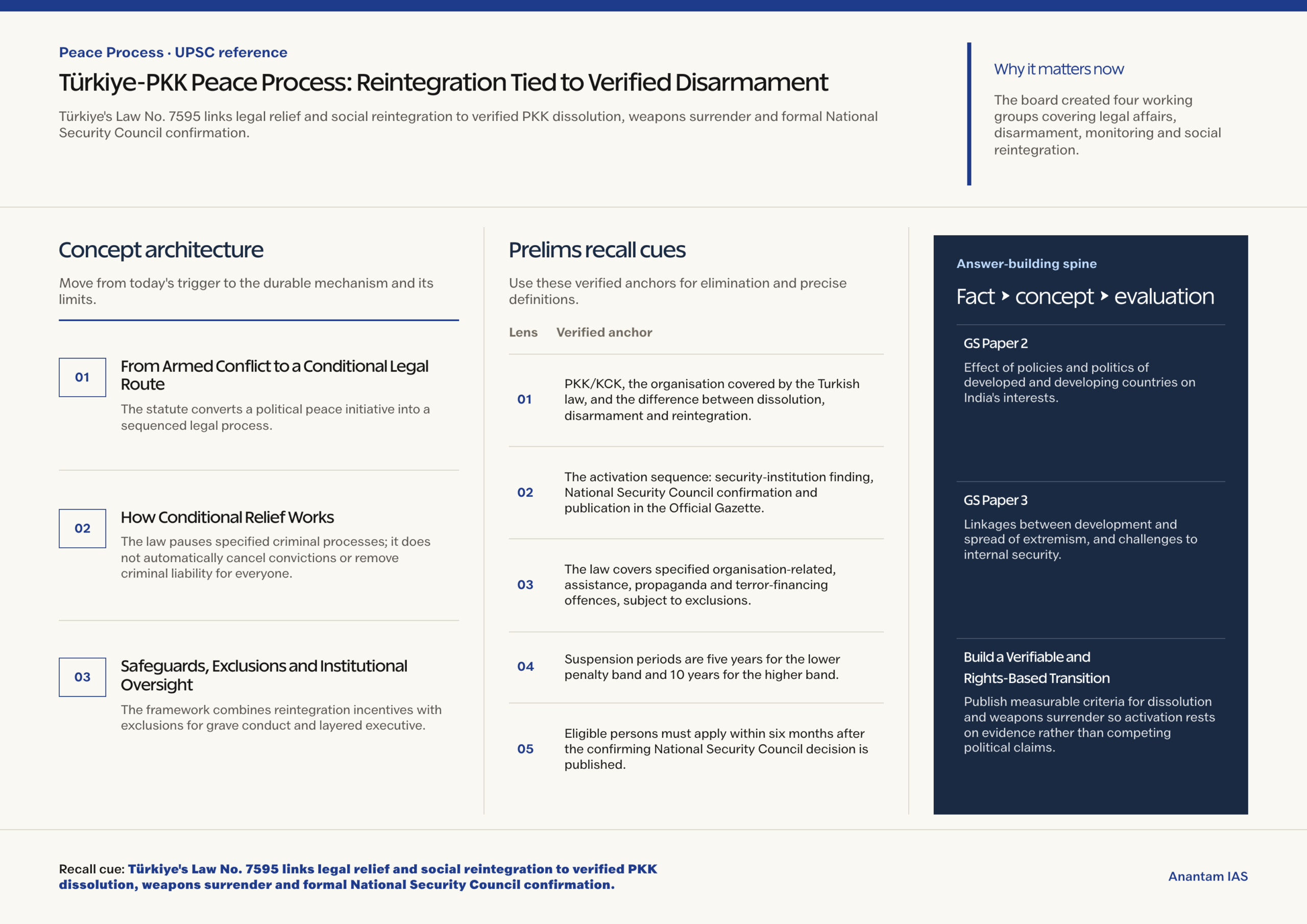
Mindmap explaining Türkiye-PKK Peace Process: Reintegration Tied to Verified Disarmament for UPSC revision
Revision mindmap: Türkiye-PKK Peace Process: Reintegration Tied to Verified Disarmament. Open the full-size image for details.

Background and Context

From Armed Conflict to a Conditional Legal Route

The statute converts a political peace initiative into a sequenced legal process, but the first legal trigger has not yet been completed.

  • The PKK announced dissolution and an end to its armed campaign, followed by a symbolic weapons-destruction event in northern Iraq, but a symbolic act cannot prove complete disarmament.
  • A declaration alone is insufficient: Turkish security institutions must find that the organisation and connected formations ended their actual existence and surrendered every weapon and ammunition item under their control.
  • The National Security Council must confirm that finding through a decision published in the Official Gazette before prosecutors, courts or enforcement judges can process relief.
  • This sequencing separates an enacted law from an activated benefit. It prevents an announcement from producing immediate legal consequences and is the key Prelims trap.
  • The double trigger also creates an evidentiary test: authorities must define what counts as complete dissolution, surrendered control and adequate verification across connected formations.

How Conditional Relief Works

The law pauses specified criminal processes; it does not automatically cancel convictions or remove criminal liability for everyone.

  • Eligible investigations and prosecutions carrying a maximum of 15 years or less may be suspended for five years; the longer 10-year period applies to the higher penalty band.
  • Execution of eligible sentences follows the same five-year or 10-year division, but requires an enforcement judge’s decision rather than operating as an automatic collective release.
  • If the person commits no new terrorism offence during suspension, a pending case may be dropped or the sentence may be treated as served after the full period.
  • A new terrorism offence revokes the suspension, allowing proceedings or sentence execution to resume. Files and proof remain preserved throughout the suspension period.
  • Applicants receive a six-month window after publication of the confirming National Security Council decision, giving the exceptional scheme a fixed entry period rather than open-ended availability.

Safeguards, Exclusions and Institutional Oversight

The framework combines reintegration incentives with exclusions for grave conduct and layered executive, judicial and parliamentary oversight.

  • Intentional homicide committed within the organisation’s activity is excluded from both proceeding suspension and sentence suspension, preserving a clear accountability line for the gravest direct violence.
  • Also excluded are offences committed before 1 June 2005 that carry, or resulted in, life or aggravated-life imprisonment under the relevant provision.
  • A high-level Monitoring and Evaluation Board coordinates implementation and may seek further judicial, administrative or legislative measures, but individual legal orders remain assigned to competent authorities.
  • A separate parliamentary Monitoring Committee follows implementation and may make recommendations, creating a legislative channel to question consistency, progress and institutional compliance.
  • The four working groups link legal processing with weapons verification and social cohesion, showing that reintegration needs civilian support and cannot be reduced to release from custody.

Way Forward

Build a Verifiable and Rights-Based Transition

  • Publish measurable criteria for dissolution and weapons surrender so activation rests on evidence rather than competing political claims.
  • Keep individual judicial review, victim participation and reasoned decisions central to balancing reintegration with accountability.
  • Pair legal relief with livelihoods, psychosocial support and local reconciliation so former members have a credible civilian pathway.
  • Use periodic parliamentary reporting to track compliance, renewed violence and unequal application without disclosing sensitive operational details.

Conclusion

  • Türkiye’s model is best understood as conditional suspension: verified organisational exit opens limited legal relief, while serious exclusions, preserved records and the risk of revival retain accountability.
  • Its legitimacy will depend on transparent verification, equal eligibility decisions, judicial review and meaningful reintegration. A peace statute can lower violence only when its legal safeguards remain credible.
  • In a Mains answer, use it to show that durable peace needs three linked pillars: credible verification, lawful reintegration and safeguards against impunity.

UPSC Practice Questions

Prelims MCQ 1

With reference to Türkiye’s Law No. 7595, consider the following statements:

  1. Its legal-relief provisions became available to all covered persons immediately upon publication of the law.
  2. Security institutions must verify dissolution and weapons surrender before National Security Council confirmation is published.
  3. Intentional homicide committed within organisational activity is excluded from the suspension framework.

How many of the above statements are correct?

(a) Only one (b) Only two (c) All three (d) None

Answer: (b) Only two

Explanation:

Statements 2 and 3 are correct. Publication enacted the law, but relief remains conditional on verification and a published National Security Council confirmation.

Prelims MCQ 2

Which one of the following best describes the legal mechanism created by Türkiye’s Law No. 7595?

(a) Automatic acquittal for every PKK-linked offence (b) Permanent immunity granted by an executive declaration (c) Time-bound suspension of eligible cases or sentences, subject to conditions and exclusions (d) Transfer of all terrorism trials to a parliamentary committee

Answer: (c) Time-bound suspension of eligible cases or sentences, subject to conditions and exclusions

Explanation:

The law creates conditional five-year or 10-year suspensions, retains serious exclusions and revokes relief if a new terrorism offence is committed.

UPSC Mains Questions

  1. Conditional reintegration can support the end of an armed conflict only when verification and accountability are built into the legal design. Discuss with reference to the Türkiye-PKK peace process.
  2. Examine how disarmament, judicial safeguards and social rehabilitation must work together in a sustainable peace process.

Sources: Grand National Assembly of Türkiye and The Hindu.

Frequently Asked Questions

Is Türkiye’s Law No. 7595 a general amnesty?

No. It creates conditional, time-bound suspension for specified proceedings and sentences. It retains exclusions, preserves case material and can withdraw relief after a new terrorism offence.

When can eligible persons receive relief under the law?

Only after security institutions verify dissolution and weapons surrender, and the National Security Council confirms that finding in a decision published in the Official Gazette.

Which offences are specifically excluded?

The law excludes intentional homicide within organisational activity and specified pre-1 June 2005 offences carrying, or resulting in, life or aggravated-life imprisonment.

What happens during the five-year or 10-year suspension?

Proceedings or sentence execution pause, records and evidence remain preserved, and a new terrorism offence can reactivate the case or the unserved sentence.

Why is the monitoring board important?

It connects legal coordination, disarmament verification, institutional monitoring and social reintegration, while reporting supports parliamentary oversight of a process that remains conditional.
Zaporizhzhia Power Loss: Why Off-Site Electricity Is a Nuclear Safety Pillar

Open article →Download PDF

Why in News?

On 29 August 2026, the IAEA reported that the Zaporizhzhia Nuclear Power Plant had remained without off-site power for more than a week and was relying on emergency diesel generators.

  • The plant lost its sole remaining 330 kV off-site line on 20 August, leaving several emergency diesel generators to supply essential loads.
  • Electricity was needed primarily for pumps cooling the six shut-down reactors and their spent-fuel pools.
  • The IAEA was told on 28 August that diesel available on site could support operations for about 10 days under the prevailing configuration.
  • This was a warning about eroded defence in depth, not evidence of radiation release or reactor-core damage.
  • A reactor stops producing electricity after shutdown, but radioactive fission products continue releasing decay heat that must be removed.
  • Off-site grid power is the preferred supply for cooling, instrumentation and other safety functions; diesel generators are a temporary on-site backup.
  • The episode connects nuclear engineering with disaster-risk reduction: safety depends on equipment, electricity, fuel logistics, staff access and communication working together.

UPSC Relevance

Prelims Relevance

  • Decay heat continues after the fission chain reaction has stopped because radioactive fission products keep decaying.
  • Spent-fuel pools also require heat removal, especially for fuel discharged more recently from a reactor.
  • A loss of off-site power removes normal grid electricity; it is not automatically a station blackout if emergency AC power remains available.
  • Emergency diesel generators supply selected safety loads, while batteries can bridge essential control and instrumentation functions for a limited period.
  • Secure off-site power is Pillar 4 of the IAEA’s Seven Indispensable Pillars for nuclear safety and security during armed conflict.
  • Electrical redundancy uses independent supply paths so that one line, switchyard or generator failure does not disable every safety function.

Mains Relevance

GS Paper 3

  • Science and technology: shutdown heat removal, spent-fuel cooling and defence-in-depth design.
  • Disaster management: cascading infrastructure failure, backup endurance and continuity of critical services.

GS Paper 2

  • International institutions: the IAEA’s monitoring, technical assistance and safety framing during armed conflict.
  • International relations: protection of civilian nuclear facilities and the limits of technical oversight in conflict zones.

Essay

  • Resilience is not the absence of failure; it is the ability of independent safeguards to prevent one failure from becoming a catastrophe.
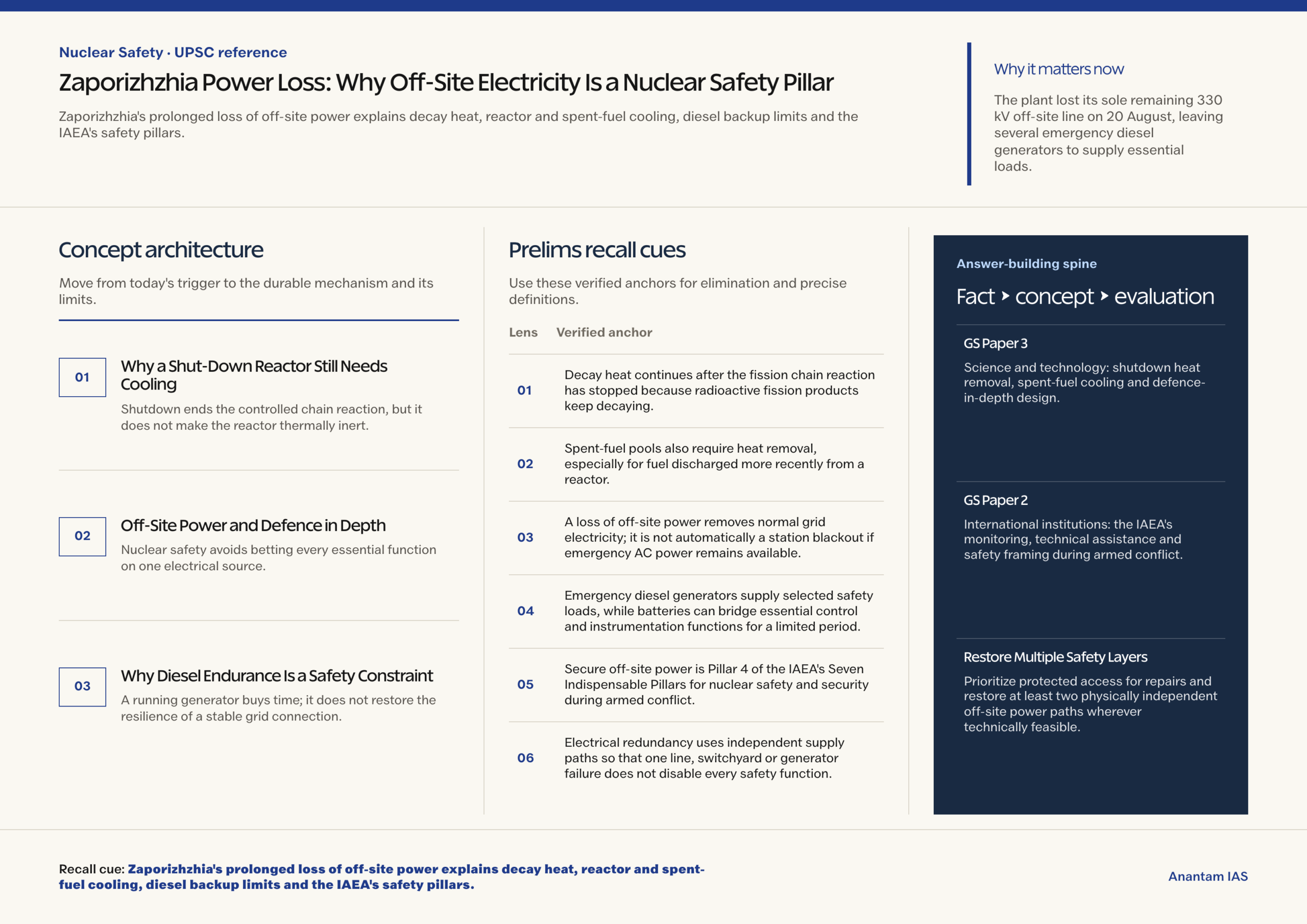
Mindmap explaining Zaporizhzhia Power Loss: Why Off-Site Electricity Is a Nuclear Safety Pillar for UPSC revision
Revision mindmap: Zaporizhzhia Power Loss: Why Off-Site Electricity Is a Nuclear Safety Pillar. Open the full-size image for details.

Background and Context

Why a Shut-Down Reactor Still Needs Cooling

Shutdown ends the controlled chain reaction, but it does not make the reactor thermally inert. The heat decline is gradual, not an on-off switch.

  • Unstable fission products continue radioactive decay and release decay heat; this heat falls over time but initially remains high enough to demand reliable removal.
  • Cooling systems carry residual heat from the reactor core to an ultimate heat sink, preventing fuel and coolant temperatures from rising unchecked over time.
  • Used fuel stored underwater also generates heat. The pool’s water removes heat, provides radiation shielding and must remain at a safe level.
  • Cold shutdown substantially lowers heat demand, but pumps, valves, controls, monitoring and water-management systems still need dependable power to preserve stable conditions.
  • The key exam distinction is simple: reactor shutdown stops power production; safe shutdown also requires continuing heat removal and monitoring.

Off-Site Power and Defence in Depth

Nuclear safety avoids betting every essential function on one electrical source.

  • The grid normally supplies robust, continuous electricity to plant auxiliaries, including cooling pumps, instrumentation, ventilation and water-treatment systems that support safe conditions.
  • Independent off-site connections reduce common-cause failure: damage to one line or switchyard should not remove every physically separated external supply path.
  • On-site diesel generators form another protective layer and are designed to start automatically when qualified safety buses lose normal power, supplying prioritized essential loads.
  • Batteries support selected direct-current loads and controls during transfer, but their stored energy is finite and cannot replace sustained high-power cooling indefinitely.
  • A station blackout is the more severe condition in which both off-site AC power and on-site emergency AC power are unavailable.

Why Diesel Endurance Is a Safety Constraint

A running generator buys time; it does not restore the resilience of a stable grid connection.

  • Diesel endurance depends on fuel inventory, generator loading, maintenance condition, cooling, lubricants and the ability to rotate or repair units; a stated runtime is conditional.
  • Fuel stored on site creates an endurance window. Once replenishment becomes uncertain, secure transport and access routes become part of the nuclear-safety system.
  • Several generators may provide equipment redundancy, yet they can remain exposed to shared hazards such as damaged supply routes or impaired maintenance access.
  • Restoring multiple independent off-site connections reduces reliance on consumable fuel and returns the plant to a stronger layer of defence in depth.
  • Neither generator operation nor a normal radiation reading proves that the underlying risk has vanished; both describe the plant’s condition at a particular time and require continued verification.

Way Forward

Restore Multiple Safety Layers

Risk falls when power, fuel and oversight are secured together rather than treated as separate problems.

  • Prioritize protected access for repairs and restore at least two physically independent off-site power paths wherever technically feasible.
  • Maintain verified diesel stocks, tested generators, spare parts and secure replenishment routes for the full period assumed in emergency plans.
  • Keep reactor, spent-fuel, electrical and radiation parameters under continuous monitoring, with prompt reporting to the regulator and the IAEA.
  • Use the IAEA’s safety pillars as a minimum operating frame: protect equipment, staff, power, logistics, emergency preparedness and reliable communication.

Conclusion

  • Off-site electricity is a nuclear safety input because cooling and monitoring continue after generation stops; backup diesel reduces immediate risk but has finite endurance.
  • In a Mains answer, frame the issue through defence in depth: independent grid lines, emergency power, fuel logistics, trained staff, monitoring and international oversight must reinforce one another.
  • The durable lesson is to distinguish a serious loss of safety margin from an accident already in progress; the evidence supported the former, not claims of core damage or radiation release.

UPSC Practice Questions

Prelims MCQ 1

With reference to electrical safety at a nuclear power plant, consider the following statements:

  1. Decay heat continues to be produced after the fission chain reaction is stopped.
  2. A loss of off-site power necessarily means that all on-site AC power is also unavailable.
  3. Spent-fuel pools may require active cooling and monitoring even when reactors are shut down.

How many of the above statements are correct?

(a) Only one (b) Only two (c) All three (d) None

Answer: (b) Only two

Explanation:

Statements 1 and 3 are correct. Off-site power can be lost while emergency diesel generators continue supplying on-site safety buses, so Statement 2 is incorrect.

Prelims MCQ 2

Which one of the following best describes a station blackout at a nuclear power plant?

(a) Loss of the reactor’s ability to generate electricity while grid power remains available (b) Loss of off-site AC power together with on-site emergency AC power (c) Automatic shutdown of a reactor following a grid disturbance (d) Temporary loss of one transmission line while another line supplies the plant

Answer: (b) Loss of off-site AC power together with on-site emergency AC power

Explanation:

A station blackout is more severe than a loss of off-site power because the emergency AC sources are also unavailable; limited battery-backed DC power may remain.

UPSC Mains Questions

  1. A nuclear reactor’s need for safety-grade electricity does not end when power generation stops. Explain with reference to decay heat, spent-fuel cooling and defence in depth.
  2. Repeated loss of off-site power at a nuclear facility is both an engineering and a governance challenge. Discuss the role of redundancy, logistics, emergency preparedness and international monitoring.

Sources: The Hindu, citing IAEA and International Atomic Energy Agency, Update 364.

Frequently Asked Questions

Why does a shut-down nuclear reactor still need electricity?

Radioactive fission products continue producing decay heat after shutdown. Electricity runs pumps, valves, controls and monitoring equipment that remove this heat and keep the reactor in a safe state.

What is off-site power at a nuclear plant?

Off-site power is electricity received from the external grid through transmission lines and switchyards. It normally supplies the plant’s auxiliary and safety-related electrical loads.

Are emergency diesel generators enough for long-term safety?

They provide crucial backup, but their endurance depends on fuel, maintenance, cooling and resupply. Stable, redundant grid connections remain the preferred long-duration electrical source.

Does loss of off-site power mean a nuclear accident has occurred?

No. It is a serious reduction in safety margin. If emergency power keeps cooling and monitoring functional, loss of off-site power does not by itself establish core damage or radiation release.

Which IAEA safety pillar covers electricity supply?

Pillar 4 of the IAEA’s Seven Indispensable Pillars states that a secure off-site power supply from the grid must exist for all nuclear sites.

Personalised mRNA Cancer Therapy: What the Melanoma Phase III Result Shows

Open article →Download PDF

Why in News?

On 19 August 2026, sponsors reported that INTerpath-001 met its Phase III recurrence-free and distant-metastasis-free survival endpoints in resected high-risk melanoma.

  • The trial compared intismeran autogene plus pembrolizumab with pembrolizumab plus placebo after complete surgery for stage IIB-IV cutaneous melanoma.
  • Sponsors described statistically significant and clinically meaningful improvement at a pre-specified interim analysis, while follow-up for overall survival continues.
  • The public announcement did not provide Phase III hazard ratios, absolute event rates or detailed subgroup findings; the registry still showed No Results Posted.
  • Intismeran remains investigational. Endpoint success is not regulatory approval and does not establish a vaccine for every cancer or for healthy people.
  • The advance tests whether a therapy built from one patient’s tumor mutations can add benefit to an established checkpoint inhibitor.
  • The exam-worthy distinction is between a therapeutic, individualised cancer treatment and a preventive vaccine given before disease develops.
  • The evidence is encouraging but incomplete until detailed efficacy, safety, quality-of-life and overall-survival data are publicly assessed.

UPSC Relevance

Prelims Relevance

  • Neoantigens arise from tumor-specific mutations and can mark cancer cells as targets for immune recognition.
  • mRNA supplies temporary genetic instructions; it does not need to enter the cell nucleus or alter genomic DNA.
  • Pembrolizumab is an anti-PD-1 monoclonal antibody, a type of immune checkpoint inhibitor.
  • Adjuvant therapy is treatment given after the main treatment, here surgery, to lower the risk of cancer returning.
  • RFS tracks recurrence or death, while DMFS tracks distant spread or death.
  • A Phase III trial compares efficacy and safety in a larger controlled population before possible regulatory decisions.

Mains Relevance

GS Paper 3

  • Science and technology developments and their applications in health: mRNA platforms, cancer genomics and precision medicine.
  • Indigenization and access questions around sequencing, bioinformatics, individualized manufacturing and cold-chain capacity.

GS Paper 2

  • Issues relating to development and management of health: evidence-based approval, affordability and equitable access to advanced cancer care.
  • Regulatory oversight of complex biologics, genomic privacy and long-term safety monitoring.

Essay

  • Precision medicine can make treatment biologically personal, but public-health value still depends on evidence, manufacturing capacity and fair access.
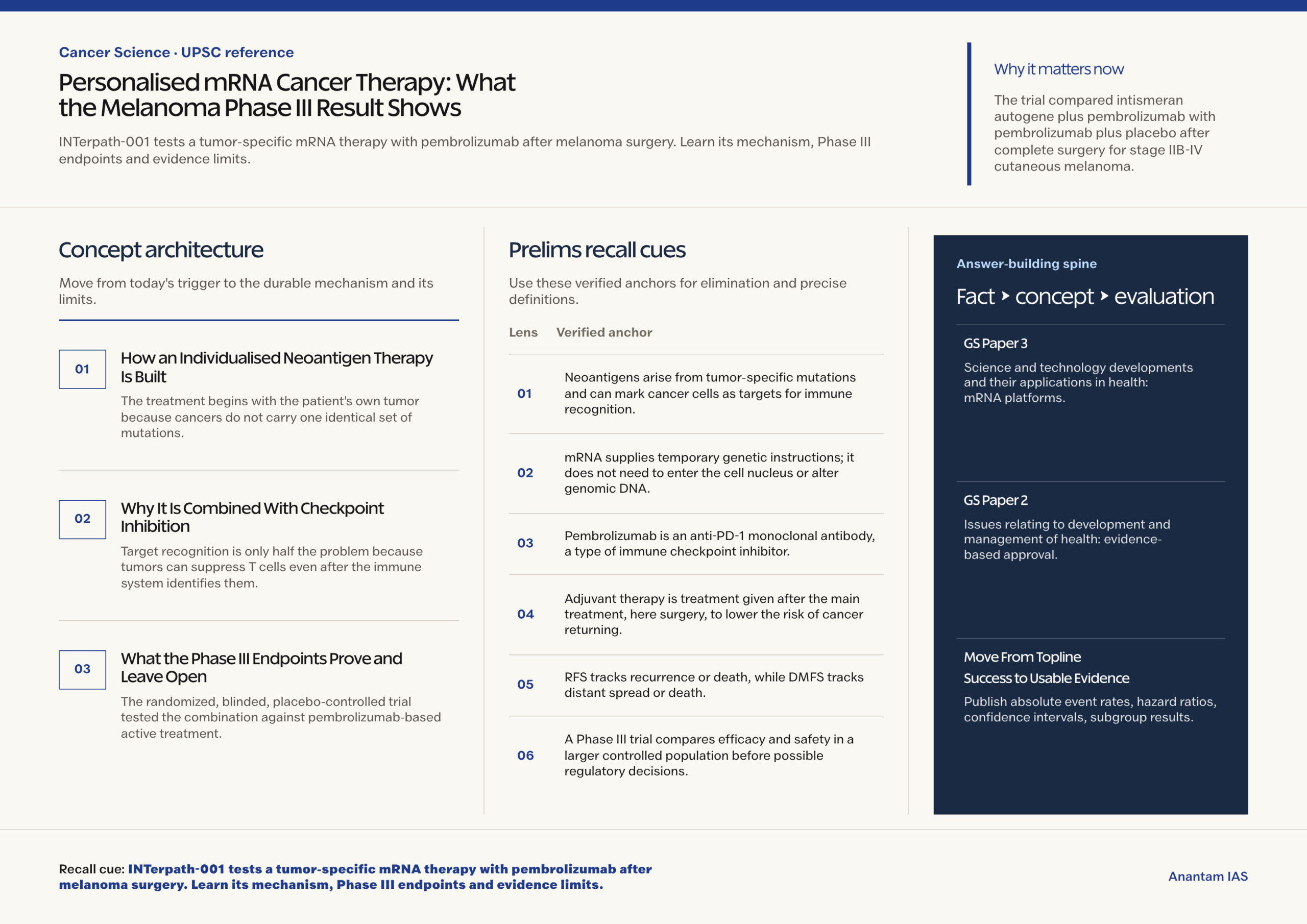
Mindmap explaining Personalised mRNA Cancer Therapy: What the Melanoma Phase III Result Shows for UPSC revision
Revision mindmap: Personalised mRNA Cancer Therapy: What the Melanoma Phase III Result Shows. Open the full-size image for details.

Background and Context

How an Individualised Neoantigen Therapy Is Built

The treatment begins with the patient’s own tumor because cancers do not carry one identical set of mutations.

  • A resected tumor sample is analyzed alongside normal material to find mutations that distinguish the patient’s cancer cells from healthy cells.
  • Some mutations create altered protein fragments called neoantigens. Because they are new to the body, immune cells may recognize them as abnormal targets that normal cells usually lack.
  • Computational selection identifies candidate neoantigens likely to be presented to T cells. This selection step matters because not every tumor mutation produces a useful immune target.
  • Intismeran uses a synthetic mRNA sequence encoding up to 34 neoantigens, tailoring temporary instructions to the patient’s tumor rather than permanently editing DNA or using one unchanged sequence for everyone.
  • After injection, cells translate the mRNA instructions into antigen fragments. Antigen-presenting cells display them, helping activate tumor-specific T-cell responses against cells carrying those markers.

Why It Is Combined With Checkpoint Inhibition

Target recognition is only half the problem because tumors can suppress T cells even after the immune system identifies them.

  • The PD-1 pathway works as an immune brake that normally limits excessive immune damage. Tumors can exploit this checkpoint through PD-L1 signaling and reduce T-cell activity.
  • Pembrolizumab is an anti-PD-1 antibody. By blocking PD-1 interaction with its ligands, it can release this inhibitory signal and restore immune activity.
  • The combination has complementary jobs: intismeran supplies patient-specific target instructions, while pembrolizumab helps activated T cells remain functional against tumor cells.
  • This is adjuvant treatment, given after complete surgical resection when visible disease has been removed but microscopic residual cancer may still cause recurrence.
  • Calling it a cancer vaccine can mislead. It is therapeutic, prepared after diagnosis from tumor information, and tested here for a defined high-risk melanoma population.

What the Phase III Endpoints Prove and Leave Open

The randomized, blinded, placebo-controlled trial tested the combination against pembrolizumab-based active treatment, but a positive endpoint does not answer every clinical or policy question.

  • Recurrence-free survival measures time from randomization until melanoma returns at any site or the participant dies from any cause.
  • Distant-metastasis-free survival measures time until cancer spreads to a distant site or death. It asks a narrower question about dangerous systemic recurrence.
  • The sponsor’s topline statement says both endpoints improved, but detailed Phase III effect sizes, confidence intervals, event counts and peer-reviewed analyses were not yet public.
  • Overall survival remains under follow-up. Longer survival, long-term toxicity, quality of life and durability require separate observation and cannot be inferred from the two reported endpoints alone.
  • The widely cited 49% and 59% risk reductions come from the earlier Phase IIb KEYNOTE-942 study. They are not INTerpath-001 Phase III results.

Way Forward

Move From Topline Success to Usable Evidence

Regulatory and health-system decisions need the full dataset, not the announcement alone.

  • Publish absolute event rates, hazard ratios, confidence intervals, subgroup results, adverse events and quality-of-life outcomes for independent scrutiny.
  • Continue follow-up for overall survival and late immune-related effects before extending claims beyond the endpoints already reported.
  • Regulators should assess both clinical benefit and the reproducibility of the tumor-sequencing, neoantigen-selection and individualized manufacturing chain.
  • Access planning should address cost, turnaround time, specialist laboratories, genomic-data protection and the risk of concentrating precision oncology in a few urban centers.

Conclusion

  • INTerpath-001 is a major proof-of-concept for combining individualised mRNA instructions with checkpoint inhibition after melanoma surgery, but it remains an investigational treatment with incomplete public Phase III data.
  • A strong answer should separate mechanism from evidence: explain neoantigen selection and PD-1 blockade, define RFS and DMFS, then state that approval, overall-survival benefit and wider cancer applicability remain unsettled.

UPSC Practice Questions

Prelims MCQ 1

With reference to individualised mRNA cancer therapy, consider the following statements:

  1. Its neoantigen targets may be selected from mutations found in a patient’s tumor.
  2. It is necessarily a preventive vaccine administered to healthy people before cancer develops.
  3. Pembrolizumab blocks the PD-1 immune checkpoint.

How many of the above statements are correct?

(a) Only one (b) Only two (c) All three (d) None

Answer: (b) Only two

Explanation:

Statements 1 and 3 are correct. The therapy is individualized from tumor information and is combined with anti-PD-1 treatment; it is therapeutic, not a preventive vaccine for healthy people.

Prelims MCQ 2

Which clinical-trial endpoint most specifically measures the time until cancer spreads to a distant site or death?

(a) Recurrence-free survival (b) Distant-metastasis-free survival (c) Objective response rate (d) Progression-free survival

Answer: (b) Distant-metastasis-free survival

Explanation:

DMFS counts distant metastasis or death. RFS is broader because it also includes local, locoregional and regional recurrence.

UPSC Mains Questions

  1. Explain how individualised neoantigen mRNA therapy and immune checkpoint inhibition can work together in cancer treatment. What scientific and access challenges could limit their wider use?
  2. A positive Phase III endpoint is a milestone, not the end of evidence generation. Discuss with reference to recurrence-free survival, overall survival, safety and regulatory assessment.

Sources: Merck and Moderna and ClinicalTrials.gov.

Frequently Asked Questions

What is intismeran autogene?

It is an investigational mRNA-based individualised neoantigen therapy. Its synthetic mRNA encodes selected targets derived from a patient’s tumor mutations to stimulate tumor-specific T-cell responses.

Is intismeran a preventive cancer vaccine?

No. It is a therapeutic treatment prepared after cancer diagnosis using tumor information and tested after melanoma surgery to reduce recurrence risk.

Why is pembrolizumab given with the mRNA therapy?

Pembrolizumab blocks PD-1, an immune checkpoint that can restrain T cells. Intismeran supplies tumor-specific targets while pembrolizumab helps sustain immune attack.

What did INTerpath-001 report?

Sponsors reported that the combination met recurrence-free and distant-metastasis-free survival endpoints versus pembrolizumab-based control. Detailed Phase III effect sizes were not yet public.

Do the 49% and 59% figures describe the Phase III result?

No. Those risk-reduction figures came from the earlier Phase IIb KEYNOTE-942 study and should not be presented as INTerpath-001 Phase III results.

India-Argentina Trade: Lithium, Pharma and MERCOSUR Pathways

Open article →Download PDF

Why in News?

India and Argentina held their fourth Joint Trade Committee meeting in Buenos Aires on 24 August 2026, advancing four distinct trade and investment tracks.

  • KABIL completed Phase II drilling in Catamarca, while possible engagement in Argentina’s Salta and Jujuy provinces remains under exploration.
  • Technical discussions advanced on SPS measures for Indian onions, dairy products, grapes, potatoes, bananas and pulses, but final market access wasn’t announced.
  • Argentina committed to work towards moving India from Annex II to Annex I in its pharmaceutical regulatory framework, not to grant automatic product approvals.
  • Both sides reported progress on terms for expanding the India-MERCOSUR PTA and on digital certificates of origin, which can reduce documentary friction.
  • The meeting links India’s critical-mineral security with practical barriers faced by agricultural and pharmaceutical exporters in the Argentine market.
  • It also shows that economic diplomacy works through separate instruments: exploration contracts, regulatory cooperation, SPS protocols and preferential tariff rules.

UPSC Relevance

Prelims Relevance

  • Argentina, Chile and Bolivia form the Lithium Triangle in South America.
  • KABIL is a joint venture of NALCO, Hindustan Copper and Mineral Exploration and Consultancy Limited.
  • SPS measures concern food safety and animal and plant health in international trade.
  • MERCOSUR is a South American trade bloc; Argentina, Brazil, Paraguay and Uruguay are parties to the India-MERCOSUR PTA.
  • A certificate of origin establishes where goods originate for applying preferential tariff treatment.

Mains Relevance

GS Paper 2

  • Bilateral, regional and global groupings and agreements involving India
  • India’s relations with Latin America through issue-based economic diplomacy

GS Paper 3

  • Critical-mineral supply-chain resilience and the energy transition
  • Export competitiveness shaped by non-tariff and regulatory barriers

Essay

  • Strategic partnerships deepen when diplomatic intent is converted into workable regulatory and commercial pathways.
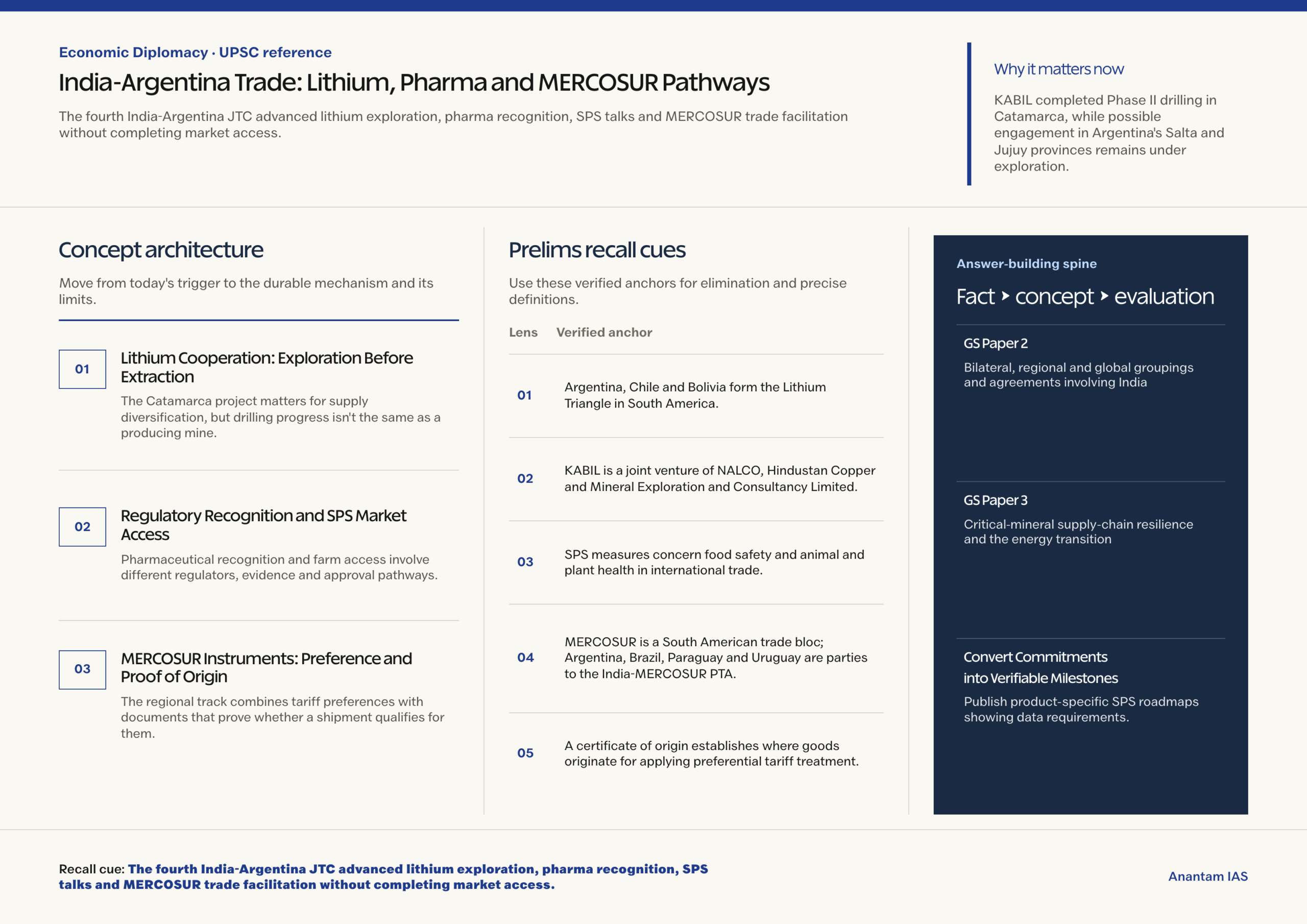
Mindmap explaining India-Argentina Trade: Lithium, Pharma and MERCOSUR Pathways for UPSC revision
Revision mindmap: India-Argentina Trade: Lithium, Pharma and MERCOSUR Pathways. Open the full-size image for details.

Background and Context

Lithium Cooperation: Exploration Before Extraction

The Catamarca project matters for supply diversification, but drilling progress isn’t the same as a producing mine. It is a staged risk-reduction process.

  • In 2024, KABIL secured exploration and exclusivity rights over five lithium-brine blocks through Catamarca’s state enterprise, CAMYEN. Exploitation rights depend on discovery, assessment and investment decisions, not drilling progress alone.
  • Phase II drilling produces geological evidence on a deposit’s continuity and quality. Drill cores and brine samples help map grade, depth and distribution before commercial viability is assessed.
  • A project must still pass resource assessment, feasibility, financing, environmental and provincial approvals before commercial extraction. Each stage can change project economics or halt development despite exploration success.
  • Overseas exploration can diversify India’s future access to battery minerals, but resilient supply also requires processing capacity, logistics and responsible sourcing. Upstream rights don’t supply refined battery material automatically.
  • Discussions concerning Salta and Jujuy are exploratory. The JTC release announced no signed mining projects there, and neither province is covered by the reported Catamarca drilling milestone.

Regulatory Recognition and SPS Market Access

Pharmaceutical recognition and farm access involve different regulators, evidence and approval pathways. Lower friction doesn’t mean removing safety checks.

  • Argentina’s promised work on moving India from Annex II to Annex I could reduce regulatory barriers, but the upgrade remains incomplete. Its effect depends on final Argentine rules.
  • The 2019 memorandum links Argentina’s ANMAT with India’s CDSCO. Regulator cooperation can improve information exchange and regulatory understanding, but it doesn’t automatically create mutual recognition.
  • An Annex-status change wouldn’t itself register every Indian medicine. Companies would still need to meet applicable quality, safety and efficacy requirements through product-specific, evidence-based applications.
  • SPS negotiations address food-safety, pest and disease risks through standards, inspection, certification, treatment and quarantine. WTO rules require a scientific basis, necessity and non-discrimination.
  • Talks cover onions, dairy products, grapes, potatoes, bananas and pulses. Argentina must still accept product-specific protocols before entry; technical discussion isn’t market authorization.

MERCOSUR Instruments: Preference and Proof of Origin

The regional track combines tariff preferences with documents that prove whether a shipment qualifies for them. Both functions must work for exporters to benefit.

  • The India-MERCOSUR Preferential Trade Agreement entered into force in 2009 and grants negotiated tariff preferences on a limited goods schedule, not all bilateral trade. A preference needn’t mean zero duty.
  • It is a PTA, not a comprehensive free trade agreement. Wider coverage or deeper preference margins require concluded negotiations and implementation; product schedules determine the commercial value for exporters in practice.
  • A certificate of origin verifies that goods meet agreed origin rules and qualify for a preference. It connects eligibility under the PTA with treatment at customs.
  • Digital certificates can shorten processing, improve traceability and reduce paper handling. They don’t alter tariffs or replace rules of origin; customs-system compatibility still matters for use.
  • Both sides advanced Terms of Reference and set a one-year negotiating objective. The terms organize future talks; they aren’t final concessions or a concluded PTA expansion.

Way Forward

Convert Commitments into Verifiable Milestones

  • Publish product-specific SPS roadmaps showing data requirements, competent authorities and pending technical steps for each agricultural export.
  • Define the legal steps and timeline for pharmaceutical Annex upgrading while preserving ANMAT’s regulatory safeguards and predictable applications for Indian firms.
  • Move lithium blocks through resource assessment and environmental scrutiny before treating exploration progress as supply security.
  • Complete MERCOSUR negotiations and make digital origin verification interoperable so tariff preferences become easier for legitimate exporters to claim.

Conclusion

  • The JTC’s value lies in four concrete pathways: lithium exploration, pharmaceutical recognition, SPS protocols and MERCOSUR trade facilitation. None is completed market access; formal implementation is the next evidence test.
  • In a Mains answer, use the case to show how India-Latin America relations combine resource security with regulatory and regional trade diplomacy, while separating announced commitments from delivered outcomes.

UPSC Practice Questions

Prelims MCQ 1

With reference to KABIL’s engagement in Argentina, consider the following statements:

  1. KABIL is a joint venture involving NALCO, Hindustan Copper and Mineral Exploration and Consultancy Limited.
  2. Its Catamarca engagement covers lithium-brine exploration blocks.
  3. Completion of Phase II drilling means commercial lithium production has begun.

How many of the above statements are correct?

(a) Only one (b) Only two (c) All three (d) None

Answer: (b) Only two

Explanation:

Statements 1 and 2 are correct. Phase II drilling is an exploration milestone; it doesn’t establish that commercial production has started.

Prelims MCQ 2

Which one of the following best describes sanitary and phytosanitary measures in international trade?

(a) Rules dealing with food safety and animal and plant health (b) Tariff preferences granted under a trade agreement (c) Exchange-rate controls applied to import payments (d) Patent rules governing pharmaceutical inventions

Answer: (a) Rules dealing with food safety and animal and plant health

Explanation:

The WTO SPS Agreement covers food-safety measures and measures protecting animal or plant life and health from specified risks.

UPSC Mains Questions

  1. India’s economic engagement with Latin America increasingly connects critical-mineral security with market-access diplomacy. Discuss with reference to India-Argentina relations.
  2. Non-tariff measures can matter as much as tariffs in determining actual export access. Examine with reference to SPS protocols, pharmaceutical regulation and certificates of origin.

Sources: PIB, Ministry of Commerce and Industry and Ministry of Foreign Affairs, Argentina.

Frequently Asked Questions

What was decided at the fourth India-Argentina Joint Trade Committee meeting?

The meeting advanced lithium exploration, product-wise SPS talks, work on India’s pharmaceutical regulatory status and MERCOSUR trade-facilitation instruments. It didn’t announce completed access across these tracks.

Has KABIL started commercial lithium mining in Argentina?

No. KABIL completed Phase II drilling in Catamarca. Drilling supports resource assessment, while commercial extraction still depends on feasibility, approvals, financing, infrastructure and further project decisions.

What does Argentina’s proposed pharmaceutical Annex upgrade mean?

Argentina committed to work towards moving India from Annex II to Annex I in its regulatory framework. The change could reduce barriers, but it isn’t complete or automatic product approval.

Why are SPS discussions necessary for agricultural exports?

Importing countries use SPS rules to manage food-safety, pest and disease risks. Product-specific evidence, inspection, treatment, certification or quarantine conditions may be settled before access is granted.

How do digital certificates of origin support India-MERCOSUR trade?

They provide electronic proof that goods meet agreed origin rules for tariff preferences. Digital processing can reduce paperwork and improve traceability without changing tariff concessions by itself.

Access to FIRs: The Accused’s Rights Under BNSS

Open article →Download PDF

Why in News?

On 25 August 2026, the Supreme Court directed Ghaziabad Police to supply journalist Abhishek Upadhyay the FIR against him and granted interim protection from coercive action.

  • The case was W.P. (Crl.) No. 339/2026; the Court enabled the petitioner to seek suitable relief after receiving the FIR.
  • The episode highlights a statutory gap: BNSS Section 173(2) immediately serves the informant or victim, not expressly the accused.
  • Section 230 BNSS supplies the accused an FIR and other prosecution papers later, after a police-report case reaches the Magistrate.
  • Early access during investigation is principally protected by judicial directions, especially Youth Bar Association of India v. Union of India (2016).
  • Knowing the allegations allows an accused to seek legal advice and pursue pre-arrest bail, oppose remand or challenge coercive action before liberty is curtailed.
  • The key exam trap is to separate an accused’s route to a certified copy from the broader rule requiring non-sensitive FIRs to be uploaded publicly.

UPSC Relevance

Prelims Relevance

  • Section 173(2) BNSS gives a free copy of recorded information forthwith to the informant or victim.
  • Section 230 BNSS requires the Magistrate to supply the accused specified documents, including the FIR, within 14 days of production or appearance.
  • In Youth Bar Association, the Supreme Court required ordinary FIRs to be uploaded within 24 hours, subject to limited extensions for connectivity difficulties.
  • A sensitive-FIR non-upload decision must be taken by an officer not below Deputy Superintendent of Police or equivalent rank.
  • Non-upload of an FIR doesn’t by itself create an automatic entitlement to anticipatory bail.

Mains Relevance

GS Paper 2

  • Structure, organization and functioning of the judiciary and police administration
  • Fundamental rights, fair procedure and institutional accountability in criminal investigation

GS Paper 4

  • Transparency, privacy and exercise of discretion by public authorities

Essay

  • Procedural fairness matters most at the stage when State power first places personal liberty at risk.
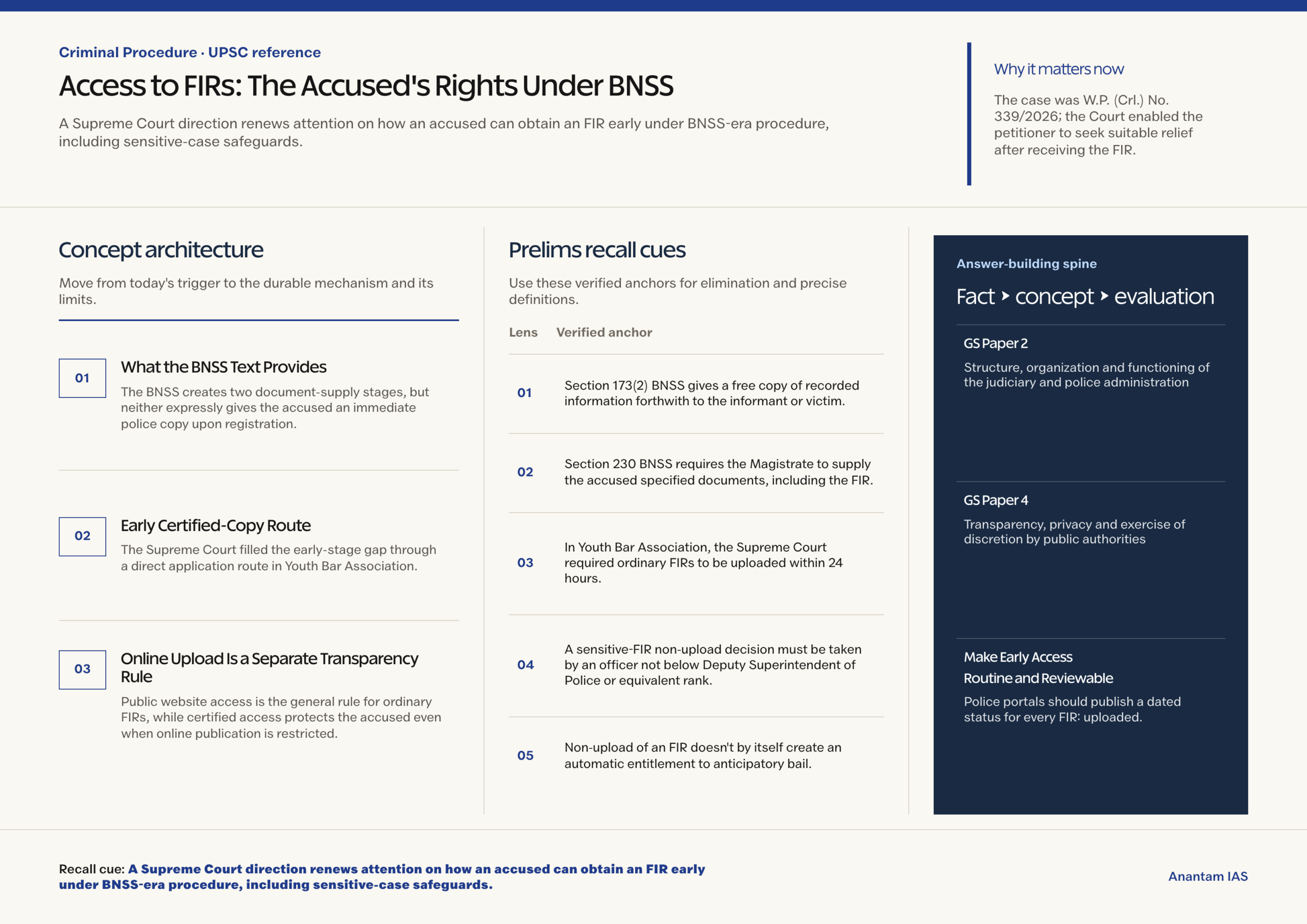
Mindmap explaining Access to FIRs: The Accused's Rights Under BNSS for UPSC revision
Revision mindmap: Access to FIRs: The Accused's Rights Under BNSS. Open the full-size image for details.

Background and Context

What the BNSS Text Provides

The BNSS creates two document-supply stages, but neither expressly gives the accused an immediate police copy upon registration.

  • Under Section 173(2), the police must give the recorded information forthwith and free of cost to the informant or victim. The accused isn’t named.
  • Section 230 applies when proceedings are instituted on a police report and the accused is produced before or appears before the Magistrate.
  • The Magistrate must furnish the FIR, police report, proposed witness statements, recorded confessions or statements and other forwarded documents free of cost.
  • This supply must occur without delay and no later than 14 days from the accused’s production or appearance. Electronic supply counts as furnishing.
  • Section 230 is a later case-paper disclosure safeguard. It doesn’t replace the need to know the accusation while investigation and arrest risk are live.

Early Certified-Copy Route

The Supreme Court filled the early-stage gap through a direct application route in Youth Bar Association.

  • A person who reasonably suspects being named may apply through a representative to the police officer concerned or Superintendent of Police for a certified FIR copy.
  • On that application and payment of the prescribed court-copy fee, the police route must supply the copy within 24 hours.
  • Once police forward the FIR to the Magistrate or Special Judge, the accused may apply there; the court should provide a certified copy within two working days.
  • These routes are distinct from Section 230’s later bundle of prosecution documents. They let the accused understand the case while pre-trial remedies still matter.
  • An FIR can inform applications for anticipatory bail, arguments against remand and other lawful protection. It doesn’t prove guilt or determine the remedy’s outcome.

Online Upload Is a Separate Transparency Rule

Public website access is the general rule for ordinary FIRs, while certified access protects the accused even when online publication is restricted.

  • Youth Bar Association directed police or State websites to upload non-sensitive FIRs within 24 hours, generally extendable for unavoidable or geographical connectivity problems.
  • Sexual offences, POCSO, terrorism, insurgency and privacy-sensitive matters illustrate the non-exhaustive category that may be withheld from public online publication.
  • The non-upload decision requires an officer of at least DSP-equivalent rank and must be communicated to the jurisdictional Magistrate.
  • An identified aggrieved person may approach the SP or Police Commissioner. A three-officer committee must decide the grievance within three days.
  • Even in a sensitive case, the accused may seek a certified copy from the court receiving the FIR, to be provided within three days. Prior public upload isn’t required.

Way Forward

Make Early Access Routine and Reviewable

  • Police portals should publish a dated status for every FIR: uploaded, delayed for connectivity or withheld through a reasoned sensitive-case decision.
  • Police stations and courts should offer a trackable certified-copy application with receipts, deadlines and electronic delivery where legally permissible.
  • Training should distinguish public disclosure from accused access so privacy protection doesn’t become a blanket reason to deny procedural fairness.
  • Courts should record non-supply early and grant case-specific relief without treating website failure alone as automatic grounds for anticipatory bail.

Conclusion

  • The durable distinction is simple: Section 173(2) serves the informant or victim, Section 230 supplies later case papers, and Youth Bar Association enables earlier accused access.
  • A strong Mains answer should balance personal liberty and fair procedure with victim privacy, using reasoned withholding and prompt certified-copy routes rather than blanket secrecy.

UPSC Practice Questions

Prelims MCQ 1

With reference to access to a First Information Report under the BNSS and Supreme Court directions, consider the following statements:

  1. Section 173(2) BNSS expressly requires the police to give the accused a free FIR copy forthwith.
  2. Section 230 BNSS includes the FIR among documents to be furnished by the Magistrate in a police-report case.
  3. An accused may seek a certified copy from the court after the FIR has been forwarded there.

How many of the above statements are correct?

(a) Only one (b) Only two (c) All three (d) None

Answer: (b) Only two

Explanation:

Statements 2 and 3 are correct. Section 173(2) names the informant or victim, while early accused access is secured through judicial certified-copy directions.

Prelims MCQ 2

Which one of the following correctly describes the sensitive-FIR safeguard in Youth Bar Association of India v. Union of India?

(a) A sensitive FIR can never be supplied to the accused (b) Any investigating officer may withhold it online without recording institutional responsibility (c) Online publication may be withheld through the prescribed process, while the accused may still seek a certified court copy (d) Failure to upload automatically entitles the accused to anticipatory bail

Answer: (c) Online publication may be withheld through the prescribed process, while the accused may still seek a certified court copy

Explanation:

The judgment protects sensitive information from routine public upload but preserves a court-based certified-copy route for the accused.

UPSC Mains Questions

  1. The right of an accused to know the allegations cannot depend entirely on public website disclosure. Examine the BNSS provisions and judicial safeguards governing early access to FIRs.
  2. How can criminal procedure reconcile transparency, personal liberty and victim privacy when an FIR is classified as sensitive? Discuss with reference to institutional safeguards.

Sources: The Hindu Explains and Supreme Court of India, Youth Bar Association order.

Frequently Asked Questions

Does Section 173(2) BNSS give the accused an immediate FIR copy?

No. It requires a free copy forthwith for the informant or victim. Early accused access during investigation rests mainly on judicial directions for certified copies.

When does Section 230 BNSS require supply of the FIR?

In a police-report case, the Magistrate must furnish the accused specified papers, including the FIR, within 14 days from the accused’s production or appearance.

Must every FIR be uploaded publicly within 24 hours?

The general rule covers non-sensitive FIRs, subject to limited connectivity extensions. Sensitive matters involving privacy, sexual offences, POCSO, terrorism or insurgency may follow the withholding process.

Can an accused obtain a sensitive FIR that isn’t online?

Yes. The accused or authorized representative may apply to the court receiving the FIR for a certified copy, which Youth Bar Association says should come within three days.

Does non-upload of an FIR automatically justify anticipatory bail?

No. The Supreme Court expressly rejected an automatic benefit on that ground. A court considers the governing bail provision and the case’s facts independently.

India-Nepal Power Trade: Flood Damage Reverses Seasonal Electricity Flows

Open article →Download PDF

Why in News?

On 30 August 2026, Nepal was reported to have requested earlier approval to import electricity from India after floods reduced its hydropower availability.

  • Nepal normally seeks Indian electricity around October, when falling river flows begin reducing dry-season hydropower output; this request sought imports from September.
  • Indian authorities were reported to be processing the request under the existing cross-border framework. A pending request isn’t an approved supply arrangement or a confirmed delivery schedule.
  • Preliminary assessments cited by officials suggested about 550 MW of generation loss and export flows roughly 400 MW below earlier peak levels; these aren’t audited final figures.
  • India was reported to have enough reserve capacity to replace the lower Nepalese inflow without exceptional procurement, supply disruption or loss of domestic grid stability.
  • The episode turns a bilateral transmission link into a resilience instrument: scheduled power can move toward the system facing a temporary shortage instead of remaining locked behind a border.
  • It also exposes concentration risk. When one generation source dominates, a common shock can reduce several plants together, shrink firm supply and abruptly reverse a country’s trade position.
  • For India, the test is not merely imported energy volume but whether dispatchable reserves can cover the shortfall while operators keep frequency, voltage and domestic supply stable.

UPSC Relevance

Prelims Relevance

  • India-Nepal electricity trade is bidirectional: Nepal usually exports monsoon surplus and imports during the drier months when hydropower generation declines.
  • The 2014 power-trade agreement covers electricity trade, cross-border transmission interconnection and grid connectivity between India and Nepal.
  • India’s 2018 cross-border electricity guidelines provide the regulatory basis for imports and exports; transactions require the prescribed approval and facilitation process.
  • Hydropower output depends on usable water flow, while storage-backed or dispatchable resources can supply electricity when variable output falls.
  • A grid’s reserve capacity is generation or demand response that can be brought into service to meet an unexpected supply-demand gap.

Mains Relevance

GS Paper 2

  • India and its neighborhood: bilateral agreements, energy interdependence and the role of infrastructure in crisis response.
  • Regional cooperation through rules-based electricity markets, coordinated system operation and mutually beneficial transmission connectivity.

GS Paper 3

  • Infrastructure and energy security: reserve margins, dispatch flexibility and cross-border grids as buffers against supply shocks.
  • Disaster management: reducing correlated infrastructure risk where several generating assets share the same river basin or hazard exposure.

Essay

  • Interdependence becomes strategic resilience when institutions allow shared infrastructure to reverse direction during a crisis.
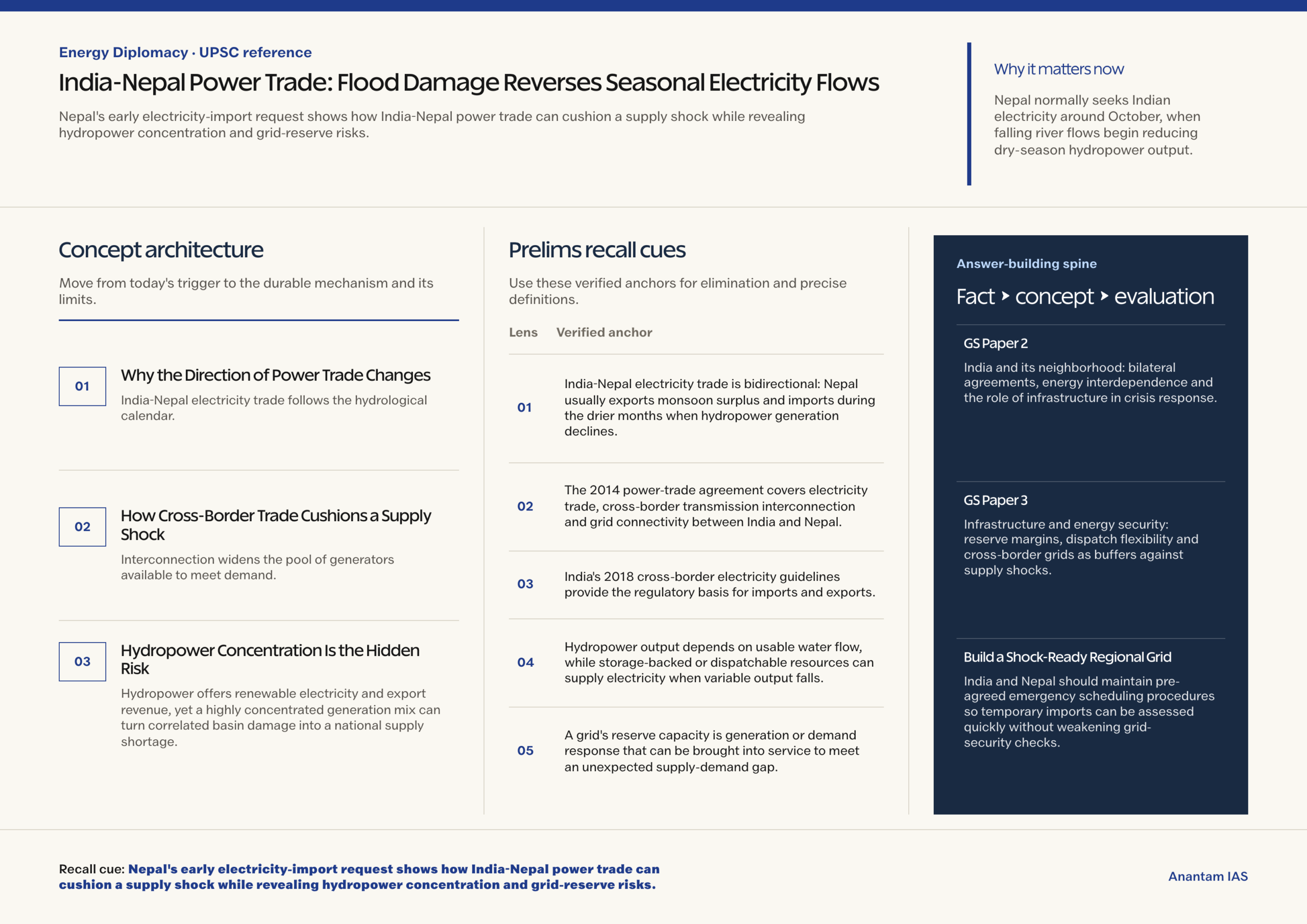
Mindmap explaining India-Nepal Power Trade: Flood Damage Reverses Seasonal Electricity Flows for UPSC revision
Revision mindmap: India-Nepal Power Trade: Flood Damage Reverses Seasonal Electricity Flows. Open the full-size image for details.

Background and Context

Why the Direction of Power Trade Changes

India-Nepal electricity trade follows the hydrological calendar, so the same transmission corridor can carry seasonal surplus outward and later bring support inward.

  • During the monsoon, stronger river flows raise Nepal’s hydropower output. Electricity beyond domestic demand can then enter the Indian market and earn export revenue.
  • During the dry season, weaker flows reduce output from run-of-river plants. Nepal then imports electricity to bridge its domestic supply-demand gap as firm availability falls.
  • Flood damage advanced this normal reversal. The important change was timing, not a new trade channel, because the corridor already supported movement in both directions.
  • A bidirectional line works like a shared reserve corridor: it carries power toward the system facing scarcity, subject to available capacity and secure operating schedules.
  • Commercial schedules still depend on available transmission capacity, approved transactions and secure grid operation at each interconnection; physical connectivity alone doesn’t guarantee electricity delivery.

How Cross-Border Trade Cushions a Supply Shock

Interconnection widens the pool of generators available to meet demand, but system operators must still balance supply and consumption continuously across both grids.

  • When Nepalese output falls, approved imports can substitute electricity from the Indian grid without waiting for damaged generating units and their evacuation lines to return.
  • India simultaneously receives less imported hydropower. Its own reserve capacity must replace that energy while keeping generation and demand matched in real time.
  • Reserves matter because electricity systems cannot store every unit at grid scale; operators must activate flexible generation or demand response when scheduled supply disappears.
  • A cross-border grid spreads risk only when the connected system has spare generation, operating flexibility, approval to schedule supply and transmission headroom at the required time.
  • Nepal’s request and India’s reported reserve position are linked: one system seeks support while the other assesses safe supply, domestic adequacy and network constraints.

Hydropower Concentration Is the Hidden Risk

Hydropower offers renewable electricity and export revenue, yet a highly concentrated generation mix can turn correlated basin damage into a national supply shortage.

  • Several plants can share the same river system, access roads, substations and transmission corridors. One regional shock may impair both generation and power-evacuation infrastructure together.
  • Installed capacity isn’t the same as firm capacity, meaning power reliably available during stressed conditions. Seasonal water, outages and damaged transmission change what operators can dispatch.
  • Run-of-river projects have less ability than large storage plants to shift water and generation across time, increasing exposure to seasonal variation.
  • Diversification doesn’t mean abandoning hydropower. It means combining it with storage, solar, stronger transmission and import contracts that preserve firm supply during low-output or repair periods.
  • The exam trap is to treat cross-border trade as permanent dependence. Properly designed, it is a reciprocal balancing arrangement whose direction changes with supply conditions.

Way Forward

Build a Shock-Ready Regional Grid

  • India and Nepal should maintain pre-agreed emergency scheduling procedures so temporary imports can be assessed quickly without weakening grid-security checks.
  • Joint planning should map common-mode failures, where generation, substations, roads and transmission lines can be disabled by the same event.
  • Nepal should diversify firm supply through storage, complementary renewables and flexible contracts while repairing hydropower assets to higher resilience standards.
  • System operators should share real-time availability, outage and river-flow information so reserve deployment and cross-border schedules rest on the same operating picture.

Conclusion

  • India-Nepal power trade shows that regional connectivity is most valuable when electricity can reverse direction as seasonal surplus becomes temporary scarcity.
  • A strong Mains answer should connect energy diplomacy with reserve capacity, diversified generation and approval-based grid operation, rather than treating transmission links as sufficient resilience.

UPSC Practice Questions

Prelims MCQ 1

With reference to India-Nepal electricity trade, consider the following statements:

  1. Nepal generally exports surplus electricity during the monsoon and imports electricity during the drier months.
  2. A request for cross-border electricity imports automatically becomes an approved transaction once submitted.
  3. Reserve capacity can help a connected grid replace an unexpected reduction in imported electricity.

How many of the above statements are correct?

(a) Only one (b) Only two (c) All three (d) None

Answer: (b) Only two

Explanation:

Statements 1 and 3 are correct. Cross-border transactions follow an approval and facilitation framework; submitting a request doesn’t itself amount to approval.

Prelims MCQ 2

Which one of the following best explains hydropower concentration risk in an electricity system?

(a) Hydropower plants cannot connect to regional electricity markets (b) A common river-basin shock can reduce output from several plants at the same time (c) Hydropower always produces more electricity in the dry season (d) Cross-border transmission permits electricity to flow in only one direction

Answer: (b) A common river-basin shock can reduce output from several plants at the same time

Explanation:

Generation concentrated in hydropower assets with shared geographic exposure can suffer correlated outages, creating a larger system-wide shortfall.

UPSC Mains Questions

  1. Cross-border electricity trade can convert regional interdependence into a buffer against climate-related supply shocks. Discuss with reference to India-Nepal power cooperation.
  2. Hydropower-led energy transitions require both regional grids and domestic generation diversification. Critically examine.

Sources: The Indian Express and Central Electricity Authority.

Frequently Asked Questions

Why does Nepal both export electricity to and import electricity from India?

Nepal’s hydropower output rises with monsoon river flows, creating exportable surplus, but declines in drier months. The same cross-border network can then carry Indian electricity into Nepal.

Did India approve Nepal’s request for earlier electricity imports?

No approval was reported in the source. Nepal requested earlier approval, and Indian authorities were reported to be processing that request under the existing cross-border electricity framework.

What is reserve capacity in a power grid?

Reserve capacity is generation or demand response that can be activated when scheduled supply falls or demand rises unexpectedly, helping operators maintain the continuous balance required for grid stability.

Why is dependence on hydropower a concentration risk?

Hydropower assets may share river basins, roads and transmission corridors. Seasonal low flows or one regional shock can reduce several plants together, cutting firm electricity availability.

How can cross-border electricity trade improve disaster resilience?

It gives an affected country access to generators outside the damaged area. The benefit depends on spare generation, transmission headroom, approvals and coordination between system operators.

US-Venezuela Oil Deal: Why Heavy Sour Crude Still Matters

Open article →Download PDF

Why in News?

On 28 August 2026, the US administration announced an oil arrangement with Venezuela, but its binding legal and commercial terms weren’t publicly established.

  • The US announcement described access to fields containing 65 billion barrels; this was an announced reserve estimate, not proof that the United States owns underground Venezuelan oil.
  • Venezuela’s government presented the arrangement as development of 17 fields that could attract investment and public revenue; those outcomes remain projections.
  • An unnamed US official cited in reporting described 55% effective output for a new venture. Without published contracts, this shouldn’t be treated as settled ownership or control.
  • The commercial logic centres on heavy sour crude, a feedstock suited to complex US Gulf Coast refineries but harder to extract, move and process than light sweet oil.
  • The announcement sits within an evolving OFAC licensing framework, so sanctions authorization and the oil agreement must be analysed as related but separate instruments.
  • A large reserve figure says little about near-term supply unless fields have investment, diluent, electricity, transport, upgrading capacity and legally secure operating arrangements.
  • The case links energy security with resource sovereignty: refinery demand can create interdependence without transferring a state’s ownership of subsoil resources.
  • For India, the durable lesson is that import diversification must consider crude quality and refinery fit, not only supplier country or headline price.

UPSC Relevance

Prelims Relevance

  • API gravity measures petroleum density inversely: lower API gravity generally indicates heavier crude.
  • Sour crude has higher sulfur content than sweet crude and needs additional desulfurization.
  • Complex refineries use units such as cokers, hydrocrackers and desulfurization plants to process difficult feedstock.
  • Venezuela is an OPEC member and the Orinoco Oil Belt is associated with extra-heavy petroleum resources.
  • OFAC general licences authorize specified transactions otherwise restricted by US sanctions; they aren’t the same as removing the sanctions programme.

Mains Relevance

GS Paper 2

  • Effect of unilateral sanctions and licensing on international economic relations
  • Resource sovereignty, contractual transparency and asymmetry between states

GS Paper 3

  • Energy security through crude-quality diversification and refinery compatibility
  • Infrastructure, technology and investment constraints on converting reserves into production

Essay

  • Natural-resource abundance becomes strategic power only when institutions, infrastructure and technology can convert geological wealth into accountable production.
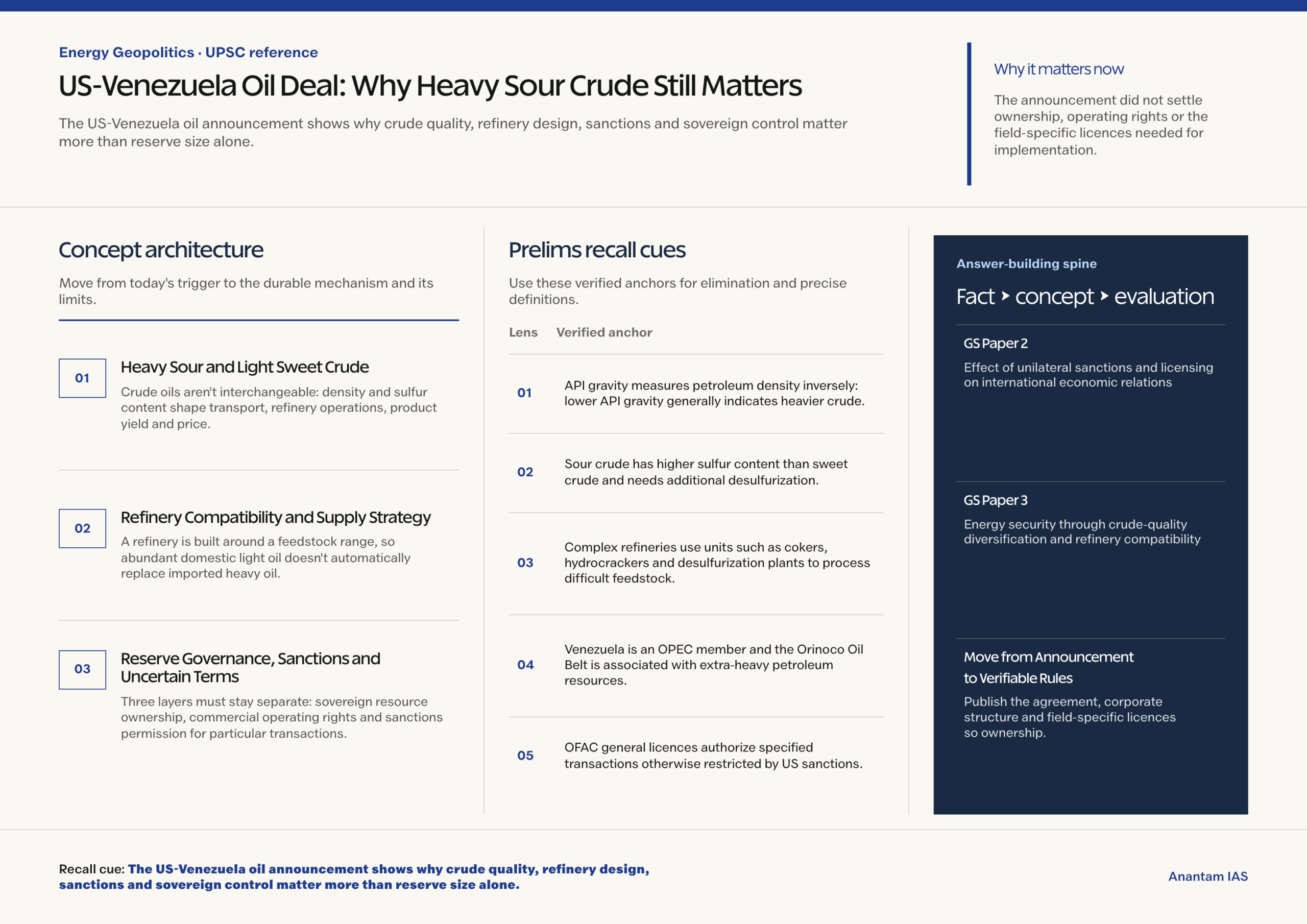
Mindmap explaining US-Venezuela Oil Deal: Why Heavy Sour Crude Still Matters for UPSC revision
Revision mindmap: US-Venezuela Oil Deal: Why Heavy Sour Crude Still Matters. Open the full-size image for details.

Background and Context

Heavy Sour and Light Sweet Crude

Crude oils aren’t interchangeable: density and sulfur content shape transport, refinery operations, product yield and price.

  • API gravity is an inverse density scale. Lower readings indicate heavier oil containing more large hydrocarbon molecules, while higher readings indicate lighter oil that generally flows and distils more easily.
  • Sour crude contains more sulfur compounds. Refiners must remove sulfur to meet product standards and protect equipment, adding hydrogen demand, processing stages, energy use and operating cost.
  • Light sweet oil yields a larger share of valuable products through simpler distillation. Heavy sour oil leaves more residue unless a refinery has equipment that can break or upgrade large molecules.
  • Venezuelan production is predominantly medium, heavy or extra-heavy and sour. Some streams need diluent, a lighter petroleum mixed in to make very dense crude easier to transport.
  • The common trap is to equate poor quality with useless oil. Heavy sour grades can be valuable when discounted enough and matched with a refinery designed to convert them efficiently.

Refinery Compatibility and Supply Strategy

A refinery is built around a feedstock range, so abundant domestic light oil doesn’t automatically replace imported heavy oil.

  • US shale production is largely light crude, while several Gulf Coast plants invested in cokers, hydrocrackers and sulfur-removal units to process heavier imported barrels from the Americas.
  • A coker converts low-value residual material into lighter products and petroleum coke. Without such conversion capacity, a refinery gets less high-value output from a heavy barrel.
  • Running a complex plant mainly on light sweet crude can leave expensive conversion units underused. The refinery may prefer discounted heavy feedstock even when the country produces plenty of lighter oil.
  • Venezuelan barrels can complement rather than simply displace US output. Their strategic value comes from matching installed machinery, geography and product demand, not from reserve volume alone.
  • But refinery fit doesn’t guarantee quick supply. Field decline, unreliable power, damaged infrastructure, financing limits and the need for diluent can delay production long after a political announcement.

Reserve Governance, Sanctions and Uncertain Terms

Three layers must stay separate: sovereign resource ownership, commercial operating rights and sanctions permission for particular transactions.

  • A reserve is oil judged recoverable under stated economic and technical conditions. It isn’t a stockpile ready for shipment, and a development right isn’t automatically ownership of petroleum underground.
  • The announced 65-billion-barrel scope and reported majority role came from US accounts. Venezuela framed the same arrangement around field development, investment and national fiscal gains.
  • Those descriptions may coexist, but they don’t settle who owns assets, bears costs, appoints managers, markets output, resolves disputes or absorbs losses. Published legal instruments would be needed.
  • OFAC general licences are conditional regulatory permissions for defined dealings involving Venezuelan oil, services or PdVSA. Their amendment doesn’t by itself validate every contract or erase all sanctions restrictions.
  • The governance test is whether future contracts disclose authority, revenue allocation, environmental duties, audit rights and dispute settlement while remaining consistent with Venezuelan law and credible public oversight.

Way Forward

Move from Announcement to Verifiable Rules

  • Publish the agreement, corporate structure and field-specific licences so ownership, operating control and purchase rights can be assessed separately.
  • Align each transaction with current OFAC authorizations, due-diligence duties and anti-corruption safeguards instead of treating political approval as blanket sanctions clearance.
  • Use independent reserve audits, costed infrastructure plans and realistic production schedules before converting resources into supply or revenue forecasts.
  • Protect Venezuela’s public interest through transparent revenue reporting, environmental liabilities, legislative scrutiny and enforceable dispute-resolution provisions.

Conclusion

  • The durable energy lesson is compatibility before quantity: heavy sour crude remains valuable because complex refineries are configured to convert it, even when light oil is abundant.
  • In a Mains answer, separate geological reserves, sovereign ownership, operating rights and sanctions licences. The announced US-Venezuela arrangement remains a case of strategic potential with unsettled terms.

UPSC Practice Questions

Prelims MCQ 1

With reference to crude-oil quality and refining, consider the following statements:

  1. Lower API gravity generally indicates heavier crude oil.
  2. Sour crude requires additional sulfur-removal processing.
  3. A coker helps convert heavy residual material into lighter products.

How many of the above statements are correct?

(a) Only one (b) Only two (c) All three (d) None

Answer: (c) All three

Explanation:

All three are correct. API gravity indicates density inversely, sour crude has more sulfur-processing needs, and cokers upgrade heavy refinery residue.

Prelims MCQ 2

Why can a complex US Gulf Coast refinery prefer imported heavy sour crude despite abundant domestic light crude?

(a) Heavy crude needs no sulfur treatment (b) Its installed conversion units can profitably process discounted heavy feedstock (c) Light crude cannot produce transport fuels (d) Heavy crude is always cheaper to extract

Answer: (b) Its installed conversion units can profitably process discounted heavy feedstock

Explanation:

Complex refineries have cokers, hydrocrackers and desulfurization capacity designed to extract value from heavier, higher-sulfur feedstock.

UPSC Mains Questions

  1. Crude-oil quality and refinery configuration are as important as reserve volume in shaping energy security. Discuss with reference to heavy sour and light sweet crude.
  2. Resource agreements involving sanctioned states sit at the intersection of sovereignty, commercial law and geopolitical power. Critically examine with reference to the announced US-Venezuela oil arrangement.

Sources: Indian Express Explained and U.S. Energy Information Administration.

Frequently Asked Questions

What is heavy sour crude oil?

It is dense petroleum with relatively high sulfur content. It flows and refines less easily than light sweet crude, but complex refineries can convert it into valuable fuels and products.

Why do some US refineries want Venezuelan crude?

Several Gulf Coast refineries have cokers, hydrocrackers and sulfur-removal units built for heavy feedstock. Venezuelan grades can match this equipment better than abundant domestic light crude.

Does the announced deal mean the United States owns Venezuelan reserves?

No published agreement establishes that conclusion. US accounts described majority control or output rights, while Venezuela emphasized development and investment. Underground ownership and commercial rights must be assessed separately.

What role do US sanctions play in Venezuelan oil trade?

OFAC general licences authorize defined transactions that sanctions would otherwise restrict. The scope, conditions and counterparties matter; a licence isn’t blanket removal of the Venezuela sanctions programme.

Can the deal quickly increase global oil supply?

Not necessarily. Heavy-oil production needs capital, diluent, power, functioning fields, transport and refinery access. Unpublished commercial terms and legal uncertainty can slow investment further.