Opens in a new tab
Join Anantam IAS Channel on Telegram

Daily Digest · Wednesday

4 November 2026 Current Affairs for UPSC

8 current affairs published on Wednesday, 4 November 2026

4 November 2026 Current Affairs for UPSC — every Why-in-News article AnantamIAS published on Wednesday, 4 November 2026, broken down with Why in News?, the exact GS paper it feeds, sub-topic mapping, MCQ-ready facts and a UPSC-style practice question. 8 articles in total, covering Polity, Economy, Environment, S&T, IR, Geography, History, Society and Internal Security — the same Why-in-News + GS-paper-mapping + practice-question format the Compass uses across every daily digest on the site.

Daily current affairs for UPSC is where new material enters your prep stream. Read this 4 November 2026 digest end-to-end in 25–35 minutes, attempt the practice question at the foot of each article (it's MCQ for some, 10/15-marker for others), then bookmark the entries that fall inside your active revision window. Everything stays cross-linked: tap any subject pill to jump to that subject's hub, or use the table of contents above to skip straight to a specific story.

Use this page three ways. Read sequentially for a one-sitting scan of everything that mattered on 4 November 2026. Download the 4 November 2026 PDF below for offline study or print revision. Or use the November 2026 Current Affairs compilation to see this day in the month's full context. For the previous day's reading, see 3 November 2026 Current Affairs; the next day's is 5 November 2026 Current Affairs.

Why we publish daily current affairs separately from the monthly compilation: daily is learning, monthly is revision. Use the daily page to add fresh material to your notes the day it breaks; come back to the November 2026 compilation 60 days before Prelims when the noise has settled and only the lasting takeaway is worth re-reading.

Drug Batch Release: Assigning Responsibility for Quality Decisions

Open article →Download PDF

Why in News?

On 3 November, the Union Health Ministry proposed amending the Drugs Rules, 1945, to require manufacturers to formally authorise a qualified person to release drug batches.

  • Licence applicants would designate a person with appropriate qualifications and experience for batch release.
  • Manufacturers would maintain release records for every batch manufactured.
  • The proposal includes a prescribed format for a Batch Release Certificate. The ministry invited objections and suggestions.
  • A batch can have laboratory results and manufacturing records held by different teams. Batch release brings the relevant evidence together before distribution.
  • Naming the person empowered to decide makes a later quality investigation easier to direct.

UPSC Relevance

Prelims Relevance

  • Drugs Rules, 1945 and manufacturing licences
  • Good Manufacturing Practices (GMP) and quality assurance
  • Batch testing and release authorisation
  • Consultation on a proposed amendment

Mains Relevance

GS Paper 2

  • Accountability in pharmaceutical regulation
  • Preventive oversight in public health

Background and Context

What a Batch Release Decision Covers

Batch release is the decision that a particular production batch can enter distribution after a review of its quality and the records behind it.

  • A laboratory result answers a defined question about a sample. Someone reviewing the batch must also establish which production batch the result belongs to and what other relevant evidence accompanies it.
  • Suppose a test result falls within the specified range but the batch reference on the report differs from the manufacturing record. The identity mismatch makes an otherwise satisfactory result insufficient evidence for that batch.
  • The overall review connects evidence about manufacture and testing to the decision on distribution. This is why the ministry describes batch release as a separate responsibility within the pharmaceutical manufacturing process.
  • The decision concerns a particular batch. A satisfactory review of an earlier batch of the same medicine cannot establish the quality of a later batch that has its own production and testing history.

Who Would Hold Release Authority?

The ministry identified a gap in the information that manufacturing licence applicants provide about their technical staff.

  • Existing licence requirements seek details of competent technical staff responsible for manufacture and testing. The ministry says the rules lack a specific provision for mentioning the person authorised to undertake the release decision.
  • Under the proposal, the manufacturer would formally authorise a suitably qualified and experienced person. The applicant would identify the person responsible for release when seeking a licence under the relevant provisions.
  • The distinction matters when several staff contribute to one batch. A person who records a test supplies evidence. Formal authorisation tells the manufacturer and a subsequent reviewer who may make the overall decision.
  • The ministry describes a manufacturer-level responsibility. Its proposal would allow an inspector examining a batch to identify the authorised decision-maker without having to infer that role from a list of laboratory or production staff.

How a Certificate Supports Traceability

Naming a person establishes authority. Keeping records for each batch makes the exercise of that authority open to later examination.

  • A licence application identifies who may take a release decision. A batch-specific record serves a different purpose because it allows an investigator to examine an individual decision after the medicine enters distribution.
  • A prescribed certificate format would give manufacturers a common way to record release. Its practical value depends on whether the underlying quality records can be retrieved and matched to the batch under review.
  • Consider a complaint received after distribution. The batch record gives the investigator a starting point for reconstructing what evidence was available before release. The complaint itself still requires investigation to establish its cause.
  • The ministry expects the measure to support compliance with Good Manufacturing Practices. Documentation can expose a missing review or an unexplained discrepancy. Its quality depends on the checks performed before the certificate is completed.

Way Forward

Make the Decision Reconstructible

  • Link the batch identifier across the release record and the manufacturing and test records examined.
  • Define who can resolve discrepancies and how the reviewer should record the resolution before release.
  • Check a sample of completed records to see whether another reviewer can reconstruct the basis for release.

Conclusion

  • The proposed change joins two questions in drug quality assurance. Who was empowered to decide that a batch could enter distribution, and can the manufacturer show the evidence behind that decision?
  • Distinguish the existing requirement to identify manufacturing and testing staff from the proposed requirement governing release personnel and records. The ministry announcement describes amendments open for comment.

UPSC Practice Questions

Prelims MCQ 1

With reference to the proposed drug batch release framework, consider the following statements:

  1. The manufacturer would formally authorise a suitably qualified person for batch release.
  2. A Batch Release Certificate would replace the need to review relevant quality documentation.
  3. The proposed amendments include a prescribed certificate format.

How many of the above statements are correct?

(a) Only one (b) Only two (c) All three (d) None

Answer: (b) Only two

Explanation:

Statements 1 and 3 reflect the proposal. The certificate records a release decision based on a review of quality parameters and documentation.

Prelims MCQ 2

Which function most directly distinguishes batch release from a laboratory test?

(a) Measuring one specified property of a sample (b) Recording the temperature of an instrument (c) Reviewing the combined quality evidence before permitting distribution (d) Allocating medicines among retail pharmacies

Answer: (c) Reviewing the combined quality evidence before permitting distribution

Explanation:

Batch release brings the relevant records and quality parameters together to decide whether a specific batch can enter distribution.

UPSC Mains Questions

  1. How could formal designation of a person responsible for batch release strengthen accountability in pharmaceutical manufacturing?
  2. Discuss the value and limitations of a standard batch release certificate as a public health safeguard.

Source: Ministry of Health and Family Welfare, PIB.

Frequently Asked Questions

What is drug batch release?

It is the decision that a particular batch may enter distribution after an overall review of the relevant quality parameters and documentation from its manufacture and testing.

Who would designate the release decision-maker?

Under the proposed amendments, the manufacturer would authorise a person with suitable qualifications and experience. Applicants seeking a manufacturing licence under the relevant provisions would designate that person.

Why keep a record for every batch?

Each batch has its own manufacturing and testing history. A separate record helps an investigator identify the decision for that batch and examine what supported its release.

Has the proposed change taken effect?

The 3 November ministry announcement invited objections and suggestions on proposed amendments to the Drugs Rules, 1945. It describes the requirements the ministry seeks to introduce.


COP31 Climate Finance: What India Wants From the Negotiations

Open article →Download PDF

Why in News?

On November 3, India outlined its COP31 negotiating position ahead of the Antalya meeting, calling for predictable climate finance and protection against additional debt for developing countries.

  • India wants parties to agree in Antalya to start a Climate Finance Work Programme. The environment ministry presented this as a decision India will seek at the talks.
  • India wants adaptation indicators to remain voluntary so a country’s ability to measure climate risks does not determine whether it can receive money to address them.
  • The ministry linked support for agricultural adaptation to food security and the livelihoods of small and marginal farmers, whose needs may differ substantially even within one country.
  • A government can identify a sound adaptation project yet struggle to finance it on commercial terms. The cost of borrowing matters alongside the amount offered.
  • When negotiators discuss national circumstances, the practical questions include who chooses the investment, who bears its financing costs and how the recipient will measure success.

UPSC Relevance

Prelims Relevance

  • Article 9.1 covers assistance for mitigation and adaptation.
  • Concessional finance offers more favourable terms than market borrowing.
  • Nationally determined contributions set out countries’ climate commitments.
  • The global stocktake assesses collective progress under the Paris Agreement.

Mains Relevance

GS Paper 3

  • Assess how financing terms affect adaptation in agriculture.
  • Explain why measurement of resilience varies across locations.

GS Paper 2

  • Distinguish a treaty obligation from a negotiating demand.

Essay

  • Who bears the cost of adapting to a changing climate?

Background and Context

What the Paris Agreement requires

Article 9 identifies both the providers and the recipients of financial assistance.

  • Under Article 9.1, developed country parties must provide financial resources to help developing country parties address both emissions and the effects of climate change, continuing their obligations under the climate convention.
  • Mitigation tackles the causes of warming, for example by replacing fossil electricity with renewable power. Adaptation reduces exposure or vulnerability to harm, for example by improving drainage on flood-prone farmland.
  • India invokes the existing finance obligation as the basis for its demand. Its preference for largely public, concessional support concerns how countries should deliver that assistance in practice.
  • A decision to establish a work programme would give parties a framework for further work on finance. Equating that decision with a payment would skip the separate question of who funds a particular project.

Why terms matter to the recipient

Two offers of the same face value can impose very different costs on a public budget.

  • A grant helps pay for an investment without a repayment obligation. A loan adds a claim on future revenues even when the investment reduces the damage from droughts or floods.
  • A concessional loan eases that claim through terms such as a lower interest rate or longer repayment period. The borrower still has to repay the principal under the agreed terms.
  • A flood embankment may protect harvests without generating a stream of fees for the government that built it. Avoided losses can justify the project even when they cannot directly service its debt.
  • Predictable funding also matters before construction starts. A local authority planning work across several farming seasons needs to know when it can pay contractors and whether it can maintain the completed asset.
  • When assessing a funding pledge, distinguish money offered from money received. A project manager can hire workers and procure materials only when the agreed resources actually become available.

How adaptation indicators would be used

Adaptation has to be evaluated against the particular risk a community faces.

  • For a drought-prone farming district, a useful adaptation indicator might track whether irrigation water remains available during a dry spell. A flood-prone district might instead measure how quickly fields drain after heavy rain.
  • India wants parties to use voluntary indicators to understand progress. Making finance depend on producing comparable measurements could penalise a district with sparse records even when farmers there face substantial risk.
  • At the international level, India wants the global stocktake to guide collective action while leaving governments to choose the measures in their nationally determined contributions.
  • The same distinction applies when reading the Antalya agenda. A national delegation can propose an approach, but an agreed decision requires parties to settle the text through the negotiations.

Way Forward

Questions to ask about a finance offer

  • Identify the instrument and repayment terms before counting the whole offer as support.
  • Check whether the payment schedule matches the investment and maintenance timetable.
  • Choose an adaptation measure that tracks the local risk and can be collected with available resources.

Conclusion

  • Read the COP31 position in two parts. Article 9.1 establishes who must provide assistance, while the split between grants and loans affects how much of the cost the recipient ultimately bears.
  • An adaptation indicator can help a government choose where its next investment should go. India wants to preserve that planning function without making the indicator a condition for accessing funds.

UPSC Practice Questions

Prelims MCQ 1

With reference to climate finance, consider the following statements:

  1. Article 9.1 covers adaptation as well as mitigation.
  2. A concessional loan may still require repayment of principal.
  3. India proposed making adaptation indicators compulsory for access to finance.

How many of the above statements are correct?

(a) Only one (b) Only two (c) All three (d) None

Answer: (b) Only two

Explanation:

The first two statements are correct. India wants voluntary indicators that do not condition access to finance.

Prelims MCQ 2

Which project most directly addresses climate adaptation?

(a) Replacing coal power with solar generation (b) Capturing carbon dioxide from a cement plant (c) Improving drainage to protect flood-exposed farmland (d) Electrifying a diesel bus route

Answer: (c) Improving drainage to protect flood-exposed farmland

Explanation:

Drainage reduces damage from an existing climate hazard. The other measures primarily aim to reduce emissions.

UPSC Mains Questions

  1. How do the terms of international climate finance affect the feasibility of adaptation investments in developing countries?
  2. Examine the tension between comparable adaptation indicators and nationally determined priorities in climate negotiations.

Sources: PIB, Ministry of Environment, Forest and Climate Change and UNFCCC.

Frequently Asked Questions

What did India seek ahead of COP31?

India called for a finance work programme, predictable support on affordable terms and voluntary adaptation indicators. The environment ministry outlined these negotiating priorities on November 3 ahead of the Antalya talks.

Who provides finance under Article 9.1?

Developed country parties must assist developing country parties with financial resources for both mitigation and adaptation. India cited this existing duty when setting out its negotiating position on future support.

Why does India favour concessional finance?

Favourable lending terms can ease the cost of borrowing. They matter particularly when a public investment protects people or crops from harm but generates little direct income for repayment.

Why keep adaptation indicators voluntary?

Indicators can show which actions reduce local climate risks. India wants countries to use them for assessment without making the ability to report particular measurements a prerequisite for finance.

Mine Repurposing: How SUVIKALP Ranks Post-Mining Land Uses

Open article →Download PDF

Why in News?

On 3 November 2026, the Ministry of Coal described how SUVIKALP, developed by the Coal Controller Organisation, helps compare future uses for closed and abandoned mines.

  • The tool follows the 2025 mining plan guidelines for coal and lignite mines.
  • TOPSIS ranks options against several criteria for the same site.
  • The ministry identified site-specific feasibility studies and detailed project reports as next steps for shortlisted projects.
  • The end of coal extraction leaves decisions about both the physical site and the people who depended on the mine.
  • A suitable future land use must fit the site’s physical limits and have an agency able to operate it.

UPSC Relevance

Prelims Relevance

  • Coal Controller Organisation developed SUVIKALP under the Ministry of Coal.
  • TOPSIS is a multi-criteria ranking method.
  • RECLAIM brings community priorities into the assessment.
  • PRISM guides implementation planning.

Mains Relevance

GS Paper 3

  • Explain how a mine’s physical condition limits the choices available for restoration and economic reuse.
  • Distinguish a high suitability score from a project ready for investment.

GS Paper 2

  • Assess how communities can influence a land-use choice before the preferred project is selected.

Essay

  • What does a mining region owe the people who remain after extraction ends?

Background and Context

What makes a closed mine suitable for another use?

A former mine can retain useful roads and power connections alongside steep slopes, disturbed ground and a loss of local employment.

  • Start with the site profile. A proposal that needs level ground and vehicle access presents different engineering questions on the floor of an open pit than on a former surface yard.
  • Examine resource constraints alongside the physical setting. An existing road may make a site easier to reach, while a lack of water could still rule out a water-intensive use.
  • Record the environmental condition before comparing returns. A proposal that looks inexpensive on paper may require substantial work to stabilise a slope or restore disturbed land before people can use it.
  • Ask who stands to gain a livelihood. Revenue from leasing a plot and employment for former mining households are different benefits. Evidence of one cannot establish the other.
  • Use these facts to identify plausible alternatives. Transferring a successful project from another mine requires checking which features made it work there and whether those features exist at the new site.

How does SUVIKALP rank the alternatives?

The comparison starts with factors relevant to the mine, then brings local preferences into the assessment before the alternatives receive their final ranking.

  • Multi-criteria decision-making places the same alternatives against several criteria. A site with good access might favour a commercial use on transport costs while another option better serves nearby households.
  • RECLAIM, the community engagement framework, brings residents’ priorities into that comparison. For instance, a village may value continued access to land more highly than the prospect of a few jobs.
  • TOPSIS compares each option with ideal and least desirable combinations of performance across the chosen criteria. An option closer to the favourable combination and farther from the unfavourable one ranks better.
  • The result is a relative ranking among the options assessed. Even the strongest option in a weak field may carry risks or costs that make it unsuitable for immediate investment.
  • Ask which assumptions drive the order. If the preferred option loses its advantage when expected maintenance costs rise, the project team has identified a cost that needs closer investigation.

What happens after a project ranks first?

The ministry identifies project preparation, financing and monitoring as work that follows the recommendation.

  • PRISM, the implementation planning model, helps proponents consider how to structure and monitor a preferred project. Its reference materials include concept notes, case studies and sample tender documents.
  • A feasibility study tests whether the proposal can work at this mine. For a public recreation area, for example, safe access and long-term maintenance need scrutiny before an investment decision.
  • A detailed project report can translate a viable concept into work that an agency can cost and procure. A sample tender from another project cannot supply missing evidence about the site.
  • Keep permissions separate from suitability. The ministry describes a decision-support tool. A favourable score gives a proponent a reason to examine an option, without conferring land-use or environmental approval.
  • Judge delivery after the site enters its new use. Compare actual environmental improvements and livelihood benefits with the expectations recorded when residents and planners first assessed the alternatives.

Way Forward

Make the preferred option open to scrutiny

  • Publish the site assumptions that determined the ranking so affected households can identify missing evidence.
  • Record local preferences before final selection and explain how conflicting priorities affected the result.
  • Assign an operating agency and identify maintenance funding during feasibility assessment.

Conclusion

  • A mine-specific comparison makes competing benefits visible while there is still time to change the proposal. Ground conditions, the cost of reuse and residents’ priorities can each alter which option deserves closer study.
  • The strongest test of repurposing comes after selection. A project needs a workable site plan, an accountable operator and evidence that the people and landscape affected by mining actually benefit.

UPSC Practice Questions

Prelims MCQ 1

With reference to SUVIKALP, consider the following statements:

  1. The Coal Controller Organisation developed the tool.
  2. RECLAIM incorporates community priorities into the evaluation.
  3. A top-ranked project automatically receives environmental approval.

How many of the above statements are correct?

(a) Only one (b) Only two (c) All three (d) None

Answer: (b) Only two

Explanation:

Statements 1 and 2 are correct. The tool ranks alternatives for further examination. Its recommendation grants no environmental approval.

Prelims MCQ 2

Which question does TOPSIS help answer when planning the future use of a closed mine?

(a) Which agency owns the surface rights? (b) What quantity of coal remains underground? (c) Which candidate use performs best across the selected criteria? (d) Which tender has received final approval?

Answer: (c) Which candidate use performs best across the selected criteria?

Explanation:

TOPSIS compares the relative suitability of candidate uses across several criteria. Ownership, reserves and tender approvals require other evidence.

UPSC Mains Questions

  1. How can multi-criteria assessment improve the choice of post-mining land use? Explain the limitations of relying on a ranking.
  2. Discuss how mine closure planning can give affected households a substantive role in economic redevelopment.

Source: Ministry of Coal, Press Information Bureau.

Frequently Asked Questions

Who developed SUVIKALP?

The Coal Controller Organisation under the Ministry of Coal developed SUVIKALP to assess alternative land uses for closed and abandoned mines using mine-specific information and community priorities.

How does TOPSIS compare land uses?

It assesses alternatives against a set of criteria and compares their distances from favourable and unfavourable combinations of performance. The resulting order expresses suitability within the set examined.

How do RECLAIM and PRISM differ?

RECLAIM brings local priorities into project evaluation. PRISM helps proponents explore the practical arrangements for a preferred use, including investment, project structure and how the implementing agency will monitor delivery.

Does the first-ranked option become an approved project?

A high rank identifies an option for further assessment. Project proponents still need to examine feasibility, secure financing and obtain applicable permissions before the proposed land use can proceed.

Telecom Interconnection: Enforcing Agreements Between Networks

Open article →Download PDF

Why in News?

On 3 November 2026, the Telecom Regulatory Authority of India (TRAI) issued its third amendment to the Telecommunication Interconnection Regulations, effective 1 January 2027.

  • Operators can agree on handover locations as traffic moves to licensed service area points of interconnection.
  • New interconnections must use Internet Protocol (IP) once the amendment takes effect.
  • The rules provide a three-year transition for existing traffic and legacy connections, with reporting on both changes.
  • A call between customers of different providers depends on the operators agreeing where and how to exchange traffic.
  • Consumer grievances follow a separate route under the TRAI complaint rules. Here the obligations fall on the operators that connect their networks.

UPSC Relevance

Prelims Relevance

  • A point of interconnection (POI) is where networks exchange traffic.
  • The new handover geography is the licensed service area (LSA).
  • IP capacity depends on simultaneous sessions as well as link bandwidth.
  • Surrender provides for a provider’s voluntary withdrawal of a POI for operational reasons.

Mains Relevance

GS Paper 3

  • Explain why competition in telecom depends on cooperation between operators at their network boundaries.
  • Assess how reporting and proportionate enforcement can support a technical transition.

Background and Context

Where Two Operators Hand Over a Call

A caller may see a single connection even when two companies supply different parts of the route.

  • When a customer on network A calls someone on network B, the first operator must hand the traffic to the second. Their agreed point of interconnection gives each side a place to exchange it.
  • The location matters because it determines which part of the journey each operator carries. A change in handover geography can simplify routing even if the caller keeps the same number and handset.
  • Under Section 11(1)(b) of the TRAI Act, the regulator can prescribe interconnection terms and ensure technical compatibility. Operators still have to work out the locations at which their networks will exchange traffic.
  • Existing traffic handled at short- and long-distance charging area points will move in phases to licensed service area points. The three-year transition gives operators time to shift calls before retiring old arrangements.
  • To measure progress, distinguish minutes of usage from a count of sites. Switching over several lightly used locations could leave much of the actual call traffic on the old route.

How an IP Handover Changes Capacity Planning

Moving the handover to a different area and changing the technology used at that handover are separate jobs.

  • After commencement, every new interconnection must use Internet Protocol. Operators have three years for the phased conversion of existing points using E1 links and time-division multiplexing, the legacy arrangement.
  • On a time-division link, different communications use assigned time slots. On an IP link, packets carrying different calls share transmission capacity, so sizing a connection requires more than counting old circuits.
  • For an IP point, the operators must consider the number of sessions their equipment can handle simultaneously as well as the bandwidth of the link, while maintaining the applicable quality of service.
  • An operator could buy more bandwidth yet still reach the limit on simultaneous sessions during a busy period. Measuring both helps identify which constraint needs attention before increasing capacity.
  • A route can change before its technology changes. Reporting on both migrations lets the regulator distinguish traffic handed over at a new location from connections already converted to IP.

How Operators Settle Obligations and Exit a Point

A quieter route, an unpaid charge and a breach of the regulations require different responses.

  • If traffic falls after rerouting, a provider may seek voluntary surrender of the redundant point for its own operational reasons. It now has a defined route for doing so.
  • Disconnection addresses an exceptional breakdown in traffic exchange for reasons attributable to the other provider. Treating routine surrender as a dispute would give the regulator the wrong picture of why a point closed.
  • For late payment of interconnection charges, the providers agree an interest rate within a ceiling tied to the State Bank of India’s one-year marginal cost of funds-based lending rate plus two percentage points.
  • A bank guarantee secures the commercial obligation. The amendment extends the reassessment interval and the validity of guarantees furnished on reassessment, allowing the amount of security to be revisited less frequently.
  • TRAI also prescribes graded financial disincentives for breaches. Their severity follows the contravention, while interest on an overdue bill concerns what one provider owes another under their commercial arrangement.

Way Forward

Track the Two Migrations Separately

  • Record the traffic moved to service area handovers alongside the share of legacy points converted to IP.
  • Check both session limits and link bandwidth before commissioning extra capacity.
  • Keep reasons for voluntary surrender separate from records of disputed disconnections.

Conclusion

  • For a cross-network call, interconnection makes access to another operator’s customers possible. Agreement on the handover and sufficient capacity at that point both matter.
  • In a regulatory answer, distinguish the technical transition from its enforcement. Reporting tracks the migration, contractual interest addresses delayed payment and graded disincentives address breaches.

UPSC Practice Questions

Prelims MCQ 1

Consider the following statements about the 2026 interconnection amendment:

  1. New interconnections established after commencement must use IP.
  2. Existing legacy points must convert to IP on the day of commencement.
  3. IP call capacity depends on both concurrent sessions and link bandwidth.

How many of the above statements are correct?

(a) Only one (b) Only two (c) All three (d) None

Answer: (b) Only two

Explanation:

Statements 1 and 3 are correct. The amendment provides a phased three-year period for conversion of existing E1/TDM points.

Prelims MCQ 2

An operator reroutes its traffic and no longer needs one handover point. Which provision directly addresses its withdrawal?

(a) Interest on delayed payment (b) Reassessment of bank guarantees (c) Voluntary surrender of the point (d) A graded financial disincentive

Answer: (c) Voluntary surrender of the point

Explanation:

A provider can surrender a point for its own operational needs, including a reduction in traffic after rerouting.

UPSC Mains Questions

  1. How can telecom operators cooperate on interconnection while continuing to compete for subscribers?
  2. Explain how capacity assessment and regulatory reporting support migration to IP-based interconnection.

Source: PIB, Ministry of Communications.

Frequently Asked Questions

When does the interconnection amendment take effect?

TRAI issued the amendment on 3 November 2026. It takes effect on 1 January 2027. New interconnections must then use IP, while existing legacy connections have a phased transition.

What changes when traffic moves to the licensed service area level?

Operators change where they hand over traffic. Existing traffic at short- and long-distance charging area points moves in phases to licensed service area points under the revised framework.

Why is bandwidth alone insufficient to size an IP interconnection?

Even when a link has transmission capacity to spare, the equipment can reach its limit on simultaneous sessions. Operators must consider both constraints while maintaining the applicable quality of service.

When can an operator surrender a point of interconnection?

A provider can use the surrender procedure when its own operational needs change. A fall in traffic, withdrawal of service from an area or rerouting can make a point redundant.

River Silt in Highways: When Excavated Material Qualifies for Reuse

Open article →Download PDF

Why in News?

On 3 November 2026, the Ministry of Road Transport and Highways and Bihar signed an agreement to desilt selected water bodies and use suitable excavated material in National Highway projects.

  • Bihar’s Road Construction Department will coordinate implementation with the National Highways Authority of India (NHAI).
  • The ministry identified 243 lakh cubic metres of suitable silt for use across 16 ongoing projects, a planned quantity rather than a record of deliveries.
  • Use in future projects depends on engineering suitability and the required approvals.
  • A highway needs fill to raise its formation above the surrounding ground. Reusing suitable excavated material can reduce demand for fresh earth from agricultural land.
  • Improved drainage and reduced flood risk are aims of the agreement. Their assessment requires evidence from the water body after intervention.

UPSC Relevance

Prelims Relevance

  • Desilting removes accumulated sediment from a selected water body.
  • MoRTH specifications and relevant Indian Roads Congress codes guide testing for highway use.
  • Bihar’s Road Construction Department is the nodal department.
  • Reconciliation compares quantities extracted, transported and used.

Mains Relevance

GS Paper 3

  • Explain how to evaluate the flood-management claim separately from the savings in fresh earth.
  • Examine how contract monitoring can keep highway demand within river management limits.

Background and Context

Where Can Sediment Be Removed?

The decision begins at the water body. A deposit that is easy to reach may still be unsuitable for excavation.

  • Sediment accumulates where flowing water deposits material. If a deposit obstructs a drainage path, removing it may improve local conveyance. The benefit depends on where the obstruction lies within the water body.
  • Under the agreement, a technical assessment precedes excavation. Crews may remove material only at approved locations and within prescribed limits. A nearby highway’s demand for earth does not determine those limits.
  • A deposit beside a riverbank or bridge needs particular care. Removing material changes the local bed profile, so site assessment must consider effects on banks, embankments, structures and the river ecosystem.
  • Consider a site where surveys permit limited removal. An increase in the road contractor’s demand leaves the site’s extraction limit unchanged. Any remaining requirement must be met from another suitable source.
  • The agreement identifies flood management as an objective. The amount excavated records work at a site. Establishing a reduction in flood risk requires examining what happened to flow and drainage afterward.

Which Excavated Material Can a Highway Use?

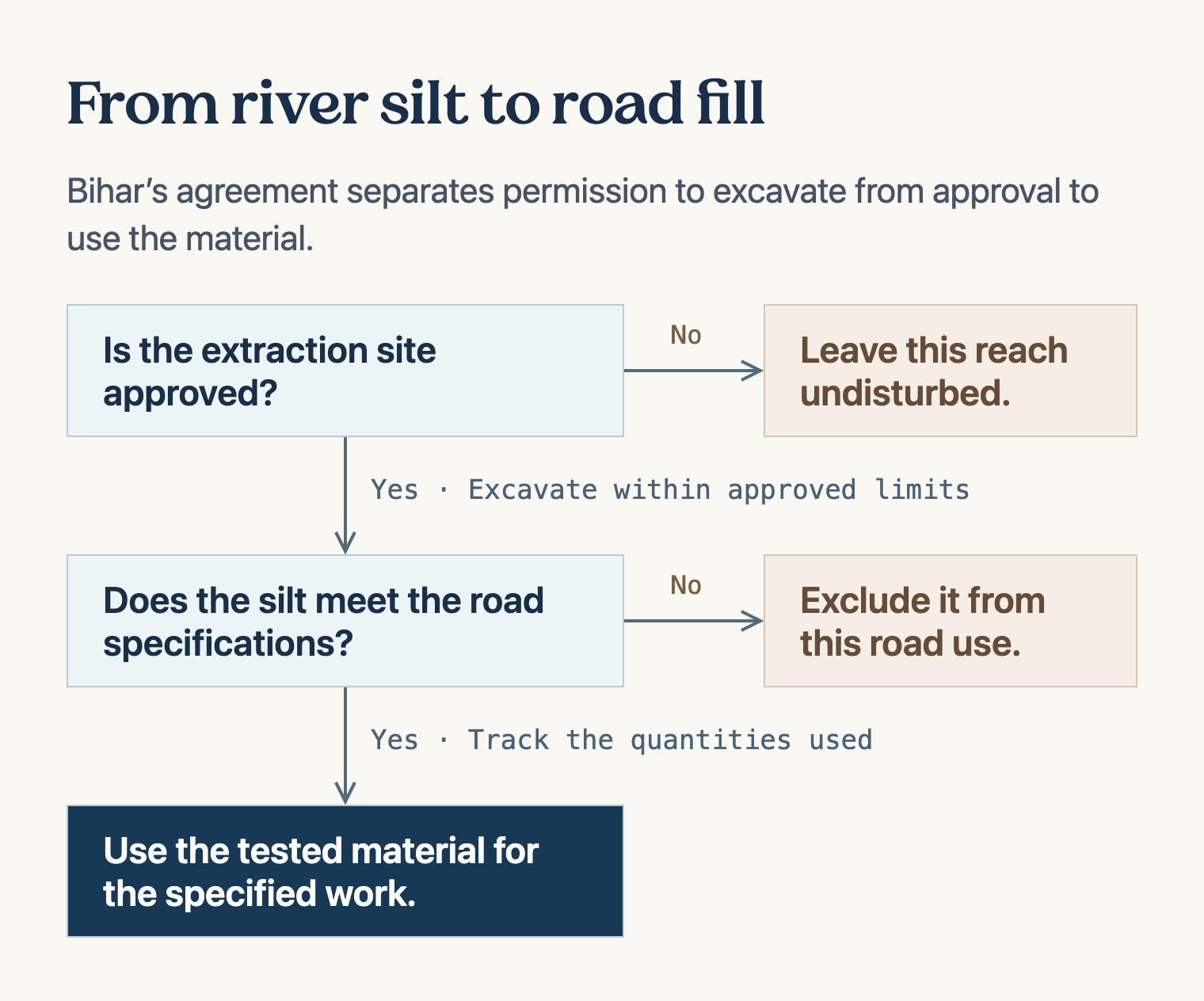
A site approval answers where excavation may occur. A road engineer faces a separate decision about the material that comes out.

  • Material used as embankment fill forms part of the raised ground supporting a road. The intended use determines what the project must check before accepting a consignment of excavated earth.
  • Sediment from different parts of a water body can vary in texture and moisture. The common description river silt gives a source, but by itself says little about how a particular sample performs.
  • The ministry specifies material testing under applicable MoRTH specifications and relevant Indian Roads Congress codes. A test result is meaningful against the requirements of the intended highway work.
  • If excavated material fails the relevant requirements, the existence of a nearby project cannot qualify it for that use. Counting it as highway fill would overstate the agreement’s usable supply.
  • The resource benefit arises when accepted material replaces fresh earth that the project would otherwise obtain. Counting everything removed from the river would include material that never displaced any fresh excavation.
Decision path for checking river excavation permission and testing silt before highway reuse
Bihar’s agreement requires approval for the extraction site and separate tests for the intended highway use.

How Can Officials Trace the Quantities?

The agreement connects records at the excavation site, during transport and at the highway worksite.

  • Joint measurement gives the agencies a common record of material removed. Comparing that figure with the approved site limit helps identify extraction beyond what the assessment permitted.
  • A transport record tracks material moved away from the source. It supports checking where the excavated quantity went, but dispatch alone cannot establish that the receiving project used it.
  • The road project records the quantity utilised. Comparing it with dispatched material helps officials investigate differences, including material awaiting use. A discrepancy calls for an explanation before anyone claims diversion.
  • Bihar’s state-level coordination committee examines proposals, facilitates approvals and monitors implementation. Regular reconciliation gives it a specific operational question to resolve when site records and project records disagree.

Way Forward

Measure the River and Road Outcomes Separately

  • Record the approved reach and limit alongside actual removal so field teams can check the two together.
  • Tie each acceptance decision to its material test and intended project use.
  • Compare drainage performance before and after excavation separately from the quantity of road fill accepted.

Conclusion

  • Bihar’s agreement links a river-management decision to a construction opportunity. An approved reach can yield material that fails engineering tests, just as suitable material can lie in a reach where excavation is unsafe.
  • The strongest evidence of resource conservation is suitable material actually used in place of fresh earth. River restoration requires its own evidence from the affected water body.

UPSC Practice Questions

Prelims MCQ 1

With reference to Bihar’s desilting agreement, consider the following statements:

  1. The Bihar Road Construction Department is the nodal department.
  2. Permission to extract sediment at a site establishes its suitability for highway use.
  3. Quantities extracted, transported and utilised are to be reconciled.

How many of the above statements are correct?

(a) Only one (b) Only two (c) All three (d) None

Answer: (b) Only two

Explanation:

Statements 1 and 3 are correct. The material requires separate testing under applicable highway specifications and codes.

Prelims MCQ 2

Which record provides the closest measure of excavated sediment put to productive highway use?

(a) Total sediment estimated in the water body (b) Maximum volume authorised for extraction (c) Tested material actually utilised in the highway work (d) Total volume dispatched from the excavation site

Answer: (c) Tested material actually utilised in the highway work

Explanation:

Actual utilisation captures the receiving project’s use. Resource savings also depend on whether that material replaced fresh earth.

UPSC Mains Questions

  1. How can reuse of river sediment in road construction reconcile demand for fill with the ecological limits of extraction?
  2. Distinguish the evidence needed to establish flood-management benefits from that needed to demonstrate savings in fresh earth.

Source: PIB, Ministry of Road Transport and Highways.

Frequently Asked Questions

Who will coordinate implementation in Bihar?

The Road Construction Department is Bihar’s nodal department. A state-level coordination committee will examine proposals, facilitate approvals, monitor implementation and resolve issues arising during work with NHAI.

Can all excavated silt go into a highway?

The material must pass appropriate tests for the intended work under applicable MoRTH specifications and relevant Indian Roads Congress codes. Approval to excavate a river reach addresses a different question.

Why compare extracted, transported and used quantities?

Each record describes a different stage. Comparing the three helps agencies trace what left the site, what moved to a project and how much the highway actually used.

Has Bihar demonstrated a reduction in flood risk through this agreement?

The announcement sets out flood management as an objective. Demonstrating a benefit would require evidence about conditions such as drainage or water-carrying capacity following work at the selected water body.

IndiaAI Foundation Models: Multilingual Training and Local Deployment

Open article →Download PDF

Why in News?

On 3 November 2026, the IndiaAI Mission released Soket’s EKA-1 and ZenteiQ’s Dhīr models under its Innovation Centre pillar.

  • The ministry reports that EKA-1 covers all 22 Scheduled Indian languages and English. Soket designed the model for tasks including mathematics, coding and reasoning.
  • ZenteiQ introduced Dhīr 2B and Dhīr 5B as multilingual assistants supporting English and ten Indian languages, with the option to run them on local equipment.
  • Both teams received access to subsidised computing resources and support for research expenses under the mission.
  • An agency choosing an assistant needs to establish which languages its users speak and where their requests will be processed. These are separate procurement decisions.
  • The announcement describes developer capabilities. Evaluating a particular public service requires testing the model on the documents, language and hardware used there.

UPSC Relevance

Prelims Relevance

  • The IndiaAI Innovation Centre supports indigenous foundation models.
  • A token is a unit into which an input is divided for processing.
  • Training adjusts model parameters using examples.
  • Inference applies a trained model to a new input.

Mains Relevance

GS Paper 3

  • Examine how shared computing infrastructure can lower barriers to indigenous model development.
  • Explain why language coverage and deployment conditions require separate evaluation.

Background and Context

What Does Multilingual Training Establish?

A foundation model learns patterns across a broad collection of examples and can be adapted or prompted for several tasks.

  • During training, a model processes sequences of tokens and adjusts internal parameters. A token can represent part of a word, so a token count cannot be read as a count of words or documents.
  • The ministry reports 26.3 billion parameters for EKA-1. These are learned numerical values. The figure describes model size, while a measure of accuracy needs a task, test examples and a scoring rule.
  • A language coverage claim tells a department which languages to consider for a trial. It leaves open how well the model handles a local spelling, an unfamiliar abbreviation or a question mixing two languages.
  • Consider an eligibility question asked in two languages. A useful paired test keeps the facts and qualifying conditions the same, then checks whether each answer preserves the exception that determines the applicant’s eligibility.

How Can a Local Assistant Answer Offline?

Once a trained model and its supporting software are installed, a local machine can process new requests using its own computing resources.

  • During local inference, a device or institution’s server produces the response. A field office can process requests during an internet outage if the application and its reference material are available locally.
  • With document grounding, an application retrieves relevant passages and supplies them to the model alongside the question. Staff can compare the response against the passage to see whether it supports the answer given.
  • A remote document index can become unreachable during an outage. An agency should test the whole application, including how it stores and retrieves the circular a user asks about.
  • Keeping processing on the premises can limit where requests travel. Access controls still matter because a shared workstation, an exposed local index or retained query histories can reveal sensitive information to another user.

What Should a Department Test Before Adoption?

A department can test both a language model and its supporting application using questions that staff encounter in daily work.

  • For a multilingual enquiry service, build a reference set with fluent speakers and subject specialists. Include an ordinary request and a borderline case in which a small translation error changes who qualifies.
  • For a field office, measure response time and memory use on the equipment staff will have. Repeat the trial with network access disabled and record which functions remain available throughout an ordinary request.
  • Ask the assistant about an amended circular after replacing the old copy. Check whether retrieval finds the current wording and whether the answer preserves its effective date and any exceptions.
  • Route uncertain answers to a responsible officer. A model may generate fluent language even when the relevant record is absent, and an applicant needs a way to obtain an authoritative decision.

Way Forward

Set Acceptance Criteria for Each Service

  • Publish language-specific test results for the tasks that matter to users.
  • Assign responsibility for refreshing the local document collection when instructions change.
  • Test access restrictions and an officer referral before using the assistant with sensitive enquiries.

Conclusion

  • The IndiaAI release gives agencies two practical questions to investigate. Which model handles the language of the intended user, and can the complete application run where that user needs it?
  • A defensible choice rests on task-level evidence. An agency can demonstrate whether an assistant preserves a condition in translation, retrieves the current rule and remains usable through a network outage.

UPSC Practice Questions

Prelims MCQ 1

With reference to the IndiaAI model release, consider the following statements:

  1. EKA-1 covers all 22 Scheduled Indian languages according to the ministry.
  2. The Dhīr assistants are described as capable of local deployment.
  3. Language coverage establishes equal accuracy across every supported language.

How many of the above statements are correct?

(a) Only one (b) Only two (c) All three (d) None

Answer: (b) Only two

Explanation:

Statements 1 and 2 reflect the announced capabilities. Equal accuracy would require comparable task-level testing in each language.

Prelims MCQ 2

A district office runs a trained model on its own server to answer a new question. Which operation is it performing?

(a) Pretraining (b) Updating model parameters (c) Local inference (d) Labelling a training corpus

Answer: (c) Local inference

Explanation:

The office uses the existing model to produce a response on local equipment.

UPSC Mains Questions

  1. How can India assess whether indigenous multilingual foundation models improve access to public services?
  2. Examine the operational and governance conditions for deploying an offline language assistant in district administration.

Source: PIB, Ministry of Electronics and Information Technology.

Frequently Asked Questions

Who developed the models released by IndiaAI?

Soket developed EKA-1. ZenteiQ developed the Dhīr 2B and 5B assistants. Both teams received support under the IndiaAI Innovation Centre pillar for developing indigenous foundation models.

How does language coverage differ between the models?

The ministry reports coverage of all 22 Scheduled Indian languages and English for EKA-1. It describes the Dhīr assistants as supporting English and ten Indian languages.

What does local inference require?

The device or local server needs the trained model, suitable computing resources and the software to process requests. Offline document lookup also needs a local copy of the required reference material.

How can officials test answers grounded in documents?

Officials can select an enquiry with a known answer, inspect the retrieved passage and compare the response with the current circular, including its exceptions and effective date.

Public Land Auctions: How Reserve Prices and Bids Shape Monetisation

Open article →Download PDF

Why in News?

On November 4, the Ministry of Finance reported the results of the November 3 auction of surplus Rashtriya Ispat Nigam Limited land in Visakhapatnam.

  • The second phase covered 114 successfully auctioned parcels.
  • The successful bids totalled ₹218 crore against an aggregate reserve price of approximately ₹184.8 crore.
  • The ministry reported an aggregate premium of 17.96% across the successful plots.
  • A public enterprise can raise money from surplus land while continuing to operate the business that originally held it.
  • The measure of price discovery depends on which plots enter the calculation and which benchmark the seller uses.

UPSC Relevance

Prelims Relevance

  • RINL operates the Visakhapatnam Steel Plant.
  • NLMC facilitated the land auction.
  • The Department of Public Enterprises administers NLMC under the Ministry of Finance.
  • A reserve price specifies the seller’s minimum acceptable price.

Mains Relevance

GS Paper 3

  • Explain how competitive bidding reveals demand for surplus public land.
  • Distinguish a successful bid from realised proceeds when evaluating asset monetisation.

Background and Context

Which Asset Went to Auction?

A steel company can own land beyond the sites it needs for production. The starting point is the particular asset the seller offers.

  • The landowner was Rashtriya Ispat Nigam Limited (RINL), the company that operates Visakhapatnam Steel Plant. Bidders competed for individual land parcels belonging to the enterprise. The plant itself fell outside this transaction.
  • The National Land Monetization Corporation (NLMC) is a wholly government-owned company under the Department of Public Enterprises. It helps public entities identify, assess and prepare surplus land and buildings for monetisation.
  • Preparing a parcel for bidding requires clarity about what a buyer would acquire. Two pieces of land held by the same enterprise can attract different bids because their locations and access differ.
  • A buyer of company shares acquires an ownership interest in the enterprise. A buyer of one of its plots acquires an interest in a specific property, which gives no voting rights in the company.

How Does the Reserve Price Shape the Result?

An auction produces two prices worth distinguishing. The seller sets a threshold before bidding, and competing bidders reveal how much they will offer.

  • The reserve price sets the minimum the seller will accept for a plot. It serves as a benchmark for evaluating bids. Setting it does not guarantee that anyone will offer that amount.
  • The winning bid reflects demand for that parcel under the conditions of that auction. A nearby plot with different access or potential uses may fetch a different price even on the same day.
  • For the aggregate premium, subtract the combined reserve price of successful plots from their combined winning bid value. Divide the difference by that same combined reserve price and express the result as a percentage.
  • This calculation weights plots by reserve value. A large premium on a low-value plot may barely move the overall figure. The aggregate alone cannot tell a reader what the typical plot fetched.

What Can the Auction Result Establish?

The ministry reported an outcome at the bidding stage. Different records answer the questions that follow about the transaction and the land.

  • The reported bid value gives the sum of successful offers. To establish how much money the seller has collected, consult payment records that show the sums actually received against those offers.
  • For ownership transfer, the relevant evidence is the completed conveyance or other applicable transfer record for the parcel. The announcement of the auction result gives neither parcel-level transfer dates nor a receipt statement.
  • The aggregate covers successful plots. Parcels left unsold contribute neither a winning bid nor a reserve price to that calculation. A premium on sold plots can coexist with unsold land.
  • NLMC described a possible third round for the remaining parcels, subject to approvals and conditions. The announcement gave no final schedule. Count a subsequent round only when a later record confirms it.

Way Forward

Report Outcomes by Transaction Stage

  • Show the number offered and number sold together so readers can assess participation as well as premiums.
  • Publish collections separately from successful bid values to make outstanding sums visible.
  • Track completed transfers by parcel so settlement progress can be compared with the auction result.

Conclusion

  • A public land auction answers a narrow but important question about demand. The winning bids reveal what bidders offered for the listed interests under the terms available to them.
  • An assessment of public value should identify the benchmark, check which parcels entered the calculation and follow the successful offers through collection and transfer. Each stage answers a different question.

UPSC Practice Questions

Prelims MCQ 1

With reference to the Visakhapatnam land auction, consider the following statements:

  1. RINL owned the parcels offered in the auction.
  2. The reserve price was the maximum price bidders could offer.
  3. The reported aggregate premium covered successfully auctioned plots.

How many of the above statements are correct?

(a) Only one (b) Only two (c) All three (d) None

Answer: (b) Only two

Explanation:

Statements 1 and 3 are correct. The reserve price is the minimum acceptable price. Bidders may offer more.

Prelims MCQ 2

Which record most directly establishes that the seller received the money due against a successful bid?

(a) The auction notice (b) The reserve valuation (c) The settlement receipt (d) The list of eligible bidders

Answer: (c) The settlement receipt

Explanation:

A receipt records payment. The auction notice and valuation describe the sale terms, while bidder eligibility precedes settlement.

UPSC Mains Questions

  1. How does competitive bidding aid price discovery for surplus public land? Discuss the limits of using an aggregate premium to assess performance.
  2. Distinguish a public enterprise land sale from an equity sale. What evidence would you seek to assess the outcome of a land auction?

Source: Ministry of Finance, Press Information Bureau.

Frequently Asked Questions

Who owned the auctioned land in Visakhapatnam?

Rashtriya Ispat Nigam Limited, the company that operates Visakhapatnam Steel Plant, owned the land parcels. The National Land Monetization Corporation facilitated the process for the surplus property.

What is an auction reserve price?

It is the minimum price the seller will accept for the offered asset. Bidders may compete above that threshold, and a plot can remain unsold if it attracts no acceptable bid.

Did every successful plot earn the reported premium?

The ministry calculated one premium across all successful plots by comparing the total winning bid value with their total reserve price. Individual plots can command larger or smaller premiums.

What distinguishes bid value from proceeds collected?

Bid value records the amounts successful bidders offered. To measure collections, the seller must establish how much money it actually received through payment or settlement records for those bids.

Dental Commission: How States Gain Representation Through a Draw

Open article →Download PDF

Why in News?

On November 3, the Union Health Ministry announced the selection of part-time members of the National Dental Commission and its three autonomous boards through a draw of lots.

  • Ten members represent state and Union territory governments on the Commission.
  • Nine members represent state dental councils for the same two-year term.
  • The second part-time seat on each autonomous board went to a member of the dental council group.
  • The two channels bring state administration and experience of professional regulation into the same national body.
  • A limited term allows rotation while the Commission continues its work across successive appointments.

UPSC Relevance

Prelims Relevance

  • The National Dental Commission Act, 2023
  • The Dental Advisory Council as a pool of state nominees
  • Two-year rotating Commission seats
  • Section 17(5) and eligibility for the second part-time board seat

Mains Relevance

GS Paper 2

  • State participation in statutory regulatory bodies
  • Balancing continuity with rotation in health governance

Essay

  • Who gets a seat when professional rules are made?

Background and Context

How the two representative groups enter the Commission

The law provides separate routes for state administrations and professional councils to participate in national dental regulation.

  • The Dental Advisory Council supplies nominees for both groups. A seat on that wider body gives a state a route into the selection process without guaranteeing its nominee a Commission seat in every term.
  • The government group brings the perspective of authorities responsible for public institutions and services. A representative can raise, for example, what a proposed training requirement would mean for a government dental college.
  • The dental council group brings experience of regulating a profession within a state. Its members can explain how a national decision on registration would affect practitioners and the officials who maintain their records.
  • The November announcement covers these rotating seats. The Commission also has a chairperson, ex officio members and other part-time members, so adding the two groups gives only part of its membership.

Which members can take a second part-time board seat?

After the Commission selection, the eligible group narrows. Each autonomous board draws its second part-time member from the nine dental council representatives.

  • Section 17(5) identifies the eligible category by reference to the council nominees appointed to the Commission. Holding one of the government group seats does not qualify a member for this particular board position.
  • The education board deals with undergraduate and postgraduate dental education. In this round, the member from Telangana joined it, giving the council group a voice in deliberations about how the profession trains entrants.
  • The assessment and rating board deals with institutions. Karnataka supplied its second part-time member. Assessing whether a college meets standards requires a different judgment from deciding which standards a curriculum should set.
  • The ethics and registration board deals with professional conduct and registration. The member from Madhya Pradesh joined this board. These three appointments describe the current allocation of seats, which can change with rotation.

What a draw of lots decides

The draw settles who serves in designated seats. The Act separately assigns regulatory functions and provides for collective decisions.

  • A draw among eligible nominees limits discretion at the final selection stage. The prior choice of nominees still matters because the membership of that pool determines whose experience the draw can bring into national deliberations.
  • The two-year term gives other jurisdictions a chance to participate in a later round. Frequent turnover also makes it harder to follow an unresolved issue unless outgoing members leave a usable record.
  • Each board takes decisions by majority vote. A council representative can contribute evidence and vote, but the appointment alone gives that individual no power to grant a licence or approve a dental college.
  • The boards operate under the overall supervision of the Commission. A board appointment connects state experience to one area of national work while preserving the statutory distinction between Commission oversight and board decisions.

Way Forward

Keep the rotation visible

  • Publish the nominee category beside each appointment so readers can trace how each seat was filled.
  • Record the term dates and board allocation together so states can follow changes between rounds.
  • Use a short handover note for unresolved issues that incoming representatives will need to take up.

Conclusion

  • The source of nomination has consequences beyond Commission membership. It determines which representatives can be considered for the second part-time seat on a specialist board.
  • A sound assessment of state participation should track the issues members raise, the decisions the body takes and whether the next group can follow up when seats rotate.

UPSC Practice Questions

Prelims MCQ 1

Consider the following statements about rotating appointments to the National Dental Commission.

  1. State government and dental council nominees enter through separate categories.
  2. Second part-time members of the autonomous boards are chosen from the nine council representatives.
  3. The November draw filled every position on the Commission.

How many of the above statements are correct?

(a) Only one (b) Only two (c) All three (d) None

Answer: (b) Only two

Explanation:

The first two statements describe the eligible groups. The draw covered designated part-time posts. Other positions, including the chairperson, have separate appointment provisions.

Prelims MCQ 2

Which issue falls most directly within the remit of the Dental Assessment and Rating Board?

(a) Preparing an electoral roll (b) Setting state health budgets (c) Assessing a dental institution (d) Maintaining a register of pharmaceutical manufacturers

Answer: (c) Assessing a dental institution

Explanation:

Institutional assessment belongs to this board. The other two dental boards specialise in education and in ethics and registration.

UPSC Mains Questions

  1. How can rotation widen state participation in a national health regulator while preserving institutional memory?
  2. Examine how the selection of part-time members links state dental councils to specialist national boards.

Sources: PIB, Ministry of Health and Family Welfare and Gazette of India, National Dental Commission Act, 2023.

Frequently Asked Questions

How long do the rotating representatives serve?

The state government and dental council representatives selected in November serve two years. These terms apply to the two rotating groups covered by the ministry announcement.

Where do the board representatives come from?

Section 17(5) directs the choice of each second part-time board member to the council representatives already selected for the Commission. The November selection drew on this pool of nine.

Why are the boards separate?

They address different regulatory questions. Dental education concerns training standards, assessment concerns institutions, and ethics and registration concern professional conduct and the records of practitioners.

Can a board member take a licensing decision alone?

The appointment gives a representative a seat in the board’s deliberations. The Act assigns functions to the board and provides for decisions by majority vote.