Context:
A recently published study has found out that average size of the trees in the Amazon rainforest has been steadily increasing due to the rising levels of carbon dioxide (CO2) in the atmosphere.
UPSC Relevance:
Environment
PYQ:
Q. With reference to the country Guyana, consider the following statements:
1.Amazon River flows through the heart of Guyana.
2.Amazon rainforest contributes to Guyana’s rich biodiversity and is often referred to as the “lungs of the Earth”.
3.It is a landlocked country.
How many of the statements given above are correct?
[A] Only one
[B] Only two
[C] All three
[D] None
About Amazon Rainforest:
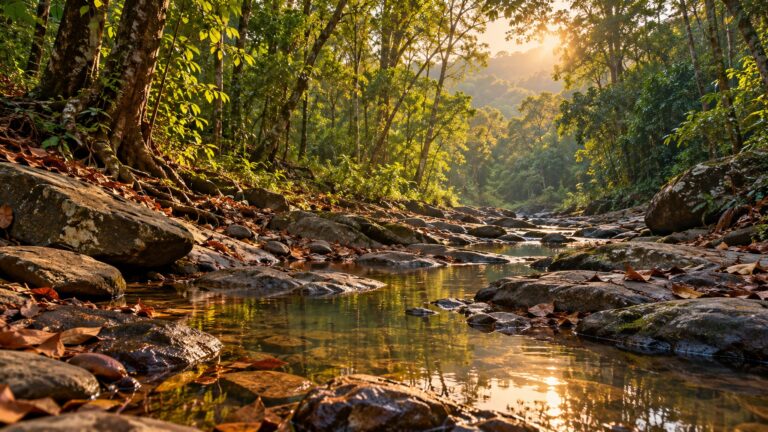
- The Amazon Rainforest is a moist broadleaf forest that covers most of the Amazon Basin of South America.
- This basin encompasses 7,000,000 square kilometres (2,700,000 sq. mi), of which 5,500,000 square kilometres (2,100,000 sq. mi) are covered by the
- This region includes territory belonging to nine nations.
- The majority of the forest is contained within Brazil, with 60% of the rainforest, followed by Peru with 13%, Colombia with 10%, and with minor amounts in Venezuela, Ecuador, Bolivia, Guyana, Suriname, and French Guiana.
- The Amazon represents over half of the planet’s remaining Rainforest, and it comprises the largest and most species-rich tract of tropical rainforest in the world.
- The rainforest likely formed during the Eocene era.
Significance of amazon rainforest:
- Biodiversity
- It’s one of the most diverse ecosystems in the world—home to 10 percent of the world’s species.
- Plants
- One square kilometer (247 acres) of Amazon rainforest can contain about 90,790 tonnes of living plants.
- The average plant biomass is estimated at 356 ± 47 tonnes per hectare.
- To date, an estimated 438,000 species of plants of economic and social interest have been registered in the region.
- According to a 2001 study, a quarter square kilometre (62 acres) of Ecuadorian rainforest supports more than 1,100 tree species.
- Animals
- There are more than 2.5 million species of insects that scuttle through the leaf litter.
- It contains roughly 1,300 bird species, 3,000 species of fish, and approximately 430 species of mammals.
- Scientists have described between 96,660 and 128,843 invertebrate species in Brazil alone.
- These animals play an important role in keeping the rainforest healthy.
- For instance, important nutrients from the carcasses, faeces, and food scraps deposited by mammals leech into the forest floor.
- This nutrient influx helps soil microbes better store carbon instead of releasing it into the atmosphere.
- The Amazon River’s Riches
- A recent study suggested that wetlands in the Amazon hold over 53 percent of the more than 6,727 tree species counted in the Amazon.
- 1/5 of the world’s freshwater is found in the Amazon basin.
- Its Carbon and Oxygen Cycle
- The Amazon produces 20% of the oxygen we breathe, so often referred lungs of the Earth.
- The Amazon stores 80-120 billion tons of carbon, stabilizing our planet’s climate.
- Amazonian evergreen forests account for about 10% of the world’s terrestrial primary productivity and 10% of the carbon stores in ecosystems—of the order of 1.1 × 10¹¹metric tonnes of carbon.
- Amazonian forests are estimated to have accumulated 62 ± 0.37 tons of carbon per hectare per year between 1975 and 1996.
- Medicinal Plants
- Seventy percent of the plants identified by the U.S. National Cancer Institute as useful in the treatment of cancer only grow in this rainforest.
- Home to large number of Indigenous tribes
- Around 30million people live in the Amazon region, of which 7 million are indigenous, representing more than 350 different ethnic groups.
- Most live in indigenous reserves known as ‘resguardos’.
- Around 60 tribes live in voluntary isolation.
Threat to the Amazon Rainforest
Deforestation
- The main sources of deforestation in the Amazon are human settlement and development of the land.
- Livestock
- 70% of the area that used to be covered by the forest and 91% of the now deforested area since 1970 is used to feed livestock.
- The cattle industry is the primary cause that led to the destruction of wildlife in Brazil and other countries globally.
- Agriculture
- The vast fields used to grow soybeans and other beans are also very prejudicial to the fertility of the soil.
- About 80% of all soybeans produced in the Amazon is used as cattle feed.
- The tropical rainforest continues to be degraded to support the ever-rising demand of animal products, which leads to an expanding area of farmland for plantations and livestock sustenance.
- The soils in the Amazon are productive for just a short period of time, so farmers are constantly moving to new areas and clearing more land.
- Illegal logging
- Between 80% and 90% of all forest clearing is still illegal, with timber being smuggled into Brazil and Peru.
- Highway construction
- In the 1970s, construction began on the Trans-Amazonian highway. This highway represented a major threat to the Amazon rainforest.
Some study reports on deforestation data
- The mean annual deforestation rate from 2000 to 2005 (22,392 km2or 8,646 sq. mi per year) was 18% higher than in the previous five years (19,018 km2 or 7,343 sq. mi per year).
- Although deforestation has declined significantly in the Brazilian Amazon between 2004 and 2014, there has been an increase to the present day.
- A 2009 study found that a 4 °C rise in global temperatures by 2100 would kill 85% of the Amazon rainforest, while a temperature rise of 3 °C would kill some 75% of the Amazon.
Impact of loss of Amazon Rainforest
- Global warming
- Deforestation in forests accounts for 11 percent of human-caused greenhouse gas emissions.
- When plants and other organisms decompose, they gradually release some of their stored carbon dioxide back into the atmosphere, is a natural part of the carbon cycle, destruction of forests accelerates this process, so that deforestation is the second leading source of greenhouse emissions behind fossil fuel burning.
- A study published in July 2021 found that in recent decades the eastern portion of the Amazon for the first time emitted more carbon dioxide than it absorbed, flipping it from a carbon sink to a carbon source
- Loss of biodiversity
- Tropical organisms like those in the Amazon tend to be more sensitive to temperature changes.
- The Amazon rainforest is home to a huge portion of the world’s reptiles, amphibians, fish and insects, all of whom more vulnerable because they are unable to control their body temperature.
- Scientists have warned, if the combined deforestation and degradation of the Amazon crosses a 20-25 per cent threshold, the forest could reach an irreversible tipping point that may result in the dieback of the entire ecosystem.
- Reduction in Precipitation
- Deforestation, fires, and warmer temperatures disrupt the Amazon’s hydrological cycle, leading to even more droughts, wildfires, and lengthier dry seasons.
Efforts have been made to conserve the rainforest:
- Reduction in deforestation: From 2002 to 2006, the conserved land in the Amazon rainforest has almost tripled, and deforestation rates have dropped up to 60%.
- Los Amigos Conservation Concession: In 2000, 360,000-acre Los Amigos Conservation Concession was created, the first of its kind in the world, helping remove the financial and operational burden of land management.
- Amazon Cooperation Treaty Organization (ACTO): ACTO is an international organisation “aimed at the promotion of sustainable development of the Amazon Basin”.
- Global Biodiversity Framework: Under Convention on Biological Diversity’s Global Biodiversity Framework,2022, member countries had agreed to protect at least 30 per cent of land and sea by 2030, emphasised greater role of countries located in the Amazon region.
- Belem Declaration: The Belem Declaration released during the Amazon Summit recognises Indigenous knowledge as a condition for biodiversity conservation.
- Global Environment Facility: Global Environment Facility Council meeting in Brazil, available funds were allocated for different areas of GEF’s work in this region.
- Amazon Fund: The Amazon Fund is a REDD+ mechanism created to raise donations for non-reimbursable investments in efforts to prevent, monitor and combat deforestation, as well as to promote the preservation and sustainable use in the Brazilian Amazon.
- Declared as New 7 Wonders of Nature: The Amazon rainforest and River, along with other 6 locations, have been officially announced as the New 7 Wonders of Nature on November 11th, 2011 in Zurich, Switzerland.
- Amazon Day: WWF-Brazil is commemorating this fifth day of September, officialised in Brazil as Amazon Day.
Why is the size of amazon trees growing?
- On average, the size of trees increased in diameter by about 3.3 percent each decade.
- This is happening due to rise in CO2 levels, which has increased by nearly a fifth in last thirty years.
- This rise in CO2 levels is benefitting the tree growth because of a phenomenon known as the carbon fertilisation effect. This effect denotes the increased rate of photosynthesis in plants due to rise in CO2 levels.
Way forward
- Land rights to indigenous people: Indigenous People are under constant threats and land rights will not only give them better protection, it will also prevent deforestation and protect the rich biodiversity within these territories.
- Reforestation: Prioritize reforestation with native species, which help restore ecosystems and ensure continued provision of ecosystem services, such as carbon sequestration, water regulation, and soil conservation.
- Conservation concessions: More conservation concessions and conservation corridors are critical to protecting forest cover and biodiversity across the southwestern Amazon.
- Empowerment of new generation: Empower a new generation who will act as the long-term guardians, mentors, and conservation planners in the region.
Tell Google you want more of this.
Add Anantam IAS as a preferred sourceOne tap, and this site shows up more often in your own Top Stories, AI Overviews and AI Mode. Remove it any time.