Why in News?
The India Meteorological Department (IMD) has launched two new AI-powered weather forecasting systems under the Ministry of Earth Sciences (MoES). The two systems launched are:
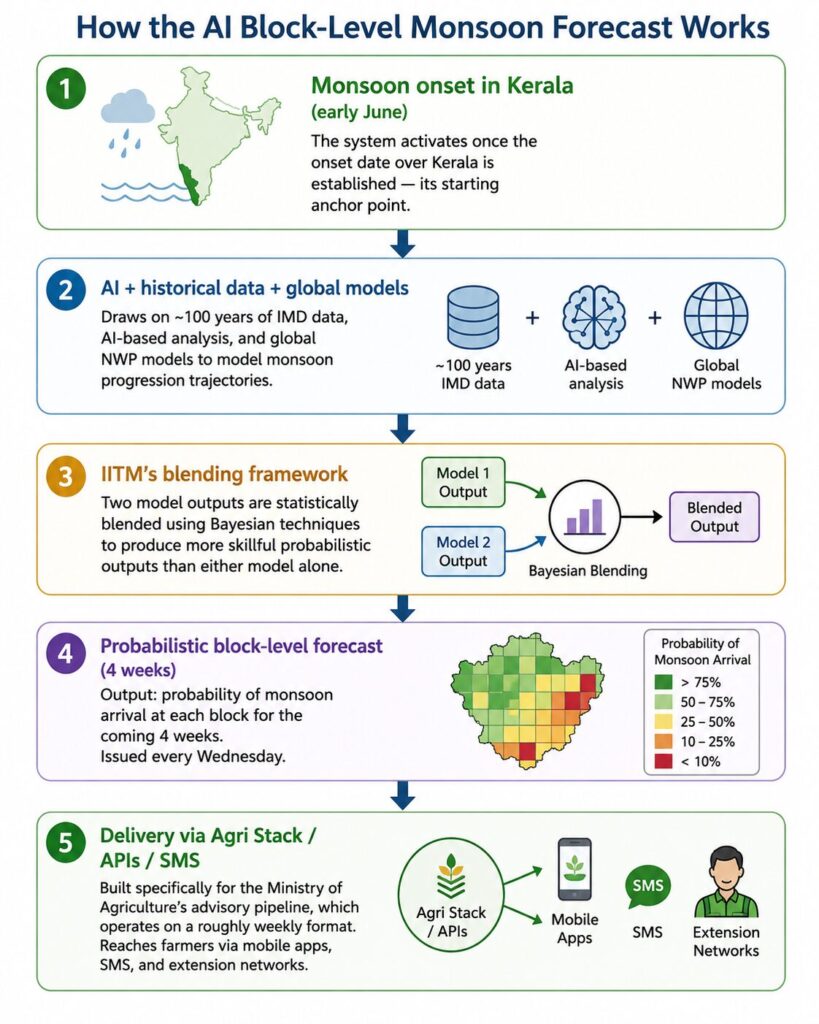
- IMD’s AI-enabled forecast of monsoon’s arrival over 15 States and comprising about half of India’s roughly 7,200-odd blocks (first-ever block-level monsoon advance forecast).
- High Spatial Resolution Rainfall Forecast for Uttar Pradesh: a pilot project providing 1 km-resolution rainfall data up to 10 days ahead.
| UPSC Relevance: GS-1 Geography: Monsoon; GS-3 Science and Technology: Artificial Intelligence and Weather Forecasting. Prelims: Southwest Monsoon; Artificial Intelligence applications in Weather Forecasting |
Block-Level Monsoon Advance Forecast System:
- For the first time, farmers in about 3,067-3,196 blocks across 15 States and one Union Territory will receive block-specific monsoon forecasts. This will cover the arrival of the monsoon, rainfall probability, rainfall intensity and monsoon progression.
- The AI system can provide forecasts up to 4 weeks in advance for monsoon progression.
- The latest system, developed using a combination of numerical weather prediction models and AI-based data-driven approaches, is part of IMD’s ambitious push for highly localised, high-resolution weather forecasts.
UP High-Resolution Rainfall Forecast System:
- It is an independent pilot model to provide highly detailed rainfall forecasts for Uttar Pradesh.
- The AI-based system uses the dense weather observational network of the state to generate 1 km resolution forecasts up to 10 days in advance. It combines data from weather stations, Doppler radars, satellites, and weather models, and uses AI-driven downscaling to provide more localised alerts.
- Need and Significance:
- Currently, the global models run by IMD provide forecasts at 12.5 kms and 3-4 kms resolution with hourly updates. While useful for broad weather predictions, they cannot accurately capture local rainfall patterns needed for precision farming and other localised actions.
- The AI model will improve hourly forecasts by refining them from 12.5 km resolution to 4 km and then to 1 km, making them more useful for local planning and precision agriculture.
- The UP pilot was developed by NCMRWF (National Centre for Medium Range Weather Forecasting), and its outputs will be made available via NCMRWF’s public APIs and websites.
Uttar Pradesh has the most extensive network of automatic weather stations (AWS) in the country; there is sufficiently dense observational data to downscale output to 1 km resolution.
Potential Use Cases:
- Agriculture: Farmers can plan sowing/transplanting with a 4-week probabilistic window; reduces crop losses from premature sowing before the actual monsoon onset at the block level.
- Water Management: Local authorities can better manage reservoir releases, groundwater recharge timelines, and irrigation scheduling with sub-district precision.
- Disaster Management: Early localised flood and drought warnings enable pre-positioned relief, evacuation planning, and NDRF deployment.
- Renewable Energy: Solar and hydro energy planners can optimise operations with high-resolution rainfall and cloud-cover data.
- Urban Planning: Municipal bodies get actionable lead time for drainage upgrades and waterlogging prevention.
- Food Security: Rainfed agriculture accounts for ~40% of India’s food production — precision forecasting directly protects food supply chains.
- Policy: Both systems feed into India’s National Monsoon Mission goals and the broader push for AI-enabled governance in climate adaptation.
UPSC PYQ 2017:
Q. With reference to ‘Indian Ocean Dipole (IOD)’ sometimes mentioned in the news while forecasting Indian monsoon, which of the following statements is/are correct?
1. IOD phenomenon is characterised by a difference in sea surface temperature between tropical Western Indian Ocean and tropical Eastern Pacific Ocean.
2. An IOD phenomenon can influence an El Nino’s impact on the monsoon.
Select the correct answer using the code given below:
(a) 1 only
(b) 2 only
(c) Both 1 and 2
(d) Neither 1 nor 2
Answer: (b)
Tell Google you want more of this.
Add Anantam IAS as a preferred sourceOne tap, and this site shows up more often in your own Top Stories, AI Overviews and AI Mode. Remove it any time.