Why in news?
Cabinet approved ₹62,370 crore subsidy for Rabi 2026-27, 64% above last Rabi, as Iran war raised urea and LNG prices. Economists estimate the fiscal deficit could rise by up to 0.3% of GDP because of this overshoot.
UPSC Relevance
Prelims: Nutrient Based Subsidy (NBS), urea pricing, neem-coated urea, nano urea, DBT in fertilizers, PM-PRANAM, One Nation One Fertiliser.
Mains GS-3: Issues related to direct and indirect farm subsidies; Government budgeting; Mobilisation of resources; Conservation and environmental degradation (soil health).
Fertilizer subsidy – what it is and how it works
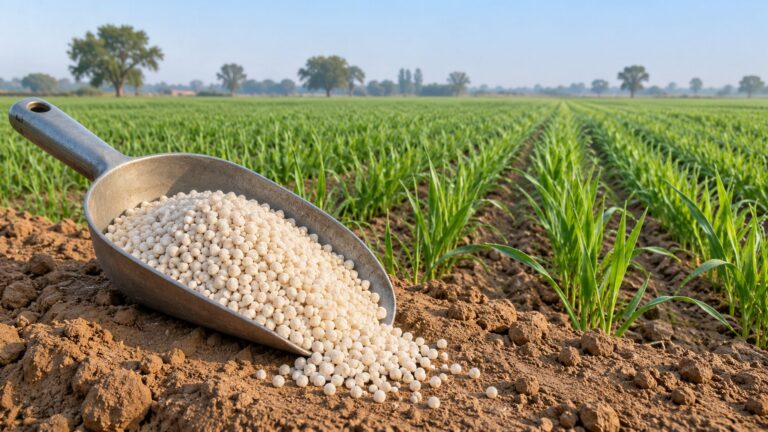
Fertilizer subsidy is the money the Centre pays to manufacturers and importers so that farmers can buy fertilizers below their actual cost. The farmer never gets this money directly. It is paid to companies after the bag is sold to a farmer through a Point of Sale (PoS) machine.
There are two separate systems, and most of the problems in this sector come from the difference between them.
| Basis | Urea | P&K fertilizers (DAP, MOP, NPK complexes) |
|---|---|---|
| Pricing | Price fixed by Centre. MRP ₹242 per 45 kg bag (excluding neem coating charge and taxes), almost unchanged for over a decade | Under Nutrient Based Subsidy (since April 2010). Companies fix MRP, but the Centre informally keeps it in check |
| Subsidy | Variable – difference between cost of production/import and fixed MRP. Any rise in gas or import price is fully borne by the government | Fixed rate per kg of nutrient (N, P, K, S), announced every Kharif and Rabi season |
| Share in subsidy (FY27 BE) | About ₹1.17 lakh crore out of ₹1.71 lakh crore | ₹54,000 crore budgeted |
Why the subsidy is needed
- Food security: Chemical fertilizers were central to the Green Revolution. Without affordable nutrients, yields of rice and wheat – the base of the PDS – would fall.
- Protecting small farmers: Over 85% of Indian landholdings are small and marginal. A sudden jump in fertilizer prices would push many into debt or force them to under-apply.
- Shock absorber: When global prices spike (2022, 2026), the subsidy keeps farm-gate prices stable, so the shock does not hit the farmer directly.
- Checking food inflation: Fertilizer is a key input cost. Higher input cost quickly turns into higher MSP demands and food prices.
- Keeping domestic industry viable: Gas-based urea plants cannot compete with imports without assured subsidy support.
Challenges and issues
- Fiscal unpredictability: Budget estimates are routinely overshot. Since the urea subsidy is open-ended, the government cannot control the final bill.
- Skewed NPK ratio: The recommended N:P:K ratio is about 4:2:1. Because urea is kept artificially cheap while P&K prices are freer, farmers overuse urea. The ratio is badly distorted, more so in Punjab, Haryana and western UP.
- Soil health and falling efficiency: Overuse of nitrogen, neglect of potash, sulphur and micronutrients (zinc, boron) has reduced soil organic carbon. Crops respond less to each extra kg of fertilizer. Only about a third of applied nitrogen is actually used by the crop.
- Environmental cost: Excess nitrogen leaches into groundwater as nitrates and escapes as nitrous oxide, a greenhouse gas nearly 300 times more potent than CO₂.
- Diversion and smuggling: Cheap urea gets diverted to plywood, resin, paint and even milk adulteration, and is smuggled to Nepal and Bangladesh.
- Import dependence and geopolitics: LNG from West Asia, potash from Canada, Russia and Belarus, phosphates from Morocco, Jordan and China. Wars, sanctions and Chinese export curbs directly raise India’s bill.
- Inequitable benefit: Subsidy follows usage. Larger farmers in irrigated, high-input regions get a bigger share than rainfed small farmers.
- Crowding out investment: Money spent on input subsidy leaves less for irrigation, research, storage and extension, which give higher long-term returns.
- Payment delays: When allocations run out mid-year, subsidy arrears to companies pile up and are rolled over to the next year.
Steps taken by the government to reduce the burden
| Measure | What it does |
|---|---|
| Nutrient Based Subsidy (2010) | Fixed per-kg subsidy for P&K so that the government’s liability is capped |
| 100% Neem-coated urea (2015) | Makes urea unfit for industrial use (curbs diversion) and slows nitrogen release |
| New Urea Policy 2015 and Gas Pooling | Energy efficiency norms for plants; uniform gas price for all urea units |
| DBT in fertilizers (pan-India 2018) | Subsidy released only after Aadhaar-linked sale on PoS machines; better tracking of buyers |
| One Nation One Fertiliser (2022) | Single ‘Bharat’ brand to cut cross-hauling and freight subsidy; retail shops turned into PM Kisan Samriddhi Kendras |
| Nano urea and nano DAP (IFFCO) | Liquid fertilizers meant to replace part of bagged urea and DAP and cut imports |
| PM-PRANAM (2023) | States that reduce chemical fertilizer use get 50% of the subsidy saved as a grant |
| Soil Health Card (2015) | Soil testing-based fertilizer advice to farmers |
| Market Development Assistance for Fermented Organic Manure (2023) | ₹1,500 per tonne support to organic manure from GOBARdhan plants |
| National Mission on Natural Farming (2024) | Promotes chemical-free farming in clusters to reduce input dependence |
Assessment: These steps have improved tracking and reduced diversion to some extent. But the core design problem – fixed urea price with open-ended subsidy – has not been touched.
Committee recommendations
- Shanta Kumar Committee (2015): Recommended paying fertilizer subsidy directly to farmers as cash (around ₹7,000 per hectare) and decontrolling fertilizer prices.
- Economic Survey 2015-16: Flagged large leakages of urea through diversion and smuggling. Suggested bringing urea under NBS-type decontrol and using JAM (Jan Dhan-Aadhaar-Mobile) for direct transfers.
- Ashok Dalwai Committee on Doubling Farmers’ Income (2018): Stressed balanced nutrient use, soil health and cutting input costs through efficiency rather than higher subsidy.
- Parliamentary Standing Committee on Chemicals and Fertilizers: Has repeatedly asked for realistic budgeting, timely release of subsidy, lower import dependence and wider use of organic and bio-fertilizers.
Case studies
- Sri Lanka (2021) – how not to do it: An overnight ban on chemical fertilizers led to a sharp fall in rice and tea output, food shortages and contributed to the economic crisis. Lesson: transition must be gradual and backed by science.
- China – Zero Growth Action Plan (2015): Targeted zero growth in fertilizer use by 2020 through soil testing and precision application. Fertilizer use peaked and started declining without hurting grain output.
- Andhra Pradesh Community Managed Natural Farming (APCNF): Covers lakhs of farmers. Shows lower input costs are possible, though long-term yield data is still being studied.
- Punjab: India’s most input-intensive state. High nitrogen use has been linked to nitrate contamination in groundwater and declining soil organic carbon.
- Talcher Fertilizers (Odisha): Uses domestic coal gasification instead of imported LNG – a model for reducing dependence on gas imports.
Way forward
- Gradual urea reform: Bring urea under NBS in phases, starting with a modest price revision, so that the urea-P&K price gap narrows and nutrient balance improves.
- Direct cash transfer to farmers: Once land records are digitised and linked, shift to per-hectare transfers as suggested by the Shanta Kumar Committee, with a way to include tenant farmers.
- Soil-test-based use: Make Soil Health Card advice actionable through PoS machines, customised and fortified fertilizers, and drone-based precision spraying.
- Secure supplies: Long-term import contracts, overseas mining stakes (phosphate and potash), strategic buffer stocks and a price stabilisation mechanism.
- Domestic alternatives: Coal gasification and green ammonia under the National Green Hydrogen Mission to cut LNG dependence.
- Independent evaluation: Large multi-location trials of nano fertilizers before scaling them up.
- Balanced approach to natural farming: Promote it first in rainfed and tribal areas where chemical use is already low, as the Sri Lanka example warns against a sudden shift.
- Realistic budgeting: Build global price scenarios into budget estimates to avoid repeated mid-year overshoots.
The fertilizer subsidy is unlikely to go away, and it should not, given its role in food security. The real task is to make every rupee of subsidy buy more soil health and productivity, rather than just cheaper urea.
Practice MCQ
Q1. Consider the following statements regarding fertilizer subsidy in India:
1. Under the Nutrient Based Subsidy scheme, a fixed subsidy is given per kg of nutrients such as nitrogen, phosphorus, potash and sulphur.
2. Urea has been covered under the Nutrient Based Subsidy scheme since its launch in 2010.
3. Subsidy is released to fertilizer companies on the basis of sales to farmers recorded on Point of Sale devices.
How many of the above statements are correct?
(a) Only one (b) Only two (c) All three (d) None
Answer: (b)
Explanation: Statement 2 is incorrect. Urea is outside NBS; its MRP is fixed by the Centre and the subsidy is the difference between cost and MRP. Statements 1 and 3 are correct.
Q2. Consider the following statements:
Statement-I: Neem coating of urea has helped reduce the diversion of subsidised urea for non-agricultural purposes.
Statement-II: Neem coating slows down the release of nitrogen in the soil, improving nitrogen use efficiency.
Which one of the following is correct in respect of the above statements?
(a) Both Statement-I and Statement-II are correct and Statement-II explains Statement-I
(b) Both Statement-I and Statement-II are correct, but Statement-II does not explain Statement-I
(c) Statement-I is correct, but Statement-II is incorrect
(d) Statement-I is incorrect, but Statement-II is correct
Answer: (b)
Explanation: Both are correct. Diversion fell because neem-coated urea is unsuitable for industrial uses like resin and plywood, not because of slower nitrogen release. So Statement-II does not explain Statement-I.
Mains Practice Question
“Fertilizer subsidy in India has protected farmers from global price shocks, but at the cost of fiscal stability and soil health.” Critically examine this statement and suggest reforms needed in the fertilizer subsidy regime. (15 marks, 250 words)
Tell Google you want more of this.
Add Anantam IAS as a preferred sourceOne tap, and this site shows up more often in your own Top Stories, AI Overviews and AI Mode. Remove it any time.