Kuno National Park cheetah population now stands at 57. That number, announced after the release of two Botswana cheetahs into the open forest on May 10, 2026, makes Project Cheetah officially the largest live wild cheetah population outside Africa. Madhya Pradesh Chief Minister Mohan Yadav personally released the two cats after their quarantine period at the Kuno soft bomas.
The 57 figure carries a lot of weight, both biological and political. It includes 54 cheetahs at Kuno National Park and three at the Gandhi Sagar Wildlife Sanctuary, a second site that began receiving translocated cheetahs in late 2024. Of the 54 at Kuno, 17 are now free-ranging in the wild while 37 remain in soft bomas, large fenced enclosures of 50 to 150 hectares used for conditioning and breeding management. The split tells you something important. Free-ranging numbers are growing but slower than the soft-boma count, which is what the National Tiger Conservation Authority (NTCA) and the Cheetah Project Steering Committee have to work with through monsoon 2026.
This piece walks through the May 2026 update, the full timeline of Project Cheetah since September 2022, the mortality story that nobody likes to revisit, and the policy and ecological questions UPSC aspirants need to track.
Quick Facts
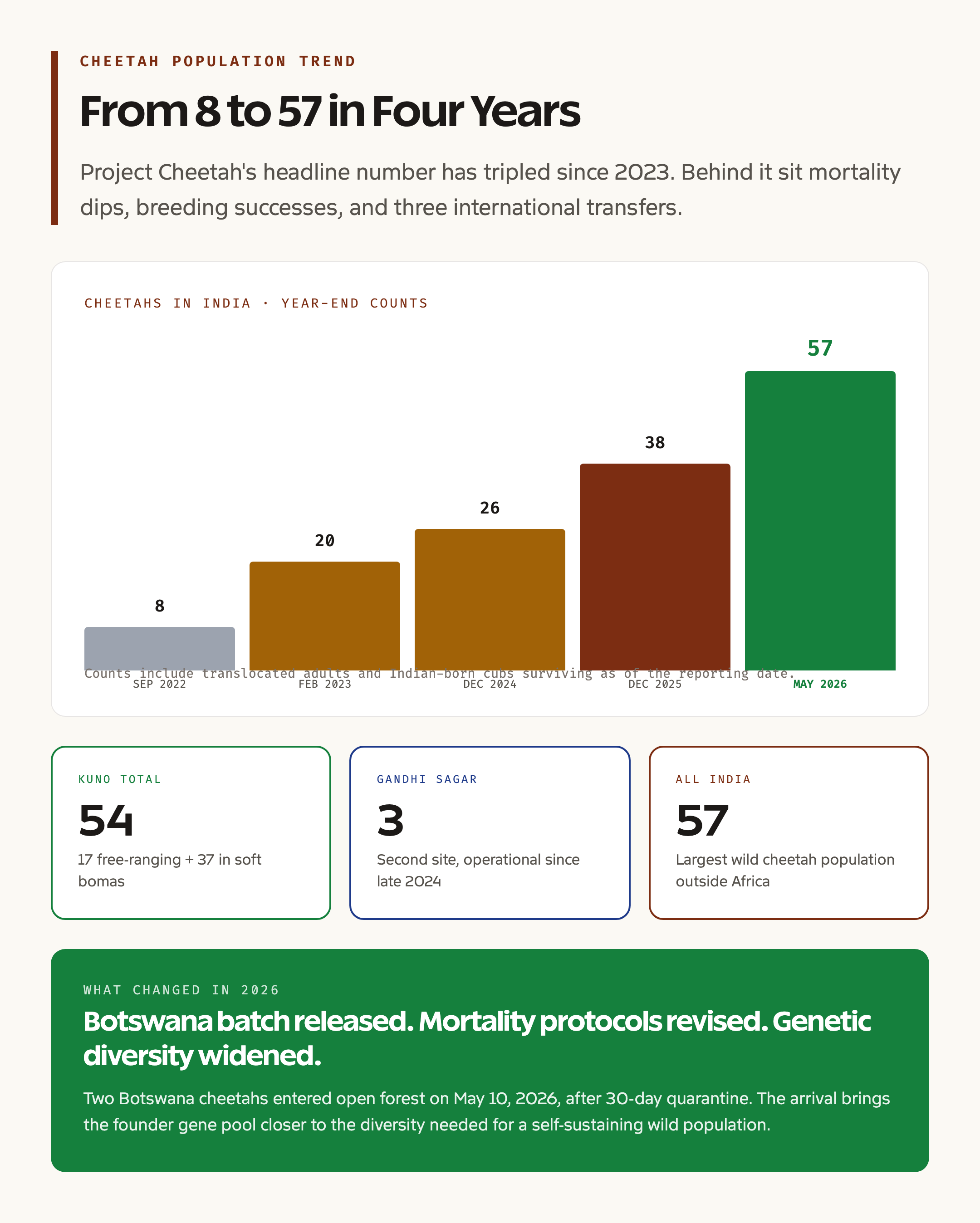
- Total cheetah population in India (May 2026): 57
- At Kuno National Park: 54 (17 free-ranging, 37 in soft bomas)
- At Gandhi Sagar Wildlife Sanctuary: 3
- Latest releases: Two Botswana cheetahs released into the open forest on May 10, 2026, after the standard 30-day quarantine
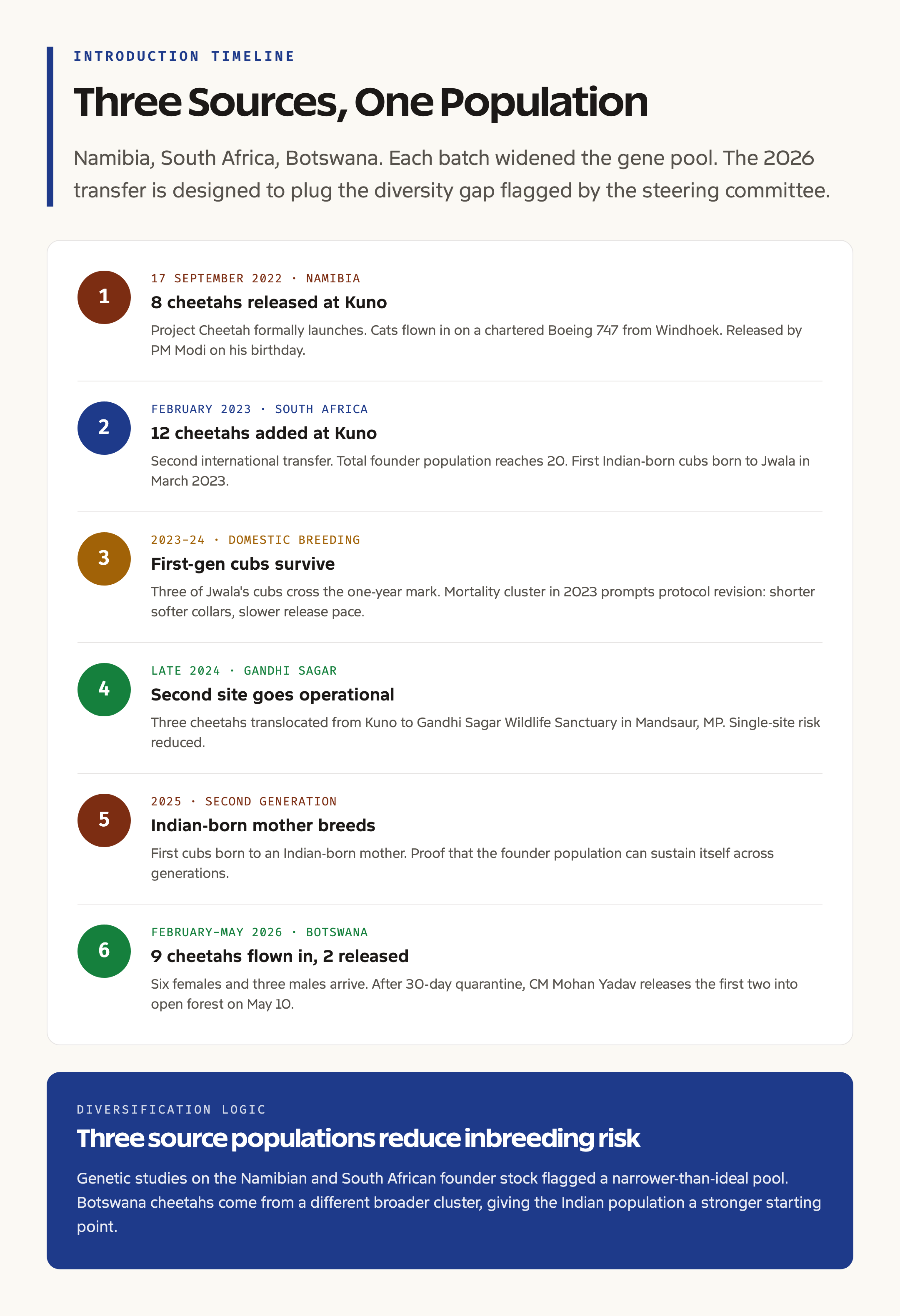
- Botswana batch: 9 cheetahs (6 females, 3 males), arrived in February 2026
- Earlier batches: 8 from Namibia (September 17, 2022), 12 from South Africa (February 2023)
- First Indian-born cubs: March 2023 (Jwala’s litter), and second generation born in 2025
- Project authority: National Tiger Conservation Authority (NTCA) under the Ministry of Environment, Forest and Climate Change
- Steering body: Cheetah Project Steering Committee, chaired by retired forest officer Rajesh Gopal
What Just Happened
Madhya Pradesh Chief Minister Mohan Yadav released two cheetahs brought from Botswana into the open forest area of Kuno National Park on May 10, 2026. These two cats had completed their 30-day quarantine period in soft bomas. They were part of the nine-cheetah batch that arrived from Botswana in February 2026, the third international consignment under Project Cheetah after Namibia in 2022 and South Africa in 2023.
The May 10 release pushed Kuno’s count to 54 and the all-India total to 57 (including three at Gandhi Sagar). Officials noted that the Botswana cats are expected to add genetic diversity to the existing Namibian and South African stock at Kuno, reducing the risk of inbreeding depression that the steering committee has flagged in internal reviews.
Two design choices distinguish this phase from the 2022 and 2023 phases. First, the use of two parallel sites, Kuno and Gandhi Sagar, follows the recommendation of the cheetah action plan that no single site should hold the entire founder population. Second, the soft boma to wild ratio is being managed more conservatively, drawing on lessons from cheetah reintroduction science and the latest cheetah update reports. Earlier, free-release pace was faster. After mortality events in 2023, the steering committee slowed down releases and lengthened acclimatization windows.
Background and Historical Context
The cheetah went extinct in India in 1952. The last three known cheetahs were reportedly shot by Maharaja Ramanuj Pratap Singh Deo of Koriya in present-day Chhattisgarh in 1947. Their decline through the late 19th and early 20th centuries was driven by hunting, habitat loss, and the loss of their primary prey, the blackbuck and chinkara, across the open grasslands of central and western India.
Discussions about reintroduction began in the 1970s, with proposals to bring Asiatic cheetahs from Iran. These never materialized because Iran’s own Asiatic cheetah population had crashed to fewer than 50 individuals and the political windows kept closing. By 2009, the Wildlife Trust of India and the Wildlife Institute of India recommended that Indian conditions could support the African cheetah (Acinonyx jubatus jubatus), which is genetically closer to the extinct Asiatic cheetah than was previously assumed.
The Supreme Court initially blocked the project in 2013 on grounds that the African cheetah was a different subspecies and that the existing protected areas were better suited to Asiatic lion translocation. In 2020, the court allowed an experimental introduction on a case-by-case basis. The Cheetah Action Plan, published by the NTCA in January 2022, formalized the framework.
Kuno was chosen as the first site for three reasons. It had been originally prepared in the 1990s as the second home for the Asiatic lion (a translocation Gujarat has resisted). It has roughly 748 square kilometers of contiguous protected area with low human density. And its prey base, primarily chital, sambar, nilgai, chinkara, and wild boar, was assessed as sufficient for a founder population of about 20 cheetahs.
Key Provisions and Features of Project Cheetah
The project is structured around four operational pillars.
- Translocation and quarantine: Imported cheetahs are held in 30-day quarantine in small bomas (around 1 to 2 hectares), then moved to larger soft bomas (50 to 150 hectares) for acclimatization, then progressively released into the open forest.
- Soft boma to wild progression: A staged release model that allows cheetahs to develop hunting skills, get used to Indian climate and topography, and avoid initial conflict with leopards.
- Health monitoring and veterinary support: A dedicated team from the Wildlife Institute of India, Indian Veterinary Research Institute, and South African and Namibian vets follows every individual cat. Each cheetah has a satellite collar with GPS tracking.
- Site expansion: Gandhi Sagar Wildlife Sanctuary in Mandsaur district of MP received its first cheetahs in late 2024. Mukundra Hills Tiger Reserve in Rajasthan and Banni grasslands in Gujarat are under evaluation.
The Cheetah Project Steering Committee, chaired by retired NTCA official Rajesh Gopal, includes wildlife biologists, forest officers, and international cheetah experts. The committee reviews mortality, breeding success, and release readiness every quarter.
Why It Matters
Project Cheetah is the only intercontinental large carnivore reintroduction attempt of its scale anywhere in the world. Its success or failure will shape conservation science for the next two decades.
For India, the project carries three distinct stakes. First, it restores a species that disappeared from the country within living memory and reasserts ecological agency. Second, it forces investment in grassland and scrub forest landscapes, which have historically been underprotected compared to dense forest and tiger reserve geographies. Third, it tests the institutional capacity of the NTCA, state forest departments, and the Cheetah Project Steering Committee to manage a complex, internationally-visible program.
For the global conservation community, India’s experiment matters because cheetahs are vulnerable globally, with an estimated 7,000 individuals left across Africa and fewer than 50 in Iran. If India can establish a self-sustaining wild population of 200 to 300 cheetahs over the next decade, it becomes an insurance population against catastrophic decline elsewhere.
For UPSC purposes, the project intersects environment, ecology, federalism (state versus center forest department coordination), international diplomacy (the MoUs with Namibia, South Africa, and Botswana), and judicial activism (the Supreme Court’s role in shaping the project).
Detailed Analysis: The Mortality Question
Behind the 57 number sits a difficult sub-story. Between September 2022 and December 2024, at least nine adult cheetahs and three cubs died at Kuno from a mix of causes. Investigations attributed deaths to renal failure from dehydration, septicemia linked to radio collar abrasions during the Indian monsoon, prey-related injuries during initial hunts, and one case of suspected leopard predation on a cheetah cub.
The 2023 mortality cluster prompted an external review and a course correction. Collars were redesigned with shorter, softer bands. Free-release pace was slowed. Veterinary teams added monsoon-specific protocols. By 2025, the mortality rate had dropped substantially.
The arrival of the Botswana batch in 2026 is part of the genetic diversification response. Genetic studies on the Namibian and South African founder stock had flagged a narrower-than-ideal founder gene pool. Botswana cheetahs come from a different broader population cluster, which should help.
Two breeding successes are worth tracking. The first Indian-born cubs were born in March 2023 to a Namibian female named Jwala. Of her four cubs, three survived past their first year. A second-generation Indian-born cohort, cubs born to an Indian-born mother, was documented in 2025 and represents the first proof that the founder population can sustain itself across generations.
Comparative Perspective
How does Project Cheetah compare with other large carnivore reintroduction or translocation programs?
| Project | Location | Species | Status |
|---|---|---|---|
| Yellowstone Wolves | USA, 1995 | Gray wolf | Considered successful, ~100 wolves in park |
| Iberian Lynx | Spain, Portugal | Iberian lynx | Population recovered to 1,600+ from <100 |
| African Wild Dog | Multiple African sites | Lycaon pictus | Mixed results, ongoing |
| Asiatic Lion | India, Gir to Kuno (planned) | Panthera leo persica | Translocation stalled, single-site risk persists |
| Project Cheetah | India, Kuno + Gandhi Sagar | African cheetah | 57 individuals, early-stage |
The Yellowstone wolf reintroduction shows what success can look like at a 30-year horizon. The Iberian lynx project shows how slow and patient recovery work is. Project Cheetah is at year four. It is too early to call it a success or failure. What can be said is that the founder population now exists, second-generation breeding has happened, and two sites are operational. The next five years are the test.
Challenges Ahead
Three problems will shape the next phase. The first is prey base. Kuno’s prey density was estimated at the lower end of the suitable range when the project started. Active prey base augmentation through chital and chinkara translocations from Pench, Bandhavgarh, and Van Vihar has begun, but it takes time. Without sufficient prey, free-ranging cheetahs will move outside the protected area and face conflict.
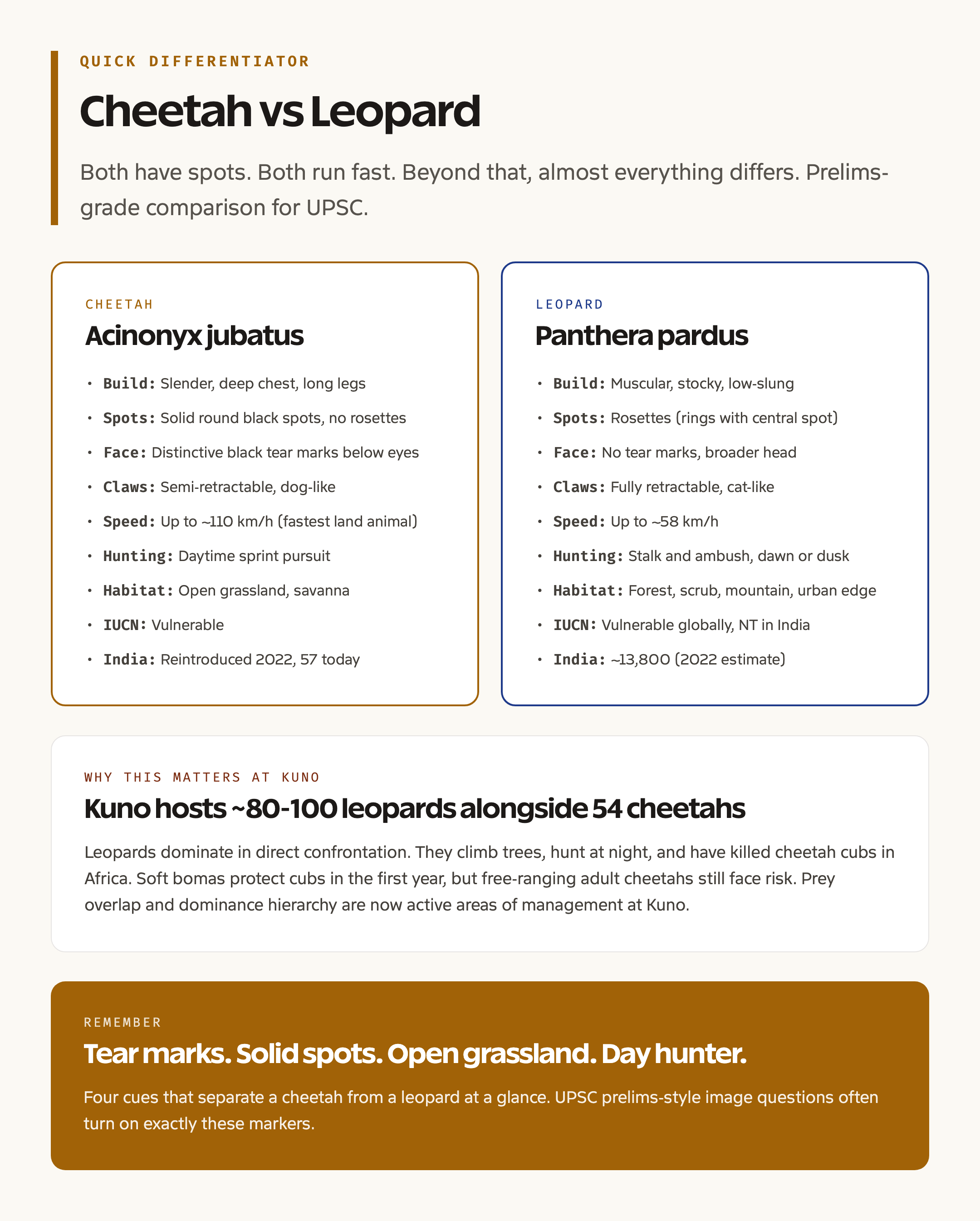
The second is leopard interaction. Aspirants should review the cheetah vs leopard differentiator to understand the dynamics. Kuno has roughly 80 to 100 leopards. Leopards are dominant in confrontations with single cheetahs and have been documented killing cheetah cubs in Africa. The soft boma model partially insulates cubs from leopards during the vulnerable first year, but free-ranging adult cheetahs still face risk.
The third is monsoon management. African cheetahs evolved in regions with shorter and lighter rainy seasons. Indian monsoons stress immune systems, can cause collar injuries, and shift prey movement. The Cheetah Project Steering Committee has adapted protocols but the seasonal mortality risk persists.
A fourth, longer-term issue is space. Kuno alone cannot hold more than about 25 to 30 free-ranging adult cheetahs at sustainable density. Gandhi Sagar adds maybe another 10 to 15. To reach the Cheetah Action Plan target of a stable population of 100 to 200 cheetahs, India needs three to five more sites operational. Mukundra Hills, Banni grasslands, and Nauradehi Wildlife Sanctuary are the leading candidates.
Prelims Pointers
- Kuno National Park is in Sheopur district, Madhya Pradesh. Total area is roughly 748 sq km.
- Kuno was originally prepared as the second home for the Asiatic lion (the translocation has not happened).
- Gandhi Sagar Wildlife Sanctuary is in Mandsaur district, Madhya Pradesh.
- Project Cheetah was formally launched on September 17, 2022, with the release of 8 Namibian cheetahs.
- The first South African batch (12 cheetahs) arrived in February 2023.
- The Botswana batch (9 cheetahs, 6 females and 3 males) arrived in February 2026.
- First Indian-born cubs: March 2023, mother Jwala from Namibia.
- The NTCA was established under the Wildlife Protection Act 1972 (as amended) in 2006.
- The Cheetah Action Plan was published by NTCA in January 2022.
- The Supreme Court approved an experimental cheetah introduction in 2020.
- African cheetah scientific name: Acinonyx jubatus jubatus.
- Asiatic cheetah scientific name: Acinonyx jubatus venaticus. The Asiatic subspecies survives only in Iran, with fewer than 50 individuals.
- Total cheetah population in India as of May 2026: 57.
Mains Questions
- Critically evaluate Project Cheetah as a model for intercontinental species reintroduction. What are its scientific and policy lessons for India? (GS Paper 3, Environment and Ecology, 250 words)
- Discuss the institutional architecture of wildlife conservation in India with reference to the National Tiger Conservation Authority and the Cheetah Project Steering Committee. (GS Paper 2, Governance, 150 words)
- Kuno National Park cheetah experience exposes the limits of single-site conservation. Examine the need for a landscape approach to large carnivore management in India. (GS Paper 3, 250 words)
- Compare Project Cheetah with the planned translocation of Asiatic lions from Gir. What does the comparison reveal about federal coordination on wildlife issues? (GS Paper 2, Federalism, 150 words)
Way Forward
Three priorities should drive the next two years. Operational site expansion is the most urgent. Mukundra Hills in Rajasthan and Banni grasslands in Gujarat need to be brought online with cheetah-ready infrastructure and prey base augmentation. Without expansion, the Kuno-Gandhi Sagar system cannot grow beyond 60 to 70 individuals.
Second, prey base. The chital, chinkara, and nilgai translocation program from source landscapes needs to be scaled. Without prey density above 20 individuals per square kilometer of primary prey species, free-ranging cheetah survival rates will not stabilize.
Third, community interface. Cheetahs ranging beyond protected boundaries will inevitably enter agricultural and pastoral landscapes. The compensation, early-warning, and community engagement protocols developed for tiger reserves need to be adapted for cheetah-specific patterns.
The 57 number is a milestone, not a destination. The Kuno National Park cheetah experiment is genuinely working at the founder population level. Whether it scales into a self-sustaining wild population of 200 or more across multiple sites is the question the next decade has to answer.
Frequently Asked Questions
What is the current cheetah population at Kuno National Park?
As of May 10, 2026, Kuno National Park hosts 54 cheetahs. Of these, 17 are free-ranging in the wild and 37 are in soft bomas. Total cheetahs in India, including those at the Gandhi Sagar Wildlife Sanctuary, stand at 57.
When did Project Cheetah begin?
Project Cheetah was formally launched on September 17, 2022, when Prime Minister Narendra Modi released eight Namibian cheetahs into Kuno National Park on his birthday. A second batch of 12 cheetahs arrived from South Africa in February 2023.
Why was Kuno chosen as the site?
Kuno was assessed as suitable because of its 748 square kilometers of contiguous protected area, relatively low human density, the prey base of chital, sambar, nilgai, chinkara, and wild boar, and the absence of tigers, which would otherwise compete with cheetahs at the apex predator level.
What is the difference between the African cheetah and the Asiatic cheetah?
The African cheetah (Acinonyx jubatus jubatus) and the Asiatic cheetah (Acinonyx jubatus venaticus) are subspecies. The Asiatic subspecies survives only in Iran with fewer than 50 individuals. Genetic studies have shown that the African cheetah is close enough to the historical Indian cheetah for ecological replacement purposes.
Why were Botswana cheetahs added in 2026?
The Botswana cheetahs arrived in February 2026 to add genetic diversity to the existing Namibian and South African founder stock. Genetic studies had flagged a narrower-than-ideal founder gene pool at Kuno. Cheetahs from Botswana come from a broader population cluster.
What is Gandhi Sagar Wildlife Sanctuary’s role?
Gandhi Sagar Wildlife Sanctuary in Mandsaur district of Madhya Pradesh is the second cheetah site under Project Cheetah. It received its first cheetahs in late 2024 and currently hosts three individuals. Multi-site distribution reduces single-site risk.
How many cheetahs have died under Project Cheetah?
Between September 2022 and December 2024, at least nine adult cheetahs and three cubs died at Kuno from causes including renal failure, septicemia from radio collar abrasions, and prey-related injuries. Protocols have since been revised, and mortality has substantially dropped.
Who runs Project Cheetah?
The project is executed by the National Tiger Conservation Authority (NTCA) under the Ministry of Environment, Forest and Climate Change. The Cheetah Project Steering Committee, chaired by Rajesh Gopal, provides scientific and operational oversight.
What is a soft boma?
A soft boma is a large fenced enclosure, typically 50 to 150 hectares, used to acclimatize translocated cheetahs to Indian conditions before free release. It allows hunting practice, monitoring, and veterinary intervention while reducing initial mortality risk.
Will India get more cheetah sites?
Mukundra Hills Tiger Reserve in Rajasthan, Banni grasslands in Gujarat, and Nauradehi Wildlife Sanctuary in Madhya Pradesh are under evaluation as additional sites. Expansion is necessary to reach the Cheetah Action Plan target of a stable population of 100 to 200 cheetahs in the wild.
Tell Google you want more of this.
Add Anantam IAS as a preferred sourceOne tap, and this site shows up more often in your own Top Stories, AI Overviews and AI Mode. Remove it any time.