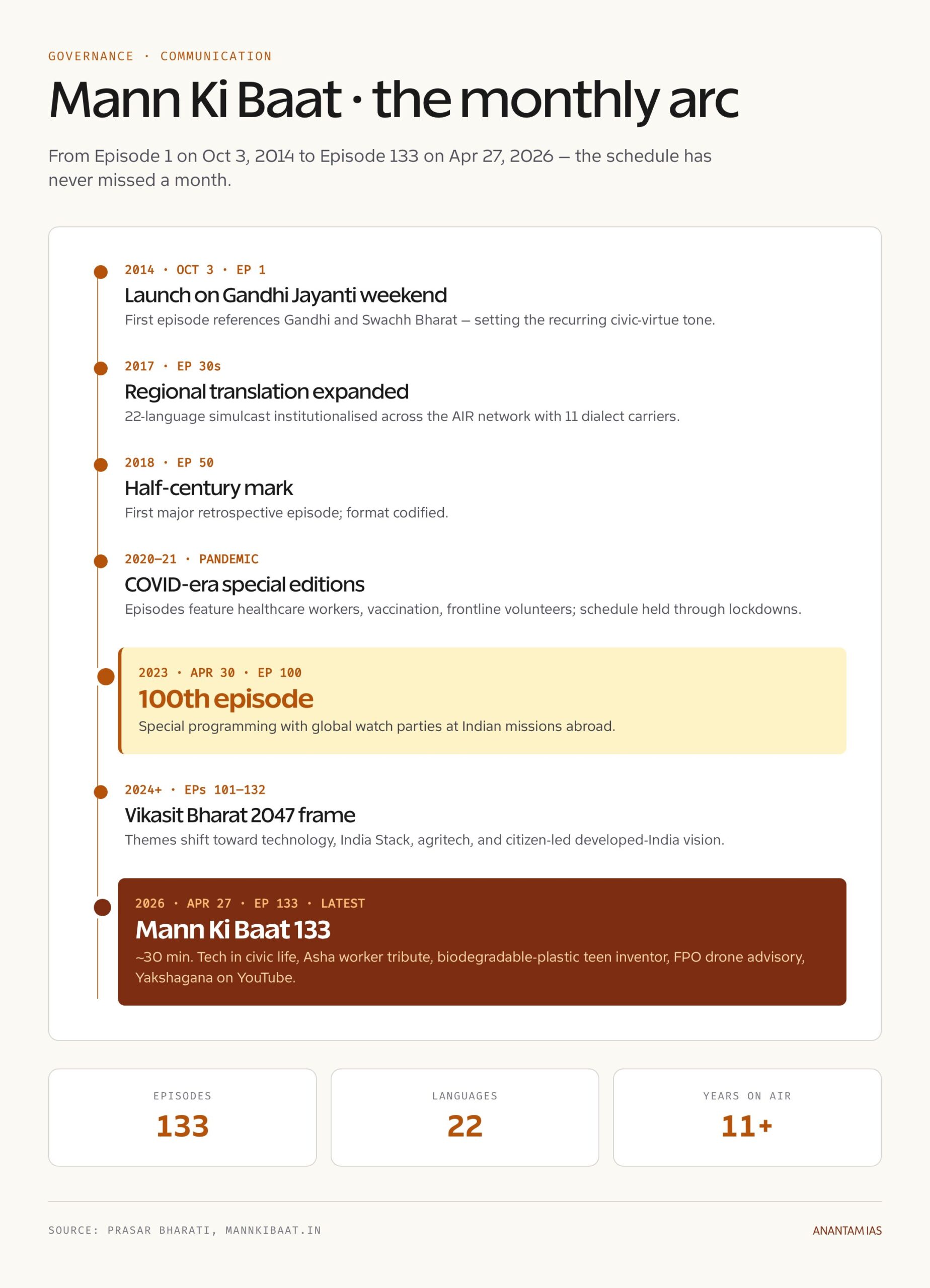
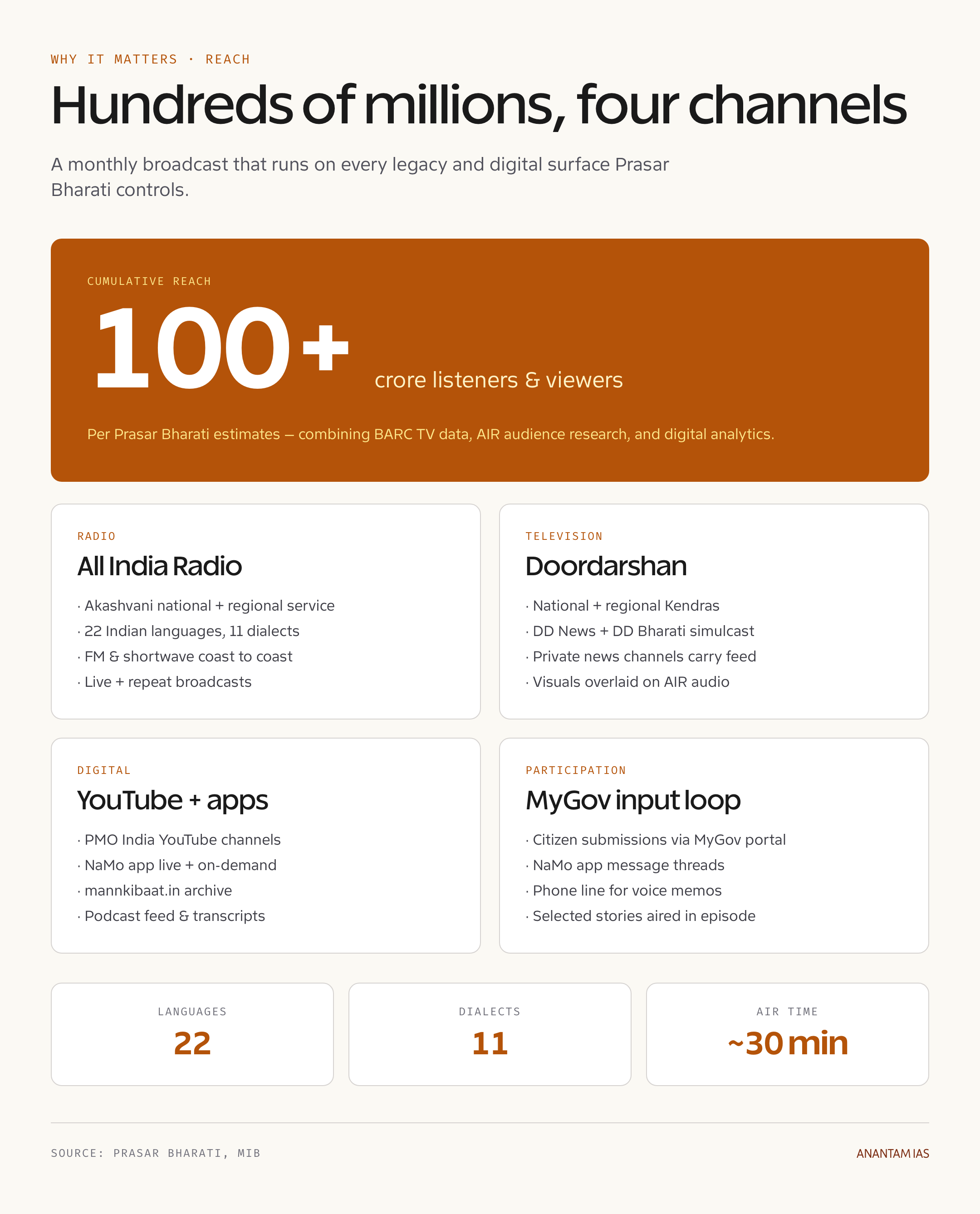
The 133rd episode of Mann Ki Baat aired on Sunday, April 27, 2026, at 11 a.m. IST. Like every previous Sunday-of-the-month broadcast since October 3, 2014, it was carried live across the entire All India Radio network, telecast on Doordarshan, simulcast in 22 Indian languages and 11 dialects, and pushed out on the NaMo app, YouTube, and the Mann Ki Baat website. The Prime Minister spoke for roughly 30 minutes. The themes ranged from agricultural innovation in a small Maharashtra village to a Gujarati teenager’s biodegradable-plastic invention to a tribute to a 78-year-old Asha worker in Bihar.
The format is unusual in democratic political communication. It is one-way. There are no callers, no panel, no opposition response. The Prime Minister speaks, the country listens, the next month repeats. Twelve years and 133 episodes in, Mann Ki Baat has become a fixture of Indian governance communication, studied by political scientists, criticized by opposition voices, and consumed by an audience that, by official Prasar Bharati measurements, runs into hundreds of millions across television, radio, and digital platforms.
Mann Ki Baat 133 is worth a closer look because it lands at a politically active moment, with several state elections in 2026, a continuing focus on technology-led governance, and a maturing format whose consistency itself is a kind of message.
Quick Facts at a Glance
- Episode number: 133
- Broadcast date: April 27, 2026 (Sunday, 11:00 a.m. IST)
- Duration: Approximately 30 minutes
- First episode: October 3, 2014
- Frequency: Monthly, last Sunday of every month
- Languages: Broadcast in 22 Indian languages and 11 dialects
- Network: All India Radio (AIR/Akashvani), Doordarshan, NaMo app, YouTube, podcasts
- Average audience: Officially estimated at over 100 crore cumulative listeners across radio, TV, and digital, as per latest available data from Prasar Bharati
- Format: One-way address, often citing citizen-submitted ideas via the MyGov portal
- Themes covered most often: Citizen heroes, women’s empowerment, technology, environment, fitness, education, culture
What Happened on April 27, 2026: Mann Ki Baat 133 Themes
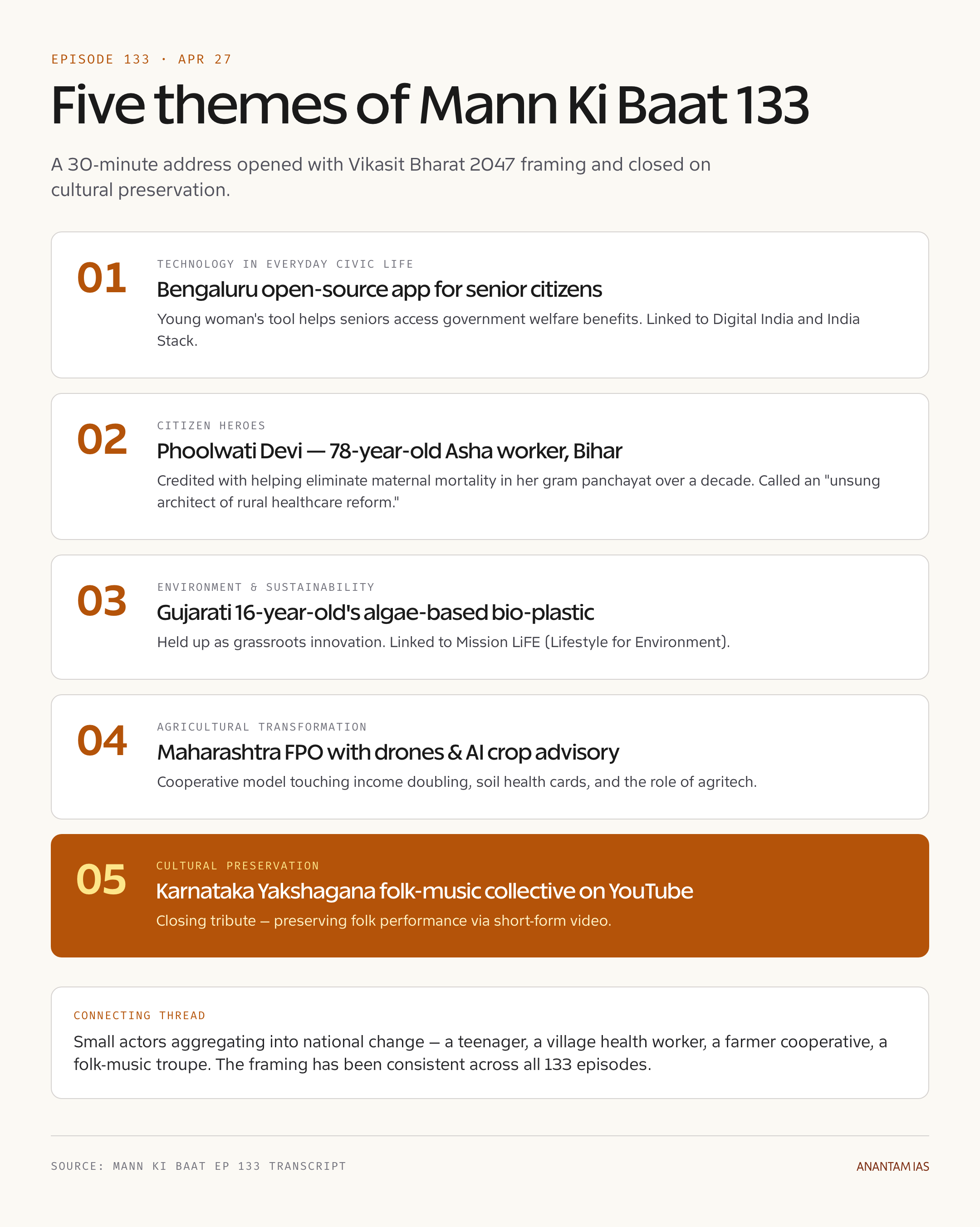
Mann Ki Baat 133 opened with a reference to the upcoming 80th anniversary of Indian independence in 2027 and the start of the Vikasit Bharat 2047 conversation. The Prime Minister urged listeners to share what their version of a developed India looks like, framing the next 24 months as an opportunity to build a citizen-led vision document.
Five thematic blocks anchored the episode.
Technology in everyday civic life. The Prime Minister highlighted a young woman from Bengaluru who built an open-source app to help senior citizens access government welfare benefits. He linked the example to broader Digital India and India Stack themes.
Citizen heroes. Mann Ki Baat 133 profiled Phoolwati Devi, a 78-year-old Asha worker from a Bihar village credited with helping eliminate maternal mortality in her gram panchayat over a decade. The Prime Minister called her one of the unsung architects of rural healthcare reform.
Environment and sustainability. A 16-year-old Gujarati student’s invention of a biodegradable plastic alternative made from algae was held up as an example of grassroots innovation. The Prime Minister linked the segment to Mission LiFE (Lifestyle for Environment).
Agricultural transformation. A Maharashtra cooperative running an FPO (Farmer Producer Organization) using drone technology and AI-based crop advisory was profiled. The segment touched on income doubling, soil health cards, and the role of agritech.
Cultural preservation. The episode closed with a tribute to a Karnataka folk-music collective preserving the Yakshagana tradition through YouTube and short-form video.
A common thread, threaded through the segments without being announced, was the role of small actors (a teenager, a village health worker, a farmer cooperative, a folk-music troupe) doing things that aggregate into national change. This is a deliberate framing choice that has remained consistent across all 133 episodes.
Background and Historical Context
How Mann Ki Baat Started: The October 2014 Launch
The first episode of Mann Ki Baat aired on October 3, 2014, four months after Narendra Modi took office as Prime Minister. The format borrowed from American “fireside chat” precedents (Franklin Roosevelt’s 1933-44 broadcasts) and from Indian precedents like Jawaharlal Nehru’s All India Radio addresses, but adapted them for the smartphone era. The first episode included a reference to Mahatma Gandhi (it aired on Gandhi Jayanti weekend) and discussed cleanliness, an early signal that the Swachh Bharat Abhiyan would be a recurring theme.
The programme has not missed a month. Through general elections, parliamentary sessions, the COVID-19 pandemic, foreign visits, and personal tragedies, the schedule has held. The 100th episode was broadcast on April 30, 2023, with special programming and global watch parties. Episodes 101 through 132 continued the format with minor adjustments, including more emphasis on Vikasit Bharat themes after 2024.
Three structural features have been stable throughout. First, the Prime Minister speaks alone; there are no co-hosts or interviewers. Second, the script draws heavily on citizen submissions via the MyGov portal, the NaMo app, and a phone line for audio messages. Third, the language is deliberately conversational, blending Hindi with English phrases and occasional regional-language quotations.
For broader context on the Prime Minister’s communication style, the related profile of Narendra Modi and the list of Indian Prime Ministers provide useful background.
Constitutional and Communication Framework
Mann Ki Baat does not have a specific constitutional basis. It operates within the broader framework of the Prime Minister’s office and the public broadcasting infrastructure of Prasar Bharati, the autonomous corporation set up under the Prasar Bharati (Broadcasting Corporation of India) Act, 1990. AIR and Doordarshan, the two principal carriers, are units of Prasar Bharati.
The Election Commission has, in past general election periods, issued advisories regulating the timing of episodes to comply with the Model Code of Conduct. Episodes that fall during the election silent period are typically rescheduled or condensed.
The 22-language broadcast leverages AIR’s regional service network, which itself dates to the colonial period and was expanded substantially after independence. The simulcast is done by regional translators who work from the Hindi or English script, with quality control coordinated centrally.
Why Mann Ki Baat 133 Matters
The reach numbers are large but contested. Prasar Bharati’s official estimates, drawn from BARC television data, AIR audience research, and digital analytics, claim cumulative listener and viewer figures running into hundreds of millions. Independent surveys, including IIM Rohtak studies, have produced varying numbers. What is uncontested is that Mann Ki Baat is one of the most consistently programmed political-communication products in Indian history.
Three reasons it matters as a governance instrument.
Direct centre-citizen channel. The format bypasses the traditional press, opposition voices, and institutional intermediaries. The Prime Minister speaks directly to citizens in their language. This has obvious political advantages and equally obvious democratic concerns.
Citizen-input loop. The MyGov submissions, even if only a tiny fraction make it into a given episode, create a structured channel for citizens to participate in shaping content. Several government schemes have been seeded or popularized through Mann Ki Baat references.
Cultural and language reach. The 22-language broadcast and 11-dialect carriage take the Prime Minister’s voice into linguistic communities that English- and Hindi-only national media do not cover. For policy diffusion in non-Hindi states, this is non-trivial.
The 133rd episode landed during a stretch where India is preparing for several state elections, the budget cycle is active, and post-2024 election themes around Vikasit Bharat 2047 are gathering momentum. The choice of themes (technology, environment, agriculture, women’s empowerment) reflects continuing policy priorities.
Detailed Analysis: Themes Across 133 Episodes
A thematic analysis of all 133 episodes reveals consistent priorities. Cleanliness and sanitation appear in roughly 40% of episodes, drawing on the Swachh Bharat Abhiyan. Women’s empowerment and the Beti Bachao Beti Padhao theme appear in 35%. Technology, Digital India, and Make in India themes appear in 30%. Citizen heroes (named individuals doing public-interest work) appear in nearly every episode. Agricultural innovation, sports, fitness, environment, and culture round out the recurring themes.
What is mostly absent is also informative. Direct discussion of opposition parties, foreign-policy controversies, internal party matters, or specific legislative debates is rare. The format is designed for non-confrontational themes. Critics argue this makes Mann Ki Baat a soft-power tool rather than a substantive policy address. Supporters argue the design choice is deliberate and effective.
The use of citizen profiles is methodical. Producers select stories based on geographic spread (every episode covers multiple states), demographic representation (gender, age, community), and theme alignment (the chosen profiles must support the episode’s broader argument).
For grounding on broader governance themes, see the related notes on PM Vishwakarma Yojana and the Vasudhaiva Kutumbakam philosophy that has anchored India’s recent foreign-policy framing.
Comparative Perspective: Mann Ki Baat in Global Context
Direct head-of-government addresses to citizens are common democracy. The format Mann Ki Baat uses, though, has specific characteristics worth comparing.
Roosevelt’s fireside chats (1933-1944) numbered 30 over 11 years, mostly during national crises. They were shorter than Mann Ki Baat, often around 15-20 minutes, and were responsive to specific events.
Britain’s Queen’s Christmas Message (since 1932) is annual, ceremonial, and largely apolitical. The Prime Minister’s New Year address is similar in tone. Neither approaches the scale or frequency of Mann Ki Baat.
Singapore’s National Day Rally speech (annual, since 1966) is the closest cultural parallel: a long, scripted, citizen-focused speech delivered in three languages by the Prime Minister, with a heavy policy and aspirational content load.
China’s CCTV addresses by the President are more formal, less frequent, and more explicitly political. They lack the citizen-hero element and the multilingual carriage Mann Ki Baat features.
What is genuinely distinctive about Mann Ki Baat is the combination: monthly cadence (not annual), multilingual simultaneous broadcast (not just translation), citizen-submission integration, and the deliberate avoidance of explicitly partisan content. It is a format that has no clean parallel.
Challenges and Critiques
The programme has not been without criticism, much of it pointed.
One-way nature. There is no real-time feedback, no caller, no opposition response. Critics argue this is propaganda by another name. Supporters argue the Prime Minister speaks regularly in Parliament and in press interactions and that Mann Ki Baat is one of many channels.
Difficulty measuring impact. Listener and viewer numbers are estimates. The actual influence on policy uptake, citizen behavior, or political opinion is hard to measure rigorously. Several university studies have produced mixed findings.
Theme selection bias. Themes that align with government priorities get amplified; themes that do not, including unemployment numbers, agrarian distress, and farmer protests at certain points, are absent or minimized. This is a content-curation choice with political consequences.
Public broadcasting cost. Critics have raised questions about the use of public broadcasting infrastructure for what is effectively a Prime Minister’s monthly address. Defenders point out that Prasar Bharati’s mandate includes such national programming.
Election Commission oversight. During election periods, MCC compliance has been a recurring issue. The Election Commission has, on occasion, asked for episodes to be deferred or modified.
For a related primer on broadcasting and communication policy, the explainer on Indian governance themes provides useful framing.
UPSC Prelims Pointers
- Mann Ki Baat launched on October 3, 2014.
- The 133rd episode was broadcast on April 27, 2026.
- The programme is broadcast on All India Radio (Akashvani), Doordarshan, the NaMo app, and digital platforms.
- It is broadcast in 22 Indian languages (matching the Eighth Schedule) and approximately 11 dialects.
- Prasar Bharati, set up under the Prasar Bharati Act, 1990, is the autonomous public-service broadcaster that carries the programme.
- The 100th episode was broadcast on April 30, 2023.
- The MyGov portal and the NaMo app are the principal channels for citizen-submission inputs.
- Mann Ki Baat operates in compliance with Election Commission Model Code of Conduct restrictions during election periods.
- The format is a monologue by the Prime Minister, typically of about 30 minutes duration.
- Themes most frequently covered include Swachh Bharat, Digital India, Beti Bachao Beti Padhao, Mission LiFE, and citizen heroes.
Mains Practice Questions
- “Mann Ki Baat is an instrument of direct centre-citizen communication that bypasses traditional intermediaries.” Critically examine its role in Indian governance communication. (GS Paper II, 250 words)
- Discuss the role of public-service broadcasting in a democracy with reference to Prasar Bharati’s coverage of Mann Ki Baat. (GS Paper II, 150 words)
- Compare the Indian Prime Minister’s monthly radio address with similar communication formats in other democracies. What does the comparison reveal about Indian political communication? (GS Paper II, 250 words)
- Communication tools like Mann Ki Baat raise questions about the line between governance communication and political messaging. Examine. (GS Paper IV, 150 words)
Way Forward
Mann Ki Baat 133 is a milestone of consistency more than of content. The format has held steady for 12 years across electoral, legislative, and crisis cycles. That consistency is itself the message: the Prime Minister will be in the citizen’s ear on the last Sunday of every month, in their language, with stories from their geography. The programme has become a fixture of the Indian political calendar.
Three improvements would strengthen the format without compromising its design. First, more independent measurement of reach and impact, ideally by Prasar Bharati’s research wing in partnership with academic institutions. Second, more explicit handling of policy-implementation feedback, where the citizen examples profiled in earlier episodes are tracked over time. Third, occasional thematic episodes with pre-announced topics, allowing civil-society and academic voices to prepare context.
The 133rd episode does not change the formula. It refines it. The next milestone, the 150th episode, will fall in mid-2027, around the 80th anniversary of Indian independence. By then, the programme will have been in continuous monthly broadcast for almost 13 years, longer than most cabinet ministers’ tenures and almost as long as a full Lok Sabha cycle. As a long-running act of governance communication, Mann Ki Baat is now its own institution. The question for the next phase is whether the format remains a monologue, evolves into something more dialogic, or stays exactly as it is on the strength of the audience it has built.
Frequently Asked Questions
Q1. When did Mann Ki Baat start?
Mann Ki Baat started on October 3, 2014, with the first episode broadcast on All India Radio. It has aired monthly since.
Q2. What is the broadcast schedule of Mann Ki Baat?
Mann Ki Baat airs at 11:00 a.m. IST on the last Sunday of every month, except where rescheduling is required for the Election Commission’s Model Code of Conduct or other administrative reasons.
Q3. Where can I listen to Mann Ki Baat 133?
Mann Ki Baat 133 was broadcast on All India Radio, Doordarshan, the NaMo app, the official Mann Ki Baat website, YouTube, and major podcast platforms. Recordings remain available on these channels.
Q4. In how many languages is Mann Ki Baat broadcast?
The programme is broadcast in 22 Indian languages, matching the Eighth Schedule of the Constitution, and in roughly 11 dialects.
Q5. How are topics for Mann Ki Baat episodes chosen?
Topics are chosen by the Prime Minister’s office based on policy priorities, citizen submissions through MyGov and the NaMo app, and thematic considerations. Citizen profiles are selected for geographic and demographic spread.
Q6. What are the most common themes covered in Mann Ki Baat?
Recurring themes include cleanliness (Swachh Bharat), women’s empowerment (Beti Bachao Beti Padhao), technology (Digital India), environment (Mission LiFE), agricultural innovation, fitness, education, and citizen heroes.
Q7. Has Mann Ki Baat ever missed a scheduled episode?
No, the programme has aired every month without missing since October 3, 2014. Some episodes have been adjusted in timing for the Election Commission’s MCC restrictions but the monthly cadence has been maintained.
Q8. What is Prasar Bharati’s role in Mann Ki Baat?
Prasar Bharati is the autonomous public-service broadcaster that carries the programme through its All India Radio and Doordarshan units. It coordinates the regional-language simulcast and digital distribution.
Tell Google you want more of this.
Add Anantam IAS as a preferred sourceOne tap, and this site shows up more often in your own Top Stories, AI Overviews and AI Mode. Remove it any time.