Why in News?
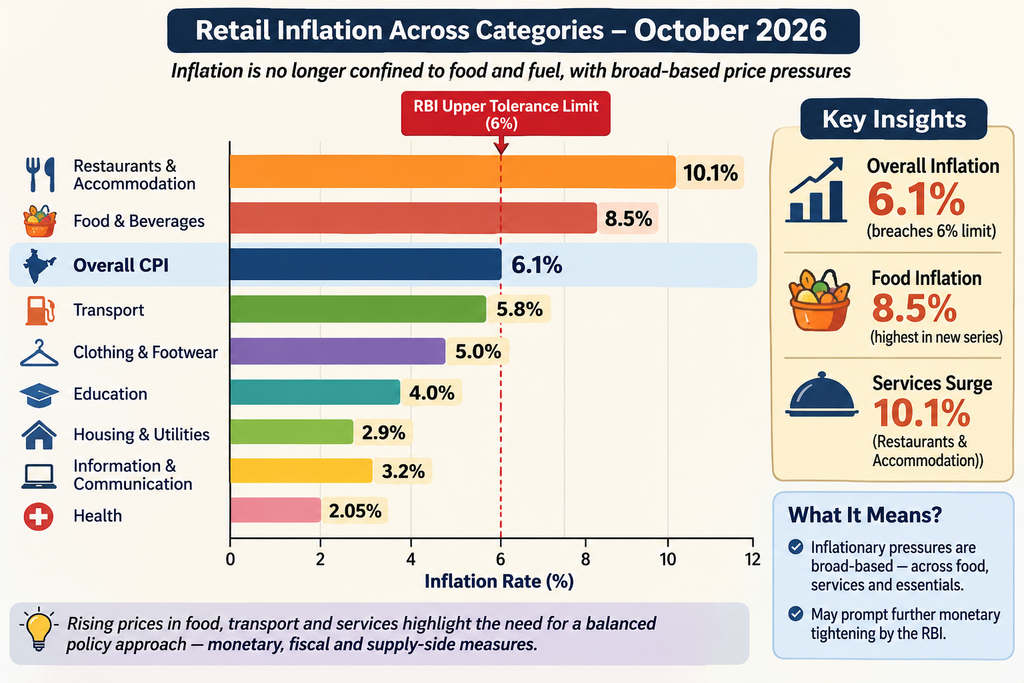
Retail inflation in India rose to 6.1% in October 2026, breaching the Reserve Bank of India’s (RBI) upper tolerance limit of 6% for the first time since October 2024.
The increase, initially driven by food and fuel prices, has become more broad-based, with inflation accelerating across several categories, including transport, clothing, housing, health and services.
| UPSC Relevance: GS-3 Economy: Inflation, Monetary Policy, Price Stability and Inclusive Growth. Prelims: Consumer Price Index (CPI), Retail Inflation, Flexible Inflation-Targeting Framework, Monetary Policy Committee (MPC), Causes and consequences of inflation. |
What is Retail Inflation?
- Retail inflation is the rate at which the average prices of goods and services purchased by households rise over time, reflecting changes in the cost of living and purchasing power.
- Measurement Index: Tracked through the Consumer Price Index (CPI)-Combined, covering both rural and urban areas.
- Policy Benchmark: Used by the RBI as the primary measure for monetary policy decisions, including changes in the repo rate, under India’s flexible inflation-targeting framework.
Retail Inflation Across Categories (October 2026):
India’s Flexible Inflation-Targeting Framework:
- Statutory Basis: Established in 2016 through amendments to the RBI Act, 1934.
- Target Setting: The Central Government, in consultation with the RBI, determines the inflation target once every five years.
- Current Mandate (April 2026-March 2031): 4%, with a tolerance band of ±2% (minimum 2%, maximum 6%).
- Definition of Accountability Failure: The RBI is considered to have failed to meet its target if average inflation remains above 6% or below 2% for three consecutive quarters. A single monthly breach does not constitute failure.
- Remedial Action: In case of failure, the RBI must submit a report to the Central Government explaining:
- Reasons for failure to achieve the inflation target.
- Proposed remedial actions.
- The estimated time frame within which inflation will return to the target range.
Implications of the October Inflation Data:
- The 6.1% reading breaches the upper tolerance limit but does not, by itself, amount to a failure of the inflation-targeting framework.
- Persistent inflation above the tolerance band could weaken the credibility of monetary policy and require corrective action by the RBI.
Structural Challenges in Controlling Food-Led Inflation:
- Inefficacy of Monetary Policy: Higher interest rates (monetary tightening) cannot fix supply-side disruptions like erratic monsoons, pest attacks, or crop damage.
- Imported Inflation and Rupee Depreciation: Global crude oil price shocks and currency depreciation increase domestic fuel, transportation and production costs.
- Second-Round Spillovers: Persistent food inflation risks de-anchoring inflation expectations, spilling over into wages, core services, and manufacturing costs.
- Regressive Impact: Inflation disproportionately affects poorer households, which spend a larger share of their income on essential goods such as food, fuel and housing.
- Demand-Pull Pressures: Stronger consumer demand, including festive-season purchases, may add to inflationary pressures when supply is unable to respond adequately.
- Cost-Push Inflation in Services: Rising food, transport and input costs can be passed on to consumers through restaurants, accommodation and other services.
Policy Matrix to Manage Inflation:
| Monetary Measures (RBI) | Administrative/Fiscal Measures (Govt) | Long-Term Structural Fixes |
| • Policy Rate Hikes: Calibrating the Repo rate to temper aggregate demand. • Liquidity Management: Absorbing excess system liquidity to prevent inflation from becoming entrenched. • Inflation Expectations: Maintaining credible monetary policy communication to anchor inflation expectations. | • Supply Interventions: Open Market Sale Scheme (OMSS), distribution of subsidised Bharat Atta/Rice. • Trade Policy: Rationalising import duties and facilitating imports of essential commodities such as pulses when domestic supplies are inadequate. • Anti-Hoarding Measures: Stock disclosure requirements and action against hoarding and speculative activity. | • Agricultural Infrastructure: Expanding cold chains, modern warehousing, food processing and integrated supply chains. • Climate Resilience: Investing in micro-irrigation, climate-smart seeds, and crop diversification. • Market Reforms: Improving agricultural marketing, logistics, storage and the efficiency of agricultural value chains. |
While the RBI must prevent temporary price shocks from becoming persistent inflation, the government must address agricultural supply constraints, improve logistics and strengthen climate resilience.
UPSC PYQ 2020:
Q. Consider the following statements:
1. The weightage of food in Consumer Price Index (CPI) is higher than that in Wholesale Price Index (WPI).
2. The WPI does not capture changes in the prices of services, which CPI does.
3. The Reserve Bank of India has now adopted WPI as its key measure of inflation and to decide on changing the key policy rates.
Which of the statements given above is/are correct?
(a) 1 and 2 only
(b) 2 only
(c) 3 only
(d) 1, 2 and 3
Answer: (a)
UPSC PYQ 2015:
Q. With reference to inflation in India, which of the following statements is correct?
(a) Controlling the inflation in India is the responsibility of the Government of India only
(b) The Reserve Bank of India has no role in controlling the inflation
(c) Decreased money circulation helps in controlling the inflation
(d) Increased money circulation helps in controlling the inflation
Answer: (c)
Tell Google you want more of this.
Add Anantam IAS as a preferred sourceOne tap, and this site shows up more often in your own Top Stories, AI Overviews and AI Mode. Remove it any time.