The Hanta virus resurfaced in international headlines in May 2026 after a quarantined Atlantic expedition cruise, the MV Hondius, recorded three deaths and at least five confirmed infections off Cape Verde. The strain implicated is Andes virus, the one hantavirus known to spread between humans, and the cluster is now being tracked across five continents. The outbreak is small in absolute numbers but unusually consequential because it tests every assumption epidemiologists have held about how hantaviruses behave outside their rodent reservoirs.
This explainer covers the full picture relevant to UPSC Prelims and Mains: virology, the two clinical syndromes (HPS and HFRS), transmission routes, the 2026 cruise outbreak timeline, India’s risk profile, the One Health frame, comparative position vs other emerging zoonoses, and the specific Prelims and Mains angles that examiners are likely to cover next cycle. Treat the article as a complete reference card on the Hanta virus, not a news clipping.
If you only remember three things about hantavirus: it lives in rodents, it usually does not spread person-to-person, and the Americas strain (Andes virus) is the one to watch when respiratory transmission is reported.
Hanta Virus: Quick Facts at a Glance
| Aspect | Detail |
|---|---|
| Family | Hantaviridae (order Bunyavirales), enveloped negative-sense RNA viruses |
| First identified | Hantaan virus, near Hantan River, Korea, 1976 (Karl Johnson and Ho Wang Lee) |
| Two human syndromes | Hantavirus Pulmonary Syndrome (HPS) in the Americas; Haemorrhagic Fever with Renal Syndrome (HFRS) in Europe and Asia |
| Reservoirs | Rodents (deer mouse, striped field mouse, Norway rat, long-tailed pygmy rice rat); insectivores; bats |
| Transmission | Mainly aerosolised rodent excreta. Person-to-person only with Andes virus, and only rarely |
| HPS case fatality | 40-50 percent |
| HFRS case fatality | 1-15 percent depending on strain |
| Vaccine | None licensed in US/EU. Inactivated HFRS vaccines used in China and South Korea |
| India status (2026) | No confirmed cases; ICMR-NIV monitoring |
| 2026 outbreak | MV Hondius cruise, Andes virus cluster, 3 deaths, 5+ confirmed cases as of May 7, 2026 |
What Just Happened on the MV Hondius
The MV Hondius is a Dutch-flagged expedition cruise that left Ushuaia, Argentina on April 28, 2026 with around 200 passengers and crew. Within ten days of sailing, multiple passengers developed febrile illness with respiratory failure. By May 5 the ship was anchored off Praia, Cape Verde, with one fatality already recorded, and Cape Verde authorities refused docking. On May 6 the Canary Islands also denied entry on ECDC advice. By May 7, WHO published Disease Outbreak News DON599 confirming Andes hantavirus by RT-PCR in the index death.
As of the latest WHO update there are 5-6 confirmed cases, 8-9 suspected cases, and 3 deaths (a Dutch couple and a German national). The index case is a Dutch citizen who spent November 27, 2025 to April 1, 2026 on a road trip across Chile, Uruguay and Argentina. Likely exposure: rodent-infested rural lodging in southern Chile or Patagonia, the historical hot zone for Andes virus.
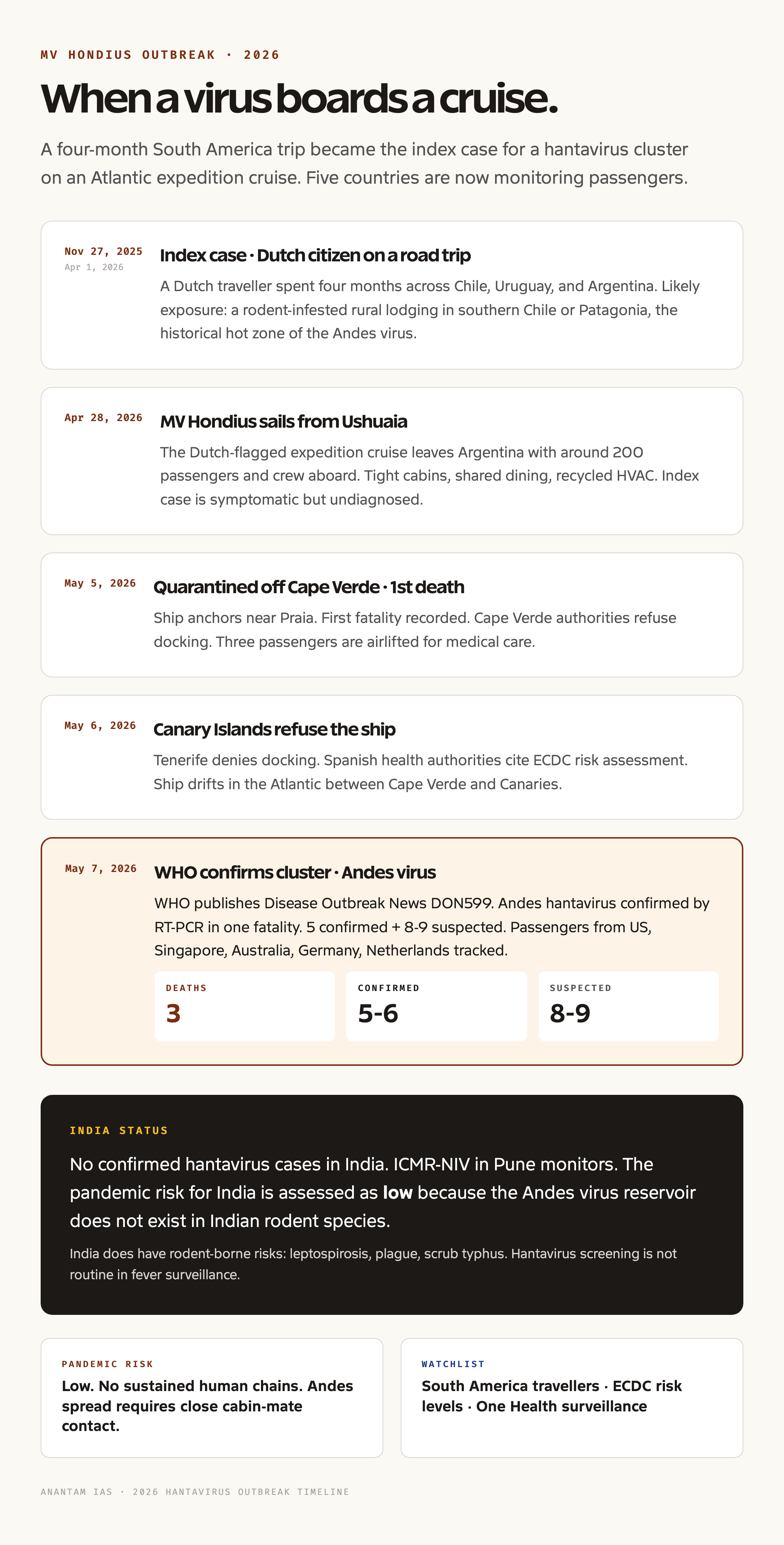
Five countries are now monitoring disembarked passengers: the United States (passengers across at least five states), Singapore, Australia, Germany, and the Netherlands. The cluster is small in absolute numbers but globally distributed, which is what raised the alarm. The fact that infection appears to have spread inside the ship — among people who never set foot in South America — is the part that has international agencies on edge.
Background and Historical Context
The Hanta virus story begins in the Korean War. Between 1951 and 1953, more than 3,000 United Nations soldiers in Korea developed an unexplained haemorrhagic fever with kidney failure. About 10 percent died. The cause was unknown for a generation. In 1976, Korean virologist Ho Wang Lee finally isolated the responsible virus from the lung tissue of striped field mice trapped near the Hantan River. He named it Hantaan virus, and the genus that emerged became Hantavirus.
The second chapter opened in 1993 in the Four Corners region of the southwestern United States. A cluster of young, healthy Navajo adults died of acute respiratory failure within days of falling sick. CDC investigators traced the cases to deer mice contaminated with a previously unknown hantavirus, later named Sin Nombre virus (“the nameless virus”). Unlike Hantaan, Sin Nombre struck the lungs, not the kidneys. This was a new syndrome: Hantavirus Pulmonary Syndrome.
In 1995 a third chapter opened in Argentina. An outbreak in El Bolsón included clusters of cases inside the same household, and one healthcare worker who became infected without rodent exposure. The virus, named Andes virus, became the first — and so far only — hantavirus where person-to-person spread is on the table. The 2026 MV Hondius cluster is forcing infectious-disease specialists to revisit those 1995 lessons in a closed shipboard environment.
Today, virologists recognise more than 50 hantavirus species across rodents, insectivores, and bats. Around 30 cause human disease. The viruses split cleanly along Old World (HFRS, Asia and Europe) and New World (HPS, Americas) lines. Each strain is locked to a specific reservoir species: Hantaan with the striped field mouse, Seoul with the Norway rat, Puumala with the bank vole, Sin Nombre with the deer mouse, Andes with the long-tailed pygmy rice rat.
Hantavirus Types and Clinical Syndromes
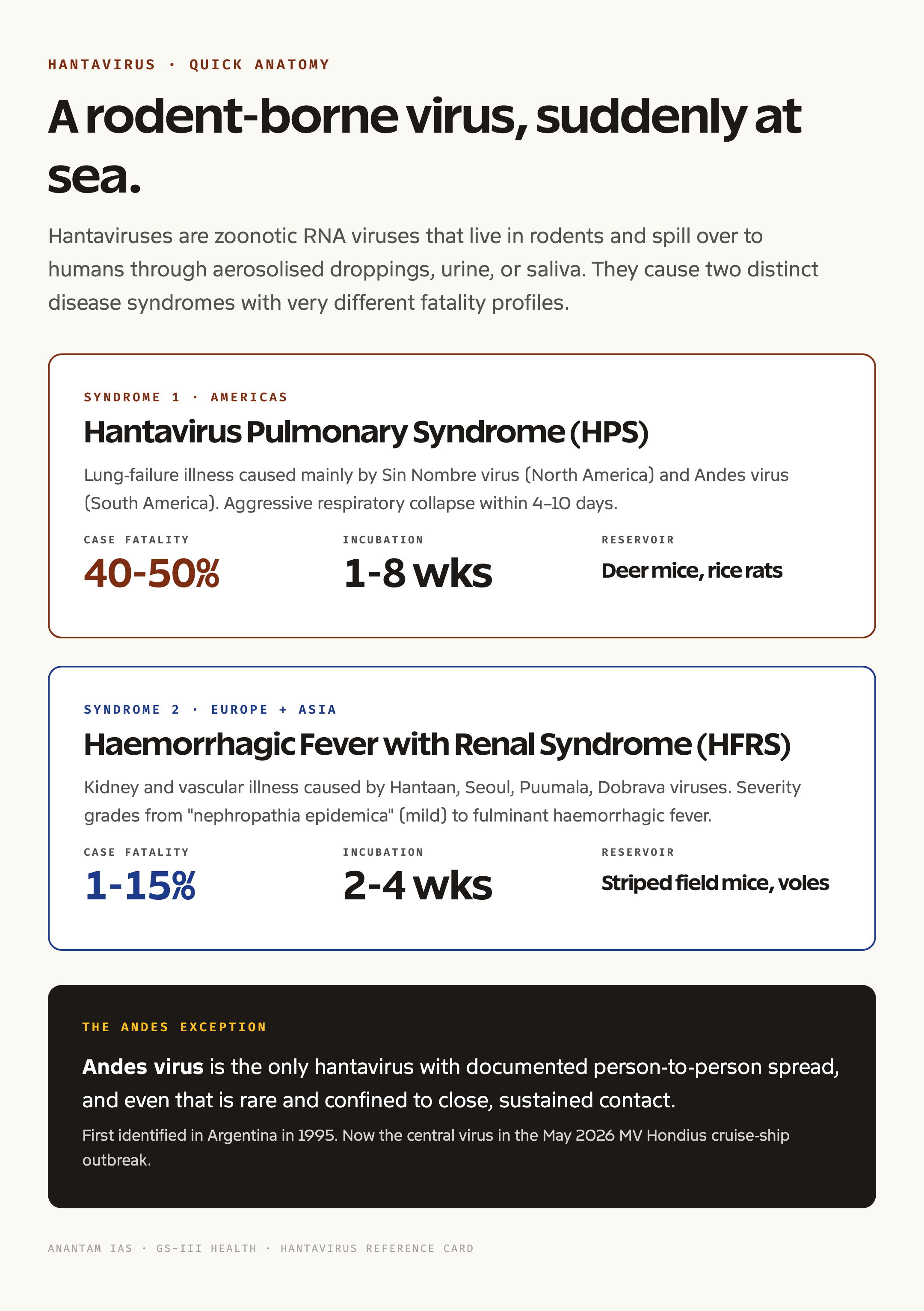
Hantavirus Pulmonary Syndrome (HPS)
HPS dominates in the Americas. The illness has a 1-8 week incubation period, then a prodrome of fever, severe myalgia, headache, abdominal pain and gastrointestinal symptoms lasting 4-5 days. The cardiopulmonary phase that follows is fast and dangerous: capillary leak in the lungs floods alveoli, oxygenation collapses, and shock follows. The case fatality rate is 40-50 percent without prompt ECMO and intensive supportive care. Sin Nombre virus is the dominant cause in North America. Andes virus dominates in South America.
Haemorrhagic Fever with Renal Syndrome (HFRS)
HFRS dominates in Europe and Asia. The classic five-stage course is febrile, hypotensive, oliguric, polyuric, and convalescent. The kidneys take the central hit: acute kidney injury, proteinuria, and microvascular bleeding. Case fatality rates depend heavily on the strain — Hantaan and Dobrava run 5-15 percent, Puumala (the cause of Nordic “nephropathia epidemica”) runs under 1 percent, Seoul runs 1-2 percent. China alone records around 10,000-20,000 HFRS cases a year.
The Andes virus exception
Andes virus carries the additional risk of human-to-human transmission. Documented in Argentina (1996 El Bolsón cluster) and Chile (multiple family-cluster reports), the spread requires close, sustained respiratory contact. Healthcare workers who treated symptomatic patients and family members sharing small living spaces have been infected. The 2026 MV Hondius cluster is the first time this transmission pattern is being investigated in a moving international cruise environment.
How Hantavirus Spreads
Most human hantavirus infections come from a single dominant route: inhaling air contaminated by rodent excreta. The virus survives in dried droppings for days. Sweeping a barn, cleaning an attic, dusting a cabin, or moving stored grain stirs the particles into the air. They reach the alveoli within minutes.
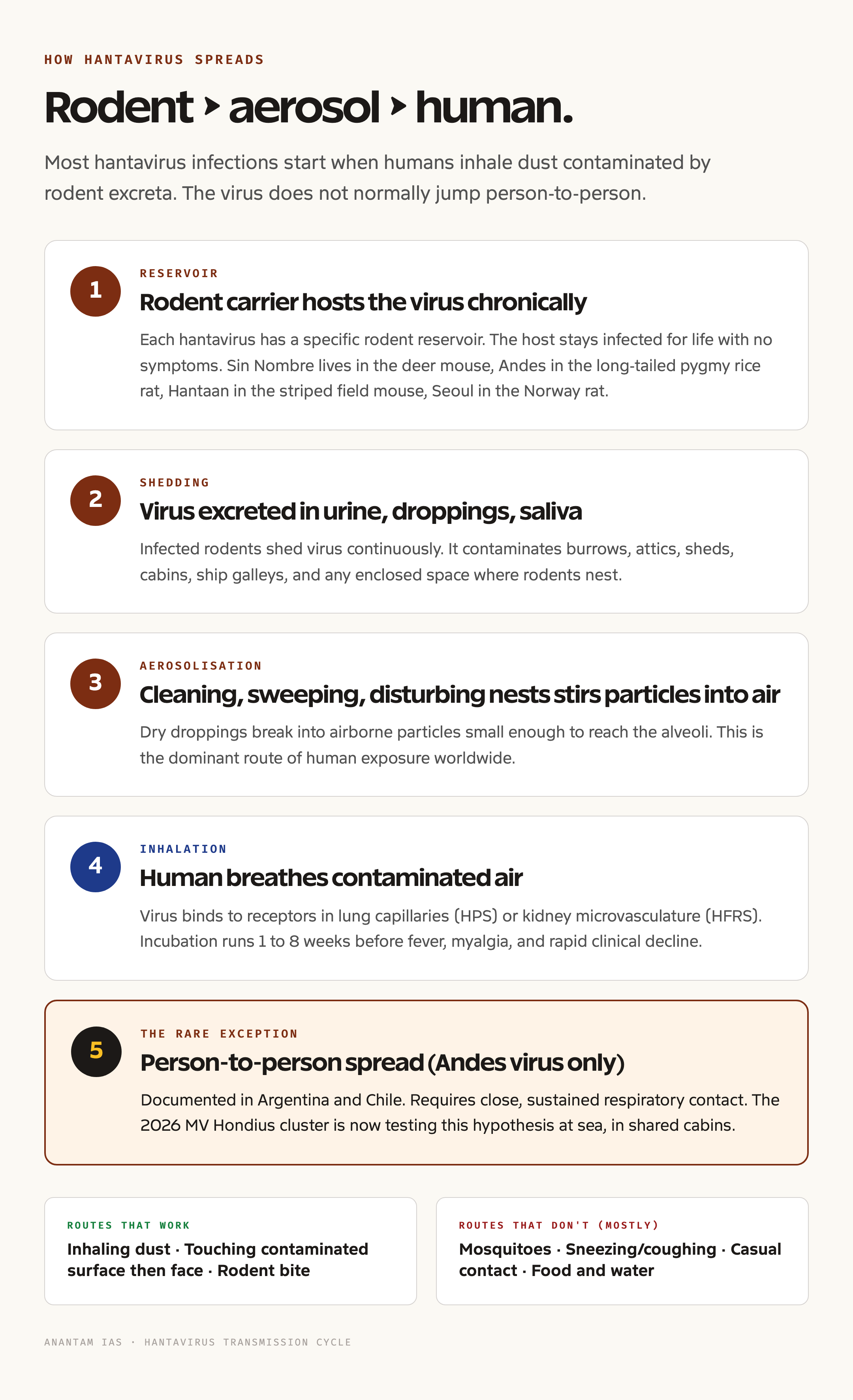
The five-step transmission cycle
- Reservoir: The infected rodent stays asymptomatic for life. Each hantavirus is locked to a specific rodent species.
- Shedding: Virus exits in urine, faeces, and saliva. Infected rodents shed continuously, often more during stress or population peaks.
- Aerosolisation: Dry excreta breaks into airborne particles when nests are disturbed. Cleaning, renovation, agricultural work, and rodent infestations in confined indoor spaces are the highest-risk settings.
- Inhalation: The virus enters through the respiratory tract. From there it binds to receptors on the inner lining of lung capillaries (HPS) or kidney microvasculature (HFRS).
- Andes exception: With Andes virus only, an infected person can spread the virus to close cabin-mates or caregivers through respiratory droplets and aerosols. The 2026 MV Hondius cluster is being investigated as a probable example.
Routes that do not transmit hantavirus
- Mosquitoes do not spread hantavirus. The recurring Prelims trap on this would equate hantavirus with arboviruses (Zika, dengue, chikungunya). It is wrong.
- Casual contact, sharing food and water, or routine workplace interactions do not spread hantavirus.
- Pet hamsters, gerbils and guinea pigs raised in pet shops are not typical reservoirs and have not been linked to outbreaks.
- Cooked rodent meat (a rural food source in some regions) is not a confirmed transmission route.
Symptoms, Diagnosis, and Treatment
HPS clinical course
After 1-8 weeks of incubation, HPS begins with non-specific symptoms: fever, severe myalgia (especially thigh, hip, back), fatigue, headache, dizziness, chills, nausea, vomiting and diarrhoea. The early phase mimics flu and is easily missed. Within 4-10 days the cardiopulmonary phase arrives suddenly: cough, breathlessness, pulmonary oedema and cardiogenic shock. Half of severe cases need intubation within 24 hours of respiratory onset. ECMO support is the difference between survival and death in many ICUs.
HFRS clinical course
HFRS classically runs through five stages: febrile (3-7 days), hypotensive (hours to 2 days), oliguric (3-7 days), polyuric (1-2 weeks), and convalescent (3-6 weeks). Petechiae, conjunctival haemorrhage, proteinuria and acute kidney injury are the hallmarks. Severity grades from “nephropathia epidemica” (mild Puumala disease) to fulminant Hantaan or Dobrava infection.
Diagnosis
Confirmation requires laboratory testing: IgM and IgG ELISA for hantavirus-specific antibodies, plus RT-PCR for viral RNA in blood samples taken in the acute phase. Western blot is used for confirmation. In low-resource settings, syndromic suspicion in returning travellers from endemic regions plus contact-history is the working diagnosis.
Treatment
There is no licensed hantavirus-specific therapy. Care is supportive. For HPS: early ICU admission, mechanical ventilation, careful fluid management, vasopressor support and ECMO for severe pulmonary oedema. For HFRS: dialysis as needed, fluid balance management, and ribavirin if started in the early febrile phase (within 7 days of onset). Ribavirin has shown benefit in HFRS but not in HPS in trials.
Vaccines and Public Health Tools
There is no licensed hantavirus vaccine in the United States, the European Union, or India. Inactivated HFRS vaccines (Hantavax in South Korea, multiple bivalent vaccines in China) are available regionally and have reduced HFRS incidence in those countries. WHO does not recommend universal hantavirus vaccination.
Public health response rests on four pillars: rodent control at home, workplace, and food-storage sites; ventilation of rodent-prone spaces before cleaning; protective equipment (N95 respirator, gloves, eye protection) for high-risk cleaning; and surveillance through veterinary checks, port screening and human syndromic case reporting. Cleaning enclosed spaces with diluted bleach (1:10) and damp-wiping rather than sweeping is the household-level recommendation.
India’s Risk Profile and Preparedness
India has not reported confirmed hantavirus cases as of 2026. ICMR-NIV in Pune carries out reservoir-host surveillance and serological screening on suspect samples. Pandemic risk is assessed as low, primarily because the major Andes-virus reservoir (long-tailed pygmy rice rat) is not native to India. Several rodent-borne diseases do circulate here — leptospirosis, plague (rare residual Rajasthan cases), scrub typhus, kyasanur forest disease — and the public-health infrastructure for those diseases would also catch a hantavirus introduction.
India’s National One Health Mission (launched April 2022) explicitly includes pandemic preparedness for novel zoonoses including hantavirus. The mission integrates ICMR, Department of Animal Husbandry, ICAR-NIVEDI (National Institute of Veterinary Epidemiology and Disease Informatics), and state health departments. The 2026 MV Hondius scare has prompted the Ministry of Health to issue a routine traveller advisory for returnees from South America with respiratory symptoms within 8 weeks of return.
Several of India’s existing institutions are first-line responders: NCDC (National Centre for Disease Control), Integrated Disease Surveillance Programme (IDSP), and the BSL-4 laboratory at NIV Pune. Strengthening syndromic surveillance for febrile respiratory illness in international travellers is the most immediate gap, and the cruise-ship outbreak has reinforced that need at all major Indian airports.
How Hantavirus Compares to Other Zoonotic Threats
| Disease | Reservoir | Route | Case fatality | Person-to-person? |
|---|---|---|---|---|
| Hantavirus (HPS) | Rodents | Aerosol | 40-50% | Andes only, rarely |
| Hantavirus (HFRS) | Rodents | Aerosol | 1-15% | No |
| Nipah virus | Fruit bats | Saliva, fluids | 40-75% | Yes (limited) |
| Avian Influenza H5N1 | Wild birds, poultry | Aerosol | ~50% | Limited |
| SARS-CoV-2 | Bats (likely) | Respiratory droplet | ~1-2% | Yes (efficient) |
| Leptospirosis | Rodents | Skin contact, water | 5-15% | No |
| Plague (pneumonic) | Rodents (fleas) | Vector, aerosol | 30-90% | Yes |
| Zika virus | Mosquitoes, primates | Mosquito, sexual | <1% | Yes (sexual) |
The instructive comparison is with Nipah virus: similar fatality rate (40-75 percent), zoonotic origin, occasional person-to-person spread, and frequent UPSC appearance. Hantavirus and Nipah occupy similar slots in the One Health surveillance ladder — high mortality, low transmission efficiency, geographically limited but globally tracked.
Challenges and Critiques
- Diagnostic gap in low-resource settings. RT-PCR and ELISA capacity for hantavirus is concentrated in a few labs globally. Most rural fever surveillance does not test for hantavirus.
- Climate change is shifting reservoir ecology. Warmer winters expand rodent populations northward and increase indoor invasion. The 2026 outbreak coincides with documented Patagonian rodent-population peaks linked to bamboo flowering cycles.
- Cruise-ship and travel-corridor blind spots. Closed environments with shared HVAC are now plausible amplification sites for any respiratory pathogen with even rare person-to-person spread. The MV Hondius cluster underscores the need for expanded port-of-entry surveillance.
- One Health coordination gaps. Veterinary, environmental, and human health systems still operate in silos in most countries. Effective hantavirus surveillance requires integrated rodent-population monitoring + human syndromic surveillance.
- Public communication failures. Earlier hantavirus scares (2012 Yosemite, 2018 Patagonia) showed how quickly mortality figures get misquoted and how easily “hantavirus” gets conflated with COVID-style respiratory pandemic risk. Calibrated messaging matters.
Way Forward
- Strengthen rodent-population surveillance at high-risk sites (granaries, ports, cruise ports, expedition lodges). Couple with environmental DNA sampling.
- Expand traveller health advisories for returnees from South America with febrile respiratory symptoms. Add Andes virus to the differential diagnostic panel for unexplained ARDS in returning travellers.
- Invest in BSL-4 capacity and a regional hantavirus reference laboratory network across South Asia. NIV Pune is the natural anchor.
- Coordinate under One Health at city, state and national level. Bring municipal pest-control, veterinary, and human-health departments under shared dashboards.
- Accelerate vaccine R&D. The 2024-25 Phase I trials of an mRNA hantavirus vaccine candidate (multiple academic groups) deserve priority status under the Coalition for Epidemic Preparedness Innovations (CEPI) framework.
- Operationalise port-of-entry quarantine protocols for cruise ships with active outbreak signals. The Cape Verde-Tenerife refusal pattern of May 2026 is a useful precedent but needs codification.
UPSC Prelims Pointers on Hantavirus
- Family: Hantaviridae, order Bunyavirales, negative-sense RNA viruses.
- Etymology: Named after the Hantan River in South Korea, where Hantaan virus was isolated in 1976.
- Two syndromes: HPS (Americas) and HFRS (Eurasia). Mortality differs sharply (HPS: 40-50%, HFRS: 1-15%).
- Reservoir: Rodents. Each hantavirus species is locked to a specific rodent host.
- Person-to-person transmission: Generally not observed; Andes virus is the only documented exception.
- Mosquitoes do NOT transmit hantavirus. Common Prelims trap.
- Vaccine: No licensed vaccine in US/EU/India. Inactivated HFRS vaccines used in China and South Korea.
- 2026 outbreak: MV Hondius cruise, Andes virus cluster, quarantined off Cape Verde, refused at Canary Islands.
- India: No confirmed cases; ICMR-NIV monitoring under National One Health Mission.
- Connection to UPSC syllabus: GS-II (Health, communicable diseases), GS-III (Science & Technology, Biotechnology, biosecurity).
Mains Practice Questions on Hantavirus
- GS-III (Science & Technology, 250 words): “Discuss the One Health approach to emerging zoonotic diseases with reference to recent hantavirus outbreaks. Suggest measures India can adopt to strengthen its preparedness.”
- GS-II (Governance, Health, 150 words): “In the context of the 2026 MV Hondius hantavirus cluster, examine how port-of-entry quarantine protocols and international health regulations should be modernised.”
- GS-III (Disaster Management, 250 words): “Compare hantavirus, Nipah and avian influenza as zoonotic threats to India. What institutional reforms can integrate animal, human, and environmental surveillance under One Health?”
- Essay (1,000-1,200 words): “Pandemics, pathogens, and the politics of preparedness: Why the next health crisis will look small until it doesn’t.”
UPSC PYQ Context
UPSC has not yet asked a direct hantavirus question, but the syllabus area is dense with adjacent precedent. The 2017 Prelims question on Zika virus tested similar reasoning: identify the vector (Aedes mosquitoes for Zika), recognise the additional transmission route (sexual), and reject misleading parallels. Hantavirus questions, when they appear, are likely to test: (a) reservoir is rodents, (b) transmission is aerosolised excreta, not mosquitoes, (c) person-to-person spread is generally absent, with Andes virus as the exception, and (d) vaccine status.
Related references on this site: Biotechnology, India’s health system, comparison of important diseases, vaccine types comparison, and NIPCR-ICMR pre-clinical research.
Frequently Asked Questions about Hantavirus
What is the Hanta virus?
Hantavirus is a family of zoonotic RNA viruses (family Hantaviridae) that infect rodents persistently and spill over to humans through aerosolised droppings, urine or saliva. The viruses cause two distinct human syndromes: Hantavirus Pulmonary Syndrome (HPS) in the Americas and Haemorrhagic Fever with Renal Syndrome (HFRS) in Europe and Asia.
What is the MV Hondius hantavirus outbreak of May 2026?
It is a cluster of Andes-virus hantavirus cases linked to the MV Hondius expedition cruise ship that left Ushuaia, Argentina on April 28, 2026. As of May 8, 2026, WHO reports 5-6 confirmed cases, 8-9 suspected cases, and 3 deaths. The ship was refused docking at Cape Verde and Tenerife and is currently quarantined in the Atlantic.
How does Hantavirus spread?
Mainly through inhalation of aerosolised particles from rodent urine, droppings or saliva. Cleaning rodent-infested cabins, sheds, attics, or barns is the highest-risk activity. Direct contact with contaminated surfaces and rare rodent bites are minor routes. Mosquitoes do not transmit hantavirus.
Is Hantavirus contagious from person to person?
Generally no. Andes virus, found in southern South America, is the only hantavirus with documented person-to-person spread. Even there, transmission requires close, sustained respiratory contact such as shared cabins, family-care settings, or healthcare exposure. Casual contact does not transmit the virus.
What are the symptoms of Hantavirus Pulmonary Syndrome?
HPS begins with 1-5 days of fever, severe muscle aches, fatigue, headache, dizziness, chills and gastrointestinal symptoms. Within 4-10 days it progresses to a cardiopulmonary phase with cough, shortness of breath, fluid in the lungs, and shock. Case-fatality rates are 40 to 50 percent without prompt intensive care.
Are there hantavirus cases in India?
As of 2026, India has not reported confirmed hantavirus cases. The Andes virus reservoir species are not native to India, and ICMR-NIV in Pune assesses pandemic risk as low. India does have other rodent-borne disease risks including leptospirosis, plague and scrub typhus.
Is there a vaccine or specific treatment for hantavirus?
There is no licensed vaccine for HPS in the United States or Europe. China and South Korea use inactivated bivalent HFRS vaccines. Treatment is supportive: oxygen, mechanical ventilation, ECMO for severe HPS, and dialysis plus careful fluid management for HFRS. Ribavirin shows benefit in early HFRS but not in HPS.
Why is the 2026 Andes outbreak being taken so seriously?
Three reasons: a roughly 35-50 percent case-fatality rate, the closed-cabin environment of a cruise ship that mimics the conditions where Andes person-to-person spread has been documented, and the geographic dispersal of passengers across the United States, Singapore, Australia, the Netherlands, Germany and other countries.
What is One Health and why does it matter for hantavirus?
One Health is an integrated approach that recognises human, animal and environmental health are interconnected. Hantavirus surveillance under One Health combines rodent ecology monitoring, veterinary checks at ports, human syndromic surveillance, and habitat management. India’s National One Health Mission, launched in 2022, includes zoonotic spillover preparedness within its mandate.
What did UPSC ask about hantavirus or related zoonoses?
UPSC has asked recurring questions on zoonotic diseases (Zika, Nipah, Avian Influenza), one-health frameworks, and rodent-borne disease epidemiology. While hantavirus has not appeared as a direct prelims question, the 2017 Zika MCQ and recurring questions on viral haemorrhagic fevers map directly to this syllabus area for both Prelims and Mains GS-II Health and GS-III Science & Technology.