Why in News?
On 31 August, MoSPI’s provisional quarterly estimate placed India’s real GDP growth at 7.8% for April-June 2026-27 under the national-accounts series with base year 2022-23.
- Nominal GDP, measured at current prices, grew by 10.3% over the same quarter of the previous financial year.
- Real GVA, which tracks value added by producers before net product taxes, grew by 8.2%.
- The new series applies double deflation to manufacturing by removing price effects from output and intermediate inputs separately.
- MoSPI cautioned that better source coverage and revisions by data-supplying agencies can change these quarterly estimates later.
- The growth print is an estimate of economy-wide production, not a complete measure of jobs, household welfare, distribution or environmental costs.
- A single quarter shows near-term momentum, but durable assessment requires later revisions, sectoral evidence and comparison across several quarters.
- The methodological change matters because relative movements in factory output and input prices can materially affect measured real manufacturing GVA.
UPSC Relevance
Prelims Relevance
- Real GDP is measured at constant 2022-23 prices; nominal GDP is measured at prices prevailing in the reporting period.
- GDP at market prices equals GVA at basic prices plus product taxes minus product subsidies.
- GVA is output minus intermediate consumption, showing the value producers add during production.
- Under double deflation, output and intermediate consumption are deflated separately with relevant price indices.
- Quarterly GDP uses a benchmark-indicator method, extrapolating annual benchmarks with indicators that capture current sectoral activity.
- An implicit GVA deflator is the ratio of nominal GVA to real GVA, usually expressed as an index.
Mains Relevance
GS Paper 3
- Indian Economy and issues relating to planning, mobilization of resources, growth, development and employment.
- Interpret GDP growth through measurement methods, sectoral value addition and the limits of a quarterly aggregate.
Essay
- What a country measures shapes how it understands growth, but measurement must remain separate from judgment about welfare.
Background and Context
Real GDP, Nominal GDP and GVA
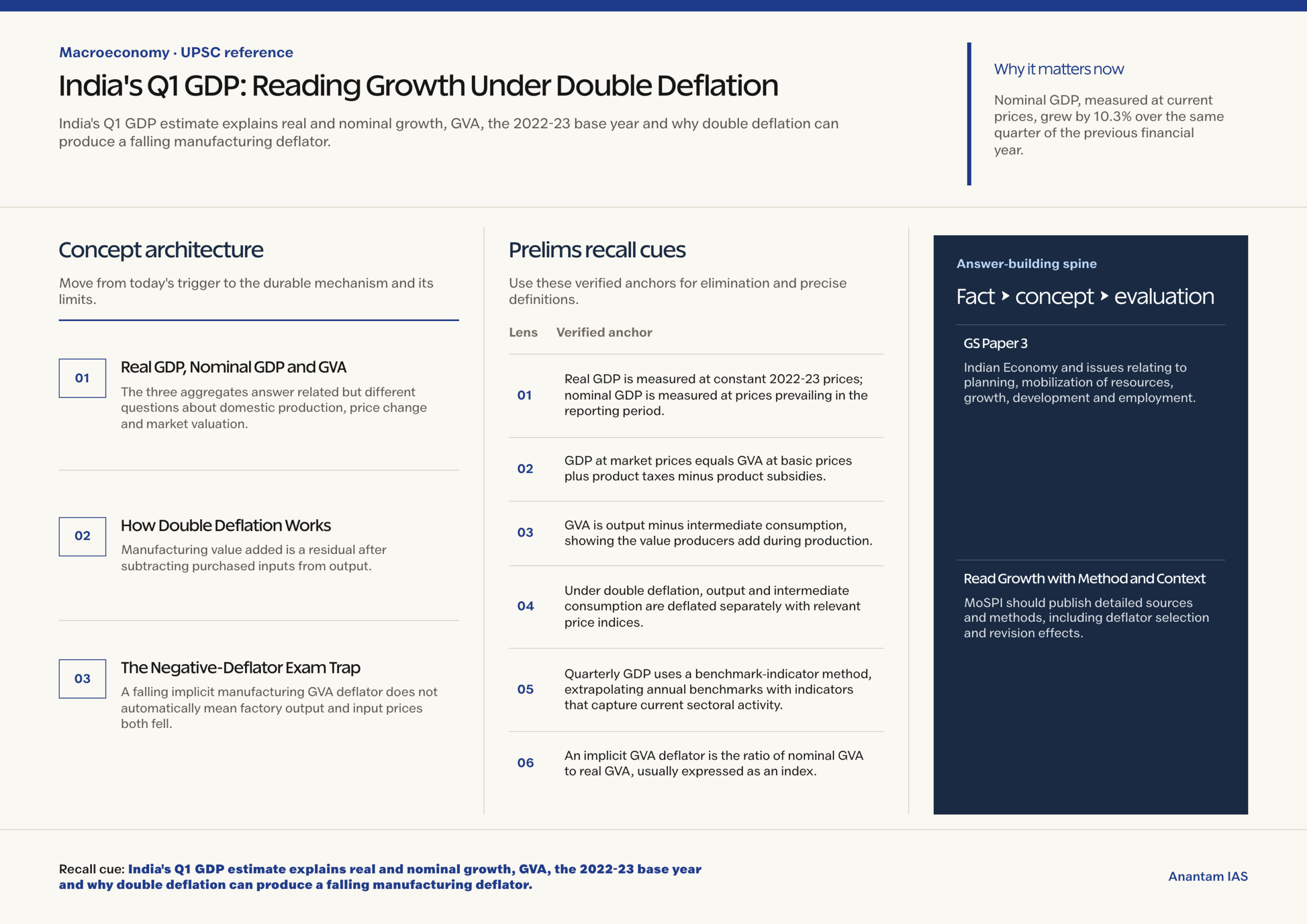
The three aggregates answer related but different questions about domestic production, price change and market valuation, so they should not be used interchangeably in analysis.
- Nominal GDP values final domestically produced goods and services at current prices. It can rise because quantities increased, prices increased or both, so it cannot isolate production-volume growth by itself.
- Real GDP values the same broad output at constant base-year prices. Removing estimated price change makes its growth rate closer to a volume comparison across periods with different price levels.
- GVA measures sectoral output minus goods and services consumed during production. A bakery’s flour is intermediate consumption; subtracting it prevents counting the same embedded value twice across production stages.
- GDP connects producer value to final market valuation by adding taxes on products and subtracting subsidies on products from aggregate GVA, because purchasers pay prices shaped by both.
- A faster GVA print than GDP can reflect movements in net product taxes rather than weaker economy-wide production. The aggregates reconcile within one national-accounting framework, not two independently measured economies.
How Double Deflation Works
Manufacturing value added is a residual after subtracting purchased inputs from output, making separate price treatment especially useful when their prices move at different speeds.
- Start with nominal output, the current-price value of manufactured goods, and nominal intermediate consumption, the current-price value of energy, materials and purchased services used to produce those goods.
- Deflate output with relevant producer price indices to estimate output volume at base-year prices. Deflate intermediate consumption separately with indices representing prices across its distinct basket of industrial inputs.
- Subtract real intermediate consumption from real output. The remainder is real manufacturing GVA, showing how much production volume manufacturers added after separately removing estimated output-price and input-price effects.
- The earlier single-deflator approach applied the same price movement to output and inputs. That can obscure a widening or narrowing wedge between factory selling prices and costs such as energy or materials.
- The 2022-23 series uses improved Producer Price Index data, allowing the output and input sides of manufacturing to receive more specific, product-linked price treatment than one common deflator provided.
The Negative-Deflator Exam Trap
A falling implicit manufacturing GVA deflator does not automatically mean factory output and input prices both fell; the subtraction at the heart of GVA changes its interpretation.
- The implicit GVA deflator compares nominal GVA with real GVA. Unlike a directly observed price index for one product basket, it is derived from value added after intermediate inputs are subtracted.
- If input prices rise faster than output prices, the current-price value-added margin can be squeezed even though factories pay more for inputs and also receive higher selling prices.
- Because output and inputs are deflated separately, changing relative prices can make the nominal-to-real GVA ratio fall. Its measured growth rate may then turn negative without either underlying price index falling.
- This is a relative-price and margin effect, not proof of economy-wide deflation, falling factory-gate prices or a statistical mistake. The underlying output and input price indices still need separate inspection.
- The estimates remain provisional in practice: quarterly benchmarks, indicators and source data are updated. MoSPI says improved data coverage and source-agency revisions can alter the initially published figures later.
Way Forward
Read Growth with Method and Context
Sound interpretation needs transparency about both the estimate and the evidence around it.
- MoSPI should publish detailed sources and methods, including deflator selection and revision effects, in forms that researchers can reproduce and scrutinize.
- Policy analysis should pair GDP with employment, consumption, investment, sectoral productivity and distributional indicators rather than treating one growth rate as a welfare verdict.
- Answers should state the price basis, distinguish GDP from GVA and flag provisional status before drawing conclusions from a quarterly estimate.
- Users should compare revised data across several quarters and avoid attributing a methodological effect to policy performance without supporting evidence.
Conclusion
- The Q1 estimate shows strong measured volume growth, but its durable lesson is methodological: real GDP, nominal GDP and GVA describe different layers of national accounts and cannot substitute for one another in an answer.
- A strong Mains answer should explain double deflation step by step, identify the negative-deflator trap and close by placing provisional quarterly GDP beside jobs, welfare, distribution and revised sectoral evidence.
UPSC Practice Questions
Prelims MCQ 1
With reference to India’s national accounts, consider the following statements:
- Nominal GDP values final domestic output at current prices.
- GDP at market prices equals GVA at basic prices plus net taxes on products.
- Double deflation applies the same deflator to manufacturing output and intermediate consumption.
How many of the above statements are correct?
(a) Only one (b) Only two (c) All three (d) None
Answer: (b) Only two
Explanation:
Statements 1 and 2 are correct. Double deflation uses separate relevant price indices for output and intermediate consumption, so statement 3 is incorrect.
Prelims MCQ 2
Under double deflation, which situation can produce a falling implicit manufacturing GVA deflator even when output and input prices both rise?
(a) Output prices rise faster than input prices in every industry (b) Nominal and real GVA are always identical (c) Input prices rise faster than output prices and squeeze the value-added margin (d) Product taxes are excluded from both GDP and GVA
Answer: (c) Input prices rise faster than output prices and squeeze the value-added margin
Explanation:
GVA is a residual after subtracting inputs. Faster input-price growth can lower the nominal-to-real GVA ratio even when neither input nor output prices fall.
UPSC Mains Questions
- Distinguish real GDP, nominal GDP and Gross Value Added. Explain why each aggregate answers a different question about economic growth.
- How does double deflation improve the estimation of real manufacturing GVA? Discuss its interpretation challenges with reference to changing input and output prices.
Sources: PIB, Ministry of Statistics and Programme Implementation and MoSPI Sub-Committee for Constant Price Estimates.
Frequently Asked Questions
What was India’s real GDP growth in Q1 of 2026-27?
MoSPI estimated real GDP growth at 7.8% for April-June 2026-27 over the corresponding quarter. The estimate uses constant 2022-23 prices and may be revised as source data improve.
How is real GDP different from nominal GDP?
Nominal GDP values final output at current prices, mixing quantity and price changes. Real GDP uses constant base-year prices to make growth closer to a comparison of production volumes.
What is the difference between GDP and GVA?
GVA measures output minus intermediate consumption at the producer level. GDP at market prices adds product taxes and subtracts product subsidies, connecting producer value added to final market valuation.
What does double deflation mean?
Double deflation removes price effects from output and intermediate consumption separately, using relevant indices for each, before subtracting real inputs from real output to estimate real value added.
Does a negative manufacturing GVA deflator mean all factory prices fell?
No. Input and output prices may both rise, but faster input-price growth can squeeze current-price value added and lower the implicit nominal-to-real GVA ratio.