UPSC CSE 2026 Essay Paper Discussion

Daily Digest · Sunday

13 September 2026 Current Affairs for UPSC

8 current affairs published on Sunday, 13 September 2026

13 September 2026 Current Affairs for UPSC — every Why-in-News article AnantamIAS published on Sunday, 13 September 2026, broken down with Why in News?, the exact GS paper it feeds, sub-topic mapping, MCQ-ready facts and a UPSC-style practice question. 8 articles in total, covering Polity, Economy, Environment, S&T, IR, Geography, History, Society and Internal Security — the same Why-in-News + GS-paper-mapping + practice-question format the Compass uses across every daily digest on the site.

Daily current affairs for UPSC is where new material enters your prep stream. Read this 13 September 2026 digest end-to-end in 25–35 minutes, attempt the practice question at the foot of each article (it's MCQ for some, 10/15-marker for others), then bookmark the entries that fall inside your active revision window. Everything stays cross-linked: tap any subject pill to jump to that subject's hub, or use the table of contents above to skip straight to a specific story.

Use this page three ways. Read sequentially for a one-sitting scan of everything that mattered on 13 September 2026. Download the 13 September 2026 PDF below for offline study or print revision. Or use the September 2026 Current Affairs compilation to see this day in the month's full context. For the previous day's reading, see 12 September 2026 Current Affairs; the next day's is 14 September 2026 Current Affairs.

Why we publish daily current affairs separately from the monthly compilation: daily is learning, monthly is revision. Use the daily page to add fresh material to your notes the day it breaks; come back to the September 2026 compilation 60 days before Prelims when the noise has settled and only the lasting takeaway is worth re-reading.

BRICS New Delhi Declaration: Consensus and Multilateral Reform

Open article →Download PDF

Why in News?

PIB released the BRICS New Delhi Declaration on 12 September 2026, setting out the summit’s common positions on global governance, security and development.

  • The declaration calls for greater developing-country representation in international institutions and renewed support for the United Nations.
  • It seeks IMF quota realignment and restoration of a functioning, two-tier WTO dispute-settlement system.
  • Members condemn the Pahalgam terrorist attack, express concern about nuclear risks and call for restraint in West Asia.
  • Across sectoral initiatives, the text distinguishes established mechanisms, ongoing discussions and proposals requiring further consideration.
  • Common wording reveals the positions members can jointly endorse, while qualifications show where national preferences remain important.
  • For India, the central opportunity is to convert representation demands into negotiations and practical cooperation without assuming unanimity on every conflict.

UPSC Relevance

Prelims Relevance

  • Consensus and sovereign equality in BRICS cooperation
  • UN Security Council reform and developing-country representation
  • IMF quota increases versus quota-share realignment
  • WTO Most-Favoured-Nation treatment and dispute settlement
  • Declaration, proposal and operational mechanism

Mains Relevance

GS Paper 2

  • Reform of international institutions and the voice of the Global South
  • Consensus-building among states with differing strategic interests

GS Paper 3

  • Trade predictability and representation in global financial governance

Essay

  • International cooperation depends on both shared goals and institutions capable of carrying them out.

Background and Context

How consensus shapes the declaration

A summit declaration records an agreed political position; its language must be read alongside national reservations and the separate procedures governing implementation.

  • Consensus allows countries with different alliances and economic priorities to endorse a common text. The resulting language marks shared ground, while leaving some disagreements unresolved rather than eliminating them through a vote.
  • The declaration reaffirms sovereign equality, non-interference and the central role of the United Nations. These principles frame cooperation among members; they do not place BRICS above institutions whose reform the grouping advocates.
  • On West Asia, members call for maximum restraint while recalling their respective national positions. That qualification matters: a jointly endorsed appeal does not establish that every member assigns identical responsibility for the conflict.
  • The condemnation of the Pahalgam attack accompanies commitments against terrorism and its financing. This is a collective political position, not evidence that a new investigation, sanctions designation or enforcement mechanism has automatically begun.
  • As with the SCO declaration, careful reading separates collective commitments from national priorities. An omitted dispute or qualified statement cannot by itself establish that a member abandoned its earlier diplomatic position.

UN, IMF and WTO reform address different problems

Representation, financial voice and enforceable trade rules are connected demands, but each belongs to a different institution and requires its own negotiated changes.

  • UN Security Council reform concerns who participates in decisions on international peace and security. The declaration seeks greater developing-country representation, including Africa, while recognising aspirations for a larger role by India and Brazil.
  • The text says China and Russia support the aspirations of India and Brazil to play a greater role in the UN, including its Council. This is not an agreed allocation of permanent seats.
  • For the IMF, the declaration distinguishes increasing available quota resources from redistributing quota shares. A larger institution does not necessarily give underrepresented economies more relative influence if members retain the same proportional shares.
  • The call for quota realignment seeks governance that better reflects economies’ relative positions while protecting poorer members. It remains a negotiating demand; the declaration itself cannot change the IMF’s allocation of voting power.
  • For the WTO, members seek restoration of two-tier binding dispute settlement and appointment of Appellate Body members. The purpose is predictable adjudication of trade disputes, alongside support for non-discrimination and developing-country needs.

Separate diplomatic demands from delivered outcomes

The useful comparison is between agreement on an objective and completion of the institutional steps needed to achieve it; they are different stages.

  • Reform advocacy can strengthen bargaining power by coordinating demands across members. But UN, IMF and WTO changes require engagement with their wider memberships; agreement among BRICS countries cannot substitute for those institutional processes.
  • The declaration criticises unilateral tariff and non-tariff measures inconsistent with WTO rules. That position neither repeals another country’s measures nor constitutes a dispute-settlement ruling that every contested policy violates the relevant trade agreements.
  • Practical cooperation continues alongside diplomatic positions through research, health, skills and other sectoral mechanisms. Assess each initiative by its stated stage: a proposal, adopted framework and functioning service represent different levels of implementation.
  • The financial section continues discussion of cross-border payments. Its exploratory language illustrates the same test: continued technical work should not be rewritten as universal deployment or a completed institutional change across all participating economies.
  • For India, the declaration provides a platform to pursue strategic autonomy and institutional reform together. Its value depends on issue-specific follow-through, since shared development interests can coexist with bilateral tensions and divergent security preferences.

Way Forward

Track the institutional follow-through

  • Identify the responsible negotiating forum for each reform demand instead of treating the summit declaration as the final decision.
  • For sectoral cooperation, track mandates, participation and implementation evidence before describing a proposed network as a delivered public service.
  • Assess India’s gains through specific negotiating outcomes and practical partnerships, while retaining clarity about qualifications in the agreed text.

Conclusion

  • The declaration demonstrates the reach and limits of consensus diplomacy: members can jointly press for fairer institutions without resolving all strategic disagreements or independently rewriting the rules of those institutions.
  • A sound assessment distinguishes representation, institutional procedure and implementation. Judge the document by what it expressly endorses and what subsequent negotiations deliver, rather than treating every shared aspiration as an accomplished reform.

UPSC Practice Questions

Prelims MCQ 1

With reference to the BRICS New Delhi Declaration, consider the following statements:

  1. It calls for greater developing-country representation in global institutions.
  2. It distinguishes IMF quota increases from quota-share realignment.
  3. Its adoption automatically allocates permanent UN Security Council seats to India and Brazil.

How many of the above statements are correct?

(a) Only one (b) Only two (c) All three (d) None

Answer: (b) Only two

Explanation:

The first two statements reflect the declaration. It supports a greater role for India and Brazil but does not allocate permanent seats.

Prelims MCQ 2

Which reform sought in the declaration most directly concerns adjudicating disputes between trading members?

(a) IMF quota realignment (b) Greater geographical representation in UN staffing (c) Restoration of two-tier WTO dispute settlement (d) Expansion of people-to-people exchanges

Answer: (c) Restoration of two-tier WTO dispute settlement

Explanation:

The WTO demand concerns a functioning binding dispute-settlement mechanism, including the appellate tier. IMF quota reform addresses a different institutional issue.

UPSC Mains Questions

  1. How does consensus both enable and constrain BRICS cooperation? Discuss with reference to the New Delhi Declaration.
  2. Distinguish the representation, financial-governance and trade-enforcement problems addressed by BRICS demands for UN, IMF and WTO reform.

Source: PIB, Prime Minister's Office.

Frequently Asked Questions

What is the central theme of the BRICS New Delhi Declaration?

It combines demands for more representative global institutions with positions on security and development cooperation. The central analytical issue is how shared political commitments translate into negotiations and implementation.

Did the declaration give India a permanent Security Council seat?

No. It supports reform and records support for a greater role for India and Brazil in the UN, including its Security Council. It does not allocate seats or complete institutional reform.

How do IMF quota increases differ from quota realignment?

A quota increase expands resources contributed through quotas. Realignment changes the relative distribution of shares among members. Increasing the overall total need not alter countries’ proportional influence in IMF governance.

Does a shared declaration mean members agree on every conflict?

No. Consensus produces common language that members can endorse, sometimes with qualifications preserving national positions. It should not be read as proof that different alliances, priorities or bilateral disagreements have disappeared.

What should students check before calling an initiative operational?

Check the wording and available implementation evidence. A proposal under discussion, an adopted framework and a functioning service are different stages; an announcement alone does not establish delivery across member countries.

Badri Cattle OPU-IVF: Embryo Transfer and Germplasm Conservation

Open article →Download PDF

Why in News?

A female Badri calf was born on 11 September 2026 after researchers transferred an OPU-IVF-derived Badri embryo into a Sahiwal recipient cow, PIB reported the following day.

  • The collaboration involved ICAR-NDRI, Karnal, and G. B. Pant University of Agriculture and Technology, Pantnagar, with support from the Uttarakhand Biotechnology Council.
  • The embryo combined an oocyte from a Badri donor cow with semen from a Badri bull; the Sahiwal cow carried the pregnancy.
  • The researchers also reported cloned embryos under a separate research strand. The announced calf was produced through fertilisation, not cloning.
  • Indigenous germplasm is a reproductive resource for maintaining breed characteristics. Multiplication can support conservation, but conserving a breed requires more than reproducing a few selected animals.
  • This case separates genetic parentage from gestation: a recipient provides the pregnancy environment without becoming the egg or sperm donor.

UPSC Relevance

Prelims Relevance

  • Badri cattle: indigenous cattle genetic resource associated with Uttarakhand.
  • OPU: ovum pick-up collects oocytes from donor females.
  • IVF: in vitro fertilisation takes place outside the animal.
  • Embryo transfer: placement of an embryo in a suitable recipient.
  • Germplasm: heritable biological material used for breeding and conservation.

Mains Relevance

GS Paper 3

  • Applications of reproductive biotechnology in animal husbandry.
  • Balancing selection for productive traits with conservation of indigenous genetic diversity.

Essay

  • Scientific progress should preserve biological options alongside increasing production.

Background and Context

What the Badri birth establishes

The reported birth demonstrates a working reproductive pathway, while wider conservation benefits still require sustained evidence.

  • Badri cattle represent an indigenous genetic resource of Uttarakhand. The conservation objective concerns preserving useful inherited variation within that resource, rather than treating every animal as an interchangeable production unit.
  • The successful birth connects laboratory embryo production with a completed pregnancy. It establishes that this particular transferred embryo developed into a calf; it does not establish a general success rate.
  • Oocytes and semen came from selected Badri animals. Their combination matters because the programme seeks to multiply Badri germplasm, even when another cattle breed supplies the gestational recipient.
  • The official announcement describes future embryo transfers and a further expected delivery. These remain prospective developments; neither should be counted as another completed birth or a verified field-scale outcome.

How OPU-IVF and embryo transfer work

The pathway separates egg collection, fertilisation, embryo development and pregnancy into distinct stages requiring different conditions.

  • Ovum pick-up uses ultrasound guidance to collect oocytes from selected donor cows. This obtains the female reproductive cells for laboratory work; it does not itself create an embryo or pregnancy.
  • Oocyte maturation precedes fertilisation in the laboratory. Researchers then expose mature oocytes to semen from a selected Badri bull, bringing together the reproductive contributions needed to form an embryo.
  • Embryo culture supports early development under controlled laboratory conditions. This stage is distinct from gestation: producing an embryo does not mean that it will necessarily establish a successful pregnancy.
  • A synchronised recipient is prepared so its reproductive stage is suitable for embryo transfer. The embryo is then placed in that animal, which carries the pregnancy and gives birth.
  • Multiple embryo production allows valuable female germplasm to be used beyond a donor cow carrying each resulting pregnancy herself. The release identifies this separation as the basis for faster multiplication.
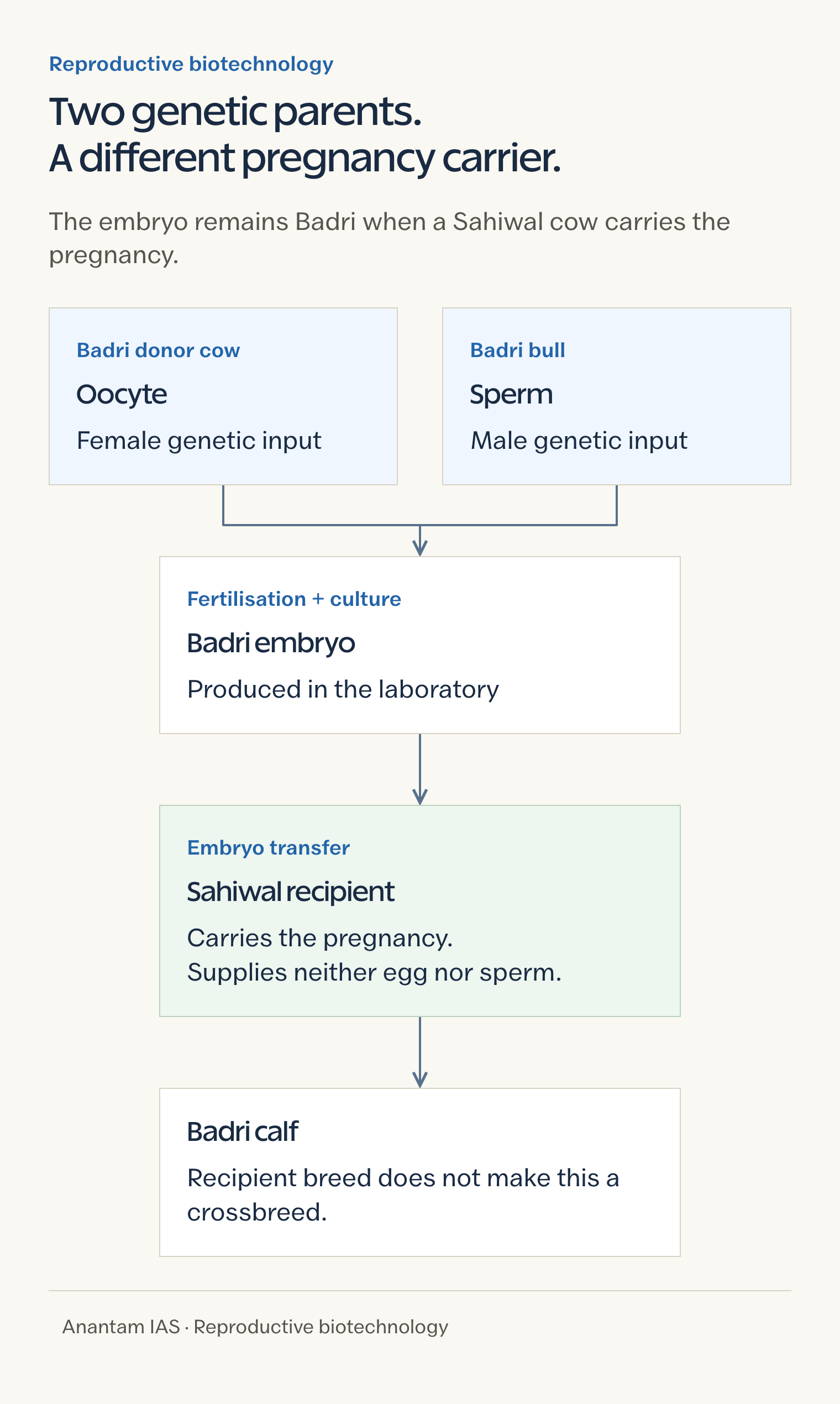
Badri oocyte and sperm form an embryo carried by a Sahiwal recipient
Badri genetic inputs and Sahiwal gestation have distinct roles.

Genetic parentage is different from gestation

The recipient breed and the method of conception answer different biological questions; confusing them changes the meaning of the news.

  • The Badri egg donor and Badri bull provide the reproductive cells used in fertilisation. The Sahiwal recipient carries their embryo; its breed does not make that embryo a Badri-Sahiwal crossbreed.
  • Crossbreeding involves reproductive contributions from different breeds. A different-breed recipient is insufficient: the relevant distinction is whose egg and sperm formed the embryo, rather than which animal delivered it.
  • IVF involves fertilisation and combines parental genetic contributions. Calling this calf a clone would erase that mechanism and incorrectly merge the announced birth with the programme’s separate cloning research.
  • The report of cloned Badri embryos concerns an earlier developmental stage under research. It is not evidence of a cloned calf being born, surviving or delivering proven conservation benefits.

Why multiplication alone is not conservation

Selection concentrates particular traits, while conservation must retain enough genetic variation to keep a breed resilient and usable.

  • Elite-animal multiplication can increase access to selected germplasm. However, repeatedly relying on a narrow donor group can narrow representation; a conservation programme should deliberately include multiple unrelated breeding lines.
  • Pedigree and reproductive records should connect donors, embryos, recipients and offspring. Such traceability supports parentage verification and breeding decisions, rather than assuming breed identity from the recipient or outward appearance alone.
  • Field evaluation should examine calf survival, health, reproductive performance and suitability under local husbandry conditions. A laboratory-to-birth milestone is an initial result, not a substitute for observing subsequent animal performance.
  • Conservation and improvement need separate measures: retaining genetic diversity answers a different question from multiplying selected stock. Programmes should track both objectives so increased production does not conceal lost variation.

Way Forward

Build a traceable conservation programme

  • Select diverse donor lines and maintain pedigree records before expanding embryo production. Avoid concentrating the breeding programme around only a few favoured animals.
  • Report outcomes at each stage, from embryo production to calf survival, rather than presenting an isolated birth as proof of routine commercial performance.
  • Include veterinary welfare safeguards for donors and recipients, alongside trained handling, reproductive monitoring and follow-up of calves.

Conclusion

  • OPU-IVF can multiply selected indigenous germplasm by separating donor genetics from the animal carrying the pregnancy. The Badri birth illustrates this mechanism without implying crossbreeding or cloning.
  • The durable policy test is whether reproductive success expands a diverse, healthy breeding population. Conservation needs traceability and field outcomes alongside technically successful embryo production.

UPSC Practice Questions

Prelims MCQ 1

With reference to the reported Badri OPU-IVF calf, consider the following statements:

  1. The oocyte donor and semen donor belonged to the Badri breed.
  2. A Sahiwal recipient necessarily makes the resulting calf a Badri-Sahiwal crossbreed.
  3. OPU-IVF involves fertilisation outside the animal.

How many of the above statements are correct?

(a) Only one (b) Only two (c) All three (d) None

Answer: (b) Only two

Explanation:

Statements 1 and 3 are correct. Genetic parentage follows the egg and semen donors. The Sahiwal recipient carried the embryo and did not contribute either reproductive cell.

Prelims MCQ 2

Which feature distinguishes OPU-IVF from cloning?

(a) Use of a recipient animal for every laboratory step (b) Absence of an embryo development stage (c) Fertilisation combining egg and sperm contributions (d) Automatic production of offspring from different breeds

Answer: (c) Fertilisation combining egg and sperm contributions

Explanation:

IVF uses egg and sperm in fertilisation. The announced calf was an IVF-derived offspring; cloned embryos were reported separately as ongoing research.

UPSC Mains Questions

  1. Explain how ovum pick-up, in vitro fertilisation and embryo transfer can support indigenous cattle conservation. Distinguish genetic parentage from gestation.
  2. Multiplication of selected germplasm is necessary but insufficient for breed conservation. Discuss with reference to genetic diversity, traceability and field evaluation.

Source: PIB, Ministry of Agriculture and Farmers Welfare.

Frequently Asked Questions

What is OPU-IVF?

OPU-IVF combines ovum pick-up, which collects oocytes from donor cows, with fertilisation outside the animal. Resulting embryos are cultured and transferred into suitable recipients to establish pregnancy.

Why is the calf Badri despite a Sahiwal recipient?

The embryo was formed using an oocyte from a Badri cow and semen from a Badri bull. The Sahiwal cow carried the pregnancy but supplied neither reproductive cell.

Was the announced Badri calf a clone?

No. The calf was produced through OPU-IVF, involving fertilisation. The same research programme also reported cloned embryos, but the release did not describe this birth as a cloning outcome.

How does germplasm multiplication differ from conservation?

Multiplication increases access to selected reproductive material or offspring. Conservation additionally requires retaining genetic variation across a breed. Concentrating on a narrow donor pool may fail that broader objective.

Steel Slag Roads: From Industrial By-product to Tested Aggregate

Open article →Download PDF

Why in News?

On 12 September 2026, CSIR-CRRI and Jindal Steel signed a technology-transfer agreement for steel slag road technology, while a work order for a 40-km Odisha road was announced.

  • The technology-transfer agreement links public road research with industrial implementation; it accompanies a call for wider technically suitable adoption.
  • The Odisha work order concerns Jindal Steel’s Angul plant; the announcement describes a planned implementation, not a completed road.
  • The release stresses processing protocols, pavement design and quality control as conditions for scaling the technology beyond demonstration projects.
  • Using a qualified industrial by-product can reduce demand for quarried natural aggregate while creating a productive destination for steelmaking residue.
  • The policy challenge is reliable replication: a successful demonstration must translate into dependable material supply and construction performance at new sites.

UPSC Relevance

Prelims Relevance

  • Steel slag: by-product of steel production, processed into road aggregate.
  • CSIR-CRRI: Central Road Research Institute; developer of the indigenous road technology.
  • Aggregate: granular construction material; it is distinct from the binder.
  • Material qualification: physical, mechanical and chemical suitability must be established.
  • Circular economy: recovering a useful material while reducing demand for virgin resources.

Mains Relevance

GS Paper 3

  • Industrial by-product recovery, resource efficiency and sustainable infrastructure.
  • Quality assurance and project economics in scaling indigenous technology.

GS Paper 2

  • Research-industry coordination and accountable public procurement.

Essay

  • Waste becomes a resource when institutions make its use reliable.

Background and Context

What actually becomes part of the road?

Steel slag road technology changes the source of aggregate; it does not remove the need to engineer a pavement for its intended use.

  • Steel slag is a by-product of steel production. Converting this residue into a usable construction material requires processing; describing every fresh heap of slag as road-ready confuses the starting material with the finished product.
  • Aggregate provides the granular material used in road construction. In this technology, processed steel slag can substitute natural stone aggregate; the road is not a continuous sheet of steel laid over the ground.
  • CSIR-CRRI connects material research with road engineering. Its role matters because an industrial producer knows its production stream, while pavement specialists assess how a processed material should function within a road construction system.
  • The immediate resource-efficiency opportunity is substitution: using a suitable industrial by-product can avoid some extraction of fresh aggregate. Productive reuse also offers an alternative to leaving steel slag accumulated around industrial sites indefinitely.
  • A useful circular-economy answer follows the material through its next application. The relevant question is whether recovered material performs a useful function safely, rather than whether moving a waste pile merely changes its location.

Why processing and testing decide suitability

The CSIR-CRRI guidelines connect processing, material specifications and pavement design, making qualification the bridge between industrial residue and road use.

  • Processing and treatment improve the properties of steel slag before application. This is a controlled conversion into aggregate, not permission to place unprocessed residue wherever a contractor would otherwise have used natural stone.
  • Material specifications cover physical, mechanical and chemical properties. Physical and mechanical testing help establish whether the supplied aggregate is suitable; the fact that material originated in a steel plant cannot establish its engineering performance.
  • Pavement and mix design determine how qualified material is incorporated into construction. Approval of an aggregate and approval of the finished road design answer different questions, so a responsible project needs to establish both.
  • Handling and storage are part of the environmental safeguards. The government’s guidelines announcement explicitly connects these practices with preventing contamination; environmental responsibility begins before the material reaches the road under construction.
  • Construction practices cover transporting and placing processed aggregate. A laboratory result cannot compensate for poor execution at the site; procurement should connect the specified material with the actual material delivered and incorporated into construction.
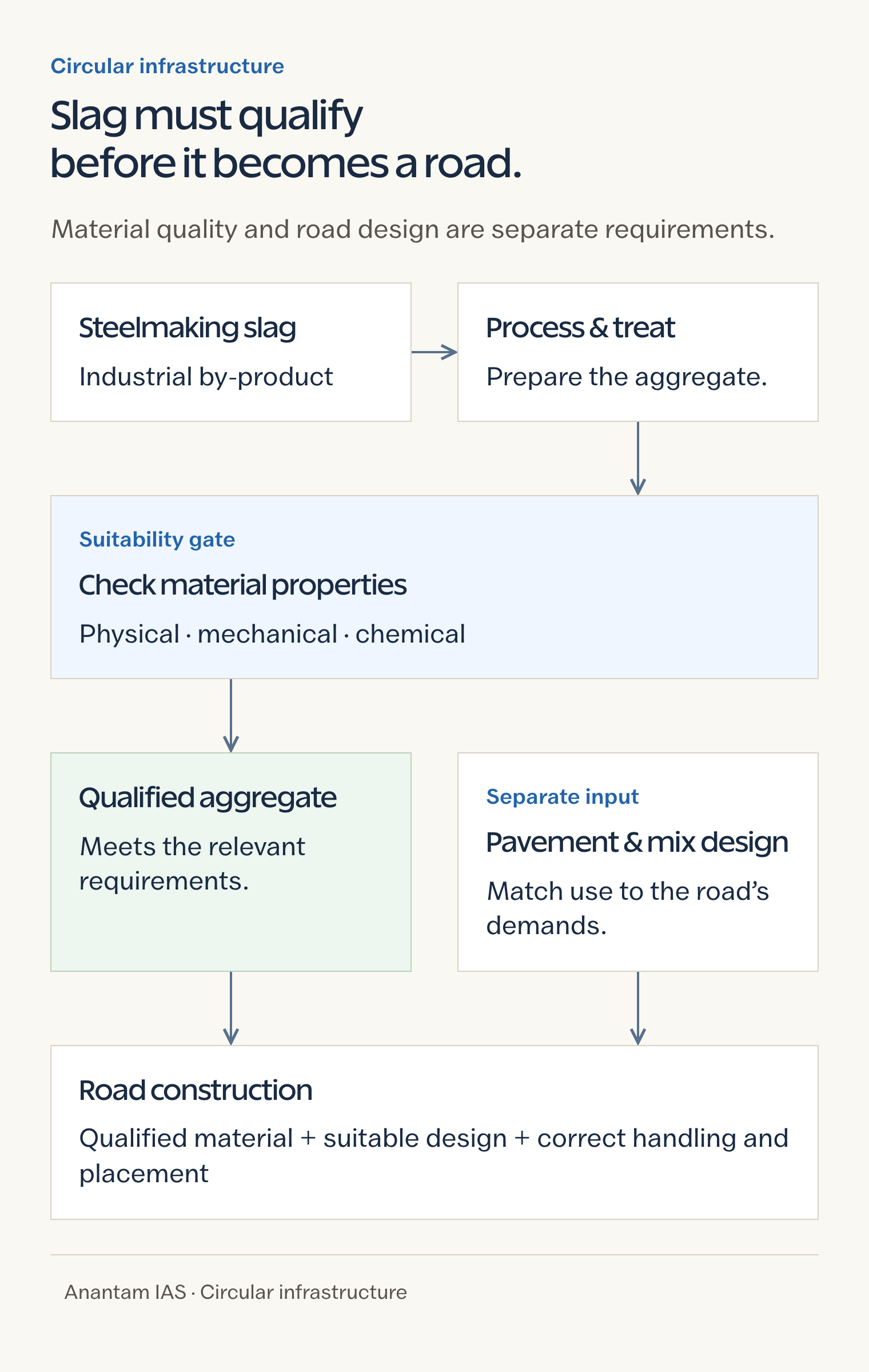
Steel slag processing and testing produce qualified aggregate, used with a separate pavement design
Processed aggregate still needs material qualification and suitable road design.

What wider adoption must prove

The new agreement advances implementation, but project performance still depends on the road, the material supply and the conditions under which construction occurs.

  • A technology-transfer agreement supports movement from research towards application. It should be understood as an implementation step, not evidence that every future road has already achieved the performance reported for an earlier demonstration project.
  • The 40-km Odisha work order signals intended scale. For public accountability, distinguish an order received, construction undertaken and a road completed; treating these stages as interchangeable would overstate what the September announcement actually establishes.
  • Traffic conditions can change as surrounding economic activity grows. The release highlights village roads acquiring heavy commercial traffic; choosing an aggregate does not eliminate the need to assess the loads the pavement must carry.
  • Project economics should compare delivered material and construction costs with a suitable alternative. Processing, transport and expected maintenance belong in that assessment; the cheapest residue at its source need not provide the cheapest finished road.
  • Performance claims need application-specific evidence. The release describes adoption where technically and economically appropriate, so avoid turning statements about stronger roads or longer maintenance intervals into unconditional guarantees for every location and pavement design.

Way Forward

Make procurement reward verified performance

  • Specify qualified aggregate and project design requirements, with documented checks of the material supplied to each construction site.
  • Compare whole-project costs, including processing and transport, against locally available natural aggregate before selecting the technology.
  • Track field performance and publish completion status accurately so future projects learn from actual road conditions rather than promotional claims.

Conclusion

  • Steel slag roads illustrate how public research can connect industrial by-products with infrastructure needs. The durable lesson is that material recovery becomes useful through qualification, suitable design and competent execution, not through a waste-to-wealth label alone.
  • For an infrastructure answer, link resource conservation with quality assurance: support wider adoption where the material and project are suitable, while keeping planned construction, completed infrastructure and demonstrated performance clearly separate.

UPSC Practice Questions

Prelims MCQ 1

With reference to steel slag road technology, consider the following statements:

  1. Processed steel slag can substitute natural aggregate in road construction.
  2. The origin of slag in a steel plant alone establishes its suitability for road use.
  3. Material qualification and pavement design address different aspects of road construction.

How many of the above statements are correct?

(a) Only one (b) Only two (c) All three (d) None

Answer: (b) Only two

Explanation:

Statements 1 and 3 are correct. Processing and material suitability checks are required; industrial origin alone is insufficient.

Prelims MCQ 2

Which approach best evaluates the economic suitability of steel slag for a proposed road?

(a) Compare only the purchase price of raw slag (b) Assume identical savings for every location (c) Compare processing, transport, construction and expected maintenance costs (d) Treat a technology-transfer agreement as proof of completed construction

Answer: (c) Compare processing, transport, construction and expected maintenance costs

Explanation:

A project-level comparison accounts for the costs of obtaining and using suitable material, rather than relying on its price at the source.

UPSC Mains Questions

  1. Explain how steel slag road technology connects circular-economy goals with infrastructure development. Why is material qualification essential?
  2. Technology transfer is necessary but insufficient for scaling an infrastructure innovation. Discuss with reference to steel slag roads.

Sources: PIB, Ministry of Science & Technology and CSIR-CRRI guidelines, Ministry of Steel.

Frequently Asked Questions

What is steel slag road technology?

It uses processed steel slag, a by-product of steel production, as aggregate in road construction. The process substitutes a construction input; it does not create a road made from solid steel sheets.

Is the announced Odisha steel slag road complete?

The September announcement reports a work order for a planned 40-km Odisha road. Receiving a work order is an implementation step, not confirmation that construction has finished or performance has been demonstrated.

Why must steel slag be tested before road use?

Its suitability cannot be inferred from its origin alone. Processing and checks of physical, mechanical and chemical properties establish whether the supplied material meets requirements for the intended road construction application.

Does steel slag guarantee lower costs everywhere?

No universal saving follows from the material alone. A project must assess processing, transport, construction and expected maintenance costs alongside suitability for its location, traffic conditions and pavement design.

CTED Propaganda Report: Beyond Content Removal

Open article →Download PDF

Why in News?

On 11 September 2026, UN News reported a new CTED assessment finding that terrorist propaganda increasingly supports recruitment, financing and claims to authority, while government and platform responses struggle to keep pace.

  • The Counter-Terrorism Committee Executive Directorate examines propaganda as part of terrorist operations, extending analysis beyond individual messages and content removal.
  • The report identifies an acceleration gap: terrorist adaptation moves faster than legislative, policy and operational responses.
  • It highlights children and young people as increasingly targeted audiences, alongside concerns about AI, online communities and blended violent extremist narratives.
  • A content-only response can miss links between harmful messaging, financial support and perceived legitimacy. Effective prevention needs cooperation across institutions that usually handle these issues separately.
  • The report insists on international human rights safeguards. Overbroad restrictions can suppress legitimate expression and deepen mistrust, weakening the public cooperation that prevention requires.

UPSC Relevance

Prelims Relevance

  • CTED: Counter-Terrorism Committee Executive Directorate, supporting the UN Security Council Counter-Terrorism Committee.
  • Terrorist propaganda: communicative material intended to recruit, incite, facilitate terrorism or mobilise support.
  • Acceleration gap: faster threat adaptation than institutional response.
  • Ideological fluidity: overlapping violent narratives rather than adherence to one coherent doctrine.
  • Rights safeguards: legality, necessity and proportionality, with privacy and due process protections.

Mains Relevance

GS Paper 3

  • Digital propaganda as an enabling function of terrorism.
  • Coordination between platforms, counter-terrorism authorities and financial intelligence units.

GS Paper 2

  • Protecting children and legitimate expression within accountable digital governance.

Essay

  • Public trust and security become stronger when rights protection guides institutional action.

Background and Context

Why propaganda is more than messaging

CTED treats propaganda as a supporting function across terrorist activity, rather than publicity that follows violence.

  • Operational infrastructure means propaganda helps sustain recruitment, financial support and perceptions of authority. The report asks policymakers to examine these connections, rather than treating every item as an isolated communications problem.
  • Perceived legitimacy can connect messaging with support for a group. CTED describes how propaganda promotes claimed governance activities, particularly where state authority is weak, contested or associated with unresolved grievances.
  • Financial intelligence and online-content analysis address different parts of the same risk. A response focused only on removing material can overlook the broader support relationships that the report identifies.
  • CTED trends reports provide policy-relevant analysis informed by engagement with Member States and research. This assessment is an analytical warning; it does not announce a new universal platform prohibition or domestic criminal offence.

What creates the acceleration gap

Threats evolve through changing technology and online environments faster than institutions can update their rules and working capacity.

  • Legislative and operational timelines are often longer than terrorist adaptation cycles. The acceleration gap includes delayed implementation and limited institutional capacity, rather than simply an absence of strict laws.
  • AI-enabled content increases the challenge of rapid production and distribution. The policy implication is to assess emerging technology risks continuously; the report does not establish that every AI-generated message is terrorist material.
  • Language and context remain difficult for automated moderation. CTED notes concerns about cultural accuracy, transparency and accountability, making human review and reliable correction processes necessary alongside tools that work at scale.
  • Cross-border platforms complicate responses because content and services may operate beyond a national jurisdiction. Coordinated government-platform cooperation must address this mismatch without assuming that one country can control the entire online environment.

Child protection needs prevention beyond policing

The report places children and young people at the centre of prevention, while warning against oversimplifying exposure and behaviour.

  • Online communities, including gaming-related spaces, can expose young users to harmful material. This identifies a safeguarding challenge; it does not mean gaming generally causes terrorism or that ordinary young users are suspects.
  • Exposure is not destiny: the report acknowledges that links between violent content and radicalisation remain complex and contested. Prevention should assess individual circumstances, rather than infer dangerousness from isolated media consumption.
  • Mixed narratives can combine grievances, conspiracy theories and violent misogyny without forming a consistent doctrine. Support services need flexible assessments, rather than forcing every vulnerable individual into a single ideological category.
  • Psychosocial support and digital literacy complement online safety. CTED describes emerging interventions linking vulnerable users with offline help, making trusted educators, families and community organisations relevant partners in prevention.
  • Gender-responsive prevention recognises that online harassment and discriminatory narratives affect young people differently. Connecting child protection with responses to gender-based harm can close gaps between otherwise separate institutions and services.

How rights safeguards strengthen security

Effective action must remain lawful, targeted and reviewable so that protection does not become indiscriminate exclusion.

  • Legality, necessity and proportionality provide tests for restrictions affecting expression and privacy. A security objective does not remove the need to define the measure, demonstrate its purpose and limit its reach.
  • Legitimate expression includes journalism, dissent and human rights advocacy. CTED warns that overbroad counter-terrorism measures can affect these activities and minority communities, undermining trust rather than reducing the underlying threat.
  • Blanket age restrictions raise questions about effectiveness, privacy and children’s access to information. The report favours inherently safer services and meaningful consultation with young people rather than relying solely on exclusion.
  • Oversight and community consultation help make measures accountable and responsive to real harms. For India, the analytical lesson is to coordinate prevention, platform governance and financial scrutiny while preserving lawful safeguards.

Way Forward

Coordinate prevention with accountable review

  • Connect financial intelligence units, counter-terrorism practitioners and platforms through lawful information-sharing arrangements that address enabling relationships as well as harmful content.
  • Build child-centred referral pathways linking online safety teams with trained educators and support services. Review interventions for gendered harms, privacy effects and inappropriate criminalisation.
  • Evaluate outcomes and errors, including harmful exposure, successful support referrals and mistaken restrictions. Content-removal totals alone cannot establish whether recruitment risks or rights violations have declined.

Conclusion

  • The CTED report reframes terrorist propaganda as an enabling function linking communication, support and perceived authority. Its central policy lesson is to connect institutional responses across these functions.
  • Closing the acceleration gap requires adaptable prevention and faster cooperation, with child protection and rights safeguards built into the response. Speed without accuracy or accountability is an incomplete security strategy.

UPSC Practice Questions

Prelims MCQ 1

With reference to the CTED report on terrorist propaganda, consider the following statements:

  1. The acceleration gap concerns a mismatch between threat adaptation and institutional response.
  2. The report treats propaganda exclusively as publicity after an attack.
  3. The report calls for counter-terrorism measures consistent with international human rights law.

How many of the above statements are correct?

(a) Only one (b) Only two (c) All three (d) None

Answer: (b) Only two

Explanation:

Statements 1 and 3 are correct. CTED examines propaganda as an enabler of recruitment, financing and perceived authority, extending beyond publicity.

Prelims MCQ 2

Which response best reflects the CTED report’s approach to young people exposed to harmful online content?

(a) Presuming terrorist intent from any exposure (b) Measuring success only by deleted posts (c) Combining safer services, support referrals and rights safeguards (d) Treating gaming participation as evidence of radicalisation

Answer: (c) Combining safer services, support referrals and rights safeguards

Explanation:

The report supports integrated prevention, acknowledges complex exposure pathways and stresses child protection alongside privacy, expression and due process.

UPSC Mains Questions

  1. Terrorist propaganda is an operational enabler, not merely a communications problem. Examine the implications for coordination between public institutions and digital platforms.
  2. How can governments narrow the acceleration gap in countering online terrorist propaganda while protecting children, privacy and legitimate expression?

Sources: UN News, reporting the CTED September 2026 Trends Report and CTED, Beyond messaging: terrorist propaganda as operational infrastructure.

Frequently Asked Questions

What is CTED?

CTED is the Counter-Terrorism Committee Executive Directorate. It supports the UN Security Council Counter-Terrorism Committee and produces policy-relevant assessments of terrorism trends and Member States’ implementation challenges.

What does the acceleration gap mean?

It describes the mismatch between rapidly changing terrorist propaganda strategies and slower legislative, policy and operational responses. Platform delays, limited contextual understanding and cross-border challenges can also widen this gap.

Why is content removal insufficient?

Removal addresses individual material, but propaganda can also sustain recruitment, financial support and claims to authority. CTED calls for coordination that addresses these enabling relationships while retaining lawful content controls.

Does online exposure inevitably cause radicalisation?

No. The report recognises that relationships between exposure and radicalisation are complex and contested. Child protection should combine safer online environments with individual assessment, digital literacy and appropriate offline support.

Colombo Security Conclave: Rehearsing a Shared Maritime Response

Open article →Download PDF

Why in News?

A Colombo Security Conclave tabletop exercise on coordinated responses to illicit maritime activities concluded at Eastern Naval Command, Visakhapatnam, on 11 September 2026, the Defence Ministry reported on 12 September.

  • The exercise ran from 9 to 11 September and involved delegations and maritime security experts from CSC member states and observer nations.
  • Participants used simulated operational scenarios addressing maritime terrorism, human trafficking, illicit trade and illegal, unreported and unregulated fishing.
  • They reviewed Standard Operating Procedures and streamlined information sharing to strengthen collective Maritime Domain Awareness.
  • The central problem is coordination: several agencies may recognise a maritime risk yet lack a shared understanding of responsibilities, information needs and the next decision.
  • A tabletop exercise tests procedures through discussion and scenarios. Its completion is evidence of preparedness activity, not proof that a real maritime incident was intercepted or resolved.

UPSC Relevance

Prelims Relevance

  • CSC: Colombo Security Conclave, the framework under which this exercise took place.
  • TTX: tabletop exercise based on simulated scenarios.
  • MDA: Maritime Domain Awareness, supporting understanding of relevant maritime activities and risks.
  • SOP: Standard Operating Procedure, providing an agreed process for handling recurring situations.
  • IUU fishing: illegal, unreported and unregulated fishing.

Mains Relevance

GS Paper 3

  • Converting maritime information into coordinated security responses.
  • Inter-agency preparedness for non-traditional maritime threats.

GS Paper 2

  • Regional cooperation that improves practical coordination while retaining clear national responsibilities.

Essay

  • Cooperation becomes effective when shared intent is translated into tested procedures.

Background and Context

What a tabletop exercise can test

A simulated incident creates a structured setting to examine decisions and coordination before agencies face a real emergency at sea.

  • Scenario-based discussion asks participants how they would respond to an evolving situation. It can expose disagreements about responsibilities or missing information without implying that the imagined incident actually occurred in regional waters.
  • SOP review examines whether the written process helps participants move from receiving information to choosing an appropriate response. The release confirms a review, but does not publish the resulting procedural changes.
  • Information-sharing arrangements matter because agencies may possess different parts of a situation. Agreeing what must be communicated, to whom and when can reduce uncertainty before a response decision is taken.
  • Simulated performance is different from operational performance. A discussion can identify procedural gaps, while real readiness also depends on personnel, communications and available assets; this announcement does not provide an independent readiness assessment.
  • Exercise outcomes should be read precisely: the reported activities were scenario discussions, SOP review and improved sharing arrangements. The announcement supplies no basis for claiming an actual interception, rescue or successful enforcement operation.

Shared maritime awareness is not shared authority

Knowing what is happening at sea supports a decision, but the responsibility and authority to act remain separate questions.

  • Maritime Domain Awareness concerns understanding relevant activity and risks in the maritime environment. In this exercise, stronger collective awareness was the stated purpose of streamlining information sharing among the participating maritime security representatives.
  • A shared assessment is more useful than disconnected observations because participants can compare information and clarify uncertainty. Yet receiving an alert does not by itself settle the significance of the event or required response.
  • Authority to act should not be inferred from access to information. A useful preparedness review asks which competent agency must decide and what permissions are needed; the release announces no new enforcement powers.
  • Jurisdiction and coordination answer different questions: jurisdiction concerns the applicable authority, while coordination concerns agencies working together. The exercise report does not establish any transfer of national jurisdiction or automatic right to board vessels.
  • Patrol assets can translate a decision into an at-sea presence, but sharing a maritime picture does not itself make those assets available. A response still requires the appropriate organisation to assign its resources.

Turning a rehearsal into usable preparedness

The next policy test is whether identified gaps lead to clearer procedures that participants can use and review in practice.

  • Distinct threats require distinct decisions even when encountered in the same maritime space. The inclusion of terrorism, trafficking and IUU fishing supports a coordination focus; it does not make their legal treatment interchangeable.
  • Clear points of contact are a practical follow-up priority: an agency should know where to send a concern and who can confirm receipt. This is a preparedness recommendation, not a newly announced exercise outcome.
  • Uncertainty handling deserves attention when reports are incomplete or contradictory. Participants should distinguish confirmed observations from assessments, so that an apparent common picture does not conceal disagreement or create unwarranted confidence in an alert.
  • Follow-up testing should check whether revised procedures resolve the specific gaps found in rehearsal. The relevant evidence would concern clearer decisions and functioning coordination, rather than the completion of another ceremonial event or declaration.
  • Regional cooperation is most useful when it lowers practical coordination barriers. This exercise illustrates a procedural route to cooperation, while its brief public account leaves the detailed scenario results and implementation arrangements undisclosed.

Way Forward

Make procedural improvements testable

  • Assign responsibility for follow-up to each identified procedural gap and revisit it in subsequent exercises. Track whether the same uncertainty continues to delay decisions.
  • Review information quality and communication together: shared reports need clear timing, confidence and a route for clarification, rather than merely wider circulation.
  • Keep authority and resource checks explicit in preparedness planning. A common assessment should lead to an accountable decision by the appropriate institution, with realistic implementation capacity.

Conclusion

  • The CSC exercise illustrates the bridge between maritime awareness and coordinated response: information must connect with tested procedures, clear responsibilities and available capacity. A shared picture alone cannot complete that chain.
  • For an examination answer, distinguish simulation from operations and cooperation from transferred jurisdiction. The verified milestone is a completed rehearsal and procedural review, with operational effectiveness requiring separate evidence.

UPSC Practice Questions

Prelims MCQ 1

With reference to the Colombo Security Conclave tabletop exercise, consider the following statements:

  1. It involved simulated operational scenarios.
  2. Participants reviewed Standard Operating Procedures and information-sharing arrangements.
  3. Its completion establishes that an actual maritime interception was carried out.

How many of the above statements are correct?

(a) Only one (b) Only two (c) All three (d) None

Answer: (b) Only two

Explanation:

Statements 1 and 2 are correct. A tabletop exercise rehearses responses through scenarios; the release does not report an actual interception.

Prelims MCQ 2

Which distinction is most relevant when interpreting collective Maritime Domain Awareness?

(a) Information sharing automatically transfers national jurisdiction (b) Shared awareness and authority to act are separate questions (c) Awareness eliminates the need for response resources (d) A simulated incident is evidence of a real enforcement action

Answer: (b) Shared awareness and authority to act are separate questions

Explanation:

Information supports decisions but does not itself establish new powers or transfer jurisdiction. The exercise announcement reports procedural review and sharing arrangements.

UPSC Mains Questions

  1. Explain how tabletop exercises can strengthen responses to non-traditional maritime threats. Distinguish shared maritime awareness from authority to act.
  2. Regional maritime cooperation requires tested procedures as well as political intent. Discuss with reference to information sharing, agency responsibility and follow-up evaluation.

Source: PIB, Ministry of Defence.

Frequently Asked Questions

What is a tabletop exercise?

A tabletop exercise uses simulated scenarios to examine how participants would make decisions and coordinate responses. It can reveal procedural gaps without requiring the scenario to occur as a real operation.

What did the CSC exercise review?

Participants reviewed existing Standard Operating Procedures and streamlined information-sharing arrangements. The stated objective was stronger collective Maritime Domain Awareness for coordinated responses to illicit activities in the Indian Ocean Region.

Does shared maritime awareness create enforcement powers?

No such power is established by this announcement. Sharing information helps agencies understand a situation, while the competent authority, necessary permissions and responsibility for action remain separate questions.

Was this an actual maritime interception?

No. The official account describes simulated operational scenarios in a tabletop exercise. It reports no actual interception or transfer of jurisdiction, so those outcomes should not be inferred from its completion.

PM-ABHIM: Linking Critical Care and Public-Health Laboratories

Open article →Download PDF

Why in News?

On 12 September 2026, the Union Health Ministry inaugurated critical-care blocks and integrated public-health laboratories under PM-ABHIM in Andhra Pradesh.

  • Critical Care Blocks support advanced emergency and intensive care, while Integrated Public Health Laboratories strengthen diagnostic and surveillance capacity.
  • The ministry described continuity of routine healthcare during emergencies as a central objective of the infrastructure mission.
  • The release distinguishes laboratories already functional from those newly inaugurated; completion and inauguration alone do not establish sustained operational readiness.
  • This is an implementation milestone under an existing mission, not an announcement of a new scheme design.
  • Patient care and population surveillance solve different problems. Emergency preparedness needs both timely treatment and information that supports public-health action.
  • Physical infrastructure creates potential capacity; staff, supplies, referral arrangements and maintenance determine whether that capacity becomes dependable care.

UPSC Relevance

Prelims Relevance

  • Pradhan Mantri Ayushman Bharat Health Infrastructure Mission
  • Critical Care Blocks and intensive-care capacity
  • Integrated Public Health Laboratories
  • Clinical diagnosis versus population surveillance
  • Surge capacity and continuity of routine services

Mains Relevance

GS Paper 2

  • Implementation and governance of public-health infrastructure
  • Connecting community, referral, critical-care and surveillance services

GS Paper 3

  • Preparedness for biological emergencies and health-system resilience

Essay

  • Preparedness is measured by services that continue working when ordinary systems come under pressure.

Background and Context

Critical care is a service, not simply a bed

Critical Care Blocks strengthen the treatment side of preparedness, where an individual patient needs advanced emergency care and dependable support systems.

  • A Critical Care Block provides infrastructure for treating severely ill patients, including during health emergencies and disasters. Its purpose is timely access to advanced care, rather than merely adding another building to a hospital campus.
  • The ministry identifies oxygen and medical-gas systems, isolation facilities and trained personnel as essential capabilities. These resources work together; an available bed cannot deliver appropriate critical care when supporting services are absent or unreliable.
  • Referral links connect community and primary services with facilities able to provide more advanced treatment. A stronger destination helps only when patients can be assessed, transferred and received through arrangements that function in practice.
  • Isolation capacity helps a facility manage infectious patients while preserving other services. Readiness involves organising care so an emergency does not force every routine ward or service to be diverted from its existing patients.
  • The operational test extends beyond civil construction: whether equipment works, essential supplies remain available and suitably trained teams can provide care. The inauguration release does not independently verify these conditions continuously at every new facility.

Laboratories connect diagnosis with public-health action

Integrated Public Health Laboratories strengthen information and testing capacity, helping health authorities recognise threats and decide how to respond beyond one patient.

  • An Integrated Public Health Laboratory supports testing for infectious and non-infectious diseases. The ministry links this capacity to earlier outbreak detection, monitoring health threats and improving the evidence available for public-health decisions across the system.
  • Clinical diagnosis helps determine what is affecting a particular patient. Surveillance examines patterns across cases and places; a test result becomes more useful when it reaches the people responsible for interpreting and acting on it.
  • Reliable testing requires more than laboratory space. Appropriate staff, functioning equipment, dependable supplies and reporting arrangements turn a completed facility into a service; poor continuity at any stage can limit the usefulness of its results.
  • Early warning is valuable when it supports a timely response. The governance question is who receives the information, checks its significance and coordinates follow-up, rather than assuming that producing additional reports automatically controls an outbreak.
  • The Bundibugyo outbreak note illustrates why changing disease patterns require interpretation. Here, the distinct focus is standing laboratory capacity that can support response across threats, not the circumstances or risk assessment of a particular outbreak.

Keep ordinary healthcare working during a surge

PM-ABHIM links emergency preparedness with a broader continuum of care, aiming to strengthen the system without displacing the routine services people still need.

  • The ministry recalls how COVID-19 required regular hospital infrastructure to be converted for isolation and emergency treatment. That experience underlines why preparedness must include capacity to respond without unnecessarily interrupting care for other health needs.
  • Community services, primary and referral facilities, critical-care blocks and laboratories have complementary roles. A connected system lets care escalate with need while information supports planning; strengthening one component alone cannot guarantee the pathway works.
  • The care-surveillance distinction also prevents misleading performance claims: treating more patients and detecting threats earlier are different outcomes. Each needs appropriate evidence, rather than using the same construction or inauguration count to represent both achievements.
  • As the clinical-registry note explains, useful health evidence must match its question. For these facilities, service-level monitoring should examine actual functioning and continuity, while avoiding unsupported claims that an inauguration already improved population health outcomes.
  • Implementation governance must address recurring needs after construction, including staffing, equipment upkeep and coordination. The new facilities are a concrete step in expanding infrastructure; sustained readiness remains a task to deliver and verify over time.

Way Forward

Verify readiness and service continuity

  • Use facility-level readiness checks covering staff, equipment, supplies and referral arrangements, with clear responsibility for resolving gaps.
  • Test reporting-to-response links so laboratory information reaches the appropriate public-health team and leads to documented follow-up.
  • Monitor routine-service continuity during emergency exercises, identifying which services would be displaced and how alternative capacity would be maintained.

Conclusion

  • PM-ABHIM’s infrastructure pairs critical care for patients with laboratory support for population health. The functions reinforce each other, but require different capabilities and evidence of performance rather than a single measure of construction progress.
  • The durable lesson is that preparedness must remain operational: facilities need trained teams, reliable support and working connections. Judge success by dependable care, timely public-health action and continuity through emergencies, not inauguration alone.

UPSC Practice Questions

Prelims MCQ 1

With reference to PM-ABHIM facilities, consider the following statements:

  1. Critical Care Blocks strengthen advanced emergency and intensive-care infrastructure.
  2. Integrated Public Health Laboratories support diagnostic and surveillance capacity.
  3. Inauguration alone establishes that a facility continuously meets all operational requirements.

How many of the above statements are correct?

(a) Only one (b) Only two (c) All three (d) None

Answer: (b) Only two

Explanation:

The first two statements describe the facilities’ roles. Operational readiness also depends on staff, equipment, supplies and functioning service arrangements.

Prelims MCQ 2

Which observation best distinguishes population surveillance from individual clinical diagnosis?

(a) Surveillance interprets patterns across cases to inform public-health action (b) Surveillance requires no laboratory information (c) Diagnosis necessarily predicts every future outbreak (d) A laboratory building guarantees effective surveillance

Answer: (a) Surveillance interprets patterns across cases to inform public-health action

Explanation:

Clinical diagnosis concerns an individual patient. Surveillance brings information together to understand population patterns and guide response; laboratory evidence can support both.

UPSC Mains Questions

  1. Explain how critical-care capacity and public-health laboratories perform complementary roles in health-emergency preparedness.
  2. Why is infrastructure completion insufficient to establish health-system resilience? Discuss with reference to operational readiness and continuity of routine care.

Source: PIB, Ministry of Health and Family Welfare.

Frequently Asked Questions

What does PM-ABHIM stand for?

PM-ABHIM is the Pradhan Mantri Ayushman Bharat Health Infrastructure Mission. It supports stronger public-health infrastructure, including critical-care and laboratory capacity, with preparedness for emergencies and continuity of routine healthcare among its objectives.

How does a Critical Care Block differ from a public-health laboratory?

A Critical Care Block strengthens advanced treatment capacity for severely ill patients. A public-health laboratory supports testing, surveillance and evidence for public-health action. Their functions complement each other within a connected health system.

Does inauguration mean a facility is fully operational?

Not by itself. Reliable operation also requires trained staff, functioning equipment, dependable supplies and effective service arrangements. The release distinguishes previously functional laboratories from those inaugurated in the new batch.

Why must routine healthcare be protected during emergencies?

Other health needs continue while an emergency increases demand. Redirecting ordinary facilities without alternatives can interrupt essential services, so preparedness should include surge arrangements that help preserve continuity of care.

Do laboratory results automatically control an outbreak?

No. Results must be reported, interpreted and connected to appropriate follow-up. Effective preparedness links testing capacity with public-health teams and response arrangements, rather than treating laboratory output alone as evidence of control.

Nepal LDC Graduation: Eligibility Is Not Transition Readiness

Open article →Download PDF

Why in News?

UN-OHRLLS listed its Nepal Graduation Readiness Assessment on 11 September 2026, ahead of Nepal’s scheduled exit from the least developed country category on 24 November.

  • The assessment finds Nepal meets graduation criteria but retains significant productive, fiscal and institutional vulnerabilities.
  • It identifies uneven implementation of the smooth transition strategy, with stronger progress in policy preparation than delivery.
  • A narrow export base, dependence on remittances and high logistics costs could complicate adjustment as support arrangements change.
  • The report calls for funded implementation priorities, sector-specific preparation and tailored international support beyond graduation.
  • Graduation eligibility recognises development gains; readiness asks whether those gains can withstand changes in support and external shocks.
  • For India, Nepal’s transition matters through trade and connectivity. Stronger productive capacity in a neighbouring landlocked economy can deepen mutually beneficial regional integration.

UPSC Relevance

Prelims Relevance

  • UN least developed country category
  • Gross national income per capita, human assets and vulnerability criteria
  • Committee for Development Policy and graduation review
  • Trade preferences and rules of origin
  • Smooth transition strategy versus graduation eligibility

Mains Relevance

GS Paper 2

  • International support for sustainable LDC graduation
  • India-Nepal economic cooperation and regional connectivity

GS Paper 3

  • Export competitiveness, remittance dependence and structural transformation

Essay

  • Development progress is durable when institutions and productive capacity can sustain it through changing circumstances.

Background and Context

Eligibility and readiness answer different questions

Formal eligibility measures progress against agreed benchmarks; readiness examines whether an economy can manage the transition without reversing its development gains.

  • The UN LDC category considers income, human assets and economic and environmental vulnerability. The framework recognises structural obstacles to development, rather than treating a country’s income level as the only relevant measure of progress.
  • The report finds Nepal meets all three criteria. Its earlier progress rested mainly on human-development and vulnerability indicators, while income qualification came later; eligibility should not be confused with a fully diversified productive economy.
  • Readiness assessment asks a different question: can firms, households and institutions absorb changing support arrangements and external shocks? Stronger indicators can coexist with weak investment, fragile public finances and limited capacity to implement reforms.
  • The World Bank’s income groups classify economies by gross national income per capita. They are separate from UN LDC identification, which includes other criteria; leaving one category does not automatically determine membership of another.
  • Nepal is scheduled to graduate on 24 November 2026; the assessment does not announce completed graduation. Its purpose is to identify preparations and risks before the change, not to reopen the established eligibility decision.

Why productive capacity matters after graduation

The assessment identifies a gap between improvements in household welfare and the domestic production, financing and institutions needed for a resilient economy.

  • Remittances support consumption and foreign-exchange availability, but dependence on overseas employment exposes households to external labour-market shocks. These inflows do not automatically build competitive domestic manufacturing or create enough productive employment within Nepal.
  • A narrow export base leaves firms exposed to changing market conditions and preferences. The report identifies garments, carpets and other vulnerable sectors for preparation, rather than assuming every exporter faces the same adjustment problem.
  • High logistics costs reduce competitiveness before a shipment reaches its buyer. For landlocked Nepal, reliable freight routes, efficient border procedures and standards infrastructure can matter alongside tariff treatment when producers try to enter markets.
  • The report finds implementation is uneven: preparing strategies and committees has advanced further than delivery in productive infrastructure, skills and other areas. A policy document cannot substitute for functioning services that firms actually use.
  • Existing cross-border rail development and electricity links show the relevance of regional infrastructure. For graduation readiness, the separate test is whether reliable connectivity lowers business constraints and remains resilient to disruption over time.

Support changes need a managed transition

Graduation can change access to particular benefits, but different partners and institutions apply different rules; support does not disappear through one universal switch.

  • Preference erosion means losing some advantage provided by favourable market access. Its effect depends on the product, destination, alternative scheme and transition arrangement, so a national graduation date alone cannot determine every exporter’s costs.
  • Rules of origin determine whether a product qualifies for preferential treatment. A low tariff offers limited help when a producer cannot satisfy sourcing or processing conditions, maintain supporting records or obtain the necessary verification.
  • Access to an alternative preference scheme may depend on eligibility and compliance requirements. Negotiating or preparing for such access is different from having secured it; the assessment should not be read as automatic approval.
  • A smooth transition strategy connects the status change to practical adjustment. The report calls for prioritised actions, assigned responsibilities, budget links and monitoring, with producer participation so that preparedness reaches individual firms and workers.
  • International support should complement domestic reforms rather than replace them. Tailored assistance can support standards, trade negotiations and productive upgrading, while Nepal strengthens revenue, investment delivery and institutions capable of sustaining gains beyond graduation.

Way Forward

Turn transition priorities into funded delivery

  • Prepare a partner-and-product transition inventory showing which preferences change, what conditions apply and which firms require assistance.
  • Link priority reforms to budgets, responsible agencies and review dates, concentrating on constraints that prevent firms from producing and exporting competitively.
  • Create sector-specific support for origin records, standards compliance and logistics, with businesses involved in testing whether assistance resolves their actual barriers.

Conclusion

  • Nepal’s graduation recognises real gains, while the assessment warns that statistical eligibility and economic resilience are different achievements. A successful transition depends on productive capacity and institutions that can manage changing support arrangements.
  • The central policy test is preparedness at the level of firms and households: preserve development gains through sequenced reforms and tailored support, rather than treating the change of international category as the final outcome.

UPSC Practice Questions

Prelims MCQ 1

With reference to least developed country graduation, consider the following statements:

  1. The UN framework considers human assets and vulnerability as well as income.
  2. Meeting graduation criteria necessarily establishes that implementation capacity is adequate.
  3. Trade-support changes may differ by partner and scheme.

How many of the above statements are correct?

(a) Only one (b) Only two (c) All three (d) None

Answer: (b) Only two

Explanation:

Statements 1 and 3 are correct. The Nepal assessment distinguishes meeting formal criteria from having sufficient productive and institutional readiness.

Prelims MCQ 2

What do rules of origin primarily establish in a preferential trade arrangement?

(a) Whether a product qualifies for preferential treatment based on its origin (b) Whether a country has joined the UN (c) Whether remittances count as merchandise exports (d) Whether graduation automatically cancels every trade agreement

Answer: (a) Whether a product qualifies for preferential treatment based on its origin

Explanation:

Rules of origin apply sourcing or processing requirements to determine whether goods qualify for the relevant preference. They are separate from a country’s graduation classification.

UPSC Mains Questions

  1. Why can a country meet LDC graduation criteria while remaining insufficiently prepared for the transition? Discuss using Nepal’s readiness assessment.
  2. Examine how domestic productive capacity and tailored international support can make LDC graduation sustainable.

Sources: UN-OHRLLS and UN-OHRLLS readiness assessment.

Frequently Asked Questions

Has Nepal already graduated from the LDC category?

No. The assessment concerns Nepal’s scheduled graduation on 24 November 2026. It evaluates preparations for that transition and identifies vulnerabilities that could threaten the durability of development gains.

What is the difference between eligibility and readiness?

Eligibility concerns meeting agreed graduation criteria. Readiness examines whether firms, households and institutions can manage changing support and external shocks without reversing progress. Strong indicators do not eliminate implementation and productive-capacity gaps.

Does LDC graduation end every trade preference immediately?

No. Effects depend on the partner, product, scheme and applicable transition arrangements. Alternative preferences may have their own conditions, so exporters need specific information rather than assuming a uniform withdrawal of support.

Is the UN LDC category the same as a World Bank income group?

No. World Bank income groups use gross national income per capita. The UN LDC framework also considers human assets and economic and environmental vulnerability, making the categories distinct despite their shared attention to development.

Why does the report emphasise implementation?

It finds stronger progress in preparing policies and institutions than in delivering some practical improvements. Firms need functioning logistics, standards support, skills and financing, so a strategy alone cannot establish readiness.

Delhi Drylands Declaration: Connecting Research, Farms and Policy

Open article →Download PDF

Why in News?

On 13 September 2026, PIB reported that the Dryland Congress adopted the Delhi Declaration on Drylands, alongside calls for stronger data systems, foresight and living laboratories connecting research, practice and policy.

  • Participating governments, institutions and delegates endorsed a shared agenda for dryland agriculture through collaboration, knowledge exchange and innovation.
  • The ICAR leadership called for ICAR-NIAP to lead dryland foresight work; the release reports a proposed mandate, not an established new mechanism.
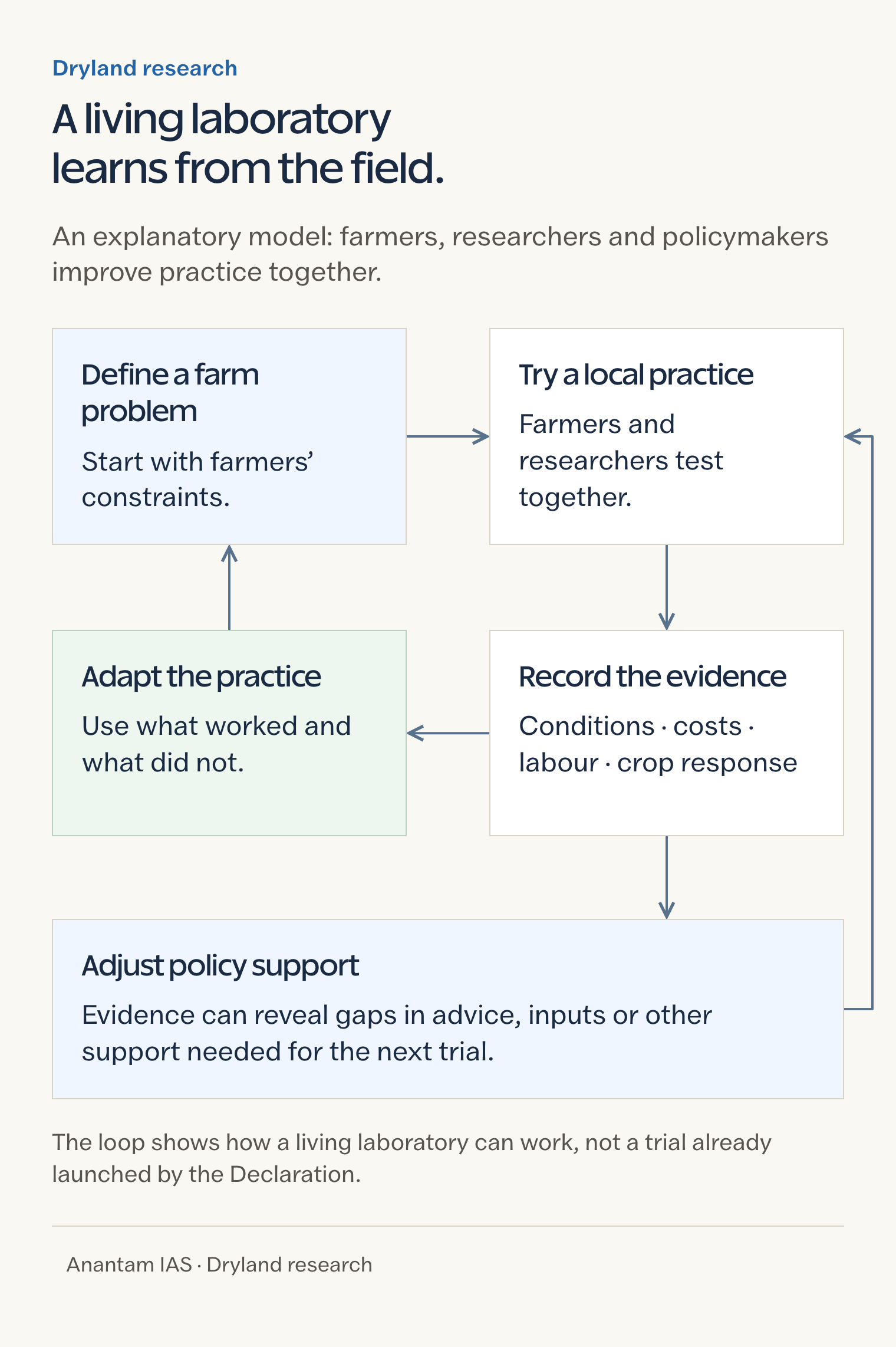
  • Living laboratories and robust information systems were highlighted as ways to connect scientific research with field practice and policy decisions.
  • Dryland resilience requires solutions that work under water constraints, while fitting the resources and decisions of the farmers expected to adopt them.
  • The implementation challenge is to turn shared knowledge into locally useful practices, then feed field experience back into research and public support.

UPSC Relevance

Prelims Relevance

  • Delhi Declaration on Drylands: shared agenda adopted at the Dryland Congress.
  • ICAR-NIAP: National Institute of Agricultural Economics and Policy Research.
  • Living laboratories: common innovation grounds linking research, practice and policy.
  • Foresight: examining possible future conditions to inform present choices.
  • Dryland agriculture: agricultural systems operating under persistent water constraints.

Mains Relevance

GS Paper 3

  • Climate-resilient agriculture through locally tested innovations and adaptive research.
  • Data systems, water constraints and long-term agricultural planning.

GS Paper 2

  • Institutional coordination between researchers, farmers and policymakers.

Essay

  • Agricultural knowledge improves when learning flows both ways.

Background and Context

Why dryland resilience needs local evidence

Dryland agriculture faces water constraints, but a useful response must also fit the farm where it will be applied and the farmer making decisions.

  • Water availability depends on climate and rainfall that replenish rivers and groundwater. FAO identifies greater precipitation variability and drought risks as pressures on agriculture, making dependable production a problem of managing uncertainty.
  • Local suitability matters even when two regions face similar water constraints. As a planning principle, decision-makers should ask whether a proposed practice fits the receiving farm’s soils, available labour, production needs and access to inputs.
  • Resilience should be assessed through the ability to manage difficult conditions, not a single impressive harvest. A useful evaluation would examine whether farmers can sustain production and recover without taking on an unaffordable additional burden.
  • Research priorities should begin with a clearly identified farm problem. For example, an innovation intended to manage a dry spell should be evaluated against that problem, rather than promoted solely because it is technically novel.
  • The declaration’s knowledge-exchange agenda creates an opportunity to compare experience across settings. Its practical value will depend on explaining where an approach worked, under what conditions, and what needs changing before another farming community adopts it.

How a living laboratory can close the feedback loop

The Congress described living laboratories as common innovation grounds; their value is connecting field experience with researchers and policymakers instead of separating these groups.

  • Start with farmers’ constraints: a useful living laboratory would allow farmers and researchers to identify a problem together. This makes the question being tested relevant before resources are spent developing or demonstrating a proposed solution.
  • Test in practice: for illustration, a soil-moisture practice could be tried under local farming conditions. The purpose would be to learn whether the practice works there, not to assume results from another location will transfer automatically.
  • Record usable evidence: the same illustrative trial could document rainfall conditions, labour requirements, costs and crop response. Researchers would then have a basis for interpreting performance, including cases where adoption creates difficulties for participating farmers.
  • Adapt through feedback: farmers’ observations should help revise the practice or the research question. This repeated learning distinguishes a useful innovation ground from an event that merely displays a technology and counts the people who attended.
  • Connect evidence with policy: repeated field findings can identify barriers that research alone cannot solve. If a promising practice needs accessible advice or inputs, policymakers can consider the support required while researchers continue checking its performance.
A learning cycle connects farm problems, local trials, evidence, adaptation and policy support
An explanatory model of a living laboratory, not a trial announced as operational.

What data and foresight add to the agenda

Data describe conditions and outcomes; foresight helps consider possible future pressures. The Congress called for both, alongside a stronger institutional mechanism for dryland agriculture.

  • Robust information systems should make findings interpretable, not collect more entries. A practical design would record the conditions behind an observed result, helping users distinguish a transferable lesson from an outcome that depends on unusual circumstances.
  • Comparable evidence helps researchers learn across innovation grounds. Shared definitions and clear measurement methods would make it easier to compare similar trials, while retaining local context instead of reducing every farm to a single performance score.
  • Foresight considers possible future conditions to inform decisions made now. In dryland planning, it can help examine how research and support priorities should change if water constraints or farmers’ production conditions evolve over the longer term.
  • The proposal for ICAR-NIAP concerns leadership of this foresight work. The announcement says the institute should receive the mandate; it does not establish that a new coordinating mechanism is already operational or has delivered an assessment.
  • Implementation accountability should connect an agreed priority with responsibility and observable results. The declaration provides a shared direction; evaluating its value requires following what institutions actually test, learn, change and support after the Congress ends.

Way Forward

Organise adoption around learning

  • Choose specific farmer problems for living laboratories and involve affected farmers in defining the question and reviewing results.
  • Build comparable, contextual data that record costs and constraints alongside outcomes, so unsuccessful trials also improve future decisions.
  • Clarify institutional responsibility for foresight and connect evidence from trials with research priorities, extension support and policy revision.

Conclusion

  • The Delhi Declaration on Drylands is most useful as an agenda for organised learning: identify a farm problem, test a response, examine the evidence and improve both the practice and the support around it.
  • In an agriculture answer, connect resilience with feedback. Scientific innovation matters when local experience can change research and policy, while clear institutional responsibilities convert conference commitments into sustained action.

UPSC Practice Questions

Prelims MCQ 1

With reference to the dryland agriculture agenda reported after the Dryland Congress, consider the following statements:

  1. Living laboratories were proposed to connect research, practice and policy.
  2. The release confirms an already operational new foresight mechanism led by ICAR-NIAP.
  3. Robust data and information systems were identified as important for dryland agri-food systems.

How many of the above statements are correct?

(a) Only one (b) Only two (c) All three (d) None

Answer: (b) Only two

Explanation:

Statements 1 and 3 are correct. The release reports a call for ICAR-NIAP to receive a foresight mandate, not confirmation of an operational mechanism.

Prelims MCQ 2

Which feature most directly makes a living laboratory useful for agricultural innovation?

(a) Treating farmer feedback as irrelevant to research (b) Promoting a practice before examining local conditions (c) Repeated testing and adaptation linking farmers, researchers and policymakers (d) Measuring success only through attendance at a demonstration

Answer: (c) Repeated testing and adaptation linking farmers, researchers and policymakers

Explanation:

A living laboratory connects practice with research and policy. Feedback allows a proposed response to be evaluated and improved under relevant conditions.

UPSC Mains Questions

  1. Explain how living laboratories can strengthen the connection between agricultural research, farm practice and public policy in dryland regions.
  2. How can data systems and foresight improve dryland agricultural resilience? Discuss the institutional requirements for turning a shared declaration into action.

Sources: PIB, Ministry of Agriculture & Farmers Welfare and FAO: Water scarcity.

Frequently Asked Questions

What is the Delhi Declaration on Drylands?

It is the shared agenda adopted at the Dryland Congress and reported by PIB on 13 September 2026. It emphasizes collaboration, knowledge exchange and innovation to improve dryland agriculture across the Global South.

What is a living laboratory in this context?

It is a common innovation ground connecting research, practice and policy. A useful implementation enables farmers and researchers to test responses under local conditions, exchange feedback and improve the proposed practice.

Has ICAR-NIAP received a new operational foresight mandate?

The release reports a call for ICAR-NIAP to be mandated to lead dryland foresight work. It does not confirm that a new mechanism is operational or that a foresight assessment has been delivered.

Why are data systems needed alongside farm trials?

Trial results need context to be useful elsewhere. Recording conditions, costs and constraints alongside outcomes helps distinguish a broadly useful practice from an approach that succeeds only under particular circumstances.