Why in News?
The Reserve Bank of India released its money-mule draft on September 11, 2026, proposing time-bound bank debit holds alongside safeguards for genuine account holders.
- The proposal remains a public-consultation draft; the RBI has invited comments until October 2, 2026.
- April 1, 2027 is the proposed implementation date, with earlier adoption allowed under the draft; it is not a claim that final directions already operate.
- The draft covers commercial banks and urban cooperative banks, including payments banks, small finance banks and regional rural banks.
- It follows a Supreme Court direction asking the RBI to circulate a standard operating procedure for temporary debit holds linked to money-mule activity and cyber-enabled fraud.
- A rapid debit hold can interrupt onward movement of suspected fraud proceeds, but mistaken restrictions can also interrupt legitimate payments.
- The policy question is how to combine fraud containment with reasons, review deadlines and a route for genuine customers to obtain release.
UPSC Relevance
Prelims Relevance
- Money mule account: an account used knowingly or unknowingly to receive, layer or transfer cyber-fraud proceeds for another person.
- Temporary debit hold: a restriction on outgoing use of suspected amounts or an account, pending verification.
- NCRP-CFCFRMS: the National Cybercrime Reporting Portal’s Citizen Financial Cyber Fraud Reporting and Management System.
- FIU-IND: receives suspicious transaction reports; the draft does not replace existing reporting obligations.
Mains Relevance
GS Paper 3
- Cybersecurity: disrupting financial-fraud chains through bank transaction monitoring.
- Financial inclusion: limiting collateral harm when genuine accounts trigger fraud alerts.
GS Paper 2
- Procedural safeguards: reasoned decisions, accessible complaints and time-bound coordination between banks and police.
Essay
- Accountable automation: technological suspicion should trigger review, not become a substitute for judgment.
Background and Context
What a money-mule debit hold actually does
The draft separates an account’s possible role in moving fraud proceeds from the account holder’s guilt, making verification central to the proposed restriction.
- A money mule account channels proceeds for another person, sometimes without its holder understanding the fraud. Receiving, layering and transferring describe different roles in moving money; suspicion alone does not establish knowing participation.
- A temporary debit hold restricts outgoing use while the bank verifies suspected activity. Its purpose is to interrupt movement of suspect funds, rather than to declare a criminal conviction or promise repayment to victims.
- Under the draft, the bank’s internal policy must distinguish amount-level restrictions from whole-account holds. Restricting the entire account is an exceptional last resort, helping preserve access to unrelated funds where a narrower hold suffices.
- The proposed procedure concerns holds initiated by banks themselves. A restriction placed or continued under a specific law-enforcement instruction follows that instruction; the bank-initiated timetable cannot be treated as overriding every lawful investigative direction.
- The draft excludes special-purpose accounts, including nodal, pool and escrow accounts, from this SOP. That exclusion is about this procedure’s scope; it does not establish a general exemption from anti-money-laundering or banking obligations.
How the customer and police-referral clocks work
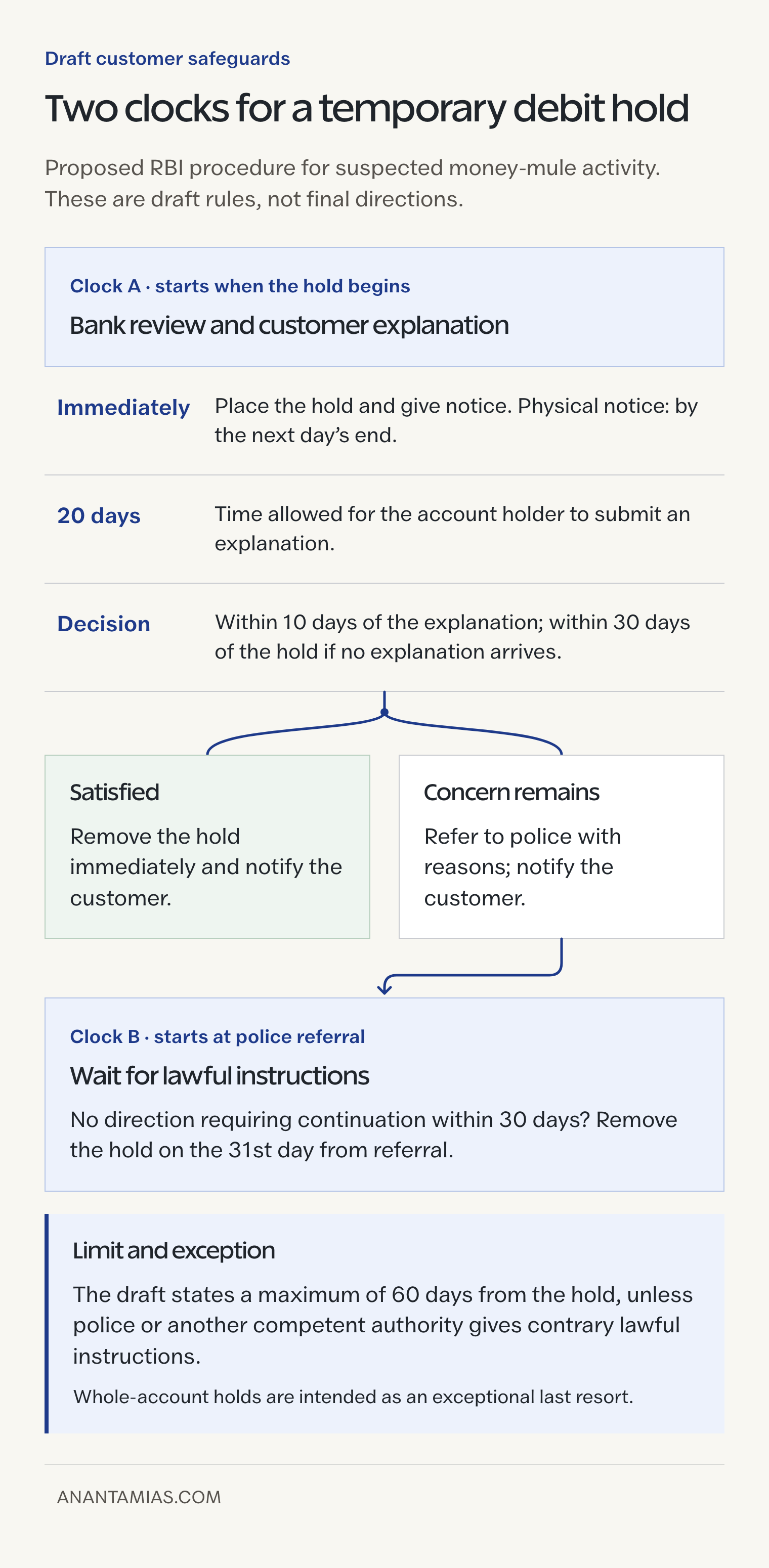
Two linked clocks begin at different events: the original hold starts customer review, while a police referral starts the period for receiving lawful instructions.
- When imposing a hold, the bank would communicate reasons, removal steps and officer contacts. Digital notice is immediate; other notice is due by the next day’s end, giving the customer a practical response route.
- The customer would receive 20 calendar days from the hold to explain the transaction or account. The bank must decide within ten days of receiving that explanation, allowing earlier resolution when a response arrives promptly.
- Without an explanation, the bank would still conduct due diligence and decide within 30 days of the hold. Silence does not authorise an indefinite restriction; satisfaction requires immediate removal and notice to the customer.
- If concerns persist, the bank would continue the hold and refer reasons to the jurisdictional police through NCRP-CFCFRMS. That referral starts a further 30-day window for a direction backed by appropriate statutory provisions.
- Without a lawful continuation direction, removal is due on the 31st day after referral. Separately, the draft states a maximum of 60 days from the initial hold absent contrary instructions; both formulations require careful implementation.
Safeguards against mistaken or indefinite restrictions
The proposal’s value depends on disciplined decisions and records, especially when automated alerts confuse unusual but legitimate activity with suspected movement of fraud proceeds.
- Banks would analyse flagged transactions using objective parameters aimed at reducing false positives. A transaction-monitoring alert starts scrutiny; treating the alert as conclusive would defeat the draft’s own requirement for explanations and due diligence.
- A central management information system would record hold dates, reasons, customer correspondence, referrals, directions and release or continuation. These linked records make it possible to check whether each deadline and decision actually occurred.
- Designated nodal officers would handle coordination and complaints, with contact details displayed on bank websites and at branches. Accessible contact information matters because a customer cannot challenge a restriction effectively without knowing who handles it.
- Existing suspicious transaction reporting to FIU-IND would continue alongside this SOP. Reporting a suspicion and deciding whether a bank-initiated hold should continue are related tasks, but neither substitutes for completing the other required process.
- The distinction is temporary containment versus final adjudication. A hold may protect an investigation, while release under the timetable prevents unsupported continuation; neither outcome alone proves guilt, innocence or recovery of every victim’s money.
Way Forward
Make time limits operational
- Configure separate hold-date and referral-date alerts so staff can distinguish the customer-review deadline from the period for lawful police instructions.
- Require a recorded justification for whole-account restrictions, including why an amount-level hold cannot adequately address the suspected activity.
- Test customer notices for usable instructions: reasons, submission channels, responsible officers and the next review step should be clear.
- Resolve the interaction between the 31st-day release wording and 60-day ceiling in final directions and implementation guidance, preventing inconsistent deadline calculations.
Conclusion
- The RBI money-mule draft offers a framework for rapid fraud containment with review, notice and limits. Its significance lies in making the bank explain and revisit a restriction rather than allowing suspicion to sustain it indefinitely.
- In an answer, evaluate proportionality and accountability together: restrict only what the risk requires, preserve a customer response route and track police directions. Keep the proposal’s consultation status separate from any claim about final enforceable rules.
UPSC Practice Questions
Prelims MCQ 1
With reference to the RBI’s draft money-mule SOP, consider the following statements:
- A money mule account may be used without its holder knowingly participating in fraud.
- Whole-account holds are proposed as the routine first response to every suspicious transaction.
- Existing suspicious transaction reporting obligations to FIU-IND would continue.
How many of the above statements are correct?
(a) Only one (b) Only two (c) All three (d) None
Answer: (b) Only two
Explanation:
Statements 1 and 3 are correct. The draft defines knowing or unknowing use and preserves reporting obligations. Whole-account holds are an exceptional last resort.
Prelims MCQ 2
Under the draft SOP, which event begins the further 30-day window for receiving lawful instructions before release is required?
(a) Publication of the RBI consultation (b) The account holder opening the account (c) Referral to the jurisdictional police authority (d) Submission of the bank’s annual report
Answer: (c) Referral to the jurisdictional police authority
Explanation:
The draft measures this further window from the date of reference to the police. It separately states a 60-day maximum from the initial hold absent contrary instructions.
UPSC Mains Questions
- How can temporary debit holds disrupt cyber-enabled financial fraud without disproportionately harming genuine customers? Discuss using the RBI’s draft safeguards.
- Examine the importance of reasoned decisions, time limits and inter-agency records in regulating automated fraud-detection systems.
Sources: Reserve Bank of India and RBI draft SOP.
Frequently Asked Questions
Is the RBI money-mule SOP already a final rule?
No. The RBI released draft amendments for public consultation on September 11, 2026. Comments are invited until October 2, 2026; April 1, 2027 is the proposed implementation date.
Does a money mule account always involve a willing participant?
No. The draft definition includes accounts used knowingly or unknowingly to receive, layer or transfer cyber-fraud proceeds for another person. A suspected transaction still requires scrutiny and appropriate verification.
Can the bank restrict the entire account?
The draft allows account-level restrictions, but requires the internal policy to make them an exceptional last resort. It distinguishes those restrictions from holding only the suspected amount pending verification.
Does the draft guarantee release after 60 days in every case?
No. Its stated 60-day maximum applies in the absence of contrary instructions from law enforcement or a competent authority. Lawful directions requiring continuation must be considered under the relevant statutory provisions.
Does lifting a temporary hold guarantee that a fraud victim recovers money?
No. Removing a temporary restriction and recovering fraud proceeds are different outcomes. The proposed SOP governs bank holds and review procedures; it does not promise recovery of every victim’s money.