Opens in a new tab
Join Anantam IAS Channel on Telegram

Daily Digest · Saturday

3 October 2026 Current Affairs for UPSC

8 current affairs published on Saturday, 3 October 2026

3 October 2026 Current Affairs for UPSC — every Why-in-News article AnantamIAS published on Saturday, 3 October 2026, broken down with Why in News?, the exact GS paper it feeds, sub-topic mapping, MCQ-ready facts and a UPSC-style practice question. 8 articles in total, covering Polity, Economy, Environment, S&T, IR, Geography, History, Society and Internal Security — the same Why-in-News + GS-paper-mapping + practice-question format the Compass uses across every daily digest on the site.

Daily current affairs for UPSC is where new material enters your prep stream. Read this 3 October 2026 digest end-to-end in 25–35 minutes, attempt the practice question at the foot of each article (it's MCQ for some, 10/15-marker for others), then bookmark the entries that fall inside your active revision window. Everything stays cross-linked: tap any subject pill to jump to that subject's hub, or use the table of contents above to skip straight to a specific story.

Use this page three ways. Read sequentially for a one-sitting scan of everything that mattered on 3 October 2026. Download the 3 October 2026 PDF below for offline study or print revision. Or use the October 2026 Current Affairs compilation to see this day in the month's full context. For the previous day's reading, see 2 October 2026 Current Affairs; the next day's is 4 October 2026 Current Affairs.

Why we publish daily current affairs separately from the monthly compilation: daily is learning, monthly is revision. Use the daily page to add fresh material to your notes the day it breaks; come back to the October 2026 compilation 60 days before Prelims when the noise has settled and only the lasting takeaway is worth re-reading.

Buxa Tiger Reintroduction: Habitat Readiness and Post-Release Monitoring

Open article →Download PDF

Why in News?

On 2 October 2026, a tigress from Valmiki Tiger Reserve in Bihar was released in West Bengal’s Buxa Tiger Reserve, beginning a phased tiger reintroduction programme, according to PIB.

  • First phase: The release begins an adaptive recovery programme; it does not establish that a viable breeding population has already returned.
  • Preparation: Habitat improvement, prey augmentation and protection preceded the translocation, with support from the National Tiger Conservation Authority and Wildlife Institute of India.
  • Follow-up: Telemetry, camera traps and field monitoring will assess the animal’s movement, adaptation, health and behaviour.
  • Ecological readiness determines whether moving a large predator can translate into lasting recovery rather than a short-lived release milestone.
  • Community participation matters because sustained recovery also requires conflict mitigation, local dialogue and conservation-linked benefits.

UPSC Relevance

Prelims Relevance

  • Buxa: Tiger reserve in West Bengal’s North Bengal landscape.
  • Valmiki: The source tiger reserve, located in Bihar.
  • Translocation: Deliberate movement of an animal between locations for a conservation purpose.
  • Telemetry: Remote tracking used alongside camera traps and field observations.
  • Recovery objective: A free-ranging, viable and self-sustaining tiger population.

Mains Relevance

GS Paper 3

  • Evaluate habitat and prey readiness before species reintroduction.
  • Use monitoring outcomes and community participation to assess conservation success.

Essay

  • Restoring an ecosystem requires more than returning its most visible species.

Background and Context

What the Buxa release actually changes

The programme adds a carefully selected animal to a recovering habitat; its larger population objective remains to be demonstrated over time.

  • Buxa’s problem was a prolonged absence of a stable resident tiger population. Habitat degradation, fragmentation, land-use changes and reduced prey availability weakened the ecological conditions needed for tigers to remain and reproduce.
  • Natural recovery and deliberate augmentation are complementary here. Earlier camera-trap records showed tiger movement through the landscape, but the presence of an individual cannot by itself establish a resident, breeding population with long-term viability.
  • Translocation moves an animal; population recovery requires establishment, breeding and persistence. This distinction prevents a release ceremony or an isolated sighting from being treated as evidence that the conservation problem has been solved.
  • Source and destination matter for different reasons: Valmiki supplied the tigress, while Buxa must support her survival and adaptation. The release followed assessment of ecological, veterinary and management parameters under established protocols.
  • Landscape movement provides useful context, but today’s decision concerns readiness at the release site. The earlier Manas conservation note explains the wider connectivity issue; it cannot substitute for evaluating Buxa’s conditions.

Why habitat and prey must come first

A predator release needs a functioning food base and secure habitat, rather than an assumption that protection on paper guarantees ecological suitability.

  • Habitat improvement addresses the conditions supporting prey and predator survival. Buxa’s preparatory work included grassland restoration and prey augmentation, showing why recovery planning must consider the wider ecosystem before increasing the predator population.
  • Prey availability is a readiness criterion, not merely a count of animals introduced. The official release reports a positive trend in monitored prey abundance; that finding supports preparation without proving future tiger population viability.
  • Protection preparedness must accompany habitat work. Additional tigers require secure conditions and management capacity, so the official programme links future augmentation to habitat, prey, protection and population assessments rather than a fixed release tally.
  • Institutional support brings scientific assessment into the state’s recovery programme. The National Tiger Conservation Authority and Wildlife Institute of India support work spanning habitat, prey, monitoring and capacity building, rather than only transporting animals.
  • Outcome assessment must separate management activity from ecological results. The tiger reserve evaluation note covers that broader distinction; for Buxa, the immediate test is whether preparatory work supports the released animal’s adaptation.

How monitoring should guide the next decision

Post-release evidence should determine whether to continue, modify or delay further augmentation; phased management makes room for learning instead of assuming success.

  • Telemetry helps managers follow the released animal’s movement. Its value lies in informing responses to changing conditions, rather than producing a map that is treated as sufficient evidence of successful ecological recovery.
  • Camera traps and field monitoring complement telemetry in the announced programme. Using these together supports assessment of movement, adaptation, health and behaviour; no single observation should carry the full burden of judging success.
  • Adaptive management connects observation to action. Further augmentation is conditional on monitoring outcomes, habitat and prey availability, protection preparedness, population viability and expert advice, rather than automatic expansion after the first tigress is released.
  • Community engagement includes dialogue, livelihood opportunities and conflict mitigation through local committees. These are practical conditions for coexistence as tiger recovery progresses, not evidence that every conflict risk has already been resolved.
  • Success means a healthy, free-ranging and self-sustaining population over time. The official announcement sets this objective but does not report that breeding, recruitment and durable population recovery have already occurred.

Way Forward

Make each release conditional on evidence

  • Review monitoring together: Use telemetry, camera-trap and field findings before deciding the next phase of augmentation.
  • Check ecological readiness: Reassess prey availability, habitat condition and protection preparedness as recovery progresses.
  • Support coexistence: Link community dialogue to practical conflict response and locally meaningful conservation benefits.

Conclusion

  • Buxa’s first release is the start of a recovery intervention, not proof of a recovered population. Keep translocation, individual adaptation and long-term population viability separate when interpreting the announcement.
  • For a Mains answer, explain the sequence from habitat and prey preparation to release, monitoring and evidence-based adjustment. Judge conservation by sustained ecological outcomes and coexistence, rather than the number of animals moved.

UPSC Practice Questions

Prelims MCQ 1

With reference to the Buxa tiger reintroduction programme, consider the following statements:

  1. Buxa Tiger Reserve is located in West Bengal.
  2. The released tigress was translocated from Valmiki Tiger Reserve in Bihar.
  3. The first release establishes that Buxa already has a self-sustaining breeding tiger population.

How many of the above statements are correct?

(a) Only one (b) Only two (c) All three (d) None

Answer: (b) Only two

Explanation:

The locations and translocation route are stated in the official release. A self-sustaining population is the programme’s objective, not an outcome established by the first release.

Prelims MCQ 2

Which approach best represents adaptive management in a tiger reintroduction programme?

(a) Fixing further releases regardless of monitoring results (b) Treating a single sighting as proof of population recovery (c) Using post-release evidence and habitat assessments to guide further augmentation (d) Replacing field monitoring entirely with the release count

Answer: (c) Using post-release evidence and habitat assessments to guide further augmentation

Explanation:

Adaptive management uses observed outcomes to adjust subsequent decisions. Buxa’s further augmentation is conditional on ecological readiness, monitoring, population viability and expert advice.

UPSC Mains Questions

  1. Why is successful animal translocation not equivalent to species recovery? Explain with reference to Buxa’s tiger reintroduction programme.
  2. Discuss how post-release monitoring and community participation can improve the design of phased wildlife reintroduction programmes.

Source: PIB, Ministry of Environment, Forest and Climate Change.

Frequently Asked Questions

What happened at Buxa Tiger Reserve?

A tigress from Valmiki Tiger Reserve in Bihar was released at Buxa in West Bengal on 2 October 2026. This began a phased programme intended to restore a viable, self-sustaining tiger population.

Does the release mean Buxa’s tiger population has recovered?

No. The first release marks the start of a phased intervention. Establishment, breeding and sustained population viability remain outcomes to be demonstrated through monitoring, secure habitat and adequate prey over time.

Why was prey preparation necessary?

Prey availability is part of the ecological foundation needed to sustain tigers. Buxa’s preparatory programme combined prey augmentation with habitat improvement, protection and scientific assessment before beginning the present reintroduction phase.

How will the released tigress be monitored?

The announced approach combines telemetry, camera traps and field-based monitoring to assess movement, adaptation, health and behaviour. These findings will help guide decisions about further augmentation alongside ecological assessments and expert advice.

RBI Bank Shareholding Rules: One-Time Approval for Repeat Acquisitions

Open article →Download PDF

Why in News?

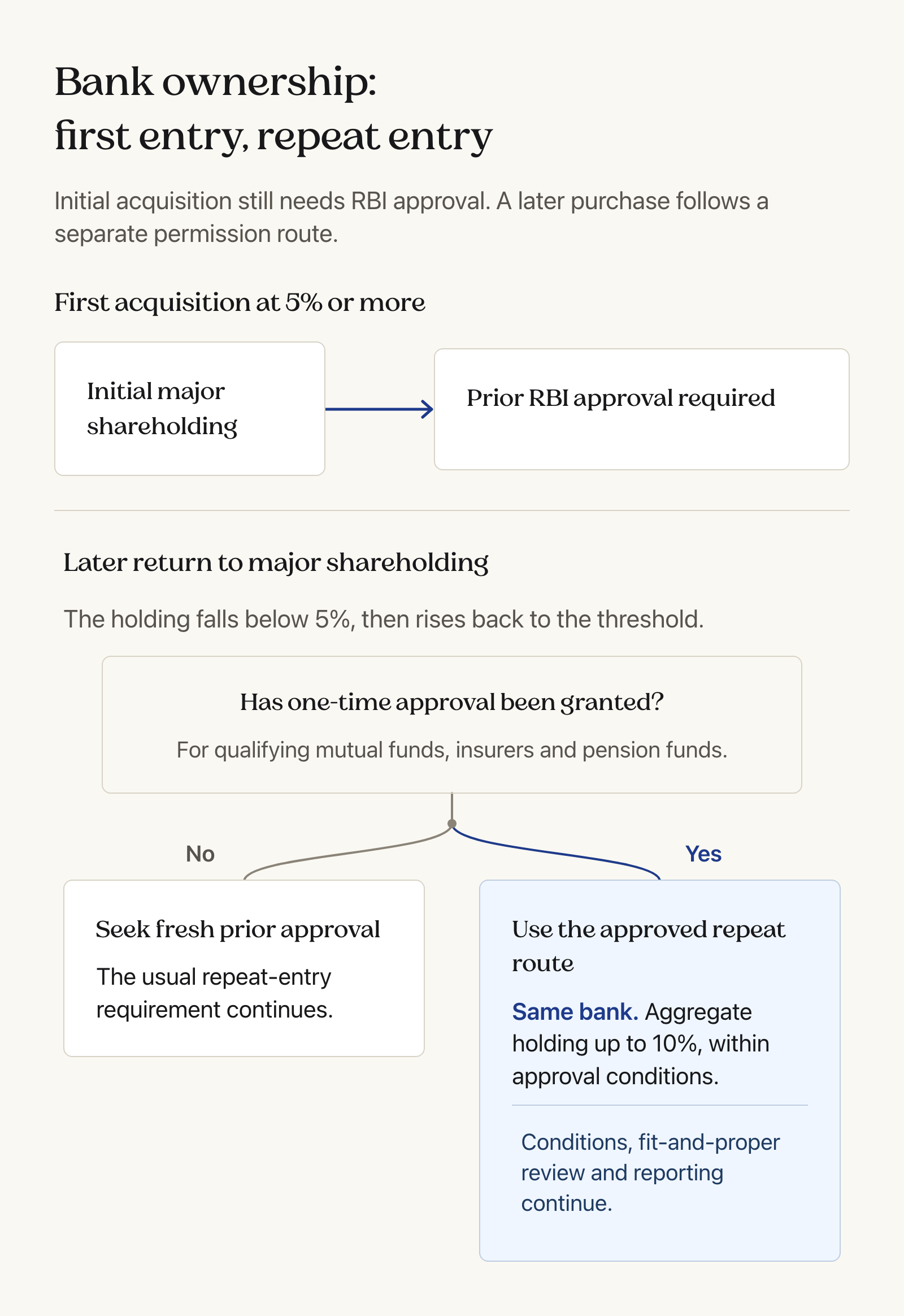
On 1 October 2026, the RBI issued immediately effective final directions allowing eligible institutional investors to seek one-time approval for subsequent acquisitions of major shareholding in the same banking company.

  • Initial acquisition still requires prior RBI approval; the change concerns later acquisitions by eligible investors.
  • The repeat-acquisition route covers aggregate holdings up to 10%, subject to approval conditions.
  • Crossings of the major-shareholding threshold must be reported within three working days.
  • Bank shares confer an economic interest and potentially voting influence; ownership oversight addresses who can exercise that influence.
  • Administrative simplification can reduce repeated applications while retaining scrutiny of the investor and the bank relationship.

UPSC Relevance

Prelims Relevance

  • Prior approval for initial major shareholding
  • Qualifying mutual funds, insurance companies and pension funds
  • Aggregate shareholding and voting rights
  • Fit-and-proper assessment and reporting obligations

Mains Relevance

GS Paper 3

  • Balance institutional investment flexibility with banking governance safeguards.
  • Distinguish reduced approval friction from relaxed prudential supervision.

GS Paper 2

  • Delegated regulation, reasoned discretion and continuing accountability.

Essay

  • Simpler procedures can coexist with stronger accountability.

Background and Context

What changes when an investor returns above the threshold?

The reform addresses repeat threshold crossings after an investor has already obtained approval for an initial major holding.

  • Major shareholding is the regulatory trigger being monitored, rather than every purchase of bank shares. Under the previous arrangement, falling below five percent meant fresh prior approval before a subsequent major acquisition.
  • Initial entry remains subject to prior approval. An eligible investor cannot treat its institutional registration, investment expertise or expectation of future approval as permission to cross the initial major-shareholding threshold without RBI scrutiny.
  • Subsequent acquisitions can use a one-time approval granted for the same banking company. This reduces repeated application requirements when a qualifying investor adjusts its portfolio after the initial acquisition, within the approved conditions.
  • Application is not approval: the RBI may grant the permission at its discretion, and the concerned banking company must provide comments. Neither submission of documents nor satisfaction of one eligibility criterion guarantees acceptance.
  • Immediate effect describes the final directions issued on 1 October, following consultation on a July draft. It does not retrospectively approve a particular transaction or mean every potentially eligible institution already holds permission.

Which investors qualify, and what remains controlled?

The permission attaches to a defined investor-bank relationship and a bounded holding, with continuing conditions after the approval is issued.

  • Qualifying institutions include mutual funds registered with SEBI, insurance companies registered with IRDAI and pension funds registered with PFRDA. Registration alone does not establish entitlement to one-time approval.
  • Aggregate holding matters for the permission covering acquisitions up to ten percent of paid-up share capital or voting rights. Splitting an economic position across transactions does not create a separate allowance for each purchase.
  • Approval conditions and the other applicable ownership directions continue to govern the investor. The simplified procedure is not a general entitlement to unlimited holdings, control of the bank or unrestricted exercise of voting rights.
  • Fit-and-proper scrutiny survives the procedural change. The RBI can revoke permission for non-compliance with its terms or if the qualifying person, or an associated person, is subsequently found not fit and proper.
  • Ownership supervision differs from product-level depositor protection. The Nidhi deposit-insurance distinction illustrates why an institution’s legal category matters; this RBI amendment addresses bank shareholders rather than creating a new guarantee for depositors.
Initial bank-shareholding acquisition requires prior RBI approval; eligible later acquisitions use a one-time approval route only if granted and within conditions.
Initial approval remains mandatory. Eligible repeat acquisitions can use a separately granted one-time approval, subject to aggregate limits and continuing oversight.

Why permission, reporting and voting influence are different

Simplifying approval does not remove the information that supervisors need to track changes in ownership and assess the people behind them.

  • Threshold reporting follows subsequent movements below or above the major-shareholding level. Investors with one-time approval must inform both the RBI and the concerned banking company within three working days of the relevant event.
  • Continuous monitoring extends to qualifying persons holding one-time approval even when they are not currently major shareholders. Oversight can follow the continuing permission, rather than disappearing merely because the current holding has fallen.
  • Portfolio advice need not automatically count as indirect acquisition by the manager. The client must own the shares and voting entitlement, receive only non-binding advice, and specifically mandate any voting exercised by the manager.
  • Approval ceilings answer how far this particular permission extends; voting rules answer how influence may be exercised. An investor must satisfy the applicable requirements together, rather than treating one approval as cancellation of other safeguards.
  • Regulatory purpose determines the relevant safeguard. Unlike draft money-mule controls on suspect transactions, this final amendment concerns ownership influence and repeated approvals; neither topic should be mistaken for a blanket relaxation of banking oversight.

Way Forward

Make simplified permission auditable

  • Investors should reconcile aggregate holdings before transactions and assign responsibility for timely threshold-crossing reports.
  • Banks should retain evidence supporting comments on applications and track the continuing conditions attached to an approval.
  • Supervisory reviews should distinguish fewer repeat applications from weaker scrutiny of ownership, association and control.

Conclusion

  • One-time approval changes the procedure for eligible repeat acquisitions, while initial permission, bounded aggregate holdings and continuing supervision remain central to the framework. It should not be described as unrestricted institutional ownership of banks.
  • For an answer, separate eligibility, permission and monitoring: who may apply, what the RBI has actually authorised, and which obligations continue afterwards. That distinction explains how procedural ease can coexist with safeguards against unsuitable influence.

UPSC Practice Questions

Prelims MCQ 1

With reference to the RBI’s October 2026 bank-shareholding amendment, consider the following statements:

  1. Prior approval continues to be required for an initial acquisition of major shareholding.
  2. One-time approval for eligible subsequent acquisitions is discretionary.
  3. Such approval removes all continuing fit-and-proper requirements.

How many of the above statements are correct?

(a) Only one (b) Only two (c) All three (d) None

Answer: (b) Only two

Explanation:

The first two statements are correct. Approval remains subject to conditions and may be revoked for non-compliance or adverse fit-and-proper findings.

Prelims MCQ 2

Which distinction best explains the purpose of the new one-time approval route?

(a) It replaces registration of mutual funds with bank registration. (b) It guarantees returns on institutional bank investments. (c) It simplifies eligible repeat acquisitions while retaining ownership oversight. (d) It permits every investor to acquire unlimited bank voting rights.

Answer: (c) It simplifies eligible repeat acquisitions while retaining ownership oversight.

Explanation:

The amendment addresses repeat acquisition approvals for qualifying institutions, subject to aggregate limits, conditions and reporting; it does not guarantee returns or permit unlimited control.

UPSC Mains Questions

  1. How can bank-ownership regulation reduce procedural burdens without weakening supervision of influence and control? Discuss with reference to the RBI’s repeat-acquisition approval framework.
  2. Distinguish eligibility to apply, regulatory approval and continuing compliance in financial-sector regulation. Why does the distinction matter for institutional accountability?

Sources: Reserve Bank of India and RBI press release.

Frequently Asked Questions

When did these RBI directions take effect?

The final amendment directions were issued on 1 October 2026 with immediate effect. The publication date of this study note does not change the legal commencement date or automatically approve individual acquisitions.

Does initial major shareholding still need RBI approval?

Yes. Prior RBI approval remains mandatory for the initial acquisition of major shareholding. The one-time route concerns subsequent acquisitions by qualifying institutional investors in the same banking company, subject to the approved conditions.

Which institutional investors are covered?

The definition includes appropriately registered mutual funds, insurance companies and pension funds, with an investee-bank group exclusion. Eligibility must be read with the applicable directions and approval conditions, rather than inferred from the investor’s name.

Can the RBI revoke a one-time approval?

Yes. The RBI may revoke permission for non-compliance with approval terms or where the qualifying person or an associated person is subsequently found not fit and proper. The simplified procedure retains continuing oversight.

RELIEF Extension: Export Credit Insurance During Maritime Disruption

Open article →Download PDF

Why in News?

On 2 October 2026, the Commerce Ministry announced an extension of RELIEF Component II timelines to support exporters facing West Asia maritime disruption.

  • The extension follows a 30 September notification; the announcement does not specify the extended closing date.
  • Component II offers 95% risk coverage for eligible upcoming shipments to specified regions.
  • Eligible Stand Alone or Whole Turnover Policies must have been obtained on or after 16 March 2026.
  • Covered cargo categories include FCL, LCL and reefer containers; energy shipments are excluded.
  • Maritime disruption can combine transport costs with payment uncertainty, making an otherwise viable export order harder to accept.
  • Insurance support addresses the exporter’s risk exposure; ports, shipping routes and buyer demand still determine whether trade can continue.

UPSC Relevance

Prelims Relevance

  • RELIEF: Resilience & Logistics Intervention for Export Facilitation.
  • Component II: ECGC insurance support under the Export Promotion Mission.
  • Export credit insurance: protection against covered export-payment risks.
  • FCL, LCL and reefer containers: distinct cargo arrangements.
  • Premium protection and risk coverage: different policy features.

Mains Relevance

GS Paper 3

  • How targeted credit insurance can sustain exports during geopolitical disruption.
  • Why risk protection cannot substitute for reliable transport and contractual discipline.

Essay

  • Resilience requires institutions that share risk without pretending to eliminate it.

Background and Context

What the extension changes

The extension continues a targeted insurance intervention; exporters still need to establish that their shipment and policy fall within its scope.

  • RELIEF means Resilience & Logistics Intervention for Export Facilitation, a time-bound intervention under the Export Promotion Mission. Component II encourages exporters to obtain ECGC cover for upcoming shipments to specified regions.
  • The 95% coverage announced for Component II is partial risk protection, not a promise to repay every rupee associated with an export. Actual entitlement still depends on the eligible loss and applicable policy conditions.
  • Premium protection is a separate feature: the premium exporters pay cannot rise beyond the pre-disruption level during the eligible period. It limits the insurance price; it does not turn the policy into free cover.
  • The policy eligibility date applies to Stand Alone Policies or Whole Turnover Policies obtained on or after 16 March 2026. An exporter should not assume that every older insurance contract automatically qualifies for this intervention.
  • The official announcement confirms a timeline extension but supplies no revised end date. Exporters must consult the applicable notification and ECGC terms before treating any particular future shipment as eligible.

How export credit insurance shares risk

An exporter may deliver goods before receiving payment, leaving a receivable exposed to buyer failure or political disruption in the destination market.

  • Commercial risk concerns the buyer or transaction, such as buyer insolvency. Export credit insurance can protect against specified non-payment events, but it does not guarantee that every disagreement with a buyer produces a payable claim.
  • Political risk concerns events outside the ordinary buyer relationship, including war or restrictions that obstruct payment transfers. The precise insured events matter: geopolitical tension alone is not proof that a covered loss has occurred.
  • Coverage and premium answer different questions: how much eligible risk the insurer bears, and what the exporter pays for protection. Holding premiums steady can preserve access even when uncertainty makes insurance harder to afford.
  • Claims remain conditional: exporters need the relevant policy, transaction records and evidence of the insured event. Insurance is a contractual mechanism for sharing covered loss, not automatic compensation whenever a vessel arrives late.
  • The Hormuz shipping-risk discussion explains the route context. Credit insurance can cushion eligible financial consequences; it cannot reopen a sea lane, prevent conflict or guarantee that a buyer remains solvent.

Cargo eligibility and the limits of support

The cargo categories define who may benefit; they should not be confused with the events that an insurance policy actually covers.

  • Full Container Load describes cargo booked as a full container, while Less than Container Load allows smaller consignments to share container space. Including both categories avoids limiting the intervention only to full-container exporters.
  • Reefer containers provide temperature-controlled transport for suitable goods. Their inclusion is relevant to perishable cargo, but it does not establish that every refrigeration failure, spoilage incident or physical cargo loss is insured under Component II.
  • Energy shipments are excluded from the stated benefits. The announcement also refers to specified regions, so neither eligibility nor coverage should be generalized to all Indian exports merely because maritime freight has become more expensive.
  • A freight subsidy reduces an eligible transport bill; export credit insurance shares covered risk. Component II’s insurance and premium provisions should not be described as an unconditional reimbursement of freight escalation across every shipment.
  • The RCMC exemption for small exports addresses compliance costs. RELIEF addresses disruption-related insurance needs; simpler documentation and better risk protection remove different obstacles and should be evaluated separately when assessing export policy.

Way Forward

Make eligibility usable

  • Publish a clear eligibility checklist covering regions, policy dates, cargo exclusions and the revised operational deadline.
  • Help exporters distinguish credit insurance, marine cargo cover and freight assistance before they price contracts or file claims.
  • Assess whether premium protection sustains access for smaller exporters while monitoring claims, exclusions and continuing exposure to disrupted routes.

Conclusion

  • RELIEF Component II combines partial risk coverage with premium protection for eligible shipments. Its economic purpose is to keep insurable export transactions viable while geopolitical disruption raises uncertainty for firms.
  • An exam answer should separate transport cost, payment risk and physical cargo damage. A targeted insurance extension addresses a defined part of that problem; its value depends on eligibility, policy conditions and accessible claims handling.

UPSC Practice Questions

Prelims MCQ 1

With reference to the announced extension of RELIEF Component II, consider the following statements:

  1. Energy shipments are included in the stated cargo benefits.
  2. Eligible reefer containers are among the covered cargo categories.
  3. Premiums paid by exporters cannot rise beyond the pre-disruption level during the eligible period.

How many of the above statements are correct?

(a) Only one (b) Only two (c) All three (d) None

Answer: (b) Only two

Explanation:

Energy shipments are excluded. The release includes reefer containers and specifies premium protection during the eligible period.

Prelims MCQ 2

Which statement best distinguishes export credit insurance from a freight subsidy?

(a) Both automatically reimburse all shipping expenses. (b) Insurance eliminates the need to meet policy conditions. (c) Credit insurance shares specified export risks, while a freight subsidy offsets eligible transport costs. (d) Freight subsidies protect only against buyer insolvency.

Answer: (c) Credit insurance shares specified export risks, while a freight subsidy offsets eligible transport costs.

Explanation:

Risk coverage concerns covered losses under a policy. Freight support concerns eligible transport expenditure; the two instruments address different problems.

UPSC Mains Questions

  1. Explain how export credit insurance can sustain trade during geopolitical disruption. What limitations should policymakers recognize?
  2. Distinguish transport-cost support from export-risk protection. Assess the importance of clear eligibility and claims rules for smaller exporters.

Source: PIB, Ministry of Commerce and Industry.

Frequently Asked Questions

What is RELIEF Component II?

It encourages exporters to obtain ECGC cover for eligible upcoming shipments to specified regions. The announced provisions combine partial risk coverage with protection against premium increases beyond the pre-disruption level.

Does RELIEF cover all export losses?

No. The announced coverage is partial, and eligibility and policy conditions still apply. Inclusion of a cargo category does not establish that every delay, physical loss or commercial dispute is insured.

Which cargo categories are mentioned?

The release lists Full Container Load, Less than Container Load and reefer containers, while excluding energy shipments. Exporters must also check the specified regions, policy eligibility and applicable operational period.

What is the new closing date?

The 2 October announcement confirms that operational timelines were extended but does not state the revised closing date. A specific deadline should be taken from the applicable notification and operational terms.

RoDTEP Extension: Refunding Embedded Taxes in Export Prices

Open article →Download PDF

Why in News?

On 2 October 2026, the Commerce Ministry announced that RoDTEP, which remits embedded taxes on exported products, will continue through 31 December 2026.

  • The extension follows a 30 September notification; the announcement and notification dates are different.
  • Coverage includes Domestic Tariff Area units, Advance Authorisation holders, Special Economic Zone units and Export Oriented Units.
  • Existing rates and value caps applicable on 30 September continue unchanged during the extension.
  • An exported product can carry unrefunded indirect taxes from earlier production stages, even when the final export receives separate tax treatment.
  • The policy addresses a domestic cost disadvantage; it does not remove foreign tariffs, weak demand or transport bottlenecks.

UPSC Relevance

Prelims Relevance

  • RoDTEP: Remission of Duties and Taxes on Exported Products.
  • Embedded, unrebated Central, State and local duties, taxes and levies.
  • Prior-stage cumulative indirect taxes.
  • Domestic Tariff Area, Advance Authorisation, SEZ and EOU categories.
  • Unchanged rates and value caps during the extension.

Mains Relevance

GS Paper 3

  • Tax neutrality and export competitiveness.
  • Distinguishing cost reimbursement from additional export incentives.
  • Predictability of trade policy and limits of tax-based export support.

Background and Context

Why taxes can remain inside an export price

A finished export carries a production history: its cost includes inputs and services bought before the final sale abroad.

  • Embedded taxes are tax costs carried within the exported product rather than a separate visible tax charged to its overseas buyer. They can arise before the exporter handles the finished goods.
  • The official description covers Central, State and local levies that remain unrebated. The relevant question is whether a burden survives existing relief, rather than simply whether some tax was paid during production.
  • Prior-stage cumulative indirect taxes concern burdens accumulated earlier in the supply chain. Looking only at the final invoice can miss costs already passed into the price of inputs or production services.
  • Consider an export-ready textile consignment: a qualifying, unrefunded tax cost may remain within its production cost. This is a conceptual example, not confirmation that every textile product or expense qualifies for remission.
  • Tax neutrality means reducing domestic tax burdens carried into overseas competition. Removing such a burden can improve pricing room, but does not guarantee that exporters cut prices or win additional foreign orders.

What the extension changes and what it preserves

The new decision extends continuity of support; it does not announce a higher rate of support for each eligible shipment.

  • The official announcement keeps RoDTEP available through 31 December 2026. This is a defined continuation period, not a promise of permanent eligibility or an assurance about policy beyond that date.
  • The listed categories are Domestic Tariff Area units, Advance Authorisation holders, Special Economic Zone units and Export Oriented Units. Inclusion of these categories should not be read as automatic approval of every shipment.
  • Rates and value caps remain unchanged, using the schedules applicable on 30 September. A continuation announcement cannot itself support a claim that the remission amount for a given eligible product has increased.
  • Predictability matters when exporters quote prices and accept orders before goods are dispatched. Knowing that a scheme continues can aid planning, although firms must still check the applicable product coverage and conditions.
  • The release identifies Appendices 4R and 4RE as the relevant schedules. It does not provide a universal rate or a complete claim procedure; practical eligibility must be checked against the applicable official provisions.

Remission, subsidies and other trade-policy tools

For an exam answer, identify the cost being addressed before calling every form of export support a subsidy.

  • Remission seeks to neutralise a qualifying tax burden already borne. An additional incentive rewards activity beyond that burden; this conceptual distinction matters, without establishing a legal verdict on any particular scheme under international rules.
  • The word unrebated sets a crucial boundary: a tax already refunded cannot be treated as a remaining burden for a second refund. RoDTEP should not be described as automatically reimbursing every tax paid.
  • The RCMC exemption for small exports concerns administrative compliance. RoDTEP instead addresses embedded taxation, so lower paperwork costs and tax remission should be analysed as different mechanisms even when both help exporters.
  • An import duty cut changes taxation at the import stage. Export tax remission addresses qualifying burdens in exported products; neither measure guarantees that the whole benefit reaches the final consumer or buyer.
  • Competitiveness has several causes: product quality, delivery reliability, logistics and market access also matter. A tax measure can correct one cost disadvantage while leaving these other constraints unresolved, limiting what its extension alone can achieve.

Way Forward

Make remission predictable and accurately targeted

  • Keep product coverage and applicable caps clear so exporters can assess eligible support before committing to orders.
  • Assess remaining tax incidence carefully and prevent duplicate reimbursement of burdens already refunded through another route.
  • Evaluate competitiveness alongside logistics and quality, rather than treating continuation of a tax scheme as evidence that every export constraint has been removed.

Conclusion

  • RoDTEP continuity preserves a mechanism for remitting embedded, unrebated taxes on exports. The October announcement extends its duration while keeping existing rates and caps, so continuity must not be confused with a larger benefit.
  • In an answer, connect tax neutrality with predictable export pricing, then identify the limits: eligible burdens must remain unrefunded, applicable conditions still matter, and tax remission cannot independently solve logistics, quality or foreign market-access problems.

UPSC Practice Questions

Prelims MCQ 1

With reference to the announced RoDTEP extension, consider the following statements:

  1. It covers embedded, unrebated taxes borne on exported products.
  2. Existing rates and value caps remain unchanged during the extension.
  3. The announcement makes every tax paid by every exporter automatically refundable.

How many of the above statements are correct?

(a) Only one (b) Only two (c) All three (d) None

Answer: (b) Only two

Explanation:

The release confirms the first two statements. It addresses embedded, unrebated burdens and does not create an automatic refund of every tax for every exporter.

Prelims MCQ 2

Which description best captures the purpose of export tax remission?

(a) Removing all tariffs charged by importing countries (b) Guaranteeing a minimum profit on every export (c) Neutralising eligible domestic tax burdens embedded in exported products (d) Replacing all export documentation

Answer: (c) Neutralising eligible domestic tax burdens embedded in exported products

Explanation:

Remission addresses qualifying domestic tax burdens that remain unrebated. It does not remove foreign tariffs or guarantee commercial returns.

UPSC Mains Questions

  1. Explain how embedded indirect taxes can affect export competitiveness. Discuss the role and limits of remission schemes in addressing this disadvantage.
  2. Distinguish tax remission from administrative trade facilitation. Why should continuity of an export scheme not be treated as evidence that its benefits have increased?

Source: PIB, Ministry of Commerce and Industry.

Frequently Asked Questions

What does RoDTEP stand for?

RoDTEP stands for Remission of Duties and Taxes on Exported Products. It addresses embedded, unrebated Central, State and local duties, taxes and levies borne on exports, including prior-stage cumulative indirect taxes.

What did the October announcement change?

The 2 October announcement confirmed continuation through 31 December 2026 under a 30 September notification. Existing rates and value caps remain unchanged, so the extension does not itself increase the applicable benefit.

Which exporter categories are covered by the announcement?

The release lists Domestic Tariff Area units, Advance Authorisation holders, Special Economic Zone units and Export Oriented Units. Category coverage should not be mistaken for automatic eligibility of every product or shipment.

Does RoDTEP refund taxes already rebated elsewhere?

Its stated purpose is remission of embedded, unrebated burdens. A tax already refunded does not remain unrebated, so the scheme should not be understood as permitting a second refund of the same burden.

Does tax remission guarantee stronger exports?

It can address a qualifying domestic tax disadvantage, but export performance also depends on quality, demand, logistics and market access. Continuation of remission alone cannot establish that all these constraints have improved.

WHO Health Estimates: Living Longer and Living in Good Health

Open article →Download PDF

Why in News?

WHO released new Global Health Estimates on 2 October 2026, covering population health trends between 2000 and 2023.

  • Global life expectancy reached 73.3 years in 2023, close to 73.4 years in 2019.
  • Healthy life expectancy reached 62.8 years in 2023, recovering more slowly than overall survival.
  • The release identifies noncommunicable diseases, mental health conditions and drug use disorders as growing challenges for health systems.
  • A health system can prevent early deaths while leaving substantial ill-health and disability untreated; survival alone cannot measure its performance.
  • For India, the policy question is how primary care, rehabilitation and long-term treatment can improve the quality of additional years lived.

UPSC Relevance

Prelims Relevance

  • Life expectancy at birth
  • Healthy life expectancy: HALE
  • Disability-adjusted life years: DALYs
  • Years of life lost: YLLs; years of healthy life lost due to disability: YLDs
  • Age-standardized rates and population estimates

Mains Relevance

GS Paper 2

  • Designing health services around survival, functioning and equitable access.
  • Using comparable health estimates without mistaking global averages for national outcomes.

Essay

  • Public health succeeds when longer lives also offer greater freedom to function.

Background and Context

What the recovery in life expectancy measures

The release describes a recovery in population survival, while drawing attention to the health of the years people gain.

  • Life expectancy at birth summarizes how long a hypothetical newborn would live if prevailing age-specific mortality patterns continued. It is a population indicator, not a guaranteed lifespan or an individual medical forecast.
  • The near-return to the pre-pandemic level is a comparison of global averages. It does not establish that every country, income group or community has recovered equally, or that all services have recovered.
  • The publication year must be separated from the observation period: these are estimates through 2023 released in 2026. They cannot establish the health situation prevailing in every country during the release month.
  • The epidemiological transition describes changing patterns of disease and death as chronic conditions become more prominent. It does not mean infectious diseases disappear or cease to require public-health resources and continued surveillance.
  • India needs to interpret this global signal alongside local needs, including community TB detection. Chronic-disease care and infection control compete for resources but must coexist within functioning primary-health services.

Life expectancy and healthy life expectancy answer different questions

Healthy life expectancy adjusts survival for ill-health, making the distinction between additional years and additional healthy years explicit.

  • HALE expresses expected years in equivalent full health. It adjusts time lived in different health states for their severity rather than simply counting everyone with any diagnosed condition as completely unhealthy.
  • The distinction matters because preventing death and restoring health are related but separate achievements. A treatment may prolong survival while a person still needs pain management, mobility support or continuing mental-health care.
  • The difference between life expectancy and HALE is an aggregate health-adjusted gap, not a prediction that every person spends those final years continuously ill. Health limitations may occur at different life stages.
  • A smaller health-adjusted gap cannot be interpreted without the survival level. Policy evaluation should examine both indicators: a population with shorter lives is not necessarily healthier because its measured gap is smaller.
  • For service planning, the distinction supports attention to functioning: whether patients can move, work, learn and participate. Mortality indicators remain essential, but cannot alone reveal these consequences of disease and injury.

DALYs measure health loss, not expected lifespan

Disease-burden measures help compare conditions that kill early with conditions that mainly cause prolonged ill-health.

  • DALYs combine years of life lost through premature mortality with equivalent healthy years lost through disability or ill-health. Adding both components captures losses that a death count alone would omit.
  • The mortality component counts premature loss against a reference life expectancy. The disability component accounts for non-fatal health loss; it does not imply that a person with disability has less human worth.
  • Unlike HALE, where higher values generally indicate better population health, a higher DALY burden represents more healthy life lost. Absolute totals should not be compared as though countries had identical population sizes.
  • Age-standardized rates help separate differences in age structure from differences in disease risk. Neither crude counts nor standardized rates answer every planning question: services also need actual numbers of people requiring care.
  • Comparable estimates depend on data quality and statistical methods. India should connect better mortality registration with governed health research, protecting patient privacy while improving the evidence available for local decisions.

Way Forward

Measure and fund healthy functioning

  • Strengthen primary-care follow-up so screening leads to diagnosis, affordable medicines and continuing treatment rather than a one-time detection exercise.
  • Track survival and functioning together, including access to rehabilitation, mental-health treatment and pain relief.
  • Publish comparable subnational indicators with uncertainty and data limitations, allowing districts to allocate staff and services against demonstrated need.

Conclusion

  • Longer life and healthier life are complementary goals. The WHO release shows why recovery in average survival cannot, by itself, establish equivalent recovery in the health and functioning of populations.
  • Use life expectancy, HALE and DALYs for their distinct purposes: duration of survival, equivalent healthy years and healthy life lost. Match the indicator to the policy question before drawing conclusions about health-system performance.

UPSC Practice Questions

Prelims MCQ 1

With reference to population health indicators, consider the following statements:

  1. HALE adjusts expected years lived for the severity of ill-health.
  2. DALYs include premature mortality and non-fatal health loss.
  3. Life expectancy at birth guarantees the lifespan of an individual newborn.

How many of the above statements are correct?

(a) Only one (b) Only two (c) All three (d) None

Answer: (b) Only two

Explanation:

The first two statements are correct. Life expectancy summarizes population mortality patterns and does not predict an individual lifespan.

Prelims MCQ 2

Which measure combines years of life lost through premature mortality and equivalent healthy years lost through disability?

(a) Crude birth rate (b) Healthy life expectancy (c) Disability-adjusted life years (d) Infant sex ratio

Answer: (c) Disability-adjusted life years

Explanation:

DALYs add YLLs and YLDs to summarize health loss; HALE expresses expected equivalent years of full health.

UPSC Mains Questions

  1. Why can recovery in life expectancy coexist with persistent ill-health? Discuss the implications for primary healthcare in India. (150 words)
  2. Explain how life expectancy, HALE and DALYs can inform health priorities. What precautions are necessary when comparing countries? (250 words)

Source: World Health Organization.

Frequently Asked Questions

What period do the new WHO health estimates cover?

The Global Health Estimates released on 2 October 2026 cover trends between 2000 and 2023. Their publication date must not be mistaken for the period in which the health outcomes occurred.

How does HALE differ from life expectancy?

Life expectancy measures expected survival under population mortality patterns. HALE adjusts expected years lived for ill-health and its severity, expressing those years as an equivalent duration in full health.

What does a DALY measure?

A disability-adjusted life year measures healthy life lost. DALYs combine premature mortality with equivalent healthy years lost through disability or ill-health, allowing analysis beyond the number of deaths alone.

Does the gap between life expectancy and HALE predict years of illness?

It is an aggregate, health-adjusted gap rather than a timetable for an individual. It does not imply that everyone remains healthy until a fixed age and then experiences continuous illness.

A Court divided by its own Architecture

Open article →Download PDF

Why in news?

Two-judge SC Bench splits on whether it can hear challenges to 2023 Election Commissioners Act and the matter has been sent to CJI.

UPSC Relevance

  • Prelims: Article 145(3), Article 141, Article 130, Article 136, Article 324, Master of the Roster, stare decisis.
  • Mains GS-II: Structure, organisation and functioning of the Judiciary; dispute redressal mechanisms and institutions; separation of powers; statutory and constitutional bodies (Election Commission).

Recent delays on constitutional matters in SC

On 23 September, a two-judge Bench gave a split verdict on petitions challenging the CEC and other ECs (Appointment, Conditions of Service and Term of Office) Act, 2023. Instead of sending the matter to a third judge, which is the usual practice, both judges placed the papers before the CJI and asked him to consider forming a Constitution Bench [under Article 145(3)]. Petitioners who came to court in early 2024 now have to wait again, delaying such important constitutional matters further. 

The Architecture of Supreme Court entails multiple roles.

RolePrimary ObjectiveKey Constitutional Provisions
Constitutional CourtInterpreting the Constitution, settling federal disputes, and determining the validity of lawsArticle 131: Original Jurisdiction (State vs. Union, State vs. State) Article 132: Appellate Jurisdiction in constitutional interpretation matters Article 143: Advisory Jurisdiction (Presidential reference) Article 145(3): Requirement of minimum 5 judges for substantial questions of law
Rights CourtProtecting and enforcing fundamental rights guaranteed under Part IIIArticle 32: Right to Constitutional Remedies (Original Jurisdiction) Article 142: Power to pass any decree necessary for “complete justice”
Appellate CourtActing as the final court of appeal for general civil, criminal, and statutory disputesArticle 133: Civil Appeals (requires High Court certificate) Article 134: Criminal Appeals Article 136: Special Leave Petition (SLP) — discretionary jurisdiction Statutory Provisions: The Direct appeals under specialized tribunal acts (NCLAT, TRAI, NGT) are also made to the Supreme Court. 

Problem – a constitutional court that became a court of appeal

  • India’s Supreme Court tries to be all : appeals court, rights court and constitutional court.
  • More judges, more small Benches: Higher strength (now 38) helped clear routine matters but did not create more Constitution Benches. The Court became many Benches, each speaking in its own voice .
  • Article 136 became routine: The Court itself said in Pritam Singh v. State (1950) that special leave under Article 136 is to be used sparingly, in exceptional cases. In practice it works as a general second or third appeal.
  • No time limit on constituting benches: References wait years because five judges have to be pulled out of regular work. There is no fixed time limit for listing them.
  • Centralisation with Master of the Roster: The CJI decides which judges sit on which Bench and what they hear (State of Rajasthan v. Prakash Chand, 1998; Shanti Bhushan v. Supreme Court, 2018). It sounds administrative, but it can shape outcomes. This is what the four senior judges flagged in their press conference in January 2018.
  • Global Comparison: The US Supreme Court picks only a small number of cases each year (roughly 60 to 70) and sits as a full court. Germany has a separate Federal Constitutional Court. 

Impact on Justice delivery

  • Weakened Judicial Review: : A court occupied with routine statutory appeals loses its agility as a constitutional watchdog. By the time the 2023 Act is decided, Commissioners appointed under it may have run many State elections one general election. Similarly, the electoral bond scheme (2018) was struck down only in February 2024, after it had operated through elections. The judges themselves called such delay an ‘institutional embarrassment’.
  • Delayed Rights Realization: When judges spend the majority of their bandwidth on routine statutory appeals (such as property or tax disputes), constitutional matters—like fundamental rights petitions. Ordinary citizens seeking protection of basic rights are often priced out or delayed by wealthy corporations and well-funded litigants occupying the court’s calendar.
  • Conflicting Jurisprudence: Different benches often issue contradictory rulings on similar legal questions. Instead of creating unified, binding precedents for the nation, the court runs the risk of creating fragmented jurisprudence driven by bench composition.
  • Geographical and Financial Barriers: Litigants with deep pockets use the apex court as a “second appeal” mechanism to prolong litigation while those lacking it remain disadvantaged. 
  • Case Backlogs: Operating as a routine appellate body leads to increase in pendency in SC.

Way ahead

  • The Supreme Court itself suggested establishing a National Court of Appeal to handle ordinary appellate cases.
  • Form a permanent Constitution Bench through a published, rule-based process, and set time limits for listing Constitution Bench references and regional benches under Article 130. (Law Commission)
  • Tighten filters of special leave petitions: clear criteria, quick dismissal of weak ones, and costs on frivolous litigation.
  • Frame clear tests for what is a ‘substantial question of law’ under Article 145(3), so that judges do not keep disagreeing on the threshold.
  • Fill vacancies in High Courts and the Supreme Court, and use retired judges (Article 128) for pendency where needed.

A Court that exists mainly to hear appeals cannot guard the Constitution quickly. The structure must change so that the biggest questions get decided on time, not after the facts have settled.

Practice MCQ

Q1. With reference to the Supreme Court of India, consider the following statements:

1. Article 145(3) requires a minimum of five judges for a case involving a substantial question of law on the interpretation of the Constitution.

2. A minimum of five judges is also required to hear a Presidential reference under Article 143.

3. A two-judge Bench can overrule a decision of a five-judge Bench.

Which of the statements given above are correct?

(a) 1 only    

(b) 1 and 2 only    

(c) 2 and 3 only    

(d) 1, 2 and 3

Answer: (b). Statement 3 is wrong; a smaller Bench is bound by a larger Bench and can only refer the matter to a larger Bench.

Q2. Consider the following statements:

1. A Special Leave Petition under Article 136 can be filed as a matter of right against any High Court judgment.

2. Article 130 allows the Supreme Court to sit at places other than Delhi, as decided by the CJI with the approval of the President.

3. Under Article 141, law declared by the Supreme Court is binding on all courts in India.

Which of the statements given above are correct?

(a) 1 and 2 only    

(b) 1 and 3 only    

(c) 2 and 3 only   

(d) 1, 2 and 3

Answer: (c). Statement 1 is wrong; special leave is a discretionary power of the Court, not a right.

Mains Practice Question

The Supreme Court of India today functions more as a court of appeal than as a constitutional court. Examine the reasons for this and its consequences for constitutional adjudication. Suggest structural reforms. (250 words, 15 marks)

India’s Model BIT: A Decade Later, Amid Changes

Open article →Download PDF

Why in news?

Revised Model Bilateral Investment Treaty awaits Cabinet approval; experts urge lessons from a decade of India’s treaty experience.

UPSC Relevance

Mains GS-III: Indian economy and issues of mobilisation of resources; investment models; FDI and its role in growth, infrastructure and employment.

What is a Bilateral Investment Treaty?

A BIT is an agreement between two countries to protect and encourage investments made by investors of one country in the other. It is a promise from the host state: you will not be treated unfairly, your property will not be taken without compensation, and if there is a dispute you can go to a neutral forum.

  • Usual protections: national treatment, fair and equitable treatment (FET), protection against expropriation, free transfer of funds and access to arbitration.

Features of the 2015 Model BIT 

  • Narrow definition of investment: It gave an enterprise-based definition. Portfolio investment and pure financial instruments were left out.
  • Carve-outs: Taxation, government procurement, subsidies, compulsory licences under IPR rules and some national security matters were kept outside the treaty.
  • No MFN clause: an investor could not claim better terms given to investors of a third country under the Most Favoured Nation clause.
  • Exhaust local remedies: the investor had to go through Indian courts and administrative bodies for at least five years before starting treaty arbitration.
  • Limited tribunal powers: a tribunal could not review the merits of a decision by Indian courts, and its remedy was mainly monetary compensation.
  • Right to regulate: the state’s power to act for public health, environment and welfare was clearly protected.
  • Investor duties: anti-corruption, truthful disclosure and legal compliance were written as obligations of the investors. 

Why a revision ?

Budget 2025–26: announced that the Model BIT would be revamped and made more investor-friendly.

  • Present model BIT is hostile to investors: Critics said the model went too far in protecting the state. Investors and capital-exporting partners found it hard to accept. Several negotiations, including with the UK and EU, stalled partly for this reason.
  • Investment need: India wants large capital for Viksit Bharat 2047. Gross FDI inflows are high, but net FDI has dropped sharply in recent years because of repatriation and Indian firms investing abroad.
  • Trade deals: India is now signing wide trade and investment agreements (EFTA TEPA, UAE CEPA, UK CETA). Investors want a clear investment protection framework to go with them.
  • Recent Investment treaties show a more flexible approach that needs to be standardised.
    • India–UAE BIT (2024): local remedies period cut to three years (from five).
    • India–Uzbekistan BIT (2024): allows a state to bring a counterclaim against an investor or investment.
    • India–Israel BIA (in force July 2026): also provides a three-year local remedies period.
    • The new model should reflect this flexibility.
  • India as a capital exporter too: Indian companies invest abroad in a big way. A balanced treaty protects them as well.
  • Experience of a decade: India has actually used new-generation BITs since 2015 and can see what works.

The core debate: protection or policy space?

Argument for stronger investor protection

  • Predictable rules attract long-term capital and technology.
  • It signals that India is a reliable destination after the retrospective tax episode.
  • Protection helps Indian investors abroad, and supports trade deals.

Argument for retaining policy space

  • Broad clauses (FET- fair and equitable treatment, MFN, indirect expropriation) were used by tribunals to challenge regulation in public interest, as the Indian cases showed.
  • Arbitration is costly and the tribunals are seen as lacking accountability. Many countries, such as South Africa, Indonesia and some EU states, have exited or rewritten treaties.
  • Developing states need room for health, environment and welfare policy.

Way ahead

  • Clear text: define FET, expropriation and MFN scope tightly.
  • Better local remedies: fix delays at home. Faster commercial courts and quicker contract enforcement reduce the need for arbitration (and improve Ease of Doing Business).
  • Dispute prevention: set up a grievance and mediation mechanism so that problems are solved before they become claims.
  • Two-way obligations: investor duties and counterclaim rights, as in the Uzbekistan BIT.
  • Follow global reform: keep the text open to a future appellate mechanism under UNCITRAL.
  • Consultation: involve states, industry and legal experts before Cabinet finalises the text.

Investors need certainty, and the state needs room to govern. A good treaty has to give both.

Centre Frames Rules to Standardise Recruitment to Tribunal Posts

Open article →Download PDF

Why in news?

Law Ministry notified Members of Tribunals Rules, 2026, letting the new National Tribunals Commission appoint heads and members of 16 tribunals.

UPSC Relevance

Prelims: Articles 323A and 323B, tribunals, National Tribunals Commission, Tribunals Reforms Act 2021, L. Chandra Kumar case.

Mains GS-II: Structure, organisation and functioning of the Judiciary; separation of powers; dispute redressal mechanisms and institutions; statutory and quasi-judicial bodies.

What is a tribunal?

A tribunal is a quasi-judicial body set up by law to decide a specific kind of dispute, for example service matters of government employees, tax appeals, company law or environment cases. It works like a court but is meant to be faster, cheaper and run by people with subject knowledge.

  • Why they were created: courts were overloaded, ordinary procedure was slow, and many disputes (tax, labour, company affairs) need technical expertise.
  • Examples: Central Administrative Tribunal (CAT), National Green Tribunal (NGT), Income Tax Appellate Tribunal (ITAT), NCLT and NCLAT, Armed Forces Tribunal, TDSAT, Securities Appellate Tribunal (SAT), Debts Recovery Tribunals.
  • Difference from courts: a tribunal gets its power from a statute, handles a narrow subject, and is not bound by strict rules of the Civil Procedure Code or the Evidence Act, though it must follow natural justice.

Constitutional basis

  • 42nd Amendment, 1976: added Part XIV-A (Articles 323A and 323B) on the recommendation of the Swaran Singh Committee.
  • Article 323A: Parliament can set up administrative tribunals for recruitment and service conditions of public servants (Union, state, local bodies and PSUs). Only Parliament can do this.
  • Article 323B: Parliament or a state legislature, each within its own jurisdiction, can set up tribunals on subjects such as taxation, industrial and labour disputes, land reforms and ceilings, elections to Parliament and state legislatures, foreign exchange, food and rent.

Origin of National Tribunal Commission: the court-versus-government timeline

  • L. Chandra Kumar v. Union of India (1997): tribunal decisions can be challenged before the High Court under Articles 226 and 227. Judicial review is part of the basic structure. The Court also said tribunals should be under a single nodal agency, not the ministry that is a party before them.
  • Finance Act, 2017 (the back route): merged several tribunals and gave the Centre power to make rules on qualifications, appointments, tenure and pay.
  • Rojer Mathew v. South Indian Bank (2019): the Court found the 2017 scheme intrusive and recommended an independent National Tribunals Commission.
  • Madras Bar Association cases (2020–21): the Court struck down provisions of the 2020 rules and parts of the 2021 Ordinance, including a four-year tenure and a minimum age of 50, as violating independence.
  • Tribunals Reforms Act, 2021: abolished several appellate bodies such as the Intellectual Property Appellate Board and moved their work to High Courts. 
  • The 2021 Act was challenged in the Madras Bar Association cases.
  • In November 2025 the Court reiterated the need for an NTC and directed the Centre to set one up within four months. The government missed that deadline, and the 2026 Act followed.
  • 2026: NTC created and rules notified.

National Tribunals Commission

  • The National Tribunals Commission (NTC) is a statutory body under the Tribunals Reforms Act, 2026 
  • Composition
    • The chairperson must be a former Supreme Court judge or a former High Court Chief Justice. 
    • The Commission has two judicial members and two technical members. 
    • The Central government appoints the chairperson and members. Critics may say this leaves some executive influence. 
    • It has a secretariat headed by a Commission Secretary.
    • headquartered in Delhi
    • Salary : ₹2.5 lakh a month for for the NTC chairperson, ₹2.25 lakh for members
  • Functions
    • Conducts selection of tribunal chairpersons and members.
    • Reviews tribunal functioning.  
    • Oversees inquiries into complaints. 
    • Maintain a National Tribunals Data Grid. 
    • Covers 16 specific tribunals, including the Central Administrative Tribunal and the National Green Tribunal. 
    • It is meant to cut tribunals’ dependence on parent ministries for administrative and financial needs.
  • Selection process
    • The Commission constitutes search-cum-selection committees. These include its judicial and technical members, a retired High Court judge or Chief Justice, a Union government secretary and two subject experts. 
  • Tenure and accountability
    • Members of tribunals hold office for five years, with possible reappointment.
    • The CAG audits the NTC’s accounts. 

New Rules : NTC and Qualification, Selection and Conditions of Service of Chairperson and Members of Tribunals Rules, 2026

  • Issued by Ministry of Law and Justice.
  • Who they cover: 16 tribunals and appellate bodies.
  • Qualification and selection: uniform eligibility for appointment to various posts in these tribunals. Search-cum-selection committees will assess candidates through expert evaluation, a personal interaction and, where needed, a writing exercise.
  • Timely recruitment : the process to fill a post must begin at least six months before it falls vacant.
  • Pay: ₹2.5 lakh a month for tribunal chairpersons, ₹2.25 lakh for members. Some exceptions are allowed.
  • Misconduct: a formal inquiry mechanism for complaints against chairpersons and members.

Why independence matters

  • The government is the biggest litigant: in tax, service, customs and company matters the Union is often one party. If the same ministry picks, pays and renews members, people doubt the fairness of the outcome.
  • Separation of powers (Article 50) : tribunals perform a judicial function, so the executive should not control them.
  • Tenure and reappointment: short terms and hope of reappointment can make a member careful about annoying the government.
  • Access to justice: a weak tribunal pushes litigants back to the High Courts or Supreme Court, which defeats the purpose.

Challenges in the tribunal system

  • Executive dominance : political and bureaucratic interference in appointments and functioning. 
  • Dependence on retired judges: creates a second-career problem and a limited pool of talent.
  • Technical members: their role versus judicial members remains debated, especially in tribunals that decide pure questions of law.
  • Appeals to the Supreme Court: direct appeals from many tribunals under statute or Article 136 add to the Supreme Court’s load.
  • Vacancies: many tribunals work with empty benches, and some have stopped functioning for months. Slow appointments cause pendency.
  • Infrastructure and staff: poor benches, no budget control and dependence on the parent ministry for funds and offices.
  • Overlapping tribunals: confusion about jurisdiction, and the trend of merging tribunals has been criticised.

Way ahead

  • Independent functioning of the new NTC with no political interference from executives in appointments. 
  • Fill vacancies on time: start recruitment six months ahead, as the rules now require, and monitor with data.
  • Cadre and training: consider a tribunal service or a pool of trained members beyond retired judges.
  • Review of the structure: decide which disputes truly need a tribunal and which can go to High Courts or specialised benches.
  • Digitisation: e-filing and virtual hearings to cut costs and delays.

Tribunals work only if people trust them. The test of the new rules is not whether they are tidy on paper but whether they can survive judicial review and make the tribunal a place where a citizen can face the State on equal terms.

Practice MCQ

Q1. With reference to the constitutional provisions on tribunals in India, consider the following statements:

1. Part XIV-A of the Constitution was added by the 44th Amendment Act, 1978.

2. Article 323A allows Parliament to establish administrative tribunals for matters related to public service.

3. Article 323B allows both Parliament and state legislatures to create tribunals on specified subjects.

4. Article 323A allows state legislatures to establish administrative tribunals.

How many of the statements given above are correct?

(a) Only one    

(b) Only two     

(c) Only three   

(d) All four

Answer: (b) 

Statement 1 is incorrect; Part XIV-A of the Constitution was added by the 42nd Amendment Act, 1976.

Statement 4 is incorrect; under Article 323A only Parliament can create administrative tribunals.

Q2. Consider the following pairs:

Case : Principle laid down

1. L. Chandra Kumar v. Union of India (1997) : Tribunal decisions are subject to judicial review by High Courts.

2. Rojer Mathew v. South Indian Bank (2019) : Recommended an independent National Tribunals Commission.

3. Union of India v. R. Gandhi (2010) : Tribunals replacing courts must match their independence and the quality of members.

How many of the pairs given above are correctly matched?

(a) Only one     

(b) Only two     

(c) All three     

(d) None

Answer: (c).

Mains Practice Question

Tribunals were meant to give speedy and expert justice, but concerns over executive control have repeatedly drawn judicial scrutiny. Discuss the constitutional position on tribunals and examine how far the National Tribunals Commission and the Members of Tribunals Rules, 2026 can secure their independence. (250 words, 15 marks)