Opens in a new tab
Join Anantam IAS Channel on Telegram

Daily Digest · Sunday

4 October 2026 Current Affairs for UPSC

7 current affairs published on Sunday, 4 October 2026

4 October 2026 Current Affairs for UPSC — every Why-in-News article AnantamIAS published on Sunday, 4 October 2026, broken down with Why in News?, the exact GS paper it feeds, sub-topic mapping, MCQ-ready facts and a UPSC-style practice question. 7 articles in total, covering Polity, Economy, Environment, S&T, IR, Geography, History, Society and Internal Security — the same Why-in-News + GS-paper-mapping + practice-question format the Compass uses across every daily digest on the site.

Daily current affairs for UPSC is where new material enters your prep stream. Read this 4 October 2026 digest end-to-end in 25–35 minutes, attempt the practice question at the foot of each article (it's MCQ for some, 10/15-marker for others), then bookmark the entries that fall inside your active revision window. Everything stays cross-linked: tap any subject pill to jump to that subject's hub, or use the table of contents above to skip straight to a specific story.

Use this page three ways. Read sequentially for a one-sitting scan of everything that mattered on 4 October 2026. Download the 4 October 2026 PDF below for offline study or print revision. Or use the October 2026 Current Affairs compilation to see this day in the month's full context. For the previous day's reading, see 3 October 2026 Current Affairs; the next day's is 5 October 2026 Current Affairs.

Why we publish daily current affairs separately from the monthly compilation: daily is learning, monthly is revision. Use the daily page to add fresh material to your notes the day it breaks; come back to the October 2026 compilation 60 days before Prelims when the noise has settled and only the lasting takeaway is worth re-reading.

Classical Language Centres: Turning Recognition Into Research Capacity

Open article →Download PDF

Why in News?

On 3 October 2026, the Ministry of Education approved five Centres of Excellence for classical language studies, covering Assamese, Bengali, Marathi, Pali and Prakrit.

  • The Department of Higher Education approved the centres to support research, preservation, digitisation and wider dissemination of linguistic and literary heritage.
  • The announcement concerns institutional support; it does not newly classify these languages as classical or confirm that all centres are operational.
  • The approved locations are higher educational institutions in Assam, West Bengal, Maharashtra, Odisha and Gujarat.
  • Recognition needs researchers, collections and sustained scholarly work to make historical texts useful to students and the wider public.
  • The policy question is whether new research institutions can connect textual conservation with reliable interpretation and wider access.

UPSC Relevance

Prelims Relevance

  • Centres of Excellence for classical language studies
  • Department of Higher Education
  • Classical language recognition
  • Eighth Schedule and its distinct purpose
  • Preservation, digitisation and scholarly interpretation

Mains Relevance

GS Paper 1

  • Institutional measures for preserving literary and cultural heritage.
  • Connecting classical textual traditions with contemporary scholarship.

GS Paper 2

  • Higher education institutions as instruments of cultural policy delivery.

Essay

  • Cultural recognition acquires substance through institutions that preserve and explain knowledge.

Background and Context

What the New Centres Are Intended to Do

The approval creates a route from cultural recognition to organised academic work, with distinct institutions responsible for particular language traditions.

  • Assamese studies will be hosted at Tezpur University and Bengali studies at Visva-Bharati University; the approval assigns identifiable academic homes rather than announcing a general language-promotion campaign without named implementing institutions.
  • Marathi studies will be based at Deccan College Post-Graduate and Research Institute in Pune, while Pali studies will be based at the Central University of Odisha under the approved institutional arrangement.
  • Prakrit studies will be based at the Central University of Gujarat. The location of a research centre should not be confused with the full geographical reach of the language or its literature.
  • The Education Ministry announcement identifies advanced research, preservation, digitisation and dissemination as the centres’ broad functions; it does not report completed collections, available courses or research results from these newly approved institutions.
  • Approval is a policy stage, not proof of delivery. Whether the centres become useful research institutions will depend on staff, access to materials and sustained academic work after the establishment decision.

Recognition, Constitutional Listing and Research Support

These are separate categories: a language can receive heritage recognition without acquiring a new constitutional position through the same decision.

  • The Union Cabinet approved classical status for these languages in October 2024. The current development adds research capacity to that earlier recognition; treating the centre approval as a fresh classification misstates the news.
  • Classical recognition evaluates historical and literary heritage. It is not a declaration that one language deserves greater respect than another, nor an assessment based only on its present number of speakers.
  • The Eighth Schedule is a constitutional list. The Official Language Department list includes Assamese, Bengali and Marathi, while Pali and Prakrit are absent; classical status and scheduled status cannot be used interchangeably.
  • A Centre of Excellence is an institutional instrument for scholarship. Its establishment does not itself amend the Eighth Schedule or create constitutional language status; distinguish the support mechanism from the language’s recognition category.
  • The practical distinction is between recognising heritage and supporting scholarship. Recognition identifies a tradition for attention, while a functioning institution provides the setting for research, preservation and wider access to that tradition.

Why Digitisation Needs Scholarship Alongside It

Preserving a textual object and making its knowledge usable are connected tasks, but neither automatically completes the other.

  • Preservation protects linguistic and literary resources from loss. A digital copy can broaden access, but conservation of the original remains a separate responsibility; a photograph does not repair a fragile physical manuscript.
  • Digitisation can make a resource available beyond its physical location. Useful access also needs accurate descriptions and organisation so a reader can identify the relevant material instead of facing an unexplained image collection.
  • Research helps interpret language, context and meaning. Merely scanning a text does not settle how a passage should be read or how different versions relate; expert scrutiny remains central to trustworthy scholarship.
  • Dissemination should connect specialised work with learners. Explanatory editions and translations can help, provided they distinguish the original text from interpretation and make uncertainty visible rather than presenting every reading as settled.
  • Institutional success should be assessed through usable scholarly outputs and access, not only the existence of a centre. This is an implementation test for the initiative, not a claim about results already achieved.

Way Forward

Build Institutions Around Usable Research

  • Publish clear academic responsibilities and staffing arrangements so the establishment approval can be followed through to functioning research programmes.
  • Link conservation and digitisation with cataloguing and expert review; make materials discoverable rather than treating the volume of scanned pages as the main outcome.
  • Support scholarly editions and accessible explanations that preserve distinctions between original evidence, translation and interpretation.

Conclusion

  • The five approved centres connect classical language recognition with institutional support for research and preservation. Their value will depend on the quality and accessibility of the scholarship they produce.
  • For an answer on cultural policy, distinguish status, institutions and outcomes: recognition establishes a policy commitment, centres support delivery, and reliable access to knowledge provides the test of success.

UPSC Practice Questions

Prelims MCQ 1

With reference to the recently approved classical language centres, consider the following statements:

  1. Their approval newly conferred classical status on the five languages.
  2. Pali and Prakrit are included in the Eighth Schedule.
  3. The centres are intended to support research, preservation and digitisation.

How many of the above statements are correct?

(a) Only one (b) Only two (c) All three (d) None

Answer: (a) Only one

Explanation:

Only the third statement is correct. Classical status was approved earlier; Pali and Prakrit are not listed in the Eighth Schedule.

Prelims MCQ 2

Which distinction best explains the October 2026 approval of classical language centres?

(a) It replaces constitutional language listing with university recognition. (b) It provides institutional support for the study of languages already recognised as classical. (c) It establishes that digitisation alone is sufficient for preservation. (d) It confirms that all approved centres have completed their research programmes.

Answer: (b) It provides institutional support for the study of languages already recognised as classical.

Explanation:

The approval concerns research institutions and their intended functions, not new constitutional status or completed institutional outputs.

UPSC Mains Questions

  1. Cultural recognition requires institutional capacity to preserve and disseminate knowledge. Discuss with reference to the approved classical language centres.
  2. Why should digitisation of literary heritage be accompanied by conservation and scholarly interpretation? Suggest measures for higher education institutions.

Sources: PIB, Ministry of Education and PIB, Union Cabinet.

Frequently Asked Questions

What was approved on 3 October 2026?

The Ministry of Education approved five Centres of Excellence for studies in Classical Assamese, Bengali, Marathi, Pali and Prakrit. The announcement identifies their host institutions and intended academic functions.

Were five languages newly given classical status?

No. The Cabinet approved classical status for these languages in October 2024. The October 2026 development concerns dedicated centres for research, preservation, digitisation and wider dissemination of their heritage.

Is classical status the same as Eighth Schedule inclusion?

No. Classical recognition concerns historical and literary heritage, while the Eighth Schedule is a constitutional list. Assamese, Bengali and Marathi appear in that list; Pali and Prakrit do not.

Does centre approval mean the institutions are operational?

No. Approval establishes the policy decision to create the centres. The announcement does not demonstrate that each centre has recruited staff, opened programmes or produced completed research and digitisation outputs.


Free-Space QKD: Combining Quantum Keys With Post-Quantum Security

Open article →Download PDF

Why in News?

On 3 October 2026, MeitY reported a free-space quantum key distribution demonstration by QNu Labs, BISAG-N and IIT Gandhinagar, combining quantum-generated keys with post-quantum cryptography for encrypted test messages.

  • The field trial took place on the night of 27–28 September, before the public announcement.
  • The 5.56 km link connected BISAG-N and IIT Gandhinagar using free-space optical equipment.
  • PIB reported a quantum bit error rate below 5% and a secure-key generation rate of 230–260 bits per second.
  • The generated keys were integrated with Vedic Kavach, a post-quantum cryptography platform, to encrypt and decrypt test messages.
  • The development concerns secure key distribution and cryptographic integration; it does not establish an operational national quantum network.
  • Quantum resilience requires examining the whole communication system, including its hardware, software and behaviour when a component becomes unavailable.

UPSC Relevance

Prelims Relevance

  • Quantum key distribution: shared secret keys using quantum communication.
  • Free-space optical link: light travels between terminals without a connecting optical fibre.
  • Post-quantum cryptography: algorithms designed to resist quantum-computer attacks.
  • Quantum bit error rate and secure-key rate measure different features of a link.
  • BISAG-N is an autonomous scientific society under MeitY.

Mains Relevance

GS Paper 3

  • Indigenous secure communication technology and protection of sensitive information.
  • Evaluating field demonstrations before procurement and infrastructure deployment.

Essay

  • Technological self-reliance depends on verifiable performance as well as indigenous development.

Background and Context

What the Field Demonstration Established

The trial joined a physical optical link to a software security platform, allowing the partners to demonstrate an integrated communication chain.

  • QNu Labs supplied the hardware-based QKD device, while BISAG-N supplied the post-quantum platform. IIT Gandhinagar provided one endpoint in the field environment connecting the two participating institutions during the trial.
  • Free-space describes the optical channel between terminals. Unlike a fibre link, it does not require a continuous optical cable between those endpoints; the reported demonstration used a pointing, acquisition and tracking system.
  • The tracking system supported operation of the optical link. The release reports the resulting error and key rates, but does not provide a complete engineering account of alignment performance under different field conditions.
  • The secure-key rate measures the production of cryptographic key material. It must not be presented as the bandwidth available for messages, video or other application traffic carried by an encrypted communication service.
  • According to the PIB release, test messages were encrypted and decrypted successfully. This supports an integration demonstration, without establishing performance across a larger network or continuous public operation.

Why QKD and Post-Quantum Cryptography Are Different

The two approaches address the quantum-security problem differently: one relies on a quantum communication channel, while the other changes mathematical algorithms.

  • QKD establishes shared secret key material using quantum communication. The keys themselves are ordinary digital bits used in cryptographic operations; the term does not mean every protected message must become a quantum state.
  • Post-quantum cryptography, or PQC, runs on conventional computers. Its algorithms are designed around mathematical problems expected to resist both classical and quantum attacks, rather than requiring a quantum computer at each endpoint.
  • As NIST explains, PQC includes approaches for protecting information and for digital signatures. Signature functions concern authentication, which is distinct from keeping the contents of a message confidential.
  • The demonstrated system combined QKD hardware with PQC software and quantum random number generation. Randomness, key distribution and message protection are related functions, but naming one does not establish that all others are secure.
  • PIB says the integrated architecture provides resilience during quantum-channel unavailability. Read this as a stated architectural benefit: the release does not disclose detailed outage tests or the precise fallback rules used in those circumstances.

How to Judge the Security Claim

A useful assessment separates successful operation in a reported trial from the evidence needed to rely on a system for sensitive services.

  • A low quantum bit error rate is a link-performance result, not a certificate of complete cybersecurity. The reported figure should be discussed alongside the tested configuration and the limits of information publicly disclosed.
  • NIST notes that physical device imperfections can create vulnerabilities in quantum cryptography. Quantum principles alone do not remove engineering flaws; practical security depends on the devices that implement those principles.
  • The phrase quantum-resistant describes a security objective, not immunity from every attack. For an answer on public infrastructure, distinguish resistance to cryptanalytic attacks from dependable service operation and secure implementation of the overall system.
  • The trial offers a basis for further development, including longer-distance links. The release presents satellite-based quantum communication as a future direction; it does not report that this trial established a functioning satellite network.
  • For policymakers, the next question is deployment readiness: what independent testing, operating conditions and recovery procedures justify reliance? These are assessment criteria, rather than additional achievements that can be inferred from the announcement.

Way Forward

Test the Complete Communication Chain

  • Require independent evaluation of hardware and software before treating a demonstration as evidence for sensitive operational use.
  • Publish outage and recovery results so users can understand which protections continue when the quantum channel is unavailable.
  • Assess key management and authentication alongside link performance; procurement should specify the security functions being tested.

Conclusion

  • The demonstration shows an Indian effort to combine free-space QKD with PQC for encrypted communication. Its value lies in the integration demonstrated, while deployment claims must remain tied to publicly reported evidence.
  • For UPSC, distinguish key distribution from message bandwidth and quantum hardware from post-quantum algorithms. A balanced answer recognises technological progress while asking how the complete system performs beyond one field trial.

UPSC Practice Questions

Prelims MCQ 1

With reference to quantum-secure communication, consider the following statements:

  1. Post-quantum cryptography can operate on conventional computers.
  2. A QKD secure-key generation rate is necessarily the message bandwidth of the communication service.
  3. QKD uses quantum communication to establish shared key material.

How many of the above statements are correct?

(a) Only one (b) Only two (c) All three (d) None

Answer: (b) Only two

Explanation:

Statements 1 and 3 are correct. The secure-key generation rate measures key material produced, not the message throughput of the associated application.

Prelims MCQ 2

Which conclusion is supported by the reported BISAG-N–IIT Gandhinagar field trial?

(a) A nationwide quantum communication service became operational. (b) The system became immune to all cybersecurity attacks. (c) QKD-generated keys were integrated with a PQC platform to protect test messages. (d) The trial established a satellite-based quantum network.

Answer: (c) QKD-generated keys were integrated with a PQC platform to protect test messages.

Explanation:

PIB reported successful encryption and decryption of test messages using the integrated system. It did not report nationwide or satellite-network deployment, or demonstrate immunity from all attacks.

UPSC Mains Questions

  1. Explain how quantum key distribution and post-quantum cryptography differ. Discuss why an integrated approach still requires evaluation of the complete communication system. (150 words)
  2. A successful technology demonstration is an input to infrastructure policy, not sufficient proof of deployment readiness. Discuss with reference to free-space quantum-secure communication. (250 words)

Sources: PIB, Ministry of Electronics & IT and NIST.

Frequently Asked Questions

What is free-space QKD?

Free-space quantum key distribution uses an optical channel between terminals to establish shared cryptographic keys. Light crosses the space between endpoints instead of travelling through a continuous connecting optical fibre.

Does post-quantum cryptography require quantum computers?

No. Post-quantum cryptography uses algorithms that run on conventional computers and are designed to resist quantum attacks. It differs from QKD, which depends on quantum communication hardware and a suitable channel.

Does the secure-key rate show message bandwidth?

No. The reported secure-key rate describes how quickly usable cryptographic key material was generated. It should not be read as the speed of an encrypted message, video stream or internet connection.

Did India launch a national quantum network through this trial?

No. The announcement describes a field demonstration between BISAG-N and IIT Gandhinagar, including encrypted test messages. Longer-distance and satellite-based communication are development directions, not operational networks established by this reported trial.

Healthy Ageing: Closing the Gap Between Care Policies and Services

Open article →Download PDF

Why in News?

WHO’s 1 October 2026 update on healthy ageing highlights care-financing gaps in the UN Decade’s midpoint report, transmitted to the General Assembly on 28 September.

  • Long-term care policies are reported by 56.7% of countries, according to WHO’s account of the midpoint assessment.
  • Dedicated resources remain a barrier: 33.8% of reporting countries have very little or no funding dedicated to developing long-term care.
  • Participation also needs attention: fewer countries report active multi-stakeholder forums on ageing, even as policy adoption advances.
  • The UN Decade of Healthy Ageing, 2021–2030, brings governments, UN agencies, civil society and older people together to improve older people’s lives.
  • A care policy establishes an intention; financing, staff and accessible services determine whether that intention becomes useful support in everyday life.
  • The reported shares concern countries and policy indicators, not the proportion of older people receiving care or an individual’s likelihood of obtaining support.

UPSC Relevance

Prelims Relevance

  • UN Decade of Healthy Ageing: 2021–2030.
  • WHO: technical coordination of the Decade with the UN Inter-Agency Group on Ageing.
  • Long-term care: continuing support rather than only episodic medical treatment.
  • Age-friendly environments and integrated care: complementary policy areas.
  • Country policy indicators: distinct from population service-coverage measures.

Mains Relevance

GS Paper 2

  • Financing and implementation gaps in services for older persons.
  • Older people’s participation, age-based discrimination and social inclusion.
  • Coordination between health services and continuing social support.

Essay

  • A longer life becomes a social achievement when dignity and support accompany it.

Background and Context

From a Care Policy to Everyday Support

Healthy-ageing policy must connect medical services with support that helps people manage daily life.

  • Long-term care addresses continuing support needs; for policy analysis, this differs from an isolated consultation or hospital episode because assistance may need to remain available after an immediate illness has been treated.
  • Integrated care asks services to respond to the person’s combined needs rather than fragmented complaints; WHO highlights community-delivered Integrated Care for Older People alongside new guidance on services for long-term care.
  • Age-friendly environments complement care provision: a practical policy assessment can ask whether homes, transport and public spaces support access, rather than assume that opening a clinic alone resolves barriers to daily participation.
  • Assistive devices, such as hearing aids, spectacles and rollators, are highlighted by WHO as important supports for independent and dignified lives; their usefulness depends on people actually being able to access them.
  • Different needs require different responses: WHO cautions against designing policy as though everyone of the same age has similar capacities, making assessments of health and social needs important for deciding appropriate support.

Why Adoption Does Not Establish Access

The report’s central implementation problem is the distance between a written commitment and a funded service people can use.

  • Policy adoption records a national commitment, but does not by itself establish available staff, a functioning delivery system or affordable access; these require separate evidence before a country can claim effective service coverage.
  • Dedicated financing gives implementation a resource base: WHO identifies financing as the binding constraint and calls for sustained investment through national budgets, country-owned plans, development cooperation and other financing mechanisms.
  • Benefit packages can connect commitments to defined entitlements: WHO reports growing inclusion of integrated and long-term care services in national universal health care packages, without claiming that every eligible person already receives them.
  • Workforce capacity is another implementation requirement; the update describes support for training and competencies, but a general statement about capacity-building cannot establish that each community has enough personnel to meet its needs.
  • Country percentages must keep their correct denominator: a share of countries with policies cannot be read as the share of older people covered, because countries differ in population and implementation remains uneven.

Participation and Evidence Make Care Accountable

Older people should help define useful support, while monitoring should show whether commitments change their experience.

  • Age-based discrimination can obstruct inclusion; WHO reports progress in legislation, but evaluating implementation also requires asking whether institutions respond to complaints and whether people can exercise the protections described in law.
  • Multi-stakeholder forums provide a channel for participation, yet the report records a decline in countries reporting active forums; more care commitments do not automatically mean stronger involvement of those expected to benefit.
  • Older people’s voices should shape service priorities and review: the report draws on their direct experiences, supporting a policy approach that treats them as participants in decisions rather than a uniform dependent category.
  • Monitoring over time helps distinguish announcements from sustained delivery; WHO calls for stronger, nationally representative data systems because one snapshot cannot fully describe changing needs, inequalities or the continuity of support.
  • Investment claims need context: the update presents an economic case for care, but policy answers should not turn that argument into a guaranteed financial return for every programme, place or financing arrangement.

Way Forward

Fund and Review the Care Commitment

  • Connect care policies to predictable funding, defined responsibilities and service standards that can be checked against actual delivery.
  • Track access and continuity alongside policy adoption, with information that reveals differences in needs and barriers among older people.
  • Restore meaningful participation through accessible consultation and review processes in which older people can identify failures and influence priorities.

Conclusion

  • Healthy ageing requires an implementation chain from policy to financed services, sustained support and accountable review; adopting a national care policy is a starting point rather than proof of universal access.
  • Use the WHO midpoint assessment to examine funding and participation gaps together: services need reliable resources, while older people’s experience helps establish whether those resources produce useful, dignified support.

UPSC Practice Questions

Prelims MCQ 1

With reference to WHO’s healthy-ageing midpoint assessment, consider the following statements:

  1. The share of countries with national care policies directly measures the share of older people receiving care.
  2. Long-term care requires attention to continuing support needs.
  3. Older people’s participation is relevant to the design and assessment of services.

How many of the above statements are correct?

(a) Only one (b) Only two (c) All three (d) None

Answer: (b) Only two

Explanation:

Statements 2 and 3 are correct. Country policy indicators do not directly measure population coverage; implementation and access require separate evidence.

Prelims MCQ 2

Which finding would most directly establish progress beyond merely adopting a long-term care policy?

(a) Publication of a policy document alone (b) A statement that population ageing is important (c) Evidence of funded, accessible and sustained services for people needing support (d) A larger number of ceremonial consultations

Answer: (c) Evidence of funded, accessible and sustained services for people needing support

Explanation:

Implementation evidence connects the policy to services people can actually use. Adoption and public statements alone do not establish access or continuity.

UPSC Mains Questions

  1. Why does the adoption of long-term care policies not necessarily establish effective access to care? Discuss the roles of financing, workforce capacity and monitoring.
  2. Explain how older people’s participation and age-friendly environments can strengthen healthy-ageing policy beyond the provision of episodic medical treatment.

Source: World Health Organization.

Frequently Asked Questions

What is the UN Decade of Healthy Ageing?

The 2021–2030 Decade is a global collaboration to improve older people’s lives. WHO coordinates it with the UN Inter-Agency Group on Ageing, involving governments, civil society and older people themselves.

How does long-term care differ from an isolated medical consultation?

Long-term care addresses continuing support needs, while an isolated consultation responds to a particular medical concern. Effective policy must connect health services with support that remains available in everyday life.

Do country policy figures show how many older people receive care?

No. These figures describe countries reporting particular policies or arrangements. They do not directly measure population coverage, affordability or service quality, which need separate evidence about implementation and access.

Why does participation matter in healthy-ageing policy?

Older people have different needs and capacities. Their participation helps identify practical barriers and priorities, while continuing feedback can show whether services provide useful support and respect individual dignity.

IARRF: Studying the Atmosphere and Ionosphere With Radar

Open article →Download PDF

Why in News?

ISRO stated on 1 October 2026 that the ISTRAC Advanced Radar Research Facility is being established for atmospheric, ionospheric and space-weather research.

  • The proposed IARRF will support experiments, radar technology development and validation of scientific models.
  • ISRO identifies weather prediction, communication and navigation studies among the intended applications.
  • Additional radars would be established according to emerging needs and after government approvals.
  • The research connects processes in the atmosphere with changes in the near-Earth space environment.
  • A facility announcement establishes a research direction; improved forecasts and dependable services require further evidence.

UPSC Relevance

Prelims Relevance

  • IARRF: ISTRAC Advanced Radar Research Facility
  • Ionosphere: electrically charged particles in the upper atmosphere
  • Space weather and solar activity
  • Radio communication and satellite navigation
  • Observation, scientific models and validation

Mains Relevance

GS Paper 3

  • Connecting scientific observations with reliable technological applications.
  • Research infrastructure for communication, navigation and environmental science.

GS Paper 1

  • Interactions between atmospheric processes and the near-Earth space environment.

Essay

  • Reliable public services depend on understanding processes that remain invisible in everyday life.

Background and Context

What the proposed facility is meant to study

IARRF brings several scientific questions together, while each observation must still be interpreted according to the physical process being studied.

  • ISRO describes a multidisciplinary research platform for radar technologies. Its remit includes atmospheric and ionospheric science, cloud studies and space weather, rather than a single announced operational service with demonstrated performance.
  • The distinction between a measurement and its application matters. An observation records evidence about a process; researchers must interpret that evidence before using it to improve a model or decision.
  • The facility will offer opportunities to conduct experiments and test scientific models. Comparing what a model predicts with observations helps identify where its description works and where further research is necessary.
  • Radar research should be read through its purpose. Studying atmospheric processes asks different questions from determining the position of a spacecraft, even when both activities involve electromagnetic observations and ground-based instruments.
  • The announcement does not specify a final instrument configuration or achieved accuracy. Readers should avoid filling those gaps with the frequency, range or capabilities of another radar discussed in the news.

Why the ionosphere matters for radio signals

The ionosphere contains charged particles, making its behaviour important for communication and navigation as well as atmospheric science.

  • Solar energy can remove electrons from gases in the upper atmosphere, producing ions and free electrons. This helps explain why the region changes between day and night.
  • According to NASA’s ionosphere explainer, changes in its density and composition can disturb radio and navigation signals travelling through or interacting with it.
  • Terrestrial weather can influence this region through pressure waves from below. The upper atmosphere is connected with lower atmospheric processes, rather than being isolated from them.
  • Space weather includes changing electrical and magnetic conditions and particle events associated with solar activity. Charged particles respond to these conditions differently from neutral atmospheric gases.
  • This creates a useful comparison: cloud and rainfall studies concern weather processes, while ionospheric research helps explain disturbances along radio-signal paths. Their scientific questions differ even where their environments interact.

How research becomes a dependable application

The practical test is whether observations improve a defined application under conditions that can be independently checked.

  • ISRO lists aviation, agriculture and weather-related advisories among intended applications. These are reasons to develop research capacity, not measurements showing that IARRF has already improved a forecast or prevented a loss.
  • A model should be checked against observations beyond those used to develop it. This is a general scientific safeguard: agreement with familiar examples alone cannot establish dependable performance in changing conditions.
  • The Sambalpur weather-radar note examines operational observations and warnings. IARRF’s announced emphasis is broader scientific research, including questions about the upper atmosphere and communication pathways.
  • Shared research infrastructure can widen access to instruments. For IARRF, the deeper question is the quality of experiments and model validation made possible by that access, rather than participation counts.
  • Additional radars require approval, according to ISRO. Establishment, experimentation, validation and operational use remain distinct stages; the announcement cannot be used to infer that every proposed instrument or service is ready.

Way Forward

Make research claims testable

  • Publish clear measurement objectives and documented instrument limitations so other researchers can understand what each observation can establish.
  • Use independent validation before describing a research result as a dependable navigation, communication or weather application.
  • Report development stages separately, distinguishing approved instruments, completed experiments and demonstrated applications.

Conclusion

  • IARRF’s value lies in connecting atmospheric and ionospheric research with practical questions about environmental conditions and technology. The research purpose is clear; the announcement does not establish completed operational capability.
  • For an answer, distinguish weather from space weather, then separate observation, interpretation and application. A proposed research platform becomes useful through evidence about what its instruments and models can reliably explain.

UPSC Practice Questions

Prelims MCQ 1

With reference to the IARRF announcement, consider the following statements:

  1. The facility’s remit includes ionospheric and atmospheric science.
  2. ISRO states that additional radars would require government approvals.
  3. The announcement establishes that all intended forecasting services are already operational.

How many of the above statements are correct?

(a) Only one (b) Only two (c) All three (d) None

Answer: (b) Only two

Explanation:

The first two statements follow the ISRO announcement. It describes a facility being established and intended applications, not completed operational services.

Prelims MCQ 2

Why can changes in the ionosphere affect communication and navigation?

(a) The ionosphere is a permanent barrier to all electromagnetic signals (b) Changes in charged-particle conditions can disturb radio-signal propagation (c) The ionosphere consists only of neutral water droplets (d) Space weather is identical to rainfall near the ground

Answer: (b) Changes in charged-particle conditions can disturb radio-signal propagation

Explanation:

The ionosphere contains charged particles; changes in its density and composition can affect radio and navigation signals.

UPSC Mains Questions

  1. Explain how atmospheric and ionospheric research can support communication and navigation. Distinguish weather from space weather. (150 words)
  2. Why should a research-facility announcement be distinguished from proven operational capability? Discuss with reference to IARRF. (250 words)

Sources: ISRO and NASA Science.

Frequently Asked Questions

What is IARRF?

IARRF is the ISTRAC Advanced Radar Research Facility. ISRO describes it as a multidisciplinary platform being established for research in radar technologies, atmospheric and ionospheric science, weather monitoring and space weather.

Has IARRF already demonstrated improved forecasts?

The announcement identifies intended applications and research opportunities. It does not provide operational performance results proving improved forecasts. Additional radars would be established according to needs and after government approvals.

How is ionospheric research different from cloud research?

Cloud research examines atmospheric weather processes. Ionospheric research examines a region containing charged particles whose changing conditions affect radio communication and navigation. The two regions can influence each other without being identical.

Why does model validation matter?

A model interprets observations and makes predictions. Comparing those predictions with independent evidence reveals its strengths and limits. Such checks are necessary before relying on a research model for practical decisions.

Jal Arpan: Moving From Tap Construction to Community Operation

Open article →Download PDF

Why in News?

PIB reported on October 3 that more than 1,850 Gram Panchayats and villages observed Jal Arpan during Gandhi Jayanti Gram Sabhas, formally handing completed water schemes to local institutions.

  • The October 2 handovers were to Gram Panchayats and Village Water & Sanitation Committees for operation, maintenance and long-term sustainability.
  • Schemes were completed and commissioned after the prescribed trial run; the release does not specify a uniform trial-run duration.
  • Activities included field-test-kit demonstrations and post-monsoon testing of water sources, with women participating in community water-quality monitoring.
  • A tap connection is an infrastructure output; reliable, safe water requires functioning equipment, dependable sources and continuing quality checks.
  • Community handover creates a local management responsibility. Its success depends on practical operating capacity rather than a ceremony or certification alone.

UPSC Relevance

Prelims Relevance

  • Jal Arpan: formal handover of completed rural water supply schemes.
  • VWSC: Village Water & Sanitation Committee.
  • Commissioning: bringing a completed system into service after required checks.
  • Field Test Kits: tools used in community water-quality monitoring.
  • Operation and maintenance: continuing tasks after infrastructure construction.

Mains Relevance

GS Paper 2

  • Decentralized service delivery and local institutional capacity.
  • Accountability for rural drinking-water operations.

GS Paper 3

  • Water security, source sustainability and infrastructure maintenance.

Essay

  • Public infrastructure succeeds when institutions can sustain the service it was built to provide.

Background and Context

What Changes When a Scheme Is Handed Over?

Jal Arpan connects physical completion with responsibility for managing the water service that follows.

  • Formal handover transfers completed rural water supply schemes to Gram Panchayats and VWSCs for operation and maintenance. The practical question changes from whether construction finished to who keeps the system working tomorrow.
  • Commissioning and trial operation come before handover in the reported process. They distinguish a completed asset from a system brought into service; the release gives no basis for prescribing a specific trial-run duration.
  • Operation concerns day-to-day functioning: running relevant equipment and organizing supply. Maintenance concerns preserving that functioning through checks and repairs. These are continuing management needs, rather than one-time construction milestones or ceremonial acts.
  • Local ownership places responsibility closer to users who experience interruptions. It does not, by itself, establish that every village has trained operators, spare parts, financing or access to technical help when equipment fails.
  • A handover record identifies a management transition; it is not evidence that future service will remain uninterrupted. Exam answers should distinguish this institutional step from measured outcomes such as functioning supply and safe water.

Why Pumps, Sources and Water Quality Need Continuing Attention

A piped system works as a service only while its physical components and water-quality safeguards keep functioning together.

  • A pump or distribution fault can interrupt service even where household taps exist. Identifying the responsible operator and arranging repairs are practical governance tasks connecting village institutions with the technical system they manage.
  • Source sustainability and equipment upkeep address different vulnerabilities. A functioning pump cannot substitute for an available water source, while an available source cannot compensate for broken equipment or a distribution problem that prevents delivery.
  • Water-quality surveillance addresses whether the supplied water is safe, not simply whether it flows. The reported post-monsoon source testing shows why quality checks remain necessary after construction and formal transfer of responsibility.
  • Field Test Kit demonstrations support community participation in monitoring. They should be understood as part of a continuing surveillance process, rather than proof that every source or household supply has already passed every safety check.
  • Women’s participation in community monitoring was specifically reported. For implementation, participation should translate into usable testing skills and a route for communicating concerns, rather than attendance alone being treated as evidence of effective oversight.

Connection Coverage and Service Reliability Are Different Tests

The useful comparison is between an infrastructure output and the continuing service households actually receive.

  • Connection coverage counts access to a physical connection; service reliability concerns whether it delivers as intended over time. An increase in the first cannot alone demonstrate improvement in the second for every household.
  • Quality and continuity also need separate assessment. Water may be available but require a safety response, or meet quality requirements when supplied but arrive unreliably. Treating both as one achievement hides different operational failures.
  • Community management can make faults visible sooner because users encounter them directly. The policy challenge is converting that information into repair and corrective action, with technical support available when a problem exceeds village capacity.
  • Financing arrangements should be assessed for their ability to sustain operations and repairs. The announcement does not establish a uniform tariff, so neither free operation nor a nationally fixed user charge should be inferred.
  • Outcome assessment should ask whether failures are resolved and safe supply sustained after handover. Counting ceremonies, certificates or recorded assets alone cannot answer that question, because each measures a different administrative activity.

Way Forward

Make the Handover Operational

  • Specify responsibility: identify operators, maintenance contacts and escalation routes before local institutions accept continuing management duties.
  • Plan recurring needs: match equipment upkeep, repair arrangements and operating resources to the actual scheme rather than assuming construction funding sustains service indefinitely.
  • Close the testing loop: connect community monitoring to reporting, technical investigation and corrective action when water-quality concerns arise.
  • Track household experience: review supply interruptions and complaint resolution alongside infrastructure records to assess service after handover.

Conclusion

  • Jal Arpan is significant because it makes the transition from building rural water infrastructure to managing it explicit. Its lasting value depends on whether local responsibility is supported by the capacity to deliver safe, dependable water.
  • Use this example to connect decentralization with service delivery: the handover is an institutional change, while sustained operation, maintenance and water-quality protection are the outcomes against which that change should be judged.

UPSC Practice Questions

Prelims MCQ 1

With reference to Jal Arpan, consider the following statements:

  1. It involves formal handover of completed rural water supply schemes to local institutions.
  2. The reported handovers followed commissioning and the prescribed trial run.
  3. A handover certificate alone establishes that future household supply will be uninterrupted.

How many of the above statements are correct?

(a) Only one (b) Only two (c) All three (d) None

Answer: (b) Only two

Explanation:

The first two statements describe the reported handover process. A certificate records a transition; future continuity depends on continuing operation and maintenance.

Prelims MCQ 2

Which distinction best explains the governance challenge highlighted by Jal Arpan?

(a) A tap connection and reliable drinking-water service are identical measures. (b) Water-quality surveillance becomes unnecessary after commissioning. (c) Infrastructure completion must be followed by continuing operation, maintenance and quality monitoring. (d) Community ownership removes the need for technical support.

Answer: (c) Infrastructure completion must be followed by continuing operation, maintenance and quality monitoring.

Explanation:

Completed infrastructure is the basis of service delivery. Its continued functioning and safety require operating capacity, repairs and water-quality safeguards.

UPSC Mains Questions

  1. Explain how community handover of rural water supply schemes changes the governance challenge from infrastructure creation to service delivery.
  2. Why should tap-connection coverage and reliable drinking-water service be assessed separately? Discuss with reference to operation, maintenance and water-quality surveillance.

Source: PIB, Ministry of Jal Shakti.

Frequently Asked Questions

What is Jal Arpan?

Jal Arpan is the formal handover of completed rural water supply schemes to Gram Panchayats and Village Water & Sanitation Committees for operation, maintenance and long-term sustainability under Jal Jeevan Mission 2.0.

When did the reported handovers take place?

PIB reported the development on October 3, 2026. The handovers described in the release were part of Gandhi Jayanti and special Gram Sabha activities held on October 2.

Does a tap connection guarantee safe and reliable supply?

A connection records physical access to infrastructure. Reliable and safe supply also depends on functioning equipment, source availability, maintenance and continuing water-quality safeguards. Connection coverage cannot establish all these outcomes by itself.

What happens before a scheme is handed over?

The release describes completed schemes being commissioned after the prescribed trial run before formal handover. It does not specify a uniform trial-run duration, and no particular number of days should be inferred.

WASH Social Bond: Tracking Finance From Investors to Basic Services

Open article →Download PDF

Why in News?

PIB reported on 3 October 2026 that NABKISAN had listed a WASH social bond on the National Stock Exchange on 1 October.

  • NABKISAN Finance, a NABARD subsidiary, raised ₹180 crore through the issue; PIB describes it as India’s first social bond dedicated exclusively to WASH.
  • Proceeds are intended to expand water, sanitation and hygiene solutions for rural and underserved communities; these are planned benefits, not reported outcomes.
  • The issue received AAA domestic credit ratings from CRISIL and CARE, both with stable outlooks; credit assessment and social-impact assessment answer different questions.
  • Social finance can bring capital-market resources to basic services, but the financing label must be connected to traceable expenditure and service delivery.
  • The policy question is whether finance reaches underserved communities and sustains useful services, rather than whether an issue attracts investors.

UPSC Relevance

Prelims Relevance

  • WASH: water, sanitation and hygiene.
  • NABKISAN: a subsidiary of NABARD.
  • Social bonds: use-of-proceeds financing for social projects.
  • ICMA Social Bond Principles: voluntary process guidelines.
  • Credit rating and social-impact reporting: distinct assessments.

Mains Relevance

GS Paper 3

  • Capital markets and development finance for basic infrastructure.
  • Accountability in earmarked financing and measurement of social outcomes.

GS Paper 2

  • Access to essential services for rural and underserved communities.

Essay

  • The value of development finance lies in the services people can actually use.

Background and Context

What the Social Label Adds to Debt

A social bond remains a borrowing instrument, with a stated social purpose for the money raised.

  • Bond investors provide finance to an issuer in exchange for the payment obligations described in the instrument; the social purpose does not turn their investment into a donation or automatically remove repayment risk.
  • Use of proceeds identifies where the raised money is intended to go; ICMA describes social bonds as financing new and existing projects with positive social outcomes, rather than unrestricted general corporate spending.
  • For this issue, the identified purpose is WASH in rural and underserved communities; the PIB release states the financing intention but does not present completed-project evaluations or measured health improvements.
  • The useful comparison is with ordinary general-purpose debt: both involve borrowing, while a social use-of-proceeds instrument adds a purpose that stakeholders should be able to trace through allocation and subsequent reporting.
  • Social purpose and repayment must be examined separately: selecting worthy projects does not establish the issuer’s capacity to meet its obligations, just as timely debt repayment does not establish improved access to sanitation.

How to Follow the Money to Services

A credible assessment follows the intended beneficiaries and funded activities, then asks what changed for them.

  • Project selection should explain which activities address the stated social need and why the chosen population needs support; a broad WASH label alone cannot show whether the most underserved households are reached.
  • Allocation evidence answers where financing went: readers need an understandable connection between the money raised and eligible activities, including a clear distinction between commitments made and expenditure actually deployed for the stated purpose.
  • Outputs describe what financing helps deliver, while outcomes describe changes for users; a funded water facility and dependable access to safe water are related but are not interchangeable measures of success.
  • Service quality matters after construction: an assessment should ask whether water remains safe and facilities remain usable, rather than count physical assets as sufficient evidence that the intended social benefit has occurred.
  • Impact reporting should state methods and limitations; an estimated benefit is different from an observed result, and an observed improvement should not automatically be attributed entirely to one source of finance.

What Ratings and Principles Can Establish

Financial confidence and social credibility require different evidence, and neither should be inferred from a label alone.

  • AAA is a credit rating, not a sovereign guarantee or proof of zero risk; the reported ratings cannot establish that water quality, sanitation access or household welfare has already improved through this issue.
  • The International Capital Market Association’s Social Bond Principles are voluntary process guidelines promoting transparency and disclosure; they offer a useful analytical reference, rather than automatically operating as binding Indian law for every issuer.
  • Issuer alignment needs its own evidence: using ICMA’s definition to understand the instrument does not establish that NABKISAN has adopted every recommendation, and the PIB announcement alone cannot settle that question.
  • Investor demand indicates appetite for the security under its offered terms; it cannot substitute for evidence that funded services reach intended users, remain affordable or deliver the improvements claimed for them.
  • The disclosure gap is an assessment boundary: the announcement supports the listing and intended use of funds, while detailed project allocation and realised benefits require subsequent records before stronger conclusions are warranted.

Way Forward

Make the Social Purpose Verifiable

  • Publish allocation information that connects proceeds to eligible WASH activities and distinguishes funds deployed from funds still awaiting use.
  • Report service outcomes alongside assets financed, with methods that reveal whether intended communities obtain safe, usable and dependable services.
  • Keep credit assessment separate from impact reporting, and clearly identify projected benefits, measured results and remaining evidence gaps.

Conclusion

  • A WASH social bond links borrowing to a specified development purpose; its credibility depends on tracing finance to eligible activities and examining whether users actually receive useful services.
  • Assess repayment capacity and social outcomes separately: neither a high credit rating nor a successful listing can replace evidence about the quality, reach and durability of the financed services.

UPSC Practice Questions

Prelims MCQ 1

With reference to social bonds, consider the following statements:

  1. Their use of proceeds is directed towards projects with positive social outcomes.
  2. A high issuer credit rating proves that the intended social outcomes have already occurred.
  3. ICMA’s Social Bond Principles are voluntary process guidelines.

How many of the above statements are correct?

(a) Only one (b) Only two (c) All three (d) None

Answer: (b) Only two

Explanation:

Statements 1 and 3 are correct. Credit ratings concern creditworthiness; realised social outcomes require separate evidence.

Prelims MCQ 2

Which evidence most directly helps assess whether a WASH bond is serving its stated social purpose?

(a) Investor demand alone (b) The listing ceremony (c) Traceable allocation and evidence of improved services for intended users (d) A credit rating without project reporting

Answer: (c) Traceable allocation and evidence of improved services for intended users

Explanation:

Allocation connects the proceeds to eligible activities, while service evidence helps assess benefits for intended users. Demand and ratings do not independently establish social outcomes.

UPSC Mains Questions

  1. Explain how use-of-proceeds social bonds can support basic services. What disclosures are needed to connect financial mobilisation with social outcomes?
  2. Why should creditworthiness and social impact be assessed separately when evaluating development finance? Discuss with reference to WASH financing.

Sources: PIB, Ministry of Finance and International Capital Market Association, Social Bond Principles.

Frequently Asked Questions

What is a WASH social bond?

It is a social bond whose proceeds are directed towards water, sanitation and hygiene activities. NABKISAN’s announced issue intends to expand such solutions across rural and underserved communities.

How does a social bond differ from ordinary general-purpose debt?

Both involve borrowing. A social use-of-proceeds bond identifies a social purpose for the raised funds, making allocation and reporting central to assessing whether the financing serves its stated objective.

Does an AAA rating prove social impact?

No. A credit rating concerns creditworthiness, not whether social benefits have occurred. The reach, quality and durability of financed WASH services require separate evidence through allocation and outcome reporting.

Are ICMA’s Social Bond Principles mandatory Indian law?

ICMA describes them as voluntary process guidelines. They promote transparency and disclosure, but their use as an analytical reference does not prove that a particular issuer has adopted every recommendation.

Sal Borer Control: Why Trapping and Sanitation Felling Differ

Open article →Download PDF

Why in News?

An Indian Express report on 4 October 2026 described ongoing sal borer control in Madhya Pradesh’s Dindori forests, combining adult beetle collection with sanitation felling of infested trees.

  • The report says felling of 1.47 lakh infested sal trees was approved a couple of weeks earlier; it does not announce a fresh approval today.
  • Villagers collect adult beetles from specially prepared trap trees, while a separate operation removes already-infested standing trees.
  • The Forest Research Institute identifies trap-tree operations as a major control practice developed to capture adult sal heartwood borers.
  • Forest health involves both pest suppression and protecting the living canopy, regeneration and forest-dependent livelihoods.
  • The central policy question is whether targeted intervention prevents further damage while avoiding unnecessary loss of healthy trees.

UPSC Relevance

Prelims Relevance

  • Sal heartwood borer: an insect pest of sal forests.
  • Trap-tree operations: capture adult beetles.
  • Sanitation felling: removal of identified infested trees.
  • Forest Research Institute: forest-pest research and management.

Mains Relevance

GS Paper 3

  • Stage-specific forest-pest control and biodiversity trade-offs.
  • Evidence, community participation and accountability in sanitation felling.

Essay

  • Conservation decisions must assess the consequences of both intervention and inaction.

Background and Context

The Pest, the Tree and the Forest

A sal-borer outbreak is a forest-health problem because damage to individual trees can affect habitat, resource use and future regeneration.

  • The sal heartwood borer is a longhorn beetle associated with sal forests. Its name describes the wood it damages; it is not a fungal disease or a leaf-eating caterpillar.
  • Grubs, the immature stage, occur inside affected trunks. An ICFRE forestry publication records woodpeckers feeding on these grubs, illustrating a natural predator relationship within the forest ecosystem.
  • Sal forests provide more than commercial timber. The report describes forest communities using leaves, seeds and resin, so damage to the tree resource can also affect everyday household livelihoods.
  • Canopy loss is part of the management trade-off: retaining heavily infested trees may sustain the pest, while removing trees also changes forest structure. Counting trees cut alone cannot establish conservation success.
  • Early detection is central to the response described by forestry researchers in the report. Waiting until widespread damage is visible reduces the opportunity for selective action before an outbreak becomes extensive.

Two Interventions, Two Different Targets

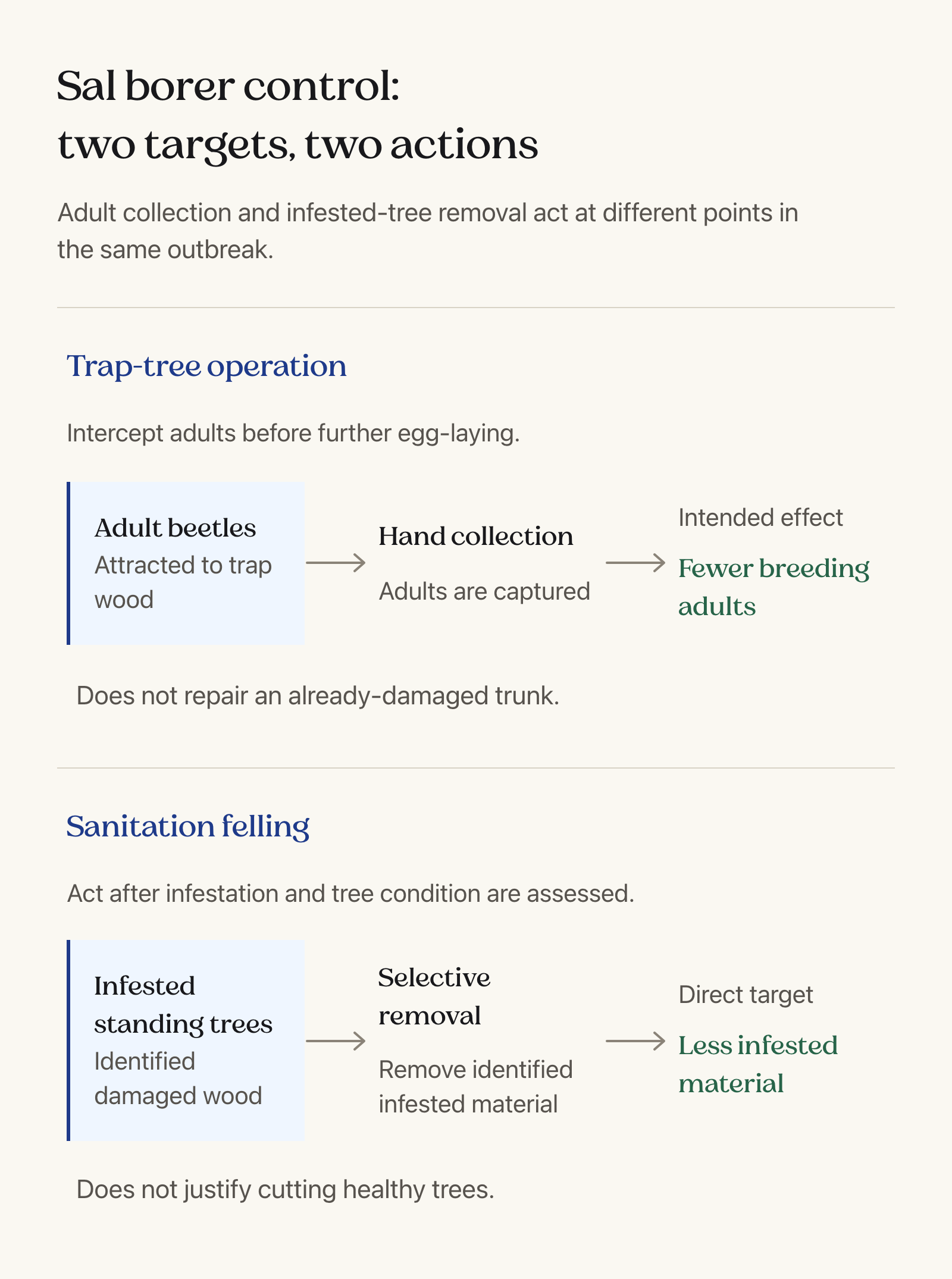
Trapping acts on exposed adults; sanitation acts on infested woody material. They address different points in the same pest problem.

  • Trap trees attract adult beetles to selected, prepared wood where collectors can reach them. The Forest Research Institute explicitly describes adult trapping as a major sal-borer control practice.
  • The Dindori operation, as reported, uses felled and debarked trap trees, followed by hand collection of beetles. These operational details describe local practice; they are not universal instructions for every forest.
  • Removing adult beetles seeks to reduce the breeding population before further egg-laying. It does not repair a damaged trunk or directly remove immature insects already concealed within another infested standing tree.
  • Sanitation felling addresses already-infested trees and wood considered beyond saving in the reported operation. Its intended purpose is to remove a source of further infestation, rather than attract exposed adults for collection.
  • The comparison is adult interception versus infested-material removal. Trapping and sanitation may operate together, but success in one cannot be assumed to eliminate the need for assessment of the other target.
Two control paths: trap wood attracts adult sal borers for collection, while selective sanitation removes identified infested trees and material.
Adult collection and selective sanitation address different targets; neither a collection count nor felling alone establishes forest recovery.

Why Evidence and Safeguards Matter

A large intervention needs a clear diagnosis and follow-up; neither a dramatic felling total nor a high beetle count proves recovery.

  • Tree selection should depend on verified infestation and condition, rather than proximity alone. The existence of a pest outbreak does not justify treating every healthy sal tree as a candidate for removal.
  • Outcome monitoring should compare new infestations, surviving trees and regeneration after intervention. Beetles collected measure operational effort, but cannot alone show whether the forest is recovering or the outbreak is controlled.
  • Sanitation safeguards should cover identification, marking, removal and handling of infested wood. A documented chain helps distinguish an ecological intervention from timber extraction, especially where the removed wood enters commercial markets.
  • Natural enemies may help suppress pests, but that does not establish the safety of deliberate mass releases. The report notes insufficient study of side-effects, supporting caution before biological-control methods are expanded.
  • Outbreak timing requires evidence across sites and seasons. A reported recurrence interval is not a fixed biological clock, and an attributed rainfall explanation should not be presented as established causation without supporting analysis.

Way Forward

Make Control Selective and Measurable

  • Link field surveillance with expert confirmation of infestation before selecting trees for sanitation.
  • Record trap effort and subsequent infestation together, so collection totals are interpreted against outcomes.
  • Protect healthy trees and regeneration, and document the handling of removed material.
  • Give forest communities clear collection procedures and transparent payment records while tracking effects on their forest-resource access.

Conclusion

  • Sal-borer management works through different targets: exposed adults can be trapped, while infested wood may require selective sanitation. The distinction explains why the two operations are complementary rather than interchangeable.
  • A sound conservation assessment asks what was diagnosed, why a tree was removed and whether new damage declined. Forest recovery, rather than the volume of timber extracted, should determine whether an intervention achieved its purpose.

UPSC Practice Questions

Prelims MCQ 1

With reference to sal-borer management, consider the following statements:

  1. Trap-tree operations target adult beetles.
  2. Sanitation felling and adult trapping necessarily target the same pest stage.
  3. A large beetle collection alone proves that a forest outbreak has ended.

How many of the above statements are correct?

(a) Only one (b) Only two (c) All three (d) None

Answer: (a) Only one

Explanation:

Trap trees capture adult beetles. Sanitation addresses infested trees or wood, while collection totals require subsequent forest-health monitoring before conclusions about control.

Prelims MCQ 2

Which observation best helps evaluate whether sal-borer control is improving forest health?

(a) Timber revenue from removed trees alone (b) Number of collection centres alone (c) New infestation and tree survival after intervention (d) A presumed fixed interval between outbreaks

Answer: (c) New infestation and tree survival after intervention

Explanation:

These observations measure pest damage and forest outcomes; revenue, facilities or assumed cycles cannot establish ecological recovery.

UPSC Mains Questions

  1. Explain why adult trapping and sanitation felling are complementary interventions in managing a sal-borer outbreak. (150 words)
  2. Discuss the ecological and governance safeguards needed when tree removal is proposed as a forest-pest control measure. (250 words)

Sources: Indian Express and Forest Research Institute, ICFRE.

Frequently Asked Questions

What is the sal heartwood borer?

It is a longhorn beetle associated with damage to sal trees. Its immature grubs occur inside affected trunks, while adult beetles can be targeted through trap-tree operations.

How do trap trees differ from sanitation felling?

Trap trees attract adult beetles for collection. Sanitation felling removes identified infested trees or wood that may sustain further infestation. The two interventions target different parts of the pest problem.

Does an outbreak justify cutting every sal tree nearby?

No. The need for sanitation must be assessed through tree condition and verified infestation. A pest outbreak does not by itself justify blanket removal of healthy trees across the surrounding forest.

Was the felling approval issued on 4 October?

The Indian Express report published on 4 October describes ongoing operations. It says approval for felling the infested trees had been given a couple of weeks earlier, rather than that day.