Opens in a new tab
Join Anantam IAS Channel on Telegram

Daily Digest · Thursday

8 October 2026 Current Affairs for UPSC

13 current affairs published on Thursday, 8 October 2026

8 October 2026 Current Affairs for UPSC — every Why-in-News article AnantamIAS published on Thursday, 8 October 2026, broken down with Why in News?, the exact GS paper it feeds, sub-topic mapping, MCQ-ready facts and a UPSC-style practice question. 13 articles in total, covering Polity, Economy, Environment, S&T, IR, Geography, History, Society and Internal Security — the same Why-in-News + GS-paper-mapping + practice-question format the Compass uses across every daily digest on the site.

Daily current affairs for UPSC is where new material enters your prep stream. Read this 8 October 2026 digest end-to-end in 25–35 minutes, attempt the practice question at the foot of each article (it's MCQ for some, 10/15-marker for others), then bookmark the entries that fall inside your active revision window. Everything stays cross-linked: tap any subject pill to jump to that subject's hub, or use the table of contents above to skip straight to a specific story.

Use this page three ways. Read sequentially for a one-sitting scan of everything that mattered on 8 October 2026. Download the 8 October 2026 PDF below for offline study or print revision. Or use the October 2026 Current Affairs compilation to see this day in the month's full context. For the previous day's reading, see 7 October 2026 Current Affairs; the next day's is 9 October 2026 Current Affairs.

Why we publish daily current affairs separately from the monthly compilation: daily is learning, monthly is revision. Use the daily page to add fresh material to your notes the day it breaks; come back to the October 2026 compilation 60 days before Prelims when the noise has settled and only the lasting takeaway is worth re-reading.

Defence Test Ranges: Opening Shared Facilities for Development

Open article →Download PDF

Why in News?

On 7 October 2026, the Ministry of Defence announced a revised Standard Operating Procedure governing Indian defence industry access to its proof ranges, field firing ranges and laboratory test facilities.

  • Testing charges are waived for iDEX, TDF, Make and other developmental projects of the Ministry of Defence.
  • A three-day slot per quarter is reserved at proof ranges for government-sponsored developmental projects and developmental projects undertaken on the Indian industry’s own initiative.
  • The revised procedure explains allotment, documentation and applicable charges, and replaces the earlier arbitration provision with a conciliation agreement clause.
  • Access to test infrastructure can determine whether an indigenous design moves from an engineering proposal to evidence that can be assessed.
  • Development support needs clear boundaries: easier access helps generate evidence, but does not itself establish product readiness or create a purchase commitment.

UPSC Relevance

Prelims Relevance

  • Proof ranges, field firing ranges and laboratory test facilities are covered by the revised SOP.
  • The listed facilities belong to DRDO, government quality-assurance agencies and the three Services.
  • Charge waivers apply to specified Ministry of Defence developmental projects.
  • Reserved proof-range slots also cover industry’s own-initiative developmental projects.
  • Conciliation and arbitration are different mechanisms for addressing disputes.

Mains Relevance

GS Paper 3

  • Shared testing infrastructure and indigenous defence development.
  • Distinguishing support for innovation from evidence-based procurement decisions.

GS Paper 2

  • Transparent administrative procedures and proportionate dispute resolution.

Essay

  • Public infrastructure creates value when access rules help ideas become verifiable results.

Background and Context

What Shared Test Facilities Provide

A development programme needs evidence about equipment, and access rules determine how industry can obtain the facilities needed to produce it.

  • Proof ranges and test laboratories provide a setting for examining equipment against specified requirements. Their value lies in producing observations that can be reviewed, rather than merely displaying a working prototype to potential buyers.
  • The revised SOP lists facilities held by DRDO, government quality-assurance agencies and the three Services. A defined list helps industry identify available public infrastructure instead of treating every organisation as an entirely separate starting point.
  • Allotment and utilisation procedures connect a request with an available facility and its conditions of use. Clear formats make the information expected from an applicant more predictable before a development team seeks a testing slot.
  • Repeatable evidence matters because a successful demonstration answers only the question actually tested. Developers and assessors must distinguish an observed result from broader claims about reliability, suitability or readiness in conditions that were not examined.
  • The shared-infrastructure principle also appears in I-STEM coordination. Here, however, the substantive change concerns defence-specific access rules, including charges, reserved proof-range time and the procedure for resolving disagreements arising under the SOP.

How the Revised SOP Changes Access

The announcement addresses the cost, timing and administrative terms of testing, with different eligibility boundaries for each form of support.

  • The charge waiver covers iDEX, TDF, Make and other Ministry of Defence developmental projects. It should be read as support for the specified project categories, not as an announcement that every private test becomes free.
  • A three-day quarterly slot is reserved at proof ranges for government-sponsored development and industry’s own-initiative developmental projects. This gives development work an identified place in scheduling, without establishing unlimited access whenever a firm requests it.
  • Slot eligibility and fee eligibility are separate questions. The release expressly includes industry’s own-initiative projects in the reserved-slot provision, but does not extend the stated charge waiver to every such project merely because it qualifies.
  • Where charges still apply, the SOP incorporates a procedure for their calculation and payment. This addresses transaction clarity: an applicant needs to understand the financial terms alongside the documents and arrangements required for facility use.
  • The earlier arbitration provision is replaced by a conciliation agreement clause. Conciliation seeks an agreed resolution between the parties; it is distinct from asking an arbitrator to determine the dispute through an adjudicatory decision.

Why Testing Access Is Not a Purchase Decision

The policy supports evidence generation during development; the announcement does not merge testing with the separate decisions involved in buying and using equipment.

  • Facility access permits a project to undertake relevant testing under the applicable procedure. It does not establish that the equipment has passed every requirement, secured all necessary approvals or become suitable for every intended operational role.
  • Test results need to be assessed against the purpose and conditions of the test. A favourable result cannot automatically answer questions outside that scope, including performance in a different environment or compatibility with another system.
  • A procurement decision concerns whether and on what terms equipment will be acquired. As the SAT-SAAW contract note explains, even a purchase contract and subsequent operational induction represent different stages, with their own conditions.
  • Export readiness also cannot be inferred from access to a public range. Although the ministry links the SOP to wider export ambitions, the announcement does not grant a blanket export approval to participating firms.
  • Implementation quality should be judged through usable access and clear decisions, not the announcement alone. The release describes the revised framework; it does not supply evidence that industry waiting times or development costs have already fallen.

Way Forward

Make Access Predictable and Results Usable

  • Publish clear facility capabilities and application requirements so firms can select an appropriate test before spending time on a request that cannot answer their engineering question.
  • Explain charge-waiver eligibility separately from reserved-slot eligibility, reducing disputes caused by treating these distinct benefits as interchangeable.
  • Track request processing and actual development-slot use while protecting sensitive information; assess whether the revised procedure improves access in practice.

Conclusion

  • Shared defence testing infrastructure can support indigenous development when firms can understand the access procedure, applicable charges and available time. The revised SOP changes these enabling conditions rather than certifying a particular product.
  • The central distinction is between supporting a test and accepting its outcome: charge relief or a reserved slot helps generate evidence, while procurement and operational decisions still require their own assessment.

UPSC Practice Questions

Prelims MCQ 1

With reference to the revised SOP for industry use of Ministry of Defence test facilities, consider the following statements:

  1. The reserved quarterly proof-range slot covers industry’s own-initiative developmental projects.
  2. Every project qualifying for a reserved slot is automatically covered by the announced testing-charge waiver.
  3. The revised SOP replaces an arbitration provision with a conciliation agreement clause.

How many of the above statements are correct?

(a) Only one (b) Only two (c) All three (d) None

Answer: (b) Only two

Explanation:

Statements 1 and 3 are correct. The waiver is stated for specified Ministry of Defence developmental projects; reserved-slot eligibility has a broader stated scope.

Prelims MCQ 2

Which conclusion follows most accurately from a firm receiving access to a Ministry of Defence proof range?

(a) Its equipment has been approved for export. (b) The armed forces are committed to buying its equipment. (c) It can undertake testing under the applicable access arrangements. (d) Its equipment has completed operational induction.

Answer: (c) It can undertake testing under the applicable access arrangements.

Explanation:

Range access enables testing. It does not itself confer procurement, export or operational approval.

UPSC Mains Questions

  1. Explain how predictable access to public test infrastructure can support indigenous defence innovation. Distinguish such support from procurement approval. (150 words)
  2. The scope of a fee waiver need not match the scope of a reserved testing slot. Discuss this distinction using the revised defence test-facility SOP. (150 words)

Source: PIB, Ministry of Defence.

Frequently Asked Questions

What does the revised defence testing SOP cover?

It governs Indian defence industry access to Ministry of Defence proof ranges, field firing ranges and laboratory facilities, including allotment procedures, relevant formats, applicable charges and arrangements for resolving issues.

Are all private defence projects entitled to free testing?

No. The announced waiver covers iDEX, TDF, Make and other Ministry of Defence developmental projects. The broader reserved-slot provision should not be treated as an automatic fee waiver for every industry project.

What is the reserved proof-range provision?

A three-day slot per quarter is reserved for government-sponsored developmental projects and developmental projects undertaken on the Indian defence industry’s own initiative. The release does not promise unlimited or immediate access.

Does successful testing guarantee an order from the armed forces?

No. Testing supplies evidence for a defined purpose. A purchase decision remains separate, and the announcement does not give participating firms a guaranteed order, blanket export approval or automatic operational induction.

Environmental Accounts: Connecting Natural Assets and Economic Activity

Open article →Download PDF

Why in News?

On 7 October 2026, the Ministry of Statistics and Programme Implementation released its environmental accounts strategy for 2026–2030 to expand coverage and address data gaps.

  • The roadmap extends the earlier strategy and identifies priorities for developing environmental-economic accounts.
  • Its scope includes forests, minerals, soil, land and water, alongside carbon stocks, biodiversity and environment-related activities.
  • MoSPI follows the System of Environmental-Economic Accounting, endorsed by the United Nations Statistical Commission.
  • The document offers guidance for States and Union Territories; publication does not mean every proposed account is already complete.
  • Economic production can rise while a natural-resource stock declines; reading both together changes the sustainability assessment.
  • Comparable environmental and economic data help identify which activities depend on particular resources and where monitoring is missing.

UPSC Relevance

Prelims Relevance

  • SEEA: System of Environmental-Economic Accounting.
  • MoSPI: India’s environmental-economic accounting strategy.
  • Stock measured at a point in time; flow measured over a period.
  • Physical accounts and monetary accounts.
  • Depletion, extraction and revaluation.

Mains Relevance

GS Paper 3

  • Natural-resource accounting and sustainable development.
  • Statistical capacity for environmental policy.

GS Paper 2

  • Coordination across ministries, States and statistical agencies.

Essay

  • Measuring prosperity beyond current production.

Background and Context

What Environmental Accounts Add

Environmental accounting connects information about nature with the economy through consistent definitions, classifications and accounting periods, rather than collecting unrelated environmental indicators.

  • SEEA organizes resource stocks, resource use and associated economic information. Its value lies in linking measurements that otherwise sit in separate departmental reports, making relationships between production and natural assets easier to examine.
  • GDP measures production during a period; it is not a complete balance sheet of nature. Higher output alone cannot establish whether the resource base supporting future production is being maintained or reduced.
  • Asset accounts record what exists at the beginning and end of an accounting period. They also explain changes between those dates, so a declining stock becomes a question about causes, not merely totals.
  • Flow accounts follow natural inputs entering the economy, products moving through it and residuals returning to the environment. Connecting these flows helps show how production depends on materials and produces environmental pressures.
  • The Indian roadmap identifies subjects for expansion and stronger data coverage. It should be read as a programme for improving measurement, not evidence that a complete national environmental balance sheet has been produced.

How Stocks and Flows Fit Together

A stock account reconciles two snapshots by identifying the changes between them; a flow account follows activity during that same period.

  • A physical stock might be timber volume in a forest at the start of the year. Timber removed during the year is a flow, measured over time rather than at a single date.
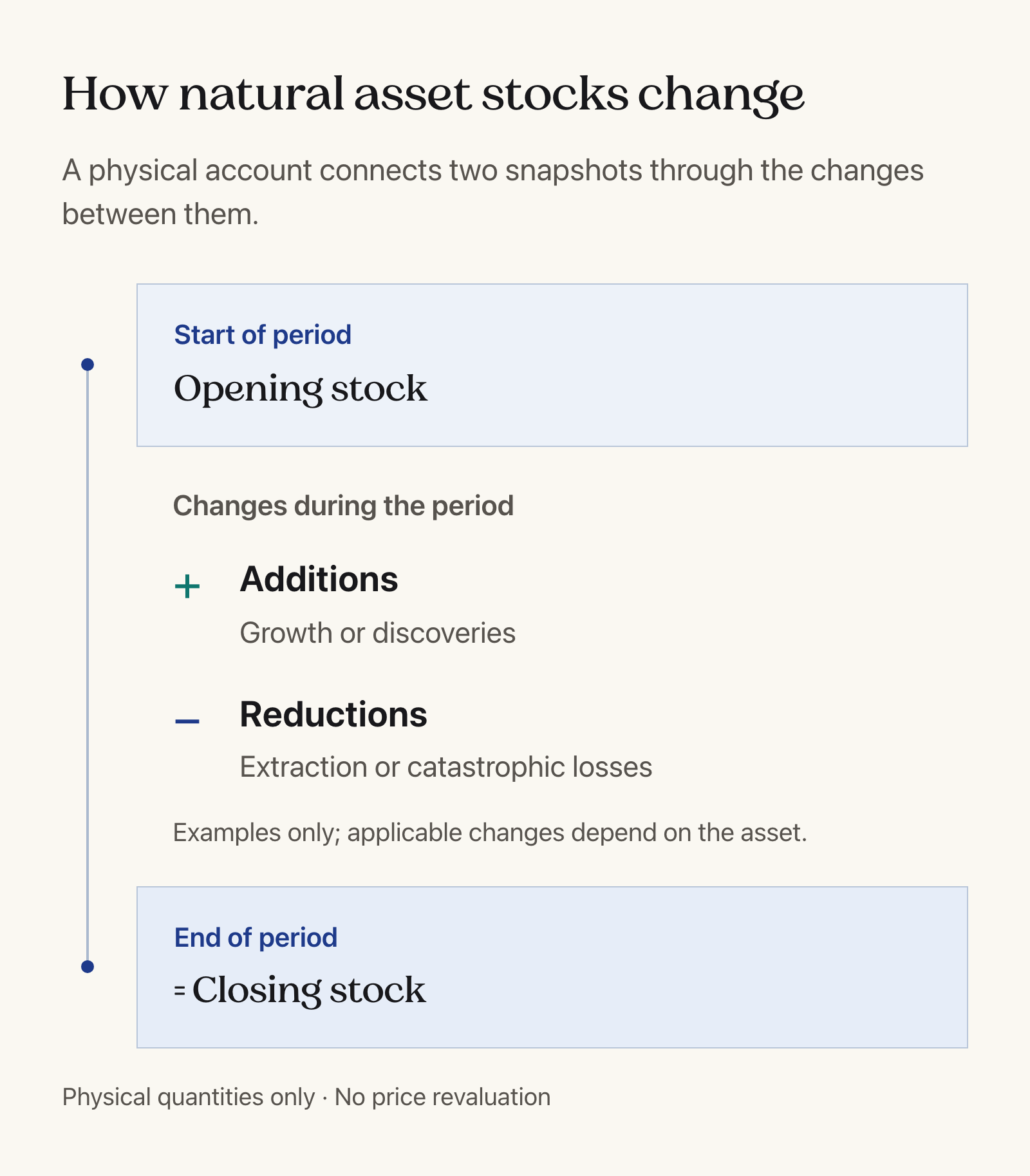
  • Opening stock plus additions minus reductions equals closing stock in a physical asset account. Additions and reductions must be classified carefully: growth, discoveries, extraction and catastrophic losses do not describe the same process.
  • Extraction records removal by economic units; it is not automatically identical to depletion for renewable resources. Regeneration matters when assessing whether resource use is reducing the available stock rather than drawing on replenishment.
  • Depletion concerns resource use that reduces the stock after accounting for regeneration. A forest fire can also reduce timber stocks, but that loss should not be confused with timber extracted for economic activity.
  • An economy may earn income from selling an extracted resource while its remaining natural assets shrink. Reading the production flow alongside the stock change exposes this distinction without assuming that all extraction is unsustainable.
Physical natural-asset account: opening stock plus additions, minus reductions, equals closing stock; changes occur between the two snapshots.
A physical asset account reconciles opening and closing quantities. Examples of additions and reductions vary by asset; monetary revaluation is excluded.

Physical Measures, Monetary Values and Limits

Physical and monetary accounts answer different questions; combining them adds insight only when their coverage, timing and valuation assumptions remain transparent.

  • Physical accounts use units such as tonnes, cubic metres or hectares, depending on the asset. They can record environmental assets even where no economic value has been assigned, avoiding dependence on market prices alone.
  • Monetary accounts express eligible assets and flows in money using accounting valuation principles. Where observable market prices are unavailable, estimates require methods and assumptions; the resulting value is not an unquestionable price for nature.
  • Revaluation is recorded separately in monetary stock accounts because prices can change even when physical quantity does not. A higher monetary asset value cannot, by itself, demonstrate that the underlying resource has recovered.
  • Environmental expenditure records economic activity directed towards protection or resource management. Spending on restoration does not prove equivalent ecological recovery; outcomes still require evidence about the relevant asset, condition or resource stock.
  • The strategy is not a replacement GDP release. It supports a broader evidence base for policy, while gaps in coverage, comparability and valuation must remain visible rather than disappear inside an invented green-GDP total.

Way Forward

Make the Accounts Usable

  • Publish definitions, coverage and uncertainty with each account so users can distinguish observed changes from methodological revisions.
  • Coordinate sectoral and State datasets around compatible classifications and accounting periods, while retaining locally meaningful resource information.
  • Read physical quantities beside monetary values; identify whether a change comes from resource use, regeneration, reclassification or prices.

Conclusion

  • Environmental accounts make the relationship between current production and the underlying natural-resource base easier to examine. Their contribution is disciplined measurement, not a claim that every ecological value can be converted into money.
  • For an answer on sustainable development, connect economic flows with changes in natural stocks, then discuss data quality and valuation limits. Treat India’s new strategy as a roadmap whose implementation still needs to be assessed.

UPSC Practice Questions

Prelims MCQ 1

With reference to environmental-economic accounts, consider the following statements:

  1. Physical asset accounts reconcile opening stocks with closing stocks through additions and reductions.
  2. A rise in an asset’s monetary value necessarily proves an increase in its physical quantity.
  3. Environmental expenditure alone establishes an equivalent improvement in ecological condition.

How many of the above statements are correct?

(a) Only one (b) Only two (c) All three (d) None

Answer: (a) Only one

Explanation:

Only the first statement is correct. Price changes can raise monetary values without increasing quantities, and expenditure needs separate outcome evidence.

Prelims MCQ 2

Which entry specifically explains changes in the monetary value of an environmental asset caused by price movements?

(a) Extraction (b) Revaluation (c) Natural growth (d) Catastrophic loss

Answer: (b) Revaluation

Explanation:

Monetary asset accounts include revaluation separately from physical additions and reductions to identify effects of changing asset prices.

UPSC Mains Questions

  1. Explain how environmental-economic accounts improve the assessment of sustainable development. Discuss their principal measurement limitations. (150 words)
  2. Distinguish natural-resource stocks from economic flows. How can India’s environmental accounting strategy strengthen evidence-based resource management? (250 words)

Sources: PIB, Ministry of Statistics and Programme Implementation and United Nations Statistics Division, SEEA Central Framework.

Frequently Asked Questions

What is environmental-economic accounting?

Environmental-economic accounting connects environmental information with economic accounts through consistent definitions and classifications. It records resource stocks and flows so policy can consider natural assets alongside production and income.

Does the new strategy replace GDP?

No. The 2026–2030 document is a roadmap for expanding and strengthening environmental accounts. Its release does not introduce a replacement GDP measure or establish that all proposed accounts have been completed.

How is a stock different from a flow?

A stock is measured at a point in time, such as timber standing at the start of a year. A flow is measured during a period, such as timber extracted during that year.

Why can monetary values and physical quantities move differently?

A resource’s price can change while its physical quantity remains unchanged. Monetary accounts record this through revaluation, making it important to examine physical accounts before inferring that an environmental asset has improved.

Does spending more on restoration prove environmental improvement?

No. Expenditure records activity undertaken for environmental protection or resource management. Evidence about resource stocks or ecological condition is still needed to determine whether the spending produced the intended improvement.

Satellite-Aided Rescue: Turning Distress Alerts Into Response

Open article →Download PDF

Why in News?

At the SAREX-2026 inauguration on 7 October, the government reported full operational capability of India’s MEOLUT ground terminal, highlighting the link between satellite alerts and maritime rescue preparedness.

  • The sea exercise off Paradip was scheduled for 8 October; the inauguration release does not establish that those sea drills had already concluded.
  • The official statement highlighted the transition towards Medium Earth Orbit Search and Rescue, or MEOSAR.
  • The National Maritime Search and Rescue Board reviewed distress-alert management, vessel tracking, information sharing and inter-agency coordination.
  • SAREX aims to test operational readiness and interoperability; exercise objectives are not measured rescue outcomes.
  • An accurate distress alert is valuable only if the responsible authority can turn it into a coordinated rescue response.
  • A ground terminal links space-based detection to operational agencies, making terrestrial infrastructure central to a satellite-enabled public service.

UPSC Relevance

Prelims Relevance

  • Cospas-Sarsat: international satellite-aided search and rescue system.
  • MEOSAR: Medium Earth Orbit Search and Rescue.
  • MEOLUT: Medium Earth Orbit Local User Terminal.
  • INMCC: Indian Mission Control Centre at ISTRAC, Bengaluru.
  • Search and rescue regions are coordination areas, not declarations of sovereignty.

Mains Relevance

GS Paper 3

  • Space technology for disaster response and maritime safety.
  • Inter-agency coordination and resilient public infrastructure.

Essay

  • Technology saves lives when institutions can act on information.

Background and Context

From a Beacon to a Rescue Authority

The rescue system separates detection, information processing and operational response; no single satellite or shore station performs all three jobs.

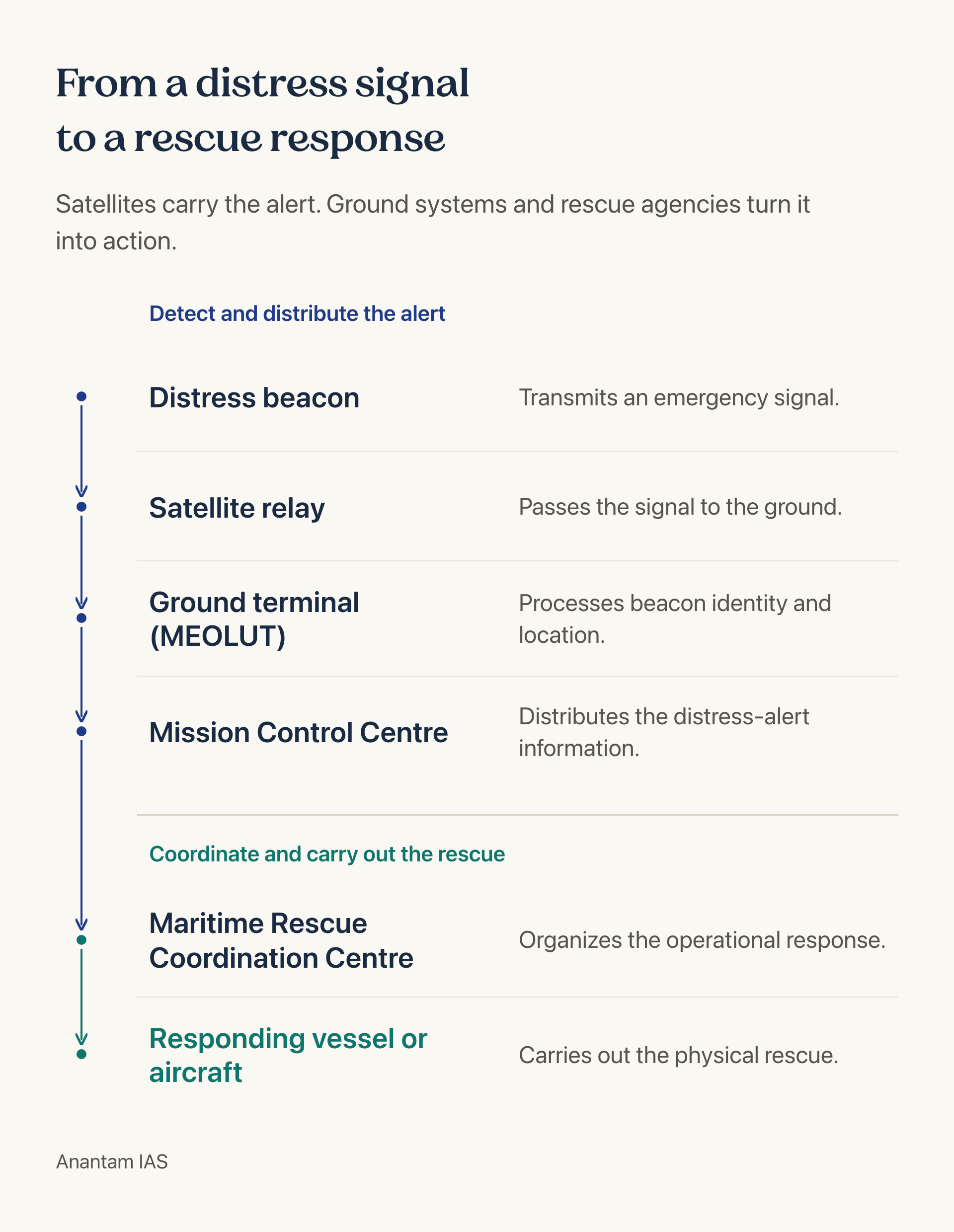
  • A distress beacon originates the emergency signal. Search-and-rescue payloads on satellites receive it and relay information towards the ground segment, connecting a person or vessel in distress with agencies beyond local radio range.
  • A Local User Terminal processes satellite downlinks. In MEOSAR, the relevant ground station is a MEOLUT, which provides beacon identification and location information for onward distribution rather than physically conducting the rescue mission.
  • The Mission Control Centre passes distress-alert information through the search-and-rescue network. ISRO’s Indian centre receives information from local terminals and other centres, helping direct useful alerts to the relevant rescue authorities.
  • A Maritime Rescue Coordination Centre organizes the operational response. It must connect the available information with suitable responding agencies and assets; receiving a beacon location is only the beginning of that practical task.
  • Rescue craft and aircraft are the response end of the chain. Satellite-aided alerting supports their mission, but cannot substitute for crews, operational decisions and the ability to reach people safely at sea.
Flow from distress beacon through satellite, MEOLUT, mission control and maritime rescue coordination to responding vessel or aircraft
The broad satellite-aided rescue chain separates alert detection and distribution from coordinated physical response.

What the MEOSAR Ground Segment Changes

The new development concerns the readiness of a ground segment within a wider alerting system, not the creation of a self-sufficient rescue capability.

  • MEOSAR uses search-and-rescue payloads associated with medium-Earth-orbit navigation satellite systems. Its role here is distress alerting and location support; a navigation constellation and a rescue service are related but not identical functions.
  • MEOLUT processing converts received satellite downlinks into usable beacon information. The reported full operational capability is significant because a satellite signal becomes operationally valuable only when ground systems can process and distribute it.
  • LEOSAR, GEOSAR and MEOSAR refer to search-and-rescue arrangements using different orbital categories. They should not be treated as three kinds of rescue boat or as interchangeable names for India’s mission control centre.
  • The 7 October announcement supplies the current capability claim. Older technical descriptions explain how the system works, but their development-stage language should not be mistaken for a fresh assessment of operational readiness today.
  • System capability and mission outcomes require different evidence. The release supports the ground-terminal milestone; it does not establish a universal rescue-time guarantee, a new location-accuracy figure or lives saved by the forthcoming sea drill.

Why Coordination Still Determines the Outcome

A functioning alert chain needs maintained equipment, usable information and agreed responsibilities, especially when an emergency involves several agencies or crosses coordination areas.

  • Beacon registration and testing are part of operational preparedness. ISRO maintains a registration database and supports coding, testing and training, illustrating why reliable emergency services require routine work before an actual distress event occurs.
  • Exercises connect agencies that normally operate separate systems. SAREX’s stated focus on joint response and interoperability matters because a well-received signal can still be mishandled when information, responsibilities or response procedures do not align.
  • Information sharing should support decisions, not simply move messages between offices. The board’s review of distress-alert management and vessel tracking points to the need to connect the emergency with available operational response capacity.
  • A search and rescue region allocates coordination responsibility; it does not establish sovereignty over the sea within it. Under the SAR framework, its delimitation does not prejudge boundaries between States or settle maritime disputes.
  • International cooperation is a functional part of maritime rescue, supported by the IMO’s SAR framework. A useful assessment asks whether agencies can exchange alerts and organize assistance across responsibilities, rather than equating equipment acquisition with preparedness.

Way Forward

Test the Entire Alert-to-Response Chain

  • Exercise handoffs between terminals, mission control and rescue coordinators, identifying where useful information is lost or delayed.
  • Maintain beacon registration, testing and user training alongside technical infrastructure; published capability requires continuing operational support.
  • Assess response readiness separately from alert detection, using exercise findings to correct coordination gaps before a real emergency.

Conclusion

  • Satellite-aided search and rescue turns a distress signal into actionable information through ground processing and coordination. Its public value depends on the whole chain, from a functioning beacon to an operational rescue response.
  • Use the MEOLUT milestone to explain technology-enabled disaster management, while distinguishing reported capability from proven mission outcomes. A search and rescue region defines responsibility for assistance, not ownership of the sea.

UPSC Practice Questions

Prelims MCQ 1

With reference to satellite-aided search and rescue, consider the following statements:

  1. A MEOLUT is a ground terminal that processes satellite downlinks for distress-alert information.
  2. A Mission Control Centre and a responding rescue craft perform the same function.
  3. The delimitation of a search and rescue region determines sovereignty over the waters within it.

How many of the above statements are correct?

(a) Only one (b) Only two (c) All three (d) None

Answer: (a) Only one

Explanation:

Only the first statement is correct. Mission control distributes alert information, while rescue units respond; SAR regions do not determine sovereignty.

Prelims MCQ 2

Which sequence best represents the broad satellite-aided maritime rescue chain?

(a) Beacon → satellite → ground terminal → mission control → rescue coordination → responding units (b) Satellite → rescue craft → beacon → ground terminal → mission control (c) Mission control → beacon → rescue coordination → satellite → distress event (d) Ground terminal → satellite → beacon → completed rescue

Answer: (a) Beacon → satellite → ground terminal → mission control → rescue coordination → responding units

Explanation:

The broad chain separates the initial distress signal, space relay, ground processing, alert distribution, coordination and physical response.

UPSC Mains Questions

  1. Explain how satellite-aided search and rescue illustrates the importance of ground infrastructure in space-enabled public services. (150 words)
  2. A distress alert is necessary but not sufficient for a successful maritime rescue. Discuss with reference to technology, institutional coordination and international cooperation. (250 words)

Sources: PIB, Ministry of Defence and ISRO, Search and Rescue.

Frequently Asked Questions

What is MEOSAR?

MEOSAR means Medium Earth Orbit Search and Rescue. It uses satellite search-and-rescue payloads and ground processing to support distress alerting and location information for the authorities responsible for organizing assistance.

What does a MEOLUT do?

A Medium Earth Orbit Local User Terminal processes satellite downlinks to provide distress-beacon identification and location information. That information is passed through mission control to the search-and-rescue authorities; the terminal does not conduct physical rescue.

Did the SAREX announcement establish completed sea-exercise outcomes?

No. The release reported the inauguration on 7 October and scheduled the sea exercise off Paradip for 8 October. It described objectives and preparedness, rather than verified outcomes from completed sea drills.

Does a search and rescue region establish maritime sovereignty?

No. A search and rescue region identifies coordination responsibility for assistance. The SAR framework separates its delimitation from boundaries between States, so the region should not be treated as territorial waters.

Why are beacon registration and testing important?

Registration, testing and user training support the operational reliability of distress-alert services. ISRO maintains beacon registration information and helps users with coding and testing, alongside the satellite and ground infrastructure.

Zinc-Air Catalysts: Improving the Oxygen Reaction Without Platinum

Open article →Download PDF

Why in News?

On 7 October 2026, the Department of Science and Technology highlighted Indian research on a metal-free catalyst called TTT-DHTD for the oxygen reaction in zinc-air batteries.

  • Researchers from SNBNCBS, Kolkata, INST, Mohali, and SRM University, Amaravati, developed the porous organic material.
  • The material was demonstrated as an air-electrode catalyst; the study appeared in Science Advances before the government announcement.
  • The reported advance concerns oxygen reduction under laboratory conditions, rather than a commercially deployed battery system.
  • Reducing reliance on precious-metal catalysts could widen material choices for energy storage, but lower manufacturing costs require separate evidence.
  • The news connects materials design with a recurring science concept: catalysts change reaction rates, not the source of a battery’s energy.

UPSC Relevance

Prelims Relevance

  • Oxidation and reduction
  • Zinc-air battery electrodes
  • Oxygen reduction reaction
  • Covalent organic frameworks
  • Catalyst versus reactant

Mains Relevance

GS Paper 3

  • Materials research and energy-storage constraints
  • Evidence needed to translate laboratory catalysts into deployable technology

Essay

  • Scientific progress depends on both discovery and reliable translation.

Background and Context

What the New Catalyst Changes

The central advance is molecular design at the air electrode, where oxygen must react efficiently for the battery to deliver useful power.

  • TTT-DHTD is a covalent organic framework: organic building blocks joined through covalent bonds into an extended porous network. Its composition and arrangement create sites where oxygen can attach and undergo reaction.
  • A catalyst helps a reaction proceed through a more favourable pathway. Here, the target is oxygen reduction at the air electrode, rather than replacing zinc or supplying an independent source of electrical energy.
  • Porosity provides access to internal surfaces, but pores alone do not establish catalytic performance. The chemistry of the accessible sites matters because oxygen must interact with them appropriately during the electrode reaction.
  • Metal-free describes this catalyst material, not the entire battery. A zinc-air cell still uses metallic zinc; treating the phrase as proof of a metal-free storage device would confuse the component with the system.
  • The DST account describes laboratory testing and computer simulations. Experiments assess behaviour, while modelling helps explain how molecular structure supports oxygen attachment and reaction; neither alone establishes commercial readiness.

How a Zinc-Air Battery Produces Current

During discharge, separate electrode reactions are linked by an external electron path and an internal ion path through the electrolyte.

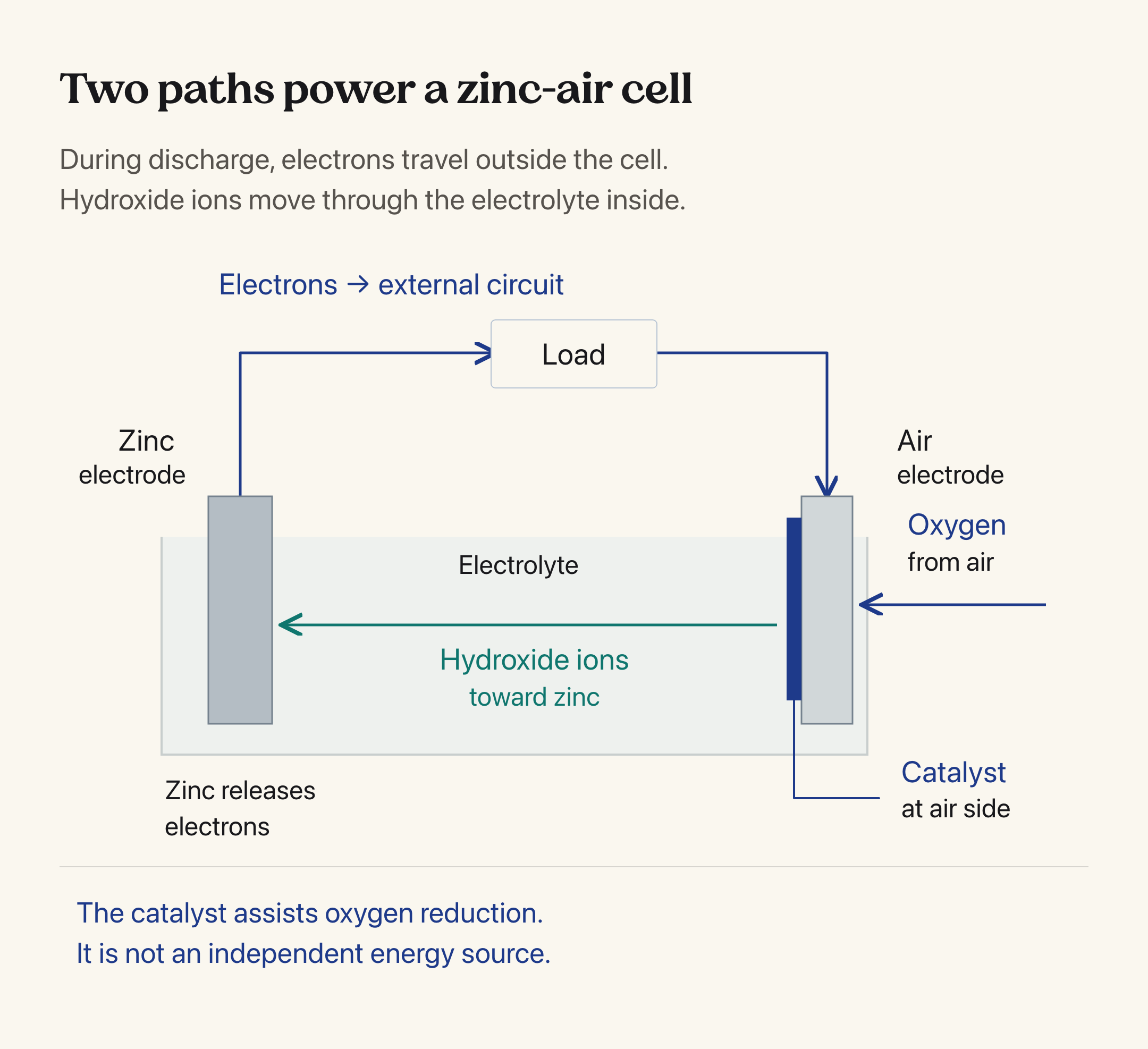
  • At the zinc electrode, oxidation releases electrons. They travel through the external circuit toward the air electrode, allowing a connected load to draw power from the cell’s overall chemical reaction.
  • At the air electrode, oxygen accepts electrons: this is reduction. Air supplies a reactant, not unlimited free energy; sustained discharge also depends on zinc participating in the paired electrode reaction.
  • In an alkaline zinc-air cell, the oxygen reaction produces hydroxide ions. These move through the electrolyte toward the zinc side, completing the internal charge-transfer route while electrons take the external circuit.
  • Oxygen reduction kinetics concern how readily the reaction proceeds. A suitable catalyst helps this electrode process; it does not remove every other limitation associated with electrolyte behaviour, electrodes or battery construction.
  • The US Department of Energy assessment identifies oxygen electrochemistry as a development challenge. Its reaction description explains the generic battery mechanism, not the measured performance of this particular Indian catalyst.
Alkaline zinc-air discharge diagram: electrons flow from zinc through an external load to the air electrode; hydroxide ions move toward zinc inside the electrolyte; catalyst sits at the air electrode.
In an alkaline zinc-air cell, discharge links an external electron circuit to an internal hydroxide-ion route. The catalyst assists oxygen reduction at the air electrode.

Why a Catalyst Result Is Not a Finished Battery

The useful comparison is between catalyst activity and complete-device performance: they answer different questions and cannot be substituted for each other.

  • Platinum is an established oxygen-reduction catalyst benchmark. Matching a selected laboratory measurement against platinum does not demonstrate identical performance across every operating condition or prove that the complete battery is equally efficient.
  • Device efficiency concerns the complete energy-conversion system, including losses beyond a single catalyst. A percentage describing one experimental comparison should not be relabelled as the fraction of energy delivered by a battery.
  • Rechargeability adds another requirement: reversing discharge chemistry reliably. Efficient oxygen reduction during discharge does not by itself establish oxygen evolution during charging, stable repeated cycling or a commercially useful battery lifetime.
  • Material availability can motivate research without proving low production cost. Processing, reproducibility and integration must also be assessed before describing an experimental catalyst as an affordable replacement in a finished energy-storage product.
  • Scale-up requires evidence from practical operating conditions and complete cells. Longer laboratory operation is useful, but should not be presented as proof of deployment, manufacturing readiness or performance over years of service.

Way Forward

Test the Full Storage System

  • Evaluate complete-cell performance alongside catalyst activity, stating the conditions and comparison basis for every claimed improvement.
  • Assess manufacturing reproducibility and processing costs before translating abundant ingredients into claims of affordable finished devices.
  • For rechargeable applications, test charging behaviour and repeated cycling separately from oxygen reduction during discharge.

Conclusion

  • TTT-DHTD illustrates how molecular engineering can expand the materials available for oxygen electrochemistry. The defensible advance is a laboratory catalyst result, with practical storage benefits still requiring evidence from complete devices.
  • For UPSC, keep the chain clear: zinc oxidation releases electrons, oxygen reduction accepts them, and the catalyst assists the electrode reaction. Energy-storage promises should be judged against system performance rather than a material label alone.

UPSC Practice Questions

Prelims MCQ 1

With reference to zinc-air batteries during discharge, consider the following statements:

  1. Zinc undergoes oxidation at the zinc electrode.
  2. Oxygen accepts electrons at the air electrode.
  3. The catalyst is the independent source of electrical energy.

How many of the above statements are correct?

(a) Only one (b) Only two (c) All three (d) None

Answer: (b) Only two

Explanation:

Zinc oxidation supplies electrons and oxygen reduction accepts them. The catalyst assists the electrode reaction; energy comes from the overall chemical process, not the catalyst alone.

Prelims MCQ 2

Which conclusion follows directly from describing an air-electrode catalyst as metal-free?

(a) The entire battery contains no metal (b) The battery does not consume reactants (c) The catalyst material does not rely on metal constituents (d) The battery is commercially rechargeable

Answer: (c) The catalyst material does not rely on metal constituents

Explanation:

Metal-free describes the catalyst’s composition. A zinc-air battery still uses zinc, and the label does not establish commercial performance or rechargeability.

UPSC Mains Questions

  1. Explain the role of oxygen-reduction catalysts in zinc-air batteries. Why is catalyst performance insufficient to establish commercial viability?
  2. Materials innovation can reduce dependence on scarce inputs, but laboratory success alone does not ensure affordable energy storage. Discuss.

Sources: PIB, Department of Science and Technology and US Department of Energy, Zinc Batteries Technology Strategy Assessment.

Frequently Asked Questions

What is TTT-DHTD?

TTT-DHTD is a metal-free covalent organic framework investigated as an oxygen-reduction catalyst. Its porous organic structure provides accessible reaction sites at the air electrode of a zinc-air battery.

Does a zinc-air battery run on air alone?

No. Oxygen from air participates in reduction at the air electrode, while zinc undergoes oxidation. The paired chemical reactions produce electrical energy; air is not an unlimited independent energy source.

Does metal-free mean that the battery contains no metals?

No. The description applies to the catalyst material. Zinc remains part of the battery, and the composition of one component should not be confused with that of the complete device.

Does better oxygen reduction prove rechargeability?

No. Oxygen reduction is central to discharge. Rechargeable operation also requires suitable charging reactions and stable repeated cycling, which must be evaluated rather than inferred from a discharge-catalyst result.

Allied Health Standards: Separating Training, Assessment and Registration

Open article →Download PDF

Why in News?

On 7 October 2026, the Health Ministry announced NCAHP regulations for autonomous boards and a Central Assessment Committee, alongside allied-health curriculum and registration measures notified earlier.

  • Autonomous boards receive separate education, assessment, ethics and registration responsibilities; the announcement does not establish that every board is already operational.
  • The Central Assessment Committee provides an assessment mechanism where a functional State Council does not exist.
  • Registration regulations were gazetted on 15 September; the medical radiology diploma curriculum was notified on 30 September.
  • The diploma curriculum is optional in 2026–27 and mandatory from 2027–28; the announcement is not an immediate compulsory change for every current student.
  • Patient safety depends on training facilities, supervised practice and professional accountability working together; a qualification document cannot substitute for all three.
  • Uneven state capacity makes the central fallback significant, while local inspection and functioning State Councils remain necessary for durable regulation.

UPSC Relevance

Prelims Relevance

  • National Commission for Allied and Healthcare Professions (NCAHP).
  • Autonomous boards under State Allied and Healthcare Councils.
  • Assessment and Rating Board versus Ethics and Registration Board.
  • Central Assessment Committee where State Councils are not functional.
  • Competency-based curriculum and professional registration.

Mains Relevance

GS Paper 2

  • Regulating healthcare education through distinct but connected institutional responsibilities.
  • Cooperative federalism and central support where state regulatory capacity is incomplete.

Essay

  • Trust in public services requires verifiable standards and accountable institutions.

Background and Context

What the Different Boards Regulate

The framework separates oversight of educational institutions from scrutiny of individual professionals, while connecting both through State Councils.

  • The NCAHP framework, under the allied and healthcare professions law, concerns education and professional standards. Its practical challenge is connecting what institutions teach with what qualified personnel can safely do in healthcare settings.
  • Undergraduate and Postgraduate Boards support recognised-course standards, competency frameworks, faculty development, training and research. They submit recommendations to the State Council, linking classroom expectations with the continuing task of improving educational delivery.
  • The Assessment and Rating Board evaluates recognition and permission applications, inspects institutions and reviews annual disclosures. Its focus is the institution offering training, rather than merely checking whether one graduate possesses a certificate.
  • The Ethics and Registration Board verifies professional documents, recommends registration and considers complaints or violations. This creates a separate route for professional conduct questions that an inspection of college facilities alone cannot resolve.
  • The framework provides for public assessment and rating information through State Council websites. For students choosing courses, usable disclosures can reveal institutional quality; publication must be accompanied by current evidence and understandable explanations.

How the Central Fallback and Training Standards Work

A common curriculum describes expected learning; assessment examines delivery, and the central fallback addresses gaps in state regulatory machinery.

  • The Central Assessment Committee operates under NCAHP supervision where a functional State Council does not exist. It performs autonomous-board functions through prescribed verification, inspection and rating procedures, addressing an institutional gap rather than declaring standards unnecessary.
  • This central fallback should be distinguished from proof of nationwide implementation. A regulatory provision creates a mechanism; effective operation still requires appointed personnel, inspections, reliable records and decisions that institutions can understand and act upon.
  • The medical radiology and imaging diploma illustrates competency-based education: knowledge must be joined with practical skills, values and professional attitudes. The aim is safe performance in healthcare settings, beyond recall in a written examination.
  • Supervised clinical exposure connects imaging theory with equipment use, patient care and radiation safety. A training institution needs meaningful practical opportunities; adopting a curriculum document without suitable clinical learning conditions cannot deliver the intended competence.
  • The distinction is between standards on paper and evidence of delivery. Curriculum requirements specify learning expectations, while institutional assessment examines the provider; neither should be casually treated as a guarantee of every individual clinical outcome.

What Registration Can and Cannot Establish

Registration makes professional status checkable, but its purpose differs from assessing a college or observing practical competence.

  • The registration framework requires a recognised primary qualification and provides State and Central Registers. Professionals where no functional State Council exists may register directly with the Central Register, avoiding dependence on a missing state mechanism.
  • Public registers and identification-linked certificates support verification of registration status. They help users distinguish a verifiable professional record from an unsupported claim, but authentication of a record does not itself measure the quality of treatment delivered.
  • Continuing professional development is connected with renewal under the framework. The governance logic is continuing accountability: skills and professional responsibilities do not end when initial education finishes or the first registration certificate is issued.
  • Interim registration for students undertaking required practical training is distinct from proposed arrangements for existing practitioners lacking prescribed qualifications. The ministry says efforts toward provisional registration and a bridge course are underway, not already implemented.
  • The useful comparison is institution versus curriculum versus individual: assessment examines the training provider, curriculum defines expected learning, and registration records professional eligibility. Separation prevents a certificate from being mistaken for complete quality assurance.

Way Forward

Make the Framework Operational and Verifiable

  • Publish board responsibilities and inspection findings in clear language, with procedures for correcting inaccurate institutional information.
  • Check clinical training capacity before curriculum adoption, including supervision and access to appropriate equipment rather than only classroom compliance.
  • Keep proposed transition arrangements clearly separate from notified eligibility routes so students and existing practitioners do not act on assumed exemptions.

Conclusion

  • Allied-health regulation works through complementary checks: suitable training institutions, competency-based education and accountable professional registration. The strength of the reform will depend on these checks operating together, rather than the mere existence of new boards.
  • For a governance answer, distinguish legal design from implementation and explain why a central fallback matters. Judge progress through functional institutions, useful public information and supervised learning, while preserving the difference between eligibility and demonstrated competence.

UPSC Practice Questions

Prelims MCQ 1

With reference to the announced NCAHP framework, consider the following statements:

  1. The Assessment and Rating Board evaluates institutions.
  2. The Central Assessment Committee provides a mechanism where a functional State Council does not exist.
  3. The announcement establishes that all autonomous boards are already operational.

How many of the above statements are correct?

(a) Only one (b) Only two (c) All three (d) None

Answer: (b) Only two

Explanation:

The first two statements describe the announced functions. Notification of a framework does not demonstrate that every board is already operational.

Prelims MCQ 2

Which distinction best describes institutional assessment and professional registration?

(a) Both exclusively assess the same individual professional. (b) Institutional assessment replaces the need for a curriculum. (c) Assessment examines the training provider; registration records individual professional eligibility. (d) Registration certifies every future clinical outcome.

Answer: (c) Assessment examines the training provider; registration records individual professional eligibility.

Explanation:

The two mechanisms address different objects of regulation. Neither registration nor institutional assessment guarantees every clinical outcome.

UPSC Mains Questions

  1. Explain how separating curriculum standards, institutional assessment and professional registration can improve allied-health education.
  2. Discuss the benefits and limitations of a central regulatory fallback where functional State Councils have not been established.

Source: PIB, Ministry of Health and Family Welfare.

Frequently Asked Questions

What is NCAHP seeking to regulate through the new boards?

The framework separates education standards, institutional assessment, and professional ethics and registration. These functions connect through State Councils, allowing scrutiny of training providers and individual professionals without treating them as the same regulatory task.

When does the Central Assessment Committee apply?

The announced framework provides for a Central Assessment Committee where a functional State Council does not exist. Under NCAHP supervision, it performs autonomous-board functions using prescribed verification, inspection and rating procedures.

When must institutions adopt the medical radiology diploma curriculum?

The curriculum notified on 30 September 2026 becomes mandatory from academic year 2027–28. Institutions may adopt it during 2026–27, so optional early adoption should not be confused with immediate universal implementation.

Does professional registration prove every aspect of competence?

Registration establishes professional eligibility under the applicable framework and makes status verifiable. It does not replace institutional assessment, supervised learning or evidence of safe performance in the particular services a professional delivers.

Is the proposed bridge-course route already implemented?

The ministry says it is undertaking efforts toward provisional registration and a bridge-course option for existing practitioners without prescribed primary qualifications. This should be described as work in progress, not an already available exemption.

SC Beneficiary Reporting: Making Financial Inclusion Measurable

Open article →Download PDF

Why in News?

On 7 October 2026, the government announced Department of Financial Services directions requiring scheme-wise and bank-wise reporting of Scheduled Caste beneficiaries following an NCSC intervention.

  • The directions dated 5 October require beneficiary numbers and percentages in State and Union Territory banking coordination reviews.
  • Existing bank and implementing-agency data must be used, with consistent definitions and methodology rather than parallel reporting requirements.
  • The information must be shared regularly with NCSC, addressing a gap that obstructed its evaluation of Scheduled Caste socio-economic development.
  • The intervention concerns reporting and accountability; the release does not announce a new loan entitlement or provide evidence that lending outcomes have already improved.
  • Aggregate scheme totals can conceal which communities receive assistance, making targeted oversight difficult even when overall financial inclusion appears to expand.
  • Disaggregated information helps identify questions for scrutiny; it must be interpreted alongside service quality and barriers faced by eligible applicants.

UPSC Relevance

Prelims Relevance

  • National Commission for Scheduled Castes as a constitutional oversight body.
  • Article 338(5)(c): evaluation of Scheduled Caste socio-economic development.
  • Department of Financial Services in the Ministry of Finance.
  • State Level Bankers’ Committees and Union Territory Level Bankers’ Committees.
  • Distinction between beneficiary counts, beneficiary shares and welfare outcomes.

Mains Relevance

GS Paper 2

  • Information access as a condition for effective constitutional oversight.
  • Accountability in delivery of financial inclusion benefits to disadvantaged communities.

GS Paper 3

  • Financial inclusion beyond aggregate lending and account indicators.

Essay

  • What gets counted influences who becomes visible in public policy.

Background and Context

Why NCSC Needs Disaggregated Information

The constitutional issue is not creating a new lender; it is enabling an oversight institution to evaluate who benefits from existing financial schemes.

  • Article 338(5)(c) gives NCSC a role in evaluating the progress of Scheduled Caste socio-economic development. The Commission identified missing beneficiary shares in banking reports as an obstacle to carrying out that constitutional responsibility.
  • NCSC raised the information gap with the Department of Financial Services. This distinguishes scrutiny from delivery: the Commission evaluates progress, while the announced directions flow through the department and existing banking coordination arrangements.
  • Scheme-wise reporting separates assistance under different programmes. Without that separation, a broad financial inclusion total could hide uneven access across programmes intended to serve different needs, making the source of a delivery gap difficult to identify.
  • Bank-wise reporting makes institutional differences visible for review. A low beneficiary share should prompt questions about access, implementation or data quality; by itself, it does not establish why that difference arose or prove discriminatory conduct.
  • The shift is from aggregate activity to group visibility. A report can show many people assisted yet still omit whether Scheduled Caste communities are being reached, leaving constitutional evaluation dependent on incomplete information about distribution.

How the Reporting Mechanism Is Intended to Work

The directions use established coordination forums and existing administrative records rather than creating a separate system for collecting the same information.

  • SLBCs and UTLBCs are the State and Union Territory banking coordination forums addressed by the directions. Their periodic review meetings must include the specified beneficiary details, giving the information a regular institutional setting for examination.
  • Banks and implementing agencies already hold relevant records. Reusing those records can reduce inconsistent requests and duplicated compilation, provided reviewers document what each field means and distinguish missing information from a genuine absence of beneficiaries.
  • The requested number and percentage of beneficiaries answer different questions: the count indicates recorded reach, while the share places that reach within the reported total. A percentage is interpretable only when its denominator is clear.
  • Regular sharing with NCSC connects banking reviews to constitutional evaluation. Data availability and compilation problems must also be reported, recognising that incomplete records can limit conclusions even when a reporting requirement has formally been introduced.
  • Consistent definitions matter across schemes and banks. Reviewers should establish whether records refer to people, families, accounts or assistance instances before comparing them; apparent differences may otherwise reflect reporting conventions rather than differences in actual access.

What Beneficiary Data Cannot Prove

Better reporting is an accountability input. It is not, on its own, evidence that financial services are adequate or have improved welfare.

  • A larger beneficiary count does not reveal whether assistance was sufficient for the recipient’s needs. Recorded participation and adequate support are separate questions, so reviewers should avoid treating an increase in entries as complete financial inclusion.
  • A reported beneficiary share does not automatically establish equitable access. Interpretation needs context about eligible populations, demand and programme design; the announcement supplies a reporting instruction, not a single benchmark that resolves all those distributional questions.
  • Loan quality cannot be inferred from beneficiary numbers alone. Information on suitable terms, repayment difficulties and productive use would answer different questions, and none should be invented from a table that records only counts and percentages.
  • Welfare impact is a further analytical step. Showing that recipients received assistance does not demonstrate how their circumstances would have changed without it; causal claims require an appropriate evaluation rather than simple attribution to the scheme.
  • Administrative follow-up gives data its value. Review meetings should investigate unusual patterns, correct records and address documented barriers; otherwise a new reporting column may improve visibility while leaving the underlying experience of eligible applicants substantially unchanged.

Way Forward

Turn Comparable Records Into Corrective Action

  • Document definitions and denominators beside each reported series so banks and schemes can be compared without confusing different units.
  • Separate missing records from zero assistance, and assign responsibility for resolving compilation problems before drawing conclusions about performance.
  • Use identified gaps to guide focused examination of access barriers; assess service quality and welfare outcomes separately with suitable evidence.

Conclusion

  • Financial inclusion becomes more accountable when its distribution is visible. The directions strengthen an information channel between banking coordination forums and NCSC, while leaving lending delivery distinct from constitutional oversight and evaluation.
  • For an answer on governance, distinguish reporting, implementation and impact. Comparable beneficiary records can reveal where scrutiny is needed, but claims about equitable access, adequate credit or improved welfare require evidence beyond a count or share.

UPSC Practice Questions

Prelims MCQ 1

With reference to the announced SC beneficiary reporting directions, consider the following statements:

  1. Scheme-wise and bank-wise beneficiary details are to be included in periodic banking reviews.
  2. Reporting should use existing data held by banks and implementing agencies.
  3. NCSC has become the direct lender under the identified financial schemes.

How many of the above statements are correct?

(a) Only one (b) Only two (c) All three (d) None

Answer: (b) Only two

Explanation:

The first two statements describe the directions. NCSC’s role is constitutional oversight and evaluation; the announcement does not make it a lending institution.

Prelims MCQ 2

Which conclusion follows most directly from a table containing beneficiary counts and percentages?

(a) Every beneficiary received sufficient credit. (b) The programme caused a measurable welfare improvement. (c) The table describes recorded reach and its distribution within the stated reporting total. (d) All differences across banks prove discrimination.

Answer: (c) The table describes recorded reach and its distribution within the stated reporting total.

Explanation:

Counts and shares describe recorded participation. Credit sufficiency, causal welfare effects and reasons for institutional differences require additional evidence.

UPSC Mains Questions

  1. Explain why disaggregated administrative data is necessary for effective constitutional oversight of financial inclusion.
  2. Distinguish beneficiary reach from quality of financial access and welfare impact. How should these differences shape the evaluation of financial inclusion schemes?

Source: PIB, Ministry of Social Justice and Empowerment.

Frequently Asked Questions

What has changed in reporting on Scheduled Caste beneficiaries?

The Department of Financial Services has directed banking coordination forums to include scheme-wise and bank-wise beneficiary numbers and percentages in periodic reviews, using existing records and regularly sharing information with NCSC.

Why is Article 338(5)(c) relevant?

The provision gives NCSC a role in evaluating the progress of Scheduled Caste socio-economic development. Missing beneficiary information limits that evaluation by obscuring who receives assistance under the financial schemes being examined.

Does NCSC provide the loans covered by these directions?

No. The announcement concerns NCSC’s oversight and evaluation role and directions issued through the Department of Financial Services. It does not turn the Commission into a lender or announce a new loan entitlement.

Will the directions create a separate reporting system?

The department has directed the use of data already held by banks and implementing agencies. The stated objective is consistent definitions and methodology without creating parallel reporting requirements for the same information.

Do higher beneficiary numbers prove improved welfare?

No. Counts describe recorded reach, but do not establish adequate assistance, service quality or causal welfare gains. Those questions need additional evidence and an evaluation suited to the outcome being claimed.

RBI Rate Hike: How Calibrated Tightening Reaches the Economy

Open article →Download PDF

Why in News?

On October 7, 2026, the RBI’s Monetary Policy Committee unanimously raised the repo rate by 25 basis points to 5.50% and adopted calibrated tightening.

  • Calibrated tightening leaves a rate hike or pause open, while ruling out rate cuts in the near term under the stated conditions.
  • The RBI identified higher oil prices, food pressures and early signs of broader inflation as concerns behind its decision.
  • The statement found limited evidence of supply pressures becoming embedded in pricing behaviour; it did not claim a fully established wage-price spiral.
  • An energy shock can spread beyond fuel through production costs and expectations; monetary policy addresses these channels without creating additional oil supply.
  • Policy transmission connects the central bank’s decision to market rates, bank pricing and spending, with delays and uneven effects across borrowers.

UPSC Relevance

Prelims Relevance

  • Policy repo rate and basis points
  • Monetary Policy Committee and policy stance
  • Second-round effects of supply shocks
  • Weighted average call rate and liquidity management
  • Headline inflation versus core inflation

Mains Relevance

GS Paper 3

  • Monetary policy response to supply-led inflation
  • Transmission constraints and the growth-inflation trade-off

Essay

  • Price stability as a condition for sustainable economic decisions

Background and Context

What Calibrated Tightening Means

The rate decision changes today’s policy setting; the stance communicates how the committee approaches its next decision as conditions evolve.

  • The repo rate is the policy rate associated with RBI lending against eligible collateral. Its increase signals more expensive central-bank funding, but it is not itself the interest rate on every household loan.
  • A basis point is one-hundredth of a percentage point. The announced increase changes the policy setting by a quarter percentage point; it does not mean that every bank loan becomes one-quarter more expensive.
  • Calibrated tightening signals a conditional direction rather than an automatic sequence of increases. The statement keeps hikes and pauses available, with the duration and extent of tightening dependent on growth and inflation developments.
  • A forecast describes the RBI’s expected future path, subject to risks. It differs from an observed inflation reading or an implemented rate decision; an examination answer must not present projections as realised outcomes.
  • A pause can coexist with a tightening stance because the committee may need time to assess earlier action. Holding the rate at a subsequent meeting would not automatically imply a shift towards easing.

Why Raise Rates During a Supply Shock?

Higher borrowing costs cannot repair disrupted oil supplies, but they can influence whether the initial price shock spreads and persists.

  • First-round effects arise when dearer energy directly raises fuel bills and indirectly increases production or transport costs. These effects can reach other prices without proving that expectations have become permanently detached from stability.
  • Second-round effects emerge when households and firms expect continuing inflation and adjust wages or selling prices accordingly. Monetary tightening seeks to restrain this persistence, rather than reverse the original physical shortage of supplies.
  • Inflation expectations matter because economic decisions look ahead. If firms anticipate further general price increases, they may adjust pricing more readily; credible policy can influence those expectations alongside its effect on borrowing conditions.
  • Core inflation excludes food and fuel and helps examine broader price pressures. However, energy costs enter other goods and services, so rising core inflation alone cannot neatly separate second-round behaviour from indirect supply effects.
  • The RBI’s assessment recognised early generalisation of price pressures but limited embedding in pricing behaviour. That distinction makes this a preventive response to identified risks, not evidence that every inflation channel is already entrenched.

How the Decision Reaches Borrowers

Transmission passes through money markets and bank balance sheets before it changes consumption, investment and eventually the wider path of prices.

  • Liquidity management supports the rate signal by influencing short-term market conditions. The RBI stated that it would use its tools to align the weighted average call rate with the policy repo rate.
  • Surplus liquidity can keep overnight rates below the policy rate, weakening immediate transmission. The statement reported this pattern recently, demonstrating why announcing a higher repo rate and implementing monetary conditions are related but separate tasks.
  • Bank pricing depends on funding costs, competition, credit demand and loan composition. Lending and deposit rates need not move together; the RBI reported dissimilar movements in these rates during the period preceding this decision.
  • Loan contracts determine how borrowers experience a change. Benchmark links and reset dates affect floating-rate loans, while fixed-rate arrangements operate differently; no immediate, identical EMI increase for all borrowers follows from the policy announcement.
  • Spending responds with lags as financing conditions influence purchases and investment plans. Tighter policy can restrain demand and inflation persistence, but it can also burden productive activity; supply-side constraints still require their own remedies.

Way Forward

Assess Transmission Before the Next Move

  • Track underlying inflation and expectations alongside headline prices to distinguish a passing supply disturbance from broader persistence.
  • Monitor money-market alignment and bank lending rates rather than assuming the policy announcement has already changed borrowing conditions uniformly.
  • Combine monetary restraint with targeted supply responses; avoid claiming that interest-rate action alone can resolve energy disruptions or food shortages.

Conclusion

  • The key distinction is between a supply shock and its persistence. The RBI can influence demand, financing conditions and expectations, while the physical sources of the initial shortage remain outside the repo rate’s direct reach.
  • For a balanced answer, connect the policy rate to liquidity, bank pricing and spending, then explain the lags and growth costs. Calibrated tightening is conditional policy guidance, not a promise of identical future rate increases.

UPSC Practice Questions

Prelims MCQ 1

With reference to monetary policy transmission, consider the following statements:

  1. An increase in the repo rate necessarily raises every borrower’s EMI immediately.
  2. Surplus liquidity can keep overnight market rates below the policy repo rate.
  3. Monetary policy can seek to limit second-round effects of a supply shock.

How many of the above statements are correct?

(a) Only one (b) Only two (c) All three (d) None

Answer: (b) Only two

Explanation:

Statements 2 and 3 are correct. Contract terms and reset dates prevent an identical immediate EMI response across all loans.

Prelims MCQ 2

Which interpretation best captures the calibrated-tightening stance announced on October 7, 2026?

(a) A fixed schedule of equal rate increases (b) An immediate commitment to reduce lending rates (c) A choice between a hike and a pause, depending on evolving conditions (d) A guarantee that supply shortages will end

Answer: (c) A choice between a hike and a pause, depending on evolving conditions

Explanation:

The RBI ruled out near-term cuts under the stated conditions while retaining hikes or pauses according to the growth-inflation outlook.

UPSC Mains Questions

  1. Why might a central bank tighten monetary policy in response to a supply shock? Discuss its rationale and limitations.
  2. Explain how liquidity conditions and bank balance sheets influence the transmission of a policy-rate change to the real economy.

Source: RBI Governor’s Statement, October 7, 2026.

Frequently Asked Questions

What did the RBI decide on October 7, 2026?

The Monetary Policy Committee unanimously increased the policy repo rate by 25 basis points to 5.50% and changed its stance to calibrated tightening, leaving subsequent hikes or pauses dependent on evolving conditions.

Can a repo-rate hike end an oil shortage?

No. Higher interest rates cannot directly increase oil supply. They can influence borrowing, spending and inflation expectations, helping contain the spread and persistence of an initial supply-driven price shock.

Does calibrated tightening require a hike at every meeting?

No. The announced stance permits a hike or a pause depending on developments. It rules out near-term cuts under the stated conditions without fixing the size or timing of future increases.

Will every loan EMI rise immediately?

No. Transmission depends on the loan’s interest-rate arrangement, benchmark and reset schedule, as well as bank pricing. A policy-rate change does not produce an identical immediate repayment change for every borrower.

Why monitor core inflation during an energy shock?

Core inflation helps assess broader price pressures beyond food and fuel. However, energy costs can enter other prices indirectly, so core inflation alone does not conclusively establish second-round inflation behaviour.

Satellite Internet: Why a Licence Is Only One Approval Stage

Open article →Download PDF

Why in News?

On October 8, 2026, the Department of Telecommunications clarified that security assessments remained under way for all three licensed non-geosynchronous satellite communication service providers.

  • The three entities hold telecom licences for Global Mobile Personal Communication by Satellite services based on non-geosynchronous satellite systems.
  • Each licensee must demonstrate compliance with security conditions before proceeding to seek spectrum assignment.
  • The government described the framework as fair and non-discriminatory, saying all three entities were broadly at the same regulatory stage.
  • The statement did not announce spectrum assignment or a commercial launch date; those outcomes cannot be inferred from the existence of licences.
  • Layered approvals separate permission to enter a regulated sector from demonstrating compliance and obtaining the radio resources needed for operations.
  • Satellite connectivity can serve difficult terrain, but technical reach and regulatory readiness are different questions when assessing actual service availability.

UPSC Relevance

Prelims Relevance

  • Global Mobile Personal Communication by Satellite services
  • Non-geosynchronous satellite systems
  • Telecom licence versus spectrum assignment
  • Security-compliance assessment
  • International Telecommunication Union and radio-frequency coordination

Mains Relevance

GS Paper 3

  • Satellite connectivity and the digital divide
  • Spectrum coordination and technology deployment

GS Paper 2

  • Transparent authorisation and regulatory accountability

Essay

  • Technology access depends on trusted institutions as well as infrastructure

Background and Context

The Approval Sequence in the Clarification

The announcement identifies separate regulatory stages, each answering a different question about whether a licensed provider can move towards offering services.

  • A telecom licence establishes the authorisation described in the statement, subject to its conditions. It does not erase subsequent obligations; treating the licence as evidence that every regulatory requirement is complete misreads the announcement.
  • Security compliance must be demonstrated by each licensee under its licence conditions. The government links this requirement to protecting users and their data, rather than presenting it as an optional commercial undertaking by operators.
  • Assessment under way means the compliance process remains unfinished in the published account. It is neither a declaration that the operators have failed nor a statement that they have already satisfied all security conditions.
  • Seeking spectrum assignment is the next step after completion of that process for an individual licensee. Permission to seek an assignment should not be converted into a claim that frequencies have already been assigned.
  • Entity-specific progression is built into the wording: a licensed entity may proceed when its process is completed. Being broadly at the same stage today does not promise simultaneous clearance or identical future completion dates.

Satellites Still Need a Ground Network

Space-based coverage does not remove the need for ground equipment, coordinated radio links and arrangements that make a usable communications service possible.

  • Non-geostationary systems include satellites in low and medium Earth orbits. Unlike a geostationary satellite that appears fixed from the ground, these satellites move across the sky, so operators use constellations to support continuous service.
  • Ground terminals and antennas provide the terrestrial end of satellite radio links. The dish in a ground station represents communications infrastructure, not proof that any particular company has received permission to operate commercially in India.
  • Remote connectivity is a major potential benefit because satellite systems can reach locations where terrestrial networks are difficult to extend. This capability explains their policy significance without establishing universal affordability, availability or service quality.
  • Radio-frequency spectrum makes communications possible, while coordination helps prevent harmful interference between systems. A satellite in orbit and a licensed operator are insufficient reasons to assume that all proposed radio transmissions may begin immediately.
  • National administrations retain licensing responsibility within an international regulatory framework. The ITU’s explanation distinguishes this national role from coordination of spectrum and satellite resources, avoiding the misconception that international coordination replaces domestic approval.

How to Assess the Government’s Claim

A clear public explanation should distinguish the government’s stated position, the disclosed status of applications and evidence about how the process actually works.

  • Non-discrimination is the government’s stated position in this release, issued in response to allegations circulating online. An evidence-based account should attribute that position rather than present the statement itself as an independent regulatory audit.
  • Comparable treatment can be examined through common requirements and consistent application of assessment criteria. This is an analytical test of fairness, not a claim that the release discloses every security condition or confidential assessment finding.
  • Security and spectrum coordination address different risks: the first concerns compliance with safeguards, while the second concerns permitted radio use and interference. Completing one stage cannot automatically substitute for the requirements of the other.
  • Commercial readiness should be judged from confirmed approvals and actual service information, not a licence headline alone. The clarification offers no basis for predicting launch dates, customer prices or which provider will become available first.
  • Regulatory transparency can improve when authorities distinguish completed steps from pending ones in public communication. Detailed operational vulnerabilities need not be disclosed for applicants and users to understand the stated sequence and present stage.

Way Forward

Make Each Stage Understandable

  • Publish clear stage-specific status without disclosing sensitive security findings, so licence announcements are not mistaken for complete operational clearance.
  • Explain common assessment requirements and reasons for procedural differences where disclosure is appropriate, allowing claims of equal treatment to be evaluated.
  • Keep consumer communication tied to confirmed service availability; avoid turning technical coverage potential into an unsupported promise of immediate access.

Conclusion

  • The durable lesson is that authorisation, demonstrated compliance and spectrum assignment are distinct. In the October 8 clarification, the licence stage had been reached, but the security-assessment process remained under way for all three entities.
  • For an analytical answer, connect satellite access with the institutions governing its use. Explain the sequence, attribute official claims and separate an operator’s potential to provide coverage from evidence that commercial services are ready.

UPSC Practice Questions

Prelims MCQ 1

With reference to the October 8 satellite communication clarification, consider the following statements:

  1. Possession of a telecom licence established that spectrum had already been assigned.
  2. Each licensee was required to demonstrate compliance with security conditions.
  3. All three entities were described as broadly at the same regulatory stage.

How many of the above statements are correct?

(a) Only one (b) Only two (c) All three (d) None

Answer: (b) Only two

Explanation:

Statements 2 and 3 reflect the release. Spectrum assignment was a subsequent step to be sought after completing the security process; it had not been announced.

Prelims MCQ 2

Which statement best describes non-geostationary satellite systems?

(a) Their satellites always appear fixed over the same point in the sky (b) They operate without radio-frequency coordination (c) They can use constellations of moving satellites to support continuous service (d) Their international coordination removes national licensing requirements

Answer: (c) They can use constellations of moving satellites to support continuous service

Explanation:

The ITU explains that non-GSO satellites move across the sky and operators deploy constellations for continuity. National licensing and spectrum coordination remain relevant.

UPSC Mains Questions

  1. Why must telecom authorisation, security compliance and spectrum assignment be distinguished in satellite communications? Explain with reference to regulatory accountability.
  2. Discuss how satellite connectivity can support digital inclusion while creating requirements for national regulation and international spectrum coordination.

Sources: PIB, Department of Telecommunications and International Telecommunication Union.

Frequently Asked Questions

Does a satellite telecom licence mean services can launch immediately?

No. The October 8 clarification identifies security compliance and the subsequent step of seeking spectrum assignment. A licence alone does not show that these steps are complete or establish commercial availability.

What was the status of the three licensees?

According to the Department of Telecommunications, security assessments were under way for all three and they were broadly at the same regulatory stage. The statement did not declare that any had completed this process.

What happens after the security process is completed?

The clarification says a licensed entity may proceed to seek spectrum assignment once its security process is complete. Seeking assignment is a subsequent step, not evidence that spectrum has automatically been granted.

Why is radio coordination needed for satellite services?

Satellite systems use radio frequencies that must coexist with other authorised services. Coordination helps limit harmful interference; international arrangements support this task while national authorities remain responsible for their licensing decisions.

Did the government announce a launch date?

No commercial launch date was provided in the clarification. The government explained the regulatory sequence and current assessment status; predictions about availability, prices or which provider would launch first require separate evidence.

AI companions and child safety

Open article →Download PDF

Why in news?

California’s ‘Adam’s Law’ regulating AI companion chatbots has raised questions about gaps in India’s laws protecting children from AI harms.

UPSC Relevance – 

Mains: 

GS1 Society

GS4 – Ethical issues in technology, Corporate responsibility.

What are AI Companions?

  • Meaning: AI chatbots designed to act as a friend, partner, mentor or confidant, rather than just answer questions. Examples include companion apps like Replika and Character.AI, and general chatbots used in a personal way.
  • Key features: They remember past chats, take on a personality, speak in a warm and caring tone, and are available 24×7. Many are built to keep the user engaged for as long as possible.
  • Scale of use: A 2025 Common Sense Media survey in the US found that about 72% of teenagers had tried an AI companion. In India, the ASER 2024 report found that about 9 out of 10 children aged 14-16 have a smartphone at home, so exposure is growing fast.

Why are Children Turning to Them?

  • Always available and never judgemental, unlike parents or teachers who may be busy or strict.
  • Loneliness, academic pressure and stigma around mental health make it easier to talk to a machine.
  • Shortage of school counsellors and child psychologists, especially outside big cities.
  • Design tricks such as flattery, constant agreement (sycophancy) and emotional language create a feeling of a real bond.

Risks and Harms

  • Emotional dependence: Children may replace real friendships with a chatbot, affecting social skills and emotional growth.
  • Harmful advice: Chatbots have been found engaging with children on self-harm, eating disorders, drugs and sexual content instead of steering them to help.
  • Psychological manipulation: Engagement-driven design can keep a vulnerable child hooked, much like social media, but in a far more personal way.
  • Hard to detect: As the article notes, the harm builds up over thousands of ordinary-looking chats. There is no single ‘crime’ that police or parents can easily spot.
  • Privacy: Children share their deepest fears and secrets, creating sensitive data that can be stored, analysed or misused.
  • Real cases: In the US, the family of 16-year-old Adam Raine sued OpenAI (2025) and the family of a 14-year-old boy sued Character.AI (2024), alleging chatbot conversations contributed to the boys’ deaths. These cases are still in court, but they have pushed companies to add parental controls and age limits.

Global Regulatory Responses

  • USA (federal): The Federal Trade Commission began an inquiry in 2025 into how AI companies test and monitor companion chatbots for harm to children.
  • European Union: The AI Act (2024) follows a risk-based approach and bans AI systems that exploit the vulnerabilities of people because of their age, or use manipulative techniques that cause harm.
  • United Kingdom: The Online Safety Act, 2023 puts a ‘duty of care’ on platforms to protect children from harmful content.
  • Australia: Has set a minimum age of 16 for social media accounts, showing a stricter approach to children’s online life.
  • United Nations: General Comment No. 25 (2021) under the UN Convention on the Rights of the Child says children’s rights apply fully in the digital world. India ratified the UNCRC in 1992.

India’s Legal Framework

  • Constitution: Article 21 (right to life and personal liberty, including mental health and privacy as held in Puttaswamy, 2017), Article 15(3) (special provisions for children), Article 39(e) and 39(f) (children must grow up in conditions of freedom and dignity and be protected against exploitation).
  • IT Act, 2000 and IT Rules, 2021: Cover cybercrimes, obscene content and child sexual abuse material (Section 67B), and set due diligence duties for intermediaries.
  • DPDP Act, 2023: Treats everyone below 18 as a child. Section 9 requires verifiable parental consent and bars tracking, behavioural monitoring and targeted advertising aimed at children. The DPDP Rules were notified in 2025 and are being phased in.
  • POCSO Act, 2012: Punishes sexual offences against children, including online grooming and sexual content.
  • Mental health support: Mental Healthcare Act, 2017 and Tele-MANAS (helpline 14416), launched in 2022, provide free tele-counselling for children in distress.
  • AI policy: IndiaAI Mission (2024, about ₹10,372 crore) supports AI development. The India AI Governance Guidelines (2025) prefer a light-touch, principle-based approach over a separate AI law.

Gaps in the Indian Framework

  • Focus on old harms: Laws deal with data, obscenity and cybercrime, not with psychological harm caused by a product’s design.
  • Liability unclear: Safe harbour under Section 79 of the IT Act was meant for platforms hosting user content. A chatbot generates its own responses, so whether it is an ‘intermediary’ is an open question.
  • No safety-by-design duties: There is no requirement for crisis-response features, risk assessments or audits before an AI product reaches children.
  • Weak investigation capacity: Cyber cells are not trained to examine algorithmic behaviour or use chat logs as evidence of harm.
  • Age verification problem: Parental consent rules depend on knowing a user’s age, which is easy to fake. Strict checks, in turn, raise privacy concerns.

The Debate

  • Protection vs innovation: Heavy rules may burden Indian start-ups and slow AI progress; too little regulation leaves children exposed. The aim is calibrated regulation, as the author argues.
  • Protection vs autonomy: Teenagers need some privacy and freedom online. Too much parental monitoring can harm trust and push them to unsafe platforms.
  • Ban vs safe design: Blanket bans are hard to enforce. Many experts favour making products safe by default rather than keeping children out completely.

Way Forward

  • Safety by design: Mandatory age-appropriate design, crisis-detection systems that direct children to helplines like Tele-MANAS, and limits on manipulative engagement features.
  • Independent audits: Regular third-party safety assessments for AI products widely used by children, possibly through the proposed AI Safety Institute.
  • Clear accountability: Define the liability of AI developers for harm caused by their products, through the proposed Digital India Act or amendments to existing law.
  • Build capacity: Train cyber police and child welfare bodies (NCPCR, SCPCRs) to deal with algorithmic harms.
  • Digital literacy: Teach children, parents and teachers about AI through schools, in line with NEP 2020’s focus on digital awareness.
  • Invest in human support: More school counsellors and community mental health services, so children do not have to depend on chatbots for emotional support.

Practice MCQ 

Q1. With reference to the Digital Personal Data Protection Act, 2023, consider the following statements:

  1. A ‘child’ under the Act means an individual who has not completed sixteen years of age.
  2. A Data Fiduciary must obtain verifiable consent of the parent before processing the personal data of a child.
  3. A Data Fiduciary shall not undertake tracking, behavioural monitoring or targeted advertising directed at children.

How many of the statements given above are correct?

(a) Only one     (b) Only two     (c) All three     (d) None

Answer: (b)

Explanation: Statement 1 is incorrect. The Act defines a child as an individual who has not completed eighteen years of age.

Q2. Consider the following statements:

Statement-I: The European Union’s AI Act prohibits AI systems that exploit the vulnerabilities of persons due to their age.

Statement-II: The EU AI Act follows a risk-based approach, under which AI practices posing an unacceptable risk are banned.

Which one of the following is correct in respect of the above statements?

(a) Both Statement-I and Statement-II are correct and Statement-II explains Statement-I

(b) Both Statement-I and Statement-II are correct, but Statement-II does not explain Statement-I

(c) Statement-I is correct, but Statement-II is incorrect

(d) Statement-I is incorrect, but Statement-II is correct

Answer: (a)

Explanation: The AI Act places AI systems in risk categories. Exploiting age-related vulnerabilities falls in the ‘unacceptable risk’ category, which is why it is banned.

Mains Practice Question 

Q. AI companions are fast becoming emotional confidants for children, but India’s digital laws remain focused on conventional cybercrime. Examine the risks posed by AI companions to children and suggest a regulatory framework that balances child safety with innovation. (15 marks, 250 words)

From the brink to a comeback: Species recovery in India

Open article →Download PDF

Why in news?

Wildlife Week (October 2–8) has brought attention to India’s species recovery efforts, from vultures and lions to dugongs and the bustard.

UPSC Relevance – Prelims: IUCN categories, species in news, protected areas, conservation schemes.

Mains, GS3: Conservation, Environmental Pollution and Degradation, Environmental Impact Assessment.

What is species recovery?

Species recovery means bringing a threatened species back to a point where its population can survive on its own in the wild. It goes beyond simply stopping a decline. It involves fixing the cause of the decline, rebuilding numbers, and making sure the habitat can hold them in the long run.

  • It usually combines in-situ methods (protecting habitat, anti-poaching, removing threats) with ex-situ methods (conservation breeding, gene banks) followed by reintroduction.
  • Success is judged by numbers, by spread over a wider area, and by whether the species can persist without constant human support.

India’s biodiversity at a glance

  • India has only 2.4% of the world’s land area but supports nearly 8% of its flora and 7.5% of its fauna.
  • It is one of the 17 megadiverse countries and contains parts of 4 of the 36 global biodiversity hotspots: Himalaya, Indo-Burma, Western Ghats–Sri Lanka and Sundaland (Nicobar Islands).
  • Around 28% of plants and over 30% of animals found in India are endemic.
  • Of 7,516 Indian animal species assessed on the IUCN Red List, 1,012 are threatened (Vulnerable, Endangered or Critically Endangered). But these assessments cover only 7.2% of documented animal species, so the real picture is likely worse.

Legal and institutional framework

  • Constitution: Article 48A (DPSP) directs the State to protect forests and wildlife; Article 51A(g) makes it a fundamental duty of citizens. Forests and protection of wild animals moved to the Concurrent List through the 42nd Amendment, 1976.
  • Wild Life (Protection) Act, 1972: Schedule I species get the highest protection. The 2022 amendment cut the schedules from six to four and aligned the Act with CITES.
  • Integrated Development of Wildlife Habitats (IDWH): Centrally sponsored scheme of MoEFCC. Its ‘Recovery Programme for Critically Endangered Species’ now covers 24 species, including the GIB, Sangai, dugong and hangul. States must carry out research, habitat improvement, protection and community participation.
  • Species-specific projects: Project Tiger and Elephant, Project Lion (2020), Project Dolphin, Vulture Action Plan 2020–25, and state initiatives like Project Nilgiri Tahr (Tamil Nadu).
  • National Red List Roadmap: Launched at the IUCN World Conservation Congress (Abu Dhabi, 2025) to prepare National Red Data Books for plants and animals by 2030. It will show where recovery efforts are needed most.
  • International commitments: CITES, Convention on Migratory Species (CMS), and Target 4 of the Kunming-Montreal Global Biodiversity Framework, which calls for halting human-induced extinction of known threatened species.

Recovery stories from India

SpeciesWhereWhat made the difference
Asiatic lionGir and greater Saurashtra, GujaratHabitat protection, monitoring, community support
Vultures (white-rumped, long-billed, slender-billed)Pinjore (Haryana), MP, Nilgiri landscapeDiclofenac ban, conservation breeding, synchronised surveys
Nilgiri tahrWestern Ghats (TN and Kerala)Project Nilgiri Tahr: surveys, radio-collaring, habitat mapping
DugongPalk Bay, Gulf of MannarIndia’s first Dugong Conservation Reserve (448.34 sq km); net compensation to fishers
Snow leopardTrans-Himalaya (e.g., Kibber, Himachal)Camera traps, community-led monitoring
One-horned rhinoPobitora WLS, Kaziranga (Assam)Anti-poaching, grassland and invasive plant management, translocation
Great Indian BustardThar (Rajasthan), Kutch (Gujarat)Conservation breeding, artificial insemination, power-line mitigation

    What has worked: lessons from the ground

    • Removing the root cause: The 2006 ban on veterinary diclofenac was the turning point for vultures. Residues in cattle carcasses caused kidney failure in Gyps vultures, wiping out over 95% of some populations. Aceclofenac and ketoprofen were also banned for animal use in 2023.
    • Conservation breeding: The Jatayu Conservation Breeding Centre at Pinjore (Haryana Forest Department and BNHS) was India’s first vulture breeding centre. For the GIB, breeding centres in Jaisalmer have even used artificial insemination.
    • Habitat-centred action: Grassland management and invasive plant control helped rhinos in Assam. Seagrass protection is the base of dugong conservation.
    • Communities as partners: Women from Kibber (Himachal) set camera traps for snow leopards. In Palk Bay, fishers who release dugongs from nets get compensation for damaged gear.
    • Science and monitoring: Regular, synchronised surveys (like the tri-state vulture count across TN, Kerala and Karnataka) give a baseline to measure change.
    • Dedicated funds: Tamil Nadu’s Endangered Species Conservation Fund focuses on lesser-known species like the mahseer, striped hyena, Madras hedgehog, lion-tailed macaque and hornbill.

    Challenges

    • Data gap: Only a small share of species has been assessed. Many plants, insects and freshwater species are simply not on the radar.
    • Charismatic species bias: Tigers and elephants attract most funds and attention, while frogs, freshwater fish and small mammals get little.
    • Development pressures: Overhead power lines are a leading cause of GIB deaths. In M.K. Ranjitsinh vs Union of India, the Supreme Court first ordered undergrounding of lines (2021) and later modified it (2024), also recognising a right against the adverse effects of climate change.
    • Single-site populations: Asiatic lions remain concentrated in one landscape, raising disease risk. The 2013 Supreme Court order to translocate some lions to Kuno has not been implemented.
    • Habitat loss and degradation: Grasslands are often treated as ‘wastelands’ and diverted for other uses. Invasives like Prosopis juliflora and Lantana camara degrade habitats.
    • Human-wildlife conflict and livelihoods: Dugongs die as bycatch; snow leopards prey on livestock. Without compensation and benefit-sharing, local support fades.
    • Short-term approach: Recovery takes decades, but funding moves with budget cycles and political priorities. Field staff shortages and weak scientific capacity at the state level make it harder.

    Way forward

    • Complete the National Red List assessment and use it to set recovery priorities based on threat, not popularity.
    • Give species plans clear goals, mapped habitats, timelines and measurable outcomes, with assured funding across budget cycles.
    • Recognise grasslands, wetlands and seagrass meadows as ecosystems that need protection, not land waiting for ‘use’.
    • Build scientific capacity close to the field: train forest staff in surveys, habitat assessment, conservation breeding and genetic analysis.
    • Involve communities meaningfully through compensation, livelihood support and roles in monitoring. Their local knowledge improves plans.
    • Pool resources from government, CSR, philanthropy and research institutions through state-level conservation funds.
    • Plan for insurance populations (second homes) for species confined to a single site.

    Species recover in different ways, as the bustard, vulture, tahr and dugong show. What they have in common is sustained effort. Conservation success is not a one-time win but a long commitment to science, habitat and people.

    Practice MCQ 

    Q1. Consider the following pairs:

    Species : Associated area/status

    1. Sangai : Keibul Lamjao National Park
    2. Hangul : Dachigam National Park
    3. Nilgiri tahr : State animal of Kerala
    4. Great Indian Bustard : State bird of Rajasthan

    How many of the pairs given above are correctly matched?

    (a) Only one

    (b) Only two

    (c) Only three

    (d) All four

    Answer: (c)

    Explanation: Pair 3 is incorrect. The Nilgiri tahr is the state animal of Tamil Nadu. Kerala’s state animal is the Indian elephant.

    Q2. Consider the following statements:

    Statement-I: India has banned the veterinary use of diclofenac to protect vulture populations.

    Statement-II: Vultures feeding on carcasses of cattle treated with diclofenac suffer kidney failure.

    Which one of the following is correct in respect of the above statements?

    (a) Both Statement-I and Statement-II are correct and Statement-II explains Statement-I

    (b) Both Statement-I and Statement-II are correct, but Statement-II does not explain Statement-I

    (c) Statement-I is correct, but Statement-II is incorrect

    (d) Statement-I is incorrect, but Statement-II is correct

    Answer: (a)

    Explanation: Diclofenac residues in carcasses cause visceral gout and kidney failure in Gyps vultures. This led to the 2006 ban on its veterinary use.

    Mains Practice Question 

    Q. “India’s species recovery stories show that laws can prevent extinction, but only sustained science, funding and community participation can ensure recovery.” Discuss with suitable examples. (15 marks, 250 words)

    Karnataka signals intent to review Cauvery allocation citing Indus Waters Treaty

    Open article →Download PDF

    Why in news?

    Karnataka told the Supreme Court it may seek reopening of Cauvery allocation, citing ‘changed circumstances’ and the Indus Waters Treaty example.

    UPSC Relevance – Prelims: Article 262, Inter-State River Water Disputes Act, river tribunals, Cauvery basin, Indus Waters Treaty.

    Mains, GS2: Issues and challenges pertaining to the federal structure; Disputes redressal mechanisms and institutions; Bilateral agreements involving India.

    The issue in brief

    • Tamil Nadu moved the Supreme Court complaining of a backlog in Cauvery water released by Karnataka.
    • In reply, Karnataka argued the present allocation is inequitable and that circumstances have changed. It reserved its right to seek reopening of the Tribunal award read with the 2018 Supreme Court judgment.
    • It relied on the Doctrine of Rebus Sic Stantibus and pointed out that India itself is seeking modification of the 1960 Indus Waters Treaty on the same ground.

    Cauvery dispute 

    • The Cauvery rises at Talakaveri in the Brahmagiri hills (Kodagu, Karnataka) and flows through Karnataka and Tamil Nadu into the Bay of Bengal. Kerala and Puducherry are also basin States.
    • The dispute goes back to the 1892 and 1924 agreements between the Madras Presidency and the princely State of Mysore. Karnataka has long argued these were unfair to it.
    • To resolve the dispute, Cauvery Water Disputes Tribunal (CWDT) was set up in 1990. It gave an interim order in 1991 and its final award in 2007, notified in 2013.
    • State of Karnataka vs State of Tamil Nadu (2018): The Supreme Court modified the award, declared inter-State rivers a national asset, gave highest priority to drinking water (Bengaluru’s needs), and said the arrangement would hold for 15 years.
    • On the Court’s direction, the Centre set up the Cauvery Water Management Authority (CWMA) and the Cauvery Water Regulation Committee (CWRC) in 2018. 

    Constitutional and legal framework

    • Entry 17, State List: Water (supply, irrigation, canals, drainage, storage, hydropower) is a State subject, but it is subject to Entry 56 of the Union List.
    • Entry 56, Union List: Parliament can regulate and develop inter-State rivers in public interest. The River Boards Act, 1956 was made under it, though no river board has ever been set up.
    • Article 262: Parliament may provide for adjudication of inter-State water disputes and may bar the Supreme Court and other courts from hearing them.
    • Inter-State River Water Disputes (ISRWD) Act, 1956: The Centre sets up a tribunal on a State’s request if negotiation fails. Section 11 bars court jurisdiction over the dispute itself.
    • 2002 Amendment: Tribunal to be set up within one year of request; award within three years (extendable by two). The award has the same force as a Supreme Court order or decree.
    • Role of the Supreme Court: Despite Section 11, the Court held in 2018 that it can hear appeals against tribunal awards under Article 136. So, in practice, disputes return to the Court.

    Rebus sic stantibus: can it apply between States?

    • The Latin phrase means ‘things standing thus’. It allows a party to end or revisit a treaty when there is a fundamental change of circumstances that the parties did not foresee.
    • It is codified in Article 62 of the Vienna Convention on the Law of Treaties, 1969. It is applied very narrowly. In the Gabčíkovo–Nagymaros case (1997), the ICJ rejected Hungary’s plea based on it.
    • India and the IWT: India sent notices to Pakistan in January 2023 and September 2024 seeking modification of the treaty, citing population growth, clean energy needs and cross-border terrorism. After the Pahalgam attack, India put the treaty in abeyance in April 2025.
    • Why the comparison is weak: The IWT is a treaty between sovereign nations under international law. The Cauvery allocation is a tribunal award with the force of a Supreme Court decree, binding under the Constitution. Domestic federal obligations cannot be dropped the way a sovereign may question a treaty.
    • Where is it justified : Fixed allocations do not adjust well to climate variability, urban growth and changing cropping patterns. Global practice, such as the Helsinki Rules (1966) and the UN Watercourses Convention (1997), favours equitable and reasonable utilisation, which needs periodic review.

    Way forward

    • Make CWMA stronger and more technical: Real-time telemetry of inflows and releases, published openly, to reduce disputes over facts.
    • A clear distress-sharing formula: Based on actual inflows, crop stage and drinking water needs, worked out in advance rather than during a crisis.
    • Revive the 2019 reform: A permanent tribunal with fixed timelines and a strong negotiation stage before adjudication.
    • Basin-level planning: River basin organisations as suggested by the Mihir Shah Committee (2016) and the draft River Basin Management Bill.
    • Demand management: Micro-irrigation, less water-intensive crops in the delta, wastewater reuse and lake revival in Bengaluru.
    • Cooperative federalism: Using the Inter-State Council and Zonal Councils for dialogue, so that water is seen as a shared national asset and not a zero-sum game.

    Periodic review of allocations is reasonable in a changing climate. But it must happen through agreed institutions and data, not by unilateral reopening of settled awards. Otherwise every dry year will reopen old wounds.

    Indus Water Treaty 

    • Signed: At Karachi on 19 September 1960, with retrospective effect from 1 April 1960. The signatories were Nehru and Ayub Khan, after about nine years of talks brokered by the World Bank. The Bank also signed for certain provisions.  
    • Eastern rivers (Ravi, Beas, Sutlej): Allotted to India, with an average annual flow of about 33 million acre-feet (MAF).  
    • Western rivers (Indus, Jhelum, Chenab): Allotted mainly to Pakistan, about 135 MAF. In effect, Pakistan gets about 80% of the system’s water.
    • India’s rights on western rivers: Domestic use, non-consumptive use, limited irrigation, and run-of-river hydropower designed to Annexure D criteria. Total storage is capped at about 3.6 MAF.
    • Permanent Indus Commission (PIC): One commissioner from each country. It shares data, conducts inspections and meets every year. The last meeting (the 118th) was in May 2022.
    • Dispute resolution (Article IX), graded in three tiers:
      • Question: Handled by the PIC.
      • Difference: A technical matter that goes to a Neutral Expert (NE) appointed by the World Bank under Annexure F.
      • Dispute: A legal matter that goes to a seven-member Court of Arbitration (CoA) under Annexure G.
    • The treaty can be modified only by a new, ratified treaty (Article XII(3)) and terminated only by mutual agreement (Article XII(4)). It contains no exit clause.
    • Present status 
      • 31 August 2026 award: A five-member Court of Arbitration unanimously declared the treaty fully in force and India still bound by it. It also imposed limited interim restrictions on some concreting work at Ratle until shortly after the Neutral Expert’s final decision.  
      • India’s response: India rejected the award and maintains the treaty is still in abeyance. India continues to take part in the Neutral Expert process while refusing to recognise the Court of Arbitration. Government sources said in July 2026 that the treaty would have to be reviewed and renegotiated before its water-sharing provisions could work again in any form. 

    Practice MCQ 

    Q1. Consider the following pairs:

    Water Disputes Tribunal : States involved

    1. Vansadhara : Odisha and Andhra Pradesh
    2. Mahadayi : Goa, Karnataka and Maharashtra
    3. Mahanadi : Odisha and Chhattisgarh
    4. Krishna (KWDT-II) : Karnataka, Maharashtra and Tamil Nadu

    How many of the pairs given above are correctly matched?

    (a) Only one

    (b) Only two

    (c) Only three

    (d) All four

    Answer: (c)

    Explanation: Pair 4 is incorrect as Tamil Nadu is not a party to the Krishna dispute; the States are Maharashtra, Karnataka, Andhra Pradesh and Telangana.

    Q2. Consider the following statements:

    Statement-I: The Supreme Court cannot hear appeals against the award of a water disputes tribunal constituted under the Inter-State River Water Disputes Act, 1956.

    Statement-II: Article 262 of the Constitution allows Parliament to exclude the jurisdiction of the Supreme Court over inter-State water disputes.

    Which one of the following is correct in respect of the above statements?

    (a) Both Statement-I and Statement-II are correct and Statement-II explains Statement-I

    (b) Both Statement-I and Statement-II are correct, but Statement-II does not explain Statement-I

    (c) Statement-I is correct, but Statement-II is incorrect

    (d) Statement-I is incorrect, but Statement-II is correct

    Answer: (d)

    Explanation: In the Cauvery judgment (2018), the Supreme Court held that it can hear appeals against tribunal awards under Article 136. Section 11 of the ISRWD Act bars courts from the original dispute, not from appeals against the award.

    Mains Practice Question 

    “Inter-State river water disputes in India are less about water and more about weak institutions and trust deficit among States.” Examine in the context of the Cauvery dispute and suggest reforms to the dispute resolution mechanism. (15 marks, 250 words)

    SC flags accessibility gaps in aviation infrastructure

    Open article →Download PDF

    Why in news?

    SC sought responses from the Centre and aviation bodies on a plea alleging systemic accessibility failures for disabled air passengers.

    UPSC Relevance – 

     GS2 – Welfare schemes and laws for vulnerable sections (persons with disabilities)

    GS3 – Infrastructure (airports) 

    Status of India’s Aviation Sector

    • Market size: India is the world’s third-largest domestic aviation market after the US and China. Annual passenger traffic has crossed 350 million, and domestic traffic has grown at about 10-12% a year over the last decade.
    • Airports: The number of operational airports (including heliports and water aerodromes) has more than doubled, from 74 in 2014 to over 160 now. The target is around 350-400 airports by 2047.
    • However, realising these goals require overcoming multiple challenges of accessibility, infrastructure and regulation.

    Accessibility in Aviation – The Ignored challege

    The petition, filed by a lawyer with a visual disability, calls the situation a ‘systemic failure’ across all stages of air travel. Using the Census 2011 disability figure of 2.21%, it estimates over 7 million disabled air passengers every year.

    • Problems flagged:
    • Visually impaired passengers forced into wheelchairs or ambulifts even when they can use stairs.
    • ‘Silent airports’ with no audio announcements, visual alerts or WhatsApp updates.
    • Airline apps and websites not compatible with screen readers; no option to declare assistance needs while booking.
    • In-flight systems without accessibility settings; no dedicated grievance channel for disabled travellers.
    • Legal framework:
    • Article 21 (right to live with dignity) and Article 14 (equality); right to travel is part of personal liberty.
    • Rights of Persons with Disabilities Act, 2016: recognises 21 disabilities; Sections 40-46 mandate accessible transport, buildings and ICT within set timelines.
    • DGCA’s Civil Aviation Requirement on carriage of persons with disabilities (revised in 2022 after a child with a disability was denied boarding at Ranchi airport).
    • Accessible India Campaign (Sugamya Bharat Abhiyan, 2015) included airports as a key target.
    • Rajive Raturi v. Union of India (2024): SC held that accessibility rules must lay down mandatory, enforceable standards, not just guidelines, and directed the Centre to frame them.

    Overall Challenges in the Aviation Sector

    • Congested airports: Delhi and Mumbai are near saturation, leading to slot shortages, long queues and delays. Infrastructure has not kept pace with traffic.
    • Safety and regulatory capacity: The Air India Boeing 787 crash at Ahmedabad (June 2025) brought safety oversight into focus. DGCA faces large staff shortages, and the Bureau of Civil Aviation Security is similarly stretched.
    • Operational fragility: In December 2025, IndiGo cancelled thousands of flights after new pilot duty-time rules came into force, showing poor planning and the risk of a market dominated by one airline.
    • High costs: Aviation Turbine Fuel (ATF) makes up about 30-40% of airline costs. It is outside GST and attracts high state VAT, which pushes up fares.
    • Weak airline finances: Several airlines have collapsed (Kingfisher, Jet Airways, Go First). Low fares, high costs and a weak rupee keep margins thin.
    • Supply chain and skills: Engine problems (such as Pratt & Whitney engines) grounded many aircraft; there are shortages of pilots, engineers and air traffic controllers.
    • MRO dependence: A large share of maintenance work is still done abroad in places like Singapore and the Gulf, causing foreign exchange outflow.
    • Regional connectivity: Many UDAN routes shut down after the subsidy period ended. Several small airports built under the scheme see few or no flights.
    • Accessibility and inclusion: As the plea shows, infrastructure is built for the average passenger; disability access is often an afterthought.
    • Privacy concerns: Digi Yatra collects biometric data, and its interaction with the DPDP Act, 2023 needs clarity.
    • Environment: Aviation emissions are rising; meeting ICAO’s CORSIA obligations and producing SAF at scale will be costly.

    Key Policies and Initiatives

    • National Civil Aviation Policy, 2016: Aims to make flying affordable and expand regional connectivity, MRO and cargo.
    • UDAN (2016): Regional Connectivity Scheme with viability gap funding and capped fares. Budget 2025-26 announced a modified UDAN to add 120 new destinations over 10 years.
    • Bharatiya Vayuyan Adhiniyam, 2024: Replaced the Aircraft Act, 1934 to modernise aviation law and simplify licensing.
    • Protection of Interests in Aircraft Objects Act, 2025: Gives effect to the Cape Town Convention, which helps lessors repossess aircraft and lowers leasing costs for Indian airlines.
    • Digi Yatra (2022): Facial recognition-based paperless entry at airports, run by the Digi Yatra Foundation, a non-profit with AAI and airport operators as shareholders.
    • MRO push: GST on MRO services cut to 5% and 100% FDI allowed under the automatic route.

    Committee Recommendations

    • Parliamentary Standing Committee on Transport, Tourism and Culture (2025, review of aviation safety):
    • Fill the large vacancies in DGCA and other safety bodies on priority.
    • Make DGCA an independent, financially autonomous regulator, similar to the UK’s Civil Aviation Authority.
    • Strengthen surveillance, audits and real-time safety monitoring of airlines and airports.
    • Standing Committee observations on airfares: Called for a mechanism to check sudden fare surges during festivals and emergencies, and greater transparency in fare-setting.
    • RPwD and Rajive Raturi (2024) directions: Frame mandatory accessibility standards, consult persons with disabilities and disability rights groups, and fix timelines for compliance.
    • ICAO audit: ICAO’s 2022 safety audit rated India’s effective implementation at about 85%, up from about 70% in 2018. ICAO recommends continued investment in regulatory staff and training to sustain this.

    Way Forward

    • Plan capacity ahead of demand: Build second airports for big cities in time and modernise air traffic management (e.g. GAGAN-based navigation).
    • Strong and independent regulator: Give DGCA autonomy, staff and funds, and separate safety regulation from the ministry’s policy role.
    • Bring ATF under GST: Or at least rationalise state VAT to lower operating costs and fares.
    • Healthy competition: Ease entry for new airlines and use the Competition Commission to check abuse of dominance.
    • Make UDAN sustainable: Link support to demand studies, tourism and cargo, rather than building airports with no traffic.
    • Build MRO and skills: Develop MRO hubs, expand flying schools and training for engineers and air traffic controllers.
    • Accessibility by design: Mandatory standards for airports, apps, websites and in-flight systems; audio-visual announcements; trained staff; a dedicated grievance system with time-bound redressal; and accessibility audits of airports and airlines.
    • Green aviation: Support SAF production from agricultural residue and promote electric ground operations at airports.

    Practice MCQ  

    Q1. With reference to India’s civil aviation sector, consider the following statements:

    1. The Bharatiya Vayuyan Adhiniyam, 2024 replaced the Aircraft Act, 1934.
    2. Digi Yatra enables paperless entry at airports using facial recognition technology.
    3. Aviation Turbine Fuel is currently taxed under the Goods and Services Tax.

    How many of the statements given above are correct?

    (a) Only one     (b) Only two     (c) All three     (d) None

    Answer: (b)

    Explanation: Statement 3 is incorrect. ATF is one of the petroleum products kept outside GST; it attracts central excise duty and state VAT.

    Mains Practice Question 

    Q. “India’s aviation sector has grown faster than its infrastructure and regulatory capacity.” Critically examine this statement and suggest measures to make the sector safe, competitive and inclusive, including for persons with disabilities. (15 marks, 250 words)

    Nobel Prize in Chemistry 2026

    Open article →Download PDF

    Why in News?

    French chemist Henri B. Kagan and Japanese chemist Kensō Soai have been jointly awarded the Nobel Prize in Chemistry 2026 for their groundbreaking discoveries of non-linear effects and asymmetric autocatalysis in organic synthesis. 

    UPSC Relevance: GS-3 Science and Technology: Nobel Prize in Chemistry

    Prelims: Nobel Prize in Chemistry 2026

    What are Chiral Molecules?

    • Chirality (Molecular Handedness): The geometric property of a molecule whose mirror image cannot be superimposed on itself, much like how our left and right hands cannot be perfectly aligned.
    • Enantiomers: The two mirror-image forms of a chiral molecule. They possess identical chemical formulas and atomic connectivity but have different three-dimensional spatial arrangements.
    • Biological Homochirality: Living systems exhibit strict structural uniformity, overwhelmingly utilising only one specific molecular handedness:
      • Proteins are composed exclusively of L-amino acids (left-handed).
      • DNA and RNA possess backbones made strictly of D-sugars (right-handed).
    • Standard laboratory synthesis under symmetric, achiral conditions naturally produces a racemic mixture, i.e., an equal (50:50) ratio of both enantiomers. 
    image 11

    What is Asymmetric Synthesis?

    • In standard chemical reactions, creating chiral molecules yields an equal mix of both mirror images. However, target industries require only one specific form. 
    • Asymmetric synthesis refers to specialised chemical methods designed to selectively produce a single desired enantiomer over its mirror image.

    This precision is critical because two mirror-image molecules interact differently with chiral biological receptors, determining whether a chemical behaves as a remedy or a toxin.

    Example: Why does Molecular Chirality matter?

    • Chirality is fundamental to pharmacology and toxicology. A tragic historical example is Thalidomide in the 1950s: one enantiomer effectively treated morning sickness, but its mirror-image counterpart caused severe birth defects. 
    • Achieving absolute control over chirality allows modern chemists to engineer highly selective chemical reactions, ensuring drug safety, efficacy, and structural integrity.
    image 10

    What did the Nobel Laureates discover?

    (i) Henri B. Kagan (Amplification through Non-linear Effects): 

    • Kagan challenged the traditional assumption that the purity of a product must linearly match the purity of the catalyst. 
    • He proved that an impure chiral catalyst can still yield a highly pure, single-enantiomer product. He demonstrated that small initial chemical imbalances can be dramatically amplified during a reaction.   

    (ii) Kensō Soai (Amplification through Asymmetric Autocatalysis): 

    • Soai designed a self-replicating chemical process known as the “Soai Reaction,” where the product acts as its own catalyst. 
    • By introducing a minute trace of one enantiomer, the reaction triggers a self-reinforcing loop.  The molecule rapidly copies itself while actively suppressing its mirror image. The final product is a virtually 100% pure single-enantiomer product, perfectly mimicking how nature creates life’s building blocks.”

    Why do these Discoveries Matter?

    • Advanced Pharmaceutical Manufacturing: Enables cost-effective, precise scale-up of pure, single-enantiomer drugs. This eliminates toxic enantiomeric byproducts and improves therapeutic safety.
    • Chemical synthesis (Agrochemicals, Flavours, and Fragrances): Ensures commercial efficacy. For example, one enantiomer of carvone smells like spearmint, while its mirror image smells like caraway seeds. Selective synthesis ensures predictable sensory and biological results.
    • Optimised Catalyst Design: The discovery of non-linear effects helps scientists decipher complex catalytic pathways, allowing them to optimise reaction conditions using cheaper, partially pure catalysts.
    • Decoding the Origins of Life (Astrobiology): It provides a mathematically sound, chemical mechanism explaining how a tiny initial asymmetry on early Earth could self-amplify into the absolute biological homochirality that characterises all terrestrial life today.

    Kagan showed how reactions can amplify molecular asymmetry, while Soai demonstrated how this amplification can become self-reinforcing. Their work links precise chemical manufacturing with the deeper question of how life acquired its molecular handedness.