Opens in a new tab
Join Anantam IAS Channel on Telegram

Daily Digest · Friday

9 October 2026 Current Affairs for UPSC

16 current affairs published on Friday, 9 October 2026

9 October 2026 Current Affairs for UPSC — every Why-in-News article AnantamIAS published on Friday, 9 October 2026, broken down with Why in News?, the exact GS paper it feeds, sub-topic mapping, MCQ-ready facts and a UPSC-style practice question. 16 articles in total, covering Polity, Economy, Environment, S&T, IR, Geography, History, Society and Internal Security — the same Why-in-News + GS-paper-mapping + practice-question format the Compass uses across every daily digest on the site.

Daily current affairs for UPSC is where new material enters your prep stream. Read this 9 October 2026 digest end-to-end in 25–35 minutes, attempt the practice question at the foot of each article (it's MCQ for some, 10/15-marker for others), then bookmark the entries that fall inside your active revision window. Everything stays cross-linked: tap any subject pill to jump to that subject's hub, or use the table of contents above to skip straight to a specific story.

Use this page three ways. Read sequentially for a one-sitting scan of everything that mattered on 9 October 2026. Download the 9 October 2026 PDF below for offline study or print revision. Or use the October 2026 Current Affairs compilation to see this day in the month's full context. For the previous day's reading, see 8 October 2026 Current Affairs; the next day's is 10 October 2026 Current Affairs.

Why we publish daily current affairs separately from the monthly compilation: daily is learning, monthly is revision. Use the daily page to add fresh material to your notes the day it breaks; come back to the October 2026 compilation 60 days before Prelims when the noise has settled and only the lasting takeaway is worth re-reading.

Cancer Medicine Pricing: Trade Margins and Ceiling Prices

Open article →Download PDF

Why in News?

On October 8, 2026, the government approved a trade-margin cap for non-scheduled cancer medicines, with the covered list and NPPA notification still to follow.

  • The approved cap is 30% of MRP, according to the Department of Pharmaceuticals.
  • The government projects price reductions of up to 70% and annual patient savings of ₹2,500 crore; these are expected outcomes.
  • A DGHS expert committee will finalise the medicine list before NPPA takes its decision and issues a notification.
  • The announced scope spans branded and generic, domestic and imported, and patented and non-patented non-scheduled anti-cancer medicines.
  • High out-of-pocket spending makes medicine affordability part of financial protection in healthcare.
  • A lower permitted margin can improve access only when patient prices fall and medicines remain available.

UPSC Relevance

Prelims Relevance

  • NPPA: National Pharmaceutical Pricing Authority.
  • DGHS: Directorate General of Health Services.
  • Scheduled medicines: covered by government ceiling-price regulation.
  • Trade-margin regulation: intervention in the margin added along the medicine supply chain.

Mains Relevance

GS Paper 2

  • Health governance: affordability, financial protection and accountable implementation.

GS Paper 3

  • Market regulation: limiting excessive margins while protecting supply incentives.

Essay

  • Access to healthcare requires both affordable prices and reliable availability.

Background and Context

What Has Been Approved?

The decision opens a wider route to price protection, but approval is only the beginning of implementation.

  • The government approval targets margins in the supply and sale of non-scheduled anti-cancer medicines. It addresses the gap between supply-chain purchase prices and the retail prices ultimately faced by patients.
  • The DGHS expert committee must identify which medicines enter the covered list. Broad category descriptions in the announcement do not substitute for that list when determining whether an individual medicine is included.
  • The NPPA decision and notification come after that listing step. Until the implementing terms are available, the announcement alone cannot establish a new enforceable price for every brand, strength or pack.
  • The official release expresses the cap as 30% of MRP. This is not a statement that sellers may add the same percentage to manufacturing cost; the denominator matters when describing any margin.
  • The projected patient savings depend on implementation and actual purchases. An upper-bound reduction describes possible relief, not a uniform discount across cancer medicines or an already measured fall in every treatment bill.

How Is a Margin Cap Different From a Ceiling Price?

Both instruments seek affordable medicines, but they regulate different parts of the price-setting process.

  • A ceiling price sets a regulatory upper limit for a scheduled formulation. NPPA notifications specify relevant formulation details, so comparisons must match the medicine, strength and unit rather than rely on brand names alone.
  • Trade-margin regulation constrains the margin allowed within the supply and sale chain. The current announcement extends that approach to additional non-scheduled cancer medicines without saying they all become scheduled formulations under the same mechanism.
  • Non-scheduled identifies a medicine outside the scheduled list; it does not mean that the government can never intervene in its pricing. The distinction is between regulatory routes, not between public concern and complete indifference.
  • The earlier 2019 intervention covered selected non-scheduled anti-cancer medicines under Paragraph 19 of the Drugs (Prices Control) Order, 2013. That precedent explains the policy approach without proving the new measure has already taken effect.
  • The official announcement distinguishes scheduled ceiling prices from the proposed wider trade-margin intervention. Keeping those categories separate prevents the common mistake of treating every medicine price intervention as an identical formula or legal classification.

Where Can Patient Relief Fall Short?

A useful assessment follows the medicine from the regulatory decision to the price and availability experienced by the patient.

  • The government reports price differences across outlets, including hospital, retail and online pharmacies. Assessing relief requires comparable product and pack information; otherwise, unlike purchases may be mistaken for evidence that enforcement has succeeded or failed.
  • Medicine expenditure is only one component of cancer care. A reduction in covered drug prices does not automatically reduce diagnostic, hospital or travel expenses, so claims about total treatment affordability need a wider assessment.
  • The announcement requires manufacturers to maintain current production levels to protect availability. Production monitoring matters alongside price monitoring because a lower listed price offers little practical relief when patients cannot obtain the medicine.
  • Patented and imported products are within the announced categories, alongside domestic and generic medicines. Patent status or place of manufacture alone cannot establish exclusion; final coverage still depends on the notified list and terms.
  • Patient-level outcomes should be distinguished from announced targets. Evidence of success would include lower comparable purchase prices and continued access, while official savings projections remain expectations until implementation produces data that can be assessed.

Way Forward

Make Price Protection Observable

  • Publish the covered list and operative terms clearly so patients, sellers and enforcement authorities can identify the applicable medicine and price rule.
  • Monitor comparable bills and availability across pharmacy channels, pairing price-compliance checks with attention to shortages.
  • Report realised savings separately from projections, explaining the comparison period and the purchases used in the assessment.

Conclusion

  • Affordability regulation must connect a sound price rule with effective implementation. The approved cap is an important policy step, while the covered list, notification and subsequent patient outcomes remain essential to judging its effect.
  • The durable distinction is between a ceiling on price and a limit on trade margin. Neither instrument should be evaluated through projected savings alone; reliable supply and the amount patients actually pay must also count.

UPSC Practice Questions

Prelims MCQ 1

With reference to the approved cap on non-scheduled anti-cancer medicine margins, consider the following statements:

  1. The official announcement expresses the cap as a share of MRP.
  2. A DGHS expert committee will finalise the covered medicine list.
  3. The announcement establishes that prices of all cancer medicines have already fallen.

How many of the above statements are correct?

(a) Only one (b) Only two (c) All three (d) None

Answer: (b) Only two

Explanation:

Statements 1 and 2 are correct. The release specifies 30% of MRP and assigns listing to the DGHS committee. Statement 3 is incorrect: the NPPA decision and notification are still to follow, and savings are projected.

Prelims MCQ 2

Which statement best distinguishes a ceiling price from trade-margin regulation?

(a) A ceiling price regulates only imported medicines. (b) Trade-margin regulation automatically converts every covered medicine into a scheduled formulation. (c) A ceiling price limits the regulated price, while trade-margin regulation limits margins in the supply and sale chain. (d) Both instruments necessarily guarantee the same discount to every patient.

Answer: (c) A ceiling price limits the regulated price, while trade-margin regulation limits margins in the supply and sale chain.

Explanation:

The instruments target different pricing elements. The announcement does not support automatic scheduled status, import-only coverage or an identical patient discount.

UPSC Mains Questions

  1. Distinguish trade-margin regulation from ceiling-price regulation for medicines. Discuss the implementation conditions necessary for patient relief. (150 words)
  2. How should India evaluate whether cancer medicine price regulation improves financial protection without weakening availability? (250 words)

Source: PIB, Department of Pharmaceuticals.

Frequently Asked Questions

Has the new cancer medicine cap already reduced every price?

No. The government has approved the measure, but the DGHS expert committee must finalise the covered list and NPPA must decide and notify. Announced reductions and savings are projections, not universal observed outcomes.

Does the cap mean a markup on manufacturing cost?

No. The official release specifies 30% of maximum retail price. It does not describe the cap as a markup on manufacturing cost. The final notification must be consulted for operative details.

What is the role of NPPA?

The National Pharmaceutical Pricing Authority is the pricing authority that will take a decision and issue the notification after the covered medicine list is finalised. Its records also distinguish scheduled ceiling prices from trade-margin interventions.

Will only generic cancer medicines be covered?

The announced scope includes branded and generic, domestically produced and imported, and patented and non-patented non-scheduled anti-cancer medicines. Individual coverage must still be checked against the final list and implementing notification.


GST Process Reforms: Recommendations Before Legal Implementation

Open article →Download PDF

Why in News?

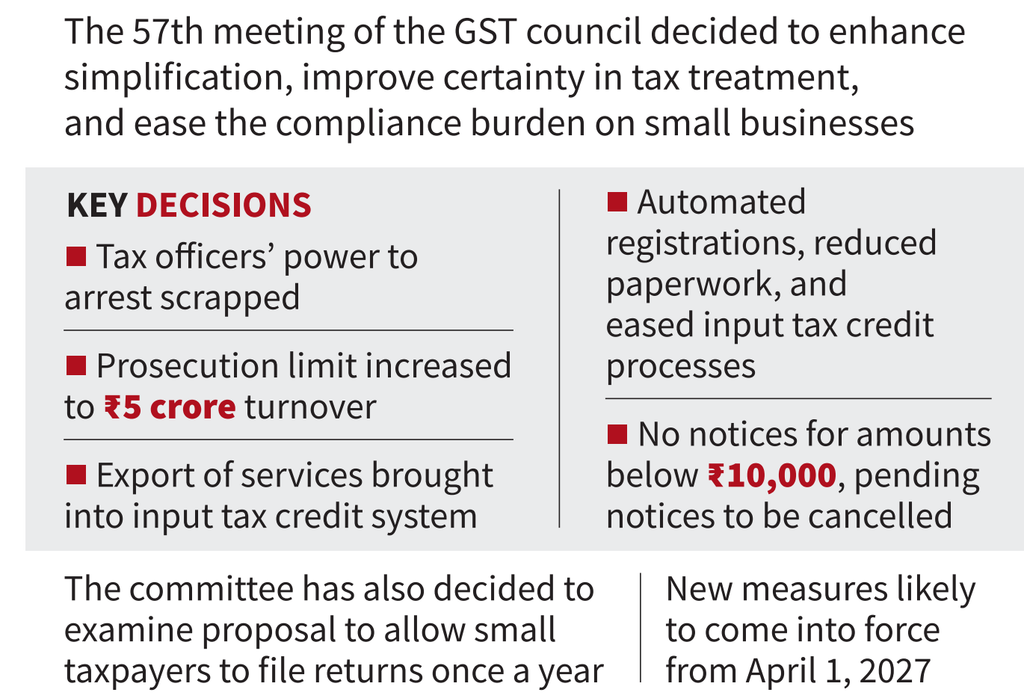
On 8 October 2026, the GST Council recommended process reforms covering registration, returns, refunds and dispute resolution, with legal implementation to follow through the relevant instruments.

  • Process reform is the central theme: reducing avoidable mismatches, officer interfaces and delays while retaining checks against fraudulent claims.
  • The proposed revised return-correction mechanism is intended for returns from April 2027, following consultation and the required legal changes.
  • The Council also recommended withdrawal of GST arrest powers through statutory amendment; the announcement does not establish that those powers have already ceased.
  • The official release explicitly distinguishes its explanatory recommendations from instruments having force of law.
  • Working capital can remain tied up when legitimate refunds are delayed; the financial constraint also helps explain the role of invoice finance.
  • Export tax relief uses different instruments: GST refunds and RoDTEP remission should not be treated as interchangeable payments.

UPSC Relevance

Prelims Relevance

  • GST Council recommendations and implementing instruments
  • Input tax credit and return reconciliation
  • Risk-based provisional refunds
  • Electronic cash ledger and electronic credit ledger
  • Natural justice and personal hearings

Mains Relevance

GS Paper 3

  • Tax administration, compliance costs and working-capital constraints.
  • Balancing faster refunds with protection against fraudulent claims.

GS Paper 2

  • Administrative discretion, reasoned decisions and access to remedies.

Essay

  • Predictable procedures can matter as much as headline tax rates.

Background and Context

A Recommendation Is Not Yet an Operative Rule

The first task is to identify the legal stage of each measure, rather than treating a meeting announcement as an immediately available entitlement.

  • The GST Council announced a package of recommendations spanning several administrative processes. The release identifies statutory amendments, rule changes and circulars as implementing routes; those routes matter because different measures require different legal steps.
  • A press release communicates the policy decision in accessible language. It does not replace the relevant legal instrument, so a taxpayer cannot establish a new entitlement solely by pointing to an announced recommendation.
  • The proposed return mechanism has a future implementation period and a consultation stage. Its intended timing must be distinguished from the date of the meeting, particularly when explaining what businesses can actually use now.
  • The proposed removal of arrest powers would require omission of the relevant statutory provision. Separately, the Council recommended changes to prosecution; neither proposal means fraud becomes lawful or every enforcement consequence disappears immediately.
  • For any measure, examine the final wording, covered transactions and commencement provisions. An announcement may describe an intended direction while leaving taxpayers dependent on subsequent instruments for the exact conditions governing its practical application.

Reconciliation and Refunds Address Different Bottlenecks

Reconciliation checks whether records agree; refunds return eligible amounts. Improving one does not remove the conditions that govern the other.

  • Input tax credit connects eligible tax paid on purchases with tax liability on supplies. The proposed return changes seek closer alignment between reported liabilities, available credit and the amounts taxpayers claim in their returns.
  • The Council proposed better correction and reconciliation facilities so mismatches can be addressed within a clearer process. The purpose is to reduce avoidable notices without treating every difference in records as deliberate tax evasion.
  • For refunds, the package proposes system-based processing and phased automation. Excess cash-ledger balances and eligible claims concerning zero-rated supplies or an inverted duty structure follow different proposed arrangements, rather than one unconditional payment rule.
  • Risk assessment remains part of the proposed automated refund design. Faster processing does not mean every submitted amount is accepted: eligibility, verification and adjustment of pending dues continue to matter within the stated arrangements.
  • Provisional sanction is distinct from final settlement. The proposed initial release of eligible refund amounts can ease financing pressure, but an early payment should not be described as proof that every claim has completed assessment.

Less Discretion Still Requires Accountable Decisions

Automation should remove repetitive friction while preserving a usable route to challenge mistakes, especially when access to money or credit is restricted.

  • The proposed registration reforms seek clearer document requirements and more automatic processing of specified changes. Standardised requirements can reduce inconsistent queries, but the release retains distinctions between categories rather than removing all scrutiny.
  • For adjudication, the Council recommended guidance on the quality and timing of notices and orders. It also emphasised that allegations involving fraud or suppression should depend on the merits of the particular case.
  • Natural justice includes a meaningful opportunity to respond before an adverse decision is reached. The package highlights personal hearings and clearer procedures, connecting administrative speed with the taxpayer’s ability to explain relevant facts.
  • For a blocked electronic credit ledger, a proposed change would allow objections and a personal hearing before the officer decides that objection. This is a proposed remedy, not proof that the revised procedure already operates.
  • Evaluation should separate processing speed from decision quality. Useful implementation questions include whether eligible refunds arrive sooner, notices explain their grounds and correction channels resolve errors without repeatedly sending taxpayers between offices and digital systems.

Way Forward

Make Each Change Traceable

  • Publish a clear implementation schedule linking each recommendation to its final instrument, commencement date and eligible category.
  • Test automated decisions against realistic mismatch cases and provide accessible routes for taxpayers to correct records or challenge errors.
  • Track refund delays and dispute quality alongside processing volumes, so reduced officer interaction does not conceal unresolved cases.

Conclusion

  • GST process reform seeks to make compliance more predictable through clearer records, faster eligible refunds and procedural safeguards. Its effects depend on legally effective instruments and reliable implementation, not the announcement alone.
  • In an answer, connect administrative simplification with liquidity and accountability: fewer avoidable steps can help businesses, while reasoned decisions and workable remedies remain necessary when the system questions a claim.

UPSC Practice Questions

Prelims MCQ 1

With reference to the GST Council’s October 2026 process-reform recommendations, consider the following statements:

  1. The explanatory press release itself gives every recommendation force of law.
  2. The proposed revised return mechanism includes a consultation stage.
  3. Risk assessment forms part of the proposed automated refund arrangements.

How many of the above statements are correct?

(a) Only one (b) Only two (c) All three (d) None

Answer: (b) Only two

Explanation:

Statements 2 and 3 are correct. The release says relevant circulars, notifications and law amendments give the recommendations legal effect; the announcement alone does not.

Prelims MCQ 2

Which distinction best explains the relationship between return reconciliation and a refund?

(a) Reconciliation cancels the need to establish refund eligibility. (b) A refund is always final whenever a return contains no mismatch. (c) Reconciliation aligns records, while a refund returns amounts subject to the applicable conditions. (d) Both necessarily involve reducing the tax rate on a product.

Answer: (c) Reconciliation aligns records, while a refund returns amounts subject to the applicable conditions.

Explanation:

Matching records and returning an eligible balance address different administrative tasks. A mismatch-free return does not by itself establish every condition for a refund.

UPSC Mains Questions

  1. How can risk-based automation improve GST administration without weakening taxpayer safeguards? Discuss. (150 words)
  2. Distinguish a tax-policy recommendation from its legal implementation. Explain why this distinction matters for evaluating the GST Council’s process reforms. (150 words)

Source: PIB, Ministry of Finance.

Frequently Asked Questions

Have the GST Council’s recommendations already become law?

The announcement does not establish that every recommendation is operative. Relevant circulars, notifications and statutory amendments provide legal effect, with their final wording and commencement provisions determining when particular changes apply.

What is the difference between reconciliation and refund processing?

Reconciliation checks alignment between reported liabilities, invoices and credit records. Refund processing determines whether an amount can be returned under the applicable conditions. Improving record consistency does not automatically establish a right to every claimed refund.

Does an automated refund mean there are no checks?

No. The proposed arrangements include system verification and risk assessment for relevant claims. Automation changes how processing occurs; it does not mean eligibility conditions or the distinction between provisional and final sanction disappear.

Did the Council abolish GST arrest powers immediately?

The Council recommended withdrawing GST arrest powers through a statutory amendment. The press release does not itself remove that provision. Separate recommendations address prosecution, so withdrawal of arrest powers should not be equated with legalising fraud.

Hydrogen Standards: Finding Gaps Across the Safety Chain

Open article →Download PDF

Why in News?

On 8 October 2026, MNRE released India’s Hydrogen Standards: Gap Assessment and Preliminary Action Framework, alongside discussions on safety across hydrogen production, storage, transport and use.

  • The gap assessment examines existing hydrogen standards and areas needing attention; its preliminary framework should not be mistaken for newly binding safety rules.
  • The discussions emphasised testing, training and coordination between public agencies, industry and experts, alongside clearer standards across the hydrogen chain.
  • Participants included BIS, PNGRB, PESO and OISD, reflecting the need to connect technical standards with different parts of industrial safety governance.
  • The PIB announcement does not list the report’s individual findings or specify new technical limits.
  • Scale-up creates connections between equipment, sites and operators; safe operation depends on the reliability of these interfaces as well as individual components.
  • A published framework identifies work to undertake. Demonstrating that facilities follow suitable requirements is a separate implementation task.

UPSC Relevance

Prelims Relevance

  • Gap assessment versus binding technical requirement
  • Hydrogen leak detection and ventilation
  • Material compatibility and hydrogen embrittlement
  • Equipment testing and operational training
  • Production, storage, transport and end-use interfaces

Mains Relevance

GS Paper 3

  • Safety infrastructure for emerging energy technologies.
  • Connecting technical standards, testing capacity and industrial deployment.

GS Paper 2

  • Coordinating agencies without leaving unclear responsibilities between them.

Essay

  • A new technology needs institutions that can test its claims.

Background and Context

What a Standards Gap Assessment Establishes

The new report concerns the adequacy of the standards system; its publication does not establish that every identified problem has already been resolved.

  • A gap assessment examines existing coverage against the requirements of an activity. Here, the announced scope spans hydrogen production, storage, transport and use, rather than judging the safety of one named plant or component.
  • The report’s preliminary action framework signals a basis for further work. It should not be described as a completed regulatory overhaul, an operating licence or proof that every facility now meets a common requirement.
  • The announcement does not reproduce the specific gaps or proposed technical provisions. Exact pressure limits, equipment specifications and compliance deadlines cannot be inferred merely from the report’s title or the list of participating institutions.
  • A technical standard and an enforceable obligation require separate examination. For any claimed new duty, identify the actual applicable instrument, its scope and implementation arrangements; the release itself does not supply those details here.
  • The immediate policy message is about connected safety capacity: clearer requirements need testing facilities, trained personnel and institutional coordination. Publishing a document is a starting point for that work, rather than evidence of completed delivery.

Why Hydrogen Needs Controls Matched to Its Properties

Established safety science explains why such standards matter; the following examples are general background, not a reconstruction of the report’s detailed findings.

  • Hydrogen is much lighter than air and can disperse quickly after release. That property does not remove the need for suitable ventilation and leak detection, particularly where equipment or surrounding structures affect dispersal.
  • Hydrogen has a wide flammable range in air and can ignite with relatively little energy. Safety design must address leakage and ignition sources together, instead of assuming that preventing one visible failure controls every risk.
  • A hydrogen flame can be difficult to see, making appropriate flame detection important. Detecting a gas release and detecting combustion answer different questions, so the relevant protective equipment needs to match the hazard being monitored.
  • Some metals can become brittle through hydrogen exposure. Material compatibility matters for the integrity of equipment; a material suitable for another application cannot automatically be assumed suitable for the intended hydrogen service conditions.
  • The US Department of Energy’s safety guidance links engineering controls with testing and training. This supports the general safety rationale; it neither prescribes Indian legal duties nor establishes the new report’s specific conclusions.

Connecting Requirements, Tests and Operators

The governance challenge is to make responsibilities clear across the chain, while checking whether a written requirement works in actual equipment and practice.

  • Production, storage, transport and use are connected stages with different equipment and operating conditions. As an implementation principle, each handover needs clear responsibilities so a problem is not left between the organisations managing adjacent stages.
  • A standard describes relevant requirements; testing provides evidence about performance against them. These functions complement each other, because a written specification cannot by itself demonstrate how a particular component or system behaves during assessment.
  • Training addresses the human side of implementation. Personnel must understand the systems they operate and the procedures relevant to their roles; buying protective equipment alone does not demonstrate that an organisation can use it appropriately.
  • The involvement of multiple institutions shows why coordination matters, but attendance does not transfer statutory powers. The announcement should not be read as assigning one participant exclusive authority over every stage of India’s hydrogen economy.
  • Implementation should be judged through verifiable capability: accessible requirements, credible testing and competent operation. These are analytical evaluation questions, not reported results; the release provides no measured reduction in incidents following publication of the framework.

Way Forward

Turn the Assessment Into Verifiable Work

  • Make the identified gaps and proposed actions accessible, distinguishing existing requirements from items still needing consultation or technical development.
  • Assign clear responsibilities and interfaces for each action, using the applicable legal framework rather than assuming that participation at a meeting establishes jurisdiction.
  • Connect testing capacity and role-specific training to deployment decisions, and assess implementation through evidence of performance rather than document counts.

Conclusion

  • Hydrogen safety depends on matching engineering controls to physical properties and making those controls work through testing, trained operators and clear responsibilities. A standards assessment can identify the work needed, but cannot complete it by publication.
  • For a policy answer, distinguish assessment, implementation and demonstrated outcomes. The October release establishes a new preliminary framework and coordination agenda; it does not establish newly binding rules or measured improvements in facility safety.

UPSC Practice Questions

Prelims MCQ 1

With reference to India’s recently released hydrogen standards gap assessment, consider the following statements:

  1. Its publication by itself proves that new binding technical limits have taken effect.
  2. The announcement covers production, storage, transport and use of hydrogen.
  3. The announcement emphasises testing, training and coordination.

How many of the above statements are correct?

(a) Only one (b) Only two (c) All three (d) None

Answer: (b) Only two

Explanation:

Statements 2 and 3 reflect the PIB release. The report is a gap assessment and preliminary action framework; publication alone does not establish new binding limits.

Prelims MCQ 2

Which statement best describes the relationship between a safety standard and equipment testing?

(a) Publishing a standard proves that all existing equipment complies. (b) Testing removes the need to specify the conditions of safe use. (c) A standard states requirements, while testing supplies evidence about performance against them. (d) Both are substitutes for training personnel.

Answer: (c) A standard states requirements, while testing supplies evidence about performance against them.

Explanation:

A requirement and evidence of compliance serve different functions. They work alongside competent operation and training, rather than replacing either.

UPSC Mains Questions

  1. Why must India connect hydrogen standards with testing capacity and institutional coordination? Discuss. (150 words)
  2. Distinguish a preliminary safety framework from effective implementation. Explain how this distinction should guide assessment of emerging energy technologies. (150 words)

Sources: PIB, Ministry of New and Renewable Energy and US Department of Energy.

Frequently Asked Questions

Did India notify new hydrogen safety rules through this report?

The announcement describes a gap assessment and preliminary action framework. It does not establish newly binding rules. Any claim about a new obligation must be checked against the relevant instrument and its scope.

What does a standards gap assessment do?

It examines existing standards and areas needing attention. The release describes this broad purpose but does not reproduce individual gaps, technical limits or detailed actions, so those specifics cannot be inferred from the announcement.

Why must testing accompany written standards?

A written requirement sets an expectation; testing supplies evidence about performance against that expectation under specified conditions. The presence of a document alone cannot establish that a particular component or facility meets its requirements.

Why were several institutions involved in the discussions?

Hydrogen activities span production, storage, transport and use, making coordination important. Participation by several institutions reflects that breadth, but does not itself redefine their statutory powers or create a single authority for every activity.

JOSH Teams: Defining Volunteers’ Role in TB Care

Open article →Download PDF

Why in News?

On October 8, 2026, the government launched JOSH teams under TB Mukt Bharat Abhiyaan, creating a structured role for youth volunteers in community outreach and patient support.

  • Each Joint Squad for Health team comprises five MY Bharat volunteers and five NCC cadets.
  • A designated Class-I officer leads each team at block or ward level.
  • The first phase covers 55 districts across 11 States and Union Territories; remaining districts will undertake orientation and mobilisation.
  • The initiative brings together the health, youth affairs and defence ministries to support community engagement.
  • Youth networks can extend community reach, but participation requires supervision and a clear division of responsibilities.
  • Trust and dignity matter when outreach workers discuss a condition associated with fear and discrimination.

UPSC Relevance

Prelims Relevance

  • JOSH: Joint Squad for Health.
  • Team composition: MY Bharat volunteers and National Cadet Corps cadets.
  • Local leadership: designated Class-I officer at block or ward level.
  • Implementation: phased deployment under TB Mukt Bharat Abhiyaan.

Mains Relevance

GS Paper 2

  • Health governance: coordinating volunteers, local administration and professional services.
  • Social justice: consent, confidentiality and protection against disease-related discrimination.

Essay

  • Public participation strengthens institutions when responsibility accompanies enthusiasm.

Background and Context

How Are JOSH Teams Organised?

The new institutional feature is an organised youth team linked to local administrative leadership, rather than an independent clinical service.

  • The team composition combines MY Bharat volunteers with National Cadet Corps cadets. Bringing these networks into a common unit gives community outreach an identifiable structure instead of leaving participation entirely to separate local campaigns.
  • A designated Class-I officer leads the team at block or ward level. This identifies administrative leadership; the announcement does not make the officer a medical specialist or transfer clinical decisions to youth volunteers.
  • The health ministry implements the initiative with the youth affairs and defence ministries. This arrangement connects the health programme with youth networks, while local work still requires coordination with health workers and community institutions.
  • Teams are envisaged as a community interface: explaining TB-related messages, addressing misconceptions, encouraging care-seeking and supporting treatment completion. Their practical contribution lies in helping people remain connected with services rather than replacing those services.
  • The first-phase deployment is limited to the announced districts. Participation in the national launch and a plan for wider mobilisation are different from having trained, supervised teams already operating in every district across India.

Where Does Volunteer Authority End?

An outreach role can support care without creating independent authority to diagnose, prescribe or compel participation.

  • The launch announcement assigns awareness and support functions, not independent diagnostic or prescribing powers. A volunteer’s participation in a government programme should never be presented as proof of professional medical qualification or clinical authority.
  • Treatment support means helping people follow prescribed care and raising difficulties with the health team. It should not become permission to alter medicines, interpret clinical findings independently or assure someone that professional advice is unnecessary.
  • For effective officer accountability, local arrangements should specify whom volunteers contact when families raise medical concerns, service complaints or privacy problems. These are recommended implementation safeguards, not detailed powers already established by the launch release.
  • Training and supervision should cover communication, respectful household contact and escalation of concerns. Clear role descriptions help volunteers recognise when a question exceeds their competence and when a qualified health professional must take responsibility.
  • The WHO community-engagement guidance treats community and health systems as complementary. The useful governance principle is partnership: affected people help shape services, while public institutions retain responsibility for providing accessible, competent care.

How Should Local Teams Protect Trust?

The same neighbourhood familiarity that helps outreach can expose people to stigma unless teams handle information and participation carefully.

  • Confidentiality should guide household conversations and reporting. Volunteers should avoid identifying affected people in public gatherings or informal messaging groups; administrative convenience is not a sufficient reason to circulate someone’s private health information unnecessarily.
  • Informed participation requires an understandable explanation of the activity and a genuine opportunity to ask questions. WHO guidance requires consent for screening and respect for refusal, so outreach should encourage engagement without threats or humiliation.
  • The announced digital reporting feature supports team activity, but its existence does not establish that all privacy safeguards are operational. Local implementation should clarify authorised access, necessary information and responsibility for correcting mistakes in reports.
  • Community feedback should influence outreach plans, including where and how conversations take place. People affected by TB can identify language, timing or behaviour that makes a well-intended visit intrusive, discouraging or difficult to participate in.
  • Phased expansion offers an opportunity to correct training and coordination problems before wider deployment. Recognition of TB-Mukt Panchayats is a separate programme achievement; it should not be read as proof of zero cases or national elimination.

Way Forward

Turn Team Leadership Into Practical Accountability

  • Give each team a clear role sheet, a named health-service contact and a route for escalating concerns beyond volunteer competence.
  • Train members in confidential communication and consent, using realistic household situations rather than relying only on publicity material.
  • Review supervision and community feedback during phased expansion, fixing coordination failures before increasing the number of operational teams.

Conclusion

  • JOSH’s contribution is an organised partnership between youth networks and local administration. Its value will depend on whether leadership, training and health-service coordination make volunteer support dependable while keeping clinical responsibility with qualified personnel.
  • Community trust is part of effective public-health delivery. Clear authority limits, respectful participation and protected information can help teams strengthen access to care without turning neighbourhood outreach into an intrusive or coercive exercise.

UPSC Practice Questions

Prelims MCQ 1

With reference to JOSH teams, consider the following statements:

  1. A team includes MY Bharat volunteers and NCC cadets.
  2. A designated Class-I officer leads the team at block or ward level.
  3. The first-phase announcement establishes completed operational deployment in every Indian district.

How many of the above statements are correct?

(a) Only one (b) Only two (c) All three (d) None

Answer: (b) Only two

Explanation:

Statements 1 and 2 reflect the announced team design. Statement 3 is incorrect: first-phase deployment covers 55 districts across 11 States and Union Territories, with wider orientation and mobilisation to follow.

Prelims MCQ 2

Which arrangement best preserves the role boundary of a JOSH volunteer?

(a) Independently changing prescribed medicines when a patient reports difficulty. (b) Publishing household health information to increase community participation. (c) Supporting prescribed care and referring medical concerns to the responsible health team. (d) Treating attendance at a national launch as authority to issue medical certificates.

Answer: (c) Supporting prescribed care and referring medical concerns to the responsible health team.

Explanation:

The announced functions concern community outreach and support. These do not create independent clinical powers. Competent care and privacy require supervision, appropriate escalation and protection of personal information.

UPSC Mains Questions

  1. How can JOSH teams strengthen community participation in TB care while preserving professional accountability? Discuss with reference to their institutional design. (150 words)
  2. Youth participation in public health requires clear authority limits and protection of dignity. Examine the safeguards needed when expanding volunteer-led outreach. (250 words)

Sources: PIB, Ministry of Health and Family Welfare and World Health Organization.

Frequently Asked Questions

What does JOSH stand for?

JOSH stands for Joint Squad for Health. The teams bring MY Bharat volunteers and NCC cadets into community TB outreach under designated local officers, linking youth participation with the TB Mukt Bharat Abhiyaan.

Who leads a JOSH team?

The announced structure places each team under a designated Class-I officer at block or ward level. Administrative leadership supports coordination, but it does not give volunteers independent authority to diagnose disease or prescribe treatment.

Have JOSH teams already been deployed nationwide?

No. The first phase covers 55 districts across 11 States and Union Territories. Other districts will undertake orientation and mobilisation. A national launch should not be confused with completed operational deployment everywhere.

Can JOSH volunteers make medical decisions?

The launch assigns outreach, awareness and patient-support functions, not independent clinical powers. Volunteers can help people stay connected with prescribed care and raise concerns with health personnel, while qualified professionals retain responsibility for medical decisions.

Manipulated Content Advisory: Platform Duties and Legal Safeguards

Open article →Download PDF

Why in News?

The Hindu reported that MeitY issued a manipulated content advisory on October 8, 2026, asking social media platforms to scrutinise misleading material, including authentic footage presented in a false context.

  • The report attributes the advisory to the Ministry of Electronics and Information Technology, or MeitY.
  • Its reported scope includes archived photographs and videos passed off as current events.
  • The report says platforms were asked to prioritise complaints from authorised government agencies.
  • Authenticity concerns whether material was fabricated or altered; context concerns whether its accompanying claim accurately describes it.
  • Public-order protection and safeguards against unjustified removal must be considered together when designing platform responses.

UPSC Relevance

Prelims Relevance

  • MeitY and intermediary governance.
  • Difference between synthetic media and misleading reuse of authentic footage.
  • Section 69A and blocking of public access to information.
  • Difference between an advisory, a complaint and a statutory order.

Mains Relevance

GS Paper 2

  • Digital governance, lawful speech and accountable administration.
  • Procedural safeguards in restrictions on online information.

GS Paper 3

  • Manipulated media, verification and public-order risks.

Essay

  • Trust depends on both reliable information and fair institutions.

Background and Context

Why Genuine Footage Can Still Mislead

A video can accurately record an event while the claim attached to it misidentifies the time, place or people involved.

  • Synthetic media creates or alters apparent evidence, such as a fabricated voice recording. A misleading caption can deceive without changing the original recording, so checking pixels alone cannot settle every disputed claim.
  • Archived footage illustrates the distinction: a genuine recording of an earlier disturbance may be presented as a new incident. The verification question becomes when and where the scene occurred, rather than whether it exists.
  • Selective editing can also remove an explanation that changes a speaker’s meaning. Comparing a short clip with its longer source helps separate a faithful excerpt from a materially misleading presentation of the same exchange.
  • Public-order risk depends on what the claim encourages audiences to believe or do. For example, wrongly identifying an old incident as ongoing could prompt avoidable fear, even when the underlying photograph is genuine.
  • Verification should examine the original upload, surrounding footage and corroborating accounts together. A missing timestamp creates uncertainty; it does not by itself prove fabrication, malicious intent or a sufficient legal basis for removal.

Separate the Advisory From a Blocking Order

The reported request for greater diligence must be distinguished from the legal authority and procedure supporting a particular restriction.

  • The Hindu reports that the advisory covers manipulated and misleadingly contextualised material. Its account establishes the reported administrative request; it should not be presented as the text of a newly enacted statutory prohibition.
  • An advisory is not, by itself, an amendment to an Act. Any claim that this communication changes a platform’s enforceable obligations requires examination of its wording, applicable rules and the authority relied upon.
  • Section 69A of the IT Act empowers the Central Government or a specially authorised officer to order public-access blocking on specified grounds, including public order. MeitY publishes the statutory provision.
  • Written reasons and prescribed procedure and safeguards are part of that provision. The existence of a public-order concern does not erase these requirements or establish that every disputed post meets the applicable statutory conditions.
  • Complaint priority describes which reports receive attention first; a binding order raises a separate question of legal authority. Receiving a government complaint should not automatically be described as receiving a Section 69A blocking order.

Design Safeguards Around the Actual Harm

A useful policy response should identify the misleading claim, explain the harm and match the intervention to the evidence available.

  • Context correction may address an incorrect date or location when removal is unnecessary and no binding legal requirement demands it. This is a policy option, not a substitute for compliance with applicable law.
  • Human review is especially useful where satire, documentary archives or criticism resemble misleading content when viewed alone. Reviewers should examine the surrounding explanation before treating an isolated image or phrase as decisive evidence.
  • Proportionality asks whether the response addresses the identified harm without unnecessarily suppressing other material. Removing a specific unlawful post and disabling an entire account have different consequences for access to otherwise lawful information.
  • Grievance safeguards should let affected users contest factual mistakes and receive a meaningful explanation, subject to applicable legal limits. A correction process matters because rapid moderation can misclassify both fabricated and authentic material.
  • Accountability should include records of the complaint, evidence considered, authority invoked and action taken. Aggregate reporting on reversals can reveal recurring mistakes without unnecessarily exposing complainants, victims or sensitive personal information to public attention.

Way Forward

Make Each Decision Traceable

  • Require reviewers to distinguish fabrication, misleading context and a disputed opinion before choosing an intervention.
  • Record the legal basis separately from the source and priority of each complaint.
  • Use contextual explanations where suitable and provide a practical route to reconsider mistaken moderation decisions.

Conclusion

  • Authenticity and context are separate tests: a real recording can support a false claim, while an edited recording is not automatically unlawful. Strong answers explain the mechanism before proposing the remedy.
  • Administrative urgency should be assessed alongside authority, evidence and safeguards. The central governance question is how to respond quickly to harmful misinformation while keeping each restriction justified, traceable and open to appropriate challenge.

UPSC Practice Questions

Prelims MCQ 1

With reference to online manipulated content, consider the following statements:

  1. An authentic archived video can mislead when presented as a current event.
  2. Detecting whether pixels were altered necessarily establishes whether the accompanying caption is accurate.
  3. Section 69A provides for recorded written reasons when issuing a blocking order.

How many of the above statements are correct?

(a) Only one (b) Only two (c) All three (d) None

Answer: (b) Only two

Explanation:

Statements 1 and 3 are correct. Authenticity does not establish context, and Section 69A requires reasons to be recorded in writing. Statement 2 is incorrect.

Prelims MCQ 2

Which approach best distinguishes complaint handling from statutory blocking?

(a) Every government complaint is automatically a Section 69A order. (b) Prioritising a complaint removes the need to examine its legal basis. (c) Complaint priority and the legal authority for a binding order must be assessed separately. (d) Authentic photographs can never be misleading.

Answer: (c) Complaint priority and the legal authority for a binding order must be assessed separately.

Explanation:

Priority determines attention to a report. A statutory blocking order depends on the applicable authority, grounds and procedure; these cannot be inferred merely from complaint priority.

UPSC Mains Questions

  1. Distinguish fabricated media from authentic content presented in a misleading context. Discuss how this distinction should inform platform moderation. (150 words)
  2. Examine how legal authority, proportionality and grievance safeguards can reconcile rapid action against harmful online misinformation with protection of lawful expression. (250 words)

Sources: The Hindu and MeitY: Section 69A statutory text.

Frequently Asked Questions

What is the reported MeitY manipulated content advisory?

The Hindu reports that MeitY asked platforms to scrutinise manipulated and misleadingly contextualised material, including old footage presented as current. The reported communication should be distinguished from an amendment to legislation.

Can an authentic video still be misleading?

Yes. Its caption may falsely identify the place, date or people involved. Authenticity checks establish whether the recording is genuine; contextual checks examine whether the claim attached to it is accurate.

What does Section 69A concern?

Section 69A concerns orders blocking public access to information on specified grounds. It identifies the competent authority, requires written reasons and makes blocking subject to prescribed procedure and safeguards.

Does prioritising a government complaint make it a blocking order?

Priority alone does not establish that a complaint is a statutory blocking order. The authority invoked, relevant legal requirements and the contents of the actual communication must be examined separately.

Wildlife Crossings: Keeping Habitats Connected Across Highways

Open article →Download PDF

Why in News?

On October 8, 2026, NHAI announced its recently released Wildlife Mitigation Measures & Structures reference document, highlighting wildlife crossings and ecological safeguards in national highway planning.

  • NHAI reported more than 2,150 structures constructed and/or proposed; this is not a count of completed wildlife crossings.
  • The document covers underpasses, overpasses, adapted culverts and canopy crossings, alongside fencing, signage and speed regulation.
  • The framework emphasizes site-specific planning, guided by ecological sensitivity, animal movement and engineering feasibility.
  • The announcement describes a reference framework; it does not announce a new mandatory wildlife-crossing statute.
  • Roads can connect settlements while creating barriers between habitats used by the same wildlife population.
  • Effective mitigation must address both collision risk and the ability of animals to move through a connected landscape.

UPSC Relevance

Prelims Relevance

  • Habitat fragmentation: division of habitat into smaller, separated patches.
  • Barrier effect: infrastructure impedes wildlife movement across a landscape.
  • Animal underpass: a passage beneath the road for wildlife movement.
  • Canopy crossing: an elevated connection relevant to tree-dwelling animals.
  • Camera trapping: a tool for recording animal movement and crossing use.

Mains Relevance

GS Paper 3

  • Reconciling transport infrastructure with biodiversity conservation.
  • Using ecological outcomes to evaluate wildlife mitigation investments.

GS Paper 2

  • Coordination between highway agencies, forest authorities and conservation specialists.

Essay

  • Development must preserve the ecological connections on which landscapes depend.

Background and Context

Why Roads Fragment Wildlife Habitats

A highway can affect animals even when they never collide with a vehicle; its ecological footprint includes the movement it prevents.

  • Habitat fragmentation occurs when a continuous habitat is divided into smaller patches. A road can separate feeding, resting or breeding areas, making the remaining habitat less useful to animals needing several resources.
  • The barrier effect concerns movement across the road. An animal may avoid traffic or disturbance, leaving suitable habitat physically present but difficult to reach from the other side of the highway.
  • Wildlife–vehicle collisions are a different impact: animals attempt to cross and encounter moving vehicles. Reducing collision risk protects wildlife and road users, but does not by itself establish that habitat connections remain functional.
  • Ecological connectivity means animals can move between habitat areas. For conservation planning, the relevant question is whether a road permits necessary movement, rather than whether forest cover survives on each side.
  • A crossing structure addresses a particular road barrier within a wider landscape. Its usefulness depends on accessible habitat at both ends; a technically sound passage cannot compensate for every loss of surrounding habitat.

How Crossings and Guide Fences Work Together

Crossings provide passage; guide fences help animals find it. The design must fit the species, terrain and movement route at that location.

  • Underpasses carry animal movement beneath a road, while overpasses carry it above. NHAI includes both approaches, allowing ecological requirements and engineering conditions to influence the form chosen for a particular corridor.
  • Adapted culverts and bridge-integrated passages can also provide routes for fauna. Listing a structure as a crossing does not establish suitability for every animal; passage design must respond to the intended users.
  • Canopy crossings address movement above ground for tree-dwelling animals. They illustrate why a single standard structure cannot meet every need: the relevant movement level and behavior differ across wildlife species and habitats.
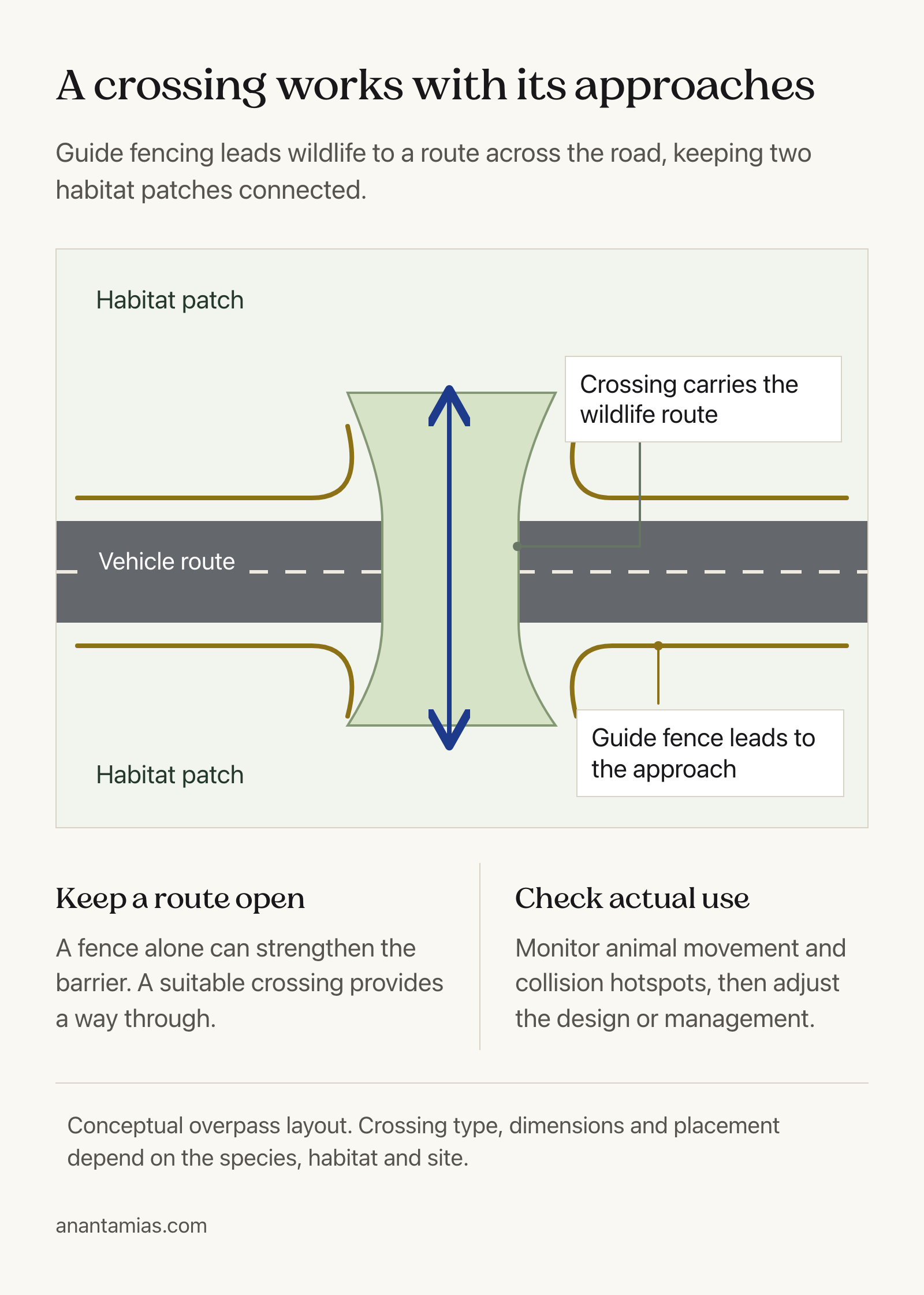
  • Guide fencing directs animals toward designated passages instead of leaving road entry unrestricted. Fencing and crossings must operate together; a barrier that blocks movement without an accessible passage does not restore ecological connectivity.
  • Noise barriers, signage and speed regulation complement structural measures by addressing disturbance and traffic risk. They serve different functions, so warning drivers cannot substitute for providing an animal with a usable crossing route.
Conceptual top view of a wildlife overpass connecting habitat across a highway, with guide fencing directing animals toward its approaches.
A crossing and its guide-fenced approaches work together to maintain habitat connectivity. Conceptual layout; site and species determine the actual design.

Measuring Results Beyond Construction Counts

A completed passage is an infrastructure output. Its conservation value requires evidence that wildlife uses it and that the intervention addresses the local problem.

  • NHAI reports camera trapping to assess movement and evaluate mitigation measures. Records can show which animals approach or use a structure, helping managers examine whether its actual use matches the intended ecological purpose.
  • Collision-hotspot records identify places needing attention. Monitoring should examine crossing use alongside collision patterns, because an apparent reduction in collisions could reflect animals being unable to cross rather than a restored movement route.
  • The announced total combines constructed and proposed structures. It describes a mixed implementation pipeline, so it cannot support a claim that every listed passage is operational or has already delivered measured conservation benefits.
  • The reference document describes mitigation approaches across highway projects. Existing statutory environmental requirements remain relevant; describing good practice in a reference framework is different from creating a new legal obligation through legislation.
  • Periodic evaluation makes mitigation a continuing responsibility after construction. Where observations show weak use or persistent collision risks, managers should investigate the crossing, its approaches and surrounding conditions before assuming the intervention has succeeded.

Way Forward

Plan for Movement and Verify Use

  • Map wildlife movement routes early enough to influence highway alignment and crossing placement, involving conservation specialists alongside road engineers.
  • Define target species and local outcomes before choosing a structure; preserve accessible habitat and maintain the approaches, fencing and passage.
  • Publish separate proposed, completed and monitored counts, then use crossing observations and collision records to guide repairs and design improvements.

Conclusion

  • Wildlife crossings should be judged as connections within living landscapes. Their value depends on species-appropriate design, usable approaches and evidence of movement, as well as the engineering work that creates the passage.
  • For infrastructure policy, distinguish building a structure from achieving a conservation outcome. NHAI’s reference framework provides a planning basis; credible implementation requires continued coordination and monitoring at the places where highways intersect wildlife movement.

UPSC Practice Questions

Prelims MCQ 1

With reference to wildlife mitigation along highways, consider the following statements:

  1. Guide fencing can direct wildlife toward designated crossing structures.
  2. A canopy crossing and an animal underpass necessarily serve identical movement requirements.
  3. Camera trapping can help evaluate wildlife use of crossing structures.

How many of the above statements are correct?

(a) Only one (b) Only two (c) All three (d) None

Answer: (b) Only two

Explanation:

Statements 1 and 3 are correct. Fencing guides movement and camera traps help record crossing use. Statement 2 is incorrect: canopy crossings serve movement above ground, while underpasses provide routes beneath roads.

Prelims MCQ 2

Which finding most directly demonstrates wildlife use of a newly completed highway underpass?

(a) The project’s expenditure exceeds its original estimate. (b) The underpass is included in a national list of proposed structures. (c) Repeated camera records show the intended animals passing through it. (d) Warning signs are installed along the neighboring highway.

Answer: (c) Repeated camera records show the intended animals passing through it.

Explanation:

Observed passage supplies direct evidence of use. Expenditure, proposals and warning signs do not show animals using the underpass. Crossing use alone still does not prove every long-term population benefit.

UPSC Mains Questions

  1. Explain how highway development can fragment wildlife habitats. Discuss the roles of species-specific crossings and guide fencing in maintaining ecological connectivity.
  2. Why are construction counts insufficient to evaluate wildlife mitigation along highways? Suggest a monitoring and coordination framework for assessing conservation outcomes.

Sources: PIB, Ministry of Road Transport and Highways and Wildlife Institute of India.

Frequently Asked Questions

What are wildlife crossings?

Wildlife crossings are structures that help animals move across infrastructure barriers. They include underpasses, overpasses, adapted culverts and canopy connections, with designs selected according to species, habitat conditions and movement patterns.

Are all the reported NHAI wildlife structures completed?

No. The October 8 announcement combines more than 2,150 structures constructed and/or proposed. That figure should not be presented as the number of operational crossings or as evidence of measured conservation success.

Why do wildlife crossings need guide fencing?

Guide fencing directs animals toward designated passages and helps limit unsafe entry onto the road. Fencing needs accessible crossings: blocking movement alone can strengthen a barrier instead of restoring connections between habitats.

Does the NHAI document create a new wildlife-crossing law?

The announcement describes a reference framework documenting mitigation measures and structures used across highway projects. It does not announce a new statute, and project implementation must still consider existing statutory environmental requirements.

How can wildlife-crossing performance be assessed?

Camera traps can record crossing use, while collision records help identify persistent risks. Evaluations should consider the intended species and local movement needs, rather than treating construction or isolated animal sightings as complete proof of success.

PRASHAST: Making Inclusion a Whole-School Responsibility

Open article →Download PDF

Why in News?

On October 8, 2026, the Education Ministry reported a nationwide PRASHAST training-module screening to help teaching and non-teaching staff make schools more inclusive for children with special needs.

  • The event involved showing an inclusive-education module; this differs from using the PRASHAST checklist to screen children for probable disabilities.
  • The module addresses whole-school participation, including drivers, aayahs, office personnel and wardens alongside teachers and special educators.
  • The initiative builds on ongoing teacher sensitisation; the announcement does not describe a newly launched PRASHAST portal.
  • Inclusion depends on transport, shared spaces and staff interactions as well as classroom teaching.
  • Early observation becomes useful when it leads to appropriate support and referral, without turning a preliminary concern into a diagnosis.

UPSC Relevance

Prelims Relevance

  • PRASHAST as a school-based digital screening tool.
  • Observable indicators and probable disability conditions.
  • Teachers, special educators and medical-assessment roles.
  • Whole-school inclusion extending to non-teaching personnel.

Mains Relevance

GS Paper 2

  • Inclusive education and barriers affecting children with special needs.
  • Public-service coordination between schools, specialists and families.
  • Implementation quality beyond enrolment and training attendance.

Essay

  • Equal opportunity requires institutions to change everyday practices.

Background and Context

What the Nationwide Screening Actually Means

The announcement concerns shared staff training, while PRASHAST also supports a separate process for identifying children who may need further assessment.

  • Module screening means presenting training content to school personnel. It should not be reported as a nationwide medical examination of children, because the announced activity and the checklist serve different purposes within inclusive education.
  • The Department of School Education and Literacy organised the initiative through PRASHAST. Its purpose is to help personnel recognise their contribution to an accessible, safe and supportive school, rather than assign inclusion solely to specialists.
  • Practical examples and interactive activities form part of the module, according to the official release. The intended learning concerns respectful everyday conduct and appropriate support across different school roles.
  • Non-teaching personnel include drivers, aayahs, receptionists, clerical staff and wardens. Their inclusion matters because a child encounters adults beyond the classroom, and each encounter can either reduce a barrier or reinforce exclusion.
  • Continuity is part of the news: teacher sensitisation was already underway before this event. The current emphasis is shared school responsibility, so describing the announcement as the first launch of the portal would misstate it.

From Observation to Appropriate Referral

PRASHAST identifies possible needs through a staged process; a school checklist must not be mistaken for a clinical diagnosis or disability certificate.

  • School-based screening uses observable indicators to identify probable disability conditions. The word probable matters: an initial concern signals a need for further examination rather than establishing a confirmed condition or explaining every difficulty a child experiences.
  • Teachers use the checklist to observe students in the school setting. Their contribution is structured information about what they notice, not an independent medical determination about the cause or severity of a possible condition.
  • Special educators validate cases within the process described by the ministry and help facilitate referral where required. This adds a specialist educational stage between initial observation and a decision to seek medical assessment.
  • Medical assessment belongs to the referral stage when needed. Validation of a screening concern by a special educator should not be described as a medical diagnosis, and teacher observation should not be presented as disability certification.
  • Role clarity prevents both neglect and premature labelling. A useful record should distinguish what was observed, who reviewed the concern and what follow-up was advised, instead of merging these separate steps into one assumed conclusion.

Why Inclusion Extends Beyond the Classroom

A whole-school approach asks whether the child can participate throughout the school day, not simply whether a place has been provided in class.

  • Transport access is an everyday example: difficulty boarding or alighting can undermine attendance before a lesson begins. Drivers and accompanying staff should know the agreed support arrangements and communicate access problems to the responsible school personnel.
  • Shared spaces also shape participation. An accessible classroom alone is insufficient if the route to a toilet, office or assembly area remains difficult to use; staff need to identify barriers across the child’s daily routine.
  • Respectful interaction should extend to reception desks, hostels and playgrounds. Staff should ask what assistance is needed rather than assume inability, while avoiding public discussion that exposes a child’s personal difficulties to unnecessary attention.
  • Family communication should explain observations in understandable terms and distinguish a concern from a confirmed diagnosis. Schools can discuss the next step without presenting referral as proof that something definitive has been established about the child.
  • Implementation quality should be judged through practical follow-up: whether staff respond appropriately, barriers are addressed and recommended referrals progress. Participation in a training event alone cannot establish that a child’s everyday school experience has improved.

Way Forward

Connect Training With Everyday Responsibilities

  • Allocate role-specific actions after training, including transport assistance, accessible routes and a named contact for follow-up concerns.
  • Keep observation and referral records clear, confidential and limited to information needed for appropriate support.
  • Review unresolved barriers with families and relevant professionals; measure completed support actions alongside training participation.

Conclusion

  • Whole-school inclusion connects teaching, transport, common spaces and staff behaviour. PRASHAST is useful in this discussion because identifying a probable need is only the beginning of a coordinated response that should improve participation.
  • Screening is not diagnosis: teachers observe, special educators validate concerns and facilitate referral, and medical assessment follows where required. An answer should preserve these boundaries while explaining how school personnel can support the child throughout.

UPSC Practice Questions

Prelims MCQ 1

With reference to PRASHAST and the reported inclusive-education initiative, consider the following statements:

  1. Showing a sensitisation module and screening a child through a checklist are distinct activities.
  2. Teacher observation through the checklist constitutes disability certification.
  3. The whole-school approach includes non-teaching staff.

How many of the above statements are correct?

(a) Only one (b) Only two (c) All three (d) None

Answer: (b) Only two

Explanation:

Statements 1 and 3 are correct. The reported event showed a training module, while checklist screening identifies probable conditions. Teacher observation does not constitute disability certification.

Prelims MCQ 2

Which sequence best reflects the PRASHAST process described by the Education Ministry?

(a) Teacher certification, followed by removal from regular schooling. (b) Medical diagnosis by transport staff, followed by teacher approval. (c) Teacher observation, special-educator validation and medical referral where required. (d) Training attendance, followed automatically by a confirmed disability diagnosis.

Answer: (c) Teacher observation, special-educator validation and medical referral where required.

Explanation:

The ministry describes teachers screening through observable indicators, special educators validating cases and facilitating medical assessment where necessary. None of these preliminary steps should be equated with automatic diagnosis.

UPSC Mains Questions

  1. Explain why inclusive education requires participation by non-teaching personnel as well as classroom teachers. Illustrate with practical school-level examples. (150 words)
  2. Distinguish school-based disability screening from diagnosis and certification. Discuss how coordination among teachers, special educators and families can strengthen appropriate referral and inclusive participation. (250 words)

Sources: PIB, Ministry of Education and PRASHAST Portal.

Frequently Asked Questions

What was screened in the nationwide PRASHAST event?

The announced event involved showing a sensitisation and orientation module on inclusive education to school personnel. This use of screening is distinct from using the PRASHAST checklist to identify probable disability conditions in children.

Was PRASHAST newly launched in this announcement?

No. The release describes continuing teacher sensitisation through PRASHAST and a nationwide module-screening event. Its current emphasis is whole-school inclusion, with teaching and non-teaching personnel sharing responsibility for a supportive environment.

Can a teacher diagnose or certify a disability through PRASHAST?

The described teacher role is screening based on observable indicators, not diagnosis or certification. Special educators validate cases and facilitate referral for medical assessment where required; preliminary concerns must remain distinct from confirmed conclusions.

Why are drivers and aayahs included in the training?

Children encounter barriers and support needs outside lessons, including during transport and movement around school. Training non-teaching staff helps make assistance and respectful interaction part of the entire school day rather than only classroom practice.

Are legal guarantees insufficient in abolishing untouchability?

Open article →Download PDF

Why in news? 

A ‘purification’ ritual after a Dalit leader’s rally in Uttarakhand revived debate on whether laws can end untouchability.

UPSC Relevance 

Prelims: Article 17, Protection of Civil Rights Act 1955, SC/ST (Prevention of Atrocities) Act 1989, NCSC.

Mains: 

GS1 – Salient features of Indian society, Social empowerment, Social reform movements. 

GS2 – Fundamental Rights, Mechanisms and laws for protection of vulnerable sections. 

GS4 – Social attitudes and prejudice. 

Untouchability and Caste Discrimination – Meaning

  • Caste: A hereditary, endogamous social group with a fixed rank in a hierarchy, traditionally linked to occupation.
  • Untouchability: The most extreme form of caste discrimination, based on the idea of ‘purity and pollution’, where certain groups are treated as polluting and are excluded from wells, temples, homes and public life.
  • Not defined in law: The Constitution abolishes untouchability under Article 17 but does not define it. Courts read it in its historical sense, as practices arising from the caste system. Some important judgments on untouchability.
    • Devarajiah v. Padmanna ( 1958): Mysore HC held that “Untouchability” is not to be read literally. It means the practices that arose historically from the caste system.
    • PUDR v. Union of India (Asiad Workers case, 1982): Article 17 (with Articles 23 and 24) is enforceable against private individuals, not just the State.
    • State of Karnataka v. Appa Balu Ingale (1992): SC held that untouchability is a crime against the Constitution and an affront to human dignity. Courts must enforce the Protection of Civil Rights Act strictly.
  • Two views on ending it: Ambedkar stressed legal abolition and the annihilation of caste itself (Annihilation of Caste, 1936). Gandhi stressed a change of heart among the upper castes (Harijan Sevak Sangh, 1932).  The law has come, but social conscience has not kept pace.

Legal and Constitutional Safeguards

  • Constitution: Article 15 (no discrimination, including access to shops, wells, public places), Article 17 (abolition of untouchability), Article 23 (ban on forced labour), Article 46 (promotion of educational and economic interests of SCs and STs), Article 338 (National Commission for Scheduled Castes).
    • Article 17 – “Untouchability” is abolished and its practice in any form is forbidden. The enforcement of any disability arising out of “Untouchability” shall be an offence punishable in accordance with law. 
  • Protection of Civil Rights Act, 1955: Originally the Untouchability (Offences) Act, renamed in 1976. Punishes the practice of untouchability.
  • SC/ST (Prevention of Atrocities) Act, 1989: Covers atrocities such as social boycott, humiliation and violence. Amended in 2015 (new offences, exclusive special courts) and 2018 (no preliminary inquiry or prior approval for arrest), which the SC upheld in Prathvi Raj Chauhan (2020).
  • Prohibition of Employment as Manual Scavengers and their Rehabilitation Act, 2013.
  • Welfare measures: Reservation, post-matric scholarships, PM-AJAY, Stand-Up India, NAMASTE scheme for sanitation workers, and the Dr. Ambedkar Scheme for Social Integration through Inter-Caste Marriages.

What the Law Has Achieved

  • Open and widespread practices such as denying access to public wells, roads and institutions have declined considerably.
  • Law has given Dalits and conscious sections of society a tool to fight back, even with limited resources.
  • Reservation has created a Dalit middle class and political representation in legislatures, services and local bodies.
  • Courts have used Article 17 strongly, for example in State of Karnataka v. Appa Balu Ingale (1992), which held untouchability is a crime against the Constitution.

Manifestations of Caste Discrimination in Modern India

  • Persistent untouchability: The India Human Development Survey (2011-12) found that about 27% of households admitted practising untouchability in some form, such as not allowing Dalits into their kitchen.
  • Atrocities and violence: NCRB recorded over 57,000 cases of crimes against SCs in 2022. Attacks on Dalit grooms riding horses, social boycotts and cases like Hathras (2020) show continuing violence.
  • Exclusion in daily life: Two-tumbler system in tea shops, separate seating in schools, refusal to eat mid-day meals cooked by Dalit cooks, denial of temple entry, separate cremation grounds.
  • Ritual ‘purification’: Washing or ‘cleansing’ places after a Dalit person’s visit, as in the present case, shows the purity-pollution idea is still alive.
  • Manual scavenging: Despite the 2013 Act, hundreds of sanitation workers, most of them Dalits, have died cleaning sewers and septic tanks in recent years.
  • Institutional discrimination: Caste bias in higher education (the deaths of Rohith Vemula, 2016, and Dr. Payal Tadvi, 2019), and caste-based work allocation in prisons, struck down by the SC in Sukanya Shantha v. Union of India (2024).
  • Housing and jobs: Landlords refusing tenants by caste or surname; studies show job applicants with Dalit surnames get fewer callbacks.
  • Honour crimes: Violence and killings in response to inter-caste marriages despite SC rulings to protect inter caste couples in Lata Singh case and Shakti vahini case. 
  • Online and global caste: Casteist abuse on social media and caste-based matrimonial filters. Caste bias has also travelled abroad: Seattle banned caste discrimination in 2023 after complaints in the tech sector.
  • Subtle forms: Under-representation in senior positions in the judiciary, media, academia and private sector boardrooms.

Why Does Caste Discrimination Still Persist?

  • ‘Notions in the mind’: Caste is rooted in social norms and ideas of purity and pollution that are learnt in childhood. Law can punish acts, but it cannot easily change beliefs.
  • Endogamy: Marriage within caste keeps caste boundaries alive. Inter-caste marriages are only about 5% of all marriages (IHDS).
  • Religious and cultural sanction: Customs, rituals and caste-based temple practices continue to give legitimacy to hierarchy.
  • Economic dependence: SCs own a small share of agricultural land. Many work as landless labourers dependent on dominant castes, which makes resisting discrimination risky.
  • Backlash against mobility: As Dalits gain education, jobs and political voice, some dominant groups react with hostility, seen in sentiments like ‘how dare you sit next to me’.
  • Spatial segregation: Separate hamlets in villages and caste-based clustering in cities reduce social contact and reinforce prejudice.
  • Caste in politics: Electoral mobilisation along caste lines keeps caste identity strong, even as it gives voice to marginalised groups.
  • Weak enforcement: Bias in police and local administration, under-reporting and long trials reduce the deterrent value of laws.

Way Forward

  • Strengthen enforcement: Exclusive special courts, trained and sensitised police, witness protection and time-bound trials under the Atrocities Act.
  • Civil law and remedies: A comprehensive anti-discrimination and equality law with a lower burden of proof, similar to the internal complaints model of the POSH Act.
  • Local dispute resolution: Use Gram Sabhas and community bodies to address discrimination quickly at the local level.
  • Change minds early: Revise school textbooks, train teachers and promote mixed classrooms and activities so that caste notions do not take root in children.
  • Build the ‘common’: Shared public spaces, mixed housing in urban planning, and common facilities like Anganwadis and water taps instead of caste-wise ones.
  • Economic empowerment: Land reforms, skilling, entrepreneurship support and credit access to reduce dependence on dominant castes.
  • End manual scavenging: Full mechanisation of sewer cleaning, and enforcement of the SC’s compensation directions (Balram Singh v. Union of India, 2023).
  • Diversity in institutions: Better representation in the judiciary, media and private sector; equity cells in universities.

Practice MCQ 

Q1. With reference to the abolition of untouchability in India, consider the following statements:

  1. Article 17 of the Constitution defines the term ‘untouchability’.
  2. “Untouchability” is to be read literally in its interpretation in the Constitution of India.
  3. The right under Article 17 is available against private individuals as well as the State.

How many of the statements given above are correct?

(a) Only one     (b) Only two     (c) All three     (d) None

Answer: (a)

Explanation: Statement 1 is incorrect. The term ‘untouchability’ is not defined either in the Constitution or in the 1955 Act. Statement 2 is incorrect. “Untouchability” is not to be read literally in its interpretation in the Constitution of India but in its historical sense. 

Mains Practice Question 

“Legal guarantees against untouchability are necessary, but not sufficient.” In light of this statement, discuss the new forms in which caste discrimination manifests in contemporary India and suggest measures beyond criminal law to address it. (15 marks, 250 words)

Why stubble fires keep coming back

Open article →Download PDF

Why in news?

With the paddy harvest, stubble fires are back, raising questions on incentives, enforcement and how burning is measured.

UPSC Relevance 

Mains, GS3: Conservation, environmental pollution and degradation; Major crops and cropping patterns; MSP and farm subsidies; Issues of buffer stocks and food security.

What is stubble burning?

  • It is the practice of setting fire to the crop residue (stubble) left in the field after harvest, to clear the land quickly for the next crop.
  • It happens mainly from early October to end-November in Punjab, Haryana and parts of western Uttar Pradesh, after the kharif paddy harvest and before rabi wheat sowing.
  • It began in the late 1970s and 1980s with the spread of combine harvesters, which leave about a foot of stubble standing in the field.

Impacts

  • Air pollution: Releases particulate matter (PM2.5, PM10), carbon monoxide, volatile organic compounds and carcinogens. Along with winter conditions like low wind speed and temperature inversion, it adds to the smog over Delhi-NCR and the Indo-Gangetic plains.
  • Soil health: Burns away nitrogen, sulphur, potash, phosphorus and other nutrients, kills useful soil microbes and reduces organic carbon and moisture. Farmers then need more fertiliser for the next crop.
  • Health: Respiratory and heart diseases, especially among children and the elderly, in both rural Punjab and urban NCR.
  • Climate: Adds to greenhouse gas and black carbon emissions.

Why farmers burn?

1. The legal factor: small windows for next crop

  • The Punjab Preservation of Sub-Soil Water Act, 2009 (PPSWA) banned paddy nursery sowing before May 10 and transplanting before June 10, so paddy would grow with the monsoon and conserve the groundwater. Violators faced a penalty of ₹10,000 per hectare per month and destruction of the crop. Haryana passed a similar law.
  • Unintended result of water laws: Harvest got pushed to late October. Farmers now have only a 10–15 day window to prepare fields for wheat, which pushes them to burn.

2. The technological factor

  • Long-duration varieties like PUSA-44 (150–160 days) yield more but shorten the window further. Punjab has since discouraged it and promotes shorter varieties like PR-126.
  • Machines like the Happy Seeder need a 60 HP tractor that stays idle most of the year. Hiring costs about ₹10,000 with long waiting periods. Manual clearing is slow and costly.

3. The economic factor: incentives favour paddy

  • Assured MSP and procurement make paddy and wheat the safest crops. Free power in Punjab and nearly free power in Haryana make water-guzzling paddy cheap to grow, even as groundwater falls.
  • Share of production procured (average, 2012–2024)
CropAll IndiaPunjabHaryana
Paddy37%87%74%
Wheat30%70%63%
  • With such assured buying, farmers have little reason to shift to pulses, oilseeds or millets.

The measurement problem : Conflicting data

  • The government says Punjab and Haryana saw about a 90% fall in stubble burning incidents in 2025 compared with 2022.
  • But the IARI relies on NASA’s polar-orbiting satellites. These pass over India only at fixed times (around 10:30 am and 1:30 pm), catch only active fires, and cannot measure the actual burnt area over 24 hours.
  • A 2025 study using data from other satellites found the fall in burnt area was only about 30%.
  • An ISRO-led study (November 2025) using geostationary satellites showed farmers have shifted to burning in the evening to avoid polar satellite passes.
  • Lesson: Fire counts alone can be misleading. Strict penalties can also create incentives for farmers and officials to ‘show’ a fall rather than achieve one.

Solutions and their limits

ApproachWhat it includesLimitation
In-situ managementHappy Seeder, Super Seeder, Rotavator, mulching; Pusa decomposer (microbial spray by IARI); direct seeding of rice (DSR); short-duration varietiesHigh machine cost, idle machines, time pressure
Ex-situ managementStraw used for 2G ethanol (e.g., IOCL Panipat), compressed biogas (SATAT), co-firing in thermal power plants, boards and packagingCollection and baling cost of ₹1,500–2,500 per acre; weak supply chains
Crop diversificationShift from paddy to maize, pulses, cotton, etc.; Haryana’s ‘Mera Pani Meri Virasat’Lack of assured procurement and markets for alternatives
Penal approachEnvironmental compensation, red entries in land records, possible denial of MSPFarmer resistance; collusion; may push burning out of sight

Way forward

  • Parliamentary Committee on air quality: Penalising farmers should be the last resort. It recommended a minimum price for stubble sold for ex-situ use, covering all costs, so farmers get assured income.
  • The NGT (2018) held that farmers who burn stubble could be excluded from MSP, a view the Supreme Court upheld in 2023.
  • Short term: Timely availability of CRM machines through Custom Hiring Centres and cooperatives; wider use of the Pusa decomposer and short-duration varieties.
  • Make straw valuable: A minimum price for paddy straw, assured offtake by CBG and ethanol plants and thermal power plants, and better baling and storage chains.
  • Long term: Diversify away from paddy in Punjab and Haryana through assured procurement for alternative crops, price deficiency payments, and rationalised power subsidy (e.g., direct benefit transfer for power).
  • Better measurement: Combine polar and geostationary satellite data and report burnt area, not just fire counts.
  • Airshed approach: Stubble is a seasonal source. Vehicles, industry, dust and waste burning also need year-round action under NCAP.

Stubble burning will not end through bans or fines alone. It sits at the meeting point of water policy, procurement policy and farm economics. Lasting change needs farmers to see a better option, not just a punishment.

Mains Practice Question 

“Stubble burning in north-west India is less a farmer’s choice and more an outcome of policy design.” Analyse this statement and suggest a sustainable way forward. (15 marks, 250 words)

Calibrating India’s inbound investment framework

Open article →Download PDF

Why in news?

Despite record gross FDI of $94.8 billion in FY26, administrative and State-level bottlenecks continue to slow actual project deployment.

UPSC Relevance – 

Prelims: FDI routes and caps, UNCTAD World Investment Report.

Mains, GS3: Indian Economy and issues relating to mobilisation of resources, growth and development; Effects of liberalisation on the economy; Investment models.

Investment Trends in India 

  • RBI data show gross inward FDI reached a record $94.8 billion in FY26. 
  • UNCTAD’s World Investment Report 2026 places India 11th among top FDI destinations after a 44% rise in inflows.
  • India is expanding its FTA network. After the India-EFTA TEPA and India-UK CETA, agreements with Canada and the EU are expected to be signed in December.
  • But there is a gap between commitments and actual projects. In greenfield data centre investment, India got about $7 billion in the first three quarters of 2025, far behind France ($69 billion), the US ($29 billion) and South Korea ($21 billion).

FDI: meaning and framework 

  • FDI is investment by a non-resident that gives lasting interest and control in an Indian enterprise.
    • In India, investment of 10% or more of post-issue paid-up equity of a listed company is FDI or any share in equity of an unlisted company; 
    • below 10% in a listed is FPI (based on the Arvind Mayaram Committee, 2014). FDI is preferred as it is long-term and brings technology and management skills.
  • Legal basis: Foreign Exchange Management Act (FEMA), 1999 and the FEM (Non-Debt Instruments) Rules, 2019.
    • DPIIT (Ministry of Commerce and Industry) frames FDI policy; 
    • RBI administers reporting.
  • Two routes: Under the automatic route, no prior approval is needed. Under the government route, approval is given by the concerned ministry through the Foreign Investment Facilitation Portal, after the FIPB was abolished in 2017.
  • Prohibited sectors: Lottery, gambling and betting, chit funds, Nidhi companies, real estate business and farmhouses, trading in TDRs, manufacturing of tobacco products, atomic energy and certain railway operations.
  • Press Note 3 (2020): Any investment from a country sharing a land border with India (including where the beneficial owner is from such a country) needs government approval. It was brought in to prevent opportunistic takeovers during COVID and mainly affects Chinese investment.
  • Top sources: Singapore, Mauritius and the US together account for a large share, partly due to tax treaties and holding structures. Singapore’s CECA (2005) has helped bring in over $195 billion since 2000.

Important sectoral caps

SectorCapRoute
Defence100%Automatic up to 74%; government route beyond
Telecom services100%Automatic
Private sector banking74%Automatic up to 49%; government route beyond
Multi-brand retail trading51%Government route
Pharmaceuticals (brownfield)100%Automatic up to 74%; government route beyond
Railway infrastructure100%Automatic
Space: satellite manufacturing (2024)100%Automatic up to 74%; government route beyond

Why the gap between commitment and deployment?

  • Centre-State fragmentation: Land, water, power, building permits and many labour approvals are with States. Even fast central clearances can stall at the State or district level.
  • Labour codes rollout: 29 central laws were merged into four codes. Central Rules came in May 2026, but labour is in the Concurrent List, so each State must notify its own rules. Gujarat has done so under all four codes; others are still finalising. Companies face different timelines across States.
  • Slow contract enforcement: Courts had about 48 million pending cases as of April, including around 6 million in High Courts. The Commercial Courts Act, 2015 and Mediation Act, 2023 have helped, and big firms now prefer institutional arbitration, but MSMEs still depend on courts.
  • Unattractive Model BIT : The Model BIT 2016 protects the State’s right to regulate: it uses an enterprise-based definition of investment, requires investors to exhaust local remedies (5 years) before international arbitration, leaves out MFN treatment and keeps taxation out of its scope. Critics say this makes India less attractive than competitors.
  • Compliance burden from QCOs: The Gauba Committee found Quality Control Orders grew from under 70 to nearly 790, covering raw materials and intermediate goods. BIS certification for imported inputs cost up to ₹20 lakh and took 6–8 months, which affects MSME supply chains.
  • Uneven approval speeds: DPIIT is the nodal agency but not the final decision-maker. A revised SOP (May 2026) sets a 12-week deadline, but compliance is uneven across ministries.
  • Weak investor protection in new pacts: The India-EFTA TEPA (in force from October 2025) has a $100 billion investment target over 15 years, but no independent bilateral investment dispute mechanism. Switzerland is negotiating a separate BIT.
  • Weak net FDI: Gross inflows look strong, but high repatriation and disinvestment by foreign investors have kept net FDI low in recent years. Gross numbers alone can be misleading.

Reforms already in place

  • Tax certainty: The Taxation Laws (Amendment) Act, 2021 ended retrospective tax demands on indirect transfers made before May 2012, settling disputes with Vodafone and Cairn Energy. The relaunched Vivad se Vishwas scheme has reduced direct tax litigation.
  • Ease of doing business: National Single Window System (2021), Jan Vishwas Act, 2023 (decriminalised minor offences across 42 central Acts), and DPIIT’s Business Reforms Action Plan ranking of States.
  • Manufacturing push: PLI schemes across 14 sectors and the India Semiconductor Mission. Tata Electronics’ fab in Dholera, Gujarat shows what coordinated administration can achieve.
  • Mobile phones as a success story: Production grew 33 times since FY15, from ₹180 billion to ₹6.27 trillion; exports reached ₹2.59 trillion. India is the world’s second-largest mobile manufacturer by volume and meets 99.2% of domestic demand locally.

Way forward 

  • Cooperative federalism in investment: A Centre-State compact on uniform timelines for land, power and labour approvals, and model rules that States can adopt quickly.
  • Strengthen single window: Make the NSWS a real decision-making window, with deemed approvals if deadlines are missed.
  • Rationalise Quality Control Orders: Apply them to finished consumer goods for safety, not to inputs that raise costs for MSMEs. Increase BIS testing capacity.
  • Faster commercial justice: More commercial benches, trained judges and well-staffed mediation centres, especially for small enterprises.
  • Balanced investment treaties: Include credible dispute settlement in FTAs and BITs while protecting regulatory space.
  • Track deployment, not just inflows: Monitor net FDI, greenfield projects and jobs created, not only headline commitments.

India has shown that it can attract capital. The next step is to make sure that capital reaches the ground quickly. Most of the remaining work is domestic, and fixing it will help Indian firms as much as foreign investors.

Practice MCQ  

Q1. With reference to Foreign Direct Investment (FDI) in India, consider the following statements:

  1. FDI policy is formulated by the Department for Promotion of Industry and Internal Trade (DPIIT).
  2. Investment from a country sharing a land border with India requires government approval irrespective of the sector.
  3. Proposals under the government route are examined by the Foreign Investment Promotion Board (FIPB).
  4. An investment of 10% or more of the paid-up equity of a listed Indian company is treated as FDI.

How many of the statements given above are correct?

(a) Only one

(b) Only two

(c) Only three

(d) All four

Answer: (c)

Explanation: Statement 3 is incorrect. The FIPB was abolished in 2017. Government route proposals are now handled by the concerned ministries through the Foreign Investment Facilitation Portal.

Q2. Consider the following statements:

Statement-I: The Taxation Laws (Amendment) Act, 2021 withdrew retrospective tax demands relating to indirect transfer of Indian assets made before May 2012.

Statement-II: The Vivad se Vishwas scheme provides for settlement of pending direct tax disputes.

Which one of the following is correct in respect of the above statements?

(a) Both Statement-I and Statement-II are correct and Statement-II explains Statement-I

(b) Both Statement-I and Statement-II are correct, but Statement-II does not explain Statement-I

(c) Statement-I is correct, but Statement-II is incorrect

(d) Statement-I is incorrect, but Statement-II is correct

Answer: (b)

Explanation: Both statements are correct, but they relate to separate measures. The 2021 Act dealt with the retrospective amendment of 2012, while Vivad se Vishwas is a general dispute settlement scheme for direct taxes.

Mains Practice Question  

Q. “India’s challenge is no longer attracting foreign investment, but converting investment commitments into projects on the ground.” Discuss the key bottlenecks in this regard and suggest measures to address them, with particular reference to Centre-State coordination. (15 marks, 250 words)

Anne Carson Wins Nobel Prize in Literature 2026

Open article →Download PDF

Why in News?

Canadian poet, essayist, translator and classical scholar Anne Carson has been awarded the 2026 Nobel Prize in Literature for her innovative writing, which draws upon classical traditions to create new forms of contemporary literature. 

UPSC Relevance: GS-1 Art and Culture: Nobel Prize 

Prelims: Nobel Prize in Literature 
image 12

About Anne Carson:

  • Born in Toronto, Canada, in 1950, Carson is known for combining poetry, fiction, essays, translation and scholarship.
  • Carson’s award recognises her overall contribution rather than one particular book.
  • Her writing reinterprets ancient texts and myths through contemporary experiences, often crossing conventional boundaries between literary genres. 
    • Blending literary forms: Her works combine verse, narrative and critical reflection. E.g., ‘Autobiography of Red’ is a novel in verse.
    • She draws upon Greek mythology and classical authors to explore contemporary human experiences. Her translations bring ancient texts into new cultural and artistic settings.
    • Her collaborations extend to theatre, visual art, choreography and opera, widening the possibilities of literary expression.
  • Major Works: Autobiography of Red, The Beauty of the Husband, The Glass Essay, The Trojan Women, etc. 

Nobel Prize in Literature: Key Facts

  • Origin: One of the five original prize categories established through Alfred Nobel’s will; first awarded in 1901.
  • Awarding institution: The Swedish Academy, Stockholm.
  • Recognition: Generally honours an author’s literary contribution across a body of work. 
  • Prize money in 2026: 12 million Swedish kronor.

Note: Rabindranath Tagore received the Nobel Prize in Literature in 1913. His Bengali poetry, recast into English, helped bring his work to an international readership.

GST Council scraps officials’ arrest powers, raises prosecution threshold

Open article →Download PDF

Why in News?

The 57th GST Council meeting chaired by the Union Finance Minister introduced landmark compliance and legal reforms. Aimed at enhancing the ease of doing business, the recommended reforms cover registration, refunds, input tax credit (ITC), enforcement and dispute resolution. 

The changes are expected to come into effect from April 1, 2027, subject to the necessary legal and administrative changes. 

UPSC Relevance: GS-3 Economy: Tax reforms, Mobilisation of resources

Prelims: GST, GST Council, input tax credit, inverted duty structure
image 13

Major Recommendations:

(i) Arrest, Prosecution and Penalties:

  • Withdrawal of arrest powers: Proposed removal of Section 69 of the CGST Act.
  • Higher prosecution threshold: Proposed increase from ₹1 crore to ₹5 crore, as stated in the Council announcement.
  • Reduced general penalty: Proposed reduction in the maximum general penalty, applicable where no specific penalty is prescribed, from ₹25,000 to ₹10,000.
  • Sentencing discretion: Proposed removal of minimum punishment, allowing courts to determine fines, imprisonment or both within the amended statutory framework.
  • Small-value disputes: No show-cause notices below ₹10,000; corresponding relief proposed for pending matters.
  • Late-fee relief: For turnover up to ₹5 crore, proposed waiver where the delayed return is filed within its due month.

(ii) Refunds and Input Tax Credit:

  • Faster acknowledgement: Proposed reduction from 15 to 10 days; applications would be deemed acknowledged if neither acknowledgement nor a deficiency memo is issued within that period.
  • Provisional refunds: Proposed automatic, risk-based sanction of 90% of the amount claimed for zero-rated supplies and inverted duty cases. Avoid presenting this as a universal three-day payout guarantee.
  • Electronic cash ledger: Proposed fully automated refunds of excess balances. 
  • Wider ITC eligibility: Proposed removal of restrictions covering employee health/life insurance, telecom towers, pipelines outside factories, free samples and specified expired stock.
  • Input-service refunds: Proposed inclusion under inverted duty refunds for credit availed from 1 November 2026.
  • Capital-goods refunds: Proposed inclusion for zero-rated and inverted duty cases, covering eligible credit availed from 1 April 2027, spread over 60 months.

(iii) Registration and Movement of Goods:

  • Simplified e-commerce registration: Eligible sellers could use an operator’s warehouse as their business address in another State, with conditional automatic registration.
  • Registration amendments and cancellation: Greater automation proposed, subject to applicable conditions.
  • Vehicle checks: Intelligence-based interception with Joint Commissioner-level authorisation; ordinarily restricted to supplier/recipient States. Missing e-way bills or origin/destination documents permit action irrespective of jurisdiction. 

Separately, the Union government proposed faceless Central GST assessment, with public consultation before Budget 2027 and implementation envisaged during 2027-28.

The reforms can improve GST’s effectiveness by making compliance easier and enforcement more proportionate. Their success will depend on timely refunds, coordinated implementation and credible safeguards against both harassment and fraud.

Practice Prelims MCQ:

Q. With reference to the Goods and Services Tax (GST) framework in India, consider the following statements:

  1. Under the dual GST model, Integrated GST (IGST) is levied and collected by the Union Government on all inter-state supplies of goods and services, and the revenue is retained entirely by the Centre to manage macro-fiscal imbalances.

2. “Exempt supplies” and “Zero-rated supplies” both result in a 0% tax incidence for the final consumer, but only zero-rated supplies allow the producer to claim a refund for the input taxes paid on raw materials.

3. Goods and Services Tax Appellate Tribunal (GSTAT) completely bypasses the requirement for taxpayers to approach the departmental Appellate Authorities.

Which of the statements given above is/are correct?

(a) 1 and 2 only

(b) 2 only 

(c) 2 and 3 only 

(d) 1, 2 and 3

Answer: (b)

PRASHAST: 72 Lakh Teachers get Training to Identify Disability in Students

Open article →Download PDF

Why in News?

The Ministry of Education has trained and sensitised over 72 lakh teachers and staff across more than 60,000 schools in India on inclusive education and disability identification through the PRASHAST digital platform. 

UPSC Relevance: GS-2 Social Justice: Vulnerable Sections, Education 

Prelims: PRASHAST, Rights of Persons with Disabilities Act, 2016.
Mains: Welfare of vulnerable sections, disability rights and government policies.

What is PRASHAST?

PRASHAST (Pre-Assessment Holistic Screening Tool) is a school-based digital disability screening and orientation tool developed by NCERT.

  • Coverage: Screens for probable conditions associated with the 21 disabilities recognised under the Rights of Persons with Disabilities (RPwD) Act, 2016 (including visual, hearing, speech, locomotor, specific learning disabilities, autism spectrum disorder, and mental health conditions).
  • Purpose: Helps identify children who may require further assessment and educational support, including those whose difficulties are not readily visible. Provides a common framework for recording observable indicators instead of relying solely on informal impressions.
  • Languages & Access: The orientation module is available in 12 Indian languages via the official portal.
  • Two-Part Screening Mechanism:
    • Part 1 (General Teachers): Observe and record everyday physical, sensory, behavioural and learning indicators using the screening checklist.
    • Part 2 (Special Educators): Validate teachers’ observations through second-level screening, tentatively categorise probable disability conditions and facilitate referrals for formal assessment where required. 

Referred children undergo appropriate assessment; authorised professionals and authorities remain responsible for diagnosis and disability certification.

Rights of Persons with Disabilities Act, 2016:

The Rights of Persons with Disabilities Act, 2016 was enacted to fulfil India’s obligations under the United Nations Convention on the Rights of Persons with Disabilities (UNCRPD), which India ratified in 2007. 

  • Disabilities: The Act increased the number of recognised disabilities from 7 to 21, adding conditions such as autism spectrum disorder, cerebral palsy, dwarfism, muscular dystrophy, specific learning disabilities, and injuries suffered by acid attack victims, etc.
  • Institutional Mechanisms: The Act provides for the establishment of: (i) Central Advisory Board on Disability and (ii) State Advisory Boards on Disability. These function as apex policy advisory and coordination bodies.
  • Disability Certificate:
    • A person with not less than 40% of a specified disability, as certified by the competent authority, is considered a person with benchmark disability. Such persons become eligible for various statutory benefits and reservations under the Act.
    • The competent authority for issuing disability certificates is a duly constituted Medical Board notified by the Central Government or the respective State Government.
  • Penalties and Enforcement: The Act prescribes penalties for offences against persons with disabilities, discrimination, and the violation of the provisions of the Act.
  • Special Courts: State Governments are required to designate Special Courts in each district “as far as possible” for speedy trial of offences under the Act.

Rights and Entitlements under the RPwD Act: 

  • Reservation Provisions: 
    • Higher Education: At least 5% reservation in government and government-aided higher educational institutions for persons with benchmark disabilities.
    • Government Employment: At least 4% reservation in government jobs for persons with benchmark disabilities.
    • Poverty Alleviation: At least 5% reservation/allocation in poverty alleviation and certain development schemes.
  • Education Rights: Every child with a benchmark disability between 6 and 18 years has the right to free education in a neighbourhood school or special school of choice.
  • Accessibility Provisions: The Act mandates the government to ensure accessibility in public buildings, transportation, information and communication systems, and services for persons with disabilities within a prescribed timeframe. The accessibility obligation applies primarily to public infrastructure, though certain provisions also extend to private entities providing public services. 

The PRASHAST initiative supports the National Education Policy (NEP) 2020’s emphasis on equitable and inclusive education, particularly through teacher preparedness and support for children with disabilities.  

Prelims Practice MCQ:

Q. With reference to inclusive education and disability identification in India, consider the following statements regarding the PRASHAST initiative:

  1. It is a school-based digital screening and orientation tool developed by the Ministry of Education to screen students for disabilities.
  2. The screening tool is designed to identify probable conditions across all 21 categories of disabilities recognised under the Rights of Persons with Disabilities (RPwD) Act, 2016.
  3. The app relies exclusively on certified Special Educators for the primary baseline assessment and initial reporting of classroom indicators. 

Which of the statements given above are correct?

(a) 1 and 2 only
(b) 1 and 3 only
(c) 2 and 3 only
(d) 1, 2 and 3

Answer: (a) 

UPSC Mains PYQ 2022 

Q. The Rights of Persons with Disabilities Act, 2016 remains only a legal document without intense sensitisation of government functionaries and citizens regarding disability. Comment. 

UPSC Mains PYQ 2017 

Q. Does the Rights of Persons with Disabilities Act, 2016 ensure effective mechanisms for empowerment and inclusion of the intended beneficiaries in society? Discuss. 

Central Armed Police Forces (General Administration) Act, 2026

Open article →Download PDF

Why in News?

The Central Armed Police Forces (General Administration) Act, 2026 officially came into force on 8 October 2026 via an MHA notification. It establishes a unified statutory framework for officer recruitment, promotion, deputation, and service conditions across the CRPF, BSF, CISF, ITBP, and SSB.

UPSC Relevance: GS-3 Internal Security: Security forces and agencies. 

Prelims & Mains: Central Armed Police Forces: Components, role & associated challenges. 

About Central Armed Police Forces: 

  • Core Forces: CRPF, BSF, CISF, ITBP, and SSB operate under the Ministry of Home Affairs (MHA). Assam Rifles (under MHA administrative control and Indian Army operational control) and the NSG (specialised counter-terrorism) maintain distinct statutory or operational models.
  • Functional Division:
    • Border Guarding: Border Security Force (BSF), Indo-Tibetan Border Police (ITBP), Sashastra Seema Bal (SSB), and Assam Rifles.
    • Internal Security & Counter-Insurgency: Central Reserve Police Force (CRPF) 
    • Critical Infrastructure Protection: Central Industrial Security Force (CISF) 
    • Specialised Counter-Terrorism / Anti-Hijacking: National Security Guard (NSG).
image 14

Major Statutory Provisions of the Act:

Aim: To establish a comprehensive and uniform system governing the recruitment and service conditions of Group A General Duty officers and other personnel across major CAPFs – CRPF, BSF, CISF, ITBP and SSB.

  • Fixed Deputation Quotas for IPS Officers:
    • Inspector General (IG): 50%
    • Additional Director General (ADG): At least 67%
    • Special DG & Director General (DG): 100% 
  • Central Rule-Making & Overriding Effect: Empowers the Central Government to frame rules on recruitment, service conditions, and deputation, carrying an overriding effect over legacy force-specific rules. 
  • Parliamentary Oversight: Rules framed under the Act are subject to being laid before Parliament for a 30-day scrutiny window.

In recent years, due to the absence of an umbrella law, regulatory provisions have evolved in a fragmented manner. This has resulted in several litigations on service-related matters, leading to some functional and administrative difficulties. 

Judicial Background & Conflict:

  • Sanjay Prakash v. Union of India 2025: The Supreme Court declared CAPF Group-A executive officers as members of Organised Group-A Services (OGAS) for all purposes and ordered:
    1. Completion of overdue cadre reviews and recruitment rule overhauls.
    2. A progressive reduction of IPS deputation posts up to the IG/SAG level within a two-year window to curb severe promotion stagnation. 
  • Current Constitutional Challenge: Critics and serving CAPF officers argue that the 2026 Act acts as a legislative override of binding judicial directions. Petitions challenging its constitutionality are currently pending before the Supreme Court, which has sought the Centre’s response. 

Key Concerns:

  • Career Stagnation & Morale: Cadre officers argue that statutory high-level IPS quotas block internal promotion pipelines, leaving direct-entry Assistant Commandants stagnant for decades compared to IPS counterparts.
  • Loss of Specialised Field Experience: Over-reliance on lateral deputation sidesteps decades of institutional, terrain-specific, and paramilitary operational expertise built by career CAPF officers.
  • Judicial Pushback: The tension between executive/legislative codification and the Supreme Court’s 2025 mandate creates an ongoing institutional impasse over the basic structure and separation of powers

The Act represents a major structural reform in internal security governance and is expected to improve administrative efficiency and coordination. However, it exposes a deep institutional conflict between centralised leadership (IPS model) and cadre-based autonomy (CAPF officers). 

Its success will depend on balancing operational requirements with transparent promotions, timely cadre reviews and institutional morale.

UPSC PYQ 2023:

Q. With reference to Home Guards, consider the following statements:

1. Home Guards are raised under the Home Guards Act and Rules of the Central Government.

2. The role of the Home Guards is to serve as an auxiliary force to the police in the maintenance of internal security.

3. To prevent infiltration on the international border/coastal areas, the Border Wing Home Guards Battalions have been raised in some States.

How many of the above statements are correct?

(a) Only one

(b) Only two

(c) All three

(d) None

Answer: (b) (Statement 1 is incorrect)

India’s Stakes in the Global Pandemic Agreement

Open article →Download PDF

Why in News?

At the UN High-Level Meeting on Pandemic Prevention, Preparedness and Response (PPPR), held on September 25, 2026, India emphasised equitable access to health products, national sovereignty and effective international cooperation. 

Meanwhile, negotiations on the Pathogen Access and Benefit-Sharing (PABS) annex to the WHO Pandemic Agreement remain unfinished.

UPSC Relevance: GS-2 International Relations: International Agreements; GS-2 Social Justice: Health 

Prelims & Mains: WHO Pandemic Agreement; One Health Approach 

What is the WHO Pandemic Agreement?

  • The WHO Pandemic Agreement is the first major global legal framework specifically designed to strengthen international cooperation to strengthen pandemic prevention, preparedness and response (PPPR). 
  • It seeks to address weaknesses exposed by COVID-19, particularly inequitable access to vaccines, therapeutics, technologies and health resources.
  • It was adopted by consensus at the 78th World Health Assembly in May 2025 under Article 19 of the WHO Constitution, which enables the World Health Assembly to adopt conventions or agreements on matters within WHO’s competence.
  • Adoption does not mean entry into force. The PABS annex is still under negotiation. Once the required process is completed, the Agreement will open for signature and ratification, with 60 ratifications required for entry into force.

The Agreement is distinct from the UN Political Declaration on PPPR, which is a political commitment rather than the treaty instrument itself.

Key Features of the Pandemic Agreement:

1. Pathogen Access and Benefit-Sharing:

Countries supplying biological resources should also benefit from products developed using them. 

  • Pathogen Sharing: Mandates member states and network laboratories to share pathogens with pandemic potential and their genetic sequence information (GSI) for research and development.
  • Real-Time Allocation: Legally binds participating multinational pharmaceutical manufacturers using the PABS data stream to earmark 20% of real-time production of relevant vaccines, therapeutics, and diagnostics for WHO allocation based on public health risk.
    • 10% is provided entirely as a free donation.
    • 10% is provided at affordable, non-profit pricing.

2. The Integrated ‘One Health’ Approach:

Acknowledging that the vast majority of human pandemics originate as zoonotic spillovers, the agreement codifies an environmental-animal-human nexus.

  • Interface Monitoring: Imposes systematic monitoring protocols across the human-animal-environment interface to detect spillover risks before mutations cross over to human populations.
  • Preventative Architecture: Standardises global laboratory capacity, data streams for vector-borne tracking, early warning community alerts, and coordinated outbreak management systems.

3. Structural Resilience of Health Systems:

The agreement establishes minimum capability baselines to prevent localised outbreaks from overwhelming primary health infrastructure.

  • Workforce Safeguards: Introduces funding and protection frameworks to expand, train, and structurally shield the domestic health and care workforce during prolonged bio-crises.
  • System Upgrades: Embeds domestic clinical systems with integrated diagnostic networks, resilient data reporting chains, and optimised primary health delivery capabilities.

4. Technology Transfer and Diversified Manufacturing:

To eliminate Global South reliance on concentrated Western manufacturing clusters, the agreement seeks a geographically decentralised industrial model.

  • Breaking Monopolies: Incentivises and pushes proprietary drug developers to transfer technology, software models, and manufacturing know-how to regional production hubs.
  • The Legal Mechanism: Operations occur on “Mutually Agreed Terms” (MAT). This legal compromise balances private intellectual property rights and public health needs, ensuring technology transfer is actively advanced while protecting innovation incentives.

5. Preservation of National Sovereignty:

  • No Executive Power: The agreement firmly denies the WHO Secretariat any supranational executive authority. The WHO cannot enforce domestic shutdowns, mandate border closures, quarantine citizens, or dictate national vaccination strategies.
  • State Autonomy: Reaffirms the ultimate authority of individual sovereign nations to determine, implement, and enforce their internal public health directives and legislative frameworks during health emergencies.

The Core Fault Lines: Global North vs. Global South

Issue DimensionGlobal North (HICs) PerspectiveGlobal South (LICs/LMICs) Perspective
One Health & SurveillanceDemands strict monitoring of the human-animal-environment interface.Refuses binding targets without guaranteed financial support to upgrade fragile health systems.
Technology & PatentsResists mandatory, binding targets regarding technology transfer and intellectual property sharing.Demands open-access technology, affordable pricing, and real-time vaccine distribution.
Sovereignty & MultilateralismThe United States rejected the Declaration, viewing the WHO’s pandemic declaration powers as a threat to national interest.Demands a harmonised global framework that respects member-state policy autonomy.

India’s Position and Way Forward

India’s stated position combines international cooperation with national ownership. It has emphasised fair PABS outcomes, implementation according to national circumstances, and member-state participation in reviewing pandemic-related tools and assessments 

India should pursue three priorities:

  • Build practical South-South partnerships: Support joint surveillance, laboratory capacity, health-worker training and One Health programmes. Operational cooperation can build trust around sensitive sovereignty questions.
  • Use multilateral platforms effectively: Advance financing, technology access and digital-health cooperation through WHO and the G20. The Global Initiative on Digital Health, launched by WHO and India’s G20 presidency in 2023, provides an existing platform. 
  • Strengthen domestic preparedness: Align biological-resource access and benefit-sharing rules with public-health needs; invest in research, essential inputs and emergency manufacturing; and improve coordination across health, animal husbandry and environmental agencies. 

India’s ability to combine its pharmaceutical strength, technological capabilities and Global South leadership with respect for national sovereignty can make it an important bridge between developed and developing countries in shaping the post-COVID global health order. 

Govt. launches JOSH teams to accelerate TB elimination

Open article →Download PDF

Why in News?

Union Health Minister launched the JOSH (Joint Squad for Health) Teams under the TB Mukt Bharat Abhiyaan to accelerate youth-led tuberculosis elimination efforts across India. 

The first phase covers 55 districts across 11 States and Union Territories, with subsequent nationwide expansion envisaged. 

UPSC Relevance: GS-2 Social Justice: Health; GS-3 Science and Technology: Diseases

Prelims: Tuberculosis, National TB Elimination Programme, PM TB Mukt Bharat Abhiyan, JOSH teams initiative 

Mains: TB control- challenges associated & policies launched. 

Key details of the JOSH Initiative:

JOSH Teams provide a community-level link between households and the TB care system, bringing together government institutions and youth networks.

  • Team Composition: Each squad consists of 5 National Cadet Corps (NCC) cadets and 5 Mera Yuva Bharat (MY Bharat) volunteers, functioning under a designated Class-I officer. 
  • Core Functions:
    • Door-to-door and block/ward-level active case finding
    • Identifying individuals with symptoms who may be outside formal healthcare
    • Encouraging diagnostic testing and reducing social stigma
    • Supporting patients to ensure treatment completion 
  • Digital support: A dedicated feature on the TB Mukt Bharat App supports team activities. Khushi Avatar, an e-Sangini initiative available in 12 Indian languages, provides TB information and medicine reminders. 
  • Institutional collaboration: Ministry of Health and Family Welfare, Ministry of Youth Affairs & Sports, and Ministry of Defence.

What is Tuberculosis?

  • An airborne communicable disease caused by the bacterium Mycobacterium tuberculosis. 
  • Can cause:
    • Pulmonary TB (Infection in the lungs): Typically, the bacteria grow in the body where oxygen and blood are in high amounts. As a result, 80% of TB cases are pulmonary. 
    • Extra-pulmonary TB: 20% of cases are extra-pulmonary, which can infect the brain, uterus, stomach, mouth, kidneys and bones.
  • High-risk groups: People with weak immunity, like those infected with HIV, undernutrition, diabetes, smoking and alcohol consumption.
  • Prevention: BCG vaccine for children. Currently, there is no effective vaccine for adults. 
  • Treatment: DOTS strategy (Directly Observed Treatment Short Course) is a WHO-recommended cost-effective strategy. 
image 15

Efforts towards TB eradication:

Global Efforts:

  • End TB Strategy: WHO declared TB a global epidemic in 1993. End TB Strategy is a global strategy by WHO to reduce TB deaths by 90% and cut new cases by 80% by 2030. It includes five pillars: integrated patient-centred care and prevention, bold policies and supportive systems, intensified research and innovation, universal health coverage, and social and economic interventions.

Initiatives by the Indian government: 

  • National TB Elimination Programme (NTEP) was adopted in 1997 (previously known as the RNTCP or the Revised National Tuberculosis Control Programme).
    • DOTS strategy: Focus on Early Diagnosis and Treatment in accordance with the DOTS strategy. Over 4 lakh DOTS centres have been established. Patients are supported with high-quality free diagnostics, treatment and medicines.
    • Nikshay Portal (Ni-Kshay: End TB) is a web-enabled patient management system for tracking of notified TB cases and TB control under the NTEP. 
    • Nikshay Poshan Yojana provides ₹1000 per month to support patients’ nutrition during their treatment.
    • Nikshay Mitra initiative: Mobilises voluntary community support for TB-affected persons.
    • Integration with Ayushman Bharat Health & Wellness Centres to decentralise screening and treatment services closer to the community.
    • Intensified IEC campaigns to reduce stigma, raise community awareness and improve health-seeking behaviour.
  • National Strategic Plan for TB Elimination 2017-2025: Adopted in 2018 in line with WHO’s TB Elimination Strategy. It set the ambitious target to reduce TB incidence, prevalence and mortality rates in India by 2025.
    • Includes 4 strategic pillars: Detect – Treat – Prevent – Build
    • Specific targets include:
      • 80% reduction in TB incidence 
      • 90% reduction in TB mortality 
      • 0% of patients with catastrophic expenditure due to TB. 
  • Pradhan Mantri TB Mukt Bharat Abhiyan campaign: Launched in 2022, the campaign encourages communities to adopt TB patients and support them through nutritional support, nutritional supplements, additional investigations, and vocational support for a minimum of 6 months or up to 3 years.

Milestones & Progress:

India accounted for approximately 25% of estimated global incident TB cases in 2024. According to the WHO Global Tuberculosis Report 2025, as cited by the government:

  • TB Incidence Decline: India recorded a 21% decline in TB incidence (compared to a 12% global decline). From 237 cases per lakh population in 2015 to 187 in 2024.
  • Treatment Coverage: Reached 92% in 2024.
  • TB Mukt Recognition: 67,933 Panchayats across 697 districts were felicitated as TB Mukt in 2026.
  • Digital Tools: Rolled out new IEC (Information, Education, and Communication) materials alongside a mobile application for real-time reporting by JOSH Teams. 

JOSH Teams can strengthen India’s TB response by connecting community trust with timely healthcare. Their success will depend on whether youth mobilisation translates into earlier diagnosis, completed treatment and reduced hardship for affected families.

Prelims Practice MCQ:

Q. With reference to the ‘JOSH (Joint Squad for Health) Teams’ recently launched by the Government of India, consider the following statements:

1. It is a joint initiative of the Ministry of Health and Family Welfare, the Ministry of Youth Affairs and Sports, and the Ministry of Defence.

2. The primary objective of the squads is to manufacture and distribute cost-effective indigenous TB vaccines at the grassroots level.

3. Each JOSH team consists of National Cadet Corps (NCC) cadets and Mera Yuva Bharat (MY Bharat) volunteers operating under a designated officer.

Which of the statements given above are correct?

(a) 1 and 2 only
(b) 1 and 3 only
(c) 2 and 3 only
(d) 1, 2 and 3

Answer: (b)