Opens in a new tab
Join Anantam IAS Channel on Telegram

Daily Digest · Thursday

29 October 2026 Current Affairs for UPSC

8 current affairs published on Thursday, 29 October 2026

29 October 2026 Current Affairs for UPSC — every Why-in-News article AnantamIAS published on Thursday, 29 October 2026, broken down with Why in News?, the exact GS paper it feeds, sub-topic mapping, MCQ-ready facts and a UPSC-style practice question. 8 articles in total, covering Polity, Economy, Environment, S&T, IR, Geography, History, Society and Internal Security — the same Why-in-News + GS-paper-mapping + practice-question format the Compass uses across every daily digest on the site.

Daily current affairs for UPSC is where new material enters your prep stream. Read this 29 October 2026 digest end-to-end in 25–35 minutes, attempt the practice question at the foot of each article (it's MCQ for some, 10/15-marker for others), then bookmark the entries that fall inside your active revision window. Everything stays cross-linked: tap any subject pill to jump to that subject's hub, or use the table of contents above to skip straight to a specific story.

Use this page three ways. Read sequentially for a one-sitting scan of everything that mattered on 29 October 2026. Download the 29 October 2026 PDF below for offline study or print revision. Or use the October 2026 Current Affairs compilation to see this day in the month's full context. For the previous day's reading, see 28 October 2026 Current Affairs.

Why we publish daily current affairs separately from the monthly compilation: daily is learning, monthly is revision. Use the daily page to add fresh material to your notes the day it breaks; come back to the October 2026 compilation 60 days before Prelims when the noise has settled and only the lasting takeaway is worth re-reading.

ESIC Amnesty: Settling Disputes Without Erasing Contributions

Open article →Download PDF

Why in News?

On 29 October 2026, the Ministry of Labour and Employment announced that ESIC had extended its New Amnesty Scheme 2025 to 31 December 2026 on existing terms and conditions.

  • The extension covers 1 October to 31 December 2026, following the earlier window ending in September.
  • Court cases filed up to 31 March 2025 remain eligible under the announced scheme; the extension does not announce a later filing cut-off.
  • The settlement conditions differ by case category, including ad-hoc assessments, dues-paid cases and specified non-compliance subsequently corrected.
  • The stated aims are reducing litigation and encouraging compliance; the announcement does not provide evidence that every eligible dispute has been resolved.
  • Social-insurance administration must collect what is due while resolving disputes that consume time and delay legal closure.
  • Conditional relief can encourage corrective action, but its effectiveness depends on accurate records, consistent decisions and enforceable settlement conditions.

UPSC Relevance

Prelims Relevance

  • Employees’ State Insurance Corporation: ESIC.
  • Difference between contributions, interest and damages.
  • Distinction between eligibility cut-off and application window.
  • Ad-hoc assessment and settlement based on actual contributions.
  • Court permission in the specified withdrawal category.

Mains Relevance

GS Paper 2

  • Social-security administration and protection of insured persons.
  • Conditional dispute resolution, accountability and access to remedies.

GS Paper 3

  • Compliance incentives and the administrative costs of litigation.

Essay

  • An effective public institution must combine enforceable obligations with workable routes to correction.

Background and Context

What the Extension Changes

An amnesty window offers a limited opportunity to resolve eligible disputes through specified conditions; extending its duration does not itself rewrite those conditions.

  • Eligibility and timing are separate tests. The filing cut-off identifies the court cases covered, while the extended closing date identifies the available window. A later deadline alone cannot establish eligibility for a newer case.
  • Existing terms continue. The announcement expressly extends the scheme on its existing conditions. Readers should not infer a new contribution waiver, a revised payment formula or an expanded class of eligible disputes from the extension.
  • Dispute resolution is the immediate mechanism. ESIC describes a structured route for employers to reach out-of-court settlements. That description does not mean that every pending proceeding disappears merely because the scheme has been extended.
  • Compliance remains central. The listed routes require payment or correction of specified defaults. The policy offers a path from dispute towards compliance, rather than announcing that underlying responsibilities no longer matter to the institution.
  • Implementation must be demonstrated. A longer window may enable additional applicants to participate, but actual settlements require case-level decisions. The release states intended benefits; it does not establish their scale or final delivery to participants.

Why the Payment Categories Must Stay Separate

Contributions, interest and damages appear separately in the official settlement conditions. Combining them into a single idea of waived dues would misstate the scheme.

  • Ad-hoc assessments can be settled by paying actual contributions and interest, with no damages levied. The relief concerns damages in this category; the stated route still requires both contributions and interest to be paid.
  • Dues-paid cases have a different condition: withdrawal is subject to payment of 10% of disputed damages. Applying the no-damages description from the ad-hoc-assessment route to this category would erase an explicit condition in the announcement.
  • Corrected non-compliance forms another route. ESIC cases involving non-submission of records or delayed payments, subsequently complied with, can be withdrawn with court permission. Later compliance and judicial permission must both remain visible in the explanation.
  • Case classification comes first. An employer needs to identify the dispute, its filing date and the applicable route before calculating a settlement. A headline about amnesty cannot substitute for that examination of the individual record.
  • Payment and closure are distinct steps. Meeting a financial condition should not be described as proof that a proceeding has already ended. Where permission is specified, the competent court remains part of the withdrawal process.

How to Judge the Administrative Design

The practical question is whether conditional settlement improves compliance and reduces unresolved disputes while preserving reliable administration for insured persons and employers.

  • Record quality determines fairness. Contribution calculations, previous payments and case histories must be reconciled before decisions. Incomplete records could cause similar applicants to receive different treatment, weakening confidence in a route intended to simplify settlement.
  • Clear instructions reduce avoidable disputes. Applicants need to know which category applies and which conditions remain outstanding. An official explanation should distinguish relief already available from a request still requiring assessment, payment or court action.
  • Administrative capacity affects access. Eligibility means little if a participant cannot establish it in practice. The broader distinction between rules and delivery also appears in disability-pension administration, though that programme has different conditions.
  • Procedural safeguards matter for workers. Compliance systems should retain accurate information and usable remedies. The worker safeguards in attendance verification offer a separate example of why administrative efficiency must be assessed alongside access and correction.
  • Success needs outcome evidence. Useful review would examine completed settlements, unresolved applications and reasons for delay. Counting announcements or available time alone would not establish whether litigation fell or participants obtained the intended administrative relief.

Way Forward

Make Settlement Conditions Usable

  • Provide category-specific explanations of eligibility, payments and procedural requirements, using the existing terms rather than a blanket claim that dues are waived.
  • Reconcile contribution and case records before communicating a settlement amount, and explain any unresolved discrepancy to the applicant.
  • Track completed closure and pending steps separately so payment, administrative acceptance and any required court permission are not confused.
  • Review access and consistency alongside disposal figures, including whether applicants can understand and correct the reasons for an adverse decision.

Conclusion

  • The ESIC extension provides more time to use existing settlement routes. Its exam value lies in the distinction between an eligibility cut-off, a payment condition and the procedural completion of a dispute.
  • Assess amnesty as a conditional compliance instrument. Whether it improves administration depends on accurate categorisation, reliable records and completed settlements, while the duties expressly retained in each route continue to matter.

UPSC Practice Questions

Prelims MCQ 1

With reference to the announced ESIC amnesty extension, consider the following statements:

  1. Ad-hoc assessments can be settled by paying actual contributions and interest without damages.
  2. Every category of eligible case receives an unconditional waiver of disputed damages.
  3. The extension announces that cases filed after 31 March 2025 are now eligible.

How many of the above statements are correct?

(a) Only one (b) Only two (c) All three (d) None

Answer: (a) Only one

Explanation:

Only statement 1 is correct. The dues-paid category requires 10% of disputed damages, and the release retains the court-case filing cut-off of 31 March 2025.

Prelims MCQ 2

Which statement correctly describes the specified route for ESIC cases concerning records or delayed payments that were subsequently complied with?

(a) The employer can declare the proceeding closed without further action (b) Withdrawal remains subject to court permission (c) The extension removes the need to establish later compliance (d) Such cases automatically become ad-hoc assessment cases

Answer: (b) Withdrawal remains subject to court permission

Explanation:

The official announcement states that these cases, after later compliance, will be withdrawn with court permission. Neither automatic closure nor removal of the compliance condition is announced.

UPSC Mains Questions

  1. Explain how conditional amnesty can promote compliance while preserving accountability in social-insurance administration.
  2. Why must eligibility, payment conditions and procedural closure be distinguished when evaluating a public dispute-resolution scheme?

Source: PIB, Ministry of Labour & Employment.

Frequently Asked Questions

What did ESIC extend?

ESIC extended the New Amnesty Scheme 2025 for three months, from 1 October to 31 December 2026, on existing terms and conditions, giving eligible participants more time to use its settlement routes.

Which court cases are eligible?

The announcement identifies court cases filed up to 31 March 2025 as eligible. The extended closing date does not announce a later filing cut-off or automatic inclusion of newer cases.

Are all contributions and damages waived?

No. Ad-hoc assessments require actual contributions and interest, with no damages. In the separate dues-paid category, withdrawal is subject to payment of 10% of disputed damages. The categories must remain distinct.

Does subsequent compliance automatically end a court case?

No. For the specified ESIC cases involving non-submission of records or delayed payments that were later complied with, the release expressly retains court permission for withdrawal. Compliance is not proof of completed closure.

Container Manufacturing: Linking Finance, Standards and Production

Open article →Download PDF

Why in News?

On 28 October 2026, the Union Cabinet approved the Container Manufacturing Promotion Scheme to support domestic container production through finance, operating assistance and common testing facilities.

  • Interest assistance provides 3% annual subvention on eligible capital loans for new facilities and expansion of existing manufacturing capacity.
  • Operating assistance covers containers manufactured to global shipping standards and sold by eligible manufacturers; production alone is not the stated condition.
  • Testing and certification support includes common facilities such as dynamic longitudinal impact testing.
  • The release describes expected capacity, employment and supply-chain gains. These are projected effects of the approved scheme, not demonstrated results.
  • Container supply connects manufacturing capability with maritime logistics. A larger factory base matters only when its products satisfy users’ quality and commercial requirements.
  • The design addresses different constraints: capital finance, the cost of supplying saleable containers and access to testing infrastructure.

UPSC Relevance

Prelims Relevance

  • CMPS: Container Manufacturing Promotion Scheme.
  • Interest subvention: assistance that reduces eligible borrowers’ interest burden.
  • Greenfield and brownfield: new facilities and expansion of existing capacity.
  • Operational assistance: linked here to standards-compliant containers manufactured and sold.
  • Common testing facilities: infrastructure usable by multiple manufacturers.

Mains Relevance

GS Paper 3

  • Industrial policy instruments and manufacturing competitiveness.
  • Domestic capability, quality standards and resilient logistics supply chains.

Essay

  • Public support produces durable capability when finance and quality requirements work together.

Background and Context

Why Container Manufacturing Needs More Than Factory Capacity

The policy problem is to produce containers that buyers can use reliably and purchase at competitive prices.

  • A container must work within a shipping and handling system. Buyers need dependable products, so the scheme expressly links assistance to global shipping standards rather than treating every manufactured box as equivalent.
  • Domestic capacity can reduce dependence on imported equipment, but capacity is a production possibility. Factories still need orders, suitable inputs and acceptable quality before that possibility becomes useful supply for logistics operators.
  • The Cabinet release identifies ancillary industries, including corner castings, specialised steel, wooden frames and paints. Their inclusion shows that container manufacturing depends on a supplier network, not only the final assembly unit.
  • Manufacturing support and port governance address different parts of logistics. Producing equipment does not itself remove delays in port coordination, inland movement or cargo handling; each constraint needs its own response.
  • For policy evaluation, separate installed capacity from actual production and sales. An announced expansion cannot establish improved competitiveness until buyers accept output and manufacturers sustain delivery under the required standards.

How the Three Support Instruments Work

Each instrument targets a different cost or capability constraint; combining them does not make their conditions interchangeable.

  • Capital expenditure creates or expands productive assets. Interest Subvention Assistance reduces the interest burden on eligible capital loans, helping the financing side of investment rather than replacing the entire cost of building a factory.
  • Both greenfield facilities and brownfield expansion are covered by the announced loan-support component. The distinction concerns whether capacity starts at a new facility or grows within an existing manufacturing operation.
  • Operational Expenditure Assistance is intended to bridge the cost gap for eligible manufacturers. The release connects it to containers that meet global shipping standards and are manufactured and sold, making saleability part of the design.
  • Common testing infrastructure addresses a capability that individual manufacturers may find costly to establish separately. The named impact-testing example concerns product performance; it is not a substitute for every other applicable quality requirement.
  • The key comparison is finance versus product qualification: cheaper borrowing can help establish capacity, while testing establishes relevant performance. Passing a test cannot repay a loan, and subsidised credit cannot establish compliance.

What Approval Establishes and What Still Needs Evidence

The approval defines policy support and intended effects; implementation evidence must establish whether the expected gains follow.

  • The Cabinet announcement confirms the approved components. It does not prove that all eligible firms have received assistance, that new plants are operating or that every domestically produced container has obtained required certification.
  • The release gives anticipated capacity and employment effects. Treating these projections as realised outcomes would confuse the purpose of public spending with its measured results, a common error when assessing industrial-policy announcements.
  • The summary does not specify every application, verification or payment procedure. Writers and applicants should not invent reimbursement rates or assume automatic eligibility merely because a firm manufactures containers in India.
  • Evaluation should examine compliant sales and sustained production alongside assistance paid. Broader industrial-output measurement offers context, but an aggregate index cannot by itself isolate whether this particular scheme caused a change.
  • Supply-chain resilience requires reliable alternatives as well as production capability. A defensible assessment would examine supplier concentration, quality failures and delivery reliability, rather than assuming that domestic origin alone guarantees uninterrupted availability.

Way Forward

Tie Support to Verifiable Performance

  • Publish clear eligibility and claim-verification rules, including how standards compliance and completed sales will be established before operating assistance is paid.
  • Track loan support, testing access and compliant sales separately so that a bottleneck in one component is visible rather than hidden by aggregate spending.
  • Compare expected and realised outcomes using consistent definitions; investigate whether supported capacity remains commercially useful after initial assistance.

Conclusion

  • CMPS combines investment finance, operating support and testing capability. Its value depends on converting these inputs into standards-compliant containers that buyers actually purchase.
  • In a Mains answer, distinguish the policy instrument, its condition and the outcome requiring evidence. Cabinet approval supports the first claim; sustained industrial competitiveness needs later verification.

UPSC Practice Questions

Prelims MCQ 1

With reference to the approved Container Manufacturing Promotion Scheme, consider the following statements:

  1. Interest assistance covers eligible capital loans for new facilities and expansion of existing capacity.
  2. Operational assistance is described for standards-compliant containers manufactured and sold.
  3. The Cabinet release establishes that all projected employment gains have already occurred.

How many of the above statements are correct?

(a) Only one (b) Only two (c) All three (d) None

Answer: (b) Only two

Explanation:

Statements 1 and 2 reflect the approved design. Statement 3 is incorrect: the employment effects are estimates, not realised outcomes.

Prelims MCQ 2

Which policy constraint is most directly addressed by common container-testing facilities?

(a) The absence of any need for global shipping standards (b) The complete financing cost of every new plant (c) The automatic allocation of export orders (d) Access to shared infrastructure for assessing product performance

Answer: (d) Access to shared infrastructure for assessing product performance

Explanation:

Common testing facilities support performance assessment and certification capacity. They neither abolish standards nor automatically finance plants or provide buyers.

UPSC Mains Questions

  1. Explain how combining capital-loan support, operating assistance and testing infrastructure can address distinct constraints in container manufacturing.
  2. How should India evaluate whether manufacturing incentives improve supply-chain resilience? Discuss with reference to the Container Manufacturing Promotion Scheme.

Source: PIB, Cabinet.

Frequently Asked Questions

What is CMPS?

The Container Manufacturing Promotion Scheme is a Cabinet-approved intervention supporting domestic container production through eligible capital-loan interest assistance, operating assistance for qualifying containers manufactured and sold, and common testing facilities.

Does the scheme cover expansion of existing factories?

The announced interest-assistance component covers eligible capital loans for both new greenfield facilities and brownfield expansion of existing capacity. The approval summary should not be read as automatic eligibility for every factory.

Is manufacturing a container enough for operating assistance?

The Cabinet release describes assistance for containers manufactured according to global shipping standards and sold by eligible manufacturers. This wording includes standards compliance, sale and manufacturer eligibility rather than production alone.

Are projected capacity and employment gains already achieved?

No. The release presents them as envisaged impacts. Establishing actual gains requires implementation and outcome evidence, including operating capacity, compliant sales and employment measured after the scheme begins functioning.

Groundwater Recharge: Turning Maps Into Suitable Local Structures

Open article →Download PDF

Why in News?

On 28 October 2026, the Ministry of Jal Shakti launched Punah Bharan, a geospatial application intended to help identify potential artificial groundwater recharge zones and suitable structures.

  • The tool combines rainfall, groundwater levels and yield with slope and drainage information to support recharge planning.
  • Its mobile interface identifies potential zones within a radius of up to 3 km; the web portal provides village-level zonation maps and thematic layers.
  • The announcement establishes a planning capability, not proof that every suggested location is suitable or that groundwater storage has already increased.
  • Recharge planning connects surface-water availability with the capacity of underground formations to receive and retain water.
  • A map can narrow the search, but field investigation must establish whether the proposed intervention fits local geology, water quality and seasonal conditions.

UPSC Relevance

Prelims Relevance

  • Meaning of artificial recharge and infiltration
  • Distinction between the unsaturated zone and an aquifer
  • Role of permeability and subsurface storage
  • Source-water quality and pretreatment
  • Groundwater-level and quality monitoring

Mains Relevance

GS Paper 3

  • Using geospatial evidence in water-resource planning
  • Matching recharge interventions to local hydrogeology and monitoring outcomes

GS Paper 1

  • Relationships between drainage, landforms and groundwater movement

Essay

  • Useful technology improves decisions when local evidence tests its recommendations.

Background and Context

What a Recharge Map Can Establish

Geospatial layers help identify promising locations, but they represent different parts of a water system rather than a completed engineering assessment.

  • Rainfall indicates a possible water source, while slope and drainage describe how runoff moves across land. Combining these layers can identify areas worth investigating before committing money to a particular recharge structure.
  • Groundwater levels and yield add information about subsurface conditions. A productive well, however, does not by itself establish available storage or prove that surface water can reach the same water-bearing formation safely.
  • Zonation groups places by assessed potential using available datasets. Conditions within a mapped zone can still vary, including soil thickness, rock fractures and water quality; the individual construction site needs closer examination.
  • The CGWB manual treats regional maps and satellite information as useful inputs, followed by detailed hydrogeological investigation to select promising formations and decide the location and type of structures built in the field.
  • Structure selection follows the local problem. A spreading structure slows water over a permeable surface, whereas other methods reach deeper formations; a popular design cannot be copied across contrasting geological settings without investigation.

How Water Reaches Underground Storage

Successful recharge requires a usable water source, a pathway into the ground and space in a formation that can receive and retain it.

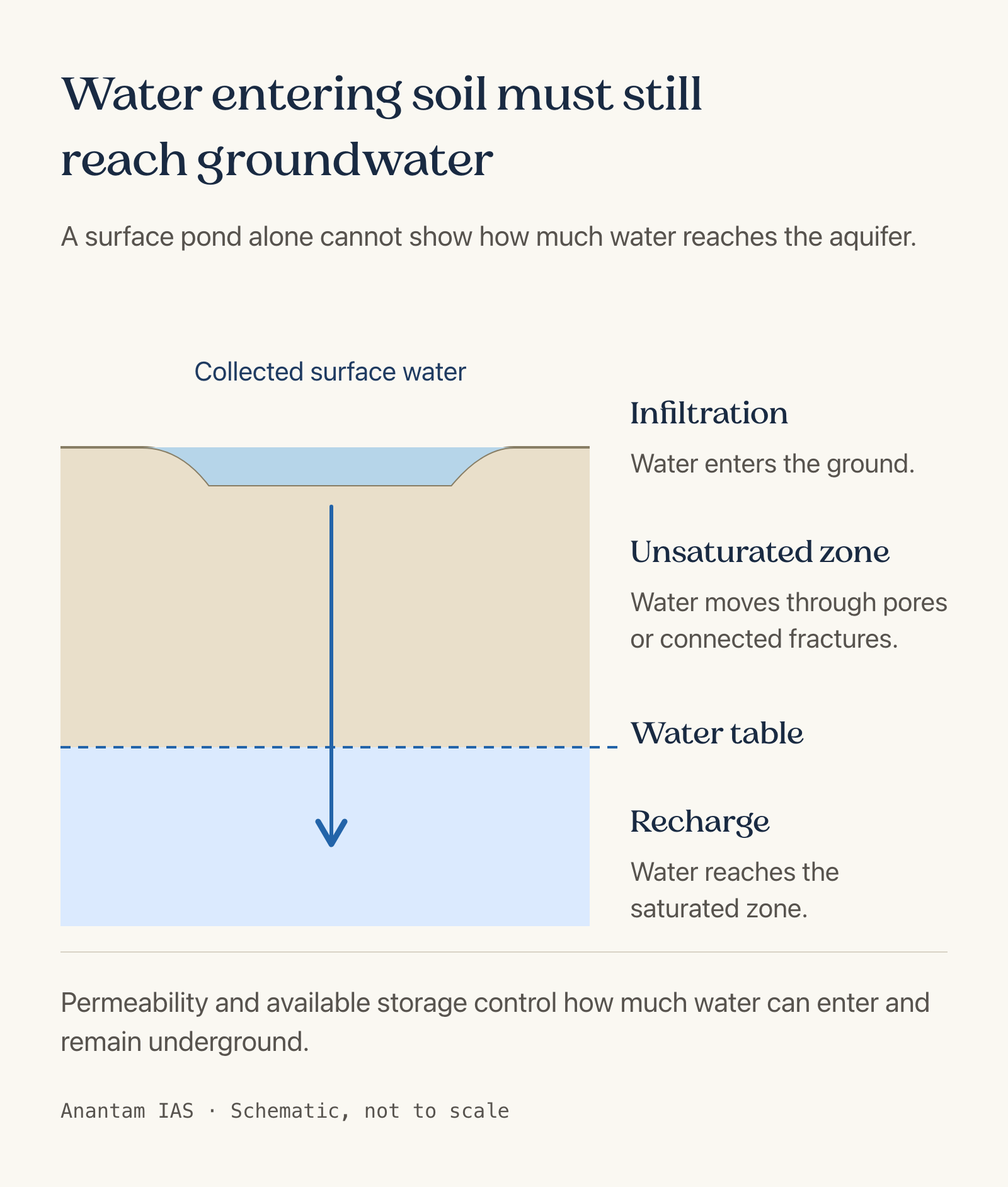
  • Infiltration is water entering the ground at the surface. In a suitable setting, that water moves downward through an unsaturated zone and contributes recharge when it reaches the saturated groundwater system beneath it.
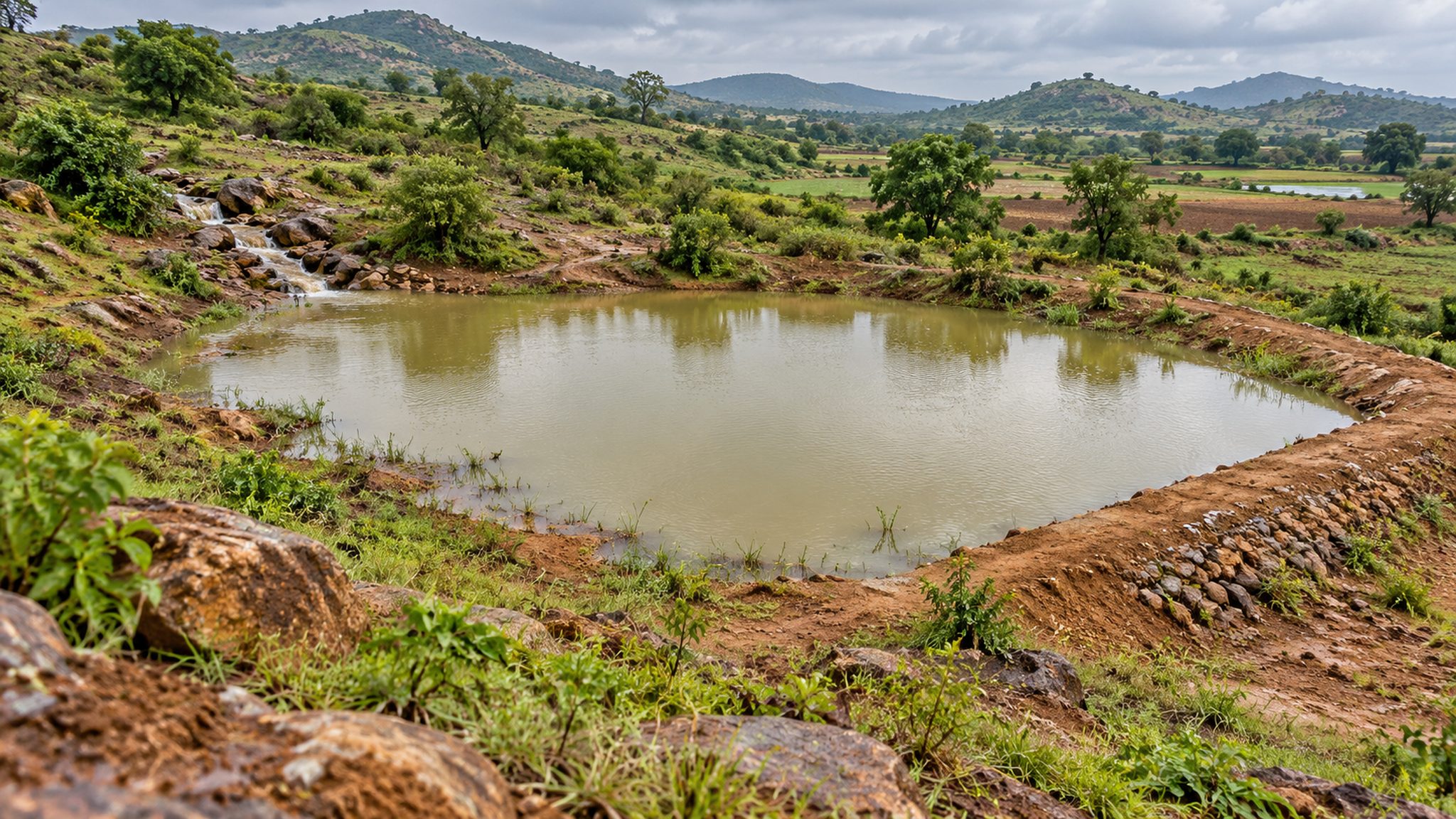
  • Permeability governs how readily water moves through pores or connected fractures. A structure can hold visible water while a poorly transmitting layer restricts downward movement, making surface storage an unreliable measure of aquifer recharge.
  • Storage space matters alongside entry pathways. CGWB assesses the thickness and extent of water-bearing formations and their replenishment capacity; adding water where suitable subsurface space is limited can create different problems from correcting depletion.
  • Source availability must be assessed seasonally. The manual emphasises non-committed surplus runoff, its quantity and timing; a structure sized without a dependable source may remain underused even where the receiving formation is suitable.
  • Aquifer response is local rather than automatic. Water may move away from the recharge site through the formation, so planning must examine boundaries, flow directions and discharge as well as the point where water enters.
Schematic showing surface water infiltrating through the unsaturated zone and reaching groundwater below the water table
In a suitable unconfined setting, infiltrated water contributes recharge when it reaches the saturated groundwater system. Schematic, not to scale.

Why Quality and Monitoring Decide Performance

A recharge structure becomes useful through safe operation and measurable groundwater benefits, not merely because construction is complete or a map recommends the location.

  • Source-water quality and required pretreatment must be assessed before recharge. Introducing polluted water can damage the receiving resource; the visible clarity of water cannot establish that it is chemically or microbiologically suitable for recharge.
  • Clogging can reduce performance when material accumulates or chemical interactions obstruct flow. CGWB specifically discusses compatibility between native groundwater and injected water because salt precipitation can clog wells and the surrounding aquifer.
  • Observation wells help track water-level changes around a recharge facility. Monitoring locations should reflect the expected influence zone and local hydrogeology, allowing the effect of an individual structure to be examined over time.
  • Quality monitoring checks whether recharge changes the receiving groundwater. The distinction explained in water-quality assessment is relevant: satisfactory results for one parameter cannot establish safety across every important contaminant or intended use.
  • Operation and maintenance need an assigned owner and resources. The issue raised by rural water maintenance finance also applies here: a completed asset can lose usefulness when routine upkeep and performance checks are neglected.

Way Forward

Test the Site Before Building

  • Combine mapped screening with field checks of source availability, geology, aquifer capacity and water quality before selecting a structure.
  • Specify pretreatment and maintenance responsibilities alongside the design, including access for inspecting and cleaning the facility.
  • Record baseline groundwater levels and quality, then compare subsequent observations while accounting for rainfall and abstraction.
  • Evaluate performance through water-system evidence rather than counts of applications downloaded or structures completed.

Conclusion

  • Geospatial screening can improve recharge planning by directing field investigation towards promising areas. Its value depends on matching available water, a suitable receiving formation and safe, maintainable structures.
  • For an exam answer, connect mapping, hydrogeology and monitoring. The launch supplies a planning tool; groundwater benefits require site-specific assessment and evidence from operation.

UPSC Practice Questions

Prelims MCQ 1

With reference to artificial groundwater recharge, consider the following statements:

  1. Mapped potential alone establishes the suitability of an individual construction site.
  2. Source-water quality and pretreatment requirements are relevant to planning.
  3. Available subsurface storage and hydraulic characteristics influence recharge performance.

How many of the above statements are correct?

(a) Only one (b) Only two (c) All three (d) None

Answer: (b) Only two

Explanation:

Statements 2 and 3 are correct. CGWB requires detailed hydrogeological investigation and assessment of source water; a regional map alone does not complete site appraisal.

Prelims MCQ 2

Which observation most directly tests the groundwater response to a recharge facility?

(a) The number of users who viewed its location online (b) The amount of concrete used during construction (c) Water-level observations from appropriately located monitoring wells (d) A photograph showing water collected at the surface

Answer: (c) Water-level observations from appropriately located monitoring wells

Explanation:

Observation wells provide evidence of groundwater-level response. Surface water, construction quantities and platform use cannot establish how the receiving aquifer has responded.

UPSC Mains Questions

  1. Explain why geospatial identification of recharge potential must be followed by hydrogeological investigation before constructing artificial recharge structures.
  2. Discuss the role of source-water quality, maintenance and monitoring in assessing the effectiveness of groundwater recharge interventions.

Sources: PIB, Ministry of Jal Shakti and Central Ground Water Board.

Frequently Asked Questions

What did the Punah Bharan launch provide?

It provided a geospatial planning tool using rainfall, groundwater and terrain information to identify potential recharge zones and explore structures. The announcement does not establish that every suggested site is suitable or that recharge benefits are already achieved.

Is infiltration the same as groundwater recharge?

Infiltration is water entering the ground at the surface. Groundwater recharge requires that water reach the saturated groundwater system. Local layers and hydraulic conditions influence how much infiltrated water completes that pathway.

Why should recharge water be assessed for quality?

Water introduced for recharge can affect the receiving aquifer. Planning must assess source quality, pretreatment and compatibility with native groundwater, followed by monitoring for contamination or changes that obstruct water movement.

How can a recharge structure’s effect be monitored?

Appropriately placed observation wells can track groundwater levels and water quality around the facility. The monitoring design should reflect local hydrogeology, expected influence and the method used for recharge.

India–Mexico PTA: Setting the Rules Before Market Access

Open article →Download PDF

Why in News?

On 28 October 2026, India and Mexico announced signed Terms of Reference formally launching negotiations for a Preferential Trade Agreement, with goods access, origin rules and regulatory cooperation among the negotiating areas.

  • The Terms of Reference establish the framework, scope, modalities and roadmap for talks; they do not announce a concluded agreement or implemented tariff concessions.
  • The agenda includes customs procedures, trade facilitation, dispute settlement, sanitary and phytosanitary measures, technical barriers to trade and trade remedies.
  • The announcement identifies cooperation potential in automotive, chemicals, electronics, pharmaceuticals and agri-food, alongside other sectors; these are opportunities, not promised export outcomes.
  • A negotiated tariff preference can matter only if a product meets the applicable origin and regulatory requirements and the exporter can demonstrate compliance.
  • The current development concerns negotiating architecture: which issues the two governments will discuss before businesses can assess any eventual preferential access.

UPSC Relevance

Prelims Relevance

  • PTA: a preferential trade arrangement whose actual product coverage and concessions depend on the agreed terms.
  • Terms of Reference: the framework and scope for negotiations.
  • Rules of origin: criteria determining whether goods qualify for preferential treatment.
  • SPS measures: measures addressing specified food-safety and animal or plant-health risks.
  • TBT: technical regulations, standards and conformity-assessment procedures.

Mains Relevance

GS Paper 3

  • Trade-policy design: connecting tariff concessions with origin verification and regulatory compliance.
  • Manufacturing integration: making preferential access usable for smaller exporters.

GS Paper 2

  • Bilateral negotiation mandates and institutions for implementing economic agreements.

Essay

  • The distance between a diplomatic commitment and a usable economic opportunity.

Background and Context

What a Negotiating Mandate Establishes

A trade negotiation begins by defining the questions to be settled, the coverage of discussions and the route towards an agreement.

  • The India–Mexico Terms of Reference provide an agreed negotiating framework. Their signature gives talks an organised starting point, but does not itself disclose the eventual tariff schedule or final obligations for traders.
  • The official release lists market access for goods among the negotiating areas. The products covered, concessions offered and conditions attached must be established through negotiations rather than assumed from the agreement’s proposed name.
  • The stated agenda combines border duties with procedures and regulatory issues. This matters because an exporter may face difficulties proving eligibility or meeting requirements even where a tariff concession is potentially attractive.
  • A negotiating announcement differs from an agreement that has entered into force. The earlier India–New Zealand market-access note illustrates why implementation status must be identified before describing benefits available to firms.
  • The release describes stronger trade and investment flows as possible gains. Treat these as objectives to evaluate against later outcomes, rather than evidence that the talks have already increased production, investment or employment.

Why Origin and Customs Rules Matter

Goods assembled through several economies need a clear eligibility test before they can receive an agreement’s preferential treatment.

  • Preferential rules of origin determine whether a product qualifies for tariff preferences under the relevant arrangement. They are distinct from the route a shipment follows or the country from which it was dispatched.
  • For products using imported components, an origin test can examine production or processing under the applicable product rule. The India–Mexico announcement does not publish such rules, so no required local-content threshold can be inferred.
  • A firm must be able to connect its claim of origin with acceptable evidence. Simple, clear procedures can reduce uncertainty; weak verification can allow goods that fail the agreed conditions to receive unintended preferences.
  • Customs cooperation and trade facilitation address how goods move through border procedures. Their inclusion in the agenda signals work on administration as well as negotiated market access; it does not mean new procedures already apply.
  • The practical question is whether eligible firms can use the preference. The India–UK preference-utilisation discussion offers a useful implementation lens, without supplying or predicting the terms of the proposed Mexico agreement.

Regulatory Access and the Limits of the Announcement

Lower border duties are only one part of access; product requirements and procedures also shape whether a shipment can enter its destination market.

  • Sanitary and phytosanitary measures address specified food-safety and animal or plant-health risks. Their presence on the agenda is relevant to agri-food trade, but does not establish a newly approved product or completed inspection arrangement.
  • Technical barriers to trade concern technical regulations, standards and conformity assessment. Negotiators can discuss these issues, but the launch announcement does not establish mutual recognition of tests or remove existing product-compliance obligations.
  • Trade remedies and dispute settlement are also included in the announced scope. Their final design remains to be negotiated; do not turn their inclusion into a claim that either government has surrendered a specific policy instrument.
  • The release presents Mexico’s links with global value chains as commercially relevant. Such links do not automatically give an Indian product preferential access to a third country; eligibility depends on the applicable arrangement’s own rules.
  • For an exam answer, distinguish potential complementarities from binding commitments. Sector names indicate areas of interest, while a usable assessment needs the final coverage, origin conditions, regulatory provisions and implementation arrangements when these become available.

Way Forward

Make the Eventual Terms Usable

  • Consult producers and smaller exporters on product coverage, realistic compliance costs and the documentation needed to prove origin.
  • Publish clear explanatory material when negotiated provisions become available, distinguishing proposals, agreed commitments and rules actually in force.
  • Evaluate eventual outcomes through preference use, border predictability and market participation, rather than treating the launch of talks as commercial delivery.

Conclusion

  • The India–Mexico development establishes a negotiating framework. Its significance lies in connecting goods access with origin, customs and regulatory questions that will shape any eventual agreement.
  • Assess future progress through agreed terms and implementation. A negotiating mandate can organise cooperation, while practical benefits depend on the final rules and firms’ ability to meet them.

UPSC Practice Questions

Prelims MCQ 1

With reference to the announced India–Mexico PTA negotiations, consider the following statements:

  1. The signed Terms of Reference formally launch negotiations.
  2. The announcement publishes a final preferential tariff schedule.
  3. Rules of origin and customs procedures are included in the negotiating scope.

How many of the above statements are correct?

(a) Only one (b) Only two (c) All three (d) None

Answer: (b) Only two

Explanation:

Statements 1 and 3 are correct. The release announces a negotiating framework, not a concluded agreement or final tariff schedule.

Prelims MCQ 2

What is the principal role of preferential rules of origin?

(a) To identify whether goods qualify for preferential treatment under an arrangement (b) To guarantee preferential access whenever goods pass through a partner country (c) To replace every product-safety requirement with a shipping document (d) To grant automatic access to all third-country trade agreements

Answer: (a) To identify whether goods qualify for preferential treatment under an arrangement

Explanation:

Preferential origin rules determine eligibility under the relevant agreement. Dispatch from a partner is not by itself sufficient, and origin status does not remove separate regulatory requirements.

UPSC Mains Questions

  1. Explain why rules of origin and customs procedures matter alongside tariff concessions in a preferential trade agreement.
  2. Discuss how the distinction between launching negotiations and implementing an agreement should guide assessment of India’s trade partnerships.

Source: PIB, Ministry of Commerce and Industry.

Frequently Asked Questions

Has the India–Mexico PTA entered into force?

The announcement reports the signing of Terms of Reference and launch of negotiations. It does not report a concluded PTA, final tariff schedule or implemented preferential access for traders.

What do the Terms of Reference cover?

They establish the framework, scope, modalities and roadmap for talks. Listed areas include goods access, origin rules, customs, trade facilitation, dispute settlement, SPS measures, technical barriers and trade remedies.

Why are rules of origin necessary?

They determine whether goods qualify for a trade arrangement’s preferential treatment. This is especially relevant when production uses inputs from several countries; the place of dispatch alone does not establish preferential eligibility.

Do the talks guarantee access to Mexico’s other trade partners?

No automatic third-country access follows from the launch of bilateral talks. A product’s treatment in another market depends on the relevant arrangement’s coverage, origin conditions and other applicable requirements.

OECMs: Recognising Conservation Beyond Protected Areas

Open article →Download PDF

Why in News?

On 28 October 2026, India released guidelines for designating Other Effective Area-Based Conservation Measures (I-OECMs) at CBD COP17, supporting recognition of conservation outcomes beyond conventional protected areas.

  • The PIB announcement describes recognition subject to appropriate criteria and governance across diverse landscapes and management systems.
  • The release confirms publication of the Indian guidelines; it does not establish that particular sites have already received recognition.
  • The CBD definition supplies the international basis for understanding OECMs: geographically defined areas with sustained biodiversity outcomes outside recognised protected areas.
  • Conservation can depend on management across a wider landscape, including places whose original purpose was not establishing a protected area.
  • Recognition needs evidence of ecological effectiveness and legitimate governance; a new label alone cannot show that habitats or species are secure.

UPSC Relevance

Prelims Relevance

  • Meaning of OECM and its distinction from a protected area
  • Meaning of in situ conservation
  • Positive and sustained long-term biodiversity outcomes
  • Governance, management and monitoring in area-based conservation
  • Role of the Convention on Biological Diversity

Mains Relevance

GS Paper 3

  • Assessing biodiversity outcomes beyond conventional protected areas
  • Landscape connectivity and evidence-based conservation monitoring

GS Paper 2

  • Legitimate governance, community participation and accountable recognition

Essay

  • Conservation succeeds when institutions sustain ecological outcomes.

Background and Context

What Makes an Area an OECM?

The international definition combines a defined place, effective governance and durable conservation outcomes; the landscape’s appearance alone cannot establish eligibility.

  • An OECM is a geographically defined area outside a recognised protected area that is governed and managed to deliver positive, sustained outcomes for biodiversity conservation, alongside associated ecosystem functions and relevant local values.
  • In situ conservation concerns biodiversity within its natural surroundings. The question is whether management sustains species, habitats and ecological functions in that place, rather than simply preserving specimens elsewhere or recording a boundary.
  • A site may have been established for another function. The CBD framework allows conservation outcomes to arise alongside other purposes, but those purposes must remain compatible with sustaining biodiversity over the long term.
  • Sustainable human activities can be compatible with the concept. Their presence does not automatically disqualify an area, just as the absence of people does not automatically prove effective conservation or qualify a site.
  • The distinction from a protected area is substantive: CBD criteria exclude an area already recognised or reported as one. OECMs complement protected-area networks by recognising additional effective conservation rather than double-counting existing sites.

How Governance Produces Lasting Outcomes

A credible conservation claim links who can act, how threats are managed and what happens to biodiversity over time.

  • Geographic boundaries identify the space being assessed, while legitimate governance identifies who can make and enforce decisions. A clearly drawn area without workable authority may offer little protection against changing pressures on biodiversity.
  • Management must address existing and reasonably anticipated threats. The CBD guidance includes preventing, reducing or removing threats and restoring degraded ecosystems; designation cannot substitute for decisions that actually influence conditions within the area.
  • Continuity matters because a brief improvement may disappear when funding or leadership changes. The international guidance connects sustained governance and management with long-term biodiversity outcomes, requiring arrangements capable of responding to new threats.
  • Baseline information records important biodiversity attributes and existing management. Monitoring then asks whether measures remain effective, allowing decision-makers to detect deterioration and adjust action instead of assuming that recognition proves continuing ecological success.
  • The COP17 implementation review illustrates the wider evidence problem: reporting an initiative is different from demonstrating its results. OECM assessment similarly needs information about conservation effectiveness beyond administrative completion or public announcements.

Why Recognition Needs Rights and Ecological Evidence

Recognition should strengthen conservation institutions while respecting the people and governance systems that already shape the area.

  • Consultation with governance authorities, landowners, rights holders and other stakeholders is part of the CBD guidance. Recognition built without understanding legitimate interests can weaken cooperation and obscure who bears conservation costs or receives benefits.
  • For indigenous and local-community territories, CBD guidance addresses self-identification and free, prior and informed consent, as appropriate and consistent with national frameworks and international obligations. These principles should not be misreported as newly enacted Indian provisions.
  • Cultural and spiritual values may support conservation, but a cultural description alone does not establish an OECM. Assessment still needs to examine biodiversity attributes, management arrangements and the continuity of positive ecological outcomes.
  • Connectivity can improve the contribution of conserved places to wider landscapes. The logic behind wildlife crossings is relevant: ecological movement depends on relationships between habitats, not only the condition of isolated patches.
  • The new Indian announcement confirms a designation-guidance step. It does not itself identify recognised sites, quantify new conserved coverage or disclose every procedural requirement; such claims need the applicable guideline text and site-level decisions.

Way Forward

Make Recognition Verifiable

  • Document biodiversity baselines, boundaries and management responsibilities before treating an area’s conservation contribution as established.
  • Build monitoring around ecological condition and threat reduction, with a clear process for revising management when outcomes deteriorate.
  • Support legitimate local governance through consultation, accessible information and transparent handling of costs, benefits and rights.
  • Publish site-level evidence and applicable procedures so that recognition can be examined independently of promotional claims.

Conclusion

  • OECMs widen the recognition of effective conservation beyond protected areas, but their value rests on sustained biodiversity outcomes, legitimate governance and management that responds to threats.
  • For an exam answer, connect recognition, rights and monitoring. India’s guideline release is a policy step; proof of conservation effectiveness requires continuing evidence from the areas concerned.

UPSC Practice Questions

Prelims MCQ 1

With reference to the CBD framework for OECMs, consider the following statements:

  1. An OECM is an area other than a recognised protected area.
  2. The presence of any human activity necessarily disqualifies an area.
  3. Positive and sustained biodiversity outcomes are central to the concept.

How many of the above statements are correct?

(a) Only one (b) Only two (c) All three (d) None

Answer: (b) Only two

Explanation:

Statements 1 and 3 are correct. CBD guidance allows sustainable human activities where they remain compatible with clear conservation benefits.

Prelims MCQ 2

Which evidence would best support assessment of an OECM’s continuing effectiveness?

(a) The number of times the site appears in publicity material (b) A boundary map without information about management (c) A one-time announcement of recognition (d) Monitoring of biodiversity condition and the effectiveness of threat management

Answer: (d) Monitoring of biodiversity condition and the effectiveness of threat management

Explanation:

Monitoring connects management with ecological outcomes. Publicity, a boundary or an announcement alone cannot establish sustained conservation effectiveness.

UPSC Mains Questions

  1. Explain how OECMs can complement protected areas. Discuss the role of governance and monitoring in sustaining their conservation contribution.
  2. How can recognition of conserved landscapes protect community rights while producing verifiable biodiversity outcomes?

Sources: PIB, Ministry of Environment, Forest and Climate Change and Convention on Biological Diversity.

Frequently Asked Questions

What does OECM mean?

An Other Effective Area-Based Conservation Measure is a geographically defined area outside a recognised protected area whose governance and management produce positive, sustained biodiversity conservation outcomes, alongside associated ecosystem functions and relevant local values.

Can an OECM include human activities?

Yes. CBD guidance allows sustainable human activities where conservation benefits are maintained. Human use alone neither proves nor rules out eligibility; the management arrangements and long-term biodiversity outcomes must be assessed.

Are OECMs the same as protected areas?

No. CBD criteria exclude areas already recognised or reported as protected areas. OECMs complement those networks by recognising effective conservation elsewhere, including areas that may have originally served another function.

What did India announce on 28 October?

India released guidelines for designating I-OECMs. The official announcement describes their purpose but does not establish that particular sites have been designated or provide evidence of new conserved coverage.

PM VGSY: Connecting Village Plans With Resources and Accountability

Open article →Download PDF

Why in News?

On 28 October 2026, the Union Cabinet approved Pradhan Mantri Viksit Gram Swaraj Yojana (PM VGSY), a Centrally Sponsored Scheme intended to strengthen participatory village planning, Panchayat capabilities and accountability.

  • PM VGSY will support holistic Gram Panchayat Development Plans by connecting village priorities, departmental interventions and available resources.
  • Implementation will run through States and Union Territories, whose Annual Action Plans require appraisal and approval by the designated Central Empowered Committee.
  • Existing departmental arrangements for delivering individual schemes will continue; approval of the new coordinating framework does not establish completed village outcomes.
  • A village may receive support through several programmes, but coordination determines whether their activities address the same local service gap.
  • Planning capacity, reliable accounts and public scrutiny help local institutions turn available funds into services residents can use.

UPSC Relevance

Prelims Relevance

  • GPDP: Gram Panchayat Development Plan.
  • PM VGSY: a Centrally Sponsored Scheme approved by the Union Cabinet.
  • Gram Sabha: a forum for informed community deliberation envisaged in this scheme.
  • Own Source Revenue: locally mobilised revenue, distinct from external grants.
  • Coverage: all States and Union Territories, including traditional rural local bodies in non-Part IX areas.

Mains Relevance

GS Paper 2

  • Participatory planning and institutional capacity in rural local governance.
  • Coordination across departments while retaining responsibility for individual programmes.

Essay

  • Democratic participation needs institutions capable of acting on public priorities.

Background and Context

How Village Priorities Become a Development Plan

A useful village plan identifies needs, connects them to available interventions and makes responsibility visible before activities are taken up.

  • Participatory planning begins with residents discussing local needs through Gram Sabhas and other Panchayat forums. The scheme envisages informed discussion of government initiatives so that village priorities can shape development choices and subsequent follow-up.
  • A Gram Panchayat Development Plan brings priorities, relevant departmental interventions and available resources together. Its practical value lies in exposing gaps and overlaps across separate programmes before officials treat a collection of activities as coordinated development.
  • Evidence-based planning requires information about community assets, benefits, beneficiaries and resources. A common view can reveal unmet needs, but its usefulness depends on complete, current records and the ability to interpret them locally.
  • Convergence connects the planning processes of Central departments and State governments with Panchayat priorities. It does not mean that each department transfers its entire programme, staff or financial authority to the Gram Panchayat.
  • For example, a village service gap may involve different departmental responsibilities. Joint planning should clarify the relevant intervention and available resources; this is an explanatory planning example, not a new funding entitlement under PM VGSY.

Who Plans, Approves and Delivers

The scheme combines local coordination with State implementation and central appraisal; these roles should remain distinct when reading its approval.

  • States and Union Territories will submit Annual Action Plans describing activities, priorities and requirements under the scheme. The designated Central Empowered Committee will appraise and approve those plans according to applicable procedures and norms.
  • Existing departmental delivery continues for individual schemes. A Panchayat can coordinate needs and monitor gaps without becoming the sole implementing authority for every programme operating in its territory or controlling all associated funds.
  • Capacity building covers digital systems, resource information, planning and communication with citizens. Training matters when representatives and functionaries can apply information to actual choices, rather than merely complete a course or enter data.
  • The approval permits need-based contractual support at State, district and block levels, while stating that no permanent posts will be created. Technical assistance supports institutions; it does not substitute for their assigned responsibilities.
  • Traditional rural local bodies in non-Part IX areas are included where Panchayats do not exist. This coverage recognises institutional differences; the announcement does not abolish those differences or impose identical local government structures everywhere.

Resources, Audit and the Limits of Approval

Better planning needs a traceable connection between resources, decisions and results, followed by public examination of how money was used.

  • Own Source Revenue and external grants are different resource streams. The scheme supports local revenue mobilisation and better use of available funds; it does not itself announce a new unlimited Panchayat power to levy taxes.
  • Accounting and auditing help trace expenditure to authorised purposes, while public disclosure allows residents to examine decisions. Preparing an audit plan is an administrative step; completing the audit and addressing findings remain separate tasks.
  • The related rural water finance discussion explains why funding conditions matter. Coordinating resources through a village plan does not automatically remove restrictions attached to a particular grant or departmental programme.
  • Unlike the municipal devolution debate, this announcement concerns rural planning capability and coordination. Improved information systems cannot, by themselves, settle broader questions about legal powers or the distribution of administrative authority.
  • Cabinet approval establishes the scheme decision, not evidence of better services already delivered. Assessment should examine whether priorities reach plans, resources match those plans, responsibilities are clear and public scrutiny leads to corrective action.

Way Forward

Make Each Plan Traceable to Follow-Up

  • Record the service gap, relevant department and available resource against each priority so residents can follow the decision.
  • Support functionaries in checking data quality before planning, and keep a practical route for residents to flag omissions.
  • Publish understandable accounts and track audit follow-up, rather than treating an uploaded plan or completed training session as the final result.

Conclusion

  • PM VGSY centres the Gram Panchayat in participatory planning and coordination while retaining departmental delivery. The important governance question is whether local priorities can be translated into feasible, resourced activities with clear responsibility.
  • Accountability requires more than a common platform: residents need understandable information, institutions need capacity and audit findings need follow-up. Use the scheme to connect participation, administrative coordination and scrutiny in a decentralisation answer.

UPSC Practice Questions

Prelims MCQ 1

With reference to the approved PM VGSY design, consider the following statements:

  1. Existing departmental arrangements for delivering individual schemes will continue.
  2. The scheme creates permanent posts at the Gram Panchayat level.
  3. Traditional rural local bodies in non-Part IX areas are included in its coverage.

How many of the above statements are correct?

(a) Only one (b) Only two (c) All three (d) None

Answer: (b) Only two

Explanation:

Statements 1 and 3 are correct. The Cabinet release expressly retains departmental delivery and includes traditional local bodies in non-Part IX areas. It states that no permanent posts will be created.

Prelims MCQ 2

Which interpretation best reflects the role of convergence in a Gram Panchayat Development Plan?

(a) Combining every departmental fund into an unrestricted Panchayat account (b) Replacing all departmental implementing agencies with the Gram Sabha (c) Linking village priorities, departmental interventions and available resources (d) Treating preparation of a plan as proof that every service gap is resolved

Answer: (c) Linking village priorities, departmental interventions and available resources

Explanation:

Convergence coordinates planning and identifies gaps across interventions. The approval does not merge every fund, abolish departmental delivery or establish completed outcomes.

UPSC Mains Questions

  1. How can participatory village planning improve coordination across government programmes? Discuss the institutional conditions needed for PM VGSY to achieve this objective.
  2. Explain why digital planning, accounting and audit systems require local administrative capacity and public scrutiny to strengthen Panchayat accountability.

Source: PIB, Cabinet.

Frequently Asked Questions

What is PM VGSY?

Pradhan Mantri Viksit Gram Swaraj Yojana is a Centrally Sponsored Scheme approved to strengthen village planning, Panchayat capabilities, resource management and accountability through State and Union Territory implementation.

Does PM VGSY replace individual departmental schemes?

No. The Cabinet release states that existing departmental arrangements for delivering individual schemes will continue. The new framework brings their planning processes and available resources together around village priorities.

Why does the scheme emphasise Own Source Revenue?

Locally mobilised revenue can support financial self-reliance alongside grants and other funds. The scheme supports mobilisation and resource management, but the approval does not announce an unrestricted new taxing power.

Does an approved village plan prove that services have improved?

No. A plan records intended priorities and activities. Delivery, resource use, audit findings and corrective action require separate examination before claiming that residents have received better services.

Women Prisoners and Children: Protecting Rights Through Custody

Open article →Download PDF

Why in News?

On 28 October 2026, the NHRC disclosed its advisory dated 23 October on protecting women prisoners and their children, recommending coordinated safeguards from arrest through release and seeking implementation reports within two months.

  • The advisory addresses Union ministries, States and Union Territories, linking prison administration with healthcare, child protection, education and access to justice.
  • Its recommendations cover children living with prisoners and separated from them, recognising that a parent’s detention can disrupt care outside prison too.
  • The requested Action Taken Report is a progress-reporting mechanism; it does not establish that the recommendations have already been implemented nationwide.
  • Custody changes where essential services must be delivered. Institutions need to coordinate care when a woman cannot independently reach healthcare, childcare or legal assistance.
  • The focus differs from the broader women’s safety advisory: this note examines custodial transitions and dependent children’s needs.

UPSC Relevance

Prelims Relevance

  • NHRC: human-rights institution issuing the advisory.
  • Child Welfare Committee: child-protection authority involved when care arrangements are unavailable.
  • District Legal Services Authority: connects prisoners with legal assistance.
  • Action Taken Report: records implementation progress, rather than creating a new criminal offence.
  • Best interests of the child: directs attention to care, development, safety and family relationships.

Mains Relevance

GS Paper 2

  • Prison reform, vulnerable groups and coordination between welfare and justice institutions.
  • Implementation accountability for health, childcare and legal aid during custodial transitions.

GS Paper 4

  • Dignity, empathy and responsibility in public administration.

Essay

  • The quality of institutions can be judged by how they treat people who depend on them.

Background and Context

Follow the Person Through Each Custodial Transition

The advisory treats arrest, admission, transfer and release as points where responsibility must pass between institutions without breaking essential care.

  • At arrest, the advisory recommends identifying caregiving responsibilities. If a woman is the sole caregiver, authorities should allow reasonable arrangements for dependent children rather than assume another adult is already available.
  • Where no immediate caregiver is available, it recommends involving the District Child Protection Unit and Child Welfare Committee. Their role concerns the child’s care and protection, separately from the criminal case against the parent.
  • Admission records should identify children living both inside and outside prison, their current caregivers and relevant health or educational needs. Updated information helps officials locate dependants when detention, transfer or illness changes arrangements.
  • The recommended records require restricted access and confidentiality. Coordination needs reliable information, but collecting sensitive family details is not a justification for public disclosure or treating a child’s identity as a criminal record.
  • Family communication is part of care continuity. Information about detention and contact arrangements helps relatives respond; interpretation or other assistance matters where disability, language or limited literacy prevents a woman from communicating independently.

Children and Healthcare Need Their Own Safeguards

A child’s welfare must be assessed directly, while health services should respond to women’s needs throughout custody and after release.

  • The advisory recommends child-friendly facilities, including nutrition, early learning, play and healthcare. Providing a place to stay alone does not meet developmental needs; services must support everyday growth and emotional well-being.
  • For children separated from prisoners, continuity of care includes schooling, contact and suitable support arrangements. Moving a child between caregivers or institutions should not make education and healthcare disappear from administrative responsibility.
  • Maternal and mental healthcare require attention beyond emergency treatment. The advisory recommends admission screening, counselling and appropriate medical support, recognising that pregnancy, distress and existing health conditions can require different responses within the same institution.
  • Medical records should accompany women when they leave prison through release or temporary legal arrangements. A community provider needs treatment information to continue care; a change in location should not force care to restart blindly.
  • The relevant comparison is identical treatment versus responsive provision. A uniform routine may overlook pregnancy, disability or caregiving needs; adjusting facilities and access can make practical protection more equal without deciding the underlying criminal case.

Connect Legal Assistance With Rehabilitation

Recommendations become useful when officials can show that people received assistance and that support survived the transition back into the community.

  • The advisory recommends accessible legal assistance and review of its performance. As the earlier note on undertrial legal aid explains, delayed help can leave a service formally available but practically ineffective.
  • Courts retain their role in decisions about bail or other legally available measures. The advisory’s proposals should not be read as automatic release, a fresh entitlement overriding applicable law, or proof that detention has ended.
  • Pre-release planning should identify shelter, childcare, counselling and other support needs early. The advisory recommends communication with district welfare and probation authorities, so essential arrangements are considered before a woman leaves the institution.
  • Individual correctional planning is recommended to connect education, skills, health and family circumstances. Periodic review matters because a person’s needs can change during custody; a static form cannot demonstrate that relevant assistance was delivered.
  • The two-month reporting request gives authorities a monitoring checkpoint. Meaningful reports should distinguish completed services, pending referrals and unresolved gaps; submitting a response alone does not prove adequate conditions or successful social reintegration.

Way Forward

Make Responsibility Traceable

  • Assign a named coordinating official for each transition, with confirmation that the receiving institution accepted the referral and essential records.
  • Review service delivery through confidential prisoner feedback and case follow-up, rather than count only meetings, facilities or forms issued.
  • Prepare release arrangements early and document unresolved shelter, treatment or childcare needs for follow-up by the appropriate district authorities.

Conclusion

  • The advisory frames custodial rights as a continuous administrative responsibility. Protecting women and their children requires institutions to connect records, services and family support across each transition, while respecting confidentiality and applicable legal procedures.
  • For an answer on prison reform, distinguish recommendations, implementation and outcomes. The useful test is whether care, legal assistance and rehabilitation actually reach the person, including when responsibility moves beyond the prison.

UPSC Practice Questions

Prelims MCQ 1

With reference to the NHRC advisory on women prisoners and their children, consider the following statements:

  1. It addresses children living outside prison as well as those living with prisoners.
  2. Its disclosure establishes automatic release for all women with dependent children.
  3. It seeks implementation progress reports from the concerned authorities.

How many of the above statements are correct?

(a) Only one (b) Only two (c) All three (d) None

Answer: (b) Only two

Explanation:

Statements 1 and 3 are correct. The advisory covers children living with or separated from prisoners and requests Action Taken Reports. It does not establish automatic release for all mothers.

Prelims MCQ 2

Which measure best supports continuity of healthcare when a woman leaves prison?

(a) Keeping all treatment information solely with the prison administration (b) Treating release as the end of every public healthcare responsibility (c) Replacing individual medical records with aggregate prison statistics (d) Providing relevant medical records so community care can continue

Answer: (d) Providing relevant medical records so community care can continue

Explanation:

The advisory recommends providing medical records when inmates leave through release and other specified legal arrangements, enabling continuity of care in the community.

UPSC Mains Questions

  1. Explain how inter-agency coordination can protect the rights of women prisoners and their dependent children across custodial transitions.
  2. Why should prison-reform monitoring distinguish recommendations, service delivery and outcomes? Discuss with reference to healthcare and rehabilitation.

Sources: PIB, National Human Rights Commission and NHRC detailed advisory.

Frequently Asked Questions

What is new in the NHRC disclosure?

On 28 October, the NHRC publicised its 23 October advisory on women prisoners and their children. It recommends coordinated safeguards across custody and asks concerned authorities to report implementation progress.

Does the advisory create automatic bail?

No. Its recommendations do not themselves establish automatic release or replace applicable legal procedures. Courts and competent authorities retain their respective roles in considering legally available relief and custodial arrangements.

Does it cover children outside prison?

Yes. The advisory covers children living with prisoners and those separated from them. Its recommendations address care arrangements, records, education, healthcare and contact, recognising that parental detention can affect children outside prison.

Why are medical records important at release?

Relevant medical records help community providers continue treatment after a woman leaves prison. Without a clear transfer of information, a change in custodial status can interrupt healthcare that remains necessary.

What should an implementation report demonstrate?

It should show which recommendations have led to functioning services, which referrals remain pending and where responsibility lies. A submitted report or newly created facility alone does not demonstrate improved welfare.

Sports Goods Manufacturing: Building Clusters That Meet Standards

Open article →Download PDF

Why in News?

On 28 October 2026, the Union Cabinet approved the Khelo India Sports Goods Manufacturing Scheme, combining manufacturing clusters, shared facilities, research, skills and certification support to strengthen domestic production and international competitiveness.

  • Dedicated Sports Goods Manufacturing Zones are envisaged to bring manufacturers, suppliers, testing facilities and design centres together.
  • Existing MSME clusters will receive support for upgrading common facilities and shared infrastructure.
  • The approval includes support for obtaining and renewing International Sports Federation certifications, alongside research in equipment, materials and protective gear.
  • Investment, employment and export growth are intended outcomes; Cabinet approval does not establish that these gains have occurred.
  • Sports equipment must combine manufacturing consistency with performance requirements; producing more units alone does not resolve quality barriers.
  • Shared infrastructure addresses a coordination problem: smaller firms may need services that are expensive to establish individually.

UPSC Relevance

Prelims Relevance

  • Industrial cluster: geographically concentrated firms and supporting services linked through production.
  • Common facilities: infrastructure or services used by several enterprises.
  • Prototyping: developing and evaluating a product before wider manufacture.
  • Certification: assessment against specified requirements, with scope that must be checked.
  • International Sports Federations: bodies whose relevant equipment requirements may matter for competition use.

Mains Relevance

GS Paper 3

  • Cluster development, MSME productivity and quality infrastructure.
  • Connecting research, skills and manufacturing with market requirements.

Essay

  • Industrial competitiveness depends on institutions and production capabilities as well as factory investment.

Background and Context

Why Co-location Can Help Smaller Manufacturers

The cluster approach connects firms with the services and suppliers needed to turn designs into reliable products.

  • A manufacturing cluster groups related enterprises and supporting activities within a shared location. The approved zones envisage manufacturers, suppliers, testing facilities, design and prototyping centres, and ancillary firms working within an integrated industrial ecosystem.
  • Co-location can shorten the distance between a component supplier and an equipment maker. It may make production problems easier to discuss, but firms still need dependable contracts, schedules and quality controls to benefit.
  • Common facilities allow several enterprises to access infrastructure that each might struggle to finance alone. Their value depends on usable equipment, competent operators and access arrangements that smaller firms can actually afford.
  • The approval covers existing MSME clusters as well as dedicated zones. This matters because strengthening established production networks requires upgrading shared services; building new industrial space alone cannot address weaknesses within existing enterprises.
  • Anchor manufacturers may attract suppliers and ancillary businesses, as envisaged in the scheme. Useful linkages must still develop through purchases, technical cooperation and reliable demand; a large factory does not automatically upgrade neighbouring firms.

Research and Certification Address Different Problems

A promising design, a reproducible manufacturing process and acceptance against relevant standards are related but separate requirements.

  • Research and design can address equipment performance, material properties and protective gear. The scheme proposes Centres of Excellence in educational and research institutions, connecting specialised knowledge with problems encountered by manufacturers and product developers.
  • Prototyping tests whether a proposed product can work before broader production. Manufacturing must then reproduce the intended design consistently; a successful prototype alone cannot demonstrate that every later batch will meet the same requirements.
  • Testing produces evidence about specified properties under defined conditions. Certification assesses conformity within an applicable framework; neither should be described as a universal guarantee covering every possible use, environment or product sold by a firm.
  • The scheme supports obtaining and renewing International Sports Federation certifications. The relevant federation, product category and certification scope matter; the Cabinet release does not establish that every supported product already holds such recognition.
  • Research support and certification support solve different constraints: one develops capabilities, while the other helps demonstrate specified conformity. This complements the financing distinction explained in research and innovation funding.

Market Access Requires More Than Installed Capacity

The policy supports productive capabilities, but commercial and sporting outcomes will depend on implementation and demand.

  • Capacity expansion increases the potential to produce goods; buyers still judge performance, consistency, price and delivery. A scheme announcement cannot establish that manufacturers have secured international orders or displaced imported equipment in actual purchases.
  • Skills connect machinery and design with repeatable production. The approved scheme envisages industry-aligned training with relevant institutions; its usefulness should be assessed through workplace competence, rather than treating participation in training as sufficient proof.
  • Market development can help buyers discover products, while credible testing can reduce uncertainty about their characteristics. Promotion alone cannot correct defective production; sustained orders require manufacturers to meet requirements across successive deliveries and product batches.
  • This is a goods-manufacturing intervention, distinct from assistance for sports training and institutional capacity. Equipment supply may complement athlete development, but manufacturing support should not be equated with coaching expenditure or guaranteed sporting success.
  • Evaluation should examine whether smaller firms gain access to facilities, whether products meet applicable requirements and whether capabilities improve. Export or employment projections remain expectations until reliable evidence documents changes attributable to implementation.

Way Forward

Make Shared Facilities Usable

  • Publish access conditions, service charges and booking arrangements so smaller manufacturers can plan their use of common testing and design facilities.
  • Link training to production tasks and documented quality problems, with feedback from manufacturers and workers.
  • Track service use and product conformity alongside investment, distinguishing announced facilities from those that are operational and accessible.

Conclusion

  • The scheme treats cluster infrastructure, research and certification as connected parts of industrial capability. Its strongest exam lesson is that proximity helps only when firms can use reliable services and translate knowledge into consistent production.
  • Assess the policy through implementation and verified outcomes: accessible common facilities, competent workers and products meeting relevant requirements. Cabinet approval creates a policy framework; it does not by itself establish export competitiveness or sporting achievement.

UPSC Practice Questions

Prelims MCQ 1

With reference to the approved sports goods manufacturing scheme, consider the following statements:

  1. It envisages co-location of manufacturers, suppliers and testing facilities.
  2. It provides support for obtaining and renewing International Sports Federation certifications.
  3. Its approval means all participating products are already internationally certified.

How many of the above statements are correct?

(a) Only one (b) Only two (c) All three (d) None

Answer: (b) Only two

Explanation:

Statements 1 and 2 match the Cabinet release. Statement 3 is incorrect: support for certification does not establish that every product has already obtained it.

Prelims MCQ 2

Which outcome most directly reflects the purpose of a common testing facility within an industrial cluster?

(a) Several firms can access specialised testing without each establishing a separate facility (b) Every product receives automatic approval for all international competitions (c) Product design no longer requires technical expertise (d) Domestic production guarantees export orders

Answer: (a) Several firms can access specialised testing without each establishing a separate facility

Explanation:

A shared facility can reduce the need for each enterprise to establish its own testing infrastructure. Certification, technical competence and commercial demand remain separate requirements.

UPSC Mains Questions

  1. Explain how shared infrastructure and supplier co-location can improve the capabilities of MSMEs in sports goods manufacturing.
  2. Discuss the distinct roles of research, testing and certification in improving industrial competitiveness.

Source: PIB, Cabinet.

Frequently Asked Questions

What did the Cabinet approve?

It approved the Khelo India Sports Goods Manufacturing Scheme, supporting manufacturing zones, existing clusters, common facilities, research, skills and certification. These measures aim to strengthen production capabilities and competitiveness.

Why are manufacturing clusters useful?

Clusters bring related firms and services closer together. Shared testing, design and infrastructure can help smaller enterprises access capabilities they may struggle to establish individually, provided access and operation are reliable.

Does certification support mean every product is certified?

No. The approval supports obtaining and renewing relevant International Sports Federation certifications. Actual certification depends on the applicable requirements and assessment; support does not itself establish conformity for every product.

How does this differ from sports training assistance?

The scheme addresses the production of sports goods, including manufacturing, materials, testing and skills. Training assistance concerns athlete or institutional development; the two may complement each other but have different immediate purposes.