Opens in a new tab
Join Anantam IAS Channel on Telegram

Daily Digest · Thursday

12 November 2026 Current Affairs for UPSC

8 current affairs published on Thursday, 12 November 2026

12 November 2026 Current Affairs for UPSC — every Why-in-News article AnantamIAS published on Thursday, 12 November 2026, broken down with Why in News?, the exact GS paper it feeds, sub-topic mapping, MCQ-ready facts and a UPSC-style practice question. 8 articles in total, covering Polity, Economy, Environment, S&T, IR, Geography, History, Society and Internal Security — the same Why-in-News + GS-paper-mapping + practice-question format the Compass uses across every daily digest on the site.

Daily current affairs for UPSC is where new material enters your prep stream. Read this 12 November 2026 digest end-to-end in 25–35 minutes, attempt the practice question at the foot of each article (it's MCQ for some, 10/15-marker for others), then bookmark the entries that fall inside your active revision window. Everything stays cross-linked: tap any subject pill to jump to that subject's hub, or use the table of contents above to skip straight to a specific story.

Use this page three ways. Read sequentially for a one-sitting scan of everything that mattered on 12 November 2026. Download the 12 November 2026 PDF below for offline study or print revision. Or use the November 2026 Current Affairs compilation to see this day in the month's full context. For the previous day's reading, see 11 November 2026 Current Affairs; the next day's is 13 November 2026 Current Affairs.

Why we publish daily current affairs separately from the monthly compilation: daily is learning, monthly is revision. Use the daily page to add fresh material to your notes the day it breaks; come back to the November 2026 compilation 60 days before Prelims when the noise has settled and only the lasting takeaway is worth re-reading.

Why India Prohibited Exports of Lithium-Ion Battery Black Mass

Open article →Download PDF

Why in News?

On November 11, the Commerce Ministry announced that India had prohibited exports of lithium-ion battery black mass to retain a source of critical minerals for domestic recyclers.

  • The Directorate General of Foreign Trade changed the export classification from free to prohibited through its November 10 notification.
  • The change took immediate effect and applies until further orders. The Foreign Trade Policy’s transitional arrangements still apply.
  • The Commerce Ministry release identifies the covered material by its description and ITC(HS) code 85491400.
  • Plants need a steady supply of secondary feedstock to recover minerals from battery waste.
  • The government reports that some Indian recyclers have imported feedstock even as black mass produced domestically went overseas.

UPSC Relevance

Prelims Relevance

  • Black mass is an intermediate material from battery recycling.
  • Recoverable elements can include lithium, nickel, cobalt and manganese.
  • The DGFT sits within the Department of Commerce.
  • The prohibition concerns exports of a specified material.

Mains Relevance

GS Paper 3

  • Assess how industrial capacity and feedstock availability interact in a circular economy.
  • Explain the trade-off between keeping secondary resources at home and ensuring enough domestic refining capacity.

Essay

  • Yesterday’s waste can become tomorrow’s resource when institutions connect collection to recovery.

Background and Context

What Is Battery Black Mass?

A discarded battery still contains materials that a manufacturer might use again. Several industrial steps stand between the used cell and a recovered mineral.

  • Two streams can supply a recycling plant. End-of-life batteries come from products already used, while manufacturing scrap arises before a battery reaches the customer. Both can yield black mass.
  • At a recycling facility, shredding battery material yields a powdery fraction called black mass. The term describes a mixture at an intermediate stage, before the constituent minerals have been separated.
  • The powder can contain lithium, cobalt, nickel and manganese. A statement that each batch contains equal quantities of all four would go beyond the ministry’s description of the material.
  • A refiner receives this mixture as feedstock. Its value lies in what the plant can recover and separate for subsequent use. A tonne of powder cannot be counted as a tonne of recovered lithium.
  • Recovering minerals from products and industrial scrap is often called urban mining. It draws on material already in the economy, whereas a primary mine starts with a naturally occurring mineral deposit.

Which Exports Does the Notification Cover?

To read the measure accurately, identify the direction of trade, the named product and its position in the tariff classification.

  • The export policy governs a shipment leaving India. A manufacturer buying black mass from a domestic supplier for refining is making a different transaction from an exporter selling that material overseas.
  • The cited tariff heading covers a broader family of unsorted battery waste and scrap without lead, cadmium or mercury. The notification identifies lithium-ion battery black mass within that family.
  • Read the product description alongside the code. A question about exports of finished electric vehicles or unused battery cells refers to different products and cannot be answered by applying this notification.
  • The DGFT made the change effective immediately, until further orders. Its duration depends on a subsequent policy decision. The ministry did not announce a fixed expiry date for the prohibition.
  • For shipments straddling the date of the change, the notification preserves the transitional arrangements under paragraph 1.05 of the Foreign Trade Policy. An earlier order alone should not be assumed to qualify.

Why Does Keeping Feedstock Matter?

The ministry identifies a mismatch between the refining capacity already built in India and the supply of battery material available to run it.

  • A recycling plant needs enough incoming material to operate its equipment regularly. When domestic powder is exported and a local plant imports replacement feedstock, collection and final mineral recovery occur in different economies.
  • Keeping more domestic black mass available could raise capacity utilisation. The plant must still obtain the material, process it safely and recover useful minerals before the trade measure can affect metal supply.
  • This distinction also explains how the export rule relates to capital support for mineral processing. Investment support acts on plant capacity, while the trade rule acts on the destination of its input.
  • The environmental case depends on sound handling of a hazardous material. Retaining the powder in India places the recovery stage within domestic oversight, but the destination alone says little about the quality of processing.
  • To assess import dependence, follow the chain to usable output. The announcement describes an expected benefit. Evidence would include how much domestic feedstock plants processed and what quantities of minerals they recovered.

Way Forward

Track Recovery Alongside Retention

  • Measure domestic deliveries of black mass to refiners alongside material held in stock.
  • Compare actual mineral recovery with the amount of black mass that entered processing.
  • Check environmental compliance where recyclers store, transport and process the material.

Conclusion

  • India has changed where a specific secondary resource can be sold. Domestic refiners gain a chance to secure material that might previously have gone abroad.
  • For a Mains answer, connect the trade decision to feedstock availability, plant use and mineral recovery. Each step provides a separate point at which to evaluate the policy.

UPSC Practice Questions

Prelims MCQ 1

With reference to lithium-ion battery black mass, consider the following statements:

  1. Battery manufacturing scrap can yield black mass.
  2. Black mass can serve as a source of critical minerals.
  3. The November notification prohibits imports of black mass.

How many of the above statements are correct?

(a) Only one (b) Only two (c) All three (d) None

Answer: (b) Only two

Explanation:

Manufacturing scrap can yield black mass with recoverable minerals. The DGFT change governs exports, so the third statement is incorrect.

Prelims MCQ 2

Which observation would most directly show progress towards the mineral recovery objective of this export measure?

(a) A rise in the number of electric vehicle registrations (b) A larger announced budget for new mines (c) An increase in usable minerals recovered from domestically generated black mass (d) A larger stock of unprocessed powder at collection centres

Answer: (c) An increase in usable minerals recovered from domestically generated black mass

Explanation:

Measured recovery connects domestic feedstock to usable mineral supply. Growing stocks alone say little about the output of refineries.

UPSC Mains Questions

  1. Explain how the availability of secondary feedstock can constrain India’s critical mineral strategy even after investment in refining capacity.
  2. Assess the economic and environmental conditions under which retaining battery black mass could reduce reliance on primary minerals.

Source: PIB, Ministry of Commerce and Industry.

Frequently Asked Questions

How does black mass differ from a spent battery?

A spent battery is a used cell or battery assembly. Black mass is a powdery intermediate obtained during the processing of batteries or manufacturing waste, from which refiners can recover minerals.

Who changed India’s export policy for battery black mass?

The Directorate General of Foreign Trade, within the Department of Commerce, changed the classification through a November 10 notification. The Commerce Ministry announced the decision on November 11.

Does the prohibition cover every item under the battery waste heading?

The tariff code covers a broader category of battery waste and scrap. The notification specifically identifies lithium-ion battery black mass, so readers should consider its product description alongside the code.

Why would an Indian recycler import feedstock?

The ministry reports that some domestic recyclers faced inadequate supplies even while India exported black mass. An operating plant needs a regular flow of suitable material to use its refining capacity.


Allied Health Registration: How the Proposed Provisional Route Works

Open article →Download PDF

Why in News?

On 11 November, the National Commission for Allied and Healthcare Professions invited comments on draft regulations that would allow eligible practitioners to enter provisional registration and work towards regular registration.

  • The commission framed the draft regulations under the National Commission for Allied and Healthcare Professions Act, 2021.
  • The consultation runs until 4 December 2026. The commission will consider suggestions and objections before finalising the rules.
  • A provisional registration certificate would follow eligibility and credential checks. Additional training or examinations would apply where prescribed.
  • A health system needs to know both who a practitioner is and which professional competencies that person can demonstrate. Different checks answer those questions.
  • A transition route gives eligible applicants an opportunity to close a training gap while preserving a common standard for regular registration.

UPSC Relevance

Prelims Relevance

  • Identify the NCAHP as the commission proposing the regulations.
  • Distinguish the 2021 Act from draft regulations framed under it.
  • Recognise the PR UID as an identifier for a provisionally registered professional.
  • Distinguish credential verification from a competency assessment.

Mains Relevance

GS Paper 2

  • Examine how a regulator can protect patients while offering a route to recognition for eligible practitioners.
  • Assess how states and training institutions could make a national registration standard accessible.

Background and Context

What Would Provisional Registration Establish?

The first decision concerns entry into a regulated profession. Under the draft, the regulator would need evidence about the applicant before granting provisional status.

  • An applicant would submit information through an integrated online system. Officials could use the same record to receive the application, examine credentials and record their decision on eligibility.
  • Credential verification asks whether the qualifications an applicant presents can be substantiated. Eligibility is a separate judgment about whether the verified record satisfies the conditions prescribed for provisional entry.
  • When the regulator grants provisional registration, the applicant would receive a certificate and a provisional registration unique identification number. That number would let officials identify the practitioner in subsequent regulatory dealings.
  • The draft covers the validity and extension of provisional status. A practitioner whose certificate has reached the end of its validity would need to look to those provisions for the available route.
  • The regulator also proposes procedures for termination and appeals. These matter to the applicant because the ability to challenge a registration decision is distinct from the opportunity to obtain further training.

How Would a Practitioner Reach Regular Registration?

A provisional certificate would give an eligible professional a starting point. The requirements for moving on would depend on the competencies prescribed for the profession.

  • A bridge course would help an eligible practitioner acquire skills needed to meet the prescribed standard. Its purpose is to address an educational gap identified on the route to regular registration.
  • Supervised clinical training would give a practitioner an opportunity to apply skills under supervision. The draft also addresses the institutional requirements for providing that training, an issue for colleges and healthcare facilities.
  • A qualifying examination or competency assessment could be required where applicable. Applicants would need to consult the conditions for their own pathway before deciding which course or examination they needed.
  • Entry in the appropriate Central or State Register would depend on fulfilling the prescribed conditions. Holding a provisional identification number for a period of time would by itself establish neither training completion nor examination performance.

Why Does the Consultation Matter?

The commission is still considering how the proposal should work. Practitioners, state councils, teaching institutions, hospitals and members of the public can all comment.

  • For a state council, a practical question is how to verify credentials issued elsewhere. Common procedures could reduce differences in how applicants with comparable records are treated across states.
  • For a training institution, the question is whether it can provide the supervised experience a course requires. A practitioner may qualify for the route yet have difficulty reaching a suitable placement.
  • For a patient, the important distinction is what each status attests to. A way to identify the practitioner helps accountability, while a competency requirement addresses the standard of care.
  • For an applicant reading the announcement, legal status comes first. The closing date concerns comments on the proposal. It is not a deadline to apply for registration under final regulations.

Way Forward

Make Each Decision Clear to Applicants

  • Publish profession-specific requirements so applicants can identify the training and assessments relevant to their qualifications.
  • Give reasons for registration decisions and identify how applicants can seek review.
  • Check whether supervised placements are accessible before requiring practitioners to complete them.

Conclusion

  • The draft makes professional recognition a sequence of decisions. Eligibility opens provisional entry, while demonstrated fulfilment of the applicable conditions would support regular registration.
  • In a governance answer, examine both patient safety and access to the training needed to meet the standard. A register can record progress, but institutions must provide the opportunity to progress.

UPSC Practice Questions

Prelims MCQ 1

With reference to the proposed allied health registration framework, consider the following statements:

  1. NCAHP invited comments before finalising the regulations.
  2. A provisional identification number would itself establish eligibility for regular registration.
  3. The proposal provides for supervised clinical training where applicable.

How many of the above statements are correct?

(a) Only one (b) Only two (c) All three (d) None

Answer: (b) Only two

Explanation:

Statements 1 and 3 are correct. The identification number records provisional status. Regular registration would depend on meeting the prescribed conditions.

Prelims MCQ 2

Which proposed step most directly assesses whether a practitioner meets the prescribed competency standard?

(a) Receiving an online application (b) Assigning an identification number (c) Conducting the applicable qualifying examination (d) Inviting comments on the draft

Answer: (c) Conducting the applicable qualifying examination

Explanation:

An examination can test competency. Receiving applications, assigning numbers and consulting stakeholders serve different functions.

UPSC Mains Questions

  1. How can competency-based registration balance workforce inclusion with patient safety in allied healthcare?
  2. Discuss the role of state councils and training institutions in making a national registration framework workable.

Source: PIB, Ministry of Health and Family Welfare.

Frequently Asked Questions

Are the proposed allied health registration regulations in force?

The commission released draft regulations for consultation. Stakeholders can submit comments until 4 December 2026. The commission will consider the feedback before it finalises the regulations.

What would a provisional registration number establish?

The number would identify someone granted provisional registration after verification and an eligibility decision. Progression to the appropriate regular register would still require the person to meet prescribed conditions.

Would every applicant take the same examination?

The announcement describes qualifying examinations, bridge courses and supervised training where applicable. The requirements for an individual practitioner would depend on the conditions prescribed for the relevant pathway.

Who can comment on the proposal?

Practitioners, professional associations, educational institutions, state allied and healthcare councils, healthcare institutions, experts and members of the public may submit suggestions or objections for the commission to consider.

UNMISS in South Sudan: What Civilian Protection Requires

Open article →Download PDF

Why in News?

On November 12, Amnesty International reported that South Sudanese authorities and the United Nations Mission in South Sudan (UNMISS) had received warnings before the March attack on Abiemnom and could have done more to protect residents.

  • South Sudanese authorities recorded at least 213 deaths in the March 1 attack. Their total included security personnel, a distinction that matters when reporting the loss of civilian life.
  • According to Associated Press reporting carried by The Hindu, Amnesty drew on survivor testimony, satellite imagery and verified images. It questioned the decisions taken between the first warnings and the attack.
  • UNMISS said it had asked the national army for assistance and provided protection and medical care to about 2,500 people who sought shelter. Its spokesperson cited budget cuts and reduced staffing.
  • People who reached the mission and people who remained in the town had different experiences. An assessment of civilian protection must account for both groups and for what officials knew before the violence.
  • Amnesty called for an investigation into the killings and a separate review of the response. These enquiries answer different questions about the attackers and the institutions entrusted with protecting the public.

UPSC Relevance

Prelims Relevance

  • UNMISS is the United Nations Mission in South Sudan.
  • The Security Council authorises peacekeeping mandates.
  • The host state has primary responsibility for civilian protection.
  • Protection involves civilian, police and military staff within a mandated mission.

Mains Relevance

GS Paper 2

  • Assess how a Security Council mandate operates alongside the host government’s responsibility.
  • Evaluate the evidence a review needs to assess a peacekeeping mission’s response to community warnings.

Essay

  • How should public institutions account for decisions made under scarcity?

Background and Context

Who Is Responsible for Protecting Civilians?

South Sudan retains primary responsibility for people on its territory. The Security Council gives UNMISS specific protection duties alongside those of the state.

  • The host government remains answerable for how its authorities respond to violence. A request for help from peacekeepers raises a question about what national officials did when they received it.
  • The Security Council sets the mission’s mandate. Countries contributing police and troops provide personnel and equipment, while mission leadership must decide how to carry out the tasks the Council authorised.
  • The UN’s protection framework assigns a role to local communities. Residents can describe threats that outside personnel may miss and help shape plans around those most at risk.
  • Humanitarian organisations coordinate with peacekeepers where their work overlaps. A family may need immediate safety, medical attention and help reaching relatives, services supplied by different actors with separate responsibilities.

How Does an Early Warning Lead to Protection?

A warning becomes useful to residents when someone assesses it, takes responsibility for a response and checks whether the danger has changed.

  • Dialogue gives civilian staff a way to raise concerns with authorities and community representatives before violence escalates. Local accounts also help explain why a past dispute continues to put families at risk.
  • Physical protection concerns the immediate safety of threatened people. In Abiemnom, the mission pointed to the people it sheltered as evidence of the assistance it could provide with its available resources.
  • A protective environment requires longer work with national institutions and civil society. People who can safely report earlier incidents give authorities a better chance of recognising danger when tensions rise again.
  • The UN treats these as complementary activities. Dialogue can continue while people seek shelter, and information from affected families can help direct attention to needs that an initial assessment overlooked.

What Can a Review of Abiemnom Establish?

A credible review would reconstruct the choices available at the time and hear from residents as well as officials.

  • Start with the record of warnings. Establish when each institution learned of the risk, what information it had and which requests it made. Later accounts of the attack cannot settle those questions alone.
  • Assess the mission’s resource explanation against the decisions it actually faced. A reduced budget matters if reviewers can connect it to the help requested, the options considered and the people those options could reach.
  • Seek the state’s account separately. Amnesty said the authorities did not reply to its requests for comment. That leaves a gap in the public record about how national officials handled the warnings.
  • Publish findings in a form that protects witness confidentiality. Residents who describe what happened need a means to correct an inaccurate account without exposing themselves or their families to further harm.

Way Forward

Make the Review Answerable to Affected Communities

  • Record when a community warning reaches the responsible official and who follows it up.
  • Give survivors a confidential channel to describe the protection they sought and received.
  • Publish the review findings and identify which institution will act on each recommendation.

Conclusion

  • South Sudan’s primary duty and the mission’s protection mandate can both be examined in the same case. Each institution should explain its own decisions once it knew people faced danger.
  • The most revealing comparison is between the warning received and the response officials could reasonably make at the time. It keeps survivors’ experience and the mission’s capacity in the same assessment.

UPSC Practice Questions

Prelims MCQ 1

With reference to protection of civilians in UN peacekeeping, consider the following statements:

  1. The host state retains primary responsibility for civilian protection.
  2. The UN Security Council provides peacekeeping missions with protection mandates.
  3. Only military personnel can carry out a mission’s protection mandate.

How many of the above statements are correct?

(a) Only one (b) Only two (c) All three (d) None

Answer: (b) Only two

Explanation:

Statements 1 and 2 are correct. Civilian and police staff also contribute to protection, so statement 3 is incorrect.

Prelims MCQ 2

Which activity best illustrates protection through dialogue and engagement?

(a) Providing emergency shelter to a displaced family (b) Increasing the authorised troop ceiling (c) Discussing a reported threat with local leaders to prevent escalation (d) Transporting injured residents to a hospital

Answer: (c) Discussing a reported threat with local leaders to prevent escalation

Explanation:

Discussion with community leaders uses engagement to address a risk before it escalates. The other activities concern relief, immediate safety or mission authorisation.

UPSC Mains Questions

  1. How does a civilian-protection mandate affect the responsibilities of a host government and a UN peacekeeping mission?
  2. What evidence should an independent review use to assess a mission’s response to an early warning?

Sources: Associated Press via The Hindu and United Nations Peacekeeping.

Frequently Asked Questions

What is UNMISS?

UNMISS is the United Nations Mission in South Sudan. The Security Council entrusts it with civilian-protection tasks, which involve civilian staff, police and military personnel working with local communities.

What did Amnesty International find at Abiemnom?

Amnesty said South Sudanese authorities and the mission had advance warning of the March attack and could have taken stronger preventive action. The organisation requested independent scrutiny of the killings and the response.

How did the mission respond to the report?

UNMISS said it sought assistance from the national army and concentrated its limited resources on people who sought refuge. It reported protecting and providing medical care to roughly 2,500 people.

Who has primary responsibility for civilian protection?

The host state has primary responsibility. The Security Council can also assign protection duties to a peacekeeping mission, whose leaders must account for the decisions they take under that mandate.

Stand-Up India: Who Can Borrow for a Greenfield Enterprise?

Open article →Download PDF

Why in News?

On November 11, the Union Cabinet approved the continuation of Stand-Up India through March 31, 2031, to finance new enterprises set up by women and Scheduled Caste or Scheduled Tribe entrepreneurs.

  • The decision covers greenfield enterprises in manufacturing, services, trading and activities allied to agriculture.
  • A term loan can finance the project, or a composite facility can also cover working capital.
  • The loan amount must exceed ₹10 lakh and can reach ₹1 crore, subject to a maximum of 85% of project cost.
  • A new enterprise must pay for equipment before its first sale. It may also have to pay suppliers before customers settle their bills.
  • Bank appraisal connects the inclusion objective with an estimate of what the enterprise can repay from sales.

UPSC Relevance

Prelims Relevance

  • Eligible borrower categories include women, SC entrepreneurs and ST entrepreneurs.
  • Greenfield refers to setting up a new enterprise.
  • A composite facility combines term lending with working capital.
  • Project cost and the permissible loan amount are different quantities.

Mains Relevance

GS Paper 3

  • Explain how working capital affects the survival of a newly financed unit.

GS Paper 2

  • Assess the role of targeted institutional credit in widening access to enterprise ownership.

Essay

  • Access to productive assets can change who participates in economic growth.

Background and Context

Who qualifies for a greenfield enterprise loan?

Eligibility turns on both the entrepreneur and the activity for which the entrepreneur seeks bank finance.

  • The Cabinet lists women as an eligible category in their own right. It also includes entrepreneurs from Scheduled Castes and Scheduled Tribes. Reading the categories together as a single cumulative test would exclude eligible applicants.
  • A greenfield enterprise starts a new business. Consider a woman opening a tailoring unit for the first time. Her proposed enterprise and her membership of an eligible category address two separate questions in the application.
  • Compare that proposal with an established tailoring shop seeking money solely to replace worn machinery. The machine would be new, but the enterprise would already exist. The object of the loan determines the distinction.
  • The sector test extends beyond factories. The Cabinet includes services and trading alongside manufacturing. It also names activities allied to agriculture, so a question limiting the scheme to manufacturing alone would omit eligible businesses.

How does composite finance work?

In a tailoring unit, the sewing machine and the rolls of cloth serve different purposes and generate different financing needs.

  • A term loan can pay for a durable asset, such as a sewing machine used across many orders. The business expects receipts from those orders over time and must plan for repayment.
  • Working capital meets expenses that recur between purchase and payment. Cloth and thread must arrive before cutting starts, and workers may need paying before a buyer settles the invoice for a finished batch.
  • A composite loan brings these two requirements into one facility. The entrepreneur can estimate them separately by listing equipment purchases first, then calculating the cash needed while the first orders move through production.
  • The Cabinet also permits a term loan alone. The applicant’s business plan helps the bank see whether a separate operating cash requirement exists and how long money would remain tied up between orders.

How do the two loan ceilings interact?

A project can satisfy the sector and borrower tests while its financing proposal still needs adjustment.

  • Apply the financing share to the project cost, the amount needed to establish the unit. Even if the bank sanctions the maximum share, the entrepreneur needs a credible source for the balance.
  • Next check the result against the absolute loan ceiling. On a sufficiently large project, the rupee ceiling can bind before the percentage limit does. Meeting either limit alone cannot establish that a proposed amount fits.
  • The lower end of the loan range also matters. The November decision uses the word “above” for the lower boundary and “up to” for the upper boundary. Only the upper endpoint is included.
  • Finally consider the repayment schedule. A unit can have a viable order book and still face a cash shortage if repayments fall due before buyers pay. This timing belongs in the bank’s credit appraisal.

Way Forward

Assess the first operating cycle

  • Separate the equipment budget from cash needed to complete initial orders.
  • Ask when buyers are likely to pay and compare that date with supplier and wage payments.
  • Track whether financed enterprises start operations and sustain repayments alongside the volume of sanctions.

Conclusion

  • For a Prelims case, identify the applicant, the new enterprise and its sector before checking the loan amount against both financial limits. Each condition answers a different eligibility question.
  • For a Mains answer, follow the loan through one production cycle. A machine enables production, working capital keeps an order moving, and receipts from the customer provide cash for repayment.

UPSC Practice Questions

Prelims MCQ 1

With reference to Stand-Up India, consider the following statements:

  1. Trading is an eligible sector.
  2. A composite loan includes working capital and term finance.
  3. The scheme is confined to women belonging to Scheduled Castes or Scheduled Tribes.

How many of the above statements are correct?

(a) Only one (b) Only two (c) All three (d) None

Answer: (b) Only two

Explanation:

Statements 1 and 2 are correct. Women form an eligible category in their own right.

Prelims MCQ 2

Which need of a newly established tailoring unit is most directly met by working capital?

(a) Buying a workshop building (b) Purchasing a durable sewing machine (c) Buying cloth while awaiting payment for an order (d) Purchasing land for a permanent unit

Answer: (c) Buying cloth while awaiting payment for an order

Explanation:

Working capital covers the operating interval between paying for inputs and collecting sale proceeds.

UPSC Mains Questions

  1. Explain how composite lending can address two distinct financing constraints facing a greenfield enterprise.
  2. How should banks assess access to credit and repayment capacity when implementing a targeted entrepreneurship scheme?

Source: Press Information Bureau.

Frequently Asked Questions

Who can borrow under Stand-Up India?

The Cabinet lists women, Scheduled Caste entrepreneurs and Scheduled Tribe entrepreneurs setting up new enterprises. The proposed activity must also fall within one of the eligible sectors.

What is a greenfield enterprise?

A greenfield enterprise is a new business being set up by the entrepreneur. In a case question, check whether the financing establishes the enterprise or pays for changes to an existing business.

Does every applicant need a composite loan?

The decision permits a term loan alone or a composite facility. A composite facility suits a project that needs finance both for durable equipment and for its operating cycle.

How does project cost affect the loan?

Project cost sets the base for the permitted financing share. Even where that share accommodates the proposed borrowing, the amount must still fall within the scheme’s stated loan range.

Nutrient Based Subsidy: How Rabi Support for P&K Fertilisers Works

Open article →Download PDF

Why in News?

On November 11, the Union Cabinet approved Nutrient Based Subsidy rates for phosphatic and potassic fertilisers for the 2026-27 rabi season.

  • The seasonal rates cover October 1, 2026, through March 31, 2027. The period of coverage began before the Cabinet announced its decision.
  • The decision covers eligible phosphatic and potassic (P&K) grades, including diammonium phosphate (DAP) and compound fertilisers containing a combination of nitrogen, phosphorus, potassium and sulphur.
  • The Cabinet cited changes in international fertiliser and input prices. Its decision authorises subsidy for companies supplying eligible grades during the season.
  • A farmer buys a finished fertiliser by the bag. The government calculates the subsidy by the nutrients contained in the eligible grade.
  • Farmers need fertilisers in time for sowing. Affordability and local availability are separate outcomes that depend partly on how suppliers respond to seasonal rates.

UPSC Relevance

Prelims Relevance

  • NBS applies to notified P&K grades.
  • N, P, K and S are the four nutrients used in the subsidy calculation.
  • A fertiliser grade specifies its nutrient composition.
  • Urea has a separate subsidy and pricing arrangement.

Mains Relevance

GS Paper 3

  • How input subsidies affect the price signals farmers face when choosing fertilisers.
  • How international fertiliser prices influence the cost of sustaining domestic supply.

Background and Context

How Nutrient Content Determines the Subsidy

The Department of Fertilizers uses the composition of each eligible grade to translate the nutrient rates into a product subsidy.

  • A grade describes the nutrient content of a fertiliser. Two bags of the same weight can supply different quantities of nutrients, so bag weight alone cannot tell a farmer how much plant nutrition each supplies.
  • The government fixes a rate per kilogram of nutrient for nitrogen, phosphorus, potassium and sulphur. Each rate applies to the relevant nutrient content of an eligible product.
  • To calculate support for a tonne of a grade, multiply each eligible nutrient quantity in the tonne by its applicable rate. Add these contributions to obtain the grade subsidy.
  • Consider DAP, which supplies nitrogen and phosphate. Both count towards its subsidy. A grade containing several nutrients can receive a different amount even when the same seasonal rates apply to both products.

How the Benefit Reaches the Farmer

The scheme links a payment to the supplying company with the price at which farmers can obtain the finished product.

  • The government provides subsidy to fertiliser manufacturers or importers at the notified rates. The farmer obtains the benefit through access to the product at a subsidised price when buying it.
  • Companies set maximum retail prices for P&K fertilisers subject to government oversight of reasonableness. The subsidy calculation supplies one input into the price decision. It does not specify the final amount printed on every bag.
  • An importer buying a finished fertiliser faces the international price of that grade. A domestic producer importing raw materials can also face higher costs when international input prices rise.
  • A higher budgetary requirement can help absorb cost pressure. On its own, the estimate cannot show that every farmer will pay less for a bag or that every district will receive adequate stocks.

Why Urea Requires a Separate Answer

The word nitrogen can appear in a question about either scheme. Identify the finished fertiliser before deciding which price rule applies.

  • Urea is a nitrogenous fertiliser sold at a government-controlled price under a separate subsidy arrangement. Applying the nutrient rates for P&K grades to a bag of urea would give the wrong policy answer.
  • Nitrogen in a covered compound fertiliser can still contribute to its NBS calculation. Eligibility attaches to the notified grade, so the presence of nitrogen does not by itself decide the subsidy route.
  • The Cabinet mentioned urea prices when discussing international input trends. That reference explains the market background to the decision. The operative approval concerns eligible P&K fertilisers.
  • Balanced nutrient use depends on the crop and soil. A grade that attracts a larger subsidy per tonne need not supply the combination a particular plot requires.

Way Forward

Track Supply Where Farmers Buy

  • Compare retail availability across districts during sowing to identify local shortages behind a comfortable aggregate stock figure.
  • Check prices paid alongside grade-specific subsidies when assessing whether the seasonal revision protected affordability.
  • Use soil-test advice to help farmers compare suitable grades before choosing the lowest-priced bag.

Conclusion

  • The nutrient rate and the grade composition explain how support is calculated. The manufacturer or importer receives the subsidy, while the farmer encounters its effect in the market for the finished product.
  • For a Mains answer, judge seasonal support against availability at sowing, retail affordability and the incentive to choose nutrients suited to the field. Each requires evidence beyond the approved budget.

UPSC Practice Questions

Prelims MCQ 1

With reference to Nutrient Based Subsidy, consider the following statements:

  1. The nutrient composition of a notified grade helps determine its subsidy.
  2. The scheme pays each farmer a fixed cash amount per hectare.
  3. Nitrogen in an eligible compound grade can contribute to its subsidy.

How many of the above statements are correct?

(a) Only one (b) Only two (c) All three (d) None

Answer: (b) Only two

Explanation:

Statements one and three are correct. Companies receive the subsidy to supply eligible fertilisers at affordable prices. A fixed area-based cash payment is a different instrument.

Prelims MCQ 2

Why can two P&K grades receive different subsidies per tonne during the same season?

(a) Each farm receives a different nutrient schedule (b) The retail dealer selects the nutrient rates (c) The grades contain different amounts of eligible nutrients (d) Each district sets its own export price

Answer: (c) The grades contain different amounts of eligible nutrients

Explanation:

Applying common nutrient rates to different quantities of each nutrient yields different per-tonne amounts.

UPSC Mains Questions

  1. Explain how the design of Nutrient Based Subsidy connects international fertiliser markets to the prices farmers face.
  2. What evidence would help assess whether seasonal P&K subsidy revisions support affordable and balanced fertiliser use?

Sources: PIB, Union Cabinet and Department of Fertilizers, Annual Report.

Frequently Asked Questions

Which season does the Cabinet decision cover?

The rates apply to eligible phosphatic and potassic fertilisers from October 1, 2026, through March 31, 2027. The Cabinet announced its approval on November 11.

Who receives the subsidy payment?

Manufacturers or importers receive support on eligible fertilisers according to notified rates. Farmers benefit through the price and availability of the fertiliser they buy for their fields.

How does the grade affect support?

The grade determines how much of each eligible nutrient the product contains. Applying the seasonal nutrient rates to those amounts gives the subsidy for that grade.

Does the rabi decision cover urea?

Urea follows a separate pricing and subsidy arrangement. The Cabinet discussed international urea prices as market context, while its operative approval applied to eligible P&K fertilisers.

BIMSTEC Public Health Plan: How Regional Surveillance Fits National Systems

Open article →Download PDF

Why in News?

BIMSTEC health ministers adopted the revised Plan of Action on Public Health for 2026–2030 at their first meeting in Colombo on November 11.

  • The ministers adopted a Joint Ministerial Statement alongside the action plan.
  • The agenda covers disease surveillance, preparedness and workforce development.
  • Bangladesh proposed a regional zoonotic disease observatory and early warning system.
  • A health authority assessing an unusual local pattern may benefit from information from neighbouring countries.
  • The meeting links regional cooperation to practical questions about what countries can detect, verify and communicate.

UPSC Relevance

Prelims Relevance

  • Colombo hosted the first BIMSTEC Health Ministers’ Meeting.
  • The revised public health plan covers 2026–2030.
  • Bangladesh proposed the regional zoonotic disease observatory.
  • India offered to host a centre of excellence in traditional medicine at Jamnagar.

Mains Relevance

GS Paper 2

  • Assess what neighbouring countries gain by sharing verified public health alerts.
  • Explain how domestic health-system capacity affects the value of regional agreements.

Essay

  • Public health cooperation can begin with a shared question while responsibility for acting on the answer remains local.

Background and Context

What Did the Colombo Meeting Decide?

The ministers gave public health a regular place in BIMSTEC cooperation and agreed on subjects for joint work through 2030.

  • The Bangkok summit in April 2025 called for a dedicated mechanism bringing health ministers together. The Colombo meeting put that decision into practice and gave ministers a forum for reviewing health cooperation.
  • BIMSTEC connects South and Southeast Asia. Bangladesh, Bhutan, India, Myanmar, Nepal, Sri Lanka and Thailand took part, bringing inland as well as coastal health systems into a discussion about the Bay of Bengal region.
  • The ministerial statement sets out shared commitments, including universal health coverage. The action plan identifies fields for cooperation, from improving the skills of health workers to exchanging experience in traditional medicine.
  • Ministers and senior officials are to meet every two years. That gives governments a recurring opportunity to ask which activities have moved beyond an announcement and which still need resources or domestic approval.
  • India and Sri Lanka separately exchanged an agreement on additional ambulances. Its bilateral scope matters because the intended recipient is Sri Lanka, whereas the regional public health agenda concerns all seven members.

How Could a Regional Warning Help a District?

The value of an early warning depends on what the receiving health authority can do with it.

  • Consider two districts on opposite sides of a border. If one reports an unusual illness pattern, its neighbour has a reason to check local records even before its own routine totals show a clear rise.
  • A useful alert identifies the observation, its timing and the degree of uncertainty. The receiving authority can distinguish a preliminary report that needs checking from a verified event that warrants action.
  • Shared case definitions matter when interpreting reports. A district that records suspected cases may count people whom a neighbouring district, using a confirmed-case definition, leaves out of its published figures.
  • Workforce development gives surveillance practical value. Staff need the skills to interpret the information they receive, check whether it fits local observations and explain their assessment to the people making response decisions.
  • The statement envisages exploring a digital health framework. Ministers identified possible applications such as interoperable records and telemedicine. An operational service would require decisions about access, compatibility and responsibility for maintaining records.

Where Does One Health Fit?

One Health brings human, animal and environmental health into the same assessment when a risk crosses those boundaries.

  • In a wetland farming community, livestock, birds and people can use the same landscape. A change observed by a veterinary team can give local health workers a reason to examine their own observations.
  • Joint assessment helps teams ask whether the timing and location of different observations fit together. Seeing human and animal illness in the same area still leaves the cause open to investigation.
  • Bangladesh’s proposed zoonotic disease observatory gives that principle a regional application. Ministers welcomed the proposal. Evidence of an operating service would include participating institutions, agreed reporting arrangements and actual exchanges of information.
  • An exam answer can use antimicrobial resistance as a second application. Health officials and animal-health authorities each see part of the picture, so coordinated interpretation can inform action within their respective services.

Way Forward

Test Whether an Alert Can Reach a Decision-Maker

  • Agree on a minimum set of reporting terms so participating agencies can interpret alerts consistently.
  • Use a joint exercise to check that the receiving authority can acknowledge, assess and act on a warning.
  • Report progress separately for adopted commitments, proposed institutions and operating services.

Conclusion

  • The Colombo plan gives governments a shared agenda for health security. Its practical test is whether information from one member helps another assess a threat early enough to make a better local decision.
  • Use the observatory proposal to explain One Health in a Mains answer. State its proposal status before discussing what veterinary, environmental and human-health teams could contribute if members establish it.

UPSC Practice Questions

Prelims MCQ 1

Consider the following statements about the first BIMSTEC Health Ministers’ Meeting.

  1. Sri Lanka hosted the meeting.
  2. The ministers adopted a public health plan for 2026–2030.
  3. The meeting announced that Bangladesh’s proposed zoonotic disease observatory had begun operations.

How many of the above statements are correct?

(a) Only one (b) Only two (c) All three (d) None

Answer: (b) Only two

Explanation:

The first two statements are correct. Ministers welcomed Bangladesh’s proposal for an observatory and early warning system.

Prelims MCQ 2

Which example best illustrates One Health in a regional preparedness plan?

(a) Pooling hospital construction budgets (b) Using a common price list for consultations (c) Reviewing veterinary and human health reports alongside environmental observations (d) Replacing district health agencies with a single regional hospital

Answer: (c) Reviewing veterinary and human health reports alongside environmental observations

Explanation:

One Health links the health of people, animals and their shared environment. Joint interpretation can identify questions that an individual service might miss.

UPSC Mains Questions

  1. How can BIMSTEC improve cross-border disease surveillance while drawing on national health systems?
  2. Explain how a One Health approach would shape the design and assessment of a regional zoonotic disease observatory.

Source: Press Information Bureau, Ministry of Health and Family Welfare.

Frequently Asked Questions

What did BIMSTEC adopt in Colombo?

Health ministers adopted a joint statement and a revised public health plan covering 2026–2030. Cooperation priorities include disease surveillance, emergency preparedness, traditional medicine, workforce development and digital health.

What is the status of the proposed observatory?

Bangladesh proposed a regional zoonotic disease observatory and early warning system. Ministers welcomed the idea in their statement. The meeting report records a proposal and offers no commissioning date.

Why do countries need comparable case definitions?

Two countries may count different groups of patients under similar labels. Knowing whether a report includes suspected or confirmed cases helps health authorities interpret a change across a border.

How does bilateral assistance differ from the regional plan?

India’s ambulance agreement with Sri Lanka concerns assistance between those two governments. The BIMSTEC action plan sets a shared agenda for health cooperation among all seven member countries.

Yuge Yugeen Bharat Museum: Adaptive Reuse of North and South Block

Open article →Download PDF

Why in News?

On 11 November, the Cabinet Committee on Economic Affairs approved the development of the Yuge Yugeen Bharat Museum in New Delhi’s North and South Block complex.

  • The relocation of government offices made the historic buildings available for a new public use. Their architectural character and heritage significance are to be preserved.
  • The approved scope includes collection storage and conservation facilities as well as thematic galleries, visitor amenities and building services.
  • The government expects an initial Adornment gallery in North Block in the latter part of 2027. The announcement describes a phased opening.
  • A former administrative complex presents a practical heritage conservation question. How can buildings designed for office work accommodate public visits and safeguard vulnerable objects?
  • The museum provides an example of how tangible and intangible heritage can be interpreted together. A displayed object can introduce visitors to skills that people still practise.

UPSC Relevance

Prelims Relevance

  • Location: North and South Block complex, New Delhi.
  • Approval: Cabinet Committee on Economic Affairs.
  • Appraisal: Public Investment Board examined the proposal.
  • Adaptive reuse: a new function for an existing building that retains its heritage significance.

Mains Relevance

GS Paper 1

  • Assess how conservation choices affect the experience of historic architecture.
  • Use adornment to explain how museums can interpret material objects and living craft traditions together.

Essay

  • How do public institutions change the meaning of inherited spaces?

Background and Context

What Does Adaptive Reuse Preserve?

An old office and a public museum make different demands on the same rooms. Adaptive reuse starts by identifying which parts of the building carry historical meaning.

  • A stone arcade can tell visitors how rooms connect and how daylight enters the building. Keeping its spatial character involves more than retaining a strip of stone across a new exterior.
  • A designer could place a freestanding display case clear of the arcade wall. Visitors could examine an object and still see the masonry, while staff could change the display without cutting into the stone.
  • Other changes deserve closer scrutiny. A new doorway may ease movement between galleries but remove historic material. A different visitor route might provide the same access through an existing opening.
  • The government has identified retention of architectural character as a project objective. An illustration of a design choice can explain the principle, while the executed design will determine how well the buildings retain that character.

How Does a Museum Care for Its Collections?

A display case is the part visitors see. The approved project also provides for the places where staff receive, examine, conserve and store collections.

  • An incoming piece of jewellery needs a collection record that distinguishes it from similar pieces. Recording its condition before movement helps staff recognise any subsequent change.
  • Preventive conservation reduces exposure to conditions that can damage an object. For a fragile textile, the choice of lighting and the length of time on display both matter.
  • Objects spend time in storage between exhibitions. Staff need to find an individual item, handle it safely and return it to a recorded location when its display ends.
  • A route that works well for visitors may be awkward for staff carrying a delicate object. Planning collection movement alongside visitor access connects the museum’s public rooms with its less visible work.

How Can an Object Explain a Living Tradition?

The proposed inaugural theme, Adornment, illustrates how a gallery can connect a physical object with the knowledge of the people who made and wore it.

  • A necklace is tangible heritage. Its shape, material and construction can be studied directly. A description of those features gives a visitor a starting point for asking where and how it was made.
  • The skill to string beads in a particular pattern is intangible heritage when a community practises and transmits it. A finished necklace alone cannot show the sequence of movements a learner must master.
  • A craft demonstration could help a visitor connect the visible pattern to a maker’s decisions. It could also explain why two communities use similar materials for ornaments with different meanings.
  • The same distinction matters for interpretation across a national collection. Identifying the community, place and use of an object lets visitors compare traditions without treating one example as representative of an entire region.

Way Forward

Assess Each Proposed Alteration

  • Record the historic fabric affected by each proposed change and examine whether another location would serve the same purpose.
  • Test visitor access and collection handling routes before fixing permanent installations in historic rooms.
  • Invite practising craftspeople to help interpret objects whose techniques still survive, and identify contributors in the exhibition.

Conclusion

  • The Cabinet decision gives the museum project approval to proceed. The first gallery remains a planned opening, and the transition from offices to public cultural use will take place in stages.
  • Assess adaptive reuse through a specific choice. A display case, accessible route or collection store can meet a museum need while allowing the older building to remain legible to visitors.

UPSC Practice Questions

Prelims MCQ 1

With reference to the Yuge Yugeen Bharat Museum, consider the following statements:

  1. The approved site includes both North and South Block in New Delhi.
  2. The proposal includes facilities for storing and conserving objects.
  3. Cabinet approval marked the public opening of the Adornment gallery.

How many of the above statements are correct?

(a) Only one (b) Only two (c) All three (d) None

Answer: (b) Only two

Explanation:

The first two statements describe the approved project. The government expects the first gallery to open in North Block in the latter part of 2027.

Prelims MCQ 2

Which of the following best illustrates intangible heritage associated with an ornament?

(a) The silver used in the ornament (b) The case containing the ornament (c) The metalworking skill transmitted between makers (d) The room where the ornament is exhibited

Answer: (c) The metalworking skill transmitted between makers

Explanation:

Intangible heritage includes knowledge and skills that communities transmit. The silver ornament is a material expression of a maker’s skill.

UPSC Mains Questions

  1. How can adaptive reuse reconcile the conservation of historic buildings with the needs of a public museum? Illustrate with the North and South Block project.
  2. Explain how a museum can interpret both tangible and intangible heritage through the example of adornment.

Source: Press Information Bureau, Cabinet Committee on Economic Affairs.

Frequently Asked Questions

Where will the Yuge Yugeen Bharat Museum be developed?

The approved site is the North and South Block complex in New Delhi. The government proposes to give the former offices a public cultural use while retaining their architectural character.

What did the Cabinet approve in November?

The Cabinet Committee on Economic Affairs approved development of the museum. The project will proceed in phases, with the first gallery on Adornment expected in North Block in the latter part of 2027.

Why does a museum need storage as well as galleries?

Many objects spend time between exhibitions. Storage allows staff to keep each object in suitable conditions, track its location and prepare it for research, conservation or a later display.

How can a gallery represent intangible heritage?

A gallery can connect a physical object with a community’s skills and practices. A maker demonstrating how to form an ornament, for example, can explain decisions visitors cannot observe in the finished piece.

Who Bears the Risk of Default Under the Micro Units Credit Guarantee?

Open article →Download PDF

Why in News?

On 11 November, the Union Cabinet approved the continuation of the Credit Guarantee Fund for Micro Units (CGFMU) through March 2031 and reduced the standard annual guarantee fee.

  • The standard annual guarantee fee falls from 1% to 0.75%. Self-help groups retain their separate fee schedule.
  • For working capital, the amount disbursed determines the basis of cover. For a term loan, the basis is the outstanding amount.
  • The decision covers the Sixteenth Finance Commission cycle, from FY 2026–27 through FY 2030–31.
  • A credit guarantee can make a viable business easier to finance when its owner has little property to pledge as collateral.
  • Risk sharing changes the lender’s potential loss. A borrower’s repayment capacity still depends on sales, expenses and the timing of cash receipts.

UPSC Relevance

Prelims Relevance

  • Identify the lending institution as the recipient of guarantee protection.
  • Connect the National Credit Guarantee Trustee Company Limited (NCGTC) with CGFMU.
  • Distinguish the amount disbursed from the outstanding loan balance.
  • Recognize eligible Jan Dhan overdrafts and self-help group loans alongside Mudra loans.

Mains Relevance

GS Paper 3

  • Explain how guarantees address collateral constraints in microenterprise credit.
  • Assess whether an expansion in lending is accompanied by sustainable repayment.

GS Paper 2

  • Distinguish the public trustee’s risk-sharing function from a bank’s loan appraisal.

Essay

  • Access to productive credit depends on how institutions allocate risk.

Background and Context

Who Receives the Loan and Who Receives the Guarantee?

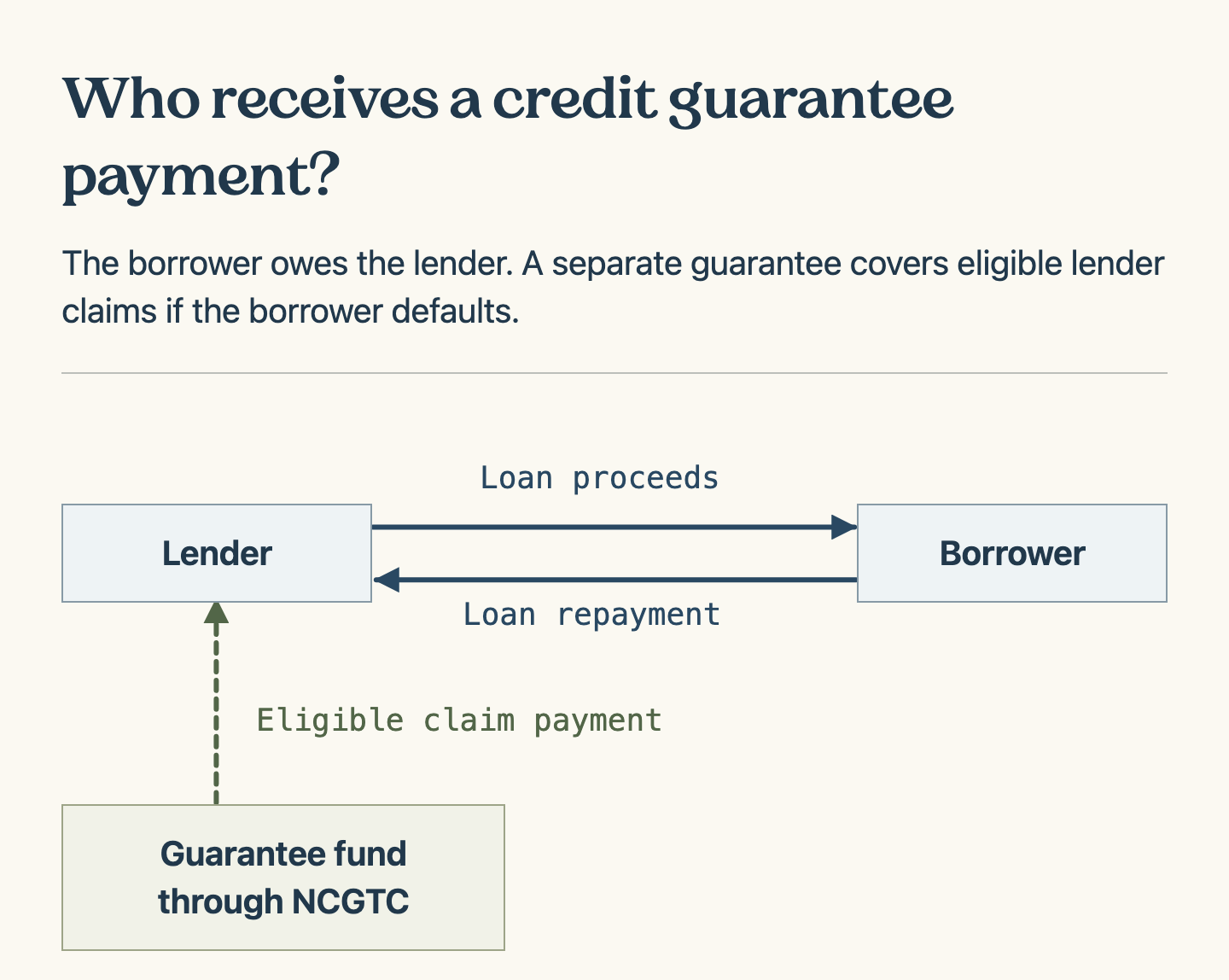
A single loan creates two relationships. Follow the money in each to identify who can claim protection when repayment fails.

  • The microenterprise borrows from a lending institution under an eligible facility. The lender releases the money to finance the enterprise and records the amount owed under the loan agreement.
  • Through NCGTC, the fund provides the lending institution with cover against eligible default risk. The trustee’s role concerns the guarantee, while the bank or other eligible institution handles the customer’s loan.
  • When an enterprise repays on schedule, its payments go to the lender. The business meets its obligations from its own resources, just as it would on another business loan.
  • If the enterprise defaults, the lender can seek payment under the guarantee terms. An eligible claim compensates the lender for covered loss. The borrower receives no claim money and remains liable for repayment.
  • A loan waiver would require a separate decision about the borrower’s obligation. In an exam question, identify whose claim the policy changes before describing its effect on the household or enterprise.
The lender advances the loan to the borrower. Repayments go back to the lender. The guarantee fund separately pays eligible lender claims through NCGTC.
The lender receives both the borrower’s repayments and any eligible guarantee payment. The borrower remains liable for the loan.

Why Does the Basis of Cover Depend on the Loan?

Consider a pottery business that needs clay for its next batch and a wheel that it expects to use for several years.

  • A working-capital limit can finance clay and packaging while the potter waits for customers to pay. A business can draw less than the bank has authorized it to use.
  • For this facility, the Cabinet links guarantee coverage to the disbursement amount. A sanctioned ceiling alone does not show how much credit the lender actually released to finance the business.
  • A term loan can finance the wheel. As the enterprise repays principal in instalments, the amount it still owes on that loan falls even though the original purchase price stays the same.
  • The outstanding amount supplies the reference for term-loan coverage. Using the initial sanction throughout the loan’s life would overlook principal already repaid and overstate the balance exposed to default.
  • Both measures identify an exposure base. To calculate a claim amount, one would also need the applicable guarantee terms. The Cabinet announcement alone does not supply a percentage of loss payable on each account.

Which Facilities Qualify and What Does the Fee Buy?

Start with the type of facility, then ask how the government prices access to guarantee protection.

  • The fund covers eligible Pradhan Mantri Mudra Yojana loans to microenterprises up to ₹20 lakh. The ceiling describes the eligible credit facility and cannot be read as the guaranteed payment after default.
  • The decision also includes qualifying Pradhan Mantri Jan Dhan Yojana overdrafts and loans to self-help groups within the specified portfolio band. Eligibility depends on the terms for the particular category.
  • A guarantee fee pays for protection against default risk. Interest is the price of borrowing under the loan contract. A lower guarantee fee does not specify the interest rate any individual borrower will pay.
  • The Cabinet kept the self-help group fee schedule unchanged. When interpreting the revised standard fee, identify the loan category first. Applying one rate across every eligible facility would give the wrong result.

Way Forward

Track Lending and Repayment Together

  • Publish repayment outcomes alongside the value of loans supported to show how new borrowers fare over time.
  • Compare claims against the corresponding exposure base when assessing the fund’s performance.
  • Explain repayment obligations at sanction so borrowers understand what the guarantee protects.

Conclusion

  • The guarantee can help enterprises obtain formal credit by sharing a lender’s default risk. An enterprise’s debt and the lender’s right to make a claim arise under separate arrangements.
  • For a question about coverage, first identify the facility type. The amount released on working capital and the balance left on a term loan answer different questions about how much money is at risk.

UPSC Practice Questions

Prelims MCQ 1

With reference to CGFMU, consider the following statements:

  1. Guarantee protection is provided to lending institutions through NCGTC.
  2. The coverage basis for a term loan is its outstanding amount.
  3. An eligible guarantee claim automatically cancels the borrower’s repayment obligation.

How many of the above statements are correct?

(a) Only one (b) Only two (c) All three (d) None

Answer: (b) Only two

Explanation:

Statements 1 and 2 are correct. Claim payments protect lenders against covered losses. A guarantee claim does not itself waive the underlying debt.

Prelims MCQ 2

Which measure does the Cabinet decision use as the basis of guarantee coverage for a working-capital limit?

(a) Projected annual sales (b) Value of the proprietor’s assets (c) Amount disbursed (d) Full sanctioned ceiling in every case

Answer: (c) Amount disbursed

Explanation:

The disbursement amount reflects credit released under the working-capital limit. The outstanding amount is the specified basis for a term loan.

UPSC Mains Questions

  1. Explain how a public credit guarantee can expand access to formal finance while preserving borrowers’ repayment obligations.
  2. Why should a guarantee fund distinguish between sanctioned limits, disbursements and outstanding balances when measuring credit exposure?

Source: PIB, Union Cabinet.

Frequently Asked Questions

Who receives the credit guarantee?

The lending institution receives protection against eligible default risk through NCGTC. The microenterprise receives funds under its loan agreement and uses those funds for the purpose for which it borrowed.

Can a borrower claim a CGFMU payout?

The lender holds the guarantee protection. A borrower facing difficulty with repayment still owes the debt under its loan agreement, even when the lender makes an eligible guarantee claim.

How is coverage measured for term loans?

The outstanding amount provides the basis of coverage for a term loan. As principal is repaid, the remaining balance changes. The announced rules use disbursement for working-capital limits.

Did the Cabinet change the interest rate on Mudra loans?

The announced reduction applies to the standard annual guarantee fee. A lending institution’s loan interest rate is a separate charge. The decision also retained the existing fee schedule for self-help groups.