
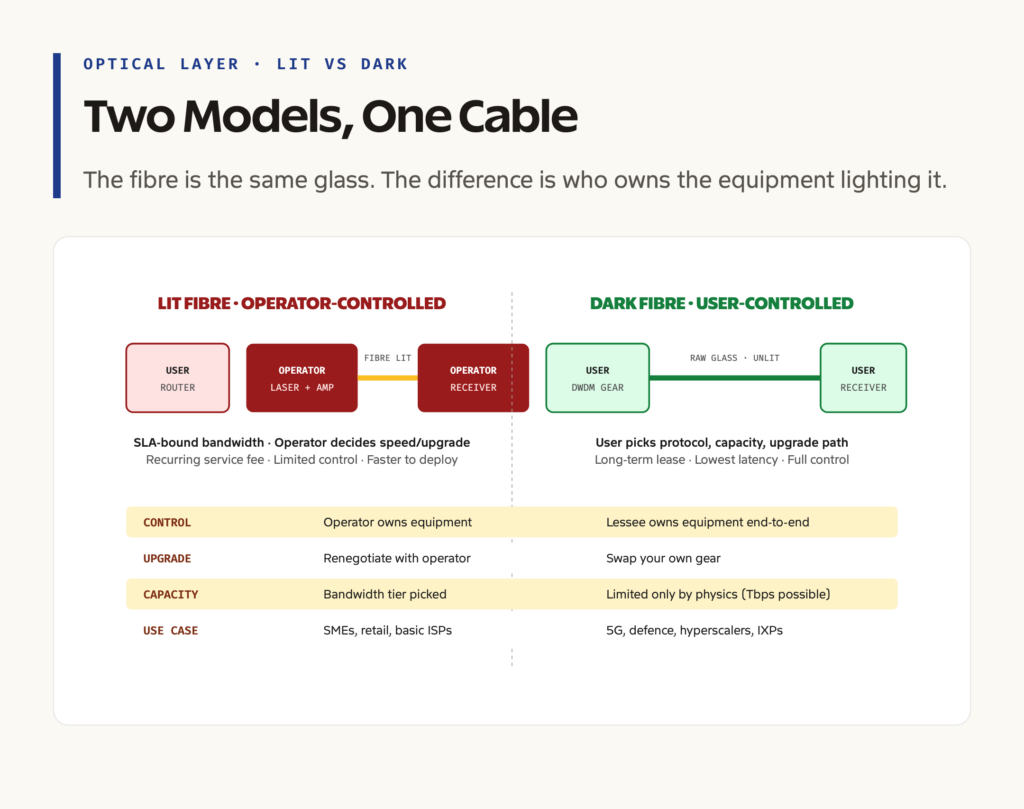
The optical fibre cables buried under Indian roads and laid along the seabeds adjacent to the coast carry an enormous volume of data every second. Most of those fibres are lit, meaning a telecom operator is firing laser pulses through them at one end and reading the pulses at the other. A surprising fraction of the fibres are dark, meaning the cable is in place but no light is being transmitted. The unlit fibres are not abandoned. They are leased, planned, or held in reserve for users who want to control the optical layer themselves rather than buy bandwidth from an operator.
Dark fibre is the term for those unlit cables and for the leasing model that goes with them. The technology is mundane. The strategic implications are not. India’s 5G rollout, the BharatNet rural broadband programme, the undersea cable landing economy, the data centre boom, internet exchange points, and the defence networks all depend on dark fibre availability. The policy debate around dark fibre access touches telecom regulation, infrastructure-sharing, public-good economics, and digital sovereignty. This article walks through what dark fibre actually is, why anyone would prefer it over lit bandwidth, where it shows up in India’s digital infrastructure, and what the regulatory questions look like.
What Dark Fibre Is
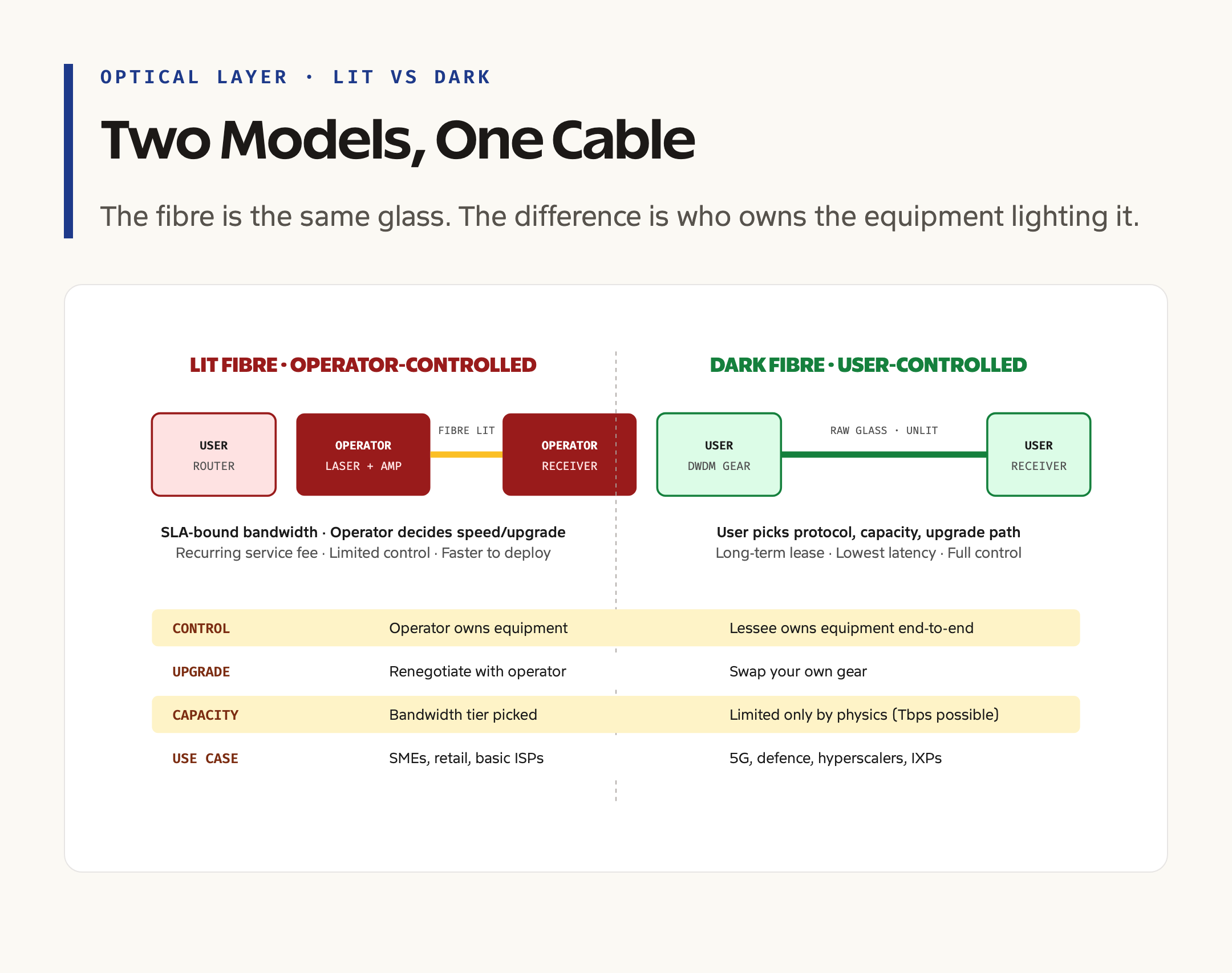
Optical fibre is a hair-thin glass strand that carries data as pulses of light. A modern submarine or terrestrial cable bundles dozens or hundreds of individual fibre pairs into a single armoured sheath. When a telecom operator commissions a cable, it does not light all of those pairs at once. The cost of the cable is dominated by the civil works, including the digging, the right-of-way clearance, and the laying. The cost of the optical equipment that lights the cable, called the transmission gear, is comparatively small but it scales with capacity. Operators deliberately lay more fibre than they immediately need, plug equipment into a few pairs, and leave the rest dark for future expansion.
Some of the dark pairs eventually get lit by the operator that laid the cable. Others get leased to third parties as raw glass. The lessee buys a long-term, indefeasible right of use to a specific fibre pair, plugs in its own equipment at each end, and runs whatever protocols and capacities it wants. From the lessee’s perspective, the cable is glass. From the cable owner’s perspective, the lease is recurring revenue with almost no marginal cost.
Lit Fibre vs Dark Fibre: Who Controls What
The architectural distinction between lit and dark fibre is about which party owns the layer-one optical equipment. In a lit fibre product, the seller owns the laser transmitters, the optical amplifiers, and the receivers. The buyer gets a service-level agreement for a specific bandwidth, a specific latency, and a specific availability. The buyer plugs an Ethernet or IP router into a handoff port at each end and pays a recurring service fee. The seller decides the technology, the upgrade path, and the price ceiling.
In a dark fibre lease, the buyer owns the optical equipment. The buyer chooses whether to run 10 gigabit Ethernet, 100 gigabit Ethernet, 400 gigabit dense wavelength division multiplexing, or any other protocol. Capacity upgrades happen by replacing the buyer’s own equipment, with no negotiation with the cable owner and no recurring price increase. Latency is determined by the cable’s physical length and the buyer’s equipment, not by the operator’s queue management. Bandwidth is bound only by the physics of the fibre, which can carry many terabits per second on a single pair with current dense WDM equipment.
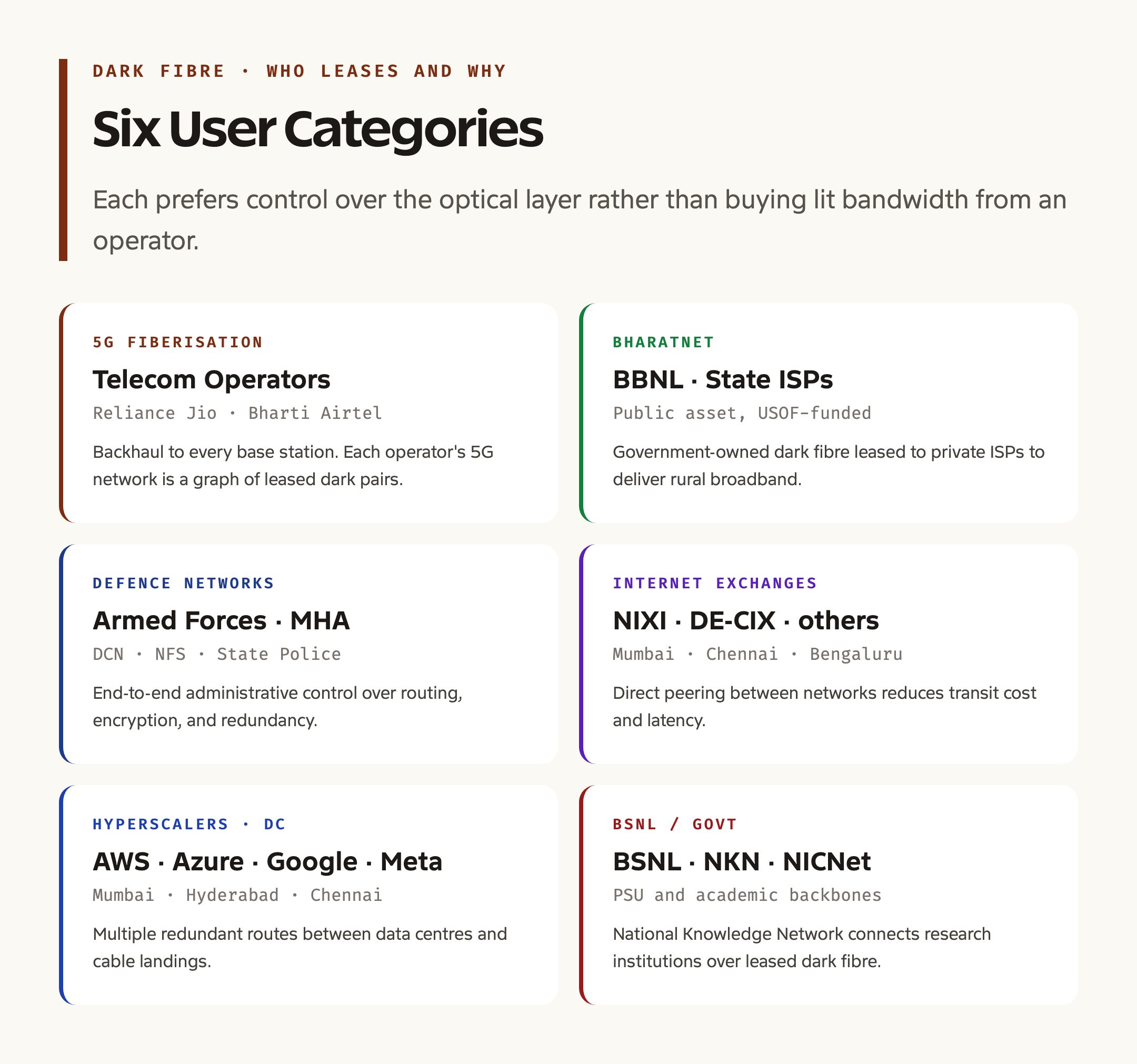
The control trade-off explains why specific buyers prefer dark fibre. A hyperscaler running a data centre to data centre link wants the lowest possible latency and the highest possible bandwidth at marginal cost. A defence network wants the cryptographic and routing chain to be entirely under its own administrative control. An internet exchange point wants to run its own peering protocols without an intermediate operator. A 5G mobile network wants to upgrade backhaul capacity at every base station every two or three years without renegotiating tariffs. In each case, dark fibre is cheaper, faster, and more strategically aligned than lit bandwidth.
Dark Fibre and the 5G Rollout
The most immediate Indian use case for dark fibre is 5G. Mobile networks at every generation depend on backhaul, the wired link between the base station and the core network. 4G networks run on a mix of microwave radio and fibre backhaul, with the share of fibre rising over time. 5G shifts the balance decisively to fibre because the air-interface capacity is much higher and microwave links cannot keep up at scale. The industry term is fiberisation, and the share of fiberised base stations is one of the closest-watched metrics for 5G readiness.
India’s 5G rollout, led by Reliance Jio and Bharti Airtel, requires fibre to within a kilometre of every dense urban base station and to within a few kilometres of every rural site. Building that fibre from scratch in every city and along every highway is expensive and time-consuming. Leasing dark fibre from existing cable owners is the faster path. Each operator’s 5G network is a graph of leased dark fibre pairs running between leased cell sites, leased data centres, and a small number of operator-owned core sites. For the technology layer, see the article on 5G technology.
BharatNet and the Public Dark Fibre Asset
BharatNet is the Indian government’s flagship rural broadband programme, run by the Bharat Broadband Network Limited, abbreviated BBNL, and funded through the Universal Service Obligation Fund. The programme has laid optical fibre cable to roughly all gram panchayats in the country, with a large remaining mile to be lit and connected. The BharatNet asset is owned by BBNL on behalf of the government, and the policy intent is that the asset should be leased to private internet service providers, state governments, and other users at non-discriminatory tariffs.
A significant share of the BharatNet fibre is dark. Lighting all of it at once is not economically rational because the rural demand profile is sparse and uneven. The leasing model lets a private ISP take over a specific stretch, plug in its own electronics, deliver service to consumers in that area, and pay BBNL a tariff that covers the public capital cost. The architectural advantage is that the fibre is laid once and reused many times by many operators. The policy debate is over how to price the lease, how to enforce neutrality among operators, and how to maintain the cable over a multi-decade lifetime.
Undersea Cables and the Coastal Landing Economy
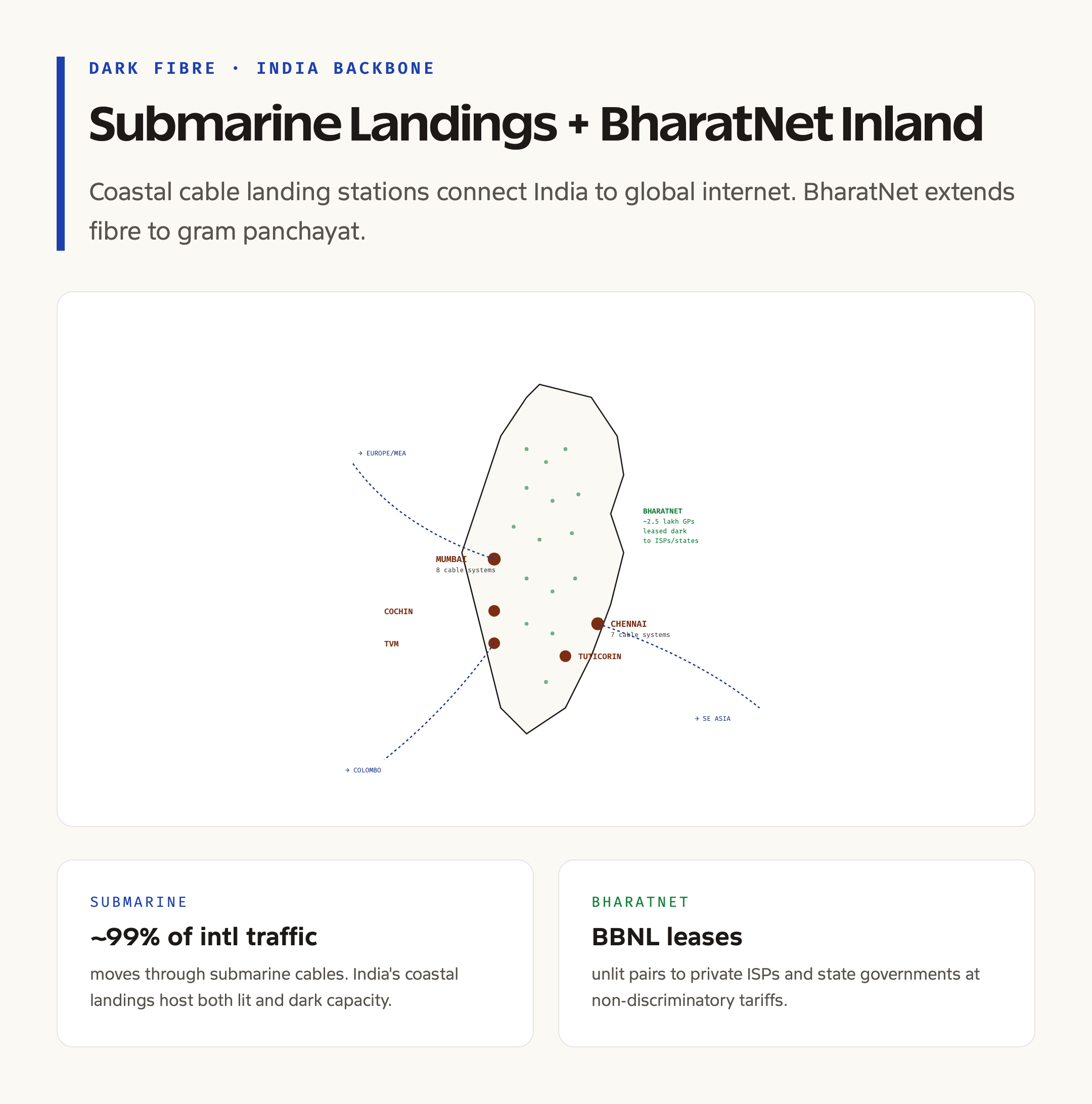
About 99 percent of intercontinental data traffic moves through submarine cables. India is connected to the global internet through cables that land at Mumbai, Chennai, Cochin, Tuticorin, Trivandrum, and a few other coastal cities. The cables are owned by consortia of telecom operators and increasingly by hyperscale technology companies. Each landing station is a building near the beach where the submarine cable terminates and connects to the inland fibre network.
Inside the landing station, a portion of the cable’s capacity is lit immediately and assigned to specific consortium members. A portion is held dark for future allocation. The price of dark fibre on a major route, expressed as the cost of an indefeasible right of use over a fifteen or twenty year term, is one of the closely watched indicators of internet capacity in the region. The expansion of cable landings on India’s east and west coasts, along with the new cables proposed in the Andaman and Nicobar Islands area, shapes the cost of international bandwidth for Indian users.
Defence and Government Networks
The Indian armed forces and several civilian government departments operate their own communication networks. The defence communication network, the network for officers, and various dedicated tactical networks rely heavily on leased dark fibre because the alternative, leased bandwidth from a commercial operator, leaves layer-one and layer-two control in the operator’s hands. A defence network that runs over a leased dark fibre pair has end-to-end administrative control. The encryption stack, the routing topology, the failure detection, and the redundancy planning are all internal.
Police, intelligence, judicial, and disaster management networks use a similar pattern. The National Knowledge Network connects research and educational institutions over a backbone that combines dark fibre leases with operator-managed bandwidth. The Election Commission‘s data networks during elections, the railway control networks, the airport authority networks, and the power grid’s dispatch networks all consume dark fibre.
Internet Exchange Points and Data Centres
An Internet Exchange Point, abbreviated IXP, is a physical location where many networks peer with each other directly rather than routing traffic through a third-party transit provider. Direct peering reduces latency and cost. The IXP is typically housed inside a data centre, and every member network connects to the IXP through a dedicated fibre. Most of those connections are dark fibre.
India has a small number of major IXPs, including the National Internet Exchange of India operated by NIXI in several cities, and a growing number of private IXPs in major data centre clusters. The data centre boom in Mumbai, Hyderabad, Chennai, and Bengaluru is structurally dependent on dark fibre availability. A hyperscale data centre needs multiple dark fibre routes to redundant cable landing stations and to backbone networks across the subcontinent. The cost of building a new data centre is partly a function of the dark fibre that can be procured around the proposed site.
The Regulatory Picture
Telecom regulation in India sits with the Telecom Regulatory Authority of India, the Department of Telecommunications, and the broader Telecommunications Act 2023. Dark fibre as a wholesale product is regulated less than lit bandwidth, but it intersects with right-of-way rules, infrastructure-sharing obligations, and the licensing framework for telecom service providers. The Indian Telegraph (Right of Way) Rules 2024 streamline the process for laying new fibre, which expands the dark fibre supply over time.
The policy debate has two main strands. The first is whether dark fibre infrastructure should be treated as an essential facility, with mandatory open access at regulated tariffs, in the spirit of the BharatNet model. The second is whether private cable owners should be required to lease unused dark fibre to competitors. The trade-off is between encouraging private investment in cable, which requires the prospect of monopoly returns, and promoting downstream competition, which requires open access. Different jurisdictions resolve the trade-off differently, and India is still settling its preferred balance.
What Dark Fibre Means for the Digital Economy
The economic consequence of cheap, abundant dark fibre is that latency-sensitive and bandwidth-heavy applications become viable. Cloud computing in distant data centres is acceptable when fibre is plentiful. Real-time applications, including video conferencing, online gaming, financial trading, and remote surgery, depend on fibre quality. The sophistication of cyber security at scale also depends on fibre, because intrusion detection and incident response require copying enormous volumes of traffic to security tools in near real time.
Looking forward, the next-generation 6G technology will require an even denser fibre footprint than 5G. The shift to edge computing, where computation happens closer to the user rather than in centralised data centres, depends on fibre to every edge node. Each of those technology shifts increases the dark fibre demand, and each puts more pressure on the regulatory framework to keep dark fibre as accessible and competitively priced as possible.
Prelims and Mains Pointers
For prelims, the high-yield facts are that dark fibre refers to optical cables that are laid but unused, that the lessee controls the optical equipment and therefore the speed and technology, that BharatNet is operated by BBNL and leases dark fibre to ISPs and state governments, and that 5G fiberisation is the dominant private-sector demand driver.
For mains, the analytical lens is on infrastructure-sharing economics, the public-good case for treating dark fibre as essential infrastructure, the strategic value of dark fibre for defence and government networks, and the role of dark fibre in the broader niti aayog dpi 2047 roadmap. Dark fibre is the unglamorous physical layer beneath every digital story, and a working understanding of the layer is necessary for any GS-III answer on telecom or digital infrastructure.
Tell Google you want more of this.
Add Anantam IAS as a preferred sourceOne tap, and this site shows up more often in your own Top Stories, AI Overviews and AI Mode. Remove it any time.





