

Disinvestment in India: Policy & Key Cases
Disinvestment is the process by which the government reduces its ownership stake in public sector undertakings (PSUs). It can mean selling a minority stake while retaining majority control, or transferring management control entirely to a private buyer. India has been pursuing disinvestment as a fiscal tool since the early 1990s — and the debate around it cuts to the heart of what public enterprises are for. For UPSC GS-III, you need to understand the types, institutions, landmark cases, fiscal targets, and the policy arguments on both sides.
What Is Disinvestment? Types and Definitions
The government holds ownership stakes in hundreds of PSUs across sectors — steel, oil, banking, insurance, airlines, telecom, and more. Disinvestment reduces that stake by selling shares.
Minority Disinvestment (Non-Strategic)
The government sells a part of its shareholding in a PSU but retains majority ownership and management control. The PSU remains a government-controlled entity. This is done primarily to:
- Raise fiscal revenue
- Improve PSU governance and market discipline
- Comply with minimum public shareholding (MPS) norms for listed companies
Example: Selling a 10% stake in Coal India through an Offer for Sale (OFS) while retaining 70%+ ownership.
Strategic Disinvestment
The government transfers both majority ownership and management control to a strategic (private sector) buyer. The PSU effectively gets privatised. This is structurally different from minority disinvestment — the government exits the business.
Strategic disinvestment is justified where:
- The public interest doesn’t require government ownership
- Private management can improve efficiency and competitiveness
- The PSU is in a non-strategic commercial sector
Buyback and Other Routes
PSUs can also buy back their own shares from the government (reducing government’s stake without a market sale). This has been used for cash-rich PSUs like Coal India and BHEL.
DIPAM: The Disinvestment Ministry
The Department of Investment and Public Asset Management (DIPAM) — under the Ministry of Finance — is the nodal body for disinvestment policy and execution in India.
DIPAM was created in 2016 by splitting the Department of Disinvestment (which itself was created in 1999 as a dedicated ministry and later converted to a department).
DIPAM functions:
- Manages disinvestment transactions (OFS, strategic sale, IPO)
- Manages government’s portfolio of PSU shareholdings
- Coordinates with SEBI, stock exchanges, and investment bankers
- Manages the National Investment Fund (NIF) — where disinvestment proceeds are deposited
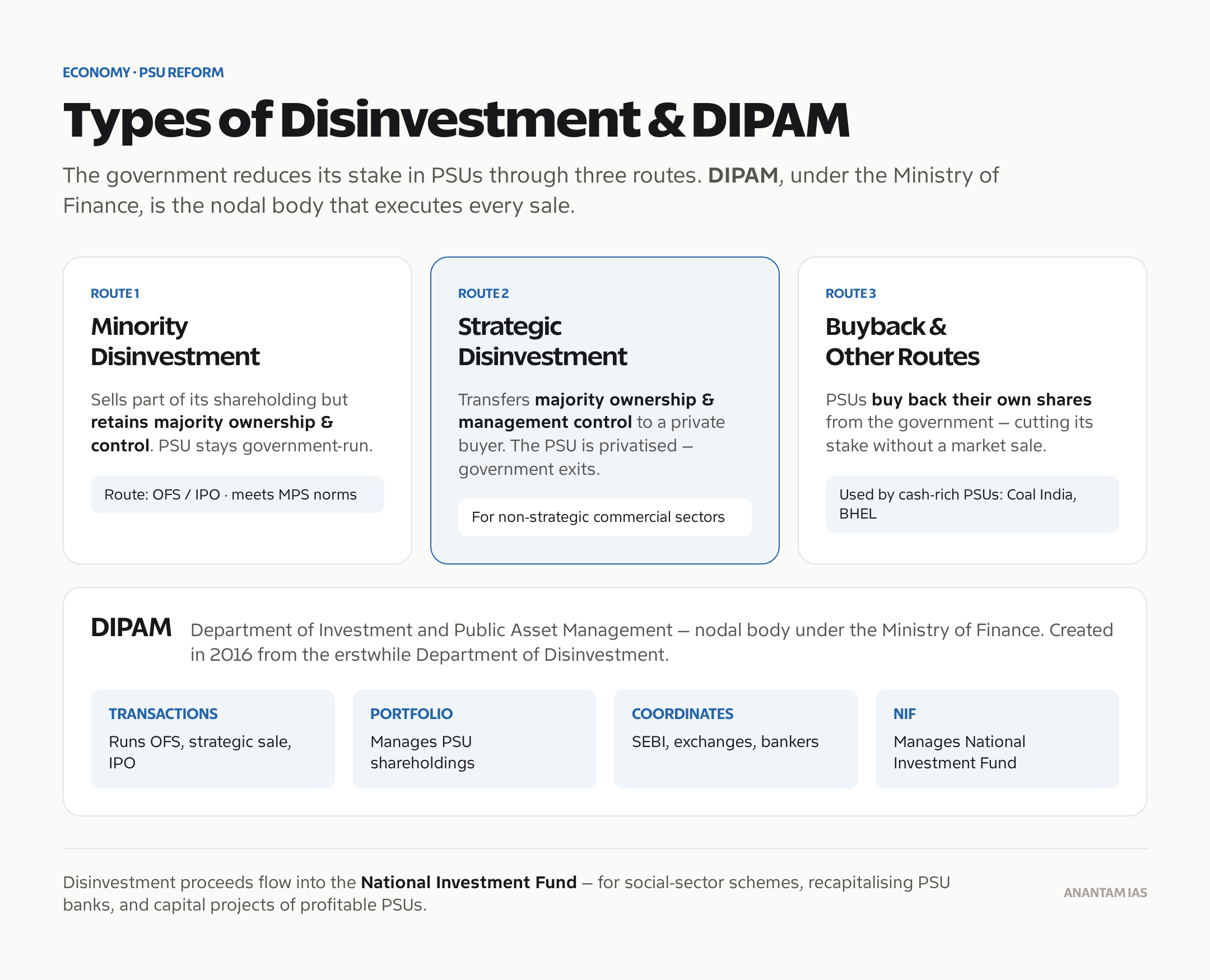
National Investment Fund: Proceeds from disinvestment flow into the NIF. They’re used for:
- Investment in social sector schemes
- Recapitalisation of PSU banks and financial institutions
- Investment in capital projects of profitable PSUs
Landmark Disinvestment Cases
Air India: India’s Biggest Strategic Sale
Air India was privatised in January 2022 — sold to the Tata Group (through Talace Pvt Ltd, a Tata Sons subsidiary) for an enterprise value of ₹18,000 crore (including ₹15,300 crore of debt taken over and ₹2,700 crore cash payment).
This was the most significant strategic disinvestment since the NDA government of Vajpayee era attempted but failed to sell Air India in 2001-02. The airline had accumulated over ₹60,000 crore in cumulative losses and required continuous government bailouts.
Significance for UPSC:
- First strategic disinvestment of a major national carrier
- Demonstrated the government’s willingness to exit loss-making PSUs
- Tata Group’s return to aviation — they originally founded Air India (formerly Tata Airlines, 1932)
- Government continued to absorb post-2018 pension and provident fund liabilities
LIC IPO: India’s Largest Ever IPO
The Life Insurance Corporation of India (LIC) IPO in May 2022 was the largest IPO in Indian capital market history — raising approximately ₹20,557 crore from a 3.5% stake sale.
Context: LIC was established in 1956 by nationalising 245 private insurance companies. It manages over ₹40 lakh crore in assets. The IPO required an amendment to the LIC Act (1956) to allow share issuance.
Significance: Even after the IPO, the government retained over 96% ownership — this was pure minority disinvestment, not privatisation. But the listing improved LIC’s governance transparency and subjected it to SEBI’s corporate governance standards.
BPCL: The Delayed Sale
Bharat Petroleum Corporation Ltd (BPCL) was among the most high-profile strategic disinvestment cases — announced in 2019-20. But the process has seen repeated delays due to high global oil price volatility and lack of interested strategic buyers. As of 2024, the strategic sale of BPCL has been effectively shelved or deprioritised.
VSNL: A Successful Early Case
Videsh Sanchar Nigam Limited (VSNL) — India’s international telecom monopoly — was strategically divested in 2002. The Tata Group acquired management control. VSNL was renamed Tata Communications and is now a global network services company. This remains one of India’s most successful strategic disinvestments.
Disinvestment Revenue: Targets vs Actuals
The government sets disinvestment revenue targets in the Union Budget. Meeting them has been consistently challenging.
| Year | Budget Target (₹ Crore) | Actual Receipts (₹ Crore) | Achievement |
|---|---|---|---|
| 2017-18 | 72,500 | 1,00,056 | Exceeded (PSU buybacks boosted receipts) |
| 2018-19 | 80,000 | 85,054 | Exceeded |
| 2019-20 | 1,05,000 | 50,304 | Missed badly (BPCL failed, CPSE-ETF only) |
| 2020-21 | 2,10,000 | 32,845 | COVID devastated receipts |
| 2021-22 | 1,75,000 | 1,31,519 | Partial — Air India sale slipped to FY22 end |
| 2022-23 | 65,000 | 42,516 | Missed — LIC IPO only partial proceeds |
| 2023-24 | 51,000 | ~30,000 | Conservative targets, limited activity |
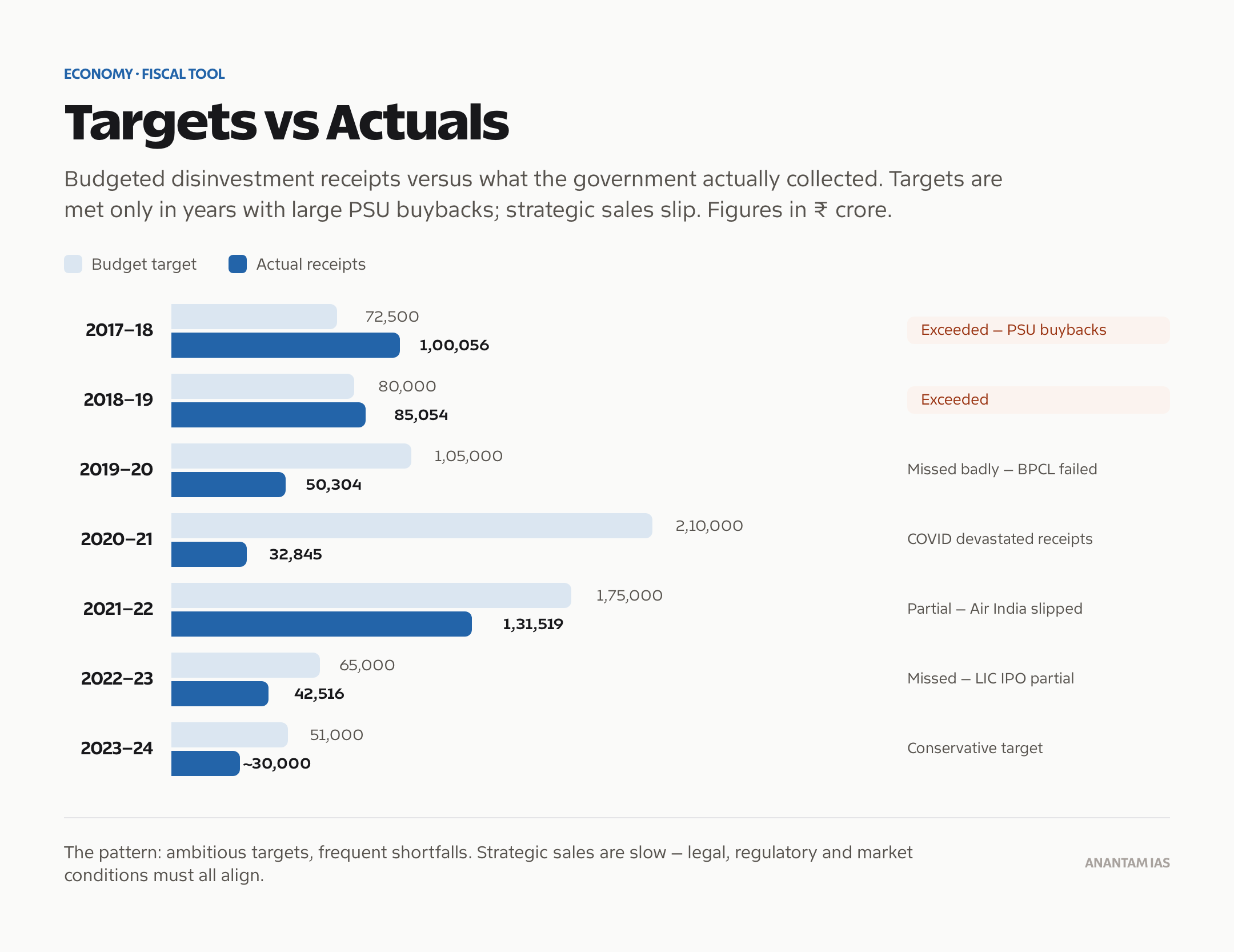
Pattern: The government consistently sets ambitious targets but falls short, except in years with large PSU buybacks. Strategic disinvestments are complex and time-consuming — legal, regulatory, and market conditions must align.
Policy Debates Around Disinvestment
Arguments For Disinvestment
Fiscal consolidation: Reduces fiscal deficit; funds social spending without additional debt.
Efficiency gains: Private management typically improves operational efficiency, customer service, and financial performance — Air India’s turnaround under Tata Group is an early validation.
Capital allocation: Government capital tied up in commercial PSUs could be redeployed to health, education, and infrastructure where market failure justifies public spending.
Shareholder discipline: Listed PSUs face market scrutiny, improving corporate governance.
Reduce government’s commercial footprint: Niti Aayog‘s New PSE Policy (2021) classifies sectors as “strategic” (minimum government presence) and “non-strategic” (privatise or close PSUs). This provides a long-term framework.
Arguments Against Disinvestment
Strategic assets: PSUs in oil, defence, insurance provide policy levers — strategic disinvestment surrenders these.
Social obligations: PSUs in banking (SBI), energy (ONGC), and services often serve underserved populations at below-market prices — private owners may abandon these.
Undervaluation risk: Selling PSUs at depressed prices (especially during economic downturns) benefits buyers at taxpayer expense.
Employment concerns: Strategic buyers may restructure, reducing employment — a politically sensitive issue.
Revenue one-time nature: Disinvestment is a capital receipt — it’s a sale of assets, not sustainable revenue. Using it to fund revenue expenditure is fiscally imprudent.
New PSE Policy (2021): The Strategic Disinvestment Framework
The National Monetisation Pipeline (NMP) and the New Public Sector Enterprise Policy (2021) announced in Union Budget 2021-22 provide the current framework.
New PSE Policy: All sectors classified into two categories:
- Strategic sectors (minimum CPSEs, mostly limited to one — others privatised): Atomic energy, space, defence, transport, telecom, power, petroleum, banking, insurance
- Non-strategic sectors: All other sectors — CPSEs to be privatised, merged, or closed
This is a significant policy shift — the government explicitly acknowledged it should not be in all commercial activities.
Frequently Asked Questions
1. What is the difference between strategic disinvestment and minority disinvestment?
Minority disinvestment sells a part of government’s stake while retaining majority ownership and management control. Strategic disinvestment transfers both majority ownership and management control to a private buyer — effectively privatising the PSU.
Department of Investment and Public Asset Management (DIPAM) under the Ministry of Finance is the nodal agency. It was created in 2016 from the erstwhile Department of Disinvestment.nn3. What was significant about the Air India privatisation?
Air India was sold to the Tata Group in January 2022 — India’s most significant strategic disinvestment. The enterprise value was ₹18,000 crore. It ended decades of government ownership of a chronically loss-making airline and returned the carrier to the Tata Group, which originally founded it.
4. What is the National Investment Fund (NIF)?
The NIF receives disinvestment proceeds. Funds are used for social sector investment, PSU bank recapitalisation, and capital projects of profitable PSUs. It ensures disinvestment receipts are tracked and purposefully deployed.
5. Why does the government consistently miss disinvestment targets?
Strategic disinvestments involve complex legal, regulatory, and commercial processes — buyer identification, due diligence, approvals, valuation negotiations — that frequently run into delays. Market conditions affect valuations. Political opposition in loss-making sectors is intense. And PSU employee unions resist privatisation.
Tell Google you want more of this.
Add Anantam IAS as a preferred sourceOne tap, and this site shows up more often in your own Top Stories, AI Overviews and AI Mode. Remove it any time.