The doctrine of escheat is one of the quieter corners of Indian constitutional and property law, but it carries surprising weight. It answers a question that most heirs never have to ask: what happens to a person’s property when there is no will and no legal heir to claim it? Common law has a clean answer. The property reverts to the sovereign. Indian law has inherited that answer, codified it in Article 296 of the Constitution, and over the decades layered it with judicial caution to make sure the State does not take what is not really ownerless.
Property practitioners encounter the doctrine when an unclaimed flat surfaces in a society’s records, when a company is wound up with assets still on its books, or when a public charitable trust collapses without a clear successor. UPSC aspirants meet it through the constitutional text and the Supreme Court’s repeated insistence that escheat is not automatic. The doctrine sits at the intersection of property law, the Constitution, civil procedure, and the law of succession, and a clean grasp of all four is what separates a passable answer from a strong one.
This guide walks through the doctrine’s common law origin, the constitutional position under Article 296, the careful distinction between escheat and bona vacantia, the procedural safeguards laid down by the Indian judiciary, and the doctrine’s place in the wider basic structure doctrine framework that protects fundamental rights against arbitrary State action.
What the Doctrine of Escheat Means
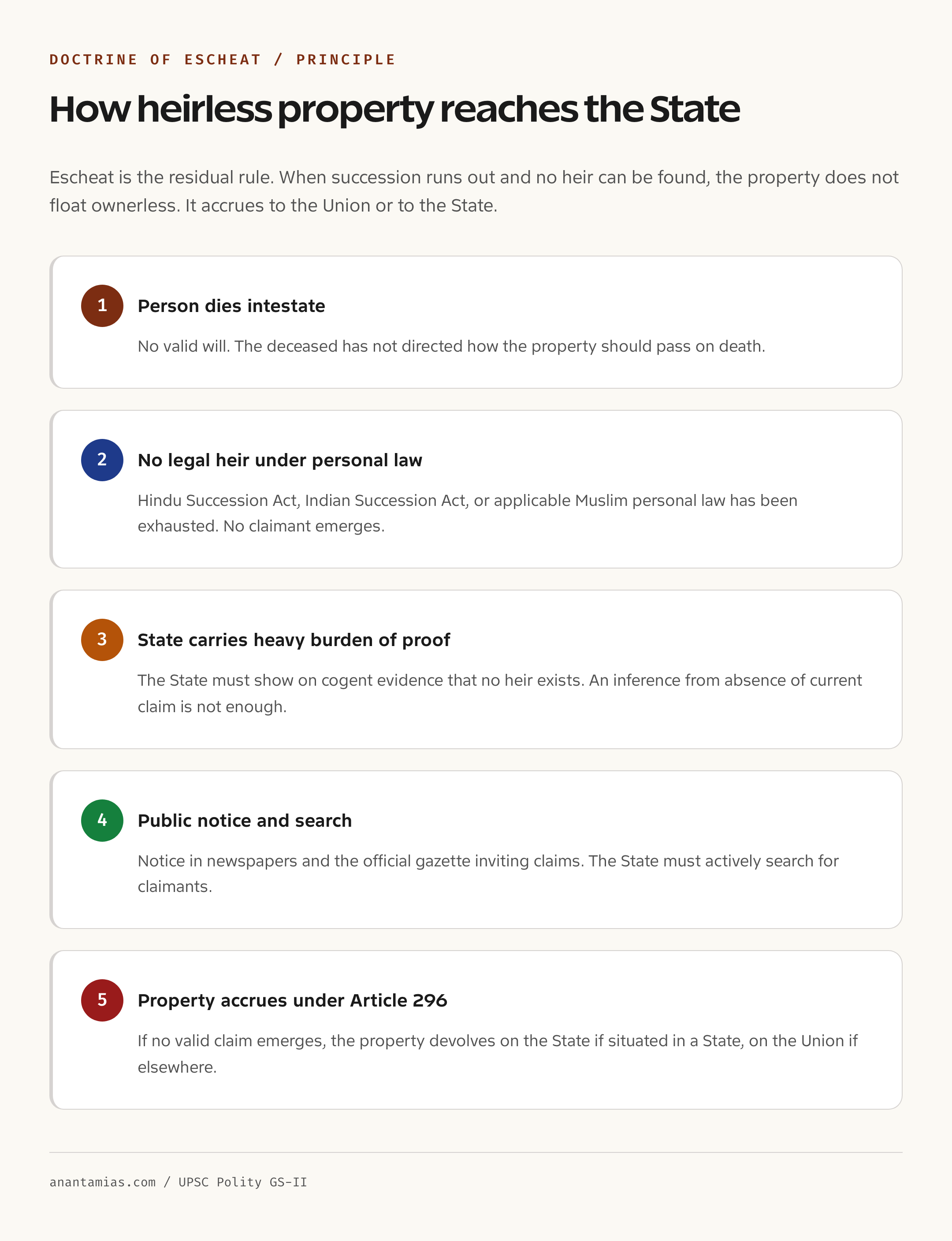
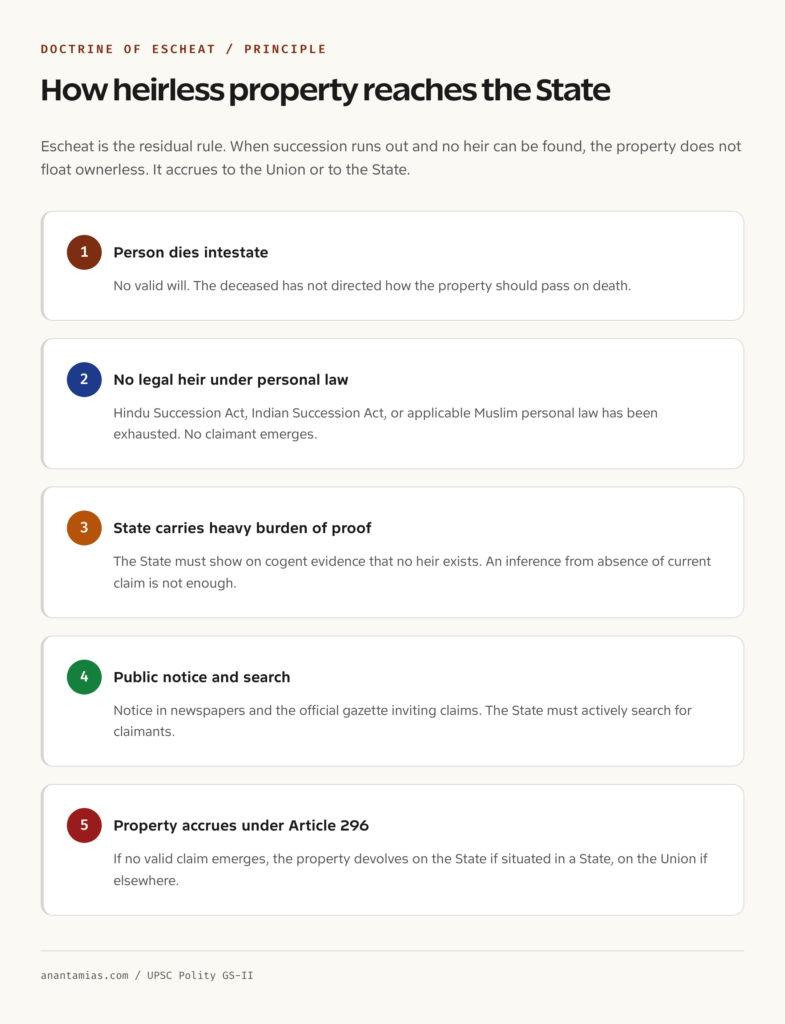
Escheat is a common law doctrine. Its operative rule is simple. If a person dies intestate, that is, without leaving a valid will, and without leaving any legal heirs to inherit under the applicable personal law, the property does not float in legal limbo. It devolves on the State. The reasoning is older than modern constitutionalism. Under the feudal English system, all land was ultimately held of the Crown. When a tenant’s line of inheritance failed, the land returned to the Crown by escheat. The same logic applied, in a slightly different form, to chattels and movables.
When India adopted its Constitution, this common law principle was preserved. The Crown was substituted by the Union and the States. The territorial sovereign in whose jurisdiction the property lay became the residual claimant. A person who dies intestate without heirs cannot leave property hanging without an owner, because property without an owner produces uncertainty, fraud, and disputes. Escheat is the legal solution. The State steps in as the heir of last resort.
Two elements have to combine for the doctrine to operate. The deceased must have died intestate, meaning no operative will, and there must be no legal heirs under the personal law that governs succession. If either element is missing, escheat does not apply. A valid will routes the property to the named beneficiaries. A surviving heir, however distant, takes priority over the State.
Article 296 and the Constitutional Position
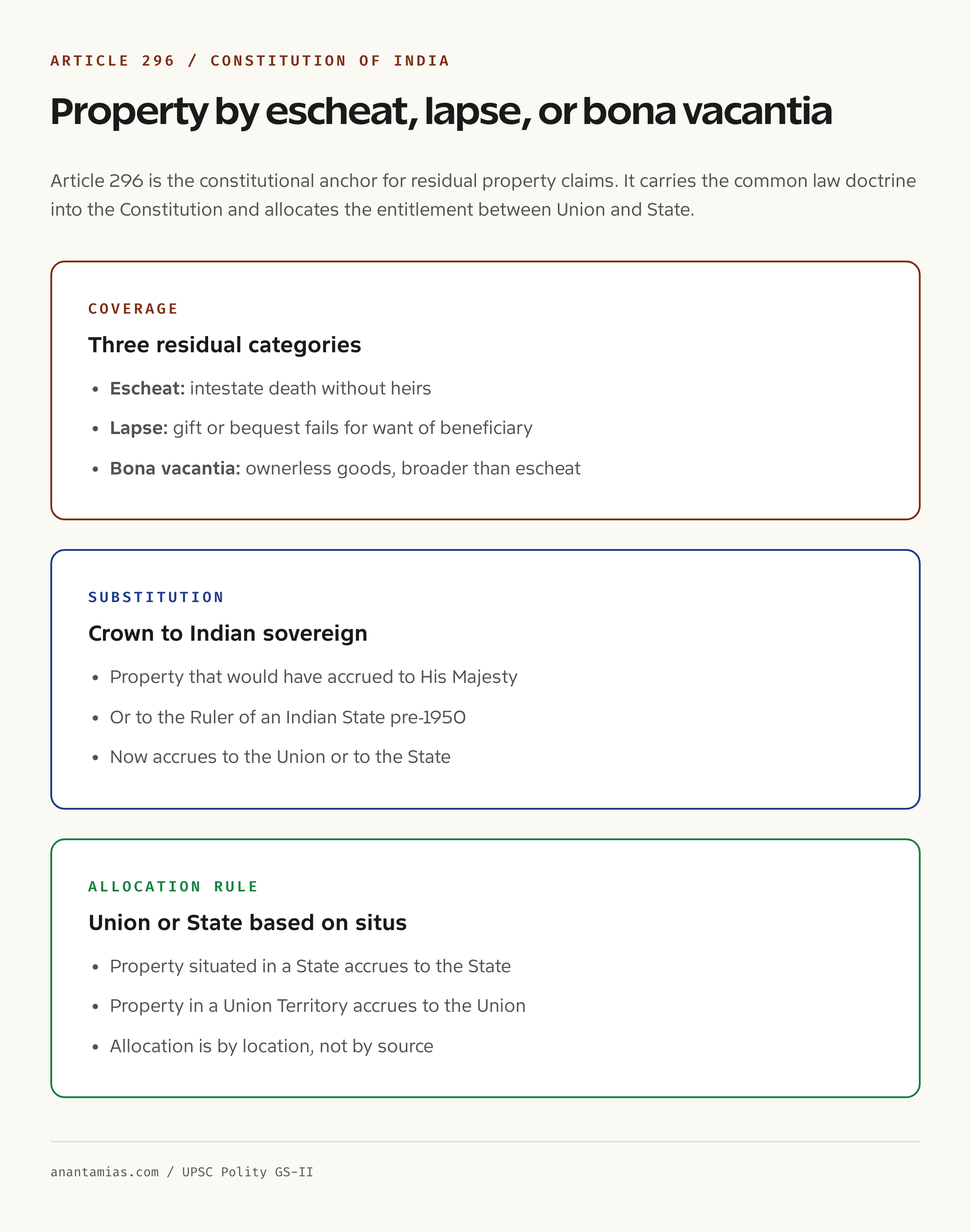
Article 296 of the Constitution of India explicitly deals with property accruing by escheat, lapse, or bona vacantia. The provision is short but does a lot of work. It says that any property in the territory of India which, if the Constitution had not come into operation, would have accrued to His Majesty or the Ruler of an Indian State by escheat, lapse, or bona vacantia for want of a rightful owner, shall now accrue to the Union or to the State, depending on where the property is situated.
The article makes two important moves. First, it carries the common law doctrine into the constitutional text, removing any doubt about its survival in independent India. Second, it allocates the entitlement between the Union and the States. Property situated in a State accrues to the State. Property in a Union Territory or in a place that does not form part of a State accrues to the Union. This dovetails with the broader scheme of the Constitution’s federal financial provisions, which run across Articles 264 to 300.
Article 296 also covers lapse, which is a related concept. A lapse occurs where a gift or bequest fails because the recipient died before the testator or was unable to take. Where a gift lapses and there is no residuary beneficiary, the property too can devolve on the sovereign. The article gathers all three concepts, escheat, lapse, and bona vacantia, into a single residual rule.
Escheat Versus Bona Vacantia
The two terms escheat and bona vacantia are often used interchangeably, but the distinction matters for both lawyers and aspirants. Escheat applies specifically when an individual dies intestate and without heirs. The triggering event is a person’s death and the absence of any successor. Bona vacantia is broader. The phrase is Latin for “ownerless goods” and applies whenever property has no claimant, whatever the underlying reason.
A company that is dissolved and leaves behind assets is the classic bona vacantia case. The company was the legal owner. After dissolution, the company no longer exists as a juristic person. The assets cannot belong to no one, and there is no individual death to invoke escheat. They become bona vacantia and accrue to the State under Article 296. The same is true of a charitable trust that is extinguished without a successor, or of unclaimed bank deposits where no claimant ever surfaces and the statutory process for treating the funds as ownerless has run its course.
Escheat, by contrast, is rooted in the law of succession. It is what happens when the intestate succession ladder runs out of rungs. Bona vacantia is rooted in the broader idea that property must always have an owner. Article 296 covers both because they share the same constitutional consequence. The State takes by default.
The Heavy Burden of Proof
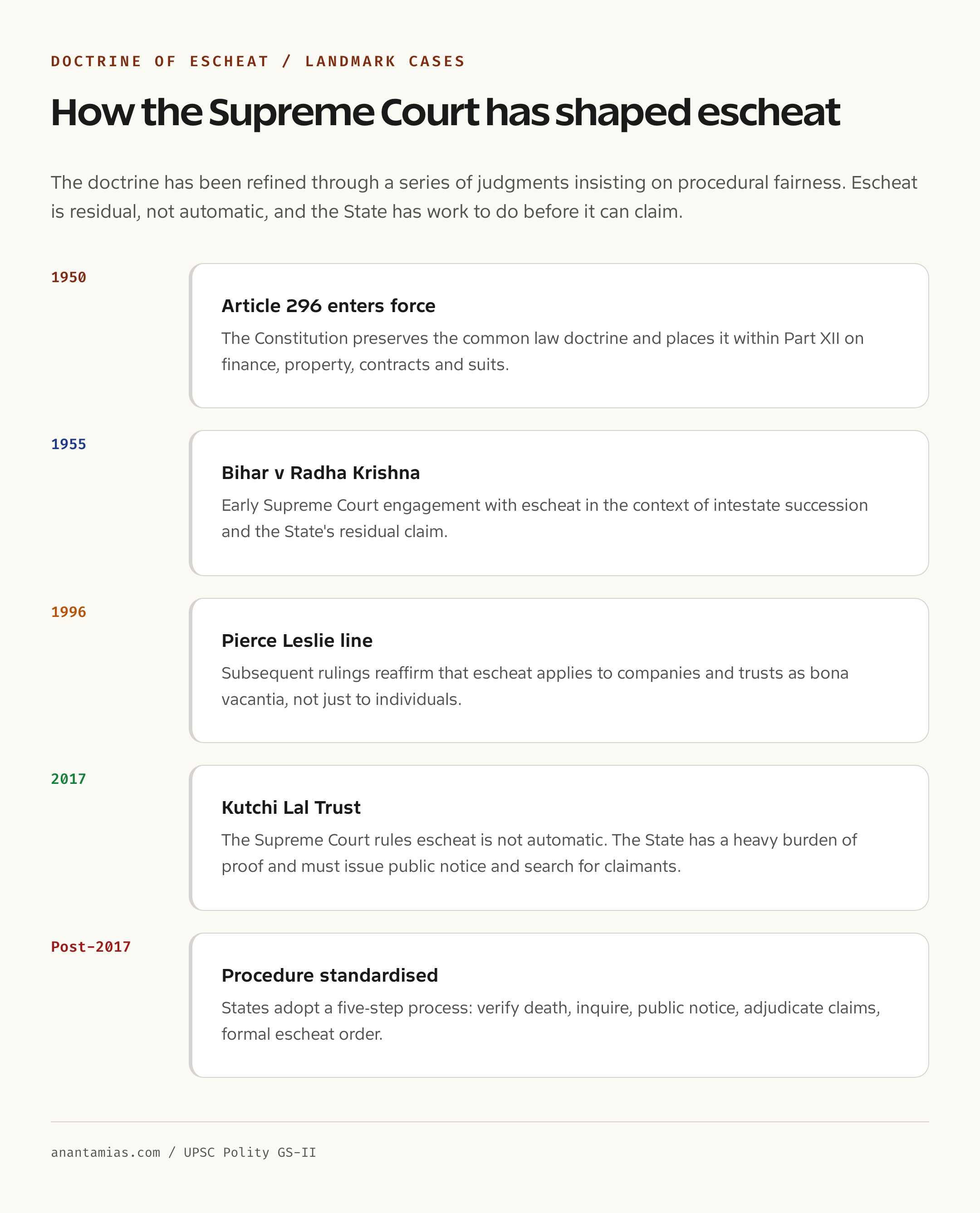
Indian courts have refused to read Article 296 as a windfall provision for the State. The leading authority is the Supreme Court’s decision in Kutchi Lal Rameshwar Ashram Trust Evam Anna Kshetra Trust through Trustee v. Collector, Haridwar and Others (2017). The case arose out of a contested claim by the Uttarakhand revenue authorities to take over land belonging to a charitable ashram trust on the ground that the trust had no rightful successor.
The Supreme Court ruled that escheat is not automatic. It laid down two important guardrails. First, the State carries a heavy burden of proof. It must demonstrate, on cogent and reliable evidence, that the deceased or the dissolved entity left absolutely no heirs or claimants. The court was emphatic that an inference of escheat cannot be drawn from a mere absence of a current claim. The State has to actively rule out the possibility of an heir.
Second, the State cannot simply take possession. It must issue a public notice and actively search for claimants. Only after the public process is complete and no valid claim emerges can the State proceed to formally take the property as escheated or bona vacantia. The judgment treats Article 296 not as a self-executing rule but as one that can only operate after due process. This places escheat squarely within the family of doctrines tied to Article 14 reasonableness and the right to life standard of fair procedure.
The Procedural Steps Followed by the State
Following Kutchi Lal, States generally follow a five-step process before claiming property under Article 296. The death or dissolution is first verified. The investigating authority then conducts an inquiry into possible heirs or claimants under the relevant personal law or company law. A public notice is issued in newspapers and in the official gazette inviting claims within a stipulated period. Claims that arise during the period are adjudicated. Only if no claim is established does a formal order of escheat or bona vacantia issue, transferring the property to the State.
The process protects two interests at once. It protects the absent heir who may surface late, perhaps from another State or from abroad. It also protects the public exchequer from inflated or fraudulent claims raised once the State announces an intention to take the property. The dual protection is the reason courts insist on strict compliance.
How Personal Laws Interact with Article 296
Personal laws in India provide for extensive lines of succession. The Hindu Succession Act, 1956, lists Class I and Class II heirs and goes on to agnates and cognates before declaring the property heirless. The Indian Succession Act, 1925, governing Christians, Parsis, and many cases of testate succession, lays down its own succession rules. Muslim personal law has its own framework of sharers and residuaries.
Article 296 sits below all these personal law schemes. It operates only when the relevant succession law has been exhausted and no heir can be found under it. The State is therefore not a competing claimant to a son or a niece or a cousin. It is the residual claimant after the personal law’s own residual categories have been worked through. This is why escheat cases often involve elaborate genealogical inquiries and notices to extended family branches.
Escheat in the Company and Trust Context
When a company is struck off the register or wound up under the Companies Act, 2013, any property remaining after creditors have been paid and members have been satisfied must be dealt with. If the dissolution leaves assets that cannot be distributed, those assets vest in the Central Government as bona vacantia under Article 296 read with the relevant Companies Act provisions. The Government then deals with the assets through the official liquidator or the relevant authority.
For trusts, the position depends on the type of trust and the applicable charity law. A public charitable trust whose objects have failed or that has been formally dissolved without a successor scheme may see its property treated as bona vacantia, again accruing to the State. The cy-près doctrine often intervenes before bona vacantia is invoked. Under cy-près, courts redirect the trust’s property to a similar charitable purpose rather than allow it to escheat. Bona vacantia is the last resort even within the charitable trust context.
Distinction From Acquisition Under Eminent Domain
Escheat must be distinguished from acquisition under the State’s eminent domain powers. Eminent domain is the State’s power to take private property for a public purpose, subject to the requirements of authority of law and compensation under Article 300A. The right to property is no longer a fundamental right after the 42nd Amendment and the 44th Amendment, but Article 300A still requires that no person be deprived of property except by authority of law.
Escheat is structurally different. There is no person being deprived. The property has no owner. The State is not taking from a citizen. It is filling a vacuum. No compensation question arises because there is no one entitled to compensation. The legitimate owner, if any, has a claim through the public notice process. The shape of the protection is therefore procedural rather than substantive.
Comparative Glance: Escheat in Other Common Law Systems
The English roots of escheat have evolved into different forms across the common law world. In the United Kingdom, the Treasury Solicitor administers bona vacantia, with separate rules for the Duchies of Lancaster and Cornwall. In the United States, escheat law is largely a State matter, and unclaimed property statutes have grown into a substantial body of law that periodically returns billions of dollars in dormant accounts and forgotten assets to State custody. Australia and Canada follow patterns broadly similar to the British model.
India’s framework is closer to the British residual model than to the American unclaimed property regime. There is no comprehensive statutory framework for unclaimed financial assets that mirrors the American statutes. The Banking Regulation Act, the Companies Act, and various sectoral laws each carry their own dormancy and lapse provisions, with eventual transfer to the State or to investor protection funds. Article 296 supplies the constitutional anchor, while the operational detail sits in scattered legislation.
UPSC Relevance and Probable Question Patterns
Escheat shows up in UPSC General Studies Paper II under polity and constitutional law. The most likely question patterns ask candidates to define the doctrine, distinguish it from bona vacantia, identify the relevant article, and discuss the Supreme Court’s procedural safeguards. Mains questions can frame the doctrine within a broader discussion of Article 300A and the State’s residual claims, or compare escheat with cy-près in trust law.
Prelims-style questions tend to focus on the precise text of Article 296 and the allocation rule between Union and State. Mains-style questions reward candidates who can connect Kutchi Lal to the broader idea that procedural fairness governs even residual State claims. A solid answer should mention the heavy burden of proof, the public notice requirement, and the link to Article 14 and Article 21 jurisprudence.
Frequently Asked Questions
What is the doctrine of escheat in simple terms?
Escheat is the rule that property of a person who dies intestate without legal heirs devolves on the State. The State steps in as the heir of last resort to ensure that property does not lie ownerless.
What does Article 296 of the Indian Constitution say?
Article 296 provides that any property which would have accrued to the Crown or the Ruler of an Indian State by escheat, lapse, or bona vacantia for want of a rightful owner shall now accrue to the Union or to the State concerned, depending on where the property is situated.
What is the difference between escheat and bona vacantia?
Escheat applies specifically when an individual dies intestate and without heirs. Bona vacantia is broader and covers any ownerless property, including assets left by a dissolved company or extinguished trust.
Is escheat automatic in India?
No. The Supreme Court ruled in Kutchi Lal Rameshwar Ashram Trust v. Collector, Haridwar (2017) that escheat is not automatic. The State carries a heavy burden of proof and must issue public notice and actively search for claimants before taking the property.
Does Article 296 apply to companies and trusts?
Yes. Property left by a dissolved company or an extinguished trust without a successor can fall to the Union or the State as bona vacantia under Article 296. In trust cases, courts often apply the cy-près doctrine before resorting to bona vacantia.
How is escheat different from compulsory acquisition under Article 300A?
Escheat operates on ownerless property and involves no deprivation of an owner, so no compensation arises. Article 300A acquisition involves taking property from an existing owner under authority of law, and is governed by separate procedural and substantive safeguards.
Tell Google you want more of this.
Add Anantam IAS as a preferred sourceOne tap, and this site shows up more often in your own Top Stories, AI Overviews and AI Mode. Remove it any time.