
For its first seventeen years, India voted for the Lok Sabha and its state assemblies on the same day, in the same season, off the same ballot machinery. Then the synchrony broke, and it never came back. The argument now is whether to rebuild it by constitutional design. On 4 December 2025, the Joint Parliamentary Committee examining the bills finished its oral hearings, and its chairperson called the idea one that serves “the interest of the country.” So the question has stopped being academic. It’s drafting now, in a committee room, with the Constitution open on the table.
That’s why this topic rewards a clear head and punishes a hot take. One Nation, One Election promises money saved and governance unfrozen. It also asks whether a federal democracy should march to one electoral clock. Both of those are real claims, not slogans, and a Mains answer that picks a side without weighing the other reads like a press release. The mark-scoring move is to hold efficiency and federalism in the same hand and show exactly where they pull against each other.
The Issue, Framed
Let’s fix the words first, because most of the confusion around this topic is vocabulary worn loose by repetition.
Simultaneous elections, the formal name behind the “One Nation, One Election” slogan, means holding the Lok Sabha poll and all State Legislative Assembly polls together, on a single synchronised cycle, so a voter casts her national and state votes in one window instead of five scattered ones across the term. It does not mean a single day of voting across India. The JPC chairperson P.P. Chaudhary said plainly on 18 May 2026 that polling would still be staged in phases; what gets synchronised is the cycle, not the calendar date.
To grasp why this needs the Constitution touched, hold four articles in view. Article 83 fixes the Lok Sabha’s term at five years. Article 172 does the same for a State Assembly. Read together, they let each House run its own independent clock, and that independence is exactly what staggered elections express. The mechanism that breaks a House early is Article 356, President’s Rule, which lets the Union dismiss a state government and dissolve its assembly when constitutional machinery fails. Its long history of misuse is the reason synchrony collapsed once, and the reason critics fear it could be weaponised again.
Behind the present bills sits one document. The Kovind Committee, formally the High-Level Committee on Simultaneous Elections, was set up on 2 September 2023 under former President Ram Nath Kovind. It worked 191 days, ran an 18,626-page report, and handed it to President Droupadi Murmu on 14 March 2024. The Union Cabinet accepted its recommendations that September, and the Constitution (129th Amendment) Bill, 2024 is the legislative shape they took.
So the issue isn’t “should elections be cheaper.” Of course cheaper is nice. The issue is whether the price of synchronising every legislature in a federal union is a quiet shift of power toward the centre and a flattening of the local voice. That’s the fault line. Everything else is detail hanging off it.
What the Data Says
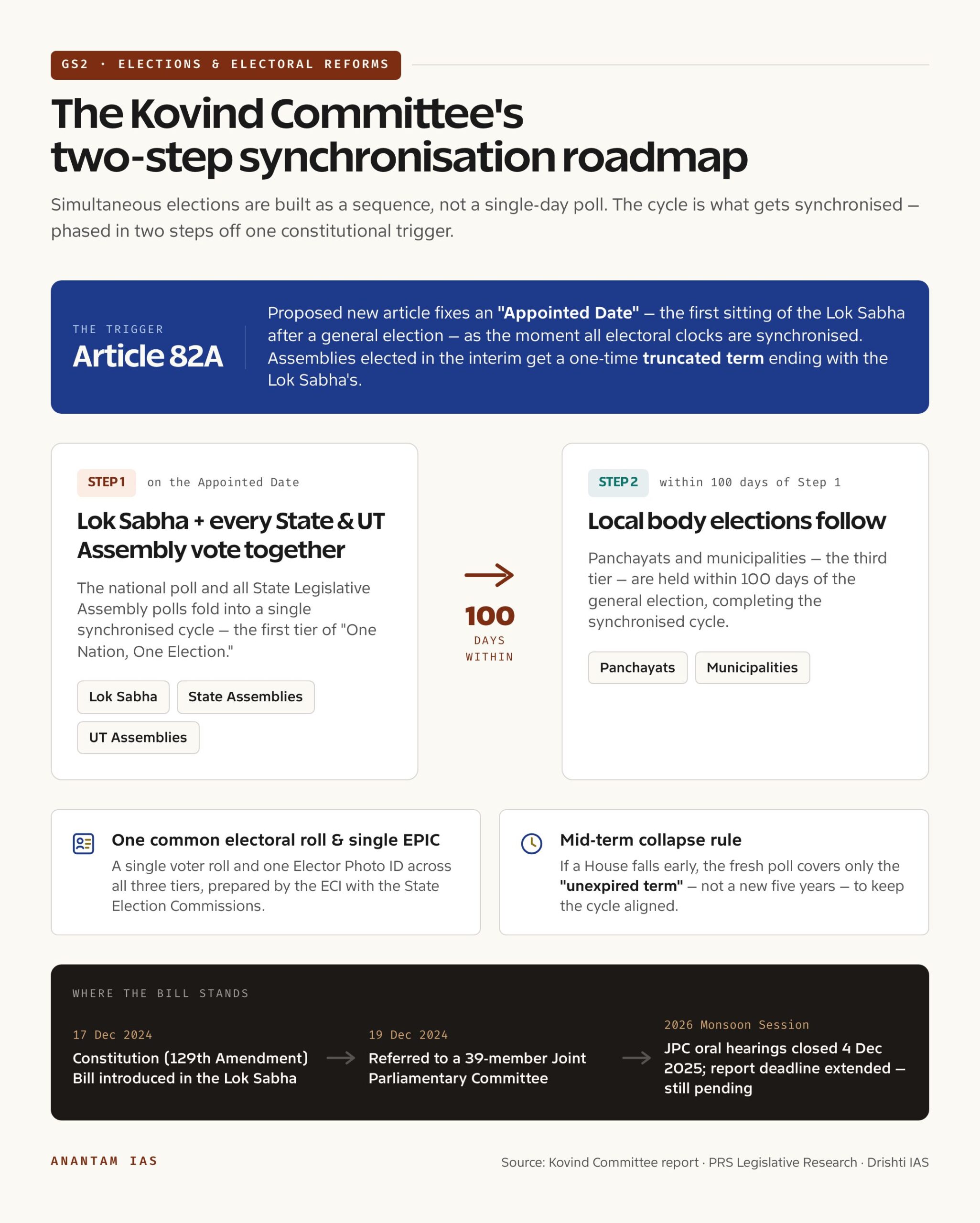
The Kovind Committee didn’t propose one big-bang election. It proposed a two-step machine, and you can’t argue about the topic without knowing how it’s built.
Step one folds the Lok Sabha and all State and UT Assembly elections into a single cycle. The trigger is a proposed new Article 82A, which sets an “Appointed Date,” the first sitting of the Lok Sabha after a general election, as the moment the clocks are synchronised. Assemblies elected in the gap before that date get a one-time truncated term that ends with the Lok Sabha’s, so everyone lines up. Step two holds local body elections, panchayats and municipalities, within 100 days of step one. Underneath both runs a single common electoral roll and a single voter ID across all three tiers, prepared by the Election Commission with the State Election Commissions. And the collapse rule is the one to memorise: if a House falls early, the fresh poll covers only the “unexpired term,” not a new five years.
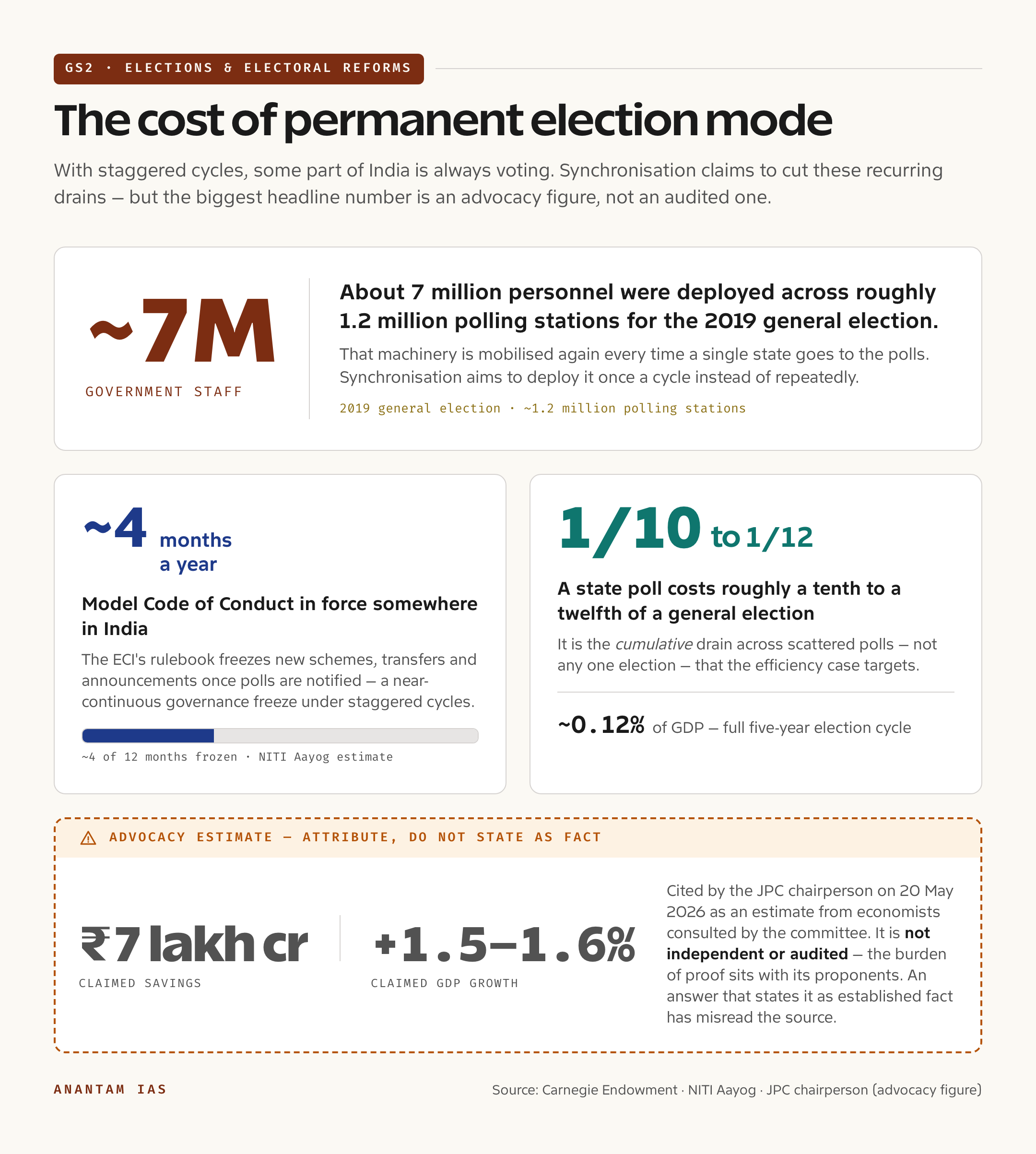
Now the efficiency numbers, because this is where the case-for lives. The 2019 general election used about 7 million government staff across roughly 1.2 million polling stations, and that machinery redeploys every time a single state votes. NITI Aayog has estimated that the Model Code of Conduct, the ECI’s rulebook that freezes new schemes, transfers and announcements once polls are notified, is in force somewhere in India for about four months every year. A state poll costs roughly one-tenth to one-twelfth of a general election, and a full five-year election cycle runs to about 0.12% of GDP. Those are the recurring drains synchronisation claims to cut.
One headline figure needs careful handling. On 20 May 2026, Chaudhary cited an economists’ estimate that simultaneous polls “could save around Rs 7 lakh crore and increase GDP growth by approximately 1.5 to 1.6 per cent”. Read that twice and attribute it every time. It’s an advocacy figure from economists consulted by the committee, not an independent or audited number, and an answer that states it as established fact has misread the source. The honest line is that the claim is large, contested, and the burden of proof sits with its proponents.
The Case For
The efficiency case is genuinely strong, and waving it off as a stunt would make for a lazy answer. So let’s state it at full strength.
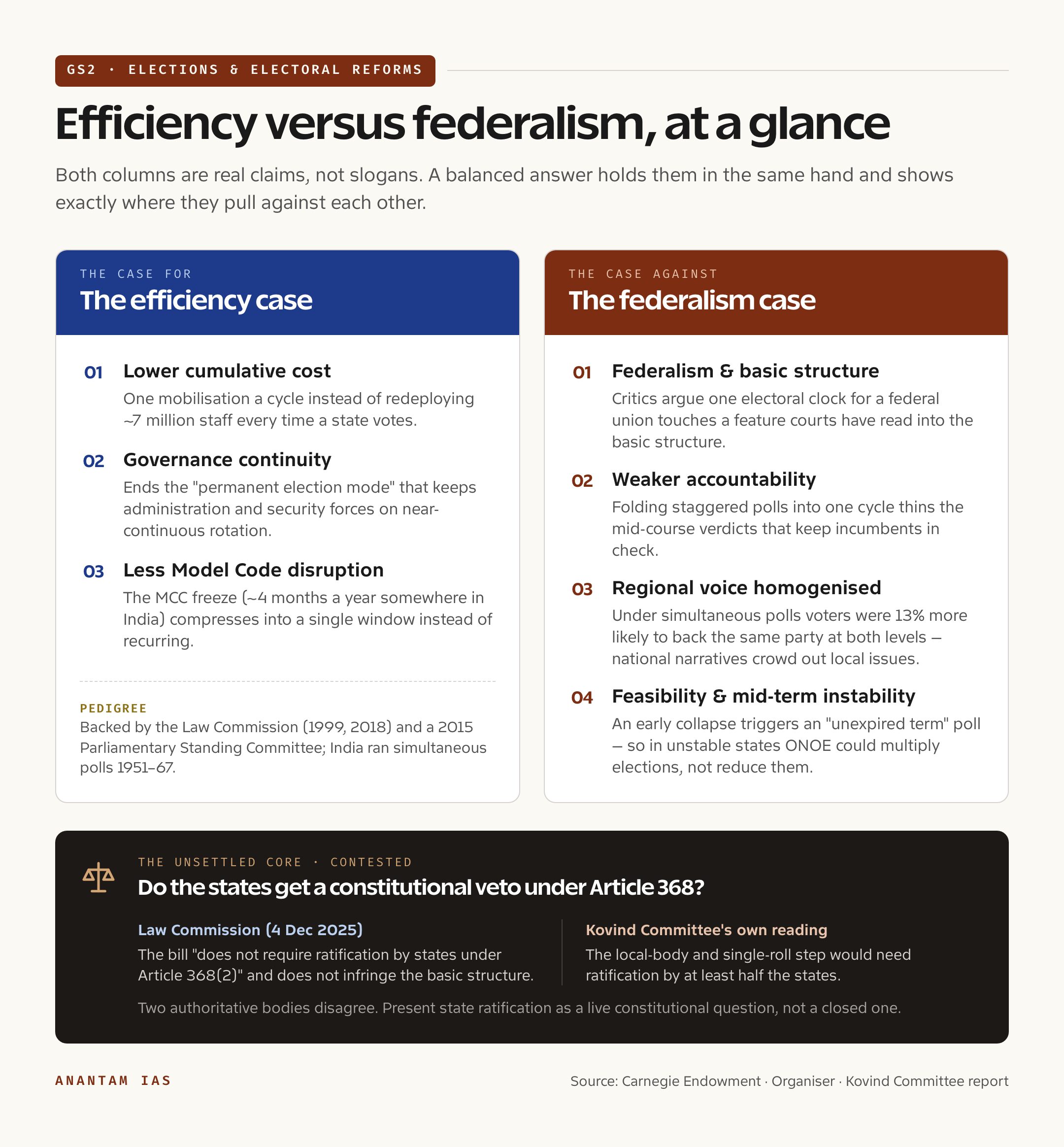
Start with the drain of permanent election mode. With staggered cycles, some part of India is always voting, which means some part is always under the Model Code of Conduct’s freeze. The Kovind Committee framed this as development disrupted and security forces diverted on a near-continuous basis. So the cost isn’t only the cash spent on a poll. It’s the governance that stalls around it, four months a year, every year.
The administrative load is the second pillar. Seven million staff, 1.2 million polling stations, central forces moved across the map again and again, all of it duplicated each time a state goes to the polls. Synchronisation lets the state mobilise that machinery once a cycle instead of repeatedly. So the argument isn’t abstract thrift. It’s about freeing administrative bandwidth that staggered polls consume on repeat.
The institutional pedigree matters too, and it’s older than the current government. The Law Commission backed simultaneous polls in 1999 and again in 2018, and a Parliamentary Standing Committee endorsed the idea in 2015, holding that it “would be beneficial and should not be seen as a threat to India’s federal structure”. So this isn’t a fringe proposal that appeared overnight. It has a documented lineage across commissions and committees.
There’s even turnout evidence, and it cuts in the reform’s favour. Studies cited by Carnegie found that national-election turnout rose about 5 percentage points when held alongside state polls, with proximate state polls seeing a 4.4-point bump. So one trip to the booth instead of several may pull more citizens into voting, not fewer.
The human-cost argument is the one the JPC has leaned on most lately. Chaudhary has cited an estimate that around 5 crore labourers migrate for roughly a month each election cycle to return home and vote, denting production and tax collection along the way. Take that as the same kind of advocacy framing as the GDP claim, sourced and attributable rather than audited. But the underlying point survives the caveat: staggered polls don’t just cost the exchequer, they pull workers off the line and freeze the administrative machine on a near-permanent rotation, and that recurring friction is the thing synchronisation is built to stop.
And here’s the clincher the case-for leans on hardest: India already did this. Lok Sabha and assembly elections ran simultaneously through 1951-52, 1957, 1962 and 1967. So synchronisation isn’t a foreign experiment grafted onto India. It’s the country’s own original design, which broke by accident and might be rebuilt by intent.
The Case Against
Here’s what the efficiency case walks past. Saving money and freeing bandwidth are real goods, but they’re administrative goods, and the Constitution protects something the budget line can’t see: the federal idea that a state’s democratic clock is its own.
The federalism objection comes first and cuts deepest. Critics argue ONOE erodes the federal principle that the Supreme Court has held to be part of the Constitution’s basic structure, the doctrine that some features are so essential Parliament can’t amend them away. AIMIM’s Asaduddin Owaisi put it bluntly in the political debate, calling the move one that “destroys federalism and compromises democracy, which are part of the basic structure”. So this isn’t a quibble over scheduling. It’s a claim that synchronisation touches a feature the Constitution may put beyond amendment.
Underneath that sits the autonomy problem. If a state assembly’s term is cut short to sync with the Lok Sabha, the practical power over when a state faces its voters drifts toward the Union. A Chief Minister’s federal autonomy includes the timing of accountability, and a synchronised clock quietly trims it.
Then there’s the evidence on voter behaviour, which is the sharpest empirical strike against the reform. A 2020 comparative study found that under simultaneous polls voters were 18% more likely to rate the party over the candidate as their top consideration, and 13% more likely to vote for the same party at the state and national level. That’s measured homogenisation. National narratives crowd out local issues, and regional parties, which live or die on state-specific concerns, fear being drowned out. So the cost isn’t only structural. It’s a documented flattening of the local voice.
Accountability is the fourth worry. Staggered elections let voters deliver mid-course verdicts, a near-continuous referendum on whoever holds power. Fold them into one cycle and those mid-term checks thin out, stretching the gap between a government’s failure and the voter’s chance to punish it.
And the feasibility paradox may be the most damaging of all, because it attacks the reform on its own terms. If a government collapses in year four, the rule holds a fresh poll only for the roughly one-year unexpired term, after which another full election follows on the next cycle. So in unstable states, ONOE could multiply elections rather than reduce them. The fixes floated for this, importing Germany’s “constructive vote of no confidence” or tightening the Anti-Defection Law, raise their own question: is stability being bought at the price of parliamentary democracy’s flexibility?
The Deeper Structural Read
Step back from the cost charts and the party positions, and the real fault line shows up. It isn’t “efficiency versus federalism” as two policy options on a menu. It’s a question about what an election is in a federal democracy, and India already answered it once, by accident.
Look at how synchrony actually broke, because the history is the argument. The cycle was first disturbed in 1959, when the Centre used Article 356 to dismiss the elected Communist government in Kerala under E.M.S. Namboodiripad, forcing a fresh poll in 1960. It collapsed decisively in 1968-69, as several state assemblies were prematurely dissolved after the 1967 defections, and the Fourth Lok Sabha was itself dissolved early in 1970, with a poll in 1971. So India’s natural synchrony didn’t survive contact with the messiness of coalition politics, mid-term collapses, and a centre willing to dismiss state governments. The staggered calendar we have now isn’t a flaw that crept in. It’s the residue of a federal democracy behaving like one.
That history exposes the structural tension precisely. To hold all legislatures on one clock, you need a way to handle a House that falls early, and every available answer touches a federal nerve. The “unexpired term” rule means a state’s voters might elect an assembly for one year, which dilutes the meaning of their mandate. A constructive vote of no confidence, borrowed from Germany, would constrain a state legislature’s freedom to remove its own government. So the synchronisation problem isn’t a drafting puzzle. It’s federalism asking to be rationed.
This is where the most consequential live question sits, and an answer that misses it loses depth. Does the reform need state ratification under Article 368? On 4 December 2025, Law Commission Chairman Justice Dinesh Maheshwari told the JPC the bill “stands on firm constitutional footing and does not infringe upon any element of the Basic Structure,” that Parliament has full legislative competence, that the right to vote is statutory rather than fundamental, and crucially that the proposal “does not require ratification by states under Article 368(2)”. But the Kovind Committee’s own reading was that the local-body and single-roll step would need ratification by at least half the states. So two authoritative bodies disagree on whether the states even get a constitutional veto over a reform that reshapes their assemblies. That gap isn’t a footnote. It’s the constitutional core of the dispute, and it’s unsettled.
And here’s the part a future administrator should sit with. The strongest version of the efficiency case, the four-months-a-year MCC freeze, the duplicated machinery, is about smoothing the operation of democracy. The strongest version of the federalism case is about preserving its structure. When a reform optimises operation at some cost to structure, the burden of proof belongs squarely with the side proposing the change, because operational gains are recoverable and structural damage often isn’t.
What Should Be Done
So what does a defensible path look like? Not a vague plea to “balance both sides,” but a set of conditions a serious reformer could actually meet. Five guardrails, none of which require abandoning the goal.
- Transition in phases, not in one leap. The bill itself contemplates a gradual switch through the Appointed Date and one-time truncated terms, and Chaudhary concedes the ECI must sequence polls in stages. A phased synchronisation lets the system absorb shocks and lets the data on cost, turnout and disruption accumulate before the change becomes irreversible. A big-bang switch forecloses the learning a reform this large needs.
- Settle the federalism question in the open. The contested Article 368 ratification issue can’t be waved away by one body’s opinion when another body reads it the opposite way. Treat state ratification as a live constitutional question to be resolved transparently, not a settled fact, and build in explicit safeguards so state assemblies keep genuine dissolution autonomy and regional issues aren’t subsumed. Reading more on federalism and the basic structure doctrine sharpens why this matters.
- Solve the mid-term-collapse problem credibly. A reform that could multiply elections in unstable states hasn’t solved its own central problem. Whether through a constructive vote of no confidence, a fixed-term mechanism, or a carefully bounded unity-government rule, the answer to “what happens when a House falls early” has to be robust enough that “unexpired term” polls don’t proliferate or freeze accountability. The link to a tightened anti-defection regime is direct, and it should be designed deliberately, not improvised later.
- Build Election Commission capacity before the rollout, not after. A near-nationwide single-window cycle multiplies demand for EVMs, VVPATs and central forces. Independently audit and fund those requirements ahead of any switch, because an under-resourced first synchronised poll would discredit the whole project. Strengthening the Election Commission’s independence and capacity is a precondition, not an afterthought.
- Pursue broad consensus, not a bare majority. With 15 of the 47 consulted parties opposed, including major opposition parties, a basic-structure-sensitive reform needs cross-party and federal buy-in. A change to the rules of the democratic game that half the political spectrum rejects starts its life with a legitimacy deficit, and no amount of efficiency erases that.
Every one of these strengthens the reform rather than killing it. A synchronisation built in stages, with the federal question settled honestly and the mid-term problem actually solved, is one the system could believe in. That’s the difference between rebuilding India’s old synchrony and imposing a new uniformity.
For Your Mains Answer
This is a high-yield GS2 topic. It pulls together the Constitution’s federal structure, electoral reforms, the basic structure doctrine, the role of constitutional bodies, and executive-legislature accountability in a single frame, which is exactly the kind of cross-cutting question examiners like.
GS paper mapping: GS2: the Constitution and its federal structure; functioning of Parliament and State Legislatures; the Election Commission as a constitutional body; government policies and the issues arising from their design and implementation.
PSIR optional relevance: Paper I maps cleanly onto federalism in India and centre-state relations, the basic structure and amendment process, the party system and the place of regional parties, and electoral reforms. Paper II’s comparative-government section is the natural home for the German constructive vote of no confidence and fixed-term-parliament debate, which is the comparative angle on mid-term stability.
Likely question frames:
- “One Nation, One Election promises administrative efficiency but risks federal autonomy.” Critically examine in light of the Kovind Committee recommendations and the 129th Amendment Bill.
- Discuss whether synchronising elections to the Lok Sabha and State Assemblies is compatible with the federal principle held to be part of the basic structure of the Constitution.
- Examine the constitutional and feasibility challenges of implementing simultaneous elections in India, with reference to Articles 83, 172 and 356.
Quotable data and references:
- Kovind Committee report: 18,626 pages, built over 191 days, submitted 14 March 2024.
- 47 parties consulted; 32 supported, 15 opposed simultaneous elections.
- Proposed Article 82A sets an “Appointed Date”; step two holds local body polls within 100 days.
- 2019 general election: ~7 million staff across ~1.2 million polling stations.
- Model Code of Conduct in force somewhere in India ~4 months a year, NITI Aayog.
- Under simultaneous polls, voters 13% more likely to vote the same party at state and national level.
- India ran simultaneous polls 1951-52 to 1967, then broke (Kerala 1959, dissolutions 1968-71).
- Rs 7 lakh crore saved and +1.5 to 1.6% GDP: an advocacy claim attributed to economists, not an audited figure.
- Law Commission (4 Dec 2025): bill “does not infringe… the Basic Structure” and “does not require ratification by states under Article 368(2)”, contested by the Kovind Committee’s own reading.
Keywords to use: simultaneous elections, Article 82A, Appointed Date, unexpired term, common electoral roll, basic structure, cooperative federalism, Model Code of Conduct, constructive vote of no confidence.
Syllabus linkages: salient features of the Constitution, federalism, basic structure doctrine, Parliament and State Legislatures, Election Commission, separation of powers and accountability, government policy design and implementation.
Balanced conclusion line: Synchronised elections may well save money and unfreeze governance, but a federal democracy is measured by how independently its parts can answer to their own voters; a reform that buys efficiency by trimming that independence has to prove the trade is constitutional, not merely convenient.
How to Build the Answer
Open with the tension, not a definition. The whole topic is that efficiency and federalism are both genuine goods, and synchronisation forces a choice only if it’s designed carelessly. That first sentence signals to the examiner that you’ve grasped the value clash, not just the news. The definition of simultaneous elections can follow in the second line.
Bring data in early but ration it. A strong first body paragraph can carry three figures: ~7 million staff in 2019, the MCC freezing governance ~4 months a year, and the 13% party-homogenisation finding. Then say what each proves. UPSC rewards the move from fact to inference, so the “this means” is where the mark sits, not the number itself.
Steelman the side you don’t take. If your stance backs the reform, first admit the federalism and accountability risks are real. If you criticise it, first concede the cost and governance-freeze case has merit and a long institutional pedigree. That’s how an answer reads balanced without dissolving into “it depends.”
Close on the structural point, not a slogan. The federal question of who controls a state’s electoral clock, and the unsettled Article 368 ratification dispute, are the deepest layer. An answer that lands there reads like constitutional analysis. One that ends on “every coin has two sides” reads like a filler.
Common Mistakes to Avoid
- Don’t state the Rs 7 lakh crore figure as fact. It’s an advocacy claim attributed to economists. Attribute it, or better, flag that it’s contested.
- Don’t write that the JPC has submitted its report. It concluded oral hearings on 4 December 2025; the report was extended to the 2026 Monsoon Session and is still pending.
- Don’t treat the Article 368 ratification question as settled. The Law Commission and the Kovind Committee disagree. Present it as the live constitutional dispute it is.
- Don’t reduce it to “cost-saving good, opposition bad.” The homogenisation evidence and the election-multiplication paradox are serious, sourced objections, not partisan noise.
- Don’t forget the history. India’s own broken synchrony from 1967 is the strongest evidence on both sides at once. Use it.
A Compact Answer Spine
- Introduction: Open with the efficiency-versus-federalism tension in one sentence; define simultaneous elections in the next.
- Mechanism: The Kovind two-step roadmap, Article 82A’s Appointed Date, the unexpired-term rule.
- The case for: Cost, the four-month MCC freeze, administrative load, institutional pedigree, India’s own 1951-67 precedent.
- The case against: Federalism and basic structure, autonomy, measured homogenisation, weaker accountability, the election-multiplication paradox.
- Structural diagnosis: Who controls a state’s electoral clock; the unsettled Article 368 ratification question.
- Conclusion: Adapt the balanced conclusion line to the exact question wording.
Diagram or Flowchart Idea
For a 15-marker, draw one causal chain rather than a decorative web. The cleanest here: synchronised cycle (Article 82A) → a House falls early → “unexpired term” poll → either elections multiply or autonomy is curtailed → safeguards needed (phased rollout, mid-term mechanism, Article 368 clarity). The examiner reads that logic in seconds.
For a 10-marker, skip the diagram and use a two-column table instead: “Efficiency (cost, MCC, bandwidth)” against “Federalism (autonomy, homogenisation, accountability).” It does more work and is faster to evaluate under time pressure.
Ethics and Governance Angle
Even a structural GS2 answer benefits from one line on values. The deeper governance question here is consent: a change to the rules of the democratic game carries a different legitimacy burden than an ordinary policy. When half the consulted parties object, pushing through on a bare majority is technically lawful but ethically thin, because the rules of the contest should command wider agreement than the contestants do.
Then convert that into design. Don’t just say “build consensus.” Say how: a phased transition that lets evidence accumulate, the Article 368 question resolved in the open, and the mid-term-collapse mechanism settled before rollout, not after. That’s the move from a moral observation to administrative maturity, which is what the examiner is grading.
A sentence pattern that travels across topics: “The aim is legitimate, but its legitimacy depends on process, federal consent, and capacity.” It accepts the reform’s objective without handing the State a blank cheque, which is exactly the posture a balance question rewards.
How to Use Data Without Sounding Mechanical
Use fewer numbers than you know. Three well-explained figures beat ten scattered ones. Lead with the scale (~7 million staff in 2019), use one for the governance cost (MCC live ~4 months a year), and use one for the counter-case (13% party homogenisation under simultaneous polls). One scale figure, one cost figure, one risk figure is usually enough.
Never leave a statistic standing alone. Follow it with “this means” or “the implication is.” That small move turns a fact sheet into analysis. In Mains, facts are raw material and judgment is the finished answer, and the difference is visible in a single line.
Handle the contested figure with care, because that itself earns marks. Writing “the JPC cites an economists’ estimate of Rs 7 lakh crore in savings, though it remains an advocacy claim rather than an audited one” shows the examiner you can weigh a source, not just quote it. That habit of attributing and qualifying is what separates an answer that feels informed from one that feels memorised.
FAQ
What is One Nation, One Election in simple terms?
It means holding the Lok Sabha election and all State Legislative Assembly elections on a single synchronised cycle, so voters cast their national and state votes in one window instead of across many staggered polls. It does not mean voting on a single day; the JPC chairperson has confirmed polling would still be phased. Local body elections would follow within 100 days under the Kovind Committee’s roadmap.
What is the current status of the One Nation, One Election bills?
The Constitution (129th Amendment) Bill, 2024 and the Union Territories Laws (Amendment) Bill, 2024 were introduced in the Lok Sabha on 17 December 2024 and referred to a 39-member Joint Parliamentary Committee on 19 December 2024. The committee, chaired by P.P. Chaudhary, concluded its oral hearings on 4 December 2025, and its report has been extended to the 2026 Monsoon Session. The report has not yet been submitted.
Why do critics say it threatens federalism?
Because synchronising every legislature to one clock can shift the practical power over when a state faces its voters toward the Union, and because comparative evidence shows simultaneous polls make voters more likely to vote the same party at state and national levels, flattening regional issues. Critics argue this touches the federal principle the Supreme Court has held to be part of the Constitution’s basic structure. Supporters counter that the Law Commission and a 2015 parliamentary panel found no threat to federal structure.
Does the reform need state ratification under Article 368?
This is unsettled and contested. On 4 December 2025, the Law Commission Chairman told the JPC the bill does not require ratification by states under Article 368(2). But the Kovind Committee’s own reading was that the local-body and single-roll step would need ratification by at least half the states. So two authoritative bodies disagree, and an honest answer presents it as a live constitutional question rather than a closed one.
Tell Google you want more of this.
Add Anantam IAS as a preferred sourceOne tap, and this site shows up more often in your own Top Stories, AI Overviews and AI Mode. Remove it any time.