The G7 (Group of Seven) is one of the most influential informal forums in global governance. Though it has no binding authority or a permanent secretariat, decisions and communiques emerging from G7 summits shape international economic policy, climate commitments, and geopolitical strategy. For UPSC aspirants, the G7 is a staple topic in International Relations, appearing in both Prelims and Mains with regularity.
What Is the G7?
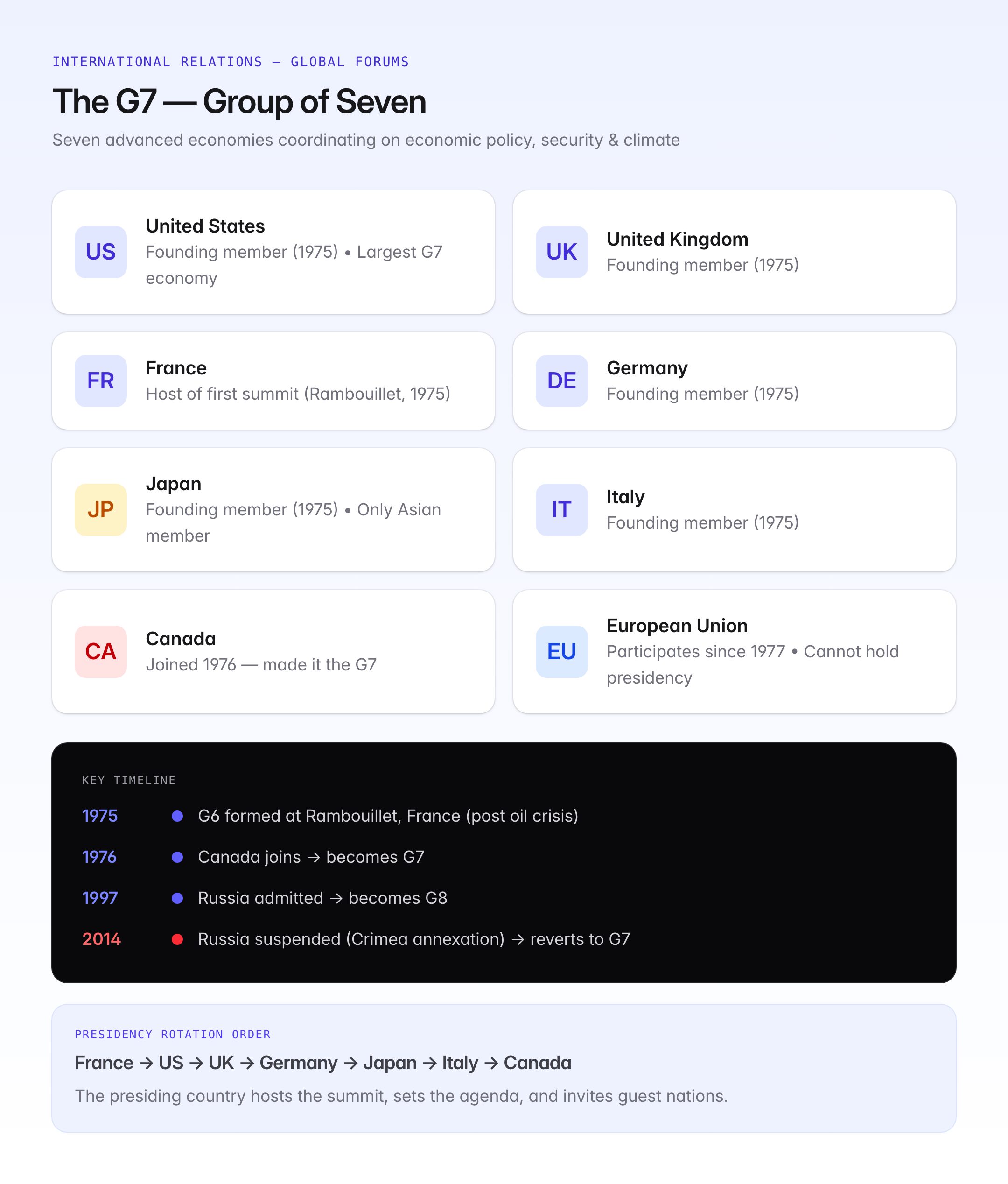
The G7 is an intergovernmental political and economic forum consisting of seven of the world’s most advanced economies. It is not a formal international organisation — it has no charter, no permanent headquarters, and no enforcement mechanism. Instead, it functions as a platform for its members to coordinate on economic policy, global security, climate change, health, and development.
G7 Member Countries
| Country | Year of Joining | Notes |
|---|---|---|
| United States | 1975 (as G6) | Largest economy in the G7 |
| United Kingdom | 1975 (as G6) | Original member |
| France | 1975 (as G6) | Host of the first summit (Rambouillet) |
| Germany | 1975 (as G6) | Original member |
| Japan | 1975 (as G6) | Only Asian member |
| Italy | 1975 (as G6) | Original member |
| Canada | 1976 | Joined to form the G7 |
| European Union | 1977 (observer/participant) | Attends summits but does not hold the presidency |
Key fact: The group was initially formed as the G6 in 1975. Canada joined in 1976, making it the G7. Russia was included from 1997 to 2014, briefly making it the G8, but was expelled following the annexation of Crimea in 2014.
History and Evolution
The G7 emerged in the aftermath of the 1973 oil crisis and the collapse of the Bretton Woods system of fixed exchange rates. The key milestones:
- 1975: First summit held at Rambouillet, France, with six members (G6). The focus was on the oil crisis, inflation, and recession.
- 1976: Canada joined at the Puerto Rico summit, forming the G7.
- 1977: The European Community (now EU) began participating.
- 1997: Russia was formally admitted, creating the G8.
- 2014: Russia was suspended from the group after the annexation of Crimea. The forum reverted to G7.
- Present: The G7 continues to meet annually, with the presidency rotating among member states.
Rotating Presidency
The G7 presidency rotates annually among member countries in a fixed order:
Rotation cycle: France, United States, United Kingdom, Germany, Japan, Italy, Canada.
The presiding country:
- Hosts the annual summit (usually in June or July).
- Sets the agenda for the year.
- Chairs meetings at all levels (ministerial, sherpa, and summit).
- Invites guest countries and international organisations.
India and the G7
India is not a member of the G7 but has been regularly invited as a guest country to G7 summits, particularly since the mid-2000s. India's participation reflects its growing economic weight and geopolitical significance.
Notable instances of India's G7 engagement:
- India has attended multiple G7 summits as a guest, including those hosted by Germany (2022, Elmau), Japan (2023, Hiroshima), and Italy (2024, Apulia).
- At the 2023 Hiroshima Summit, PM Modi participated in the outreach session on themes including the Global South, food security, and climate.
- India has used these platforms to articulate the concerns of the Global South, advocate for reformed multilateralism, and push for climate finance from developed nations.
Why India is not a G7 member: The G7 comprises the world's most advanced economies measured by net wealth, GDP per capita, and institutional development. India, despite being the world's fifth-largest economy by nominal GDP, does not meet the per-capita income thresholds. India's forum for global economic coordination is the G20, which it also chaired in 2023.
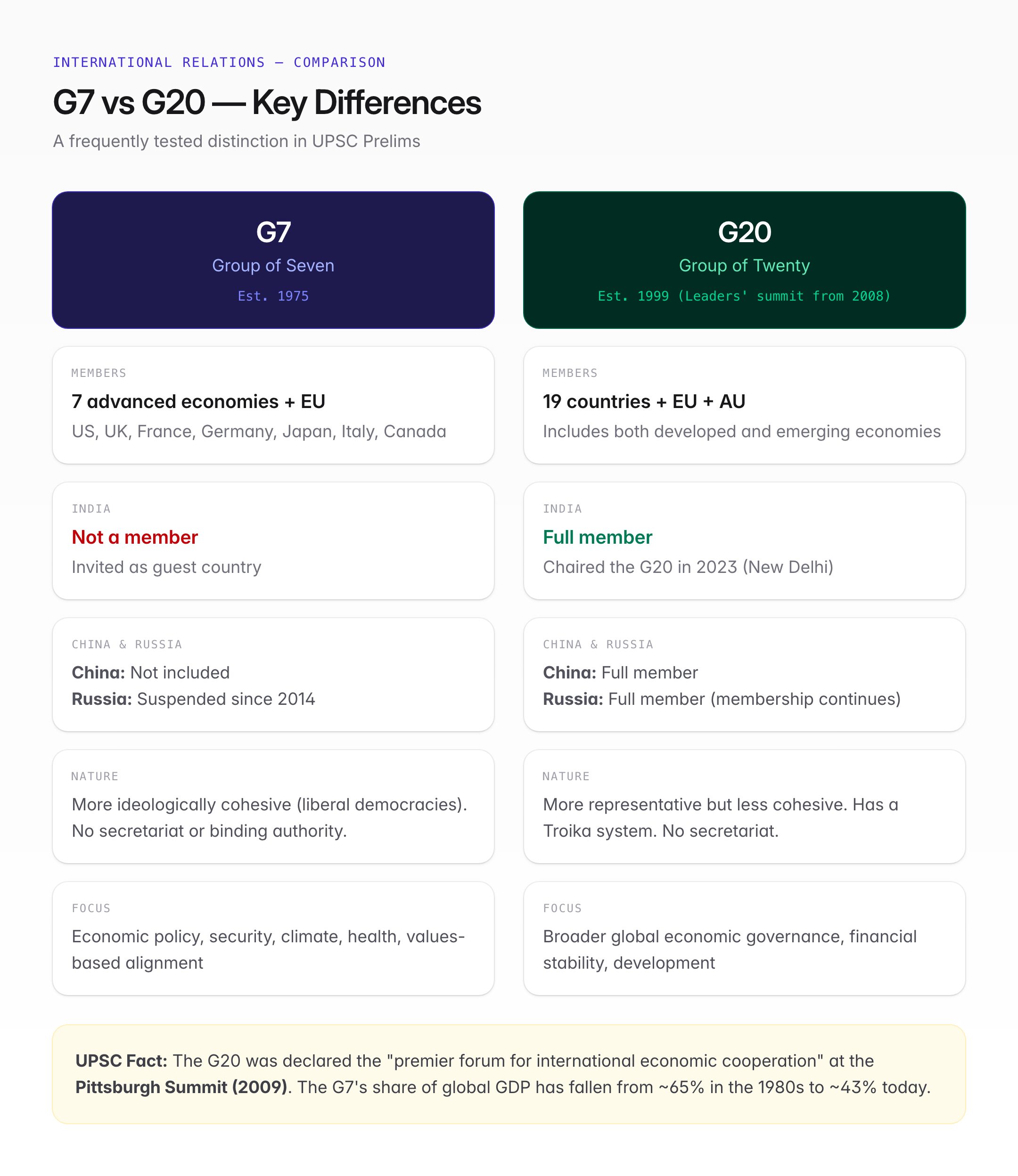
G7 vs G20 — Key Differences
| Feature | G7 | G20 |
|---|---|---|
| Members | 7 advanced economies + EU | 19 countries + EU + African Union |
| Includes India? | No (guest only) | Yes (full member) |
| Includes China? | No | Yes |
| Includes Russia? | Suspended (2014) | Yes (membership continues) |
| Focus | Economic policy, security, values-based alignment | Broader global economic governance, financial stability |
| Nature | More ideologically cohesive (liberal democracies) | More representative but less cohesive |
| Secretariat | None | None (but has a Troika system) |
| Established | 1975 | 1999 (leaders' summit from 2008) |
UPSC Tip: Questions often test whether candidates can differentiate between the G7 and G20, especially regarding membership and India's role.
Key Themes at Recent G7 Summits
While specific outcomes change each year, the G7 consistently addresses these themes:
- Global economy: Inflation, supply chain resilience, trade rules, sanctions coordination.
- Climate and energy: Commitments on phasing out fossil fuels, clean energy investment, climate finance for developing nations.
- Global health: Pandemic preparedness, vaccine equity (especially post-COVID-19).
- Geopolitical security: Russia-Ukraine conflict, Indo-Pacific strategy, China's economic practices.
- Artificial intelligence: Since 2023, AI governance has become a major agenda item, including the Hiroshima AI Process.
- Food security: Support for developing nations affected by food price shocks.
- Nuclear non-proliferation: Consistent theme, especially at the 2023 Hiroshima summit.
Criticism of the G7
The G7 faces several criticisms that are relevant for UPSC Mains essays and IR answers:
- Lack of representativeness: It excludes major economies like China, India, and Brazil, making it an unrepresentative body for global decision-making.
- No enforcement power: G7 communiques are political statements, not legally binding commitments. Implementation varies widely.
- Declining share of global GDP: The G7's share of global GDP has fallen from over 65% in the 1980s to around 43% today, as emerging economies have grown.
- Perception as a "Western club": The absence of African, Latin American, and most Asian nations limits its legitimacy on global issues.
- Overlap with G20: With the G20 established as the premier forum for global economic cooperation (declared at the Pittsburgh Summit, 2009), some question the G7's continued relevance.
Significance in Global Governance
Despite criticism, the G7 remains important because:
- It allows like-minded democracies to coordinate positions before broader forums like the G20 or UN.
- It can act faster than multilateral bodies because of its small, cohesive membership.
- It serves as a signalling mechanism — G7 statements on sanctions, climate, or technology influence markets and international norms.
UPSC Relevance
GS Paper Mapping:
- Prelims: G7 membership, presidency rotation, G7 vs G20, India's status.
- GS Paper II (Mains): International relations — important international groupings, India's bilateral and multilateral engagements, effect of global groupings on India.
- Essay: Topics on global governance, multilateralism, and the relevance of Cold War-era institutions.
Key Prelims Facts:
- The G7 consists of the US, UK, France, Germany, Japan, Italy, and Canada; the EU also participates.
- The G7 was originally formed as the G6 in 1975 at Rambouillet, France.
- Russia was part of the group (G8) from 1997 to 2014, when it was suspended over Crimea.
- The G7 presidency rotates annually; the host country sets the agenda.
- India is not a G7 member but regularly participates as a guest.
- The G7 has no permanent secretariat or binding authority.
- The G20, not the G7, is the "premier forum for international economic cooperation" (Pittsburgh, 2009).
- Japan is the only Asian member of the G7.
- India chaired the G20 in 2023 (New Delhi Leaders' Declaration).
Tell Google you want more of this.
Add Anantam IAS as a preferred sourceOne tap, and this site shows up more often in your own Top Stories, AI Overviews and AI Mode. Remove it any time.