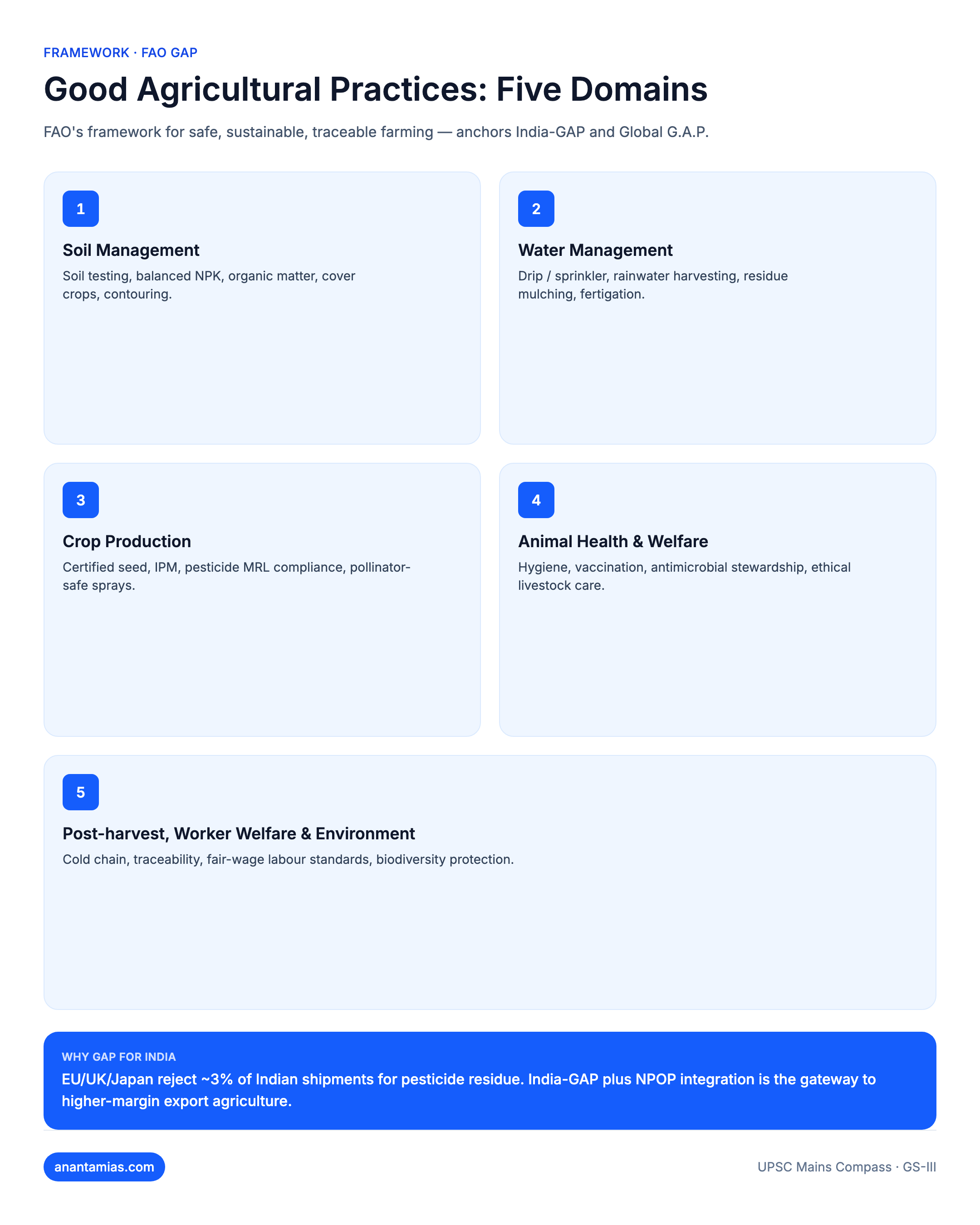
The GAP (Good Agricultural Practices) approach is the Food and Agriculture Organization's (FAO) framework of farm-level practices that ensure food safety, environmental sustainability, social welfare, and economic viability for on-farm activities and post-production handling. Originally formulated by the FAO in 2003, GAP has become the global benchmark for sustainable agriculture, adopted in different forms by the EU (GLOBAL-G.A.P.), Japan (JGAP), ASEAN (ASEAN-GAP), and India (India-GAP — administered by the Quality Council of India (QCI) through the Agricultural and Processed Food Products Export Development Authority, APEDA).
For UPSC, the GAP approach is a GS-III topic that bridges agriculture, environment, climate change, food safety, agri-exports, sustainable development, and farmer welfare. Prelims has tested the FAO origin, India-GAP authority (QCI), and the link with GLOBAL-G.A.P. for export markets. Mains has asked about how Good Agricultural Practices contribute to environmental sustainability and farmers' income.
What is GAP?
According to FAO, Good Agricultural Practices are "practices that address environmental, economic and social sustainability for on-farm processes, and result in safe and quality food and non-food agricultural products."
GAP comprises practices such as:
- Zero tillage / conservation tillage.
- Integrated Watershed Management.
- Precision farming (drones, sensors, GPS-guided machinery).
- Integrated Production and Pest Management (IPPM).
- Organic and natural farming.
- Crop rotation, intercropping, mulching.
- Mushroom and vermi-composting.
- Animal welfare standards.
- Post-harvest hygiene.
- Worker health and safety.
Key Principles (FAO Framework)
| Pillar | Focus |
|---|---|
| Environmental sustainability | Soil, water, biodiversity, climate |
| Economic viability | Profitability for farmers |
| Social welfare | Fair labour, community benefit |
| Food safety | Pesticide residues, microbial contamination |
| Quality | Grading, traceability, branding |
Background: Why India Needs GAP at Scale
Soil and Water Crisis
- Indian soils have an average soil-organic-carbon (SOC) below the world average.
- Excess nitrogen application has caused soil acidification in 30% of Indian farmland.
- Groundwater nitrate contamination affects Punjab, Haryana, Rajasthan.
- 78% of India's water is used in agriculture, much of it inefficiently.
- The Composite Water Management Index (NITI Aayog) warns 600 million Indians face high to extreme water stress.
Pesticide Burden and Export Rejections
- India is the fourth-largest producer of pesticides globally.
- EU rejected Indian basmati, grapes, chillies, tea consignments multiple times for pesticide residues.
- GLOBAL-G.A.P. certification is now mandatory for many EU/UK retailers.
Climate Change Pressure
- Indian agriculture contributes ~14% of national GHG emissions, mainly through methane (paddy, livestock) and N2O (urea).
- Rainfed farming (~52% of net sown area) is hit by erratic monsoons.
Doubling Farmers' Income
- GAP-certified produce earns a 15-30% premium in export and premium domestic markets.
- Climate-smart practices reduce input costs by 20-30%.
Components: How GAP Operates Across Farm Functions
1. Soil Management
- Crop rotation to break pest cycles and balance nutrient extraction.
- Conservation tillage — minimum or zero tillage to retain SOC.
- Mulching with crop residues or plastic to retain soil moisture.
- Rational fertiliser application — soil health card-based dosing, neem-coated urea, nano fertilisers.
- Organic supplementation — vermi-compost, FYM, green manure.
- Soil health card — crop-specific recommendations.
2. Water Management
- Real-time monitoring of soil moisture and irrigation needs.
- Rainwater harvesting through farm ponds, check-dams.
- Aquifer management — collective groundwater protocols.
- Micro-irrigation — drip and sprinkler with 80-95% NUE.
- Watershed development under PMKSY.
- Mulching to reduce evaporation.
3. Animal Health and Welfare
- Pasture availability and rotational grazing.
- Vaccination schedules — FMD, brucellosis, PPR.
- Animal disease surveillance through veterinary network.
- Antibiotic use stewardship to combat AMR.
- Animal welfare — clean water, shelter, transport standards.
4. Crop Production
- Selecting crops suited to agro-ecological conditions — soil type, rainfall, temperature.
- Market acceptability and nutritional value consideration.
- Crop rotation, intercropping, relay cropping for soil health.
- Pest and disease management — IPPM, biocontrol agents, resistant varieties.
- Pesticide application following label and re-entry intervals.
5. Post-Harvest Practices
- Drying to safe moisture levels.
- Sorting and grading by size, colour, defect.
- Pack-house operations under hygiene protocols.
- Cold chain for perishables.
- Hygienic storage to prevent fungal and aflatoxin contamination.
- Traceability through batch coding and QR.
6. Energy and Waste Management
- Solar-powered pumps under PM-KUSUM.
- Biogas from livestock waste.
- Crop residue management to avoid stubble burning.
- Recycling of plastic mulch, drip lines.
- Composting of farm waste into vermi-compost.
Benefits of the GAP Approach
- Efficient utilisation of agricultural inputs — water, fertiliser, pesticide reduction of 20-40%.
- Productivity boost — soil health and pest management practices push yields up 15-30%.
- Environmental sustainability — reduces emissions, soil degradation, water pollution.
- Climate resilience — diversified, resource-efficient farms withstand monsoon shocks.
- Food safety — reduces pesticide residues, microbial contamination.
- Export competitiveness — GLOBAL-G.A.P. and India-GAP certification opens EU, US, UK, Japan, Korea markets.
- Premium pricing — 15-30% above conventional produce in domestic and export markets.
- Social welfare — worker safety, fair labour, community engagement.
- Animal welfare improvement — vaccination, hygienic housing.
- Doubling farmers' income alignment — Dalwai Committee identified resource-use efficiency (a GAP outcome) as 25% of DFI growth.
- Reduces post-harvest losses — currently 20-25% in horticulture.
Challenges of GAP Adoption in India
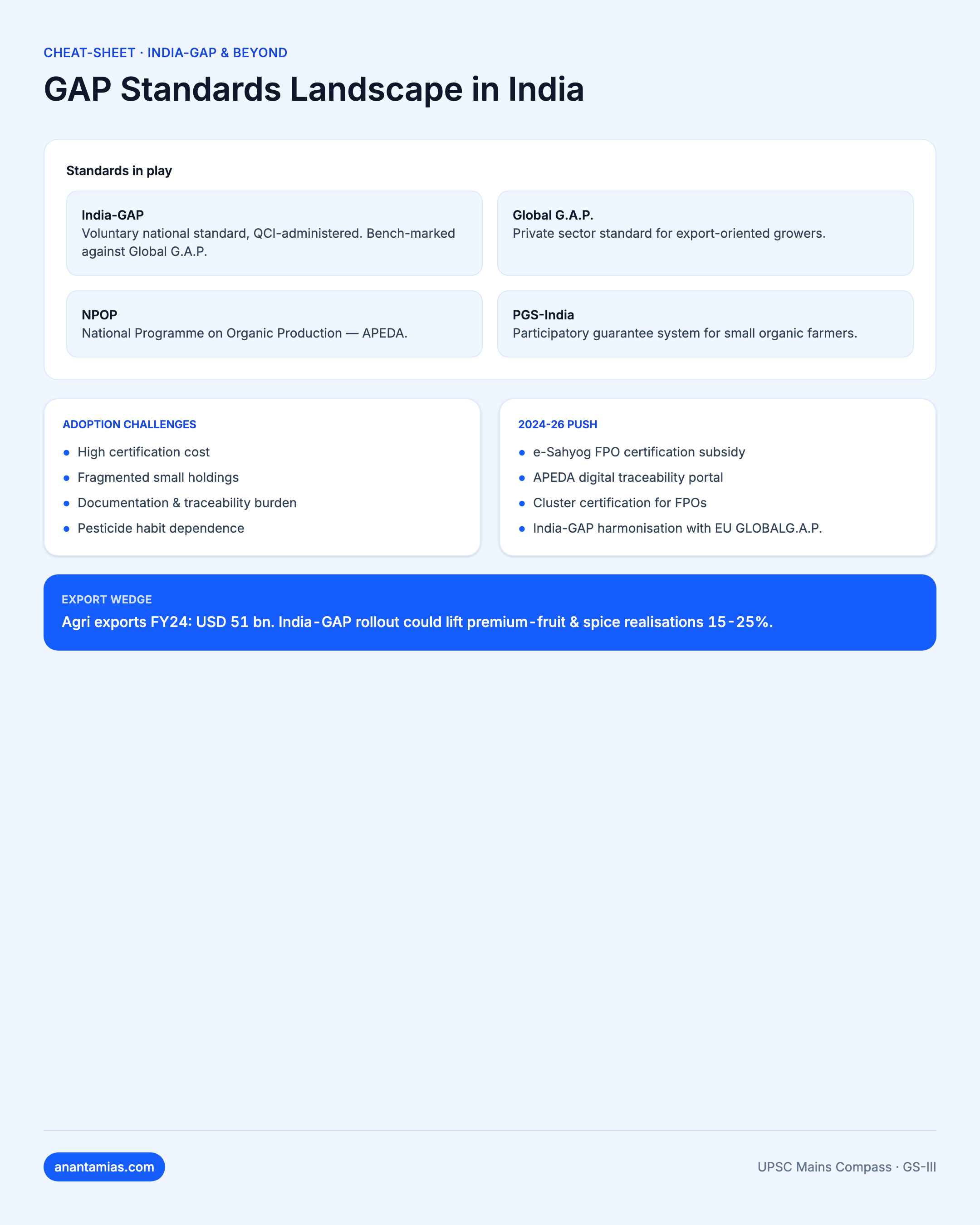
- High certification cost — GLOBAL-G.A.P. costs Rs 50,000-2 lakh per farm; prohibitive for small farmers.
- Awareness gap — most small/marginal farmers haven't heard of India-GAP or GLOBAL-G.A.P.
- Infrastructure deficits — pack-houses, cold chain, drying yards needed for compliance.
- Documentation burden — record-keeping required for certification is intensive.
- Fragmented landholdings — group certification through FPOs is the workaround but slow to scale.
- Limited private auditors — certification bodies concentrated in major cities.
- Pesticide regulation gap — many neonicotinoids and OP pesticides still legal in India but banned in EU.
- Weak extension services — KVKs and ATMA underfunded.
- Lack of premium price discovery — domestic markets do not consistently pay GAP premium.
- Climate variability — erratic monsoons disrupt GAP-compliant cropping calendars.
- Soil testing capacity — Soil Health Card programme has reach but inconsistent quality.
Indian Implementation: India-GAP and Related Standards
India-GAP
The National Programme for India-GAP is administered by the Quality Council of India (QCI) with APEDA support. It has three tiers:
- India-GAP Level 1: Basic compliance for domestic markets.
- India-GAP Level 2: Enhanced compliance, suited for processors.
- India-GAP Level 3: Equivalent to GLOBAL-G.A.P., suited for exports.
GLOBAL-G.A.P.
The international standard widely required by EU, UK, German retailers (Tesco, Sainsbury, REWE). Indian exporters of grapes, mango, banana, pomegranate increasingly hold GLOBAL-G.A.P. certification.
NPOP (National Programme for Organic Production)
For organic produce, India-GAP equivalent is NPOP under APEDA — recognised by EU and Switzerland.
PGS-India
Participatory Guarantee System for organic certification — peer-based, lower cost, suited to small farmers.
Specific Schemes
- Paramparagat Krishi Vikas Yojana (PKVY) — subsidises cluster-based organic farming.
- National Mission on Sustainable Agriculture (NMSA).
- National Mission on Natural Farming (NMNF) — Rs 2,481 crore through 2025-26.
- MIDH — clean-cultivation grants for horticulture.
Recent Developments (2024-2026)
| Year | Update |
|---|---|
| 2024 | National Mission on Natural Farming approved with Rs 2,481 crore through 2025-26 |
| 2024 | India-GAP simplified for small farmers; group certification via FPOs incentivised |
| Budget 2024-25 | Rs 365 crore for natural farming and GAP-aligned practices |
| 2025 | PGS-India and NPOP merged operations to reduce duplication |
| 2025 | Sikkim, Nagaland, Tripura continue as fully organic states; Kerala, AP, MH expanding |
| Budget 2025-26 | Rs 600 crore allocated to natural farming, soil health, GAP certification |
| 2025-26 | Bharat AgriTech Foundation supports startups in GAP-compliant traceability |
| 2026 | India-GAP mutual recognition pilot with ASEAN countries |
Reforms and Way Forward
- Subsidise GAP certification for small/marginal farmers via FPOs.
- Develop a national auditing and certification system for GAP — accelerate India-GAP adoption.
- Mandatory GAP compliance for all government-procured produce (PDS, ICDS, MDM).
- Strengthen Krishi Vigyan Kendras (KVKs) as GAP extension centres.
- Pesticide regulation harmonisation — phase out compounds banned in EU.
- Cluster-based GAP certification — group certification through FPOs.
- Digital GAP records under AgriStack for traceability.
- Premium price guarantee through MSP-style support for GAP-certified produce.
- Convergence with PM-KUSUM, PMKSY, MIDH for energy and water dimensions.
- GAP-linked credit incentives through Kisan Credit Card.
- Skill development — short courses at agricultural universities.
- Awareness campaigns in regional languages.
- Bilateral mutual recognition with ASEAN, EU, GCC for India-GAP.
Government Schemes and Budget Allocations (2025-26)
- National Mission on Natural Farming (NMNF): Rs 2,481 crore (2025-26).
- Paramparagat Krishi Vikas Yojana (PKVY): cluster-based organic farming.
- National Mission on Sustainable Agriculture (NMSA).
- MIDH: clean cultivation grants.
- PMKSY (Per Drop More Crop): micro-irrigation; Rs 6,500 crore MIF.
- PM-KUSUM: solar pumps and energy.
- Rashtriya Krishi Vikas Yojana (RKVY): state-led agricultural reforms.
- APEDA and QCI: certification ecosystem.
- AgriStack: traceability backbone.
Mains Answer Hook
A model GS-III answer should: (a) define GAP per FAO; (b) trace its environmental, economic, social, food-safety pillars; (c) describe India-GAP, GLOBAL-G.A.P., NPOP, PGS-India ecosystem; (d) cite the NITI Aayog water stress warning, soil acidification data, EU rejection cases; (e) connect to PKVY, NMNF, NMSA, MIDH, PMKSY, PM-KUSUM, AgriStack; (f) propose reforms — group certification, premium price guarantee, pesticide harmonisation.
Use: "GAP is not a label; it is the operating system for an agriculture that respects soil, water, animal welfare, and the consumer plate."
Prelims Pointers
- GAP = Good Agricultural Practices; framework by FAO (2003).
- India-GAP: administered by Quality Council of India (QCI) with APEDA support.
- GLOBAL-G.A.P.: international standard; EU, UK, Germany retailers.
- NPOP: National Programme for Organic Production — under APEDA.
- PGS-India: Participatory Guarantee System — peer-based organic certification.
- National Mission on Natural Farming: Rs 2,481 crore (2025-26).
- Paramparagat Krishi Vikas Yojana (PKVY): cluster-based organic farming.
- First fully organic state: Sikkim.
- Pillars of GAP: environmental, economic, social, food safety, quality.
- Implementing ministry: Department of Agriculture & Farmers Welfare; APEDA under Commerce.
FAQ on GAP Approach
What is the GAP approach in agriculture?
A framework of farm-level practices for environmental sustainability, economic viability, social welfare, and food safety — first formalised by FAO in 2003.
What is India-GAP?
The Indian standard for Good Agricultural Practices, administered by Quality Council of India with APEDA support; aligned with GLOBAL-G.A.P. for exports.
How is GAP different from organic farming?
Organic farming bans synthetic inputs; GAP allows them with safety standards. NPOP is the organic equivalent; India-GAP covers conventional with sustainability rules.
Why is GAP important for exports?
EU, UK, US, Japan, Korea retailers increasingly require GLOBAL-G.A.P. or equivalent certification. Without it, Indian agri exports face rejection.
Which scheme supports GAP adoption?
Paramparagat Krishi Vikas Yojana, National Mission on Natural Farming, MIDH, PMKSY (Per Drop More Crop), PM-KUSUM all align with GAP principles.
What is PGS-India?
Participatory Guarantee System — a peer-based organic certification model suitable for small farmers, offering lower cost than third-party certification.
The GAP approach is the framework through which Indian agriculture can simultaneously raise productivity, protect resources, ensure food safety, and earn export premiums. For UPSC, anchor your answers in FAO origin, India-GAP under QCI, GLOBAL-G.A.P. for exports, the NMNF-PKVY-NMSA policy stack, and the EU-rejection cautionary tales. Pair these with the soil, water, animal, post-harvest pillars for a Mains-grade answer.
Tell Google you want more of this.
Add Anantam IAS as a preferred sourceOne tap, and this site shows up more often in your own Top Stories, AI Overviews and AI Mode. Remove it any time.