Disclosure: this guide contains Amazon affiliate links. As an Amazon Associate, Anantam IAS earns from qualifying purchases — at no extra cost to you.
The wrong book can waste weeks of your preparation. The right one, combined with regular practice, can get you past the 25% qualifying cutoff with room to spare. This guide is a curated, opinionated list — not a dump of every book ever printed.
Each recommendation covers a specific skill: grammar, essay, precis, translation, or PYQs. Buy 2–3 books maximum. More books mean less revision.
What the Hindi Compulsory paper actually tests
Hindi Compulsory (Paper A) is a qualifying paper worth 300 marks — the marks are not added to your merit total, but you must score at least 25% (75 marks) to clear it. Miss that cut-off and your GS and optional papers are never even evaluated. So the aim is not mastery; it is a clean, confident pass with the least time spent — and the fastest route is to pick books by the skill each section tests.
| Section | What it tests | Typical weight | Book to lean on |
|---|---|---|---|
| Essay (निबंध) | Structured writing on a contemporary theme | ~100 marks | A Nibandh Sangrah / Drishti Hindi Nibandh |
| Reading comprehension (अपठित बोध) | Understanding an unseen passage | ~60 marks | Lucent / Samanya Hindi practice sets |
| Precis (संक्षेपण) | Condensing a passage to about a third | ~60 marks | Sankshepan aur Pallavan — Arihant |
| Grammar & vocabulary (शब्द ज्ञान) | Sandhi, samas, idioms, synonyms/antonyms | ~60 marks | Hindi Vyakaran + Muhavare aur Lokoktiyan |
| Translation (अनुवाद) | Short English↔Hindi passages | ~20 marks | Anuvad Sahaayika — Bholanath Tiwari |
Notice the pattern: more than half the paper is writing — essay and precis alone are roughly 160 of the 300 marks. No book passes this paper for you; a practice notebook does. Use the lists below to fix specific weaknesses, then write, in Devanagari, by hand.
The Core 3-Book Kit
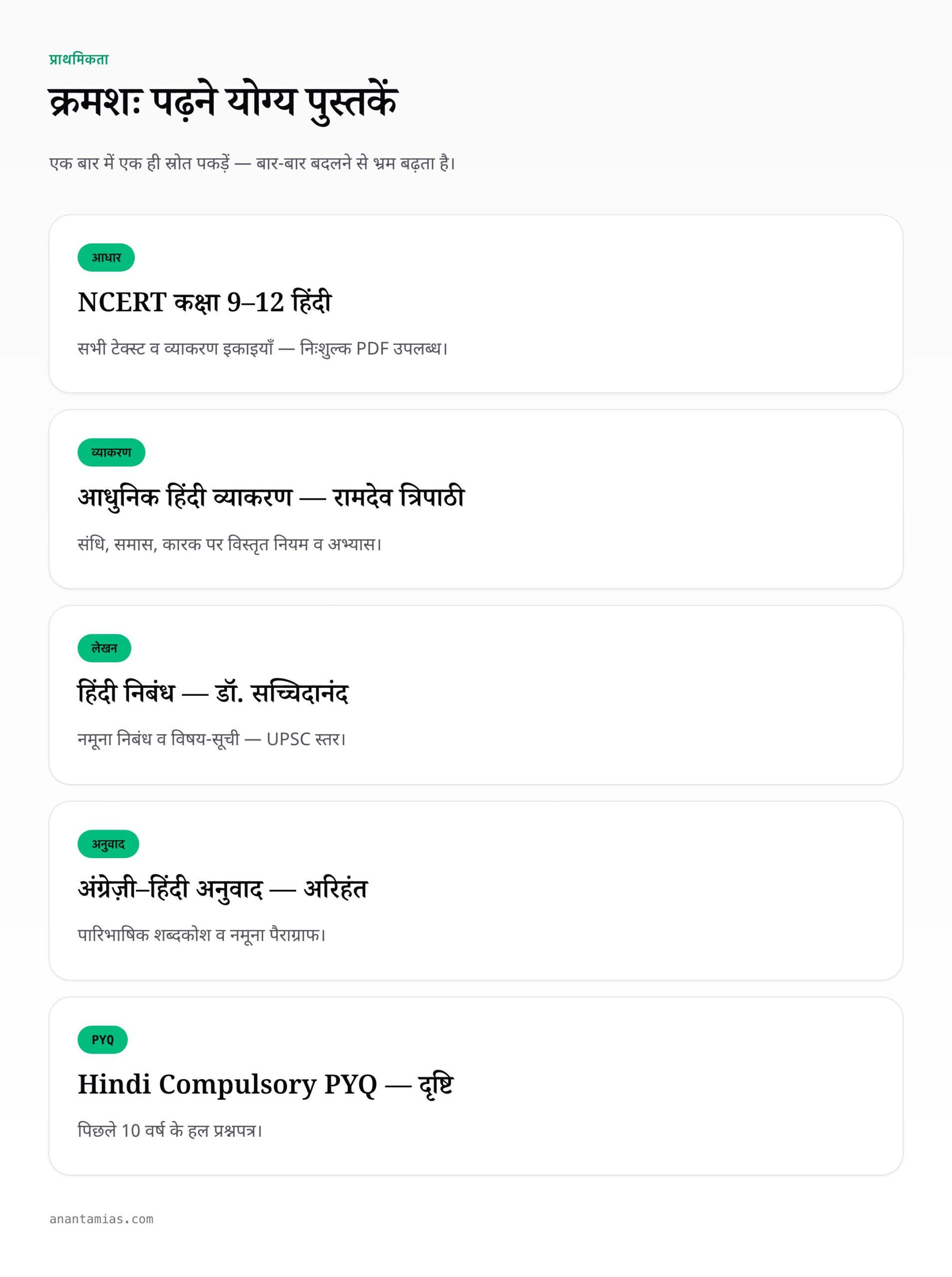
If you are short on time or budget, just get these three:

- 458 pages covering grammar, vocabulary and usage
- Written for the compulsory-language paper pattern
- Practice questions after each grammar unit
- Samanya Hindi by Arihant / Lucent — grammar and vocabulary.
- Hindi Vyakaran by Kamta Prasad Guru or Vasudev Nandan Prasad — classical grammar reference.
- UPSC Hindi Compulsory Previous Year Papers (compiled) — any publisher.
Recommended Books by Section

Adhunik Hindi Vyakaran Aur Rachna — Vasudev Nandan Prasad
- 416 pages of grammar and composition
- The reference teachers still recommend for व्याकरण
- Explains rules rather than listing them
For Grammar (व्याकरण)
- Samanya Hindi — Lucent Publication: Bestseller, complete coverage, excellent for quick revision.
- Hindi Vyakaran — Vasudev Nandan Prasad: Depth in sandhi, samas, and karaka with abundant examples.
- Arihant Samanya Hindi: Topic-wise chapters + MCQs; good for SSC as well as UPSC.
For Essay (निबंध)
- Hindi Nibandh Sangrah — various publishers: Sample essays across 100+ topics.
- Saamayik Nibandh — Shreeranjan Suridev: High-quality model essays on contemporary themes.
- Drishti IAS Hindi Nibandh: Exam-oriented essays with proper structure.
For Precis and Comprehension
- Sankshepan aur Pallavan — Arihant: Step-by-step method with solved passages.
- UPSC Compulsory Hindi — Unique Publishers: Dedicated precis chapters.
For Translation
- Anuvad Sahaayika — Dr. Bholanath Tiwari: Classic text for English-Hindi translation.
- Practical English-Hindi Translation — Suyash Suprabhat: 200+ graded passages with model answers.
For Idioms and Vocabulary
- Muhavare aur Lokoktiyan — Ramchandra Varma: Exhaustive idiom dictionary.
- Paryayvachi Shabdkosh — Arjun Tiwari: Synonym and antonym reference.
Comparison Table
| Book | Best For | Difficulty |
|---|---|---|
| Lucent Samanya Hindi | All-round grammar | Beginner-friendly |
| Vasudev Nandan Prasad | Deep grammar | Intermediate |
| Drishti Hindi Nibandh | Exam-ready essays | Beginner |
| Arihant Sankshepan | Precis technique | Intermediate |
| Bholanath Tiwari Anuvad | Translation | Intermediate |
| Ramchandra Varma Muhavare | Idioms | Beginner |
Online and Free Resources
- upsc.gov.in — official previous year question papers (free PDF).
- Drishti IAS Hindi YouTube channel — free grammar and essay classes.
- Rajbhasha.nic.in — government translation samples, useful for formal register.
- NCERT Hindi Textbooks (Class 9–12) — excellent for clean, standard Hindi prose.
How to Use These Books (Not Collect)
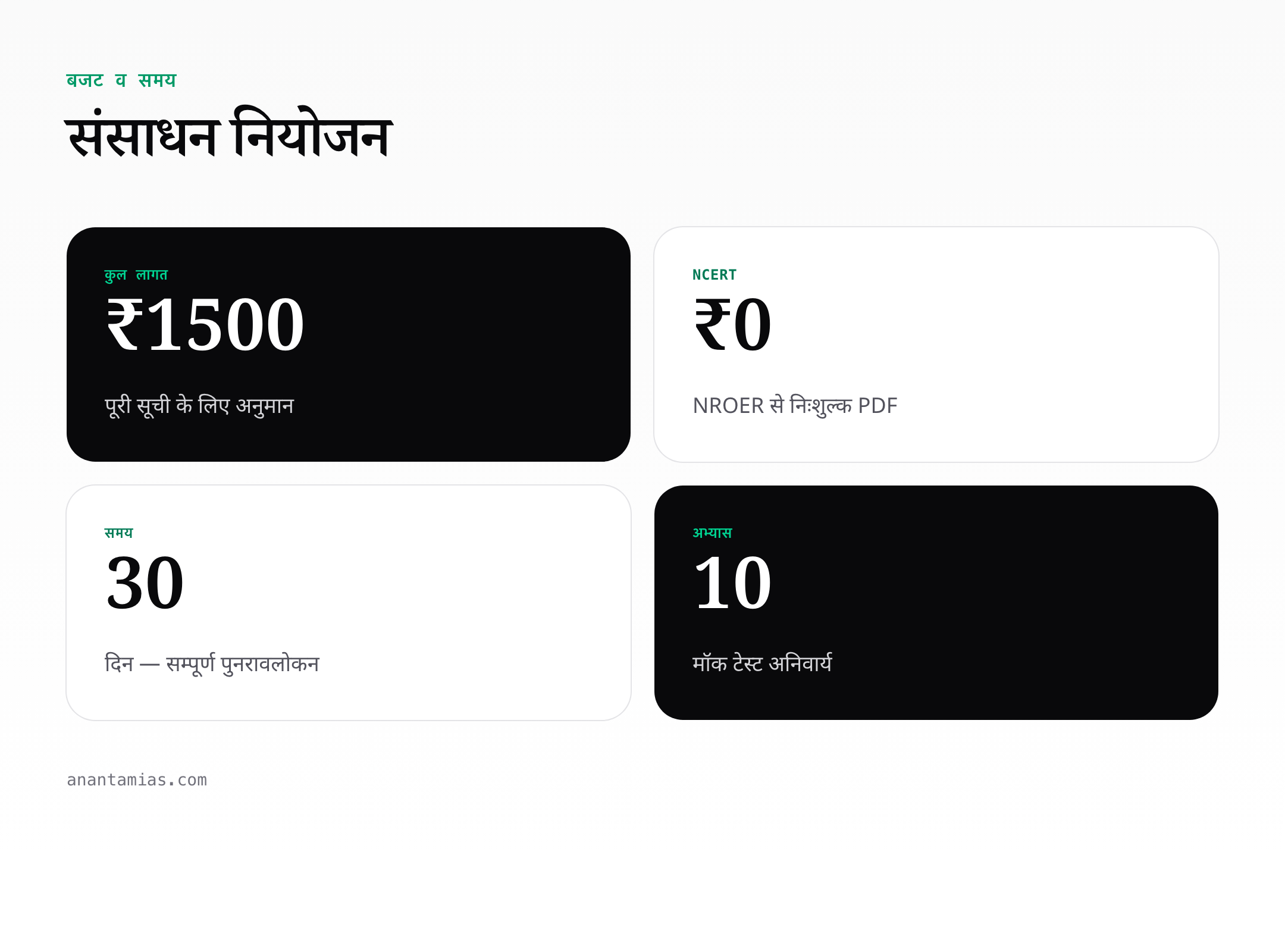
- Read Lucent cover-to-cover in the first 10 days. Mark weak topics.
- Use Vasudev Nandan Prasad only for topics you got wrong in Lucent.
- Write 10 essays from Drishti IAS Nibandh — 2 per week.
- Practise 15 precis passages from Arihant Sankshepan.
- Do 15 translations from Bholanath Tiwari — alternating directions.
- Solve last 10 years PYQs in full-length mock mode.
Books to Skip
- Multiple overlapping grammar books — one is enough.
- Sahitya-heavy books (B.A./M.A. Hindi texts) — irrelevant for Compulsory.
- Bulky Pallavan collections — UPSC does not ask pallavan.
- Low-quality local publications with typographical errors.
NCERT Books — A Hidden Gem
If you are a non-Hindi medium aspirant, start with NCERT Hindi Class 9 and Class 10 textbooks (Kshitij, Sparsh). These have standard Hindi prose, grammar exercises, and writing tasks. Two weeks with NCERTs can rebuild your Hindi fluency from scratch.
Digital Tools Worth Using
- Google Input Tools — for typing Devanagari on phone/laptop.
- Shabdkosh.com — English-Hindi dictionary.
- Hindwi.org — curated Hindi prose and poetry.
- Test Series — Vision IAS / Drishti — full-length Hindi Compulsory mock tests (if budget allows).
Budget-Based Buying Guide
| Budget | Buy These |
|---|---|
| ₹500 (minimum) | Lucent Samanya Hindi + PYQ compilation |
| ₹1000 | Above + Drishti Hindi Nibandh + Arihant Sankshepan |
| ₹1500+ | All the above + Bholanath Tiwari Anuvad + test series |
Remember: the aspirant who revises one book five times beats the aspirant who reads five books once. For a qualifying paper, ruthless focus on 2–3 books plus PYQs is all you need.

Nibandh-Drishti — Drishti IAS (11th Edition)
- 552 pages of Hindi essay models and frameworks
- Topic-wise structure across polity, society and economy
- Useful for essay architecture, not for copying
Frequently Asked Questions
Which is the single best book for UPSC Hindi Compulsory?
Lucent Samanya Hindi is the single best book — it covers grammar, vocabulary, idioms, and antonyms in one volume and is widely used by UPSC toppers.
Are NCERTs useful for Hindi Compulsory?
Yes. NCERT Hindi Class 9 and 10 (Kshitij, Sparsh) rebuild fluency in standard written Hindi and are especially helpful for non-Hindi medium aspirants.
Do I need a separate book for essay writing?
A dedicated Nibandh book (Drishti IAS or similar) helps you see 40–60 model essays and absorb structure quickly. One is enough — do not buy three.
Should I join a Hindi Compulsory test series?
If your budget allows, yes. Test series forces regular writing practice, which is the single biggest differentiator between aspirants who pass and those who fail.
Can I prepare from YouTube alone?
YouTube is useful for grammar concepts, but you still need a core book and practice notebook. Free resources + Lucent + PYQs is a viable minimum-budget path.
Tell Google you want more of this.
Add Anantam IAS as a preferred sourceOne tap, and this site shows up more often in your own Top Stories, AI Overviews and AI Mode. Remove it any time.