Introduction
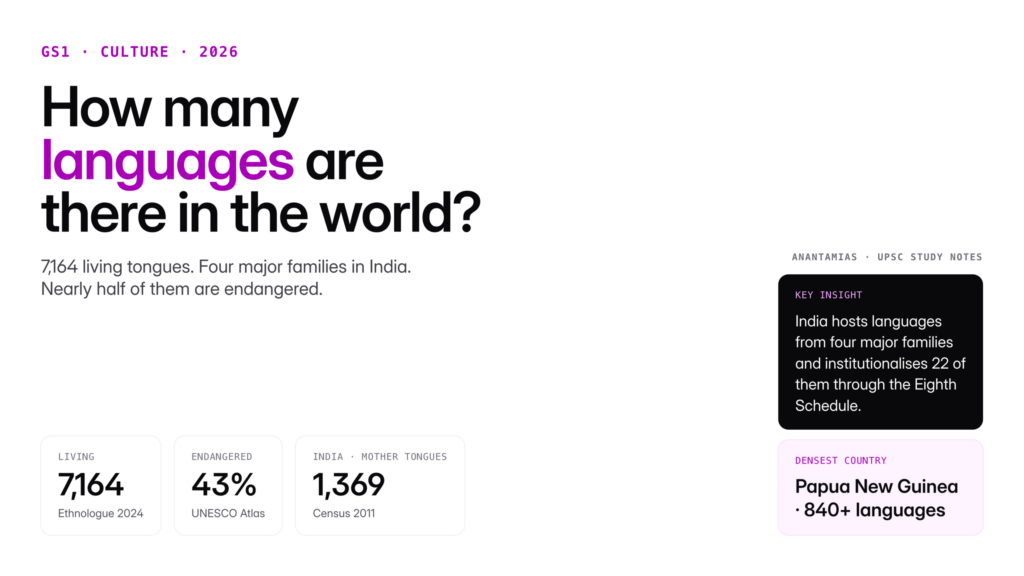
Language is the oldest technology humanity ever invented, and the world still runs on an astonishing variety of it. According to Ethnologue’s 2024 edition, there are 7,164 living languages spoken across the globe, spread unevenly across continents, families and socio-political contexts. For a UPSC aspirant, the headline number is only the entry point. What matters is how those languages are distributed, which families dominate, why almost half of them are endangered, and where India, home to more than 1,600 mother tongues, fits in this global map.
This article unpacks the data behind that 7,164 figure, walks through the major language families, explains why linguistic diversity is collapsing, and ties the whole picture back to the Indian Constitution’s Eighth Schedule and Census 2011 figures. The framing is exam-oriented: Prelims-ready numbers, Mains-ready arguments, and a comparative lens for GS1 culture questions and GS2 federalism debates.
Quick Facts at a Glance
| Metric | Figure | Source |
|---|---|---|
| Living languages worldwide | 7,164 | Ethnologue 2024 |
| Languages with at least 1 million speakers | ~400 | Ethnologue |
| Languages classified as endangered | ~3,045 (43%) | UNESCO Atlas |
| Most spoken language (native) | Mandarin Chinese (~940 million) | Ethnologue |
| Most spoken language (total speakers) | English (~1.5 billion) | Ethnologue |
| Country with the most languages | Papua New Guinea (840+) | Ethnologue |
| Mother tongues recorded in India | 1,369 rationalised, 19,569 raw returns | Census 2011 |
| Scheduled languages (India) | 22 | Eighth Schedule |
| Classical languages (India) | 11 (as of 2025) | Ministry of Culture |
| Languages extinct since 1950 | ~230 | UNESCO |
Background and Historical Context
The question of how many languages exist is surprisingly young. Systematic global cataloguing began only in the twentieth century. The Summer Institute of Linguistics (SIL International) started publishing Ethnologue in 1951, listing 40 languages in its first edition. By 2024, that figure had grown to 7,164, not because thousands of new languages emerged but because field linguists documented what had always been there. The ISO 639-3 standard, maintained by SIL, now assigns three-letter codes to each identified language, providing the closest thing to an official global register.
Before modern linguistics, Europeans grouped languages by religion, script or perceived civilizational status. The breakthrough came in 1786 when Sir William Jones, a judge in Calcutta, noticed structural affinities between Sanskrit, Greek and Latin and hypothesised a common ancestor. This insight gave birth to the comparative method and the concept of language families, the tree-like classification that still organises the field.
The twentieth century added another lens: endangerment. The 1992 Quebec conference of the International Linguistic Congress first warned that half the world’s languages could vanish within a century. UNESCO formalised this alarm through its Atlas of the World’s Languages in Danger (launched 1996, revised multiple times), classifying languages on a five-step scale from vulnerable to extinct. The 2023 edition flagged that around 43 percent of living languages are endangered, a figure that has become the standard citation in cultural policy debates.
Post-colonial nation-building also reshaped linguistic geography. The UN has six official languages (Arabic, Chinese, English, French, Russian, Spanish), yet these account for less than 3 percent of the total. India alone has contributed to this complexity: Article 343 made Hindi the official language, Part XVII recognised English for official use, and the Eighth Schedule, expanded from 14 to 22 languages, institutionalised multilingualism as a federal principle.
Key Features of Global Language Distribution
Uneven Geography
Asia and Africa together host roughly 62 percent of the world’s languages. Asia alone contains around 2,300 living tongues, while Africa hosts about 2,150. The Pacific region, despite its small population, packs in close to 1,300 languages, giving Papua New Guinea its status as the most linguistically dense country on earth, with over 840 languages for around 11 million people. Europe, by contrast, has only about 280 languages, and the Americas roughly 1,060.
Speaker Concentration
A tiny minority of languages dominates human communication. Just 23 languages account for more than half of all native speakers, while the bottom 3,500 languages are spoken by fewer than 10,000 people each combined. Mandarin Chinese leads in native speakers, but English dominates in total speakers when second-language users are counted. Hindi, with around 345 million native speakers and over 600 million including second-language users, ranks in the global top three on most lists.
Language Families
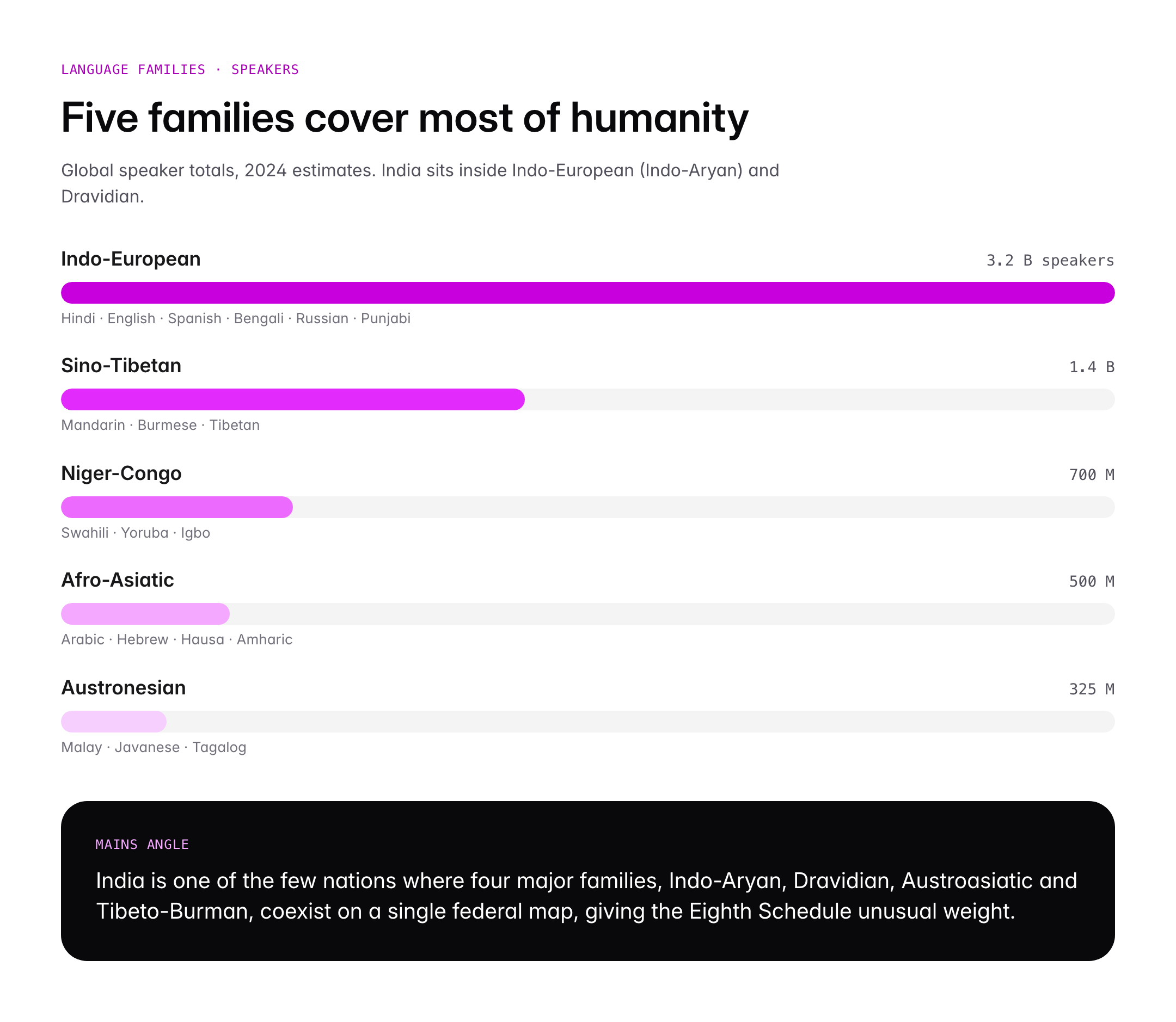
Linguists group all 7,164 languages into roughly 142 families plus dozens of language isolates. The largest five families cover the vast majority of speakers:
- Indo-European: ~3.2 billion speakers (Hindi, English, Spanish, Bengali, Russian, Punjabi)
- Sino-Tibetan: ~1.4 billion (Mandarin, Burmese, Tibetan)
- Niger-Congo: ~700 million (Swahili, Yoruba, Igbo)
- Afro-Asiatic: ~500 million (Arabic, Hebrew, Hausa, Amharic)
- Austronesian: ~325 million (Malay, Javanese, Tagalog)
India is one of the few countries that hosts languages from four major families on its soil: Indo-Aryan, Dravidian, Austroasiatic and Tibeto-Burman.
Scripts and Writing Systems
Only about 4,065 of the 7,164 living languages have a developed writing system. The remaining 3,100 or so are purely oral, which makes them disproportionately vulnerable to extinction. Global scripts number around 300, with Latin, Chinese and Devanagari covering the majority of written communication. India itself uses at least 12 distinct scripts for its scheduled languages.
Endangerment Gradient
UNESCO’s five-tier scale runs from vulnerable (spoken mostly by children in restricted domains) to critically endangered (spoken only by very elderly speakers) to extinct. Roughly 578 languages are critically endangered today, and linguists estimate one language dies every 40 days.
Significance for UPSC and General Knowledge
- GS1 Indian Society: Linguistic diversity is a pillar of India’s composite culture and directly informs answers on communalism, regionalism and identity.
- GS2 Polity and Governance: The Eighth Schedule, Official Languages Act 1963, and Constitutional Articles 343 to 351 are recurring Prelims and Mains themes.
- GS1 World History: Indo-European expansion, colonial language imposition and the spread of Arabic through trade are frequently asked.
- Essay paper: Endangered languages make strong case studies for culture, technology and globalisation prompts.
- Interview board: Candidates with a regional mother tongue are often asked about its script, literary heritage and classical status.
- Current affairs: Recent additions to India’s classical language list (Marathi, Bengali, Assamese, Pali, Prakrit in 2024) feature in Prelims MCQs.
Detailed Analysis: India’s Place in the Global Linguistic Map
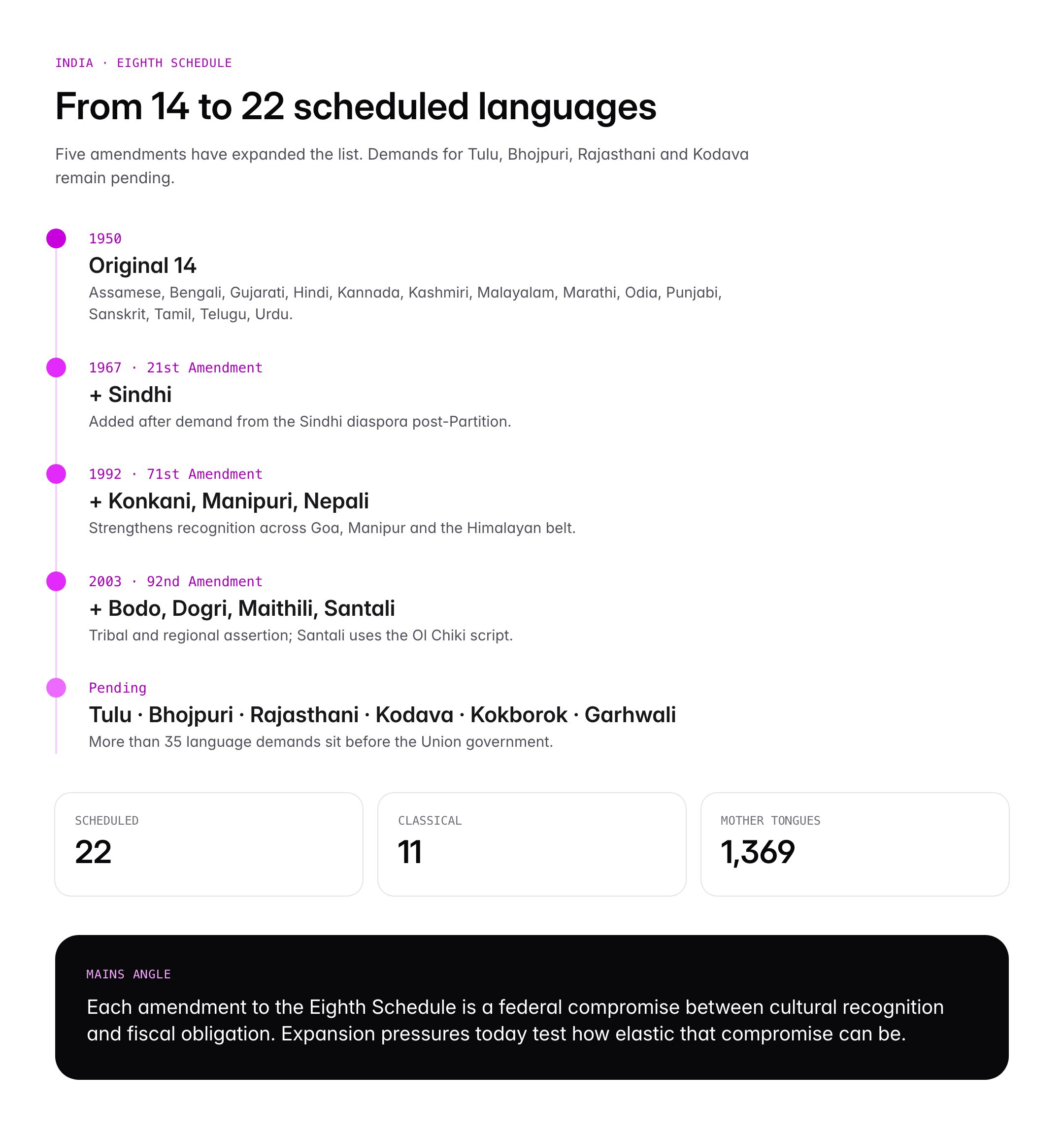
India is a linguistic universe in itself. Census 2011 recorded 19,569 raw mother tongue returns, which were rationalised to 1,369 mother tongues grouped under 121 languages. Of these, 22 enjoy constitutional recognition in the Eighth Schedule: Assamese, Bengali, Bodo, Dogri, Gujarati, Hindi, Kannada, Kashmiri, Konkani, Maithili, Malayalam, Manipuri, Marathi, Nepali, Odia, Punjabi, Sanskrit, Santali, Sindhi, Tamil, Telugu and Urdu. The original 1950 Constitution listed only 14; Sindhi was added in 1967, Konkani, Manipuri and Nepali in 1992, and Bodo, Dogri, Maithili and Santali in 2003.
Hindi is India’s largest language, claimed as a mother tongue by about 43.6 percent of the population in Census 2011. Bengali follows at 8.0 percent, then Marathi at 6.9 percent, Telugu at 6.7 percent, Tamil at 5.7 percent and Gujarati at 4.6 percent. At the other end, languages like Great Andamanese and Mahl are spoken by fewer than 100 people each and feature in UNESCO’s critically endangered list.
India’s linguistic policy rests on a delicate architecture. Article 343 declares Hindi in Devanagari as the official language of the Union. Article 344 provides for an Official Language Commission. Articles 345 to 347 empower states to adopt their own official languages. Article 350A mandates primary education in mother tongue for linguistic minorities. Article 351 directs the Union to promote Hindi. The Official Languages Act, 1963 extended the use of English for official Union purposes beyond the original 15-year deadline, a compromise that calmed the anti-Hindi agitations in Tamil Nadu.
The classical language tag, created in 2004, now covers eleven languages: Tamil (2004), Sanskrit (2005), Kannada and Telugu (2008), Malayalam (2013), Odia (2014), and the 2024 additions of Marathi, Bengali, Assamese, Pali and Prakrit. Classical status unlocks central funding, chairs at universities and the Centre of Excellence for Studies in Classical Languages. The Three Language Formula, revived under NEP 2020, once again places linguistic choice at the centre of educational federalism.
Comparative Perspective
| Country/Region | Living Languages | Dominant Family | Official Languages | Notable Feature |
|---|---|---|---|---|
| India | 447+ (Ethnologue) | Indo-Aryan + Dravidian | 22 scheduled | Four major families coexist |
| Papua New Guinea | 840+ | Trans-New Guinea | 3 (Tok Pisin, English, Hiri Motu) | Most dense globally |
| Indonesia | 707 | Austronesian | 1 (Bahasa Indonesia) | Unified through Malay-based lingua franca |
| Nigeria | 520 | Niger-Congo | 1 (English) | Uses colonial tongue as neutral link |
| China | 281 | Sino-Tibetan | 1 (Putonghua) | Strong central standardisation |
| Russia | 105 | Indo-European + Uralic | 1 (Russian) federal, 35 regional | Republican-level recognition |
| United States | 335 | Indo-European | None federal, English de facto | Heavy immigration-driven diversity |
India’s model, which combines Eighth Schedule recognition, a three-language formula and bilingual administration, is the closest real-world experiment in balancing federal unity with linguistic plurality. Contrast this with Indonesia, which deliberately sidelined Javanese, the majority tongue, in favour of a neutral Malay-based national language, or with France, which constitutionally bars recognition of regional languages.
Controversies and Debates
The counting of languages is itself contested. The distinction between a language and a dialect is notoriously political, famously captured by Max Weinreich’s quip that “a language is a dialect with an army and a navy”. Serbian and Croatian are mutually intelligible but politically distinct; Hindi and Urdu share grammar and core vocabulary yet are classified separately. Ethnologue’s figure of 7,164 is therefore a working estimate that other bodies such as Glottolog (8,500+) and the World Atlas of Language Structures put at different numbers.
Within India, the National Register of Mother Tongues excludes any tongue reported by fewer than 10,000 speakers, a threshold that critics argue erases smaller communities from official statistics. The demand to include Tulu, Bhojpuri, Garhwali, Rajasthani, Kodava and Kokborok in the Eighth Schedule has been pending for decades. Language politics also intersects with migration, employment and education access, as seen in debates over Hindi imposition through NEET, CAPF recruitment and central job exams.
The endangerment debate carries its own tensions. Revitalisation efforts, such as Maori immersion schools in New Zealand or the Welsh Language Act, show recovery is possible, but they demand sustained state investment. For most small Indian languages, neither funding nor documentation has kept pace with generational language shift.
Prelims Pointers
- Ethnologue 2024 lists 7,164 living languages globally.
- Asia hosts the highest number of languages, followed by Africa.
- Papua New Guinea has the most languages of any single country.
- Mandarin Chinese has the most native speakers; English has the most total speakers.
- India’s Eighth Schedule currently recognises 22 languages.
- Sindhi was added in 1967 via the 21st Constitutional Amendment.
- Bodo, Dogri, Maithili and Santali were added in 2003 via the 92nd Amendment.
- India has 11 classical languages after the 2024 additions of Marathi, Bengali, Assamese, Pali and Prakrit.
- Article 343 makes Hindi in Devanagari the official language of the Union.
- The Official Languages Act was passed in 1963.
- UNESCO classifies roughly 43 percent of living languages as endangered.
- A language dies approximately every 40 days, per UNESCO estimates.
Mains Practice Questions
Q1. Examine the role of linguistic diversity in shaping India’s federal architecture. (15 marks, 250 words)
- Establish India’s scale: 1,369 mother tongues, 22 scheduled languages, four major families.
- Trace constitutional architecture: Articles 343 to 351, Eighth Schedule evolution, Official Languages Act 1963, Article 350A.
- Evaluate outcomes: linguistic states reorganisation (1956), three-language formula, NEP 2020; note tensions around Hindi imposition and Eighth Schedule pending demands.
Q2. “The extinction of a language is the extinction of a worldview.” Critically analyse in the context of UNESCO’s framework and India’s endangered languages. (15 marks, 250 words)
- Frame the Sapir-Whorf link between language, cognition and culture; cite UNESCO’s five-tier endangerment scale.
- India-specific evidence: Great Andamanese, Majhi, Sidi, Toda under severe threat; Census thresholds leaving many undocumented.
- Suggest a way forward: digital documentation, Bhasha Samman, mother-tongue education under NEP, community-led revitalisation.
Conclusion
The figure of 7,164 living languages captures only the top layer of a deeper truth. Roughly half of that total is under threat, a handful dominate commerce and diplomacy, and a few dozen carry the weight of the world’s literary and philosophical heritage. India, with languages from four major families and 22 scheduled tongues, sits at the heart of this diversity, and its constitutional architecture remains one of the most ambitious attempts anywhere to govern plurality through law.
For the UPSC aspirant, the takeaway is twofold. On the factual side, remember the anchor numbers: 7,164 globally, 22 in the Eighth Schedule, 11 classical, 43 percent endangered. On the analytical side, the language question recurs across GS1 society, GS2 polity, Essay and Interview. Mastery of both registers turns a trivia-style question into a gateway for richer answers on culture, federalism and identity.
Frequently Asked Questions
How many languages are there in the world today?
According to Ethnologue’s 2024 edition, there are 7,164 living languages spoken worldwide. Other databases such as Glottolog count more than 8,500, reflecting different thresholds for what qualifies as a distinct language. Asia and Africa together host around 62 percent of the total, with Papua New Guinea alone containing over 840.
What is the most spoken language in the world?
Mandarin Chinese leads in native speakers with around 940 million. English, however, is the most widely spoken overall, reaching about 1.5 billion people when second-language users are included. Hindi ranks third on most lists, with roughly 345 million native speakers and over 600 million total.
Why is language diversity important for UPSC preparation?
Languages cut across GS1 (Indian society and culture), GS2 (Official Languages Act, Eighth Schedule), Essay and Interview. Knowing global figures, endangerment data, and India’s constitutional scheme lets aspirants answer questions on federalism, minority rights, cultural policy and colonial legacy with precision and context.
How is global language diversity related to the Eighth Schedule of the Indian Constitution?
The Eighth Schedule lists 22 recognised languages and anchors India’s multilingual federalism. It parallels global debates on minority language protection under UNESCO. Adding or excluding a language has direct effects on recruitment, education medium, and cultural funding, mirroring international concerns about endangered tongues.
How many languages are spoken in India?
Census 2011 recorded 19,569 raw mother tongue returns, rationalised into 1,369 mother tongues grouped under 121 languages. Ethnologue lists around 447 living languages in India. Of these, 22 are scheduled, 11 have classical status, and several hundred remain undocumented or unrecognised due to speaker thresholds.
Which language family has the most speakers globally?
Indo-European, with roughly 3.2 billion speakers, is the largest by far. It includes English, Hindi, Spanish, Bengali, Russian and Punjabi. Sino-Tibetan is second with around 1.4 billion speakers, dominated by Mandarin. Together, these two families account for well over half of humanity’s daily communication.
How many languages are endangered or extinct?
UNESCO classifies about 43 percent of the world’s living languages, roughly 3,045 tongues, as endangered. Around 578 are critically endangered. An estimated 230 languages have gone extinct since 1950, and linguists warn that one language dies roughly every 40 days if current trends continue.
What are the classical languages of India?
India has eleven classical languages after the 2024 additions. They are Tamil (2004), Sanskrit (2005), Kannada and Telugu (2008), Malayalam (2013), Odia (2014), and Marathi, Bengali, Assamese, Pali and Prakrit (2024). Classical status unlocks central funding, dedicated research centres and university chairs.
Tell Google you want more of this.
Add Anantam IAS as a preferred sourceOne tap, and this site shows up more often in your own Top Stories, AI Overviews and AI Mode. Remove it any time.