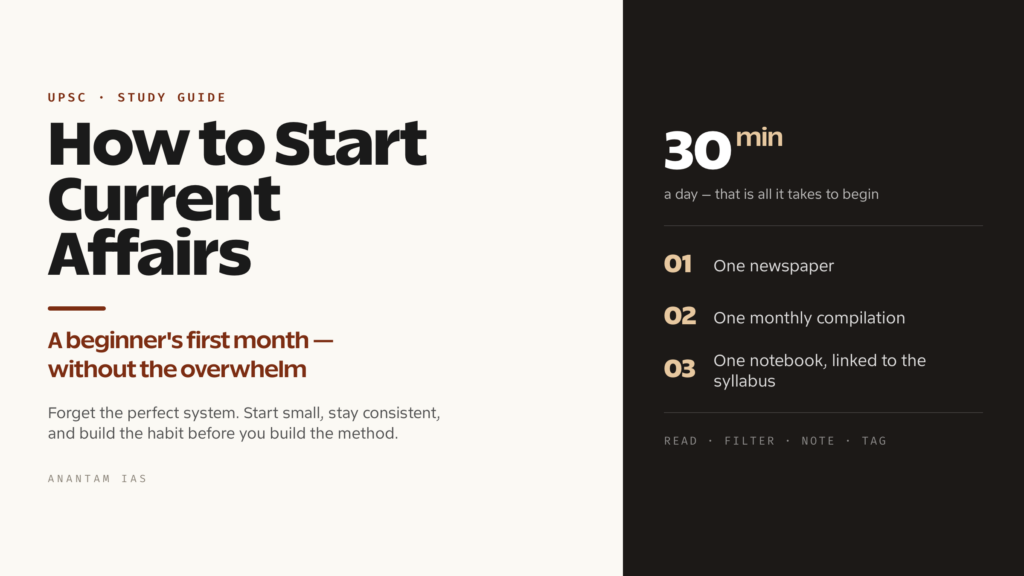
Almost every UPSC aspirant hits the same wall in their first week. Someone tells them, with great confidence, to “start doing current affairs” — and then says nothing about what that actually means. So they open a newspaper, find forty pages of politics, sport, business and opinion, feel a wave of panic about how much there is to remember, and either try to memorise everything or quietly give up after three days. The problem is almost never laziness. It is that nobody showed them how to begin, and beginning badly is the fastest way to burn out.
This guide is deliberately not about the perfect system. It is about the first month — the unglamorous business of getting started without drowning. If you are completely new to current affairs, the worst thing you can do is copy a topper’s elaborate routine on day one. The best thing you can do is start small, stay consistent, and let the habit grow. Once the habit is real, you can graduate to a fuller method; we link to our deeper guides at the end for exactly that. For now, the goal is simpler and more important: read a little, understand it, and keep coming back tomorrow.
When to Start — and Why Small Beats Big
The honest answer to “when should I start current affairs?” is: the day you decide to attempt UPSC, in the lightest possible way. You do not need to wait until you have finished the NCERTs or built your static foundation. Current affairs and static subjects feed each other, and the habit of daily reading takes weeks to settle, so the earlier you begin the gentler the curve. But “start early” does not mean “start heavy.” It means start small enough that you cannot fail.
Here is the trap most beginners fall into. They treat current affairs as a memory test, try to capture every name, scheme and number, make sprawling notes they never reopen, and collapse under the weight within a fortnight. The exam does not reward that. It rewards understanding a smaller set of genuinely important developments and being able to connect them to the syllabus. So your first month has exactly one target, and it is not “cover everything.” It is to read consistently for thirty days without missing more than a couple. Consistency, not coverage, is what you are building first.
Think of it like learning to run. You do not begin with a marathon; you begin with a manageable distance you can repeat daily until it stops feeling hard. Current affairs is the same. A beginner who reads thirty focused minutes every single day will, within a month, comfortably outperform one who does three-hour binges twice a week and quits. Volume can come later. Right now you are training a muscle.
Your Starter Kit: One Newspaper, One Monthly, One Notebook
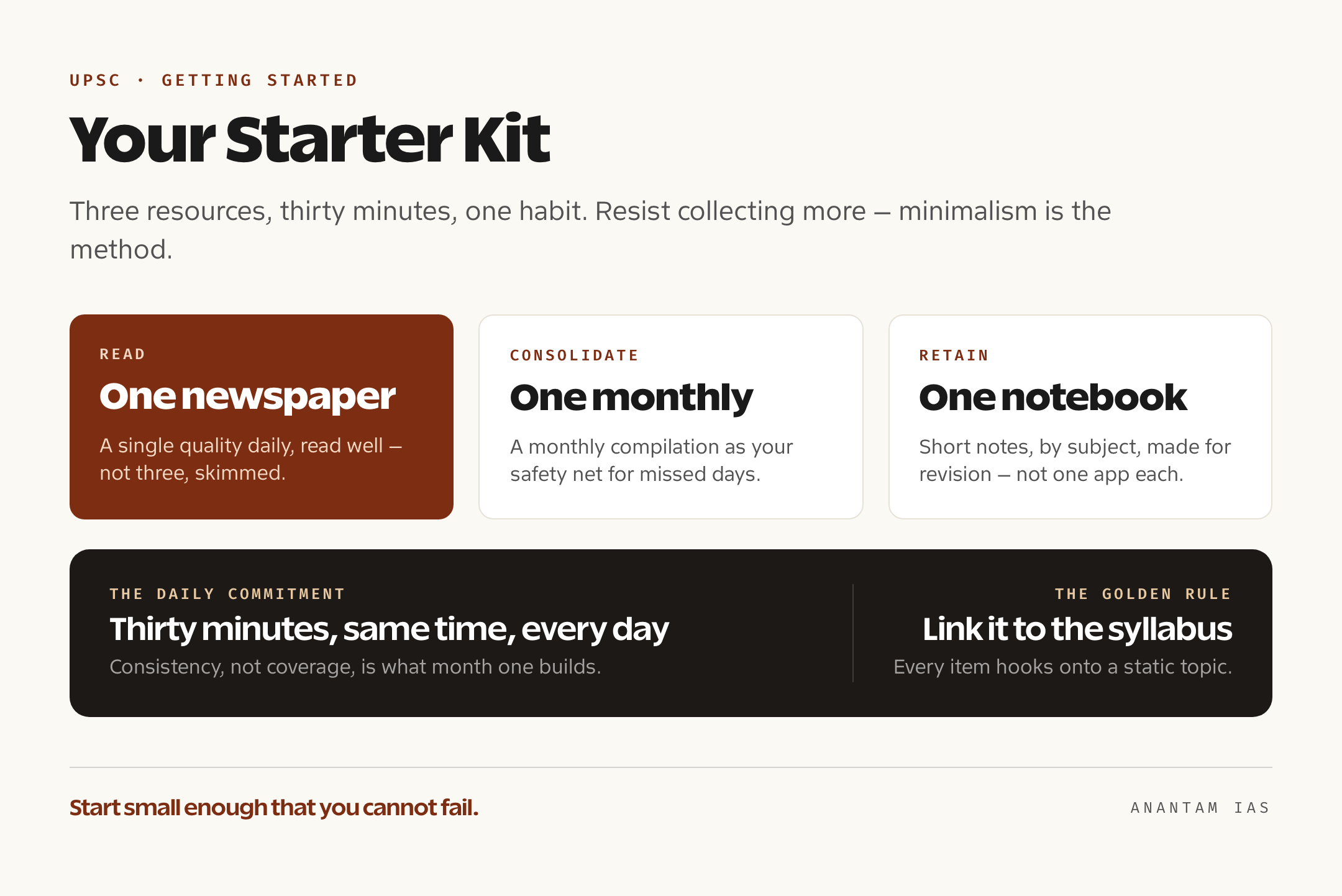
Resist the urge to collect resources. Beginners often hoard five newspapers, three monthly magazines, four YouTube channels and a dozen Telegram groups — and then read none of them properly. The fix is ruthless minimalism. To start, you need only three things.
First, one newspaper. Pick a single quality daily — The Hindu or The Indian Express are the standard choices — and read only that. One newspaper, read well, beats three skimmed in a panic. Do not switch papers looking for the “best” one; they overlap heavily, and the discipline matters more than the masthead.
Second, one monthly compilation. A good monthly current-affairs magazine consolidates the month’s important developments in one place, already filtered for relevance. This is your safety net: even if you miss a day’s newspaper, the monthly catches the big items. It also teaches you, by example, what “exam-relevant” looks like, which is a skill you are still developing.
Third, one place to make notes — a single notebook or one digital document, organised loosely by subject (Polity, Economy, Environment, International Relations, Science and Tech, and so on). Not five apps. One. The point of notes is revision, and you can only revise what you can find again.
That is the entire starter kit. You can add our daily and monthly current affairs section to that mix, since it already presents each development as exam-ready pointer notes linked to the syllabus, which is exactly the format a beginner should imitate. But three core resources are enough to begin. Anything more is procrastination dressed up as preparation.
The First 30 Days: A Simple Daily Routine
Now the routine itself, stripped to what a beginner can actually sustain. Give current affairs a fixed thirty-minute slot at the same time every day — ideally morning, when the newspaper is fresh and your mind is clear. Fixing the time is half the battle; a habit attached to a slot survives, a habit you “fit in when free” dies.
Inside those thirty minutes, run the same small loop every day. Read the front page, the national and international pages, the editorial page, and the economy pages, skipping local crime, sport, celebrity and pure political mud-slinging. Filter as you go: for each item, ask a single question — could this connect to the syllabus? If a story is about a new scheme, a Supreme Court judgment, an international agreement, a report or index, a science or environment development, it stays. If it is transient noise that will not matter in three months, it goes. Note only what survives the filter, in a line or two, in your own words. And tag each note to its subject and, where you can, to the part of the syllabus it touches. Read, filter, note, tag — that is the whole loop.
In your first week, the filtering will feel slow and uncertain, and you will over-note out of fear. That is normal. By week three you will start recognising the patterns — the same kinds of schemes, judgments and reports recurring — and your filtering will sharpen and your notes will shrink. That shift, from copying everything to capturing what matters, is the single most important thing the first month teaches you. Do not rush it; let the daily repetition do the work.
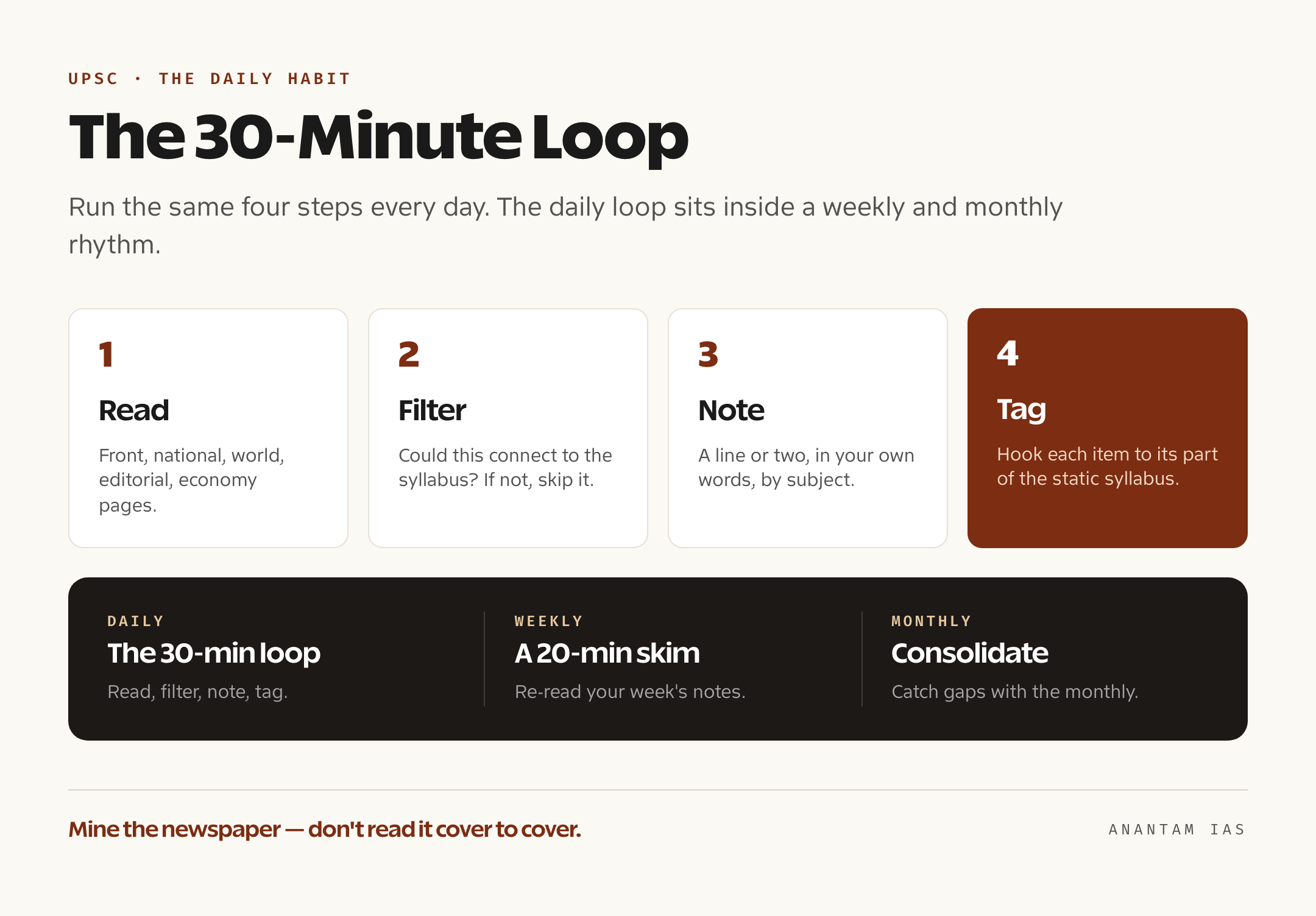
Around that daily loop, add two light rhythms. Once a week, spend twenty minutes skimming your own notes from the past seven days — not relearning, just reminding. Once a month, read the monthly compilation against your notes to catch anything you missed and to consolidate. Daily reading, weekly skim, monthly consolidation: that three-layer rhythm is the backbone of every serious current-affairs method, and you are building it in miniature from day one.
How to Read the Newspaper Without Drowning
The newspaper intimidates beginners because they try to read it like a novel — start to finish, every word. Stop. A newspaper is to be mined, not read. You are looking for a relatively small number of exam-relevant developments buried in a lot of material that does not concern you.
Train your eye to skip aggressively. Sport, the bulk of crime reporting, day-to-day political theatre, stock tips and lifestyle pieces are almost never asked about and can be ignored without guilt. What you actively hunt for is different: government schemes and policies, Bills and Acts, court judgments and constitutional questions, the work of institutions and regulators, India’s bilateral and multilateral relations, the economy and key data releases, environment and biodiversity, science and technology developments, and important reports, indices and reports. The editorial and op-ed pages are gold, because they explain the why behind the news — but as a beginner, read them for understanding, not for memorising the writer’s opinions.
A simple beginner’s tell: if you cannot say in one sentence why a story might matter for the exam, it probably does not, and you can move on. With practice this judgment becomes near-instant, and a forty-page paper collapses into the fifteen or twenty minutes of reading that actually count.
Making Notes You Will Actually Revise
The most common beginner mistake is making beautiful notes that are never reopened. Notes exist for one purpose — revision before the exam — so make them with revision in mind, not as a tidy transcription of the newspaper.
Keep them short and in your own words; a development you can summarise in two lines you have actually understood, while one you copied verbatim you have only transcribed. Organise by subject so that, months later, all your Polity notes sit together and all your Economy notes sit together, ready to revise as a block. Capture the durable concept, not just the headline: behind every news item sits a piece of the static syllabus — a constitutional provision, an institution, a scheme’s objective, an international body — and it is that anchor, not the day’s specific event, that the exam usually tests. Leave room to add to a topic over time, because a story like a particular Bill or a particular treaty will keep reappearing, and you want one growing note per theme rather than ten scattered fragments.
Do not obsess over format. A clean notebook and a clean digital document both work; what matters is that the notes are short, findable and revisited. If you never reopen a note, it was wasted effort, however neat it looked.
Linking News to the Syllabus — the Habit That Pays Off
This is the habit that separates aspirants who “follow the news” from those who “do current affairs for UPSC”, and it is worth building from the start. Every important development should be hooked onto the static syllabus. A new environmental rule connects to environment and ecology and to governance. A Supreme Court judgment connects to polity and the relevant articles of the Constitution. A trade agreement connects to international relations and the economy. A new index connects to whatever it measures.
Doing this turns a flood of disconnected facts into a structured, revisable web, and it is the reason syllabus-tagged current affairs is so much more powerful than a chronological news diary. It also quietly tells you what to read more about: if a news item touches a static topic you have not yet studied, that is a signal to go and cover it. In the beginning you will manage only loose links, and that is fine. The act of asking “where does this sit in the syllabus?” is itself the training. Keep the official UPSC syllabus within reach as your map.
Beginner Mistakes to Avoid
A few traps catch almost everyone, and knowing them in advance saves months. Do not try to read everything — coverage anxiety is the enemy, and chasing every source guarantees you finish none. Do not hoard resources; one newspaper and one monthly, used well, beat a shelf of unread material. Do not make notes you never revise; if it will not be reopened, do not write it. Do not start with months of backlog — begin from today and move forward, and only later, once the habit is set, consider filling gaps. Do not treat current affairs as rote memorisation of names and numbers; understand the development and its link to the syllabus, and the details will stick far better. And do not break the chain: missing one day is recoverable, but missing a week resets the habit you are trying to build. Consistency forgives almost every other mistake.
Graduating to a Full System
Once you have read consistently for a month and the daily loop feels natural rather than forced, you are ready to level up — to refine your sources, tighten your note-making, add structured monthly consolidation, and build the ruthless revision cycle that carries you to the exam. That is a different, deeper conversation, and we have written it out in full.
When you are ready, move on to our guide on a complete UPSC current affairs strategy — sources, notes and how much is enough, and the companion piece on how to prepare current affairs without drowning, which lays out the five essential sources, the syllabus-tagging method, and the eighty-twenty of what actually gets asked. Pair either with our daily current affairs pointer notes, and you have a system that runs from your first day to your last revision. But none of that matters until the habit exists — so for the next thirty days, keep it simple: one newspaper, one monthly, thirty minutes, every day.
FAQ
When should a beginner start current affairs for UPSC? Start as soon as you decide to attempt the exam, but begin lightly — around thirty focused minutes a day rather than a heavy routine. You do not need to finish your static syllabus first; current affairs and static subjects reinforce each other, and the daily reading habit takes a few weeks to settle, so an early, gentle start works best.
How many newspapers should I read as a beginner? Just one. Pick a single quality daily such as The Hindu or The Indian Express and read it well rather than skimming several. One newspaper read properly, supported by one monthly compilation, gives a beginner everything they need; adding more sources usually means reading all of them badly.
How much time should current affairs take each day? About thirty minutes a day is the right starting point. Fix it to the same slot — ideally the morning — and protect it. Once the habit is established and your filtering is faster, the same coverage often takes even less time, freeing you to go deeper on the items that matter.
Should I make notes from day one? Yes, but keep them short, in your own words, organised by subject, and made with revision in mind. The aim is a small, findable set of notes you will actually reopen — not a tidy transcription of the newspaper. If a note will never be revised, it is not worth writing.
What is the most common beginner mistake in current affairs? Trying to cover everything. Coverage anxiety pushes beginners to hoard sources, over-note, and burn out within weeks. The fix is to read one newspaper and one monthly consistently, filter ruthlessly for syllabus-relevant items, and prize consistency over volume. Understanding a smaller set well beats memorising a larger set badly.
Tell Google you want more of this.
Add Anantam IAS as a preferred sourceOne tap, and this site shows up more often in your own Top Stories, AI Overviews and AI Mode. Remove it any time.